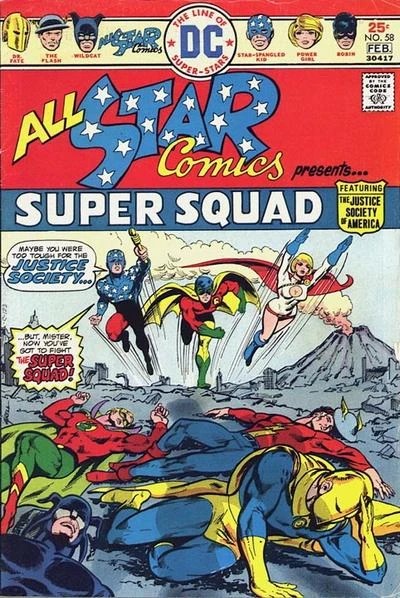
All-Star Comics #58 (Jan.-Feb., 1976)

In October, 1975 — just a little less than a quarter-century since their last headlining appearance in All-Star Comics #57 (Feb.-Mar., 1951), and about half that time since their revival in Flash #137 (Jun., 1963) — the Justice Society of America finally returned to newsstands in their own book.  The premiere superhero team, not just of DC Comics but of all comics, was at last back in full force, ready to reclaim its former glory.

And it had Marvel Comics to thank for the opportunity.  Read More

1st Issue Special #9 (December, 1975)

My first encounter with Doctor Fate dates back to 1966, when I met him as a member of the Justice Society of America in Justice League of America #46 — the opening half of that year’s annual summer JLA-JSA meet-up event, which, as it happened, was the first such event I experienced as a young comics fan.  As I wrote in my post about that issue nine years ago, he very quickly became one of my very favorite JSAers, probably due as much to his look (that golden, whole-head-covering helmet was so cool) as to his power set (I developed a predilection for the supernaturally-based superfolks pretty early on, for whatever reason).  That opinion hadn’t changed by September, 1975, so when the sorcerer from Salem was granted a solo showcase in the ninth issue of 1st Issue Special (his first such since 1944!), it was pretty much a given that I would show up for the occasion.  Read More

Doctor Strange #4 (October, 1974)

As we previously noted in our post about Doctor Strange #2 back in May, in June, 1974, Marvel Comics provided fans of the Master of the Mystic Arts’ normally bimonthly series with the release of an extra issue.  But Doctor Strange #3 didn’t feature the third chapter of the continuing story begun by scripter/co-plotter Steve Englehart and penciller/co-plotter Frank Brunner back in the premiere issue of their hero’s newly revived solo title; rather, behind a new cover by Brunner (and also wrapped within a new 1 1/2-page framing sequence by Englehart, Brunner, and inker Alan Weiss), the comic offered an edited presentation of an old story that had originally run in Strange Tales #126 (Nov., 1964) and #127 (Dec., 1964).  That tale by Stan Lee and Steve Ditko was indisputably a stone classic, and as a latecomer who’d only arrived at the Doc Strange party in 1969, my younger self was happy to have it; still, even I was impatient to see the continuation of the Sorcerer Supreme’s current quest to escape the Orb of Agamotto, and rescue his beloved Clea from the sinister but self-righteous Silver Dagger, by the time Doctor Strange #4 finally showed up in the spinner rack.  Read More

Detective Comics #439 (Feb.-Mar., 1974)

As of November, 1973, it had been twenty-seven months since the last time I bought an issue of Detective Comics.  (For the record, that issue was #416, featuring the fourth appearance of Man-Bat.)  There hadn’t been any conscious “drop” decision involved in this long dry spell between purchases; like a lot of other titles, Detective was simply one of those books I made an individual buy-or-not-buy choice about every time I saw a new issue on the stands.  I’d check out the cover, glance at the credits for the Batman story, note who Bats was fighting this go-around — maybe even see who was starring in the backup feature (there was always a backup feature back then) — and if one or more of those aspects grabbed me (or, if the spinner-rack pickings were really slim that week, even just mildly interested me), I bought the comic book.  Read More

Justice League of America #108 (Nov.-Dec., 1973)

In August, 1973, the second half of the 11th annual team-up event between the Justice League of America and the Justice Society of America led off with a cover (by Nick Cardy) that clearly called back to a particular predecessor — namely, the cover that had graced the second half of the 5th such summertime event, way back in July, 1967.  And why not?  That Carmine Infantino-Murphy Anderson number is an all-time classic, which, aside from its own individual excellence, arguably established the motif of “two line-ups of superheroes charging each other” that has been a staple of super-team comic book covers ever since.

That said, it rankled me just a bit at the time — and, what the hell, I guess it still does — that to make the idea work in the context of JLA #108’s story by writer Len Wein and artists Dick Dillin and Dick Giordano, editor Julius Schwartz had to fudge the cover copy a bit.  After all, there aren’t just “two different Earths” represented among the eight costumed stalwarts heading towards blows whom we see on the cover above — there are three.  The JLA’s Earth-One, the JSA’s Earth-Two, and — as had been introduced to DC Comics’ readers just one issue before — Earth-X.  A world inhabited by yet another team of heroes, newly dubbed “the Freedom Fighters”, who had been published during the Golden Age of Comic Books by DC’s now-defunct rival, Quality Comics… and also a world where the Nazis had won World War II.  Read More

Justice League of America #107 (Sep.-Oct., 1973)

Back in June, 1973, there was very little chance that my fifteen-year-old self, upon seeing Justice League of America #107 in the spinner rack, would have passed on buying the book.  For one thing, I was following the series regularly during this era (although I’d somehow managed to miss the previous issue, #106); for another, I’d been partaking of the annual summer get-togethers between the JLA and their Earth-Two counterparts, the Justice Society of America since 1966’s iteration, and I wasn’t about to stop now.  (Indeed, I’d continue to follow the JLA-JSA team-ups even through periods when I was otherwise ignoring the JLA title, all the way up to the last one in 1985, when Crisis on Infinite Earths rang down the curtain on the tradition.)  Read More

Justice League of America #102 (October, 1972)

Fifty years ago, this issue brought the conclusion of the tenth annual Justice League-Justice Society summer team-up extravaganza — a special event which also served to commemorate the League’s reaching its 100th issue milestone.  Making the occasion even more memorable, this JLA-JSA get-together was the first to take up three whole issues; it also featured the unexpected return, after twenty-seven years, of yet another DC Comics superhero team: the Seven Soldiers of Victory.

Or maybe that should be most of the Seven Soldiers of Victory, since one of the key mysteries of the storyline concerns a lonely grave standing on a Himalayan peak, with a stone marker inscribed to an “Unknown Soldier of Victory”.  As of the conclusion of JLA #101, small teams of Justice League and Justice Society members have retrieved four out of seven of the time-lost Soldiers (or Law’s Legionnaires, as they’re also called) — the Crimson Avenger, the Shining Knight, Green Arrow, and Stripesy — with three more left to go.  So who’s buried in the Unknown Soldier’s grave?  Is it Vigilante?  The Star-Spangled Kid?  Speedy?

The answer, as many of you reading this already know, is:  none of the above.  Which is, and simultaneously is not, a cheat.  But we’ll get to that soon enough — just as we’ll get to the solution to the separate mystery posed by Nick Cardy’s superb cover (his best yet for the title, in the opinion of your humble blogger) — who else among our heroes is doomed to die?  Read More

Justice League of America #101 (September, 1972)

The fifty-year old comic book that’s the subject of today’s post features the middle chapter of the three-month-long celebration of Justice League of America‘s reaching its hundredth-issue milestone, as well as of the tenth annual summer event co-starring the JLA’s predecessors from the Golden Age of Comics, the Justice Society.  Your humble blogger is as eager as the rest of you to jump back into the story by writer Len Wein, penciller Dick Dillin, and inker Joe Giella — but before we do, let’s take a good, close look at the cover by Nick Cardy.

Like all of the other JLA covers of this era, it features a left-hand column of League members’ floating heads (this particular issue also includes a right-hand column of JSA heads as an added bonus).  But unlike virtually any other such cover, there are only three full-time active members of the League included in this group of five — the presently non-powered Diana Prince being on a leave of absence, while Metamorpho is only a “reserve member”.  That meager number is the max number of “official” JLAers appearing in the story as well. Read More

Justice League of America #100 (August, 1972)

In the spring of 1972, Len Wein had been writing comics professionally for almost four years.  The career trajectory of the 23-year-old fan-turned-pro had thus far taken him from writing scripts for DC titles like The Adventures of Jerry Lewis, House of Secrets, and Hot Wheels, to similar work at other publishers including Marvel, Skywald, and Gold Key (Star Trek being among his gigs at the latter outfit), and then back to DC, where he’d been scripting Phantom Stranger for about a year, among other assignments.  But his experience with the publisher’s best-known super-heroes had largely been limited to a single issue of Teen Titans, one Batman story in Detective (both co-written with his friend Marv Wolfman), and, more recently, a smattering of tales in Superman, Flash, World’s Finest, and Adventure.  So you can imagine his surprise (and excitement, and trepidation) when, out of the blue, editor Julius Schwartz asked him if he’d like to write Justice League of America on a regular basis:  Read More

Justice League of America #83 (September, 1970)

As regular readers of this blog know, I went through a brief period at age 12, lasting roughly from the fall of 1969 through the spring of 1970, when, for one reason or another, I became disaffected with comic books.  By June, 1970, my interest in them was again on the increase, but I wasn’t quite all the way back yet; and one unfortunate consequence of this was that I failed to buy Justice League of America #82 off the stands when it was released that month.  Why was missing this one comic such a big deal?  Simply because it featured the first chapter of that year’s two-part team-up between the Justice League of America and their counterparts on “Earth-Two”, the Justice Society of America — an annual summertime tradition at DC Comics ever since 1963, and one in which I’d faithfully participated ever since 1966.  That mean that not only had I been buying and enjoying these mini-epics for most of the time I’d been reading comics, but for a significant chunk of my life, period.  Four years is a pretty substantial period of time when you’re only twelve years old, after all.  Read More