Phantom Stranger #41 (Feb.-Mar., 1976)

Cover to Phantom Stranger #11 (Jan.-Feb., 1971). Art by Neal Adams.

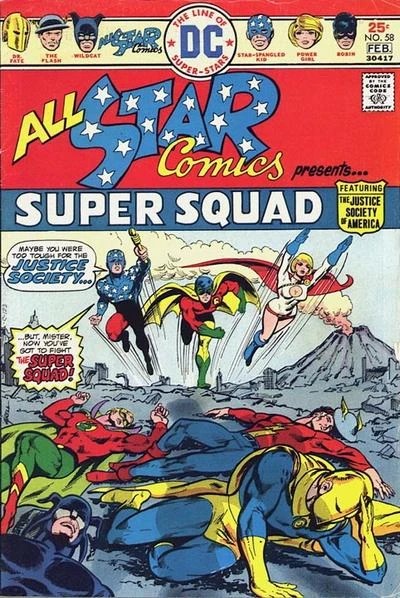
By the time that the 41st issue of Phantom Stranger arrived in spinner racks in November, 1975, I had been buying the title regularly for a full five years — or, to put it another way, for an unbroken run of thirty issues.  That made it unique among the DC Comics offerings I was picking up regularly at the time, as none of the others — Beowulf, Claw the Unconquered, Hercules Unbound, Kong the Untamed, Warlord, and the just-revived All-Star Comics — had even been around just one year before, let alone five.  As for the other DC books that I’d been routinely buying back when I first sampled Phantom Stranger in November, 1970 — these included Green Lantern, House of Mystery, Jimmy Olsen, Justice League of America, Superman, and World’s Finest — while most of them were still going concerns, a couple weren’t; and those that were still being published had become occasional purchases for me, at best.  Phantom Stranger was the only DC comic I’d bought continuously for the last half-decade — the sole survivor of my own personal DC Comics class of ’70.

And after this month, it would be gone, as well… because the 41st issue of Phantom Stranger was also to be the final one.  Read More

Adventure Comics #440 (Jul.-Aug., 1975)

Arriving in spinner racks in late April, 1975, the 440th issue of DC’s Adventure Comics featured an updated look, as the title’s current lead feature — the Spectre — finally got a cover logo of his own.  A number of artist Jim Aparo’s earlier covers, excellent as they were, hadn’t even featured the character’s name anywhere in their copy… which was perhaps not the best call ever made by editor Joe Orlando.  But now, finally, we had the return of the classic logo that the great Ira Schnapp had designed for the Spectre’s Silver Age revival in Showcase back in 1965, which had then gone on to grace most of the issues of his subsequent titular series.  It was a good move — though one that came a little late, given that Adventure #440 would be the last to feature the Spectre as the book’s headliner.  Read More

Stalker #1 (Jun.-Jul., 1975)

Following our coverage of Beowulf #1 in January, and Claw the Unconquered #1 in February, we come now to the third of the brand-new sword and sorcery series launched by DC Comics in the first quarter of 1975 — the shortest-lived of the group, as things turned out, but your humble blogger’s personal favorite, nevertheless.

In a career-spanning interview with Paul Levitz conducted in 2019 by Alex Grand and Jim Thompson, the primary progenitor of Stalker (also, albeit a few decades later, DC’s president and publisher) recalled how the project came to be.  At the time, the 18-year-old Levitz was working as an assistant to DC editor Joe Orlando…  Read More

Adventure Comics #438 (Mar.-Apr., 1975)

The issue of Adventure Comics we’re going to be looking at today was the eighth in a row to feature the Spectre as its headliner, and as such, might well have been taken by a casual browser of the spinner racks in December, 1974 as simply offering more of the same.  Yet this issue departed from its immediate predecessors in at least a couple of respects, beginning with its title logo.  In response to recent commercial trends, as of the Spectre’s third outing (issue #433), DC Comics had started slapping the word “Weird” above “Adventure” on the venerable series’ covers.  That was an adjustment which made good sense as far as the Astral Avenger was concerned… but wasn’t quite as good a fit with the King of the Seven Seas, Aquaman, who began a run as Spec’s backup in issue #435Read More

Forever People #9 (Jun.-Jul., 1972)

In October, 1971, Don and Maggie Thompson’s fanzine Newfangles reported:

There are indications that DC is in serious trouble. Dealers are not too keen on the 25¢ comic book[s], sales are skyrocketing for Marvel, Charlton and Gold Key (GK has 15¢ books, Marvel and Charlton 20¢)… DC’s titles are also reported to be dying in droves on the stands, if they get that far—wholesalers prefer to handle the 20¢ books, apparently.

A couple of months later, with disappointing sales reports now in for about a quarter-year’s worth of the “bigger & better” format DC had inaugurated in June, publisher Carmine Infantino prepared to make some course adjustments.  The most significant upcoming change would be to the format itself (more on that later), but there were other indicators of Infantino’s efforts to staunch the bleeding as 1972 got underway; for example, Green Lantern, one of the signature series of DC’s Silver Age, was cancelled with its 89th issue, shipping in February.  As for the titles written, drawn, and edited by Jack Kirby, with which DC had clearly hoped to clean up with sales-wise following Kirby’s 1970 defection from DC’s chief rival, Marvel Comics: Jimmy Olsen was removed from Kirby’s purview with the 148th issue (which, like GL #89, came out in February); and while Infantino wasn’t quite ready to pull the plug on Kirby’s three remaining titles — the core books of the star creator’s interconnected “Fourth World” epic — he appears to have been determined to take a more active role in guiding their respective directions than he had before.  If the King could ever have been said to have had free rein in managing “his” comics at DC (and that’s by no means an indisputable statement), that day was over.  Read More

Green Lantern #86 (Oct.-Nov., 1971)

There’s a lot going on on the cover of Green Lantern #86.  Besides boasting an outstanding illustration by Neal Adams that would probably be even better remembered than it is if it hadn’t followed right on the heels of its instantly iconic predecessor, the cover also boldly heralds the inclusion within the comic’s pages of “an important message” from no less a personage than the 1966-73 mayor of New York City, John Lindsayand proudly announces that Green Lantern has won the Academy Award for Best Comic.  That’s a lot to take in — but don’t worry, we’ll get to it all, starting with the subject of Adams’ compelling cover image — the concluding installment of the groundbreaking two-part story focused on drug addiction that Adams and writer Denny O’Neil had begun in the previous issue, #85Read More

Justice League of America #74 (September, 1969)

The second half of 1969’s iteration of DC Comics’ annual summer event teaming the Justice League of America with their Golden Age predecessors, the Justice Society of America, sported a cover that was — for this particular twelve-year-old’s money — considerably more exciting than the previous issue‘s.  That cover had featured a row of JSAers looking on passively while some nameless kid ripped up a lamppost; this one, pencilled and inked by Neal Adams, heralded the first meeting between the Superman of Earth-One (the one currently appearing in multiple DC titles every month) and the Superman of Earth-Two (the one who’d ushered in the whole Golden Age of Comics in the first place in 1938’s Action Comics #1) — and from the looks of things, it was going to be a, shall we say, rather contentious meeting.  That I would buy this comic book was never in question; but I have a hard time imagining anyone who was even a casual reader of DC superhero comics seeing this book in the spinner rack in July, 1969, and not picking it up.  Read More

The Brave and the Bold #72 (June-July, 1967)

Carmine Infantino is generally (and rightfully) acknowledged as one of the two or three primary architects of the “look” of DC Comics during the Silver Age; I think it’s interesting to note, then, that almost all of his interior artwork from 1962 through 1967 (when the artist transitioned from full-time pencilling into management responsibilities at DC) was done for just one of the company’s numerous editors, namely Julius Schwartz.  The fact is, however, that even though Schwartz did keep Infantino very busy throughout those years, the artist still managed to complete the odd job for another DC editor here and there — including a couple of issues of The Brave and the Bold for George Kashdan, both of which (probably not coincidentally) co-starred one of the two or three characters most closely associated with Infantino — the Flash.  Read More