Avengers #144 (February, 1976)

As regular readers of this blog may have noticed, I tend not to talk very much about the covers of the half-century-old comics we discuss here; unless they’re really strikingly good, my tendency is simply to note who drew them — to the extent that that’s known, anyway — and then move on.  (And just this week, in writing about Defenders #32, I forgot to do even that much; my thanks to reader Ben Herman for stepping into the breach.)  But I’m going to make an exception this time, simply to express my disappointment with this particular job by Gil Kane and Frank Giacoia.  While there are aspects of the composition that work well, the central figure of Hellcat — a significant new character (OK, technically a new combination of two pre-existing characters) whom readers are seeing here for the very first time — is almost painfully awkward, at least to my eyes.  Kane was a great talent, but among the very many (probably too many) covers he cranked out for Marvel in the 1970s, it stands to reason that there’d be at least a few clunkers; and for me, this is one of them.  (Naturally, your mileage may vary.)  Read More

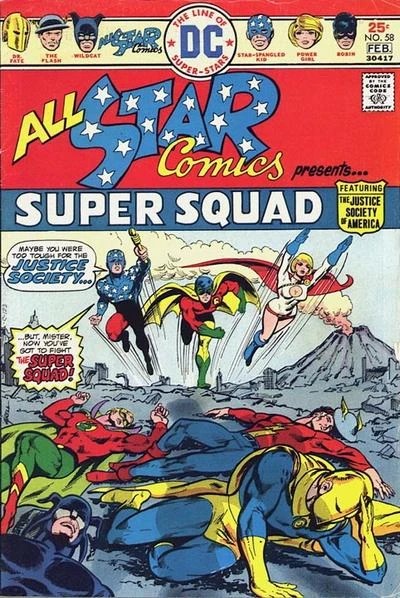
All-Star Comics #58 (Jan.-Feb., 1976)

In October, 1975 — just a little less than a quarter-century since their last headlining appearance in All-Star Comics #57 (Feb.-Mar., 1951), and about half that time since their revival in Flash #137 (Jun., 1963) — the Justice Society of America finally returned to newsstands in their own book.  The premiere superhero team, not just of DC Comics but of all comics, was at last back in full force, ready to reclaim its former glory.

And it had Marvel Comics to thank for the opportunity.  Read More

Hercules Unbound #1 (Oct.-Nov., 1975)

Fifty-plus years ago, the spring of 1975 brought news of personnel changes to the major American comic book companies that might not have made it into any major metropolitan newspapers, but were guaranteed to garner headlines in the comics fanzines of the time.  Without doubt, the most dramatic such development was the return of artist/writer/editor Jack Kirby to Marvel Comics following a five-year tenure at rival DC; but another change that happened more or less simultaneously with Kirby’s move — and was essentially the reverse mirror image of it — was also significant enough to get a fair amount of ink in The Comics Reader and its ilk: the return of Gerry Conway to DC Comics as both a writer and an editor after having spent the better part of the past half-decade writing for Marvel, where he’d ultimately been responsible for such high-profile titles as Thor, Fantastic Four, and Amazing-Spider-Man. Read More

Stalker #1 (Jun.-Jul., 1975)

Following our coverage of Beowulf #1 in January, and Claw the Unconquered #1 in February, we come now to the third of the brand-new sword and sorcery series launched by DC Comics in the first quarter of 1975 — the shortest-lived of the group, as things turned out, but your humble blogger’s personal favorite, nevertheless.

In a career-spanning interview with Paul Levitz conducted in 2019 by Alex Grand and Jim Thompson, the primary progenitor of Stalker (also, albeit a few decades later, DC’s president and publisher) recalled how the project came to be.  At the time, the 18-year-old Levitz was working as an assistant to DC editor Joe Orlando…  Read More

Unknown Worlds of Science Fiction #1 (January, 1975)

In February of last year, we ran a post on the first issue of Worlds Unknown — a four-color anthology title from Marvel Comics devoted to the science fiction genre, with a special focus on adapting short stories and novels by well-known SF authors.  As we discussed at the time, this passion project of Marvel’s editor-in-chief, Roy Thomas, saw just six issues released in this format before it took a hard turn in a decidedly different direction (an adaptation of the fantasy film The Golden Voyage of Sinbad) for its final two issues, the last of which came out in April, 1974.

Given its poor performance in the marketplace, Thomas’ project could hardly be called a success; still, in October of the same year, it became clear that the editor hadn’t given up on the basic idea behind it, as that month saw the debut of a brand new entry in Marvel’s ever-growing, and ever more genre-diverse, line of black-and-white comics magazines:  Unknown Worlds of Science FictionRead More

Hero for Hire #9 (May, 1973)

In March, 1972, Marvel Comics published the first issue of Hero for Hire.  The new comic’s titular star, Luke Cage, wasn’t Marvel’s first Black superhero (that distinction belonged to the Black Panther, who debuted in 1966), or even its first Black American superhero (that would be the Falcon, whose first appearance came in 1969).  But he was the first Black superhero to star in his very own comics title — not just from Marvel, but from any major American company — and that made the release of Hero for Hire #1 a milestone.

According to Roy Thomas, the initiative to create Luke Cage came from Stan Lee, who was then on the verge of ascending from his longtime role as Marvel’s editor-in-chief to become its publisher — and who was determined to diversify Marvel’s line on a number of levels, one of which was race.  Taking obvious inspiration from the “blaxpoitation” trend in early 1970s American cinema, Lee and Thomas worked with writer Archie Goodwin and artist John Romita to conceptualize and design the new hero, before bringing two more artists on board — George Tuska and Billy Graham. (the latter being the only Black person among this assortment of talents) — to craft the first issue’s story with Goodwin.  Read More

Avengers #93 (November, 1971)

If there’s a single comic book that best exemplifies the potential of the all-new, 48-page format which Marvel Comics rolled out to great fanfare in August, 1971 (or, as we’ve christened it on this blog, Giant-Size Marvel Month), it surely must be the subject of today’s post: Avengers #93, featuring the 34-page story “This Beachhead Earth” — which, in addition to being the mid-point of the extended storyline known as the Kree-Skrull War, was also the first installment of a short but superlative run on the series by the creative team of scripter Roy Thomas, penciller Neal Adams, and inker Tom Palmer.

And if any set of classic comics exemplifies just how contentious two talented creators can become over the issue of who deserves the credit for which aspects of their storied collaboration, it’s the same short Avengers run by Thomas, Adams, and Palmer. Read More

Vampirella 1972 Annual

As I related on this blog back at the top of the month, in the summer of 1971 my young teenage self finally dared to dip a toe into the waters of the (allegedly) more mature comic book content represented by the black-and-white output of Warren Publishing.  But as daunted as I might have been by the prospect of encountering more gore and violence than my tender sensibilities were at that time accustomed to within the pages of Warren’s Eerie or Creepy, I’m certain that I experienced even greater trepidation regarding my decision as to whether or not I should purchase the magazine that’s the primary topic of today’s post.  Because, in addition to the same more generous amounts of violence and gore offered by its fellow Warren publications, Vampirella also appeared to promise a more substantial serving of sex.  Read More

Kull the Conqueror #2 (September, 1971)

In the waning months of 1970, with the early sales reports on their new Conan the Barbarian series good enough to warrant bumping the title up from bi-monthly to monthly publication, Marvel Comics — likely driven at least in part by the enthusiasm of Conan writer (and Marvel associate editor) Roy Thomas — decided to take a chance on another sword-and-sorcery barbarian hero created decades earlier by pulp writer Robert E. Howard: King Kull.

Though he’d almost immediately come to be seen by comics fans (well, by this one, anyway) as Howard’s “number two” hero, Kull was actually the earlier creation, predating the author’s imagining of Conan the Cimmerian by some three years.  Kull could even be seen as the prototype for the later, more commercially successful hero, as the very first Conan story, “The Phoenix on the Sword” (published in the magazine Weird Tales in 1932) was a reworked version of an unsold Kull yarn, “By This Axe I Rule!”  Read More

Sub-Mariner #40 (August, 1971)

In the spring of 1971, roughly four months after he’d crossed over a couple of Marvel superheroes in Iron Man #35 and Daredevil #73, writer Gerry Conway did it again — though this time, the team-up tale started in Daredevil and ended in another title (Sub-Mariner), rather than the other way around.  What was more, Conway even managed to work in a third marquee hero — the biggest star among the three, actually — although that hero’s title, Amazing Spider-Man, wasn’t itself a part of the crossover.  Perhaps oddest of all, after getting the ball rolling in Daredevil, Conway completely dropped the Man Without Fear from his narrative, so that DD’s role in the second half of the crossover was limited to appearing in a single flashback panel.

Whatever the thinking was behind doing things this way, if the intention was to get Marvel fans who weren’t currently consistent buyers of Daredevil and/or Sub-Mariner to pony up for at least one issue of each series, then it worked, at least as far as my thirteen-year-old self was concerned.  Having been a fairly regular purchaser of DD’s book in earlier days (through most of 1968-69, to be more precise), and an occasional sampler of Subby’s title as well, I very likely would have grabbed both comics even if there hadn’t been a third co-star.  But adding Spidey to the mix made it virtually a no-brainer for me — as I suspect it also did for a good number of other fans. Read More