
 When last we left Adam Warlock at the end of our Warlock #5 post back in January, the superheroic would-be savior of Counter-Earth had just saved thousands of Northern Californians from dying, either as a result of bomb test-caused earthquakes and flooding, or from the fire of armed missiles — the “Deathbirds” — which the same test had inadvertently triggered… only to have the very man responsible for ordering the bomb test in the first place, President Rex Carpenter, subsequently declare him a menace on national television.
 The next issue of the series, sporting a cover by John Romita, picks up very soon after those events, as Adam finds himself under assault by the United States military. Warlock #6 also sees the partial return of Mike Friedrich as the book’s writer, providing the finished script over a plot by Ron Goulart (who’d written issue #5), who in his turn worked from an “idea” contributed by Marvel editor-in-chief Roy Thomas.
Additionally, issue #6 also features a major changing of the guard on the series’ artistic side, as Bob Brown replaces Gil Kane as penciller. Kane, who’d co-created the feature with Thomas back in Marvel Premiere #1 (Apr., 1972) and had drawn every installment but one since then, would go on to provide one more cover for the book before its cancellation, but was otherwise done with Warlock as of #5.

Regular readers of the blog may recall that I’m not the world’s biggest Bob Brown fan, and I’d be less than honest if I told you that I didn’t think that the overall artistic quality of Warlock declined following Gil Kane’s departure. But to give Mr. Brown his due, the man had a real gift for the single, striking image — as exemplified not only by his many classic covers for DC Comics in the 1950s and 1960s, but also by the dramatic opening splash panel of Warlock #6 shown above. (Kudos also to inker Tom Sutton, who gave Brown’s pencils here the extra texture and polish they didn’t always receive from other embellishers at Marvel.)
Unable to reason with those attacking him — and unwilling to risk the safety of the many innocents in the immediate vicinity — Warlock flies away at such speed that the military helicopters are unable to pursue him. Meanwhile, our hero’s new friend, Dr. Victor von Doom — who, you’ll remember, is a good guy on Counter-Earth, a benevolent scientist who’s so important and respected that he has a direct hotline to the White House — calls the President to remonstrate with him on Adam’s behalf. After getting nowhere with that tactic, Von Doom next tries his only other contact in Washington — his best friend and fellow scientific genius, Reed Richards:


As the readers of Warlock in 1973 were aware, the differences between the history of the “regular” Earth of the Marvel Universe and the recently-created (by the High Evolutionary) Counter-Earth — the most important of which was the lack of any super-powered individuals among the native populace — were all supposed to be due to the influence of the High Evolutionary’s mortal enemy, the Man-Beast. So, although we’re not told so directly, we have to assume that the Man-Beast was somehow responsible for Reed Richards having Victor von Doom as a college roommate rather than Ben Grimm (though, as we’ll see on the pages that follow, Ben is still part of the overall picture). Perhaps the villain also interfered in Victor’s past in other ways that aren’t shown, since neither the tragic loss of Vic’s mother, nor his following in her witchy footsteps, seem to figure into his motivations on Counter-Earth.


There’s obvious irony in Counter-Earth’s Reed Richards transforming not into the elastic (but human-looking) Mister Fantastic, but rather into a being that has a lot more in common with the “true” Earth’s Thing (over whose fate “our” Reed has long struggled with guilt) — the super-strong, monstrous Brute.


Remember Astrella? The mysterious young woman who keeps turning up offering to assist Adam and his friends, but never telling them anything about herself? Oh, wait, I forgot — back in Warlock #1, she said she was the sister of the Prophet — a character who appeared at first to be a “John the Baptist” figure, but who in fact turned out to be the Devil — i.e., the Man-Beast — in disguise. Everyone in the story seems to have forgotten all about that (probably because the storytellers have, too).
Anyway, Warlock agrees to accompany Astrella to the meeting of his sympathizers, which is being held somewhere south of San Francisco — even as her thought balloons reveal to the reader (though not of course to Adam) that the whole thing is a set-up. “I feel like a heel!” she frets internally. Gee, good to know.
Traveling south by car, Warlock and Astrella get as far as the Golden Gate Bridge, at which point the Brute (who seems to have gotten from the East Coast to the West in record time) attacks them. Of course, as Astrella’s continuing internal ruminations quickly confirm for us readers, this has been the plan all along…


Warlock saves the bridge, but the Brute takes advantage of the temporary weakness that occurs when our hero employs the power of his soul-jewel, and drives him down into the deep waters below, intending to drown him…
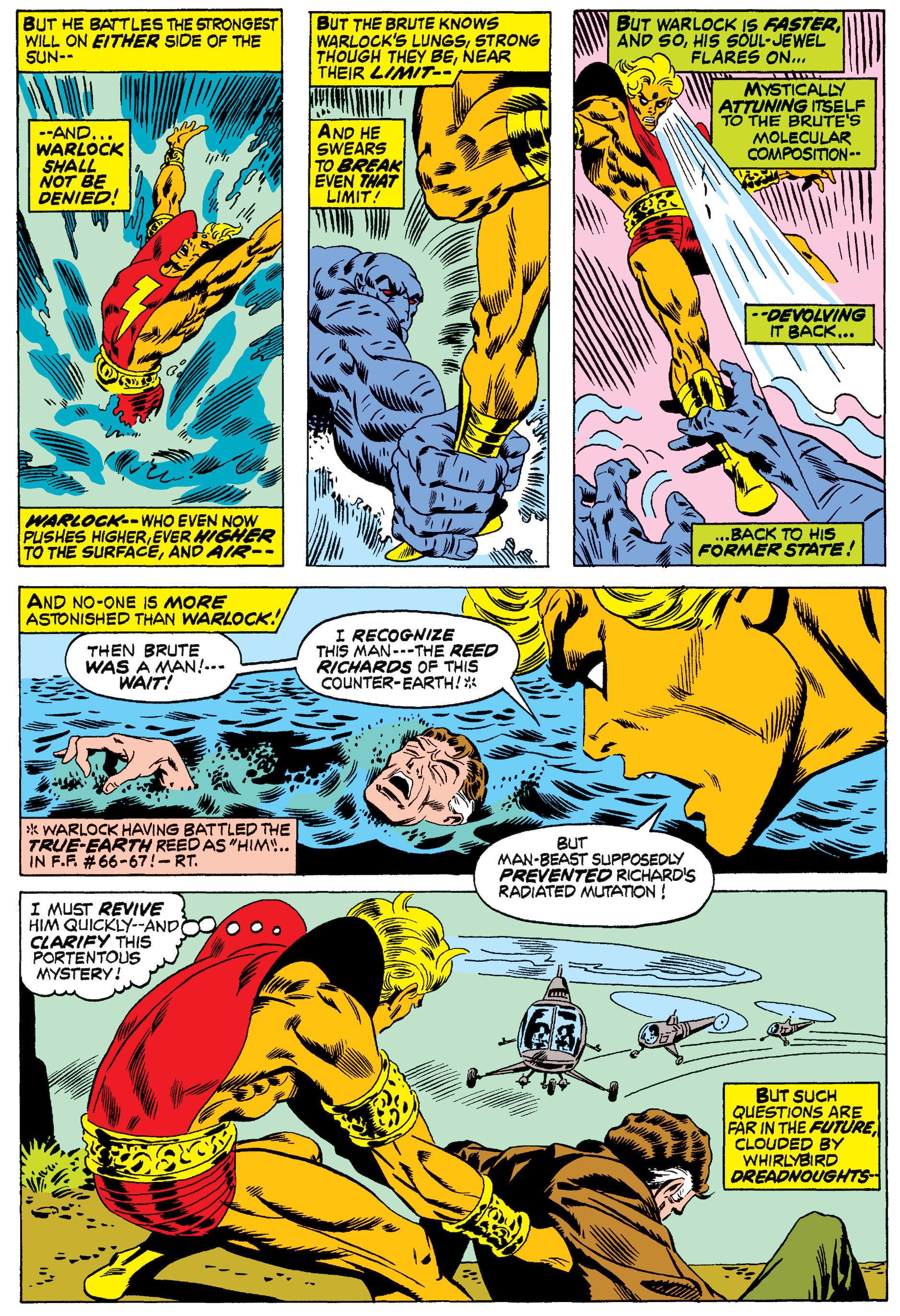
There’s a bit of a flub in the editorial footnote in the fourth panel above, as Warlock never actually came face-to-face with any of the Fantastic Four’s members during his debut outing as “Him”, back in FF #66-67. (Frankly, this is the kind of mistake that the continuity-minded Roy Thomas seems unlikely to have made, leading me to suspect that at least in this instance, “R.T.” was actually writer Mike Friedrich.)
Attacked for the second time this issue by military helicopters, Adam again flees. Flying to the site towards which he had been traveling with Astrella — a coastal mountain cabin — he finds in residence only Dr. Von Doom, who explains that he, too, was directed there by the mystery woman. Adam fills Von Doom in about his encounter with Reed Richards, and the shocking news of his friend’s transformation makes the scientist more convinced than ever that “something pretty rotten” is going on. “Even the President seems sucked into it!”

 Warlock #7 features Gil Kane’s last cover for the series, as inked by Frank Giacoia; per the Grand Comics Database, Giacoia also inked Bob Brown’s pencils for the story within (“Doom: At the Earth’s Core!”), despite the comics’ own credits listing Tom Sutton. Meanwhile, Mike Friedrich once again assumes his status as the series’ sole writer (or, at least, that’s what the credits say).
As Jason Grey hurriedly explains to Warlock and Von Doom, he and Adam’s other young friends/allies/disciples, David Carter and Ellie Roberts, were hanging out in San Francisco, waiting for — who else? — Astrella, when they were recognized and attacked by a group of angry men who, having heard and believed the accusations of President Carpenter, considered them to be traitors. The police quickly arrived, but instead of merely breaking up the fight, decided to take Adam’s followers into protective custody, with only Jason managing to escape… and then, of course, to make his way to the cabin Astrella had already told the trio about.
Meanwhile, Carpenter himself has arrived in San Francisco; and in a press conference held on the restored Golden Gate Bridge itself, he announces to the listening crowd of locals: “Warlock’s heroic repair of this glorious Golden Gate Bridge cannot go unrecognized.”

Around this same time, a very confused, but otherwise apparently healthy Reed Richards is being released from the local U.S. Army Hospital…


The Brute successfully smashes his way out of the hotel, but almost immediately afterwards, he begins to feel woozy. “I need food,” he realizes, “some kind of energy — lots of it!” Meanwhile, Warlock has flown to the police station where Ellie and David are being held; and, after he breaks up a confrontation between two opposing sets of demonstrators on the sidewalk in front of the precinct (our hero’s supporters carry signs saying “Warlock Saves!” and “What a Friend We Have in Warlock!”, just in case any reader has forgotten about the religious allegory at the heart of the series), the police release the two teenagers into his custody. As they exit the station, who should show up but, you guessed it, Astrella — who proceeds to explain her never arriving at the mountain cabin with the excuse, “I found out it was all a trap — by your enemies!” Of course, another one of those handy thought balloons instantly clues us readers in to the truth (“– only I was the one setting it — and then couldn’t go thru with it!”), but since neither Adam nor his friends are privy to Astrella’s interior monologue, they accept her explanation as offered.

Realizing that the Brute retains enough of Reed Richards’ intellect to be able to operate the “inner space exploratory vehicle” called Earth-Corer-1 — and guessing at his ultimate aim in directing the machine to dig straight downwards — Victor von Doom hops in his convertible and drives into the city to find Adam Warlock…

So, Von Doom believes that the Brute can draw off enough of the geothermal energy at the Earth’s core to turn the planet into “a literal snowball“? I’m not a geophysicist or anything, but that notion seems pretty dodgy to me. But, hey, maybe things work differently on Counter-Earth, so let’s just accept that the scientific genius with the direct hotline to the White House knows what he’s talking about here.
Soon afterwards, Warlock is using the power of his soul-jewel to blast a tunnel towards the center of the Earth, while Von Doom, David, and Ellie follow in his wake in an “auxiliary vehicle” designed by the good Doctor. (Presumably, they had to go back to Von Doom’s lab to retrieve said vehicle, so it’s not clear why they can’t just use the tunnel the Brute has already drilled at that location — especially since, as we’ll see presently, Warlock is going to need all that power he’s expending digging a hole when it comes time to fight the Brute.)
Eventually — though well before they’ve traveled the full 1,802 miles to the Earth’s core, or so I’m guessing — our intrepid little band come upon the Brute, who’s parked the Earth-Corer and is now slurping up geothermal energy like nobody’s business. But while the Brute is now ten times more powerful than before, Warlock’s strength has been depleted by his tunneling efforts (see? what’d I tell you?), and the monster soon has him on the ropes…


As Von Doom sprints toward the Earth-Corer, he reflects how Reed was there for him after the accident that scarred his face. “Now I can attempt no less!” Once he’s reached the device, he makes a few adjustments to convert its radiation shield “into a radiation absorber!” And then…


Back in July, 1973, my sixteen-year-old self found this conclusion to be both effective and affecting. And my sixty-six-year-old self still finds meaning and value in the sentiments Adam Warlock expresses in the story’s final couple of pages, as well as in the paraphrase of a Bible verse etched into Victor von Doom’s memorial plate. But the story’s attempt to evoke a sense of pathos through the idea of “Doctor Doom” sacrificing himself to save the world largely falls flat for me now, mostly because it’s obvious to me today just how indifferent Mike Friedrich (and before him, Ron Goulart) has been in developing the character of Counter-Earth’s Victor von Doom — and its Reed Richards too, for that matter* — through these last three issues.
We recognize these characters as reflections of the original iterations we know so well because they share the same names, the same faces (or masks), and some of the same key past experiences. But change the names, or the faces, and what is there about the Counter-Earth characters to identify them as cracked-mirror versions of Doctor Doom and Mister Fantastic? Take away his famous name and distinctive mask, and we’d never recognize the heroic scientist in this story as a variant of Marvel Comics’ greatest supervillain… or so at least it seems to me.**
Of course, in coming back to this story in 2023, I’ve got five decades of experience in reading and viewing stories about alternate worlds that I didn’t have when I first read it. Back in 1973, it worked just fine for me (and, I suspect, for many other readers) for Marvel’s storytellers to simply say “hey, this is Doctor Doom, only on this world he’s a good guy,” because we hadn’t seen this sort of thing a hundred times before. So, perhaps I should cut Friedrich and Goulart a break for not trying any harder than they necessarily had to to get the effect that they wanted. Like I said, it worked for me at the time, so I can hardly say that the writers didn’t earn their share of the 20 cents I paid per issue.
And, in any event, the storyline in Warlock moves away from the whole “alternate Marvel Universe” business after this issue. Perhaps we’d have seen more familiar faces show up eventually, had the series continued. But, as most of you out there reading this are probably already aware, the next issue of Warlock — #8 — would be the last one, at least for a while.
Behind a cover by John Buscema and Frank Giacoia, Mike Friedrich and Bob Brown pick up the threads of their tale one last time (Tom Sutton is again credited as inker, although the Grand Comics Database indicates the honors were actually done by Mike Esposito and [maybe] Frank Bolle)…

From this opening splash, the story cuts away to an undisclosed location, where a mysterious “Council” (consisting of several white guys in suits) views a slide-show intended to prove that Adam Warlock is a menace. Presumably, Friedrich intended for this Council to play a role in future stories, but due to Warlock’s cancellation, he never got the chance; after this one page appearance, they’re never referred to again.
The story now returns to the demonstration currently happening in front of the U.S. Capitol:

Somehow, the two demons are visible only to the protestors; the cops on hand, believing that the previously peaceful demonstration is suddenly and inexplicably turning violent, wade in and begin to bust heads and make arrests.
Meanwhile, Warlock and his three young friends are all hanging out together in Astrella’s mountain cabin — yes, the very same location that she’d told them last issue was a trap. Sure, Warlock had to return there to pick up the recovering Jason Grey, but it makes absolutely no sense for the group to stick around afterwards; nevertheless, that’s where they are when Astrella herself arrives, and, after brushing aside Adam’s attempt to ask her a few pointed questions, turns on the TV to show him and the others what’s currently going down in D.C….


As “R.T.”‘s footnote indicates, this is the same Recorder who’d previously appeared in various issues of Thor, beginning with #132 back in 1966. The new name he’s given here by the High Evolutionary, Memorax, was fated not to catch on, being largely ignored by later writers (perhaps because someone at Marvel realized it was just too damn similar to the name of a certain then-active recordable media company to be certain of avoiding legal trouble).
H.E. proceeds to give Memorax a 2-page crash course in the history of Counter-Earth in general, as well as Adam Warlock’s mission there, with an emphasis on the first few episodes of the series. It’s nothing that readers who’ve been around since the beginning (or thereabouts) wouldn’t already know — but for anyone coming in at any time after Warlock #2, the background it provides could be very helpful in making sense of this issue’s concluding scene when it arrives, around ten pages from now.
The story now leaves H.E. and the Recorder, returning to Washington — and to President Rex Carpenter, who’s decided to go personally to the scene of the present disturbances, against the advice of his staff…


Warlock holds his own against the two demons for a couple of pages; but then Aggression takes the battle into the inner realm of Warlock’s mind, at which point Friedrich and Brown proceed to give us three pages of frankly unconvincing psychedelia. (The artist tries his best, but I think even many of his fans would agree that this kind of thing really isn’t in his wheelhouse.) Finally…

We’d already seen a riff on the Temptation of Christ back in Warlock #2; so, you can take the preceding page as a reprise of that sequence, or if you prefer, a nod to The Last Temptation of Christ.


 On one level, Friedrich is playing fair here; there was in fact a sequence of panels on the final page of Warlock #2 (see right; art by John Buscema and Tom Sutton) that showed the misty remnants of the discorporated Man-Beast descending into a crowd who were listening to a speech by an unidentified political candidate. And while the narrative captions (scripted by Friedrich, who was working from a plot by Thomas) had suggested that the Man-Beast’s dissipating spirit might have entered into all present (the old “there’s a bit of the Devil in everyone” idea), they hadn’t come right out and said that was in fact the case.
Nevertheless, there’s a problem here, and it arises from the fact that Astrella Carpenter had been introduced an issue earlier, in the Thomas-scripted Warlock #1, where (as we’ve already noted) she’d introduced herself as the sister not of Rex Carpenter, but of the Prophet — who was actually the still-corporeal Man-Beast, wearing a rubber mask to pass himself off as human. Sure, you can go through the cognitive effort to cobble together an explanation for yourself as to how Astrella somehow came under the influence of the Man-Beast before his spirit possessed her brother (you can even imagine yourself receiving a no-prize from Marvel for going to the trouble, if that floats your boat)… but that doesn’t mean that our storytellers didn’t make a mistake in the first place, now does it?

But perhaps it’s unseemly to quibble about such errors at this point, seeing as how our storyline has been brought abruptly to a halt — and one must assume that the axe came down on Warlock quite abruptly indeed, as it seems unlikely that Friedrich would have introduced new plot elements (e.g., the Council and Memorax) had he known that “Confrontation!” would in fact be the last Adam Warlock story, at least for the time being.
An editorial note on the issue’s letters page makes the finality indicated by the story’s last caption 100% official:

In retrospect, it seems a little odd for Marvel to hold up the Silver Surfer as a beacon of hope for Adam Warlock’s fans; after all, it had been three whole years since the cancellation of the Surfer’s book, and the guy still hadn’t returned to regular publication. Also, based on what we know now, his “popping up more and more these days” was less a result of increased fannish “clamor”, and more a matter of Stan Lee’s relaxing his proprietary grasp on his favorite character enough to allow Steve Englehart to use the Sky-Rider of the Spaceways semi-regularly in Defenders.
Ironically, as things ultimately worked out, Adam Warlock would return in his own solo series much, much sooner than would the Silver Surfer — a whole thirteen years sooner, in fact. Though even before that, the cliffhanger with which the original run of Warlock was so abruptly cut short would be resolved in the pages of Incredible Hulk, as editor/plotter Roy Thomas laid on the Christian religious allegory to an extent not seen since Warlock‘s earliest episodes for a three-issue story arc your humble blogger can’t help but think of as “The Passion of Adam Warlock”. You can decide for yourself if that’s an appropriate title when we discuss that arc in this space, roughly ten months from now.
*The Reed Richards of Counter-Earth would mount a comeback several years later in Fantastic Four, evidently because Roy Thomas was keen to write an “evil twin” storyline in that book — though, of course, since Counter-Earth Reed wasn’t really evil, he had to contrive to make him so by having the poor guy get knocked on the head really hard. (More details to follow [maybe] in 2026, when the blog’s fifty-years-ago coverage window will catch up with those issues.)
**My musings on this subject were spurred in part by the insights of Prof. James Kakalios, author of The Physics of Superheroes, whose keen analysis of the key psychological difference between Reed Richards and Victor von Doom (the real ones, that is), as well as some thoughts regarding the scientific plausibility of Counter-Earth, may be found within the 30th episode of Douglas Wolk’s Doom-centric podcast, Voice of Latveria.
Imagine cracking open a bottle of what you thought was a fine wine of excellent vintage, only to put it to your lips and discover the bottle was full of castor oil! That was my experience opening Warlock #8 and discovering that the art was done, not my Gil Kane, one of my Top Three Artists (my own personal Holy Trinity, perhaps), but by Bob Brown! Not that it’s Brown’s fault, necessarily, it’s just that, compared to Kane, his work was a dull as his name. In his defense, he did find greater success as a comic book artist than I ever did, but except for covers and that occasional splashpage Alan mentioned, his work was just not exciting to me, especially when compared to Kane.
As to the story, Friedrich was never my favorite writer, either, and somehow the hodgepodge of story by Thomas, outline by Goulart and script by Friedrich (or however they did it), resulted in a couple of stories that jumped all over the place without any real characterization or direction. While I enjoyed seeing the Counter-Earth versions of Doom and Reed Richards, Richards here was a whiner who didn’t handle his transformation into the Brute with anywhere near the strength of character Ben Grimm showed in his transformation into the Thing. That said, the whole “Christian allegory” of the series was really getting tiresome at this point, even for this 15-year old Southern Baptist Bible Baby.
There was some great potential in examining the teachings of a Messianic figure in the milieu of a superhero comic, but Marvel was either afraid of where it would take them or too trapped in the standard bam-biff-pow of the traditional comic book world to ever really do it justice, which, with all due deference to that editorial note you re-printed for us, Alan, was probably one of the main reasons it got cancelled. Thanks, Alan.
I’m a fan of Kane but Brown also knocked my socks off. Nothing of his I ever read was anything of a delight, especially his Avengers and Daredevil. I was bereft when the X-Men fill in of his was used posthumously, that they revealed he would have succeeded Cockrum on X-Men! Byrne’s run was good (I used to be a fan of Byrne’s until he was an asshole too much online that I can’t now look at his work without recalling the awful things he’s said) but I’ve always dreamed of what could have been with Brown.
Oh and my love for Warlock must have been permanently seared into me by Thomas. Friedrich is one of those creators that I would only follow if I was ape about the character or artist. His writing usually just fell flat for me.
Back in the day, the only issue of the original run of Warlock I got brand new was issue 6. I bought it without any prior knowledge of Warlock (or Him) whatsoever. A, pnd I have no memory whatsoever of what prompted me to get it, but back then I’d often get something just on a whim, as long as I had enough coins on me and there wasn’t anything else on the racks I wanted more. Anyhow, while it didn’t blow me away, unlike, say, Captain Marvel #27, I still found it very intriguing, particularly with the variant versions of Reed Richards and Victor Von Doom. And while I wouldn’t rate Bob Brown as one of my favorite upper tier comics artists, I found it reasonably good enough, although I have to grin at the “magic” by which fully clothed Counter-Earth Reed transformed into the horribly ugly Brute clad only in a bikini bottom, but when he transformed back into Reed, he was once again fully clothed. Can’t recall if my 11 year old self made note of that, but it certainly strikes my 61 year old self as silly.
And this was just a month or two from the coming brouhaha over Betty Ross Talbot transforming from her Harpy persona and entirely naked as she & Hulk began a long fall from, oh, eight miles high at the end of one issue, somehow managed to clothe herself in a burlap sack by the splash page of the next issue with she & Hulk just beginning their long journey to the ground. Of course, the CCA would have seriously frowned on any comics readers seeing Reed or Betty in the raw, and I’m sure Thomas wasn’t inclined to push the boundaries too much in the standard superhero comics, even if he & Smith got away with doing so in Conan the Barbarian, at least to some extent. Funny to think that Stan Lee even considered having Sue Storm run around invisible & nude in the first issue of Fantastic Four.
Anyhow, I eventually got Warlock #8 (a couple of decades after getting Warlock #9 — now that was a knockout!). I’d already read the conclusion of the Counter-Earth saga in the Hulk. Overall, the first Warlock saga was intriguing if not quite a classic. One of the first Marvel superhero series set almost entirely apart from the rest of the Marvel universe, although not quite as far apart as Starlin would set the next Warlock saga. Parts of it don’t really make much sense, such as the pseudo-scientific magic by which the High Evolutionary, with some interference from the Man-Beast, could create a near duplicate of the Earth in which many of the very same historic events of billions of years but somehow compressed into 5 years — such as, if given that H.E. created Counter-Earth circa 1967, how could C.E. Reed Richards have even existed in 1961 to do anything? Comic book magic strikes again! Just can’t contemplate it too much or I’ll hurt my brain. 🙂
What strikes me as silly is that no matter what world, galaxy, dimension, etc. a character is from in the Silver Age and early Bronze Age Marvel universe, he (and sometimes she) inevitably has super-hero briefs and boots on. Gloriously goofy!
I liked Mike Friedrich’s work.
I thought his work on Ant-Man in Marvle Featrure was clever (I wonder if he had come up with the idea for The Atom at DC). I liked his work on Green Lantern (I saw it 8 years after it was published, but it was good. I wonder if GL # 73 & 74 had sold better, he and Adams would have taken over with # 76?)
I liked his work on Iron Man (for the most part). Fire Brand was a great bad guy and I liked what he did with the Masked Maurader. I liked his work on CPT Marvel (although his collaborator, Starlin, apparently did not).
However, he did not catch on.
I liked early Warlocks because it reminded me of Green Lantern, with Kane’s art (and Friedrich’s writing, although I was not aware he wrote GL for some years).
The religious issue is interesting in view of the fact that Friedrich is now an ordained Methodist Deacon.
Well, John, Mike Friedrich would have been a *little* young to have come up with DC’s Atom — he was only 12 when Ray Palmer made his 1961 debut in “Showcase”. 🙂
I wrote about Friedrich’s first published story a few years ago; if you’re interested, you can find that post here: https://50yearoldcomics.com/2018/01/14/spectre-3-mar-apr-1968/
I was thinking more about the idea that drove the Ant-Man series in Marvel Feature: a size changing hero stuck at a small size.
Friedrich’s JLA work from about a year before (the Merlyn the Archer story) featured the Atom and Schwartz seemed to be looking for something to do with the IP (e.g., the team-up with Superman in WF writen by Maggin and the Atom stories, first in Detective and then in Action in 1973, initially by Maggin).
I wonder if Schwartz had rejected the idea of an Atom stuck at 6 inches tall and Fredrich “recycled” it at Marvel when he left DC? (If so, Schwartz was right, the Ant-Man strip in Marvel Feature did not sell.)
Ah, I misunderstood. Thanks for the clarification, John.