
When we last checked in with the Man-Thing back in March, at the end of his 18th issue, it was for the finale of the three-part “Mad Viking” trilogy — one of the most intense and memorable storylines to have yet appeared in the feature, perhaps matched only by “The Kid’s Night Out!” (which had in fact been published concurrently with it, in the Man-Thing’s quarterly Giant-Size vehicle). As you may recall, Man-Thing #18 concluded with Manny, his human friend Richard Rory, and a distressed teenager named Carol Selby abandoning the small Florida town of Citrusville in the wake of a book burning incident at the town’s high school in which people as well as pages had perished. That downbeat ending presaged a significant change in direction for the series — one which writer Steve Gerber and artist Jim Mooney would manage to explore in depth for only three issues before having to abruptly wrap up everything as best they could in the title’s terminal release, Man-Thing #22.
 But outside of the mere fact that there had been a change in direction — which could easily have been decided upon for creative reasons as much as for commercial ones — there was little about Man-Thing #20 to suggest that, in April, 1975, the monthly series’ end was already in sight. Rather, the issue’s cover by Gil Kane and Frank Giacoia highlighted the feature’s new setting, as “The Most Startling Slime Creature of All!” was shown to have abandoned his swampy roots and relocated to the “Big City”.
Just which big city had been graced by Manny’s arrival was made clear on the story’s opening splash page — though we’d have to wait a few pages to find out exactly how our mute, mostly-mindless muck-monster had made his way to the suburbs of Atlanta, GA…

Joining Jim Mooney to provide the art for this installment is veteran Frank Springer, whose inking style is generally a good match for Mooney’s pencils; that said, my personal preference is for Mooney’s own inks over his stuff, as had been the case in the previous two issues — and, thankfully, would also be the case for the remaining three issues of Man-Thing, Volume One.
One more thing to note re: the credits box is the shout-out to Anthony Pezzella for having designed the costume of the Scavenger (a new character we’ll meet presently). Pezzella had previously been credited for the creation of the supervillain Death-Stalker, who’d debuted in Daredevil #113 (Sep., 1974) in a story that (not so coincidentally) was written by Steve Gerber and guest-starred Man-Thing; in an editorial note on that issue’s letters page, he was identified as “a young Brooklynite” and “a loyal fan, critic, and friend of Steve’s.” And now you know.

As Gerber reveals in the scene that follows, Colleen Sanders is leaving her husband (and two young sons), not for such “traditional” reasons as infidelity or abuse, but due to a deep discontentment with her life as it is. Such a narrative was becoming more familiar in the wake of the Women’s Liberation Movement that had emerged in the late 1960s; enough so that Colleen’s decision to leave home in the middle of the night would, I think, have seemed comprehensible to most readers of 1975 (even those that might not necessarily approve).
The Man-Thing, attracted as always by strong emotions, remains a silent witness as Colleen exits her house, gets into her car, and prepares to drive away…

The gentleman in the purple and yellow spandex is, of course, the Scavenger. While he’s not the first costumed villain to ever appear in the Man-Thing series — that distinction would go to the original Foolkiller, who debuted in issue #3 (and died an issue later) — his appearance here could be taken as signifying a move on Gerver’s part towards more “mainstream” (i.e., superhero) comic-book storytelling in this series — though, as we’ll soon see, the bent towards horror that’s been a part of the “Man-Thing” feature ever since its inception back in Savage Tales #1 (May, 1971) isn’t going anywhere…

Enraged by being pulled away from his victim, the Scavenger attempts to fight Man-Thing, first by hitting the creature with his fists, then by head-butting him. Naturally, all he accomplishes by this is to get his hands and head covered in ooze…

One of the Sanders’ neighbors does indeed manage to produce a handgun — though not before the Scavenger has already leapt into the air and flown away. That doesn’t stop the gun owner from unloading on Man-Thing, of course, and though the bullets can’t harm Manny any more than the Scavenger’s blows could, the hostile vibes do serve to drive him away — leaving the suburbanites to see to the stricken Colleen…


As Richard Rory heads towards the room of Carol Selby, he recalls the events that brought him and his companions to this motel; so we get a brief recap of the events of Man-Thing #18, followed by an explanation of how Richard and Carol loaded both themselves and Manny into the former’s van, then drove out to the swamp to take the latter “home” — only to have the slime creature refuse to budge…


Back in the present, Rory tells Carol that, now that the Man-Thing has gone missing, she has to call her parents to tell them where she is and that she’s OK, so that he can then safely call the police to report a missing muck-monster… only to have her refuse to do so: “No, Mr. Rory, I don’t dare… not for my sake… for yours!”

Meanwhile, in downtown Atlanta, the Scavenger has found a new victim — a waitress working alone in a donut shop. Based on his earlier attack on Colleen Sanders, we might have assumed that our villain was some sort of psychic rapist/vampire — but, as we’re about to witness, the reality is even more disturbing and horrific…

Back at the motel, Richard Rory is still trying to process what his “kidnap victim” has just told him. He decides there’s nothing to be done about it now other than to go back to his own room and get some sleep. But then, as he opens Carol’s door to make his exit, she throws herself into his arms…

Richard and Carol run out into the corridor, joining a number of other guests, all of whom immediately discover the source of the scream — the Man-Thing has returned, and he’s understandably frightened the desk clerk on duty. “Somebody do something!” the man shouts from the lobby floor. “Kill it!” “No!!” cries Richard Rory. “Don’t hurt him!”


Everybody stands around watching this bizarre “fight” — everybody but Richard Rory, who tries to sneak up behind the Scavenger to club him with a lamp, but only succeeds in drawing his individual attention…


The late Steve Gerber indicated on several different occasions over the years that he wasn’t much for plotting out his multi-issue storylines in advance — and that seems to be the case here, since one line in this issue’s final panel — “The scars on his face will last forever” — will be proven 100% false two issues from now… which, as it happens, will also be the issue in which we actually learn “the Scavenger’s macabre secret”, contrary to the “Next” blurb at the bottom of the page, which promises that’s coming up in issue #20. It seems safe to assume that, at this point, the writer was still working out exactly who the Scavenger was and how he’d come to be. Which isn’t necessarily a problem, as this approach has generally worked pretty well for Gerber in the past. We’ll just have to see how it goes.
 As for another upcoming event promised by #19’s “Next” blurb — “the return of several old friends” — Ed Hannigan and John Romita’s cover for Man-Thing #20 gives us a pretty good idea of what to expect on that front. All four of the marquee-level guest-stars hyped on the cover have in fact met the Man-Thing previously: Spider-Man in Giant-Size Spider-Man #5; Daredevil in Daredevil #113-114; Shang-Chi in Master of Kung Fu #19; and the Thing in Marvel Two-in-One #1. So it’s not entirely out of left field to imagine he might encounter one or more of them again… but all four at the same time? And in Atlanta, yet? That seemed pretty unlikely to the jaded comics fan that I was even in May, 1975; and so I assumed that this was a fake-out, intended to draw fresh eyes to the title in hopes of picking up a few extra sales. And, as we’ll see, I was right. (At least about it being a fake-out; the sales motivation remains a speculation on my part, but seems a pretty safe bet, all the same.)
“The Nightmare Box!” picks up in the immediate aftermath of “The Scavenger of Atlanta!”, continuing on from the events of its final scene…

Please take note of the name dropped by the Scavenger in the next-to-last panel, “Thog”, this is the first time we’ve seen it invoked in the current storyline, but it for sure won’t be the last.
As he’d done following his earlier encounter with Man-Thing, the disappointed Scavenger flies off in a huff… leaving Richard and Carol to deal with the frightened and angry motel desk clerk. He orders them to leave the premises immediately, taking “that walkin’ pile of crud” with them; and so, with no other choice, our odd trio takes again to the road…

Thrown clear of the crash, the Man-Thing nevertheless needs a moment to “regain his psychic ‘wind'” before clambering back up the grassy slope to the overturned van…


The sports car’s explosion leaves next to nothing behind — save for the mysterious “box” mentioned by its dying driver. As the wail of sirens herald the arrival of first responders, a reeling Richard Rory can think of only one thing to do…


Artist Paul Jennings adds a couple more touches to his painting of the Man-Thing, and he’s done. Once his model, Sage, has changed into her street clothes, he takes her to lunch; afterwards, he goes on alone to deliver his latest work of art to his client, the enigmatic Dani, who’s commissioned it for the cover of the Atlanta Journal‘s next Sunday supplement:

Paul’s question, innocuous as it seems, appears to upset Dani in some subtle fashion; claiming to have suddenly gotten a headache, she tells him he should be on his way now. Startled, he leaves the office as requested — but a few moments later, feeling that something is “off” with Dani, Paul re-enters, and sees…


And with those closing words from Paul Jennings’ journal, he departs from this narrative, never to be seen again. Perhaps if Man-Thing had continued on past issue #22, Steve Gerber would have eventually brought him and/or his model Sage back into the book — though it seems just as likely that the writer wanted the “Dani’s Eyes” chapter of the storyline to have its own, separate identity, functioning almost as a standalone piece within the greater arc. We’ll probably never know for sure, either way.

And speaking of departures from the narrative… let’s all take a moment to bid a fond farewell to Richard Rory and Carol Selby, as the opening caption of the page above gives us the last word we’ll hear about either of them in this series. And, at least as regards Carol, it’s the last word we’ll hear, period, given that she never turns up in another Marvel comic, as far as I know — meaning that we’ll all just have to hope she eventually found another way to escape Citrusville in general, and her mother in particular, even if we never did get to read about it. (Richard, on the other hand, being something of a stand-in for Steve Gerber himself, wouldn’t be forgotten quite as easily… though an account of the specifics of his fate will need to be postponed until another, later post.)

And so we come to our cover scene, as the Man-Thing is forced to fight his “guest stars” (as well as his other friends) for the next couple of pages. I have to say, neither Steve Gerber nor Jim Mooney seems to have had much enthusiasm for this bit, given that “Spidey”, et al, only appear in a couple more panels; rather, most of the action comes in the form of Manny’s tussle against a giant snake that emerges from the mouth of the decapitated head of “Carol Selby”.
In any event, the demons wearing the shapes of Shang-Chi, Richard Rory, and the rest soon grow as weary of the subterfuge as our storytellers seem to have been from the get-go, and so…


 The story continues in Man-Thing #21, whose Kane-Giacoia cover nay not have any actual superheros on it, but still leans pretty hard into that genre’s conventions with its depiction of the gaudily-garbed Scavenger giving Manny such a punch. Meanwhile, inside the book, the story continues right from where Gerber and Mooney left things at the end of #20, as our protagonist shambles into the scene of urban chaos first glimpsed in that issue’s final panel.
Unfortunately for the Man-Thing, the eight demons responsible for throwing downtown Atlanta into a panic manage to escape the police quite easily — the cops’ gunfire has no effect on them, and they’re strong enough to toss the squad cars out of their way while hardly breaking stride — which leaves just one hideous monster for law enforcement to focus on, Not only does Man-Thing have to contend with officers on foot and in cars, but there’s even a police helicopter on the scene. That last bit actually works to the swamp creature’s advantage, however, as he’s able to grab hold of one of the low-flying helicopter’s landing skids and hitch a ride — at least until the pilot, desperate to rid himself of his unwanted hanger-on, takes the chance of coming close enough to the treetops of a city park for their tallest branches to catch onto the Man-Thing…


Ah, there’s our friend “Thog” again. All of these seemingly disparate characters seem to be connected, but how?
Like Colleen Sanders in issue #19, Elsbeth Duhl (rhymes with… well, you can guess) is unhappy in her marriage. But unlike Colleen, her dissatisfaction really does seem to be about her specific partner, rather than the institution and/or accompanying lifestyle, as Roland seems to have been pretty difficult to live with even before he started regularly dropping the name “Thog”, a phenomenon which we’re told is only a dozen or so days old.
As she takes the elevator down to the lobby of their apartment, Elsbeth reflects on how different Roland was when they first got married, twenty-five years ago. He had planned to be a theoretical mathematician, but found he was unable to teach: “He could recite equations, but when called upon to explain them — the words would catch in his throat.”


As Dani holds the Nightmare Box, light once again passes between her eyes and its surface, signifying that her emotions are somehow being drawn into it. Once she’s literally been drained, the Box is shown to be significantly larger.
Meanwhile, the Scavenger has flown his latest victim to a seedy-looking house…

Notice something different about the Scavenger’s face? Yep — those ten scars we were previously told would be there “forever” are all gone now.


Upon reaching adolescence, the young Scavenger-to-be proved to be attractive to girls — at least until they got to know him, and realized he was unable to feel anything when embracing them, no matter how much he might want to. He decided it would be better if he became ugly, and began trying to disfigure himself in a variety of ways — knives, broken glass, fire, hydrochloric acid…

At this point, we still have no idea what the Scavenger’s first name is, but, based on how the doctor in the flashback above addressed his parents, his surname would appear to be Nicolle. Gee, do you think he might be related to Atlanta Journal editorial staffer (and Nightmare Box-filler) Dani Nicolle?


Just in case you didn’t think it was creepy enough when the Scavenger “merely” drained the life out of Millicent Godfrey and left nothing but her bones behind. Yeeesh.

Remember these guys? Like the footnote says, they’d both last appeared in Giant-Size Man-Thing #3, in a sword-and-sorcery-flavored yarn whose finale had seen them magically cocooned by the young sorceress Jennifer Kale and then sent soaring off into the far reaches of space — a destination from which they’ve now been retrieved, evidently by the hand of the mysterious Thog.
The barbarian Mortak leaps up to attack the Man-Thing with his bare hands, which goes about as well as you’d expect. The subsequent assault by the wizard Klonus is another matter, however…


There have been a couple of previous occasions when the Man-Thing was temporarily changed back into his original human self, Ted Sallis; this, however, is the first time that Sallis’ consciousness has become fully aware while in the Man-Thing’s body, and the disorientation and body horror that understandably follows is made chillingly vivid by Gerber’s scripting…


And so, with a dramatic, full-page splash panel, our behind-the-scenes bad guy stands revealed at last as the Nether-Spawn — the immensely powerful demon-lord who’d first menaced the Earth in Steve Gerber’s very first Man-Thing story, way back in Fear # 11 (Dec., 1972). I’m sure there must have been Man-Thing readers in 1975 who’d already recalled the couple of panels from the villain’s second appearance (in Fear #13) in which he’d given his name as “Thog”, but my younger self wasn’t among them; and so, this development was a complete surprise to your humble blogger. After all, it had been an awfully long time since we’d seen the guy — ever since the finale of Man-Thing #1, in fact.
In more than one sense, Thog the Nether-Spawn could be considered to be the Man-Thing’s original arch-foe, having faced him first in Gerber’s premiere outing (which also happened to be only Manny’s third solo outing overall) as well as in the first issue of the muck-monster’s own eponymous title. Which made it all the more appropriate that the demon was returning now for the two characters’ ultimate showdown in what would prove the final issue of the series — a fact that Gerber must surely have been aware of when it came time to write the bottom-of-the-page “Next” blurb for “Pop Goes the Cosmos!”… even if (as I suspect) he hadn’t known the end was quite that near when he’d originally turned over the plot of Man-Thing #21 to Jim Mooney to illustrate.
Before we move on to the final story itself, we’ll pause to note that issue #22’s rather generic (though still well-done) cover was by Ed Hannigan and Klaus Janson. And now, without further ado:

Yes, that’s none other than Steve Gerber himself pictured on this comic’s opening splash page, making him the third comic-book writer this month to insert himself into his own story following Cary Bates and Elliot S! Maggin’s mutual turn in Justice League of America #123.

The enchanter Dakimh had been an on-again, off-again part of the “Man-Thing” feature for almost as long as Thog the Nether-Spawn, having made his debut in Fear #14. He’d last been seen in the aforementioned Giant-Size Man-Thing #3, where he appeared to have died — though that scene would have come a long time after this 1972-set flashback, naturally.


Gerber and Mooney proceed to give us individual, footnoted tableaux representing Man-Thing’s earliest Gerber-scripted adventures, up to and including the introduction of the Superman-parody character Wundarr in Fear #17, before opting to cover just about everything that happened after that in a single montage…

I can’t say that I’m much more enthusiastic than Steve Gerber was in regards to identifying all the characters depicted in the above splash — but, among the ones we’ve previously spent time with on this blog, but haven’t already taken notice of in this particular post, are: the macabre “Fathers” of the Fountain of Youth from Man-Thing #7-8; glam rocker Eugene “The Star” Spengler from Man-Thing #16; and, last but not least, the one and only Howard the Duck, from Fear #19 and Man-Thing #1.

Our storytellers proceed to give us a brief recap of the closing pages of GSMT #3, ending with a somber scene not actually depicted in that issue…


The process of filling the box left Dani completely exhausted, but no more than had her “frenzies” — and it made for less damage, not to mention the risk of physical harm to herself and others. So, it seemed like a good deal, especially when all her “supplier” — Thog — asked in return was that she fill up another box every time she was brought a new empty one. Dani took that deal readily…


See how it’s all coming together? I’m still not sure that Gerber had all of these complex interrelationships between the storylne’s characters in mind when he first set down to plot out Man-Thing #19 — and I also suspect that he might have taken a little longer to connect all these dots, had he been given the opportunity to so — but, in the end, it all works.
Next up is one of the text-heavy pages Steve Gerber often employed in his comics around this time; to my mind, the device’s use here seems as likely to have been driven by the need to conserve space as by any aesthetic considerations (not that that should be taken as a knock against the author):

Back in July, 1975, my eighteen-year-old self had no idea whatsoever who the oddly-garbed “friend of Dakimh” was supposed to be — mainly because I hadn’t bought The Haunt of Horror #1 (May, 1974), the black-and-white comics magazine wherein had appeared “In the Shadows of the City”, a seven-page story  written by Gerber with art by Vicente Alcazar. This story had introduced readers to “Mr. Graybar”, a distinctively-attired man with a penchant for elaborate fantasies of violent murder… or are they just fantasies? The story never makes it completely clear; but, either way, you can get a taste of the mood of the whole piece by way of its concluding page, which I’ve shared at right.
Just going by this story, which to the best of my knowledge is the character’s only other appearance, Mr. Graybar seems like a very unlikely candidate to have become buddy-buddy with Dakimh; indeed, to judge by the hostile sentiments he expresses throughout the tale’s brief length, he would appear to be more in alignment with the ethos of Thog. But appearances can be deceiving; and I’m wondering if Gerber conceived of this character as a sort of necessary (and ultimately benign) release-valve for humanity’s most negative impulses. The phonetic similarity between the names of the character and his creator might even lead one to speculate that Mr. Graybar is, like Richard Rory, something of a stand-in for Steve Gerber himself — or, at least, what he saw as the darkest parts of himself.


(Hey, if it can work for the Ancient One…)


Is this double-page spread Jim Mooney’s single greatest illustration ever? Could be. In any event, it’s certainly a blast to pore over as one inevitably tries to identify all of the figures shown in the background.

The climax of “Pop Goes the Cosmos!” manages to wrap up the main plot of the four-issue saga about as well as one could reasonably ask for, although there are a number of loose ends one assumes Gerber and Mooney would have attended to if the storyline had gone on for several more issues, as seems likely to have been the original plan We never do find out what happened to either Danielle Nicolle or Roland Duhl following Thog’s defeat, for example — nor do we ever see the hideously homicidal Robert Nicolle, the Scavenger, brought to any sort of justice for his crimes. Which, frankly, is pretty dramatically unsatisfying… but it’s hard to imagine how our storytellers could have handled matters any better than they did, given the eighteen pages they had to work with.*

“But I really can’t go on… it says here.”
There was no letters page in Man-Thing #22, so the story’s all-text final caption was as “official” a valediction as we’d get from Steve Gerber (or anyone else at Marvel, for that matter) on the occasion of the title’s final issue, But while it might have been nice to get some words from “real world” Steve in regards to what he’d been trying to accomplish since beginning his journey with Man-Thing three years before, or his thoughts concerning the feature’s ultimate commercial failure, in the end these parting words from “in universe” Steve would simply have to do. And we could have done worse, I suppose.
As it happened, even fifty years ago your humble blogger had already seen a number of his favorite series crash and burn; and so, despite my disappointment at Man-Thing‘s demise, I’m not sure I gave a whole lot of thought at the time to the hows and whys of it. Looking back, however, it seems like a particularly abrupt ending to what must have still been a fairly popular series not all that long before. After all, the title character had managed not only to maintain a monthly publication schedule since early in the feature’s run (Fear had gone monthly with issue #15, published in May, 1973, and Man-Thing itself remained monthly throughout its entire 22-issue lifespan), but also to support a quarterly, giant-sized spinoff — the fifth and final issue of which had come out just two months before the last issue of the main Man-Thing title itself. One has to wonder why Marvel didn’t at least consider knocking the book down to a bi-monthly schedule for a while, prior to dropping the ax.
On the other hand, there could be little doubt that the early-Seventies surge in popularity of the horror genre overall had significantly receded by the middle of 1975 — at least as far as Marvel Comics was concerned. The last of the original four titles in the “Marvel Monster Group” of black-and-white magazines launched in 1973, Vampire Tales, released its final, all-reprint issue in August, one month after Man-Thing shambled off the stage. Meanwhile, among Manny’s four-color brethren, the Frankenstein Monster’s title had been cancelled in June; the Living Mummy’s sojourn in Supernatural Thrillers came to an end on the same date of July 15th as Man-Thing itself last appeared in spinner racks; and come September, the muck-monster’s previous home base, Fear — which since issue #20 had played host to Morbius, the Living Vampire — would publish its final issue as well. (Going somewhat against the flow was Son of Satan, which wasn’t spun out of Daimon Hellstron’s feature in Marvel Spotlight until the late date of September, 1975 — but that series, like the still reasonably-successful Ghost Rider, had always had one foot in the costumed superhero camp.) Of the remaining two color titles featuring traditional Gothic horror style monsters, Werewolf by Night would manage to hang on through the end of 1976, while the other, Tomb of Dracula, would prove to be a unique outlier, making it almost to the end of the decade. Still, the boom time for the horror genre was clearly over. The new series characters that Marvel was bringing forward in mid-1975 who didn’t engage in straight-up superheroics might be involved with the supernatural (e.g., Modred the Mystic in Marvel Chillers), or fight monsters of the sort that dominated Marvel’s output in the pre-Fantastic Four #1 era (e.g., Bloodstone in Marvel Presents), but didn’t come across as “horror heroes”, per se. And of course there were also those new series that were harder to classify, like Skull the Slayer, which had debuted in May… or the forthcoming Howard the Duck, which would be replacing Man-Thing on Steve Gerber’s schedule as of October.
 As for the Man-Thing himself, by this time the muck-monster was so thoroughly embedded into the Marvel Universe that any knowledgeable fan would have expected him to show up again, and probably sooner rather than later — and they’d have been right. In fact, it wouldn’t be all that long, relatively speaking — just four years — before the Man-Thing title itself was revived, relaunching with a new #1 for a run that would last eleven issues. But Manny had also been keeping quite busy during
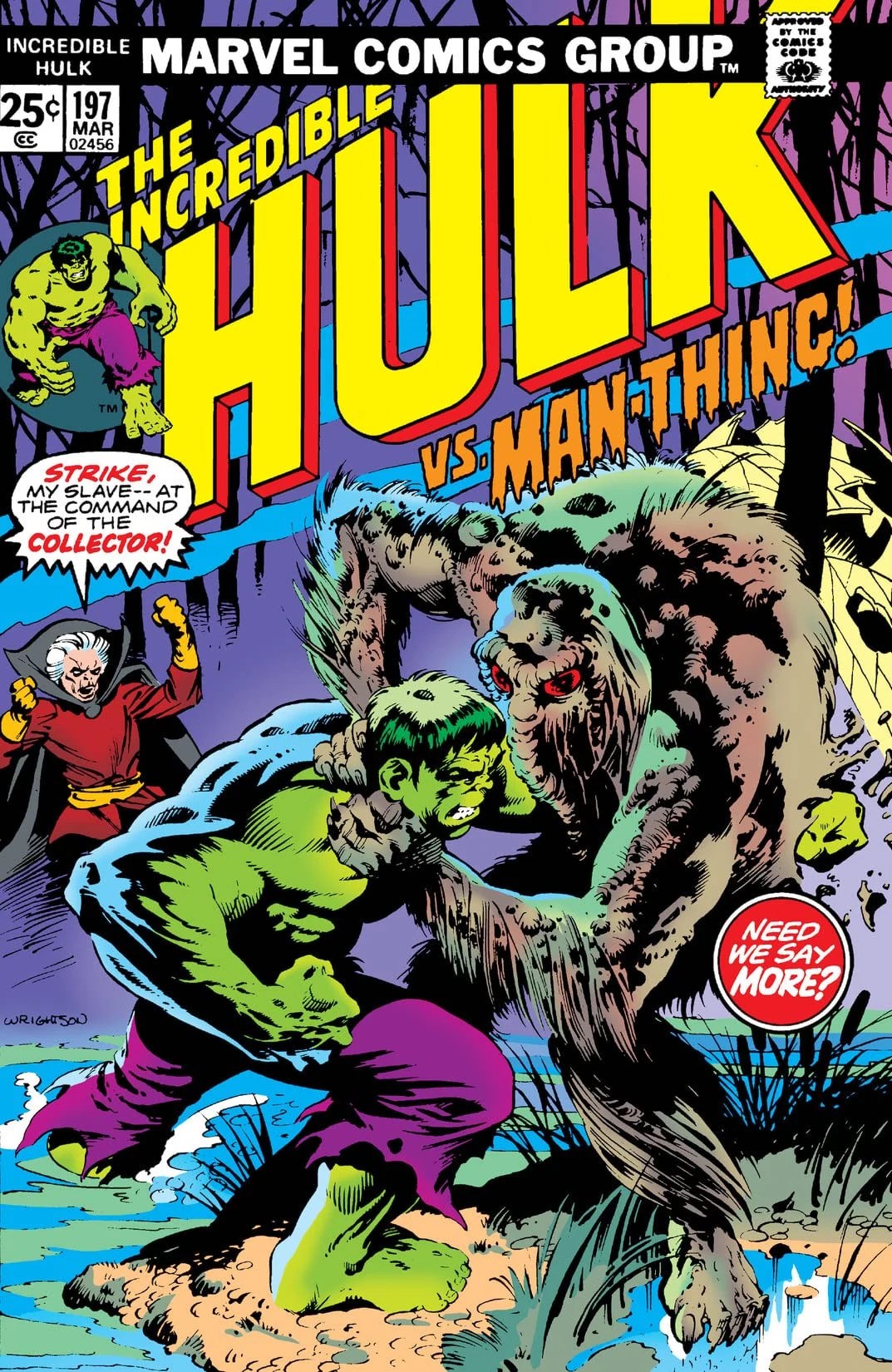 the interval between headlining gigs, his first post-cancellation appearance coming as early as November, 1975, when he joined his fellow homeless horror-lead Morbius, along with the (somewhat) more successful Werewolf by Night, and even Ghost Rider (who was already in the Champions by this time), as “The Legion of Monsters” for their one and only tryout appearance in Marvel Premiere #28 (Feb., 1976). One month later, our guy showed up for a two-issue guest-star stand in Incredible Hulk, the first half of which was graced with a spectacular cover by Bernie Wrightson, the co-creator of Manny’s DC Comics counterpart/rival Swamp Thing. (Swampy’s other co-creator, Len Wein, wrote the story) Immediately after that, the Man-Thing
  teamed up with Iron Man in the latter’s Annual #3 (Jul., 1976), for a story which even offered us a brief glimpse of Richard Rory, still cooling his heels in stir for that kidnapping rap. Would it surprise you to learn that that yarn was written by one Steve Gerber? No, I didn’t think so.
 Steve Gerber actually returned to Man-Thing multiple times throughout the rest of his career, indicating his continued affinity for the character; indeed, the third volume of Man-Thing by Steve Gerber: The Complete Collection devotes over 300 of its almost 400 pages to stories published after the original series’ cancellation. Among its highlights are Howard the Duck #22-23, in which Manny was reunited not only with Howard, but with their old comrades Dakimh, Jennifer Kale, and Korrek, as well. Your humble blogger is very much looking forward to sharing that two-part story with you… but, given that it parodies a certain blockbuster science-fantasy movie set a long time ago, in a galaxy far, far away, I’m sure you’ll understand why that particular piece of personal gratification will have to be delayed for a few years.
Additional cover art credits:
- Marvel Premiere #28 (Feb., 1976) by Nick Cardy.
- Hulk #197 (Mar., 1976) by Bernie Wrightson.
- Iron Man Annual #3 (Jul., 1976) by Rich Buckler and Frank Giacoia.
- Howard the Duck #23 (Apr., 1978) by Gene Colan and Alan Weiss.
*As far as I’ve been able to ascertain, neither Roland Duhl nor Dani Nicolle ever appeared in another comic following Man-Thing #22. Robert Nicolle, on the other hand, was brought back several decades later as a member of a supervillain team, the Unkillables, who appeared in multiple issues of Wolverine:The Best There Is, a series written by Charlie Huston and drawn by Juan Jose Ryp that ran for 12 issues in 2010-2011. Your humble blogger must confess to never having read any issues of that title, but according to the ever-invaluable Appendix to the Handbook of the Marvel Universe the Scavenger gave Logan’s healing factor quite the workout therein.
I really liked this back in 1975.
This was Vertigo before Vertigo was a glimmer in Karen Berger’s eye.
The book had run hot and cold.; You had great stuff like Dakihm stories and the Carnival of Souls story. You had insightful human interest stories like the intro of Richard Rory in #2, Song-Cry of the Living Deadman,” “Candle for Sainte-Cloud,” or the “Dawg” story . But you also had the Fountain of Youth story or the one with the grievously injured Vietnam Vets or the Khords story that were OK or marginal.
But the “Decay Meets the Mad Viking”/Book Burns in Citrusville” Arc and the “Atlanta Arc” were among the best things done in US Comics at that time. None of what Alan Moore was lauded for in the 1980s would have been possible without this stuff.,
This and Gerber’s Defenders shaped my comics sensibilities. This got cancelled, Bill Mantlo’s “Tapping Tommy” story put me off the Defenders.. I thought HTD was good (but REALLY inconstant.
The last Gerber thing I really liked was his three issues of Mr Miracle, where he seemed inspired by what Kirby did with the concept without being mesmerized by it.
He died too young. But as his literary hero Camus wrote of Sisyphus:
“I leave Sisyphus at the foot of the mountain. One always finds one’s burden again. But Sisyphus teaches the higher fidelity that negates the gods and raises rocks. He too concludes that all is well. This universe henceforth without a master seems to him neither sterile nor futile. Each atom of that stone, each mineral flake of that night-filled mountain, in itself, forms a world. The struggle itself toward the heights is enough to fill a man’s heart. One must imagine Sisyphus happy.”
Wonderful overview, Alan, of this final story arc of the first volume of Man-Thing tales. Back in 1975, the only part of this I got was issue 21, which certainly piqued my interest, but I never saw #22 on the racks of the Treasure Island NEX that was my sole comics source at the time. Needless to say, I did eventually fill on all those Gerber Man-Thing shaped holes in my collection. As with a few other comics series or runs of the 1970s that I mostly missed or otherwise didn’t fully appreciate at the time, I later came to regard Gerber’s run on Fear/Man-Thing as one of the highlights of the ’70s and comics in general. When I did finally read MT #22, I was a bit disappointed that such a complex story came to what appeared to be a rushed conclusion, but on the other hand, I still found it enjoyable and was glad it wasn’t left to be completed sometime, somewhere in another title written by someone else (as happened with a few other titles in the era, including the initial run of Warlock and Omega the Unknown).
As to other aspects of these 4 issues, although the costume makes the Scavenger look like a typical super-villain, he was really one of the most horrific villains ever, albeit a sort of twist on Dracula. A couple of weeks ago, I watched a film called Novocaine, starring Jack Quaid (best known for his starring role in The Boys tv series), as a character who, like Robert Nicolle, couldn’t feel pain at all, but wound up using that for more benevolent purposes, albeit without a costume and sort of compelled into action by circumstances and not having any sort of extraordinary healing powers. Not the sort of film that’s going to earn anyone any Oscar nominations and several gross-out scenes, but still reasonably entertaining. And it did remind of the Scavenger.
A more sort of down-to-earth horror was Richard Rory’s dilemma and continued run of rotten luck, even when trying to do the “right thing”. Of course, we readers know that he didn’t “kidnap” Carol at all or have any illicit intent towards her, but too often the law is an ass and applied unjustly, in the real world as much as that of the comics. The Nightmare Boxes were a unique concept, although I wonder if Gerber drew some inspiration for that from Kirby’s Boom Boxes in his 4th World Quartet of series.
Mooney’s art, IMO, was appropriately moody, and I liked his depiction of facial expressions. When I finally did read MT #20, the appearance of the four super-heroes on the cover struck me as odd and I wasn’t the least bit surprised to discover that within the interior of the mag they weren’t the real deal but rather demons who took on the images of various people Manny had encountered during his meanderings, including those particular heroes (but not the very first one he met, Ka-Zar, but I suppose he didn’t have a colorful enough costume and wasn’t popular enough to qualify to try to grab readers’ interest to be worth including him on the cover).
Anyhow, Gerberr’s run of about 35 Man-Thing stories, maybe 37 if the guest-appearances in MTIO and Daredevil are included, made for a pretty wild and unique ride. Many classic tales to fill readers with horror and thought on the human condition and monstrosities who appeared fully human, perhaps even ‘beautiful” as with the unmasked Scavenger, but were truly more horrible than the mis-shapen muck-creature who starred in these stories. Gerber’s own guest-starring role in the concluding chapter sort of made sense as more than most writers, he tended to put many of his own sensibilities and concerns into his stories. Also a sort of call-back to FF#10, among other tales wherein the comics creators show up in their own stories. Although Gerber wasn’t involved in the creation of Man-Thing at all, he unquestionably made Man-Thing his own, as much as Marv Wolfman did with Dracula. Fifty years later, IMO, no one else has quite captured the aspects of this series that made it work for as long as it did. Claremont tried a few years later but couldn’t match Gerber’s quirky imagination. Of course, we would see more of that in Gerber’s other works over the remainder of his life, which itself concluded all too soon. I’m now older than he was at his death, which seems very strange but then there were many other creative people I admire who departed at fairly young ages. And so it goes, as Kurt Vonnegut put it. Au revoir.
“too often the law is an ass and applied unjustly” True, but “I swear I didn’t know she was 17!” is a standard cop-ourt.
Of course, in this case the readers know Rory didn’t know how old she was (although, since she was in high school, he should have guessed, but the circumstances were such that Rory and Carol could justly be regarded as being in a state of shock from seeing just about the entire town go bonkers, behaving like Nazis and cheering the unjustified murder of innocent people. They were escaping a town gone mad. And note, the story was written at a time not much more than 10 years after a period when these same people might have taken part in a lynching or murdering of people of color only on mere suspicion of having either committed some horrible crime or for having tried to exercise their federal constitutional rights.
I loved Gerber’s Marvel work and a little of what he did for DC (I assume their often dictatorial editorial system watered down what made Gerber Gerber) but I hate any story where the writer appears as he did like this.
This one works for me in a way Grant Morrison’s turn in Animal Man didn’t. Probably because Gerber’s only there as eyewitness, and (unlike Morrison) isn’t waffling about how clever his plots are.
This raises the obvious question: if Gerber gets his plots straight from Dakihm, what about Roy Thomas writing the original story? Did Dakihm know back then that Man-Thing needed to have a writer? Or did earlier writers build Man-Thing on tabloid stories about the muck-monster in the Everglades (“Eyewitness sees SHIELD agents battle slime monster!”)?
Excellent review Alan.
A few historical notes: I remember reading an interview with Steve Gerber from about 20 years ago, where he revealed that he had intended for this story to run for 5 issues. But he was told MT 22 would be the final issue so he did what he could to wrap up the story as quickly as possible. I suspect this is why MT 22 feels very rushed and why there are the text pieces and why we never see any real resolution regarding the Scavenger or Dani which possibly would have been in the fifth chapter. Oh well…at least Steve got to resolve the storyline as much as he could. Marvel used to cancel comics mid storyline… Remember what happened to the first Warlock series? Cancelled with number 8 mid story and it took nearly a year to resolve that in another series. And that often happened unfortunately.
Roy Thomas noted in an interview some years ago that in 1974 Man-Thing was one of Marvel’s biggest sellers, not only in their top 10 but actually top 5. So what happened? I have a vague memory that it may have been in the letters page of Tomb of Dracula around this time that Marv Wolfman stated that “the craze (horror comics) has fled us”. Marv made various cosmetic changes to Tomb of Dracula, changing the logo, having Gene Colan handle covers and stating TOD was “Comic’s Number One Fear Magazine”. Did that help? Hard to say but Tomb of Dracula did stay monthly for another 2 years. In the meantime, Werewolf by Night went bimonthly as of August 1975 (and as noted would be cancelled a little over a year later), and Man-Wolf, Frankenstein Monster, Living Mummy, Morbius and Man-Thing were all cancelled, as were all 4 of the black and white horror magazines launched with such fanfare in 1973, as well as Haunt of Horror. I tried to figure out what would have caused the downturn for the Man-Thing series. Was it the loss of Mike Ploog? The series had some perfectly fine artists after Ploog, including Marvel’s top artist at the time John Buscema. Jim Mooney did some really fine work on this series. So I guess the only conclusion is that the bottom really did fall out regarding horror series. Marvel did try to give Man-Thing another shot in 1979 as a bi-monthly series, but it did not work out. Michael Fleisher and Chris Claremont tried, and I read those issues, but their work while competent was just not as good or interesting or original as Gerber. Maybe Gerber was the only one who could get a handle on Man-Thing which was a difficult series and character to write.
By the way, while I read and liked MT 19-22, I didn’t think it was nearly as good as 16-18, and was struck by how cruel Gerber was to Richard Rory in MT 20. He actually had Rory go to jail and serve time for something that was really not his fault (although yes he was shown to be pretty foolish for taking Carol with him).
Regarding Son of Satan, it appears that an editorial decision was made by Len or Marv or both that Marvel Spotlight and Marvel Premiere should be more like a “Showcase” style series and constantly have different new features. Presumably the sales of Son of Satan and Iron Fist justified being spun off into their own series. Iron Fist 1 appeared in August 1975 and Son of Satan 1 appeared in September 1975. I remember being disappointed that Gerber did not write SOS 1. Jim Mooney drew that issue. I decided not to continue buying the series which was written mainly by John Warner. Nothing against him but it just did not interest me. I looked up the rest of the series on the Grand Comics Database and noticed it did seem to have more of a horror focus which is probably why the series only lasted about a year and was cancelled by the end of 1976.
The last regular issue of Tomb of Dracula appeared in January 1979. Marv Wolfman had actually written 3 more issues that were to be TOD 70-72, but Marvel was not planning to publish them. Marv was finally able to convince Jim Shooter to publish the equivalent of an annual which became the double sized TOD 70 in May 1979. Marv had to cut out 14 pages of material already drawn by Gene Colan, but at least was able to publish a finale for Tomb of Dracula. And so the horror comics of the 70s came to an end (yes I know the Man-Thing was revived later in 1979 but I don’t really count that).
Did I realize at this time (July 1975) that this was the last issue of Man-Thing? I guess so. The cover certainly hinted that. I think I was more sad that I wouldn’t see further stories of this character by Steve Gerber. I have to admit that I never felt very strongly about the Man-Thing character (never as interesting as the counterpart Swamp Thing, whose series I dropped after Wrightson’s departure). But I did read the entire series and all the giant size issues and all of Gerber’s work which was usually entertaining and interesting. I had no idea that Gerber still had more interesting stories to tell in Defenders, Omega, Howard the Duck and Guardians of the Galaxy. Thanks Alan!
Claremont’s approach to characterization (at least by the time he started writing it) didn’t allow for the kind of quirkiness and unpleasantness that made Gerber’s work memorable.
I had a spawn in my nethers once. Fortunately, they gave me a cream and it went away in about a week. (Thanks, I’ll be here all week. Tip the waitstaff. Try the veal)…
Actually, as I believe I’ve pointed out in the past, I dislike any comic where the main character doesn’t have his own distinctive POV. Man-Thing, Swamp Thing (before Moore) and several other horror characters fit into this mold and I never cared for them b/c you never really knew what the main character was thinking about what was going on in his/her own book and that made me nuts as a reader and felt like a disservice to the character. As a result, I don’t think I’ve ever read a single Man-Thing story other than the ones you’ve deconstructed here, Alan. Not unless it was a team-up in someone else’s mag, I guess. And I don’t really feel like I’ve missed that much. Gerber was a great writer, whose work I enjoyed for the most part, but even after fifty years, with all the wisdom and insight that implies, I still don’t understand what the rest of you are going on about, talking about how great Gerber’s run on this book was.
This is the one time you can really tell that Gerber was making this stuff up as he went. The character development is minimal in the beginning, and even though the pay-off can sometimes make it work, the short term effect of characters like Scavenger and Dani Nicolle and even to an extent Richard and Carol, because their characters are never fleshed out and we seldom get a real reason to care about them, feels unfinished and rushed. What little I knew of Richard Rory fifty years ago, sounded like a Rick Jones wannabe and why would anyone want that? We already HAD a Rick Jones. Why did we need another one? And the way Gerber would write one of these characters only for as long as we needed them and then abandon them to whatever limbo happened to be handy at the time, felt lazy and like poor writing to me. THOG sounded like something you’d say if you were trying to say “THOR,” and choked on the last letter. I dunno. I’m willing to accept the fact that you guys are seeing something I don’t, but I have no idea what it is…and I guess I never will. Thanks, Alan.
I can understand your perspective on the series, Don, although I’m not so particular myself on expecting certain things in every comic, aside from a reasonably good story and art. That the star of the mag, Man-Thing, was such a limited character in that he had no coherent thoughts and couldn’t speak at all didn’t bother me because Gerber used him as a catalyst in a wide variety of stories that I found interesting, often relating to social concerns that are still with us today, including pollution, environmental destruction, racism, religious extremism, misplaced jealousy, individualism existential angst and nihilism, to name a few. Not every story worked well, but I think most did.
Although I didn’t think all that deeply about why I mostly quit collecting comics in the mid-80s, in reflection one aspect that struck me was that I could tell that all the characters I’d grown to love reading about in the 1970s were either becoming too static or changing in ways that didn’t appeal to me. But then, that’s the nature of fictional characters in series that last for decades. Especially back then, for the most part they could grow or mature so much, because they couldn’t become too old and rarely were they allowed to change significantly, although I know that did happen in later years with several characters, such as the Hulk developing different personas, Peter Parker marrying, Tony Stark’s long bout with alcoholism, the Vision being entirely dismantled and restored with a far more robotic personality. Still many great stories and great runs, but also a lot of dreck, and trying to keep up with so much was becoming draining to me. Obviously, I didn’t entirely lose interest, but my comics buying dropped considerably.
Man-Thing, by his very nature, couldn’t change that much but as written by Gerber, he reacted to extreme emotions but somehow only harmed those who also happened to be evil so he himself wasn’t the sort of evil monster like Dracula or even the Werewolf, who generally posed more of a threat to innocent people although I don’t recall that he was actually shown doing so (but I only have about 10 or so issues of his series, so maybe that happened in issues I didn’t get). But Gerber did create many interesting characters with unique personalities in his stories. Yeah, a few were akin to old EC O. Henry style morality plays with twist endings.
Anyhow, as Sly Stone sang long ago, “different strokes for different folks.” One of my roommates from back in the late 1980s loved rap, which I couldn’t stand, and he couldn’t suss the sort of music that I liked. And as an adult, I’ve had very few friends I knew personally who shared my interest in comics — one of them loved underground comics, particularly those of Robert Crumb and Harvey Pekar, but hated superhero comics, insistent that they were a form of propaganda for vigilantism and fascist domination, which I find peculiar, although I could partially understand where he was coming from with only a superficial knowledge of the genre.
As I put it at Atomic Junk Shop (https://atomicjunkshop.com/a-supporting-actor-in-his-own-book-reading-the-essential-man-thing/), Manny was a supporting actor in his own book. That worked great most of the time, but then we got things like the whiny OMG My Soul SUFFFFFEEEERS! writer in #12. But hey, no book works all the time.
He is almost exactly both a “Greek Chorus” AND a “:Deus ex machina” He both comments on what he perceives and is a plot device.
Another point that may be worth making here is that the representations of comic-book stories one finds on this blog aren’t the “real”, complete stories. As generous as the scan-to-synopsis ratios tend to be (for better or worse), these are ultimately abridged versions, or, if you prefer, very detailed reviews, in which the “pure” content has been inevitably altered by my critical and editorial choices. While it may be unlikely that Don would have liked Gerber’s “Man-Thing” better if he’d encountered it in its original form, it’s at least a possibility, or so it seems to me.
How does Swamp Thing not have his own perspective? He’s always sharing it (to use Fred Hembeck’s words) “crusty yellow thought balloons.”
I agree Thog is an uninspired demon name.
Richard Rory is appealing precisely because he’s not Rick. Rick hangs out with Hulk, Cap, Avengers, Mar-Vell; Rory hangs out with a walking pile of mud.
. . . and somewhat Daredevil and (sort of_ Omega. the Unknown (may be the term is “Omega adjacent”).
Now I’m wondering if Richard Rory has appeared anywhere since showing up in Omega the Unknown volume 1? Suddenly a bizarre idea popped into my head of a series featuring several minor supporting characters who went into comic limbo during the 1970s showing up again 45 to 50 years older and remembering the Marvel Comics universe as it was back then and trying to figure out how all the superheroes who remained active between then and now somehow avoided getting older and have no memory of even being alive during the 1970s, aside from maybe Wolverine and Thor. Yeah, a very silly idea but gave me a giggle.
Rich Rory’s post-Omega (and post-Gerber) appearances seem to have been primarily in the pages of “Savage She-Hulk” — which brought him a good bit closer to being a “Rick Jones” analogue than his creator is likely to have ever imagined. http://www.marvunapp.com/Appendix7/roryrichardmt.htm
I like this idea, though it would be tricky to make it work.
I bought this one at the time (Mill Road News, Cleethorpes, of blessed memory). I was 13. Reading it was a mind blowing experience. Still love it today.
These are my favourite Man-Thing issues. Odd, quirky, troubling, never run of the mill. Really brought the best out of Mooney. And shortly Gerber and Mooney would return with the equally quirky take on Shazam, Omega the Unknown. By the way Alan you forgot to mention Gerber and Starlin’s Man-Thing story from Rampaging Hulk #7. I remember enjoying that.
I wouldn’t say I “forgot” to mention that Rampaging Hulk story, Spirit — it’s included in that statement that I made about how “the third volume of Man-Thing by Steve Gerber: The Complete Collection devotes over 300 of its almost 400 pages to stories published after the original series’ cancellation”. I couldn’t very well call out *all* of those stories individually without making this already fairly long post longer still. 🙂
Man-Thing was way more interesting than I thought at the time. Flipping through issues didn’t give me enough exposure to appreciate the content. This wrap-up was impressive, if rushed.
I wonder if Scavenger inspired David Reed’s “Skull” Dugger in Batman 289 — an anhedonic who uses a ray to siphon joy out of people for him to feel, even though it kills them in the process.
The discussion here reminds me of one of the problems I had with Alex Segura’s Secret Identity, set at an Atlas-like startup in the mid-1970s. References to classic characters like Spidey but no awareness of all the wild work being done in the Bronze Age (Swamp Thing, Man-Thing, Warlock, Engelhart’s Dr. Strange). The follow-up volume, Alter Ego, mentions a (fictitious) series having a ghost as a recurring character as if that was some daring break from the usual crimefighting books.
Hi, Alan,
I so enjoyed this book for its unpredictability. Would it be fantasy? Social satire? Quirky character study? Some combination thereof? I remember people being surprised by GIANT-SIZE MAN THING #2 because Man-Thing was actually the focus of the story.
A lot of credit should go to Jim Mooney, whose career included Tommy Tomorrow in the 1950s and 1960s, Supergirl, and a lot of other “straight-arrow” superheroes. To go from that to Steve Gerber weirdness without skipping a beat is pretty impressive.
At his best (which definitely includes this title – pace, Don Goodrum), Gerber found ways to explore offbeat characterizations and unusual themes within the confines of comic books. In fact, one of the reasons why I cherished his work and that of others (Englehart, McGregor, et al.) was the fact that they were able to maintain an authorial voice, even when writing characters created by others. You could tell a Gerber story from an Englehart story not just by the plotting but by the specifics of word choice, rhythms of the language, and all those other things that an English major like me adored (even though I was six years away from my degree in 1975).
I hadn’t known that this was intended to go at least one issue more, and I like to think Gerber would have been able to have some kind of closure for Carol and the other characters. (Alan, you left off one panel where Carol says she feels weird that Richard seems to be looking at her, and Richard says he’s NOT looking at her – he’s picturing himself in prison.
Speaking of which I’m glad you mentioned that IRON MAN Annual, which was delightfully crazy. That book was also noteworthy for returning Richard Rory, albeit in prison garb.
Even with the cancellation of this title, Though, Gerber would still be hanging around for a while to deliver his idiosyncratic stories, and I like to think that I never took him for granted. RIP, Steve!
Another aspect of the writing of Gerber, Englehart, MacGregor, Starlin, etc., was their unique perspectives on various aspects of society. So much has changed over the last 50 years, but still, many of the concerns they addressed back then are still with us, even if some details are different. And there are still plenty of crazy and excessively greedy people.
While I agree that “Thog” does not seem to be a clever name, this might be purely coincidental, but when I read it this time around, I thought that the name is an anagram of “Goth”. I also noticed that “Roland Duhl” might, aside from the obvious meaning in the last name, be deliberately similar to the author Roald Dahl, who I would not be surprised if he was one of Gerber’s favorite authors.