
The cover of this issue of Conan the Barbarian, as produced by the art team of Gil Kane and Vince Colletta, is unquestionably a solid piece of work; if it has any real flaw, it’s that it’s a little generic. Yes, Conan is shown holding a length of chain in one hand, which at least vaguely nods to the “A Barbarian Chained!” title blurb at the cover’s bottom (and, for the record, we will indeed see our hero so bound before this issue’s story is over and done). But other than that, it’s just a generic Conan illustration, which could have appeared anywhere, anytime, over the past several years of the title’s run, and has little true relation to this specific issue’s contents.
But, in a way, that was an appropriate choice, back in September,1975. Conan the Barbarian was at this time on the verge of making a major shift in direction, setting a new course that the series would henceforth follow all the way through issue #100, published more than three and a half years later. So the cover of Conan #57 could be taken as a capper for the entire run up to this point — a run that as recently as the past year (the last for which the Academy of Comic Book Arts’ “Shazam” Awards were given) had been deemed “Best Continuing Feature” — a fact the cover itself proudly proclaims. In that sense, this cover serves not only (or even primarily) to promote the single story contained within the comic’s pages, but to commemorate this whole era of the series… what we might call “Conan the Barbarian B.B.”.

Art by John Buscema and John Romita.

Art by Marie Severin, John Buscema, and Ernie Chan.
That’s “B.B.” as in “Before Bêlit” — Bêlit being the she-pirate who would become Conan’s partner in both love and adventure beginning with the following issue’s adaptation of the first part of Robert E. Howard’s 1934 short story “Queen of the Black Coast” (available to read for free here)… and ending with the adaptation of the conclusion of that story in Conan the Barbarian #100 (Jul., 1979).
As we’ve discussed in several previous posts, Conan writer (and editor) Roy Thomas had decided very early on that the internal chronology of the barbarian hero’s color comics series would proceed more or less in “real time”, with each year of publication roughly corresponding to an equivalent year in Conan’s life. Based on the quasi-official timeline that had been developed around 1936 by a couple of early Conan fans (and subsequently acknowledged by the aforementioned Robert E. Howard, the character’s creator), Conan was supposed to first hook up with Bêlit around the age of twenty-three, and then remain with her for at least a couple of years after that. Thomas’ scripting of the monthly series, which had of late alternated between his own original stories and adaptations — both of non-Conan tales by Howard and of sword-and-sorcery fiction by other, Howard-inspired authors like Gardner Fox — had now reached that point in the fictional timeline.
Most comics writers might well have made a modest effort to get Conan into the general vicinity of where we find him at the beginning of Howard’s story — i.e., a seaport in the country of Argos — prior to the launch of Marvel’s adaptation of “Queen of the Black Coast”, and, having accomplished that, happily called it a day. But Roy Thomas was a different sort of writer. His work on Conan was consistently distinguished by its attempt to provide the sense of following “a man’s whole life” (as Thomas himself puts it in his book Barbarian Life: A Literary Biography of Conan the Barbarian, Volume Two [Pulp Hero Press, 2019]), rather than just presenting a series of unconnected adventures. And so, he took pains to integrate Howard’s original Conan stories as seamlessly as possible into the tapestry of original and adapted tales that made up the rest of the content in Marvel’s Conan comics, which at this point included the black-and-white Savage Sword of Conan as well as the color Conan the Barbarian title.

Cover to Conan the Barbarian #11 (Nov., 1971). Art by Barry Windsor-Smith.
The template for Thomas’ approach had been set in the earliest days of Conan at Marvel, when the writer and artist Barry Windsor-Smith had led into their adaptation of Howard’s “Rogues in the House” by introducing a seemingly one-off, unrelated character in Conan the Barbarian #6, following that in issue #8 with the debut of another, also evidently one-and-done character — and then brought those two characters together in issue #10, where they slipped into the roles of a couple of previously unnamed figures from “Rogues”, which was itself ultimately adapted in full in Conan #11. The effect was to make Howard’s 1934 yarn feel as natural a part the ongoing continuity of Marvel’s Conan series as if Thomas and Windsor-Smith had created it from scratch.
As we’ll see in this post, Thomas’ approach to setting up “Queen of the Black Coast” follows this model quite closely. In the first few pages of the original story. the hero offers an account of the events immediately prior to its opening, mentioning (among other things) a certain “young soldier” he considers a friend, as well as that soldier’s “sweetheart”. Never named in Howard’s text — and not actually making an appearance outside of Conan’s oral chronicle — both of these characters would be added to the monthly Conan title’s supporting cast in the months leading up to the beginning of the Bêlit storyline.
The “sweetheart” actually appeared first — and was introduced in such fashion that it probably set off few if any bells among those Conan comics readers of 1975 who were already familiar with Howard’s “Queen”. In issue #52, the Cimmerian adventurer arrives in the Nemedian city of Belverus, seeking employment as a mercenary, and almost immediately encounters an acrobatic young street performer. Originally assuming the youth to be a boy, Conan is quickly disabused of this notion when the performer’s cap is dislodged in the midst of an altercation with some unfriendly soldiers (art by John Buscema and Tom Palmer, here and in succeeding panels)…

The girl, whose name is Tara, soon attaches herself to Conan as his unasked-for “squire”, even as he himself joins up with a mercenary band called the Crimson Company. That change in our hero’s current status allows Thomas to foreshadow “Queen of the Black Coast” in another (and rather more obvious) way than the introduction of Tara (who hardly seems likely to become anyone’s sweetheart at this point). In that story, Howard offers the following very specific description of Conan’s attire:
…a black scale-mail hauberk, burnished greaves and a blue-steel helmet from which jutted bull’s horns highly polished. From the mailed shoulders fell the scarlet cloak, blowing in the sea-wind. A broad shagreen belt with a golden buckle held the scabbard of the broadsword he bore…
Impressive, but hardly in keeping with the bare-torsoed look Conan generally sported in Marvel’s comics. And so…

Even the dialogue describing the armor’s provenance, as spoken by the curly-haired gentleman we see sparring with Conan (and with Tara, too, if only verbally) in the splash panel above comes directly from a later passage in “Queen of the Black Coast” (although there, it’s implied that Conan has pieced the ensemble together himself over the course of his extensive travels; a notion that clearly wouldn’t have jibed with the continuity of Marvel’s comics series):
Young in years, he was hardened in warfare and wandering, and his sojourns in many lands were evident in his apparel. His horned helmet was such as was worn by the golden-haired Aesir of Nordheim; his hauberk and greaves were of the finest workmanship of Koth; the fine ring-mail which sheathed his arms and legs was of Nemedia; the blade at his girdle was a great Aquilonian broadsword; and his gorgeous scarlet cloak could have been spun nowhere but in Ophir.
(Note that, in Howard’s prose, Conan’s arms and legs are covered by mail, as well as his torso. Which goes to show that for all of Thomas’ attention to fidelity, he was prepared to take artistic liberties — or at least to let John Buscema take them. Or maybe he just missed that bit, although that seems unlikely.)
Incidentally, that curly-haired gent — Murilo, the commander of the Crimson Company — had previously appeared in Conan #11 — which, as noted previously, was based on Robert E. Howard’s “Rogues in the House”. His return for this storyline thus not only provides some connective tissue with past comic-book continuity, but also establishes a link between two of Howard’s original Conan stories which the author himself is highly unlikely to have ever imagined.
Over the next three issues, Conan, Tara, Murilo, and the rest of the Crimson Company become involved in the ongoing rivalry between three Ophirean city-states — a rivalry which, as Conan’s adventures almost always do, ultimately drags in multiple supernatural elements, including a giant shadow-demon and an equally outsized scorpion-god. Towards the end of the storyline’s second chapter in issue #53, we meet a young soldier of the Crimson Cavalry named Yusef — the only survivor of an encounter with that very shadow-demon — although his full significance to the plot won’t be evident until the following issue, when he reports his misfortune to his comrades — and begins to interact regularly with both Conan and Tara…

Wouldn’t you just know it — Tara (whose leaping and kicking abilities have, incidentally, proved surprisingly useful in a world of swords and sorcery) somehow gets it into her head that, having managed to escape being slaughtered by a giant monster by the entirely rational act of fleeing from it, Yusef must be a coward. But the cavalryman manages to change the acrobat’s mind over the course of the story’s concluding chapter in Conan #55, when they and the rest of the Crimson Company, not to mention the city they’ve been hired to protect, almost fall to the shadow-demon…

And then, after all the storyline’s threads have been neatly tied up, Conan makes a decision…

Our trio of adventurers makes one danger-filled stop on the way to Argos, chronicled in issue #56, and then it’s on to #57… which, as you’ll be able to see below, features the work of an unexpected guest artist: Mike Ploog.

Cover to Kull the Destroyer #11 (Nov., 1973). Art by Mike Ploog.
Ploog — whose most regular gig at Marvel at this time was the “Terror on the Planet of the Apes” serial that ran in most issues of the black-and-white Planet of the Apes magazine — hadn’t drawn Conan prior to this, although he had pulled a stint on Marvel’s now-moribund comic about that other Robert E. Howard-created barbarian, King Kull, a couple of years earlier. With this issue, he joined the very small fraternity of artists who had thus far pencilled the lead story in an issue of Conan the Barbarian; besides Barry Windsor-Smith and John Buscema, the only other members of that group were Gil Kane (who’d drawn issues #17 and #18) Neal Adams (who’d provided full art for #37) and Rich Buckler (who’d pencilled #40).
Ploog brought as distinctive a look to Conan and his world as any artist to date, with an approach that evoked the raw power of Buscema, the dynamism of Kane, and the exotic atmosphere of Windsor-Smith, while also adding an exaggerated expressiveness — call it “cartooniness”, if you must — that was new to the title, if not the genre. Alas, this would prove to be the one and only time Mike Ploog would draw a Conan comics story (though he’d return to Kull one last time, for a single story in the b&w Savage Sword); nevertheless, I’m grateful we at least got what we did… especially so since the artist was able to ink his own pencils for this job, which almost always made for superior results than when his work was finished by someone else.

As the blurb at the bottom right-hand corner of this opening splash page indicates, “Incident at Argos” (an accurate title, though one can understand why Marvel opted to use “A Barbarian Chained!” as the title for the cover blurb, instead) has been “freely adapted from an episode by Robert E. Howard”. Said episode is in fact the very account of recent events that Conan offers in the opening scene of “Queen of the Black Coast” — the one that’s already inspired Roy Thomas’ creation of the “young soldier” Yusef and his “sweetheart” Tara. Your humble blogger looks forward to sharing that account with you in full, in its original, Howard-penned prose (though not until much later in the post, for reasons I hope are obvious).

Conan’s irritation at not finding a war brewing in Argos may be understandable, but it’s clearly unfair of him to take it out on this poor citizen, who quite understandably would prefer to live in peace. (Besides which, whose idea was it to leave the comfortable employ of Murilo in the first place, hmm?) At least Thomas allows Tara and Yusef to call their friend out on it…


Despite her continued protests, Tara is carried off against her will to a nearby clothier, in a sequence that’s supposed to be funny (and probably was to my eighteen-year-old self, if I’m going to be honest), but hasn’t aged very well. Once they arrive, the acrobat finally acquiesces, and soon enough..

Other than the mail missing from his arms and legs, the only items of Conan’s attire as described by Robert E. Howard in “Queen of the Black Coast” that haven’t yet been accounted for by Roy Thomas and company are his greaves. But, with the very next panel, that’s about to change…

Why is Cicero’s fellow guard pleased that Conan has merely been knocked out, rather than killed? Because there’s a black market in Argos for big, strong strangers — and one of the other people in on it is Publio, the merchant that Yusef had earlier suggested their little group might approach about local employment opportunities. Oh, the irony,,,

Conan keeps surreptitiously working away at his bonds, and a little later, while the two crooked guardsmen are hauling what they believe to be a helpless (not to mention unconscious) prisoner to the docks, he breaks free, quickly sending both of his captors reeling. The scuffle hasn’t gone unobserved, however…


The visions that Momratha shows Conan in this scene (which has no counterpart in this story’s Howardian source text) do more than allow Mike Ploog to deliver his own take on such iconic scenes from our hero’s future career as his crucifixion — they also provide the opportunity to include a supernatural element, without which this particular “episode” would be all swords, no sorcery. (Roy Thomas generally tried to avoid letting that happen, although he was willing to make exceptions — and would in fact do so in the very next issue).


Conan is swiftly clapped in chains (see? what’d I tell you?), and, on the following day, is brought before Ephemero Portus — a magistrate whom one of Conan’s guards smugly tells him is known locally as “the maiming judge”…


Conan may be outnumbered, but he has the high ground; and his opponents soon fall back before his ferocity, calling for archers…

The detail of the judge’s ring is another element that’s original to “Incident in Argos”, rather than having been drawn directly from Robert E. Howard’s account of these events in “Queen of the Black Coast”. Recalling the creative decision-making involved decades later for Barbarian Life, Vol. 2, Roy Thomas admitted that he had some regrets about the addition, saying that he’d “copped out”. As the author went on to explain:
I wasn’t 100% comfortable with the notion of Conan simply killing a judge who is going to clap him into prison (and relegate him thus to torture) because he won’t turn state’s evidence, so I made the judge a secret criminal, as well.
Not that that might fully exonerate Conan in terms of motive, because the Cimmerian never notices that ring, and it has nothing whatever to do with why he slays the judge. It’s just dumb luck that Conan kills a fully bad man instead of merely a stern judge. In a sense, I suppose, it’s what the post-WWII philosophers would have called an “existential” death: the judge deserves to die because he is guilty of something, even if he’s killed for the “wrong reason.”
Not that I was consciously thinking of existential philosophy when I gave the plot to Mike. I was just looking for a way to hedge my bets, and to keep Conan from looking like a wanton murderer — if not to the mass of readers, then at least to the Comics Code people who would be passing judgment on the issue before it was printed, and who could have made me change that scene.

With the above panel, Tara and Yusef exit the regular supporting cast of Conan the Barbarian… although this isn’t quite their last appearance in the series. (While I’m tempted to tell you just where they fetch up, there’s a good chance that I’ll be writing a post about that issue, so we’ll save the details for now.)

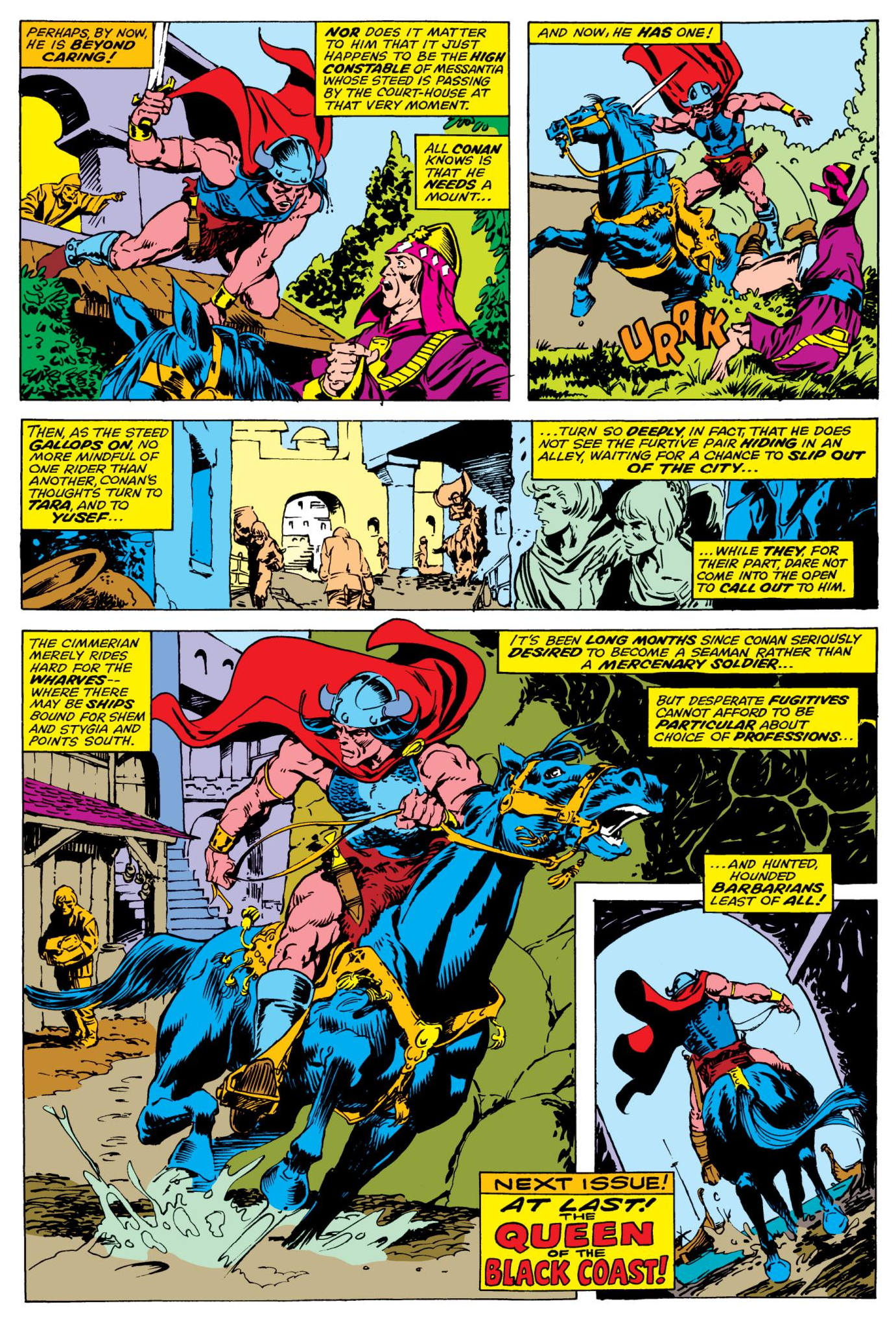
And with that, Conan rides out of “Incident in Argos”, and straight into the opening scene of “Queen of the Black Coast” — in both its prose and comics versions. But before we close out this post, here, as promised, is the passage from the original story on which the comic we just finished with was based. (The speaker is of course Conan himself; as to who’s on the receiving end of this monologue, you”ll have to wait until October to find out, sorry.)
“Well, last night in a tavern, a captain in the king’s guard offered violence to the sweetheart of a young soldier, who naturally ran him through. But it seems there is some cursed law against killing guardsmen, and the boy and his girl fled away. It was bruited about that I was seen with them, and so today I was haled into court, and a judge asked me where the lad had gone. I replied that since he was a friend of mine, I could not betray him. Then the court waxed wroth, and the judge talked a great deal about my duty to the state, and society, and other things I did not understand, and bade me tell where my friend had flown. By this time I was becoming wrathful myself, for I had explained my position.
“But I choked my ire and held my peace, and the judge squalled that I had shown contempt for the court, and that I should be hurled into a dungeon to rot until I betrayed my friend. So then, seeing they were all mad, I drew my sword and cleft the judge’s skull; then I cut my way out of the court, and seeing the high constable’s stallion tied near by, I rode for the wharfs, where I thought to find a ship bound for foreign ports.”
And there you have it. And, now that you do, it’s time to take our leave of our favorite barbarian, at least until next month’s look at Conan the Barbarian #58. I look forward to seeing you then.
Hi Alan,
Posts like this are why I so appreciate your blog. Not just for the chance to revisit fondly remembered stories (usually written by guys named Steve) but also to take a look at those books that never caught my attention. That most definitely includes CONAN THE BARBARIAN, a title I could never really warm up to despite having one of Marvel’s more literate scripters at the helm and despite a Murderers Row of artists illustrating the adventures. Despite being something of a Marvel junkie at this time, I just could never warm up to the sword-and-sorcery books (before you ask, that includes the four-issue sting by my man Steve Englehart on KULL). Was it the high testosterone level? The rather causal approach to a high body count? The fact that Conan himself never did it for me? I can’t pin it down, even after 50-plus years.
But most times, my exposure was limited to looking at a new issue, reading the first couple of pages, and then returning it to the spinner rack at either Marty’s or Zenelli’s (the two drugstores in Dover, NJ, where I bought my comics). I would later go back and actually buy, as back issues, #18 through 26, so I could see, in context, the “Song of Red Sonja” story that seemed to have cleaned up the awards at the time. I also got #37 for the obvious reason of Neal Adams. But none of them stuck with me the way the contemporaneous issues of, say DR. STRANGE or MAN-THING did.
Your take on this issue sorta confirms my feeling. I actually remember hearing that Ploog was illustrating this story, which intrigued me because I thought his work on the PLANET OF THE APES black-and-white book was top-notch. And I did actually take a look at this book when I saw it on the stands. I can now appreciate the wit in Thomas’ script, and the art really is cool, despite being so different from the Smith/Buscema/Adams work that I had previously seen. But nah – your take on these stories is good enough for me. I don’t feel I missed all that much. It is fun to look back on those days, though, when the writers could cram a pretty decent amount of story into 17 pages. I can see somebody today turning this one issue into possibly a two-parter, possibly ending the second part with a dramatic introduction of Belit.
Cheers!
I own a few of the Barry (Windsor-)Smith issues of Conan, the Neal Adams/Crusty Bunkers issues (including the comic book & record), and the magazines their work appeared in. I also have the Marvel Treasury Edition that reprints “Red Nails” with added color.
Though I like Conan, I felt, even in the 1970s, that it was a bit of a one-note storyline. Conan would more often than not meet a beautiful, but elusive young lady, a rival and/or chum, a sinister sorcerer, an evil wizard and/or despot of high or low standing, and some sort of supernatural creature(s).
When I actually sat down to read any of these I enjoyed them as individual stories, but to “binge watch” made their redundancy all too apparent.
I still like Conan, though.
You sound a lot like Robert Bloch in a letter to *Weird Tales*
A Crack At Conan
Conan is rapidly becoming a stereotyped hero, but I was greatly pleased with Francis Flagg, a real writer, with something to say. I am awfully tired of poor old Conan the Cluck, who for the past fifteen issues has every month slain a new wizard, tackled a new monster, come to a violent sudden end that was averted (incredibly enough!) in just the nick of time, and won a new girlfriend, each of whose penchant for nudism won her a place of honor, either on the cover or on the inner illustration. Such has been Conan’s history, and from the realms of the Kushites to the lands of Aquilonia, from the shores of the Shemites to the palaces of Dyme-Novell-Bolonia, I cry: “Enough of this brute and his iron-thewed sword-thrusts-may he be sent to Valhalla to cut out paper dolls.” I would like to see the above tirade in print—I feel sure that many of your other readers would support me—at least there is good material there for an arguement.
Between Conan and Solomon Kane, I would choose Kane; however, when I actually read the collected Conan stories, I finished them very impressed.
Could Mike Grell have unconsciously been thinking of this period in the Cimmerian’s career with the Warlord? Travis Morgan’s beloved is named Tara, and the son they have together is Joshua, which is Yusha in Arabic. That’s pretty close to Yusef, although the precise equivalent would be Joseph.
There you have it! I’m sure many other noticed it, too.
This may be why I was so fond of Sword of Sorcery at DC—it only lasted for five issues and didn’t have time to wear out its welcome. Likewise with Atlas’ Wulf the Barbarian (the first two issues anyway).
But Conan has endured across the decades in his comics incarnation, so there is obviously a market, even within the narrow parameters of his genre.
I was a huge fan of the Marvel version of Conan even before I came across the wonderful Robert E Howard originals. I loved the Buscema art on the book but this Ploog drawn issue is an absolute gem. The way Thomas weaves this story into the REH adaptation in the next issue is also masterful.
In answer to some of the comments above – sure, sword and sorcery had its tropes, but so did most of the superhero books of the day. The endlessly recycled stories found in Spider Man, FF, and Thor at this time are a good case in point. At least with the Thomas Conan there was a sense of progression. Roy’s decision to unfold the saga in real time was a sound one. After Roy, the book fell into total repetition and monotony, but 1970 to 1980 was a golden age for Conan comics and this issue is an excellent example.
In general, I think any argument “it’s the same thing over and over!” and “all the characters in this genre are interchangeable” is a sign someone’s predisposed to dislike the genre rather than the prime reason. Someone who likes superheroes/hardboiled PIs/sword-and-sorcery heroes will perceive more variation, or else enjoy the familiarity of the stories.
I, for example, think all games in any given sport are just like every other game but obviously to fans there’s a lot more going on than I perceive.
With super-heroes like the Fantastic Four, for instance, you have them interacting with one another, and not always on a friendly note, and then the love interests like Alicia Masters or Crystal of the Inhumans. Then, besides an array of super villains, there are many different *locations* to explore, whether on or within the Baxter Building, in NYC in general, or other parts of earth, or the negative zone, or other planets, etc.
Far, far greater diversity than what Conan offered, being locked into the Hyperborean age with a mashup of pseudo-medieval architecture and fashions (though, ironically, his era was supposed to be much earlier). Like I said, I own a lot of these Conan comics and magazines and enjoy them, but the monotony of settings and scenarios is undeniable.
Here we are, 55 years after Conan’s premiere issue, and the character is still in print. If the fans didn’t buy it, he wouldn’t be. The formula works. I like it, but in small doses, that’s all.
Correction: Robert E. Howard created the fictional Hyborian age for his Conan stories. The Hyperborean age has to do with ancient Greeks.
My bad. I don’t think I expressed myself very well. I agree with you about the concepts and characters of the Marvel superheroes being varied, at least at first. For example, Kirby came up with a wealth of great ideas during his time on the FF. But in the 70s these were being repeated ad nauseum. That is what I was specifically referring to. The interesting stuff in the 70s took place at the fringes of the MU, written by the likes of Gerber and McGregor, I thought.
As for fringe 1970s Marvel, I liked some of the short story adaptations (Robert E. Howard, Robert Bloch, Harlan Ellison, George Alec Effinger, Fredric Brown, etc.) that were done in Journey Into Mystery, Chambers of Chills, Supernatural Thrillers, and Worlds Unknown. These were edited by Roy Thomas and had art by John Buscema, Dick Giordano, Frank Brunner, Ralph Reese, Gil Kane, Marie Severin, and others. Steranko did a cover for one of them. Don McGregor had a hand in at least one story adaptation. Not long lived series, but interesting.
One more ’70s fringe Marvel title: after Not Brand Ecch, but before Crazy magazine (Marvel’s answer to Mad and Cracked) was Arrgh! which ran for five issues in 1974. It seemed (to me) to be Marvel’s answer to DC’s Plop! right down to having a lot of horror-themed humor and satire. Interesting to see Alfredo Alcala’s art in both titles.
Agreed. I love those adaptations and have collected complete runs of all those titles you mention. Marvel did those really well during Roy’s time as editor in chief.
Aargh! has some terrific Sutton and a rare Grandenetti Marvel job.
One Marvel title that came out after Not Brand Ecch and before Arrgh! was Spoof! The comic book series lasted from 1970 to 1973, but to this day I have never seen a single issue, only a few cover scans online. Looks like it was similar to these other titles.
I have the complete run of Spoof, too! The humour is sub-Mad type, but there’s some lovely work from both Severins.
You missed one REH detail Roy worked in — the backstory to the Scorpion God/Shadow God rivalry was taken straight out of “The Altar and the Scorpion,” a King Kull story in which the monarch is offstage.
I’m not sure why I started buying Conan at last around this time but I came in midway through the Shadow And Scorpion arc. Thoroughly hooked — no disrespect to Windsor-Smith’s amazing art but I think the storytelling worked better with Thomas and Buscema. Loved Tara, disappointed she got toned down as the story progressed. Thomas was definitely the best non-REH writer at the time — one reason I didn’t rush to buy the book was that the Lancer paperbacks with all the deCamp, Carter and other stories had left me thinking Conan’s average was “meh.” (https://frasersherman.com/2016/01/04/the-lancer-conan-why-i-thought-robert-e-howard-was-bland-sfwapro/)
Regarding the killing of the judge, one of the things that struck me in the What If Conan Walked the Earth Today issue of What If is that it’s a lot more shocking seeing Conan attack modern-day cops than cutting them down in ancient times.
A fun review, thanks.
I confess that I parted ways with the Conan comic at some point after BWS left the book. Not that I didn’t like Big John’s work on the title, but Windsor-Smith’s art was so powerful and so singular, while Buscema’s work was so “everywhere” in the MCU that it wasn’t enough of a draw to pull me in. Also, as Man of Bronze says above, the stories were getting a little repetitious. Still, I was getting ready to come back in a big way with the arrival of Belit. I was a big fan of those comics and enjoyed them thoroughly all the way to #100. I look forward to reading them all once again with the rest of you as Alan peels back the layers to the “story behind the story.” Thanks, Alan.
The Shadow monster that Conan fought a few issues earlier was the most frightening comic monster in all my time reading comics.
Alan, I read this one in the Dark Horse trade paperback The Chronicles of Conan Volume 8: Brothers of the Blade and Other Stories published in August 2005, which collected Conan the Barbarian #52 to #59. I enjoyed your recap of “Incident in Argos” (or “Conan’s Day in Court” as the “Next” caption at the end of Conan #56 promised).
The Dark Horse collections were, in my mind, hampered by two factors: the failure to reprint the covers of the issues they were presenting (I initially didn’t realize that you were blogging about “Incident in Argos” because I’ve never actually seen the cover to this issue before) and, worse, some really bland, underwhelming “modern” recoloring. So, I appreciate seeing both the cover for the first time, as well as viewing what I am guessing is coloring that is much closer to the original comics from 1975. May I ask the source of all of your images?
I’m looking forward to your post on Conan #58 next month as the Hyborian Age’s famed Pirate Queen makes her dramatic introduction. Hopefully you’ll be looking at subsequent issues, as well, as Conan and his lovely freebooting femme fatale sail the Black Coast.
The images are from the digital edition of the Epic Collection, Conan the Barbarian: Queen of the Black Coast, published a few years ago when Marvel had the Conan license again for a while. Like most of Marvel’s other contemporary reprints, it follows the coloring scheme used in the original comics.
I did try to like Conan. I liked Kull fine and some DC series were good but he never clicked with me. I did love the Windsor-Smith stuff (and wish I had seen it before reprint of that awful Kirby style he used in Avengers) and who isn’t a fan of John Buscema. Well, at least up until his last Avengers run where it was too little Buscema and wway too much Palmer. I would start picking up Conan again and drop it within an issue or two and this was back when I was a completist! I’d read somewhere about Thomas planning to bookend the adaptation with Belit with other stories and thought it sounded interesting so next issue I’d be jumping back on. I believe I lasted the same number of issues as usual, picking up the centennial issue down the line and then never any Conan stories by any creator or publisher. I think my main problem was Conan was not very heroic at his essence and I realized much later I read comics for heroic fiction. Also, if you’re going to adapt Howard’s stuff you have to be true to what his creator did which was what the public wanted at the times. I could get past the old fashioned values in short arcs elsewhere but not longterm like with Conan.
Like others, I never got into Conan or the S & S tiles at the time. Like any others I do appreciate Windsor Smith’s artwork, after the event as I would have missed it as the time.
Also in the heyday, Conan seemed to the most prominent if not only (?) character at the time that was clearly placed outside the Marvel universe.
Perhaps contractual clauses prevented it , but you chaps will know, were there ever any crossovers with Conan and other Marvel Universe characters ? Apart from on a poster of course.
There were, in fact, enough references to Conan-related concepts in other Marvel comics of the 1970s that it was reasonable to conclude that both the pre-Cataclysmic age of Kull and the Hyborian Age of Conan were part of Earth’s prehistory in the Marvel Universe.
At least while Roy Thomas was calling the shots, however, Conan never appeared on-panel with a contemporary Marvel hero. I think that as close as they ever came in that era were a cameo by Peter Parker in the What If? issue that featured Conan in NYC, and a Marvel Team-Up issue that teamed Spidey with Red Sonja.
Thanks Alan, yet another nice reflection on a comic I actually owned back in the day, and still do.
I was a moderately big Conan fan back then – heading into my early teens, it felt more grown-up, mostly I suppose because of the gore and sexual content – although both were mostly implied in the colour comics, they were still more to the fore than in any other Code-approved titles of the time. However, my interest waned as the title settled into a monster-of-the-month rut and I came to realise that Conan himself wasn’t a terribly interesting character. When I downsized my collection a few years later, this was one of the few Conan comics I held onto, along with the handful of Barry Smith issues I had managed to acquire.
Reading it again now, it seems to hark back to those earlier BWS stories with its backdrop of waterfront taverns and back alleys and the contrast between the barbarian Conan and the civilised, even decadent characters he interacts with. Thomas seems to be enjoying himself, and Ploog does a lovely job on the art.
Just one nit-pick – you mentioned the Miller/Clark chronology of Conan’s career as having been developed in 1938 and approved by Howard. In fact, it was sent to Howard in 1936; he reviewed and tweaked it shortly before his death in that year and it was first published in 1938.
Whoops! You’re absolutely right, of course, Colin, so thanks for the catch. The post has been corrected.
Don’t want to sound like all the others on here but yeah I kinda found Conan very repetitive also. And as Don Goodrum points out, after BWS left it was just hard to feel good about anyone who came after. Not to say Buscema and Ploog didn’t do great work, it just wasn’t as awesome as Smith’s.
But regarding this story itself, it seems sort of ehhhhh to me. Conan comes off as a little abrasive. Not with just his enemies but even the fellow he simply wanted information from. He seems to take relish in pummeling people in a way I don’t remember seeing in the earlier stories. He was always curt and to the point, obviously but the tone just seems different, crueler, to me. Also the shifts from scene to scene seem forced, jarring, One moment he’s running for his life from the kidnappers, the next some witch with a “crystal ball” is telling his future. Why does she save him? Did she foresee the guy romping past her home like 20 minutes before it happened? The cut off seemed a bit arbitrary too. “oh look, they’re in danger.. that’s all I can see……better go save ’em!”
The Mike Ploog art was good though. He lent a real grittiness to the scenes. Buscema was a great artist but I never thought Conan was his strong suit, I just liked his Superhero stuff more. This issue after al is just the prologue to meeting Belit in the next one though and I for one am really looking forward to seeing that for the first time!
At this point 50 years ago, I still hadn’t yet gotten any issue of Conan and I think it wouldn’t be until nearly two years later that I would start collecting the title. I was never a great fan of the series but found it entertaining enough and kept on getting up until about the time Thomas departed. In later years, I got many of the Smith era issues and loved them.
As to this issue, hadn’t seen it before but a fascinating tale. I can only guess if Howard (or Thomas) meant it as any sort of critique of an unjust society but it did make me consider how one responds to a “civilization” which is thoroughly corrupt and wherein injustice is rife, with a judicial system that perpetuates injustice, as in what existed in much of the U.S. south itself in the era during which Howard wrote the story, as well as in the totalitarian societies in the U.S.S.R., Fascist Italy and in Germany even before Hitler came to power but which would become far worse afterwards. Of course, in the real world of the 1930s, never mind the 2020s, it’d be more difficult for even a person with the physical prowess and battle wits of Conan to bust free, cleave heads and make a quick getaway. Closest equivalent in real life was when a U.S. bomb fell on the court of the notorious Nazi judge Roland Freisler and he was killed by a shard of shrapnel. While presiding on the “People’s Court” from his appointment by Hitler in 1942 until his death on February 3, 1945, he had sentenced over 5,000 people to death, most for “crimes” that wouldn’t be crimes at all in any truly civilized nation. Not quite the same as one of his would-be victims breaking free and chopping his head off, but still just desserts for a perpetrator of evil. Conan lived in an imaginary brutal world of the distant past and survived by his own brutality and wits, and sometimes that had to include crowning a corrupt judge with steel right through his head, to paraphrase Mick Jagger!
I must count myself among those who can only really take Conan in relatively small doses, and while I’ve read at least a couple of Howard’s stories, in the late ’70s (my brother Terry got a few of the books) they didn’t pique my interest enough to want to read more. Oddly, when I came across Dave Sim’s parodic take on Conan, Cerebus, circa 1982, I was instantly taken in with Sim’s own take on an ancient civilization that was a bizarre mishmash of multiple eras and the sly, savage, greedy and opportunistic talking aardvark at the center of it all, with Sim taking pokes at the tropes of sword & sorcery, super-heroes, politics, religion and on and on. Well, at least that was fun for the first 150 or so issues.
Back to Conan, strikes me as somewhat strange that while Howard created one of the great fictional anti-heroes who could survive just about any situation, Howard himself couldn’t survive his own psychological issues that resulted in his suicide. Maybe Conan and the world he lived it represented the sort of person he wished he could be and a world he may have preferred to the hardscrabble life he had in Texas. Conan’s life may have not been all that easy, but he had many exciting adventures, hard scraps, and his way with multiple beautiful women, of which the closest modern counterparts would be the most successful pop stars, actors or businessmen. Of course, Conan would eventually become a king, reaching the height of power in his world, but still having to worry about being stabbed in the back by someone else who wanted that power. But who’d want to read the “adventures” of a guy who becomes a king and then lives happily ever after?
Just some musings to start the day!
I don’t think Howard meant anything deep by Conan’s view of the law. It’s kin to the long line of stories about barbarians/Tarzan types/simple country bumpkins who call out the strange incomprehensible ways we civilized types do things.
The Shadow Thief in Hawkman was my first encounter with someone of the “he can hit you but you can’t hit him!” type of villain and it seemed utterly diabolical.
And yes, the shadow thing was an impressive monster.
On the other hand even in the Silver Age we had endless iterations of Ben demanding a cure and Reed failing (a couple of times after meeting Alicia they had Ben get over it. I kind of wish they hadn’t fallen back onto the old reliable again).
That said, I agree with you the FF and the other books had a lot going — but from the POV of people who don’t get superheroes it’s all just “long underwear characters” in the words of Amazing Fantasy 15.
The success of the Marvel and DC movies over the past two decades seem to indicate that audiences love super-heroes (on the big screen, at least), and the recent Fantastic Four movie is no exception.
I saw the 1982 Conan film when it came out, and enjoyed it. Years later I liked it even more with the original ending that was shown only in Europe until DVD releases included it.
Commenting on Conan no. 57, I like Mike Ploog’s interior art with its rough textures (unlike the slick Marvel house style inks on Gil Kane’s otherwise fine cover), but his faces are often a bit too cartoonish for my tastes.
Whereas much as I like Conan in print and comics, the movie didn’t work for me at all.
William Stout, a fine comics artist, illustrator, and painter, storyboards the 1982 Conan film and absolutely hated it. For him it moved at a snail’s pace. I liked it, especially the score by Basil Polidouris the beautiful locations.
I felt the movie took so many liberties with the character, his story and setting that it ended up as Conan in name only. It could have been any generic S&S character. Certainly not the Conan portrayed by REH.
That was my feeling too.
Then Kevin Sorbo’s “Kull” swiped the plot of “Hour of the Dragon” and made Howard’s broody Valusian into a Conan type, though it was more fun.
I was in the the Field Artillery Officers Basic Course when the 1982 Conan movie showed on TV on the day after Thanksgiving 1984,.
We had an instructor in the Weapons Dep’t who pointed out in some context relating to computing Artillery Safety Data. that the Conan movie contained a lot of incidents from a variety of Conan stories, which made the film feel episodic, although it had a strong central theme.
I like the movie, but thought John Landis was trying to make a movie that: 1) summed up his existentialist world view of the importance of endurance in a violent and random world:; and 2) got as much of the Conan canon on film as possible, in case no one made another one.
Given how iconic Sandahl Bergman was in Conan the Barbarian (1982 and All That Jazz (1979). I don’t know why she did not have a bigger career.
John Milius, not Landis, directed Conan. When he, Spielberg, and Lucas were film students the other two always thought John M was the most talented and would be the most successful. But that was not the case. He had a decent run as a scripter and director in the 1970s and early 1980s, but by mid decade his career seemed to have stalled. Not sure what happened.
You’re right. Millius. not Landis. Both are talented.
Millius’s whole personality shines through that movie script. It reflects everything you read about him,. much as his scripts for Apocalypse Now and his contributions to HBO’s Rome did.
It’s odd how the only one from that movie who went on the bigger things was Arnold Schwarzenegger (James Earl Jones and Max Von Sydow being fixtures by that point)..
Millius has also said it was a disguised Viking movie . . . .
I read a bit about John Milius online (he is 81 now) and he claims that being a right wing extremist made him far more vulnerable to blacklisting than if he had been a left wing extremist. Regardless, the “career killers” as director seem to have been “Farewell to the King” (1989) and “Flight of the Navigator” (1991) which both did poorly at the box office. As screenwriter he still worked on some high profile films afterwards, but not as director.
As for the 1982 “Conan” film, though I liked it, I agree with Frank Frazetta when he said, “Sure, Annie can pump iron, but he’s a nice guy. He’s not Conan. You need a six foot tall Charles Bronson. He doesn’t have to know how to act. He just has to know how to kill.”
Anyone who knows the Howard stories and has seen this film knows that the Valeria character helping Conan at a critical moment from beyond the grave was taken directly from “Queen of the Black Coast” with Belit doing the same.
When Marvel adapted the 1982 film into a comic they changed the ending: in the film Conan is almost mesmerized by Thulsa Doom and almost drops his sword, but comes to his senses, renews his grip and deals a fatal blow to Doom. In the comic drawn by John Buscema Conan remains stoic and unmoved during Doom’s attempt to control his mind. Not sure why the scripter felt he couldn’t show any vulnerability.
I also think Basil Poledouris’ score for the 1982 “Conan the Barbarian” film is one of the best I have heard from that decade. Listen for yourself:
https://youtu.be/D22VavwMpbQ?feature=shared
But yes, things have changed radically in the public acceptance of superhero stories as the MCU and the CWverse have shown.
Some thoughts on endless iterations, not brought to you by the letter D (may I use the Library, Lucien?):
My first prolonged reading of the *F.F.* was #107-13, in which Mr. Fantastic developed a cure for the Thing, which allowed Ben to change back and forth between his two forms. (He never got to say “Thing on!,” alas, or even “Thing Ring — do your Thing!”) Of course, the side-effect of this was that Ben’s mind got twisted and he went bad, and in #113, he basically said that Reed shouldn’t bother any longer trying to find him a cure.
Well before that, in #25, we saw that Reed found a cure, which would change Ben back, apparently permanently, and he refused it because “Alicia digs me as the Thing.” In #78, he succeeds in changing Ben back, but it’s a one-time process:, and the following issue, Ben undoes the change to battle the Android Man.
This is to protect Alicia, and the story finds Ben musing that in his human form, Alicia doesn’t find him as appealing as she does as the Thing.
Maybe it’s a Theodore and Alice situation:
Owen Wister visited his friend Theodore Roosevelt in the White House, and daughter Alice was being rambunctious. Wister grew exasperated and demanded:
“Theodore, can’t you control Alice?”
To which the President replied:
“I can either govern the country or control Alice. I cannot possibly do both.”
Mr. Grimm may be Ben or he may be the Thing, but he cannot shift between selves. as Hank Pym could between sizes. (Reed never does turn to Hank for help there, as he does with Bruce Banner, does he?)
And speaking of Alicia…
Moondragon could restore Matt Murdock’s sight. Did the Silver Surfer ever offer to do something similar with Alicia?
I can’t say that I’m a huge fan of Conan, either. He’s also a character I’ve found I can only take in relatively small doses, as well.
This is an old trope, particularly in US fiction.
Cooper’s first novel of the Leatherstocking Tales, The Pioneers (1823). involves Hawkeye being prosecuted for killing a deer, productively but out of season. While Hawkeye does not kill Judge Templeton (based on the author’s father), he does escape jail and flee West (to The Prairie, setting of the next novel).
Americans are often fascinated by the apparent dichotomy between law and justice. This may have lead to the “merging of the divided bench” in NYS around 1850. where civil courts of law and equity were merged.
I haven’t read much Conan beyond the Barry Windsor-Smith period, but Mike Ploog was always an interesting artist and I like his work on this fill-in issue quite a bit.
Mike Ploog was great on this Conan story, and made a nice change from the regular artistic shenanigans of Buscema. I was a fan of his after seeing his work on Marvels “Frankenstein” and “Werewolf by Night” strips“
When his artwork was shot directly from his pencil on the first instalment of “Terror on the Planet of the Apes” and particularly his work on King Kull “The Mirrors of Tuzun Thune” it looks amazing. Shame he didn’t get the opportunity to do more Conan.
Roy Thomas’s bold idea to follow Conan’s life from youth to Kinghood is to be lauded, although ultimately unsuccessful due to his departure from Marvel, I always enjoyed this chronological approach rather than the scattershot non linear storytelling Titan Comics, his latest publisher is adopting.
That said, Thomas was definitely running out of steam, in my opinion at the end of his tenured, my own interest waned considerably and I dropped the title shortly after the death of Belit.
I like Howard’s writing (at least at it’s best). He described action well and also wrote fairly :round” characters within the limits of the Pulp field he was working in.
Conan, as he is written in Hour of the Dragon and Phoenix on the Sword. comes off as a wily, thoughtfully pragmatic and tough old survivor.
Conan is presented as a man who can speak and read a number of languages and can communicate in those languages about complex issues. I’m reminded of Army Senior NCOs who spoke German and Korean (or years ago, Vietnamese) fluently after several tours “in country.”
My father was a pre-(and during) WW2 Merchant Mariner (ultimately a Chief Warrant Officer) who learned a frightening number of languages dealing with officials in Ports in a lot of countries..
Such people pick up a lot about the history, religious views and customs of the countries they visit. So that aspect of how, Conan was portrayed by Howard made sense to me.
Howard wrote Conan based on people he had known who had been peace officers (or criminals) in the old west (which was not quite so “old” when REH was young), as well as people he had known growing up in oil boom towns in the early 20th Century Texas and working for an oil company writing a newsletter., like wildcatters, roughnecks. probably company “goons” etc..
Despite a lack f formal education and a fairly insular life (he left Texas once to my knowledge and lived almost all his life in CenTX), Howard was well read and had a vivid imagination. People like my father (about 5 years younger than Howard)) were pretty rare before the World War and mostly lived on the coasts. Howard sort of intuited this detail.
Had Howard lived longer and served in WWII, I suspect he would have become a noted popular writer, someone like Louis L’Amour, John D. McDonald or Max Brand.
I really enjoyed this deep dive into Incident at Argos. Its fascinating to see the care put into adapting Howards work, and the discussion about the art and storytelling makes it even richer. Great read!volleyball
When I was younger, Thomas’s continuity-driven scripting was appealing, as was the conceit of following one man’s entire life in the pages of Conan and Savage Sword. When Thomas left the titles, I was disappointed when subsequent writers adopted a monster/sorcerer-of-the-month approach.
Today, however, I find those later stories more appealing. I have less patience for plots whose entire reason to exist is wrapped in minutiae from other stories, or where multiple pages do little more than set up a sequence in an issue still months or years away. I appreciate how Thomas tried to invest Conan with the same depth as Lord of the Rings, but the relative simplicity of a done-in-one Conan story, with some small nod to where the character should be, chronologically and geographically, satisfies this reader, at least.
When I first read this I was disappointed that Tara was not going to be a continuing character, as I felt she brought something fresh to Conan ( akin to Robin joining Batman in the golden age) but re-reading this comic now I feel uneasy about Conan’s wanton (Roy’s choice of word) killing of the magistrate, and the various ploys that Roy used to excuse this rather ineffectual. It looks like my distaste is a bit of the inner subconscious Ditko coming out in me ( Ditko having the viewpoint that a hero was a hero because he/she was of a moral fortitude that did not succumb to the grey temptations that lie in our varied paths in life…although things are never quite that clear with the complex Mr D as his Mr A did, from recollection, perform at least one questionable act!).
Overall Conan in the colour comic by now had by now reached its peak, and subsequent issues, with few exceptions, were not of particular interest.
Conan was never a hero in that sense. While he defeated terrifying evil forces in several REH stories, it’s always been as part of his job (e.g., Black Colossus, in which he’s the general of the forces fighting the Veiled Prophet). And he’s also been a thief, a bandit, and now a pirate.
That said, I agree with Poul Anderson he’d have been a good king of Aquilonia because he understands “enough” (none of the “You have a nicer castle than mine … so now it IS mine” stuff real kings have pulled) and probably picks competent administrators for the boring parts of running the country.
I agree, I’d have loved to see Tara stick around. Of his many sidekicks during the pre-Belit run, she was the most fun.