
If you were a savvy comics fan scanning the spinner racks in December, 1975, artist Frank Brunner’s cover for the second issue of Howard the Duck would likely suggest that, following his and writer Steve Gerber’s recent skewerings of a couple of popular comic-book genres — namely, horror (in Giant-Size Man-Thing #5) and sword-and-sorcery (in HtD #1) — they were about to turn their satirical sights on the most popular of them all (at least in the American comics of the 1970s); you know, the one that revolves around colorfully costumed people with funny names.
But while that assessment would ultimately prove to be very much on the money, a turn past the cover to the book’s opening splash page would have clued you in that, before taking on the sacrosanct superhero tropes on which Marvel Comics’ hallowed House of Ideas has been built, Gerber and Brunner (joined by Steve Leialoha on inks) had one other genre stop to make first…


Panel from Flash Gordon (1966 series) #4 (Mar., 1967). Text and art by Al Williamson.

Panel from “A Funny Thing Happened on the Way to Mongo!”. Text and art by Frank Brunner.
“Killmallard” is of course a take-off on Killraven — the lead character in the “War of the Worlds” feature that had been running in Marvel Comics’ Amazing Adventures title since issue #18 (May, 1973), and was as of December, 1975 being produced by the creative team of writer Don McGregor and artist P. Craig Russell. That said, the outfit that the alien-zapping waterfowl is sporting in this sequence — its distinctive headpiece, in particular — owes a good bit more to the wardrobe of Flash Gordon, the newspaper comic-strip sci-fi adventure hero created by Alex Raymond in 1934, than it does to anything ever worn by Killraven. (Incidentally, Frank Brunner had previously visited similar parodic territory to this in his own “Smash Gordon” strip, originally published in 1972, and subsequently reprinted by Marvel in Unknown Worlds of Science Fiction #1 [Jan., 1975]).
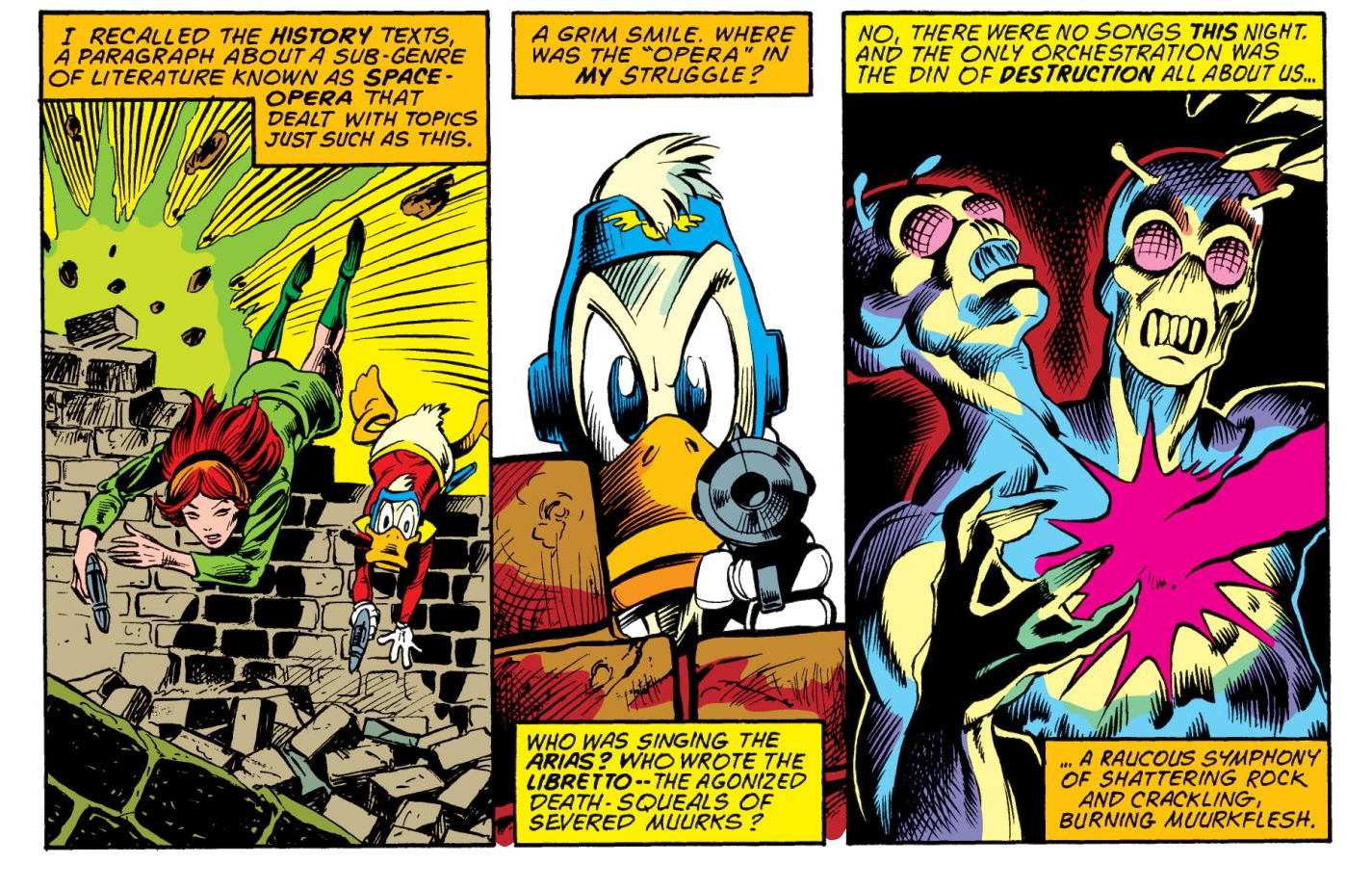
I’m sure this didn’t occur to my younger self back in 1975, but in 2025, your humble blogger is moved to question whether the label “space opera” is altogether appropriate as a descriptor of Killmallard’s milieu. After all, that term usually implies that a story is set (at least in part) in outer space, whereas the present situation seems to involve a mere alien invasion (and conquest) of our own planet Earth. But, that’s a minor quibble, I suppose.

Opening splash page from Amazing Adventures #34 (Jan., 1976). Text by Don McGregor, art by P. Craig Russell.
Perhaps more to the point, my fellow fans of ’75 who, unlike me, had been reading Amazing Adventures would recognize the dense, somewhat florid prose found throughout this sequence as a parody of the scripting style of Don McGregor, who at this point had been writing the adventures of Killraven and his crew of Martian-fighting rebels for over two years.


Whoa, Howard just met Beverly Switzler, and they’re already shacking up? Well, maybe… although the relationship may not have progressed quite as far as the sight of our feathered protagonist naked in the young lady’s bed might imply. Howard, at least, seems to be under the impression that Bev is already romantically involved with the “Arthur” mentioned in the last panel above; after requesting that she not give him any more of the latter’s stories to read at bedtime, Howard adds, “Your boyfriend’s got a weird imagination.” To which Beverly casually replies, “Oh, Arthur’s not my boyfriend, exactly. I’m sort of a sister to him.”

That first panel above — the one with Howard’s eyebrows arching above the panel border — isn’t exactly what you’d call subtle, is it? One can only wonder if that bit of visual innuendo was the idea of artist Brunner — or of author Gerber, who reportedly wrote this particular story full-script.
Following Beverly and Howard’s shared recollections of how they were rescued from Pro-Rata’s tower, Howard ruefully notes that he’s back where he was before that whole adventure began — “no job, no home, no bread — !” Beverly tries to console him by telling him that at least he has one friend (her), and come the next day, he’ll make another. “Who — Arthur?” Howard asks skeptically. “Don’t tell me you’re jealous,” Bev replies, “just because he names his heroines after me?” “Nah!” says Howard.

 Despite the fact that Howard and Beverly are shown to be in bed together throughout this page, there was one single panel that the Comics Code Authority appears to have required be redrawn (see right for the OG version). My guess is that the CCA drew the line at an image that unambiguously showed the two characters together under the sheets, even if there was clearly nothing going on (yet). But, who knows.

While I wasn’t actually reading Don McGregor’s “Killraven” in Amazing Adventures (or, for that matter, his “Black Panther” in Jungle Action — and, yes, I do regret both of those lapses in judgment, half a century on), I at least knew who the guy was. So I imagine it must have occurred to me to wonder if Arthur Winslow might be based on him… which, of course, he was, as would eventually be officially confirmed in the Howard the Duck letters column.


By December, 1975, all we Steve Gerber fans were of course well acquainted with the author’s predilection for dropping a large amount of typeset text onto a page from time to time. And the example above is largely typical of what we’d come to expect from such passages — more than just a device for allowing the writer to fit more words into an eighteen-page story than the comic-book format would normally allow, it’s an efficient vehicle for conveying important, but largely non-visual information (such as found here in the idea-focused dialogue between Arthur Winslow and Phelch the Space Turnip) in a manner that doesn’t throw the rest of the narrative off-balance.

According to an interview Steve Gerber gave The Comics Journal in 1978, the character we’d come to know as the Kidney Lady was based on a real person he’d encountered in New York’s Times Square.


As “Turnip-Man” flies with Beverly over the Cleveland skyline, Phelch pipes in some background music — the lack of which in real life Arthur had previously bemoaned — but this does nothing to alleviate Arthur’s mounting distress, and he accuses the Turnip of having betrayed him. Meanwhile, Bev — who can hear the music, but not the voice of Phelch — wonders who the heck Arthur is talking to.

While I won’t claim to remember what I made of this scene when I first read it in 1975, in 2025 it definitely gives off sexual assault vibes. That may not in fact be exactly what’s happening here, as we’ll learn a couple of pages hence — but even knowing what’s coming, this scene is still kind of creepy.
Returning our attention to Howard, we find him briefly considering chucking this whole business and leaving Beverly to her fate: “I mean… that leafy lunatic could make duck soup outta me… and I don’t even know where he’d take her…” “Well, I do!” retorts the Kidney Lady.

(Just in case you’re wondering, “Sunspot Slope” appears to be completely fictional. For better or worse, Steve Gerber doesn’t seem to have been too terribly interested in the real-world Cleveland, OH, despite having opted to use it as the primary setting for this series.)

All things considered, I’m a little surprised that the Comics Code Authority folks let Gerber get away with using the word “arousal” in this context. (After all, just a couple of months before this, they’d made Roy Thomas replace the phrase “mating dance” with “love dance” in an issue of Conan the Barbarian.)


Back in 1975, my eighteen-year-old self thoroughly enjoyed this story, even if I didn’t rate it quite as highly as issue #1’s “Howard the Barbarian”. That may be in part because of my overall lack of familiarity with the work of Don McGregor (I’d read a few of his short stories for Warren Publishing’s black-and-white horror anthology comics, but that was about it), as compared with my much greater knowledge of the sword-and-sorcery genre Gerber and Brunner had skewered in that earlier effort. Somewhat ironically, while I’m much better able to appreciate the McGregor parody today (having managed to [mostly] catch up on both his Killraven and Black Panther work in the past decade or so), I find myself rather more in sympathy with the heroic idealism espoused (however imperfectly) by Arthur Winslow than I probably was half a century ago, when I was largely content to accept Gerber’s portrayal of the would-be Turnip-Man as a sort of misguided schmuck, and likely counted myself “sophisticated” for feeling that way.*
On the other hand, my sixty-eight-year-old self still finds plenty of entertainment value in “Cry Turnip!”, thanks to the (mostly) witty script by Gerber as well as the terrific art by Brunner and Leialoha. Which, of course, makes it a shame that this would be the last “Howard the Duck” story produced by this particular trio of creators, as Frank Brunner left the feature following this issue.
A clue to at least one reason for the artist’s decision to move on following HtD #2 may be found in the issue’s final caption, in which “Judo Jim Starlin” is thanked for “his assistance in laying out this most challenging script!”
A few years later, in a piece written for The Comics Journal #51 (Nov., 1979), the artist offered some details regarding the script’s “challenges”:
…Steve Gerber and I co-authored Howard #1. I was quite pleased with the book and looked forward to the next issue. Unfortunately, Gerber decided to write a full finished script — the reason for this being, I was told, so that he could voucher it faster and get paid. The script arrived in two parts; I had no idea where the story was going and the second part was late, but having committed myself to do it, I did it [evidently with layout help from Starlin — YHB].
A little further on in the same article, the artist described his other major complaint regarding his situation vis-a-vis Howard:
It was… around this time that I began to realize what a hit the first issue was. I called Marvel and asked for a small raise on my pencilling rate, not having had one in over a year. Editors had been changed. I was told to wait until Christmas. “Jesus!” I thought, “Here’s a book selling like hotcakes and I can’t get a lousy three bucks extra a page. You wait until Christmas, I’m leaving!”
But while Frank Brunner was quite prepared to leave Howard the Duck behind, cartoon ducks in general were a different matter. For an account of what happened next, we turn to Sean Howe’s Marvel Comics: The Untold Story (Harper, 2012):
He [i.e., Brunner] left the book, and through a small mail-order company began selling poster prints of a mobster duck, titled “Scarface Duck.” It looked a lot like Howard… but then, hadn’t Howard looked a lot like Donald anyway? “I was filling a void left by slow-moving Marvel,” Brunner reasoned, “which did not immediately see the potential of the fan market — or of the duck.” The print sold quickly. Gerber wasn’t pleased. He told Brunner he wanted some of the profits from his co-creation. “Which part of the print,” Brunner asked Gerber, “did you write or draw? What part of the deal did you arrange?”

 You can kind of see Brunner’s point — especially since, as Howe’s text implies, both Howard and Scarface would likely never have existed without Walt Disney’s Donald Duck. Certainly at least part of the appetite of 1970s comic-book fans for high-quality graphic narrative (and art prints) featuring cartoon ducks had been stoked by several decades’ worth of comics starring Donald as well his fellow Disney Ducks — most especially, by those written and drawn by Carl Barks, “the Duck Man”. (Though, judging by the photo of Barks shown of right, the mostly-retired cartoonist — who was then supplementing his income producing oil paintings of Donald, Uncle Scrooge, and their ilk — didn’t take it at all personally.)
Even after “Scarface Duck”, Frank Brunner wasn’t quite done with Disneyesque waterfowl. His next such project would involve a new “ground-level” comic book from Mike Friedrich’s Star*Reach Productions, entitled Quack… but as there’s a good chance we’ll be writing a full blog post about that title’s first issue in about six months, we’ll refrain from further discussion of it here. Meanwhile, back at Marvel Comics, Howard’s webbed feet hardly missed a step, as his series not only continued without Brunner’s involvement, but increased its publishing frequency from bi-monthly to monthly with its sixth issue. By that time, of course, the title had a new regular penciller — the veteran Gene Colan — although, prior to that, Howard the Duck #3 had been graced by the art of another Marvel mainstay, John Buscema. But since that’s yet another comic we expect to be writing about in the near future, we’ll defer our comments regarding Big John’s take on the House of Ideas’ latest sensation to another post, on another day.
*We should note for the record that Steve Gerber and Don McGregor don’t appear to have ever been less than friendly in their actual lives; as evidence of the regard and affection the latter held for the former, see the obituary McGregor wrote following his colleague’s passing in 2008.
Another excellent overview of a comcis classic, Alan! I missed this when it was new but eventually added it to my collection. Hadn’t read McGregor’s memoriam on Gerber previously but I found it very moving. And it’s true that in the mid-70s, in mainstream comics, Gerber & McGregor were among a small band of writers with very distinct styles and “voices” that anyone paying attention couldn’t mistake for any other comics writer. In late 1975, I hadn’t yet read enough of McGregor’s comics to fully appreciate his own style — I’d only gotten one or two issues each of his Black Panther and Killraven yarns when they were new on the racks, although I’d eventually add the full runs to my collection. Still, in those issues I did have, his particular voice and style was very evident. And I’d already become a big fan of Gerber’s mags, originally through Daredevil, which may not have been the best, for either Gerber or DD, but still had that Gerberesque touch that appealed to me.
Going through this particular story, even as I’m enjoying the writing and art, I also find myself noticing multiple things going on, particularly in regard to Arthur’s debate with Phelch and Arthur’s repressed nature, of which I can recognize some aspects in my own life. And, yep, there was a period in my life, a few decades ago now, when I worked security, bored out of my mind and counting down the hours! Might’ve been interesting if Gerber had kept Arthur around a bit longer or brought him back in later tales, but I can understand the reasoning of letting him go having used him for this particular story idea and Arthur having been based on a particular professional colleague and friend. Gerber was more keen on keeping around or revisiting characters that were based on himself, as with Richard Rory and the soon to be introduced Paul Same. More observations to come after I get some more sleep!
Such a wonderful issue. It’s endlessly quotable and almost works as a sort of mission statement about how Gerber felt about the glory and the limitations of pop culture (the next issue would ask similar questions far more seriously). I always thought HTD was at its weakest when used as a specific parody, and strongest when it pondered things like this. See his final Dr. Fate run with its “Killhead” story line for an updated take on the same subject.
Missed all Howard material as a teenager, but seeing it now, I am slightly surprised that the Comics Code Authority let the name Phelch go through the goalposts…leaves Jim Starlin’s “merde stingers” in the dust somewhat!
Jeepers, I read this issue and the obvious implication they were sleeping in the same bed flew past me. But even in my late teens I was naive about such things.
The assault aspect flew past me too. Bev looks less pleased about his constant state of arousal than if everything were consensual.
This rereads well, even though the turnip’s critique of pop culture is a stock and shallow one (I’m reminded of a Tom Strong issue where he’s trapped in an illusory world and sees through it because the idea there are no heroes, no adventures, nobody fighting for justice — that’s just unbelievable!). And publishers definitely hadn’t given up on heroes in 1975, either.
The Don McGregor parody is obvious now but I was a couple of years away from reading a friends collection of Jungle Action. I kind of agree with Patr below, that the “space opera” phrasing was mostly so Gerber could bring up “opera.”
I’ve always wondered what Gerber’s intentions were when he had the Kidney Lady make the cryptic vow that she’d be sending two new legs after Howard. He never got around to following it up, which left a dangling plot thread for Bill Mantlo to pick up in the first issue of the HTD b&w magazine, revealing the Kidney Lady to be a sorceress in charge of the Chair-Thing. Not sure if you’ll be covering that issue come 2029, so I don’t want to kick off much of a discussion of Mantlo’s tenure on Howard here if it’s in the hopper for a few years from now. There were a couple of issues of the magazine I kind of liked (the Christmas issue worked for me, and parts of Duckworld), but mostly his complete misreading of what made the Kidney Lady enjoyable set the tone for his run. (And then he dragged poor Harold H. Harold into HTD. Man, Tomb of Dracula supporting characters could not catch a break when writers decided to drag them into unrelated series…)
I dropped the HtD color series like a hot potato when Gerber left, Wire154, and never picked up an issue of the b&w magazine — so no worries about spoiling any future discussion of Mantlo’s run in my posts. 😉
I remember this one quite well and not just for the way Brunner drew the delightful Ms Switzer. Howard was a character that woke up the cynical, sarcastic side of me and taught me the rudiments of how to make him funny. Having largely made a career out of that cynical and sarcastic side in both my career on the radio and my on-and-off again attempts at writing, I’m grateful. Thanks, Steve.
Since writers work behind the scenes, seldom seen by the folks who read them, it’s easy to believe they live forever, so while I wasn’t surprised Gerber had passed, I’d never considered it a possibility, either. It’s easier to believe they’re all sitting around the Bullpen somewhere, writing comics and cracking wise and being legendary. Would that it were so. Still, I enjoyed MacGregor’s obit piece, which was obviously heart-felt.
Lastly, though I hate to throw Michele Wolfman under the bus, is it just me or does the coloring on Arthur in that last panel make him look like a completely different person from how he looked at the beginning? What happened to his beard?
Finally, I’m glad that 1975-me wasn’t a tied into the “Inside Baseball” of comics that I would discover in a couple of years through the Comics Journal and other publications, so I hadn’t heard about Brunner leaving the book before Colan showed up two months later. Never been a huge Colan fan, but by #3, I was a huge HtD fan, and I remember Master of Quack-Fu well and look forward to re-living it with you all. Thanks, Alan!
Frank Brunner was too slow for the (bi-)monthly grind in comics. Like Wrightson, Jeff Jones, Mike Kaluta, Bruce Jones, and a number of others in that generation, he was really suited for short stories in comics, wanting to artistically invest a lot in a low page count.
Artists of the prior generation like Joe Kubert, Alex Toth, Frank Thorne, and Ric Estrada found a way to simplify their work with mimimalized finishes that would permit them to generate a high number of pages at consistent intervals.
Frank Frazetta was another one who excelled at drawing short stories in comics (1944-54, 64-65). He only drew one full length comic, Thun’da no. 1, in 1952.
I own Howard the Duck no. 1, but I don’t think I ever saw no. 2 at the newsstands.
Now this is how I like to start my Saturday mornings! A pot of coffee following a good workout and another of Alan’s stellar reviews! Have to also say that I was so irked that this issue didn’t make it to grocery store racks in my SW Oregon timber town back in late ’75. After both GSMT’s and Howard’s first issue, my buddies and I couldn’t wait to meet the Deadly Space Turnip and were so crestfallen when this issue didn’t show up. Yet today’s review is the first time I’ve actually checked it out all those years later.
You could say that Howard the Duck both elevated Steve Gerber to my top echelon of comic book writers and that he also led to the writer falling hard from that perch. I had always enjoyed the quirky energy Gerber brought to the titles of his that I read (i.e. The Defenders, Marvel Two-In-One and even Daredevil). But somewhere that quirkiness shifted for me to a more cynical worldview that I found less appealing as a kid. The fill-in issue of Howard with his skewed observations and ramblings did it for me – I was close to quitting comics at that point anyway. Next time I encountered his work was on Saturday mornings with Thundaar and Dungeons & Dragons.
I bring that up because this issue would not have appealed to me had I read at that time. I would not have picked up on his having fun with Don McGregor (another writer I read on occasion). The art was gorgeous, but I would not have cared for the Arthur/Turnip dynamic. As an adult, it’s okay if you’re wanting to explore certain relationship dynamics but fails if you’re looking to spoof the superhero genre.
But this also leads to what was I saw as the ultimate challenge with Howard the Duck. He’s fun as a foil to spoof various comic book genres. But what do you do with him once you’ve run out of various categories? And does that have enough appeal to sustain an audience?
In short, this issue reminded me why I was so excited about those early HTD issues as well as why I eventually lost interest in the character.
Now to get on with the rest of my Saturday – shopping, laundry some office work, blog writing, preparing dinner and watching my Oregon Ducks in tonight’s CFP game!
Rick wrote: “But this also leads to what was I saw as the ultimate challenge with Howard the Duck. He’s fun as a foil to spoof various comic book genres. But what do you do with him once you’ve run out of various categories? And does that have enough appeal to sustain an audience?”
That has been the inherent problem in so many comics. Denny O’Neil and Neal Adams/Dick Giordano said Green Lantern/Green Arrow was like a cause-of-the-week comics mag that, by the end of its run, was running out of causes/social issues that could be addressed in a code-approved comic book.
Wein and Wrightson said Swamp Thing was likewise becoming a monster-of-the-week book that was largely played out by issue ten.
Alan Moore proved that Swamp Thing could be “renivented” and taken in a number of different directions. I’ve yet to read any Green Lantern stories that surpass the O’Neil-Adams era, despite certain dated elements.
Howard could likewise have been brought into new directions. Thus far no one has surpassed the Gerber era, but the limits are only in the minds of the creators.
Don’t worry, A.I. will come up with some clever “new” spins on the character in the future.
E. Nelson Bridwell on Inferior Five seemed to see that was a problem. Along with parodies such as the Eggsmen and the Kookie Quartet, he had the team encounter versions of Tarzan of the Apes, the Man From UNCLE and the Scarlet Pimpernel/Tale of Two Cities (combined into one adventure).
Brunner’s departure from HtD was inevitable both due to unlikely hood of his being able to keep up with a monthly schedule as well as his creative clashes with Gerber. I suspect by this point, Gerber found Howard made the perfect focal point for expressing his views of multiple aspects of American culture and the anxieties of trying to make one’s way in the world, which could be difficult even for us hairless apes who were born into it. As will eventually be revealed, Howard felt alienated even in his own world, and in the Marvel version of our own Earth, Howard keeps encountering people who are living on the edges of society, including Beverly, struggling to earn enough just to pay for their basic needs, as well as many trying to make it in the creative arts, such as Arthur. I think HtD worked best when Gerber’s stories dealt with various real life anxieties and foibles, as well as the sort of disturbed people that anyone may actually encounter in the world. The Kidney Lady may seem utterly bizarre to some, but, of course, we, the readers, are 100% more likely to encounter someone like her on a bus or strolling through a crowded metropolitan area than to spot Superman flying through the sky, Spider-Man crawling up a building, or the Hulk landing on a sidewalk. I’ve had to deal with several deeply disturbed people just at my job. Whatever future plot lines Gerber had her hint at in this issue, I suspect Gerber simply lost interest in and ran with a different trajectory when he finally did a story that more fully dealt with her, beginning in HtD # 11. Never read Mantlo’s story, but just reading the description of it, it feels entirely contrary to what I feel was Gerber’s intent.
“Deinstitutionalization” both made things like Willowbrook less likely and increased the likelihood of an encounter with someone like the “Kidney Lady” (indeed made it almost a certainty, depending on where you lived and what you did).
You know you are old when you remember a time when Geraldo Rivera might have been on the way to becoming a respected journalist.
Well, you have to admire his skill at reinvention .He has remained relevant and he continued to help the people whose problems he discovered so long ago . . . .
Even just looking at the cover I am reminded of ol Stan’s “long underwear character” remark and the inherent absurdity of the superhero genre . I think it is like opera (aside from Space Opera) , which is also absurd looking from the outside, unconvincing exaggerated make up for the stage, sung dialogue, melodramatic singers who act in a an obvious way all due to the artform’s conventions , yet is compelling and even moving for those who can be absorbed in it. So in comics how can you parody that which is already absurdly close to parody other than as a gentle “Not Brand Echh”? Maybe in addition to more “adult” themes , and attempting more “realism” , you play with the form or narrative – hence the MacGregor touches , but got to admit as I mentioned before , this all was mostly lost on my younger self. I suppose that is also what Alan Moore was doing with some of his work later though it was after my active time in reading new comics.
I do recall that when I saw the cover 50 years ago, I laughed out loud. And Howard’s line, “What’s with him? His turnip too tight”? Classic.
i liked this back in 1975, but I was concerned it was just going to be movie and pop-culture parodies.
I was presently surprised when it became . . . something else.
About this time, Brunner did the cover for Super Team Family # 3 (a Flash/Hawkman Team Up). I think it was Brunner’s only DC credit and was a nice drawing. That possible was what MI types call “an indicator.”
Indicators in the UK & Ireland are called “turn signals” in the US. 😉
i was thinking more like what the “IC” calls “Indications and Warnings” . . . .
I thought I saw some Starlin art. He had a very particular way with noses sometimes.
I never knew Frank Brunner had a daughter who acted in several well known television series between 1999 and 2011:
https://m.imdb.com/name/nm2382004/bio/?ref_=nm_ov_bio_sm
I loved Space Turnip, and even more so the Kidney Lady. And of course Howard and Beverley! But it’s goodbye Frank, and his lovely renditions of said Beverley. Maybe for the best, as Gerber was not that comfortable with having a co-plotter. The night watchman scenes are very Starlinesque, as are the eyes looking out is the cosmic void, yet overall the look remains very Brunner.
Alan, thanks for including the Brunner poster, which I have never seen before, and also the great Barks photo. Looks like he was enjoying all the innuendos and suggestive poses, which by-passed most of us kids back then!!! It’s great he seemed to have enjoyed the issue as much as I have enjoyed some of his superb Duck stories over the years ( an let’s face it, most of his Duck stories rated a 9 out of 10 over 2 decades plus of story-telling).
Obviously wrong about SG not liking having a co-plotter…..given he was co-plotting Omega with Mary Skrenes!!!
One more note about Brunner here on his last regular series of the ’70s….all his characters looked different….he tended not to use ( or have in his armory) the ‘stock’ face, either male or female. Beverley looks different to Clea. And this is much appreciated on my part! In the recent Dr Strange/ Dracula cross-over ( which I have yet to re-read, but looking forward to) I recall at the time having difficulty telling apart Drac and Dr Strange visually. And of course any get together between Don Blake, Steve Rogers and Clint Barton would have caused enormous confusion…..which is probably why Sal B had Clint wearing his Hawkeye mask under his Golden Archer mask in Cap #179 ( can you image the reader’s reaction: ‘what…the Golden Archer is….Steve Rogers?????’)! Even Stan got confused on some pages between Reed Richards and Johnny Storm in some of Kirby’s FF panels, once Kirby started bulking them both up in his late techno art period!!