
 Last October, at the end of our post concerning Captain America #193 (Jan., 1976) — a comic which, you’ll remember, featured the return of artist/writer/editor Jack “King” Kirby to the star-spangled hero he’d co-created with Joe Simon back in 1940 — your humble blogger invited you all to return in May, 2026 to see how the eight-issue, Bicentennial-themed storyline that had kicked off therein would turn out. Four months later, however, I’ve come to the realization that trying to cover seven chapters’ worth of Kirby’s epic in a single go would likely result in a post of such length as to try the patience of even the most indulgent followers of this blog — and so, I’ve decided to break up the remainder of our “Madbomb” coverage into two posts, the first of which is presented here. (Of course, given that this piece is still aiming to hit the high points of four individual comics, it’s still likely to be a pretty long read… though not quite as much of an imposition on your time as our originally planned Captain America #200 mega-post would have been, so at least there’s that.)
 Anyway, let’s get to it, shall we? Our first stop is CA #194, which finds Kirby assisted on interior inks by veteran artist Frank Giacoia (who may also have done the same honors for the cover, although the Grand Comics Database credits John Verpoorten). As the story opens, our two heroic protagonists, Steve (Captain America) Rogers and Sam (Falcon) Wilson, are undergoing extensive, rigorous conditioning as a precautionary defense against the threat they soon must face…


Along with delivering the visual impact one expects from a Kirby double-page spread, this piece also helpfully and efficiently brings any readers who might have missed CA #193 up to date — not that that deters Kirby from forcefully exhorting such unfortunate souls to go scouring the stands for that issue regardless (“You should! You must!”). But then, what else would you expect from the man who once advised the prospective readers of Jimmy Olsen #141, “Don’t ask! Just buy it!”?
Captain America’s brooding is interrupted when his and Falcon’s “government chums” hit the heroes with a “maximum charge” of mind-wave energy similar to what powers the “Madbomb”. Luckily, thanks to their “diffusion helmets”, they’re only stunned unconscious, rather than driven stark raving bonkers. Whew!


Here, for the first time, we meet some of the leaders of the sinister organization plotting to set off “Big Daddy” on the USA’s 200th birthday. Leaning into the Bicentennial theme (as well as indulging his Dickensian penchant for aptronyms) Kirby offers us a wealthy, self-styled aristocrat named Taurey — after “Tory”, one of the names commonly applied to the colonists who remained loyal to the British Crown during the American Revolution — and his underling, the mercenary general Heshin — after “Hessian”, as the German soldiers who served as auxiliaries to the British army in the Revolutionary War were called.

Half a century ago, it might have seen far-fetched to imagine a cadre of extraordinarily wealthy men this hell-bent on bringing back the Good Old Days of monarchist government… today, alas, not so much. I suppose the main difference between Taurey’s bunch and today’s oligarchs (setting aside the 18th-century cosplay) is that our latter-day breed appear to be working to subvert democracy mostly from within the current system, rather than plotting to overthrow it. (Not that that’s any better, of course.)


Upon his return to Captain America, Jack Kirby chose not to deal with much of what had gone down with the hero and his world in the interval since the last time he’d last been involved in chronicling Cap’s adventures, back in 1968. For whatever reason, however, he kept the Falcon around for his new run (this might have been mandated by Marvel, of course, but I doubt it) — and that, I think, was a wise choice, especially for this storyline. While Kirby’s attempts at giving Sam Wilson a modern Black American speech pattern may not be very convincing, the content of Sam’s dialogue turns out to be very important in allowing our artist/writer an opportunity to critique how America’s history has often fallen short of its stated ideals.

Fifty years further down the road, the sentiments expressed in this scene by both Steve Rogers and the nameless (white) doctor — that, as of 1976, America has “grown up“, and is finally “making good on its promise to all men” may seem terribly naive; but, when one considers the great gains that had recently been made in a relatively short time thanks to the Civil Rights Movement of the ’50s and ’60s, one can understand why Jack Kirby — who at his core seems to have been an optimist, regardless of the horrors he’d witnessed as a G.I. in World War II — believed his country truly had turned a page… or, at least, hoped very much that it had.
Now released back to active duty, Steve and Sam can begin their actual mission — taking an airborne “skimmer” into “the barren wastes of a remote area” (evidently the Western Badlands) where a number of agents of S.H.I.E.L.D., searching for the makers of the Madbomb, have gone missing…

Yep, the boulders are fake ones — mere props, made from foam rubber — and what’s more, the giant (who hasn’t been badly hurt in his encounter with the skimmer) turns out to be not all that unfriendly; Steve guesses the big guy was simply tossing the “rocks” around as a kind of game. But further speculation is rudely cut short when a new figure appears on the scene:


Despite our heroes being outnumbered and outgunned, for a page or so it looks like the good guys will win the day. They make a break for their wrecked skimmer, intending to use its radio to alert S.H.I.E.L.D., but then…


Interestingly, the soldier’s mention of “Taurey and Heshin” in the third panel is the last we’ll hear of those two men, not just for this issue, but all the way up to CA #199. As we’ll soon discover, while those guys may be calling the shots in regards to the big picture, there are others who are managing things on the ground (or, more accurately, under the ground) at the facility our heroes have discovered.
Turning to the next page, we find that Steve and Sam were only faking having been knocked out by the “mind-wave launcher” — in truth, that onerous S.H.I.E.L.D. conditioning from the beginning of the issue has done exactly the job it was supposed to do. Our heroes’ submission was nothing more than a ruse to get inside the enemy base… though, when they finally open their eyes, they’re immediately given good reason to think their scheme may have worked a little too well…


 With one mystery now solved, Cap and Falc’s next steps are clear — they need to 1) break out of their cell and 2) take this whole operation down… or, as the Living Legend of World War II more stirringly puts it in this issue’s last panel, “Let’s put an end to this nest of rats!”
And, of course, that’s just what they’ll endeavor to do in the next chapter, which originally arrived in December, 1975 under a cover by Kirby and Giacoia (though the story itself was inked as well as lettered by D. Bruce Berry, who’d done these same tasks for most of the King’s jobs for DC Comics during the last couple of years).
“1984!” begins with our heroes’ cell-break, which turns out to be pretty easy, all things considered…

Once Cap and the Falcon have subdued the handful of soldiers set as guards over the “Manual Labor Pool”, it’s on to their next stop..


The surgeon (?) in charge of this horrorshow is unimpressed when Cap orders him to cease and desist on “the authority of the U.S. government!” “Your America means nothing here!” the man sneers. “We are changing things! Creating a new America!”
“I’ve heard that line before!’ Cap retorts. But when he orders the release of the room’s latest “patient”, he’s told it’s already too late: “He no longer fits into your society!”


Captain America’s gallantry towards Cheer Chadwick (“Do as they say, Miss.”) may be reflexive; still, it seems rather misplaced, given his previous encounters with such dangerous women as Madame Hydra/Viper and (with the Falcon) Nightshade. After all, “Miss Chadwick” has already made it unambiguously clear that she’s one of the bad guys — so why should our good guys assume she’s essentially harmless? (OK, fine, the odds are at least fair that Jack Kirby hadn’t read any of the comics featuring the two villainesses I just mentioned; on the other hand, he and his old partner Joe Simon had given us Madame Hydra’s likely prototype, Countess Mara, all the way back in Captain America Comics #10 [Jan., 1942] so it’s not like the idea of an evil and deadly young woman was a new one to him.)
All that said, I’ll allow that our heroes’ letting Cheer personally escort them to what they hope will the secret location of the “Big Daddy” Madbomb may in fact be a better option than their trying to fight their way through the whole so-called Royalist Forces of America to achieve the same objective. Just don’t turn your back on her, OK, guys?

Once they arrive at Cheer’s chosen destination of Level Five, however, what Cap and Falc are faced with is far different from what they’ve been expecting…


Clearly, this sequence is specifically inspired by the 1949 novel by George Orwell that gives this issue’s story its name, with the composite figure of “the Chief” standing in for Orwell’s shadowy “Big Brother”, and “the Love Machine” being a take on the novel’s “Two Minutes Hate”. But in more general terms, the scene also calls back to concepts and characters from Jack Kirby’s earlier work, such as Glorious Godfrey and his Justifiers from Forever People #3 (Jun.-Jul., 1971), and the Hate-Monger, created by Kirby and Stan Lee back in Fantastic Four #21 (Dec., 1963).
Anti-fascism was without question a long-term crusade for Kirby, extending at least as far back as the iconic “punching Hitler” cover of Captain America Comics #1 (Mar., 1941). Decades after his death, it remains a message of perennial relevance, though thankfully more urgent at some times than at others (unfortunately for all of us, we happen to be living through a time when it’s very urgent indeed).


OK, so maybe instead of advising “don’t turn your back on Cheer Chadwick”, I should have just said “watch your back, guys!”, period. Welp, it’s too late now.
The massive figure who just floored Cap and Falc is recognizably female, and even though our heroes take her rather more seriously as a threat than they have Cheer, they still seem to have problems getting out of the way of their own assumptions regarding gender — with the predictable result that their assailant, who ironically goes by the name “Tinkerbelle”, renders them both unconscious within a couple of pages.

Cheer ultimately prevails upon Tinkerbelle to take the new “recruits” away to prepare them for “the game”; once alone, she places a call to “Poppa”:


Before we proceed to our saga’s next chapter, Cheer’s remark above referring to Captain America and the Falcon as “two masked men” provides us with the opportunity to make a general observation concerning something very odd about this story: namely, that no one in it who doesn’t already work for the U.S. government seems to have any idea who our heroes are. I mean, I get that the Madbomb masterminds are running a more-or-less closed society in their ginormous complex beneath the Badlands (although they must have recruited their soldiers and workers from somewhere else, originally), as well as that the Falcon could be considered to still be relatively new to the superhero scene — but Cap has been a public figure in the Marvel Universe since the 1940s. It’s just not credible that no one at all recognizes him; at least, not without an in-story explanation being provided for it.
 We’ve now arrived at Captain America #196, which sports another cover pencilled by Kirby and embellished by Giacoia, while Berry continues to provide inks (and letters) for the story within. “Kill-Derby” opens with a completely gratuitous (though nevertheless exciting) fight scene as Cap comes to long enough to mix it up with some of his would-be competitors for a few pages; ultimately, however, he submits to being sprayed in the face by some kind of tranquilizing gas…

Some minutes later, Cap and Falc both return to consciousness. As they reorient themselves to their surroundings, the latter hero realizes that his partner isn’t quite “whole”…

While it’s perfectly understandable for Cap to be upset at the theft of his shield — and by the idea of it being used as a weapon in a blood sport — the notion that he “roars in anger” over the situation feels a little over the top, at least to me.

After Cheer declares that the games will not proceed until “her” players are produced, one of the competitors already in the arena radios his own team’s captain, Tinkerbelle. She assures him she’ll take care of the problem, then turns her attention to our heroes…

Your humble blogger counts himself among those who generally enjoy Jack Kirby’s dialogue; that said, there are times when his language sounds gratingly unnatural coming out of the mouths of contemporary humans (as opposed to, say, gods), and I’m afraid that the exchange between Cap and Falc in the panels above is one of those times.
Soon after this scene, our now skateboard-equipped heroes have joined the others in the arena…


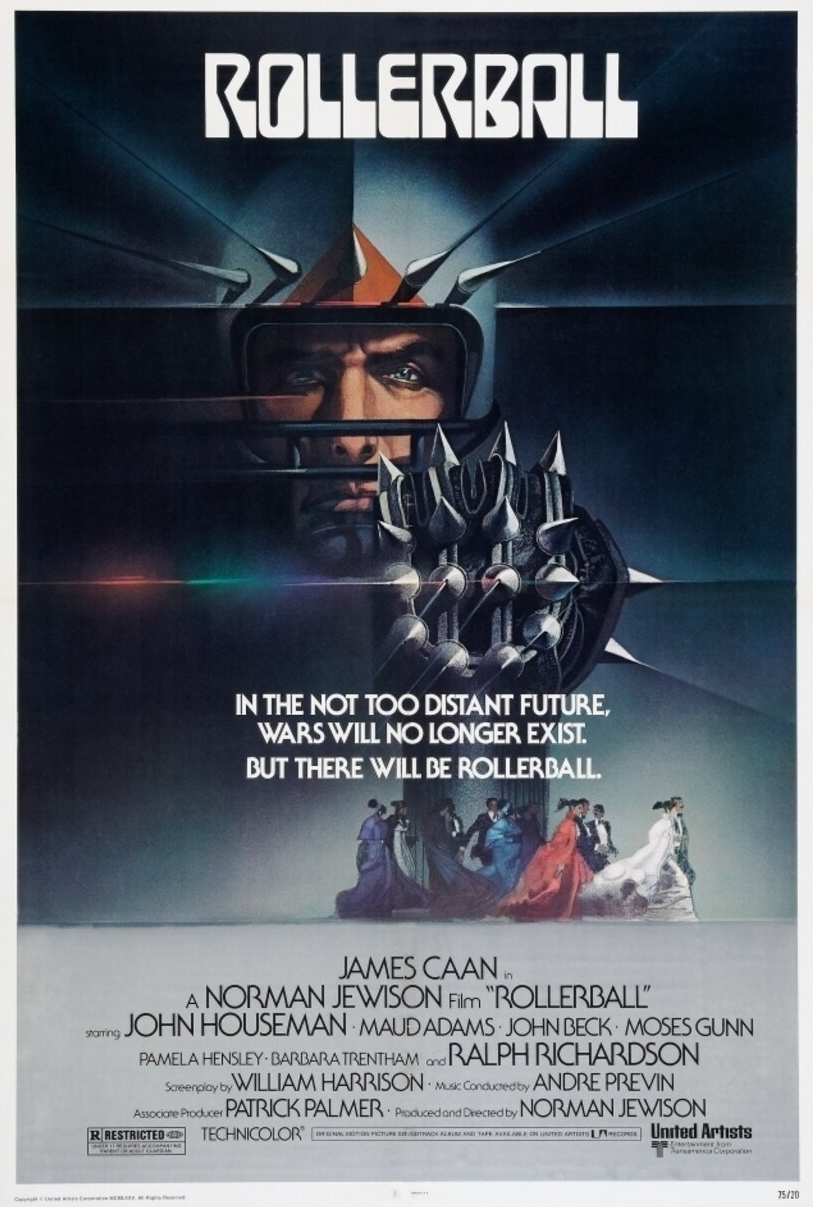
Movie poster by Bob Peak.
Kirby has undoubtedly taken cues from the 1975 dystopian science-fiction film Rollerball for his development of the fictional sport of “Kill-Derby”, though it’s worth noting that he’s opted to put his players on modified, motorized skateboards, rather than the roller-skates found in the movie — a change that probably reflects his awareness of the growing popularity of skateboarding in his home state of California around this time.

Ignoring Tinkerbelle’s call for him to wait for her orders, the Falcon soars on ahead — and is almost immediately brought down by a net fired from the opposing team. Cap stops rolling just long enough to help free his partner, and then gets right back in the game…

Cap continues to batter his way through the horde, though he’s briefly felled when what appears to be another player turns out to be an explosives-rigged dummy. He’s soon back on his feet, but a moment later he and several of his teammates find themselves caught in the path of a massive propeller-machine driven by the opposing side, But by now the Falcon has returned to action; he smashes the propeller with a steel bar, then runs interference for Cap so the latter can continue his search for the man who stole his shield. And, wouldn’t you know, just as we come to this episode’s final page…

This brings us at last to February, 1976, and the comic book that gives this blog post its title.
Behind another cover by Jack Kirby and Frank Giacoia (or maybe John Verpoorten?), we find Giacoia back on interior inking duty, as well:


Cap and his foe knock each other around for a couple of pages, but eventually, our hero gets the upper hand. Sensing this, the mood of the crowd begins to shift; one lone voice begins to chant, “Kill! Kill!!”


As indicated by that last panel, Captain America and the Falcon aren’t the only government operatives currently out in the field trying to bring down the makers of the Madbomb. In the wake of Steve and Sam’s disappearance while on assignment, U. S. Army forces under the command of the improbably-named General Argyle Fist have been scouring the area of the Badlands where their skimmer went down. They’ve had a couple of disappointing setbacks over the past couple of issues, but now seem to at last be on the verge of flushing out their elusive enemy…


Kirby’s openhearted, irony-free valorization of the United States military might strike an odd note for some contemporary readers — and, in fact, it probably did for some readers fifty years ago as well, coming as soon as it did after the conclusion of the Vietnam War. But it’s not hard to see how this approach would have come naturally to Kirby, who, after all, had been personally involved in the military effort that overcame the fascist threat against America and its allies in World War II.


That “BOOOM” heralds the arrival of General Fist and his troops, as Cap and Falc realize when that first sound is followed by that of distant gunfire. Still, that won’t stop our heroes from being crushed by a panicking crowd, unless the Falcon takes flight and pulls Cap along with him — which, of course, is exactly what happens…


The Falcon lays into the Royalist troops, with Cap following close behind…

As Captain America shouts the “all clear” to Fist’s men, the remaining enemy troops flee the scene…


Detail of panel from Thunderbolts #31 (Oct., 1999). Art by Mark Bagley.
Although it’s not obvious from this page, the Chadwicks’ “private pneumatic car” is taking them not just away from the scene of their crimes, but out of the “Madbomb” story arc completely. It’s hard to fathom why Kirby went to the trouble to keep “Poppa”‘s face obscured in both of his brief appearances if he had no further plans for the character; but, if he did in fact have any vague notions of bringing the Chadwicks back, he never acted on them — and so Marvel’s readers would have to wait until 1999, and the 31st issue of Thunderbolts, for writer Kurt Busiek and artist Mark Bagley to reveal both the name and physiognomy of Dr. Hesperus Chadwick (you can check out his mug at right). Was it worth the wait? I’ll leave that for you to decide.
Actually, Kirby would leave quite a bit more than the Chadwicks behind as he moved to the next and final phase of his storyline. Not only would the next three issues of Captain America recenter our old friends Taurey and Heshin as the primary villains of the piece, they’d introduce important new characters as well; meanwhile, the geographical locus of the narrative would abandon the Badlands for the East Coast. Indeed, if a reader was so inclined, they could completely skip the four issues we’ve covered here today, and hop from CA #193 straight to #198 without worrying about being able to easily follow the plotline to its end in issue #200.
So, does that mean I should have skipped this post, and just covered all the proceedings since #193 in a single entry in May, like I’d originally planned? I’d like to think not; that, while I might have been able to get across the narrative gist of #194-197 in a few paragraphs, the thematic content of these chapters of the story (especially #195’s “1984!”) is important for understanding how Jack Kirby saw the stakes in this Bicentennial conflict he’d arranged between America’s heroic defenders and a self-styled “elite” ready to consign the nation’s Constitution to “the scrap heap!”
Not to mention that you’d have missed out on all the thrilling superheroic action in these issues — which, if not the whole point of the enterprise, is nevertheless where much of the pleasure one may find in reading Jack Kirby’s 1970s run on Captain America is to be found.
In any event, I figure this post has definitely been worth my time, so I hope that you feel the same way. And also, that you’ll return three months from now to find out how the whole thing ends… though, before we can get to the exciting climax, we’ll have to see what that “Captain America’s Love Story!!” next-issue blurb at the end of #197 is all about. (Be forewarned, however, that Cap’s longtime ladyfriend Sharon Carter is not involved… yeah, it’s going to be weird.)
I’m not well-versed enough in the era to be able to work out exactly who, but given how specific Cheer Chadwick’s features are, it seems clear that Kirby was modeling her on some real world contemporaneous person. And I’d bet that her father was also somebody of note, someone that Jack expected the readership of the period to be aware of.
Good question. Cheer Chadwick looks a bit like Cher Bono (!), but Kirby may have had some other famous conservative women in mind like Anita Bryant, Phyllis Schlafly, or even one of Nixon’s daughters in mind.
“Cheer Chadwick” may be a mashup of Cher and Chastity, a character she portrayed in a 1969 film of the same name (and which she named her child — now self-named Chaz).
These issues were so jarring to fans of the Englehart/Buscema Cap. Even after all these years, as much as I love Kirby’s work my inner teenager can’t deal with this Cap, nor the MacGregor-less Panther.
File Under: I Was A Teenage Fundamentalist Marvelite 😀
But for someone who earned for that Silver Age vibe found only in Marvel Tales and Marvel’s Greatest Comics reprints, it was a welcome return – and more kid friendly – though admittedly a step backwards in the development of comics in the ’70s.
I just wish Joe Sinnott were on inks, and Stan Lee, or even Roy Thomas, on dialogue. But it was what it was, and Kirby was no longer in top form, but still quite competent.
*yearned* for
I am not a huge fan of D. Bruce Berry’s inking over Jack Kirby. I am a lot fonder of Frank Giacoia’s inking here. But I would have preferred to have Joe Sinnott or Mike Royer inking these issues.
Agree about the jarring shift but if you were a 60s reader as a fundamentalist you may then have embraced the return of the original co creator – Englehart et al were more Modernists or reformers for the contemporary age. I loved Kirby back then and collected most of his Cap run but looking back it’s clear on his return, he was even more out of sync with other Marvel titles.
As someone who’s recently reread Cap’s Silver Age run as part of rereading the Silver Age (https://atomicjunkshop.com/tag/rereading-the-silver-age/) it feels completely divorced from the Lee/Kirby run too.
As of 50 years ago, my comics hobby had started with at least a few issues of Kirby’s late era FF, including issues 84 and 101 & 102, but also many of the MGC reprints, and the TOS era reprints in Marvel Double Action, as well as several Thor reprints, so I had plenty of examples of the Lee/Kirby era collaborations. I’d also gotten a couple of issues featuring Kirby’s short run on the Inhumans from Amazing Adventures, and as my brother collected Kamandi and had also gotten a couple of issues of OMAC, I’d read those too. But reading these first few issues of Kirby’s mid-70s run on Captain America & the Falcon was my first experience with essentially unfiltered Kirby on a series I’d been reading before Kirby took over and it was a little bit unsettling. His style, at this point, had gotten so over the top and more bombastic than any other Marvel mag I’d read before. In many ways, it seemed like another fictional world, outside of the usual MU, somewhat similar to the “alien” worlds of Deathlok, Killraven or Conan. The versions of Cap I was most familiar had been written either by Lee or Englehart in both his own series and in the Avengers. Kirby’s mid-70s Cap seemed almost a different character altogether in which aside from partnering up with the Falcon, his recent past hadn’t happened. Indeed, the only past that would be referenced thus far was to a previously never referenced ancestor with the same name who was nearly identical to him and had lived 200 years earlier and had just happened to duel and thereby kill the look-alike ancestor of a foe whose identity he did not yet know. Even my 13 year old self found that aspect of the epic rather corny.
But then Kirby referenced the racist injustices and norms of America’s past. And although aspects of this epic do echo those of Englehart’s Secret Empire epic, in which (although not made explicit but strongly hinted) the mastermind of the attempted imposition of tyranny on the USA was the sitting President himself. In Kirby’s epic, it’ neo-Tory royalists who wanted to impose on Americans a greater tyranny than old King George III himself and his minions ever did. I’m sure if Kirby had somehow lived to the present in full healthy state of mind, he’d be aghast to see our current president attempting to impose a new form of royalist tyranny on the nation, just in time for the 250th anniversary of the Declaration of Independence.
Kirby’s world in this Cap adventure is rather jarring, with its mix of gung ho dynamism and reflections on threats that are mostly out of this world but also reflect real world threats of the past, present and future.
My friend Edwin and I disliked Jack Kirby’s return to *Captain America* immensely (we were both Steve Englehart fans) and we wrote an angry letter to “Let’s Rap with Cap” protesting the new direction. It began:
“We could kill Kirby for ‘Kill-Derby.'”
(It was not published.)
Looking at the “Madbomb” arc again through your perceptive lens, Alan, I’m not feeling homicidal, but I can’t say I’m more favorably impressed.
I snickered at “the Love Machine,” for it reminded me of Jacqueline Susann (who wrote a novel with that title) and it’s not really wise to allude to her, unless you’re Batton Lash in *Supernatural Law* #32).
The “Inferiors” seemed like a return to the Alpha Primitives Kirby created to serve the Inhumans, and it should be noted that the fact that these were slaves didn’t get addressed by Lee and Kirby, or Lee without Kirby, but by Roy Thomas and John Buscema with Omega the Obscure (not to be confused with Omega the Unknown) in *Fantastic Four* #132.
Taurey and Heshin I caught at fourteen, but “Big Daddy” was no Burl Ives, and the storyline seemed to be not Tennessee Williams’s Margaret the Cat full of life, but Shakespeare’s “tale told by an idiot, full of sound and fury, signifying nothing.”
As for the Falcon…
Kirby took a little heat (not too much, according to Mark Evanier and Steve Sherman*) when he used Deadman in *Forever People* #9-10, because Boston Brand didn’t sound as he had in *Strange Adventures* and elsewhere. I wouldn’t have minded the socially conscious Sam Wilson we had here too much if it hadn’t sounded so much like Jay Little Bear, once of Captain Savage’s Leatherneck/Battlefield Raiders and then of Combat Kelly’s Deadly Dozen.
Gary Friedrich and Arnold Drake didn’t do it especially well with Jay, but it was part of his character from the first. With the Falcon, it felt like we were just meeting him, as if he came from the Fourth World, rather than from the Exiles’s Island six years earlier.
Cheer Chadwick seems like a missing link between one of the women who showed up working with super-villain on the “Batman” TV series and Roy Thomas’s 1980s Harlequin, who served the Manhunters.
It’s easier to believe in her oohing and aahing over Darkseid than the Red Skull.
I wonder whether she thinks that the Elite is “cooler than a Tasti-Freeze,” as Marcie Cooper said that her grandfather Dan Richards led her to believe the Manhunters were in *Infinity, Inc.* No, 47.
It does make sense that she’d find her way to the Sons of the Serpent thirty years later.
Be of good cheer, Mind-Grabber Kid. Your day will come again.
*
Thinking of that reminded me of *Avengers* letters columns in which the person dealing with the merry missives said that there was a minority that wanted Captain America, Iron Man and Thor not to be actively featured in the title, albeit a highly vocal one.
Yet we never saw letters from the majority calling on the Bullpen to use the Big Three as much as possible and to keep them active.
They must not have been as eloquent.
I won’t beat around the bush. At the time, I would have ran away from Kirby’s Captain America will all the speed my 15-year-old cross country legs could generate. And I would have done so for two reasons. The first being that I could not stand Jack Kirby’s art. Sure, I enjoyed the reprints of his 60’s work. But at that time, it was far too dated and, to borrow FredNotFaith2’s term, “bombastic” for my young tastes. I will add that the decades have granted me a greater appreciation for the power and scope of his art that I clearly did not appreciate at the time.
The second reason was that I would have found this storyline to be simplistic nonsense – far beneath the complexity of Englehart, Gerber and other writers of that era. A world existing only in the black and white styling of this one held no appeal for me. Even had I read this twenty years ago, while I would have been more respectful towards the art, I would have rolled my eyes at the very concept that our nation would ever find itself in a situation where a single demagogue could hold such sway or that a group of oligarchs would obtain such power. While I knew we clearly had our shortcomings, I would never have imagined our nation where we are today.
That’s not to turn this into a political post but to also honor the convictions that Jack Kirby fought to maintain and that were imbedded in so much of his work.
Ultimately, that I’ve given this much thought to a storyline that I gladly dismissed decades ago means a tip of my mocha to Alan for the review and everyone else for your comments.
Unlike many of you so far, my first taste of Captain America was the Jack Kirby version. I’d seen re-prints somewhere of the books from the 40’s and when Stan and Jack brought Cap into the MCU, I overcame my general apathy over most of what Marvel was doing and checked it out. As a result, I wasn’t surprised at the Captain America that showed up in Cap #193, but was nonetheless disappointed that after Englehart’s efforts to give Cap some depth and to explore who he was beyond the costume and his moral rigidity and uber-patriotism, Kirby took us right back to the spirit of the sixties and a Cap that would no more have given up the shield and taken a turn as Nomad, than he would have spoken disrespectfully to a woman. Kirby’s version of Cap was the patriotic, two-dimensional antithesis of the modern Marvel hero. Marvel heroes like Spider-Man and Reed Richards and well, everyone else were flawed, human men and women who made mistakes and often slipped on the banana peel of their own humanity. Steve Rogers, on the other hand, at least according to Kirby, was perfect in every way. A flawless representation of the American spirit and goodness that was very hard to swallow after Vietnam and Watergate. Kirby’s threats to the American way of life, almost always came from outside the country and represented un-American attempts to destroy our goodness and our way of life. If Kirby had been writing the Secret Empire storyline, the villain would have been the Red Skull or Doctor Doom; he would never have unmasked Richard Nixon as the bad guy, no matter how flawed and human he was in real life.
The Falcon, under Kirby’s hand, was a bit more realistic, if still just as two-dimensional. Kirby’s version of Sam Wilson spoke like a militant in wooden and poorly-written “ghetto-speech,” but spent all his time palling around with a blond, blue-eyed white guy wrapped in an American flag. Let’s just say that, in the seventies, there were inconsistencies. Kirby’s Cap was totally in sync with his 40’s manifestation, but after what Englehart had done with him, Jack’s return to the character, for all it’s action and excitement, felt like a huge step back. It would be a long, long time…Chris Evan’s portrayal of the character in the Marvel movies, to be exact…before I could take Cap seriously again. Thanks, Alan!
I never read this when it came out and to be honest, I regret having info about it now. I disliked his first issue so much, Captain America became the first title (and only one for years still) that I dropped mid-run because my completism was pretty much complete otherwise. Despite acknowledging Kirby’s place as a founder and pioneer of Marvel Comics, I just do not like his art. (I do find it much more palatable when inked by Colletta and Sinnott though) Ditko was gone from the Big Two for the most part when I started reading comics and it’s the same situation with him. They did create much of the visual language I was reading but I only liked it when used by other artists. And Kirby’s writing? Too simplistic for me and very awkward sounding and for god’s sake why did anyone let him name the characters he created? I only resumed reading this title with the first issue he was not on and never even sampled Black Panther. I did like Eternals and Machine Man but they didn’t have the onus of being established Marvel characters being dumbed down and simplified.
In regard to Jack Kirby’s politics, I’m going to quote Mark Evanier here:
“Jack [Kirby] was pretty consistently anti-bully, anti-Nazi and anti-deifying charismatic leaders in his work and in interviews and conversations. His wife Roz said he voted the straight Democratic ticket all his life. Whenever he didn’t like the Dem nominee, he liked the G.O.P. one less.”
In the present day that whole sequence with the Elite’s “We must beware of the Freedom Freaks” unfortunately reminds me of Fox News, or one of the other far-right “news” outlets. Heck, if you give Cheer Chadwick blonde hair, she could easily be a Fox News talking head.
As I said in my comments on Alan’s previous entry on Captain America #193, the whole “Madbomb” storyline sadly was very prescient on Kirby’s part. I guess he was aware that fascism could just as easily come to the United States via a homegrown movement as much, if not even more so, as an outside foreign agitator as represented by a figure like the Red Skull.
While the “Madbomb” story could be criticized for is meandering nature, and as Alan says you could conceivably omit the middle installments, I feel that Kirby nevertheless does use these chapters to illustrate the concrete horrors of the world that the oligarchs of the “Elite” wish to create.
Just to provide some balance: the Democratic party in the the mid-1970s and in prior decade’s does not resemble the one that exists today. The push for socialism among the Dems only began with Mike Harrington in 1973, and didn’t gain any traction until much, much later. Even after Roe v. Wade, by 1975 only 19% of Democrats were pro-abortion, according to polls. The party was much more conservative in policy than the one that exists now. If you look at JFK’s record he looks like a soft Republican from a 21st century perspective. The overall cultural zeitgeist has radically changed from then till now.
I don’t think Jack Kirby would have been too thrilled with Bernie Sanders, AOC, or Zohran Mamdani (though Kirby was living in California when he returned to Marvel).
Maybe Michael Harrington didn’t found the Democratic Socialist Organizing Committee until 1973, but people on the right had been knocking Democrats as “socialist” since well before then. I can recall my late dad (an Army vet who served on the home front in WWII, and whom I know voted Republican in national elections from at least 1964 on) saying that FDR had started our country on the road to socialism.
Nowadays, of course, “socialist” is too tame a label, and just about anyone slightly to the left of Ronald Reagan is called a “radical left lunatic” and/or “Communist”.
I’d be leery of speculating what Kirby would have made of Sanders, AOC, or Mamdani unless I had a lot more information about his stated political beliefs than I believe is available.
A lot of my Jewish friends in NYC are leery of their new mayor.
As for party changes, I sure you know all about the southern “Dixiecrats” and where they stood on racial matters.
While we’re talking politics: I didn’t vote for either Trump or Harris in this election. In fact, I never vote for the Republicans or Democrats in presidential elections. Many view third party candidates are mere spoilers or a throw away vote, but I find the two party monopoly in the United States to be unfair. They do not encompass the voice of the people. We are made to choose from an elitist group who polarize the masses while they do the same masonic handshake, regardless of what side of the aisle they’re on. All heads of state worldwide go to Davos to the World Economic Forum every year. The elite cook up their plans for themselves and a select few “thinkers” they will bring into their employ.
In the United States I see both major parties dissolving the middle class. Their agendas are merely two sides of the same mountain.
Well, MoB, I couldn’t disagree with you more, but I think we’ve strayed further from the subject of fifty-year-old comics than I’m comfortable with encouraging in this forum. Let’s move on, OK?
You’re the boss! Great fun to look at these old comics again.
Alan, I apologize for referencing real-world politics and dragging us off-topic.
For me, the appeal of these issues is that they show us exactly *what* the Madbomb conspiracy intends to do if they win.
A lot of the time in superhero comic books, the villains say they want to conquer the world, but we have no conception of what they would actually do if they accomplished that goal. I guess Doctor Doom is the exception, since Latveria shows us how he would run the world, i.e. everyone would be at peace & cared for, but in constant fear that their “benevolent” ruler would lose his temper over a minor slight and blow everything up, or just sacrifice them on a whim to gain even greater power.
With this set of issues, Kirby paints a horrific dystopia that will occur if the Royalist forces win. It’s genuinely chilling, and it gives our heroes a very concrete impetus to fight against the Madbomb plot in order to prevent this nightmare scenario from spreading to the rest of the country.
No need to apologize for referencing real-world politics, Ben. I do it myself, so I can hardly expect others to avoid the topic — nor would I want to. My only concern in this discussion was that people were starting to post comments that were *just* about politics, with no mention of comics at all. I’d have the same concern if people started going off on a tangent arguing about sports or music or whatever.
I agree with you that Kirby’s depiction of the sort of “America” Cap and Falc must fight to prevent from becoming reality is one of the strongest aspects of this storyline.
Well, Third Party candidates have value in testing ideas.
FDR adopted some of Norman Thomas’s ideas for the New Deal.
(Thomas was a perennial Socialist candidate. he also later said, “Don’t burn the flag; wash it!” which I agree with.)
I know I shouldn’t, but I can’t help myself. Having worked and still working for a labor union for the past three decades, I can attest that the Democratic Party has always tried to have a large tent that attracts and encompasses as many voters as possible – a good strategy for winning elections. While social and conservative media have worked to vilify the likes of AOC or Bernie, my experience is that the party has always had participants with the viewpoints promoted by either of them. Which is fine. Compromise is not a dirty word. Of course, conservative media now attacks anyone who falls outside their line by tarring them with the “socialist” label.
What doesn’t seem to gain enough traction amid all of that is just how far to the right the Republican Party has swerved over my career. Time was when we could work with them on certain bills and issues. Now, to even associate with us is unthinkable.
There are times I wish I could take a magical lens that allowed me to view our future a decade from now to see where we’re at. Other times that consideration scares me to no end.
I don’t know…John Scalzi said to the effect that in a sensible country he’d be a moderate conservative, and it’s only because this one has moved so far to the right that he looks like a radical.
I was a moderate at my very liberal college, an ultra-radical leftist in the Bible belt red-state town I used to live in.
Another thought: Taury and his group have a lot in common with the Hellfire Club when they debuted — arrogant elitists who sees themselves as entitled to rule (obviously lots of difference too) and fond of dressing in old-style clothes (obviously not the women). Sebastian Shaw and his crew are far more memorable individuals than Taury and Heshin.
My first thought was that Cheer Chadwick looked like Cher, but I can also see a resemblance to Patty Hearst, both in looks and background (child of the wealthy, elite Hearst family). Her kidnapping, apparent criminality and trial occurred between 1974 and 1976, and I think at the time these issues were being produced, the popular impression of her was of a spoilt ‘entitled’ rich girl gone bad. Not an exact parallel (especially given subsequent pardons and revelations), but possibly an influence for someone who followed current affairs at the time?
Kirby’s former assistant Mark Evanier has commented often on Kirby’s prescience regarding the shape of things to come, so I’m not too surprised that he foreshadowed the rise of an amoral, wealthy elite bent on distorting a country to suit their very entitled and narrow-minded beliefs, but the eerie moment for me was the computer/AI-generated propagandist figure on screen inciting the audience to violence and then granting them, effectively, a ‘liberty day’. Whooo. And if you replace the wig from Taurey’s ‘antiquated costume’ with a blondish (and very poor comb-over) and fringe, you could almost be watching a contemporary news broadcast.
I don’t know if this is the advantage of 20-20 hindsight, but it feels like I’ve always thought that Steve Rogers came from an immigrant background, based mainly on the Lower East Side/Brooklyn setting of slum poverty that he was raised in (like Joe Simon and Jack Kirby). The idea that he had an American ancestry dating back 200 years to the War of Independence felt somewhat odd, or incorrect.
Throughout his career, Kirby quite often employed visual, thematic or dialogue links when he cut from one scene to another (part of his very impressive storytelling skill-set). I think, therefore, that Cap ‘roaring in anger’ at the loss of his shield was simply to set up the shift to the crowd in the arena ‘roaring in bloodlust’ at the prospect of violence. Sorry, Alan, it might be clumsy but I don’t think it’s too over the top (much).
This also sets up the first time, that I’m aware of, that it’s clearly stated how much Cap’s shield means to him. Previously, I believe, early Avengers and ToS stories clouded the fact of whether it had Stark magnets or not (or whether subsequent retcons said they were two different shields), Roy Thomas had destroyed it outright in his first Avengers’ issue, Gerry Conway in his brief run on the title had suggested there was a ‘secret origin’ which might explain the shield’s invincibility, but it had never been so definitely identified as having a personal significance to Cap.
Alan, you also said: “Your humble blogger counts himself among those who generally enjoy Jack Kirby’s dialogue; that said, there are times when his language sounds gratingly unnatural coming out of the mouths of contemporary humans (as opposed to, say, gods), and I’m afraid that the exchange between Cap and Falc in the panels above is one of those times”. I agree with every word of that – Kirby’s dialogue was one of the things that drew me to the Fourth World, but “Yes! Because our standards are high, because we’re fair and able in battle!” is about the hokiest and least realistic word-balloon I’ve encountered in the last however many decades.
One last note, as I’ve mentioned before, is the difference between Falcon’s plain white boots (visible in #193 and Kirby’s pencil art), and which are now being redrawn with the previous claw and tassel details by, presumably, various hands. The re-drawing on the splash page of #197 is especially noticeable (and poor).
I can only sympathise with you guys living through ‘an amoral, wealthy elite bent on distorting a country to suit their very entitled and narrow-minded beliefs’, and not just reading a fiction about it.
Best wishes, as always.
The basis for Kirby’s characters isn’t always evident. If he hadn’t admitted Big Barda was inspired by Lainie Kazan I would have never made the connection. Likewise with Mister Miracle and Jim Steranko, and Glorious Godfrey and Billy Graham. Then there were others, more thinly veiled, like Funky Flashman and HouseRoy. 🤣
Of course, that Kirby named the character “Cheer” strike me a big clue that the character was at least based on her appearance if not her personality and he just added another “e” to her name. I mean we are talking about a story that also had characters named for Tories and Hessians. Kirby wasn’t being overly subtle.
What if Cheer’s father’s post-Beatle moptop were derived from Sonny Bono’s?
That would make Kirby’s character concepts here even more unified in origin.
I loved Jack for a number of reasons. Subtlety was never his strong suit. (cf. Darkseid, Desaad…)
Technically speaking there is no reason why someone with an immigrant background can’t also have a native ancestor going back over 150 years or so. All it takes is being of the second generation after a mixed marriage.
I still find the idea of a look-alike near ancestor going by the same name and presumably with similar values rather odd. That is high fantasy stuff and out of place in this book, IMO.
Good call about Patty Hearst. I think it will become more relevant in later 1976 Cap issues by Kirby.
I meant to say that in my long comment below. Immigrant mom, blue-collar American dad or the like.
Two of my nephews have at least one ancestor who arrived in the British-North American colonies in the mid-1700s as well as a mother who migrated from the Philippines to the USA in the 1970s. Both nephews served in the U.S. Air Force, as did their father, one of my younger brothers.
It is a bit funny, however — I don’t know if Simon or Kirby ever made any reference to Steve Rogers background in their 10 issue run on Cap in the 1940s, and maybe my memory’s playing tricks on me again, but seems it was in the Lee/Kirby era that Steve Rogers was made out to have a background similar to Kirby’s actual and Ben Grimm’s and Nick Fury’s fictional backgrounds as poor white kids from the rougher neighborhood of Manhattan. And Simon’s and Lee’s background were much the same, although neither were reputed brawlers like Kirby. And all were from immigrant families but Simon & Kirby made Cap look much like the sort of muscular, blonde Aryan stereotype the Nazis so idealized, although very few of the top Nazis – certainly not Hitler, Goebbels or Himmler – in any way resembled their own ideal, aside from being pale-skinned. But then, the original android Human Torch was also made to look the perfect blonde Aryan when we wasn’t aflame. Clark Kent and Bruce Wayne both had the dark-haired thing going on, and maybe it was just a coincidence that two of the Timely Big Three were blondes.
Good point. Perhaps that reflects that Steve is meant to be peak physical human and “blond, blue-eyed” fits that description for a lot of people (though obviously Project Rebirth didn’t make him blond).
Although, he did not start out that way.
Or even, a family being here and supporting the Colonies in the Revolution . . . and then moving back to the mother country for personal reasons (someone died and they needed to take over the farm/smithy/law practice or to take care of family members) and then later generations return to the States.
Think of the Alan Ladd’s character in Botney Bay (1954).
Kirby was really prescient.
He sort of predicted not only the militia movement of the late 1980s and early 1990s but also support for a more authoritarian take on the Republic.
The LTG reminds me of the real LTG Russell Honore who commanded the JTF that helped restore order in New Orleans in 2005 (also a solid and very bombastic and energetic guy).
So, wait, nobody is going to ask who exactly Cap is yelling to on the cover to issue #197? 😊
I was wondering about that myself. Seems a sort of meta thing — Kirby was having Cap speak directly to us reader.
Kirby seems to have liked that for covers–there’s often an extra turning to address the audience.
and the Hate-Monger, created by Kirby and Stan Lee back in Fantastic Four #21 (Dec., 1973).
You meant December, 1963 that Fantastic Four #21 was appearing in.
Whoops! Thanks for the catch, Mike. Will fix right now.
The inclusion of the ancestor Steve Rogers feels odd to me. Like I am missing something.
Yes, I know that we will see him again in a few months, and that it is a shout-out to the bicentennary as well as a foil to Taurey’s ideas and ancestor.
Still rather odd.
Speaking of Taurey, he is revisited in two alternate continuities a long time after this run. Peter Gillis gave him some proeminence in “What If?” #44 (1984), and Al Ewing took it from there in 2015-2017.
Unfortunately, I can’t say that I appreciate this run. It may be too much for me to expect more character development from 1970s Kirby, but what I see is a lot of fighting and posturing with a bare plot.
And yes, it is odd that Cap gets so upset by simply having been separated from his shield. That happened before, and he is usually mentally disciplined enough to avoid such levels of wrath.
You should see what happens when anyone tries to take Linus’ blanket away from him in “Peanuts.”
I’ve seen a number of films and stories where a contemporary person is the namesake of an ancestor or relative, even bearing a striking resemblance. That’s central to the plot of Prisoner of Zenda. Even Dark Shadows had Barnabas Collins turn up at the family mansion, bearing a striking resemblance to an “ancestor’s” portrait — when it turned out he *was* the ancestor, now a vampire set free from his shackled coffin.
Over at Tom Brevoort’s blog, I’ve run into arguments Kirby’s 1970s Marvel work is way underestimated. Every time I read it I realize it isn’t. Kurt Busiek made the point that it often takes time for Kirby to really find his groove on a book and that’s true — Kamandi got really good after a year. But when I reread early Kamandis, they’re enjoyable; not so much Black Panther or his Captain America (and Kirby didn’t improve despite staying on it for a while).
I can buy a lookalike ancestor (though I’d prefer it if Ancestral Rogers had never risen above a common private) because that’s the kind of implausibility I expect in comics. It has to be set up a lot better than this to work, though (say someone starts kidnapping or murdering anyone named Steve Rogers, a la the original Terminator).
The Falcon bringing up slavery is a detail I didn’t expect and un-Sam as his dialog is, I’m still glad they mentioned it. But assuming Ancestral Rogers must have owned slaves is a large jump — not everyone did. Some people, even in 1776 were abolitionists. Since Steve brings it up — what did his ancestors do in the Civil War? Kirby doesn’t make it work.
All that said, how do I find this arc? I despised this run when it came out and my opinions haven’t changed. Kirby does get points for realizing there are people who do indeed think monarchy and aristocracy were the right side in 1776 (I would have considered tearing up the Constitution melodramatic bilge back then) but the story’s complete divorce from the Englehart run was annoying. Even aside from that, it wasn’t very good. And while I can recognize the anti-fascist message, I also see now how much of this was recycled from the earlier Kirby material (the race resembles the Hialeah racetrack run by Mr. Sacker in Kamandi).
Minor point, since when did Cap’s shield return like Mjolnir? My impression has always been that it’s Cap’s sheer skill at throwing that makes that happen, not inherent in the shield.
There was a brief period in the early 1960s (mostly in “Tales of Suspense”) when the shield was not established as indestructible and it was shown to return to Steve due to magnets inside his gloves.
After that yes, it was due to Cap’s skill.
Interestingly, 2007’s “Fallen Son: Death of Captain America” #3 by Jeph Loeb has Hawkweye reveal that the shield returns to his hand as well, getting it about as right as Cap himself in the first try (Captain America #317 and that issue both imply that it is indeed the first time that Clint attempts to throw the shield). Clint claims that it is just part of being a Marksman, while Tony Stark claims that it is very much not so.
Maybe they were trying to imply that in the MU markmanship is something of a superpower, I don’t know. Or that the range of what is possible for highly skilled humans drifts into high fantasy territory, Wuxia-like. It would actually make sense.
I looked at the evolution of the shield some years back: https://frasersherman.com/2011/05/29/when-captain-america-throws-his-mighty-shield/. And also the possibility ordinary MU/DCU humans are superhuman by our standards (https://atomicjunkshop.com/does-this-mean-aunt-may-could-beat-me-up-ordinary-people-in-comic-books/)
At one point DC made Green Arrow’s skill metahuman (https://www.cbr.com/wait-green-arrow-used-to-have-superpowers/). I don’t believe Marvel ever did that with Hawkeye.
I think what bugs me about the dialogue about Steve’s ancestors is that it’s so vague — maybe he owned slaves, maybe not — and more, that Steve’s so casual about it. Even average folks get uncomfortable with the idea their family wealth was built on slavery — Steve’s unlikely to shrug it off (and under Englehart probably wouldn’t have).
Also, which ancestors are we talking about?
If we go back enough generations to reach 200 years in the past, any person is bound to have at least a few dozen (quite possibly 200 or more) different ancestors living at the same time. It is entirely possible, borderline likely even, that for someone born in the late 1910s as Cap presumably was that would include at least one slave and at least one slave owner.
How could one meaningfully select a representative sample of such a group? Which criteria would one even use?
Comics (and fiction in general) often focus on one specific bloodline, or imagine a line of Superman or Batman descendants stretching into the future rather than a branching tree of Kents or Waynes. So I won’t fault Kirby for focusing on one ancestor (or Steve — not everyone’s curious about genealogy).
That said, the possibility of a wide range of ancestors of different beliefs and ethics would have made for an interesting explanation.
I can only guess that Kirby, consciously or otherwise, was adhering to an expectation of male first-born lineage.
Which is, frankly, odd. And far, far more Abrahamic than I ever want to care.
i have not re-read the Cap’s Bicentennial Battles Treasury since it came out, but it came out in 1976 – could Cap’s reference to his ancestor be connected to that story. I can’t remember if it was Cap himself who was transported back to the Revolution, or if it was an ancestor.
I haven’t re-read that one in decades either, James, though I plan to do so before its 50th anniversary in June, so I can blog about it! If no one answers your question before then, I’ll try to remember to address it at that time. 😉
In the Bicentennial Battles Treasury, Cap himself is transported back 200 years to meet Benjamin Franklin and Betsy Ross, and the design of his costume inspires the creation of the continental army flag. How’s that for a Kirby Konundrum?
This treasury made it to the UK and I was blown away by it in the long, hot summer of ’76.
I just read it on the app. It has its fun moment — lots of dynamic Kirby action — but in trying to make a statement about America, Kirby hasn’t much to say. I like it better than when i first read it, but not much.
And no, there’s no connection with Captain Steve Rogers of the Army of the Revolution. A shame — tracking the Rogers line through American history might have given the book a stronger spine.
For a long time I haven’t engaged with much of what Jack did after leaving DC in 1975. I did like Machine Man when it was coming out, and I read Captain Victory in real time when it was coming out, but, since I got back into comics as an adult, my Kirby reading has stopped with Kamandi and Omac. After reading this blog post, however, I think I’m going to add the Jack Kirby 1970s Captain America omnibus to my to-read list. As Alan notes so well in this post, whatever one thinks of post-1975 Kirby’s bombastic dialogue, declining artistic skill, and propensity for setting his stories in a Kirbyverse disconnected from the larger DC and Marvel continuities, even at this late date Jack was still dealing in big ideas and concepts that seem eerily prophetic today. Yeah, maybe at the time the Madbomb story seemed absurd, but, from the vantage point of 2026, not so much. There was a spark of ideas inside of Jack Kirby that never went out.