
Prior to the release of today’s featured comic fifty years ago this month, only three artists had lent their pencils to delineating the adventures of Marvel Comics’ newest superstar, at least officially: Val Mayerik, who’d drawn the character’s debut appearances in Fear #19 and Man-Thing #1; Frank Brunner, who’d illustrated the two solo strips that subsequently appeared in Giant-Size Man-Thing #4 and #5, as well as issues #1 and #2 of Howard’s self-titled series; and John Buscema, who’d done the same for the third and most recent issue.
With Howard the Duck #4, Gene Colan joined their number. He’d remain on board as the title’s regular artist for most of the next half-decade, pencilling all but six issues of the twenty-seven remaining in its initial run as well as drawing the short-lived “Howard” newspaper strip and contributing to seven out of nine issues of the Howard the Duck black-and-white comics magazine that succeeded the color book — a tenure with Howard that ended up exceeding that of the character’s primary creator, writer Steve Gerber, by over two years.
Originally, however, Colan’s stint was only meant to be for a single issue — at least if this item from the Bullpen Bulletins page that ran in Marvel’s comics shipping in March, 1976 is to be believed:

Honestly, it’s hard to imagine Bernie Wrightson — an immensely talented artist, but one who’d soured on the regular-series deadline grind after drawing ten bimonthly issues of DC Comics’ Swamp Thing a couple of years previously — lasting more than a few months on the job, especially after Marvel made the decision to make Howard a monthly publication with issue #6… though it certainly would have been something to see. And, as it happened, Wrightson would make a small but significant contribution to the larger “Howard the Duck” enterprise; but we’ll postpone saying more about that until later in this post.
As for Gene Colan, he had evidently been keeping too busy drawing Tomb of Dracula and Doctor Strange to have been paying close attention to the rest of Marvel’s line of late, and wasn’t familiar with Howard as a character prior to getting the call to draw an issue. And, when he did get that call, he wasn’t sure what to make of it. Or at least that’s how Steve Gerber remembered things, in a joint interview with Colan conducted by Tom Field for his 2005 book Secrets in the Shadows: The Art & Life of Gene Colan, and reprinted in part in Marvel Masterworks — Howard the Duck, Vol. 1 (2021):
Steve Gerber: …I don’t know if you remember this, Gene… But John Verpoorten, who was Marvel’s production manager at the time, called and asked you if you’d be willing to do the book. I was actually standing in John’s office at the time. And you, Gene, thought you were being demoted to drawing funny-animal books!
Gene Colan: Really? Was that my comment? [laughs]
Gerber: Well, you’d never seen the book at that point, and John had to reassure you: “No, no, no… this book is really big with the fans! I think you’re really going to enjoy it!”
In the end, Colan did of course accept the assignment — and not just for a one-off, but as a regular ongoing gig, which by his own account he enjoyed very much. And Gerber was very happy with the collaboration, as well; as he said in the same interview:
…Gene was the choice to draw this book, simply because he was the least likely choice ever to draw a funny-animal-looking character. His artwork was so real, and he drew people so well — to me there was no other choice among the other people working for Marvel at that time. He was the person I wanted to have do it if he were willing.
And that’s probably all the background we need to cover for now, prior to diving into the first outing on Howard the Duck by the newly-formed Gerber/Colan team…

I know I said “the Gerber/Colan team”, but I’d be remiss not to mention inker Steve Leialoha, who, while he may not be Tom Palmer, does an excellent job bringing Colan’s photo-impressionistic pencil art to life — and also provides visual continuity with the previous three issues, all of which he had embellished. (Leialoha also inked Colan’s cover for this issue.)

As readers of our HtD #3 post may recall, Howard sustained an injury to his shoulder while quack-fu fighting with Count Macho in that issue’s climactic martial-arts throwdown. I kind of wish we’d gotten to see just how things went down at the office of the poor veterinarian who was evidently persuaded to provide our hero with medical care, but I guess we’ll just have to use our imaginations.


“Oboy, here it comes, folks,” Howard says with a roll of his eyes, “the tale of woe you’ve all been waiting for!” But Beverly shushes Howard, and invites their neighbor to tell then his story while she goes to make a pot of coffee. “You’re sure you want to listen to this?” Paul asks. “I mean — it goes back to when I was just a kid.”


The indignant Howard assures Paul that “these threads happen to be the height of elegance,” pointing out that they were chosen by Beverly, “an’ she knows class, see?” The bemused artist assures his feathered visitor that he didn’t mean anything personal, then adds, “I can see how some women could get off on a tough little guy — even in a duck suit!” At which point, Bev steps into to correct his misapprehension: “Uh, Paul — that’s not a costume. He’s for real. His duckness is inborn.”


Feeling the need to “get out an’ do some thinking“, Howard dresses and leaves the apartment without waking his roommate, grousing silently as he goes: “I should’a known! Every time I let my mind slip like that…! I start off tryin’ to minimize one punk’s problem and wind up dissecting a whole social structure!”
Meanwhile, on a nearby street, a mugger threatens an old woman, telling her she has just ten seconds to hand over her purse…

The situation we find ourselves observing here has obvious similarities to the main premise of issue #2, where another acquaintance of Howard and Beverly’s, aspiring writer Arthur Winslow, took on the persona of a superhero. In that instance, the would-be vigilante was loosely based on Steve Gerber’s fellow comics scribe Don McGregor; in the case of struggling artist Paul Same, however, the model is none other than Gerber himself. In addition to being something of a lookalike for his latest literary stand-in, Gerber suffered in the 1970s from a sleeping disorder, and was known to occasionally doze off while he was working in the Marvel editorial offices. (In case anyone has any doubts, the author himself freely admitted in a 1978 interview with The Comics Journal, “I was Winky-Man.”)
As long as we’re paused here, we’ll note that while Paul Same may be essentially derived from Steve Gerber, his specific shtick as Winky-Man seems to have been at least partially inspired by DC Comics’ original version of the Sandman, Wesley Dodds, who used a gas gun to make criminals go nighty-night and was fond of leaving a bit of verse attached to the unconscious miscreants he left to be hauled off by the cops (“There is no land beyond the law, where tyrants rule with unshakable power! It’s but a dream from which the evil wake to face their fate … their terrifying hour!”).


Recognizing Paul even in his Winky-Man getup, Howard manages to get his neighbor out of the bar and into a nearby alley before things get even uglier. “You’re asleep, aren’t you, Paul?” he demands to know. “C’mon, ya dope — snap out of it! You could’a been killed!” To which a still-dazed Paul manages to reply, “Wha?– where am I?”


Finally recovering his equilibrium, Howard grabs the Roman candle out of Winky-Man’s hand; unfortunately, that’s when the thing goes off.


I’ve seen it suggested online that Xavier Couture was intended as a parody of Marvel Comics publisher Stan Lee; I can’t say that I see much, if any, of Lee’s personality in this snobby art critic, but I suppose that there’s a superficial physical resemblance — and, of course, Lee was already famous for wearing a hairpiece, so they had that much in common, at least.

And that’s all, folks!
Back in April, 1976, I’m pretty sure that my eighteen-year-old self found this first foray by the Gerber/Colan/Leialoha team to be generally satisfying, though I suspect I may have been a tiny bit concerned that Gerber seemed to be recycling basic story ideas so early in the title’s run. Thankfully, the next installment would find the author striking off in a new direction… one that would soon see Howard and Bev leaving the series’ current setting of Cleveland, OH behind, at least for the time being… though that of course is a topic for another, later post.
But don’t turn that dial just yet, friends, because we’re not quite done with Howard the Duck #4 yet! Before we sign off, we need to take a glance at this issue’s letters page, where the following important announcement appeared:

Did the younger me — who, incidentally, was looking forward to voting in his first U.S. Presidential election in seven months’ time — rush to write Mr. Gerber a check for $1.25 and drop that puppy in the mail? You better believe it (and I know I wasn’t the only one).
Just in case you can’t make out the artist’s signature on that button — as well as to give you a better opportunity to appreciate the artwork itself — here’s a larger view:
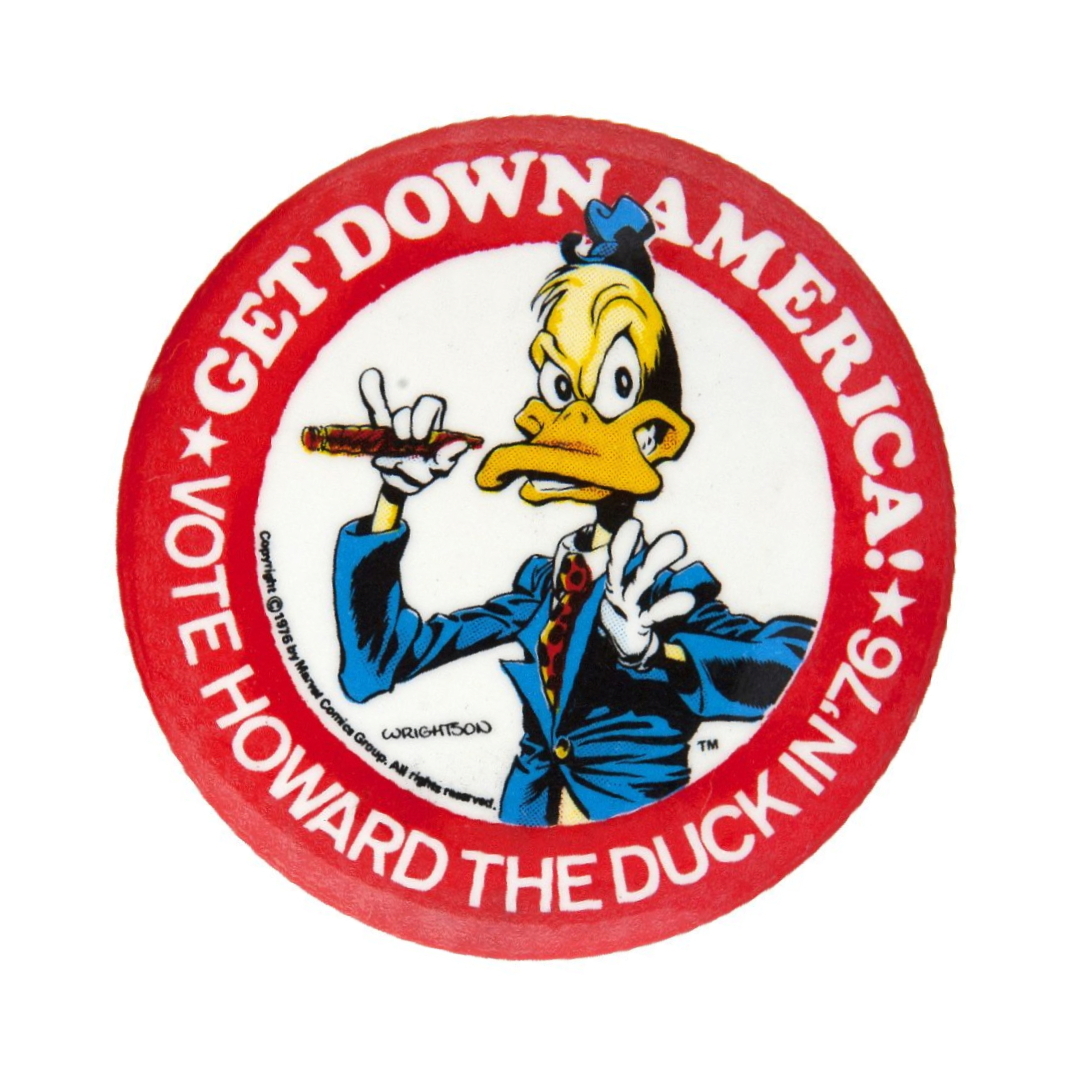
Yep, that’s “Wrightson” as in Bernie Wrightson. Remember him?
Wrightson also found the time to produce Howard’s official “Presidential portrait”, which was made available for mail-order purchase some time after the button:

And, yes, I sent off for that one as well.
We’ll have more to say about Howard’s Presidential campaign in later posts, naturally — but before I close, I feel obliged to confess something about that “Get Down America!” slogan… namely, that it took some four decades for me to finally get the joke.
Wauggh!
Oh, you surely aren’t the only one. I’ve still got mine!
The repetition of #2 didn’t bother me at the time, as far as I can recall. It’s more noticeable now.
Not having seen any images of Steve Gerber, the resemblance to the artist didn’t hit me either.
This is great stuff. Howard was definitely my favorite Marvel character at the time. This particular issue also stood out, in my mind. Even all these years later the section wherein Howard says “Glamorize the outlaw cause he makes it on his own terms even if they’re stupid and destructive” resonates with me. Without climbing up on a soapbox, sooo true! The Godfather, the Sopranos, the movies Casino, Goodfellas and a thousand others, feature “heroes” or protagonists who’s real business is murder. Is it any wonder that so many today, after a lifetime of such “entertainment” have no real moral compass? Anyway, off the soapbox. As Gerber himself mentions Colan just had a knack for drawing people. No cookie cutter creations for him. Every single figure springs to life, whether it’s the boozy bar patrons or the haughty art critic. He just had that knack. His Beverly is uhh yummy too! I smiled at bit over how this go round Howard is pictured in an easy chair reading instead of propped up in Beverly’s bed. A minor concession to the Comics Code Authority mayhap? Either way it’s still the most unorthodox relationship of the 70’s. A decade that included Sonny and Cher and Tiny Tim and Miss Vicki by the way.
People are very bad at telling the difference between “daring rebel who challenges the unfair status quo” and “jackhole who breaks rules that are there for a reason”
As I recall, in the black-and-white Howard magazine, freed from the constraints of the Comics Code, Colan got to draw Beverly topless, which made quite an impression on pre-teen me. Beverly’s slip in this issue is pushing the boundary of what he could get away with in the color comic. I think Leialoha does a fantastic job here embellishing Colan’s notoriously difficult pencils. Hard to believe that Berni Wrightson was in the running to pencil Howard: I’d love to have seen that, even if it only lasted for two or three issues.
Hmm:
I seem to recall letter column suggestions in *Superman* titles in election years that the Man of Steel should run for President, and DC saying that Superman was ineligible, due to his birth on Krypton. (Beyond that, in the Bronze Age, Superman was pretty much twenty-nine years old: old enough for the House of Representatives {25}. but too young for the Senate {30} or the Presidency {35}.)
(The 1986 retcon would allow Kal-El/Clark to become President, according to an*Armageddon 2001* Annual, but we’re in 1976 here.)
Duckworld rules out Howard, sad to say, for had he become Chief Executive, based on his relationship with Beverly, he would surely have taken Abigail Adams’s advice to heart and “Remember(ed) the Ladies.”
Howard’s final observation brought to mind two things, one past and one to come:
In 1967’s “Valley of the Dolls,” a catfight between Neely O’Hara (Patty Duke) and Helen Lawson (Susan Heyward) makes it clear that Helen is wearing a wig…and when she goes out at a ceremony soon afterwards, she handles the revelation with grace and aplomb, getting the crowd on her side.
In 2004’s “Out of the Frying Pan” episode on “Sex and the City,” Samantha Jones (Kim Cattrall) finds her hair falling out due to cancer treatment. Eventually, she shaves it all off, and at an event, she reveals that she’s bald, causing other women present who’ve also undergone cancer treatment to remove their wigs (and lover Smith Jarrod to shave his head in support).
I wonder what Howard would have made of Sinead O’Connor.
Exit, pursued, not by a bear, but by a poem:
Wee Willie Winkie
Rins through the toun,
Up stairs and doun stairs
In his nicht-gown,
Tirling at the window,
Crying at the lock,
“Are the weans in their bed,
For it’s now ten o’clock?
“Hey, Willie Winkie,
Are ye coming ben?
The cat’s singing grey thrums
To the sleeping hen,
The dog’s spelder’d on the floor,
And disna gie a cheep,
But here’s a waukrife laddie
That winna fa’ asleep.”
Onything but sleep, you rogue!
Glow’ring like the moon,
Rattling in an airn jug
Wi’ an airn spoon,
Rumblin’, tumblin’, round about,
Crawing like a cock,
Skirlin’ like a kenna-what,
Wauk’nin’ sleeping folk.
“Hey, Willie Winkie –
The wean’s in a creel!
Wamblin’ aff a body’s knee
Like a very eel,
Ruggin’ at the cat’s lug,
Rav’llin’ a’ her thrums –
Hey, Willie Winkie –
See, there he comes!”
Wearied is the mither
That has a stoorie wean,
A wee stumpie stousie,
That canna rin his lane.
That has a battle aye wi’ sleep,
Before he’ll close an e’e –
But a kiss frae aff his rosy lips
Gies strength anew to me.
(From William Miller, who is not the William Miller of “Almost Famous.” Willie Winkie says: “Only You Can Prevent Rock Stars from Kidnapping Your Daughters and Your Sons!”)
I think he’d have given points to her for taking on the church long before anyone was ready to hear about some of its scandals.
Forgot to mention, it’s an interesting point that the blue-collar, down-to-Earth Howard reads philosophy (Hegel) for pleasure. I don’t know Hegel so whatever significance his choice might have is lost on me.
I always thought Howard was from the USA, just not ours.
I own this one! Very enjoyable. There seem to be quite a few likenesses in this issue, as Colan used a lot of photo reference. The lady in the doorway early in the story who says, But you’re—a–duck!” looks like Alice Pearce who played the original Gladys Kravitz on “Bewitched” and Couture, while somewhat echoing Funky Flashman/Stan Lee, bears a strong resemblance to Vladimir Lenin(!). Is that in itself a sideways remark about Stan? 😉
Alice Pearce:
https://www.imdb.com/name/nm0668879/mediaviewer/rm1500168192/?ref_=nm_ov_ph
Vladimir Lenin:
https://www.onthisday.com/images/people/vladimir-lenin.jpg?w=360
I remember liking Colan a lot more on Howard than some of the other stuff he was working on at the time. The work seemed more finished, as if he had more time to get it done (while the book was bi-monthly, I suppose he did). I was pleasantly surprised. I didn’t stick around for Howard’s whole run-I don’t even think I made it through Gerber’s entire time on the book, but even if I didn’t realize the subtle stuff like Paul Same being based on Gerber, it was still enjoyable. And yes, I had a Howard for President button like everyone else and still have it today. Thanks, Alan!
I forgot what a fast artist Gene Colan was. When he took on Howard the Duck, he was now penciling three series in the mid-1970s, and even if two of them were bi-monthly, that’s still very impressive.
Aw man. I’m gonna sorta go against the grain here today. As I’ve indicated in previous comments, poor distribution meant missing HTD between #1 to #7. However, based on Alan’s excellent reviews, I confess that I would not have cared for any of these issues. Nor did I stick around long once Howard started showing up on the comic book racks.
Why?
Part of it is that this kind of comic book did not appeal to my 15-year-old mind. While I would have certainly enjoyed the Colan-Leialoha art (and their enticing depictions of Beverly!), Gerber’s writing was already starting to wear thin on me. I wasn’t ready for his world-weary cynicism at that age – preferring instead superhero action (ala the X-Men, Avengers and so on).
That said and looking at this now decades later, while I’m still not Steve Gerber’s greatest fan, I appreciate that he found an angle that worked for a comic book with an anthropomorphic duck. I mean, what else was he going to do? Have Howard fight each member of the Ringmaster’s Circus of Crime? Go toe-to-toe with the Toad? Once Gerber exhausted genres to spoof, I credit him with the creativity to shift this series into a direction that clearly kept up interest and sales. Given that my comments make me the outlier today underscore that Steve Gerber was clearly doing something right.
Speaking of doing something right, once again, huge thanks to Alan for yet another outstanding review!
I got this issue about two months before I turned 14, and while my comics habit remained fixated mainly on superheroes for at least 8 more years, by age 15 my interests began expanding to other genres. Of course, it helped that my allowance expanded such that I could afford more comics, and even start buying albums, and somehow I’d gotten seriously fascinated by the Beatles (and not through any older relatives or friends that I knew at the time, but simply through hearing their songs on the radio, even in the mid-70s, years after they’d broken up). I’d never claim to be a “typical” 1970s kid, although admittedly I fit some norms of nerdiness or geekdom.
I’m envious. My comic book collecting was definitely limited by my budget. It used to be that I was allowed only one dollar per week which caused near panic when prices increased to 30 per issue.
At the time of this issue, I didn’t realize it but was just about year from the day I’d quit collecting comics (for a couple years). I bring that up because my attention also drifted into music – an even more expensive habit. I wasn’t as smart as you gravitating to the Beatles. My earliest albums were Boston, ELO, Styx and so on.
On top of that, being a skinny runner with glasses, I wore that NERD hat quiet well. 🙂
It seems Berni Wrightson enjoyed drawing *another* cartoon duck (to offset his mostly moody, serious horror stories) before his brief dalliance with Howard. In 1970 he drew one on the first page of Mary this House of Mystery story (though it didn’t see print until two years later) :
https://blogger.googleusercontent.com/img/b/R29vZ2xl/AVvXsEg4OftPzEkb24g99MiHPoejMgRQaC-3zMoJINaejLQ11NuniGhOiG9CGWIvUfujquO-T3vAP3UWT8yO-itmkFWjd-Crg_nYu5X_EbWrr6_TGWCwqO_6UvRC3MHaP9tNaVMQ2QCLfFvSbz4/s1600/House_of_Mystery_204-02.jpg
And in 1971 on the final page of “Beneath the Dignity of the Apes,” a satire that appeared in Blast no. 1, we see another:
https://pota.goatley.com/magazines/blast-1-1971-02/#k-6
Seems “Mary” as in Skrenes crept into my post, as she wrote the HoM story under her then nom de plume Virgil North.
Mary Skrenes had an interesting comics career.
She published several comics stories for DC under her pseudonym of Virgil North, She published others under the by-line of Steve Skeates, due to friction with editor Joe Orlando (she had been brought into writing mystery and romance comics by Dick Giordano).
She also worked as an assistant editor for Dorothy Woolfolk during an abortive attempt by DC to do “gothic romance” comics in 1971.
In addition to being the model for the character Bev, she was used as the model for a minor character by Neal Adams in the award winning Batman story, Night of the Reaper.
The lady was Bronze Age royalty.”
Xavier Couture, I think, was intended more as a shot at any critic who didn’t understand what Gerber was attempting with his outside-the-norm comics, rather than being aimed specifically at Stan Lee. If it was meant to be Stan the Man (and that wig reveal does leave you wondering), it would be another example of Gerber’s reach exceeding his grasp,.
It’s weird – post HtD, Gerber teamed up with Jack Kirby for the noteworthy Destroyer Duck (after Gerber’s fall from grace with Marvel… and Howard). The Gerber/Kirby collaboration was celebrated as the satirical, intellectual writer teamed with the all-action, more simplistic artist, but it was Jack Kirby who really (really in a big way) nailed the satirical dig at Stan Lee as Funky Flashman in Mister Miracle #6. If Xavier Couture was aimed at the Man, it failed big-time given that a number of us weren’t even sure that he was the target.
I think, as suggested above, this issue did make me less concerned about collecting HtD. It did feel like going over the same ground as #2 and I wondered how many of Bev’s neighbours/exes were going to feature as ‘weird creative individual of the month for Howard to rail against’.
I don’t recall seeing the first three issues of HtD on the comics racks of the Treasure Island Navy Exchange where I got my comics from October 1974 through July 1976, when we moved to Lemoore, CA, but I did see the fourth issue and I can’t say I know what prompted me to give it a try, but I did invest a quarter of my allowance on a mag that seemed very different from the standard super-hero fare that made up my usual picks. Of course, I was already a fan of Gerber’s unique writing and sense of humor. I loved it and kept on collecting the comic until the bitter end (only ever got one issue of the magazine, but I did get the later series, both those by Gerber and not). Not particularly profound but very fun to read. Never had the sort of extreme sleeping problems Gerber had or that of Paul Same and wouldn’t have guessed at the time that Same was a stand-in for Gerber himself. Still, I could relate to the outlooks of both Howard and Paul, and certainly Howard could be taken as a stand-in for other aspects of Gerber’s personality.
Eventually, I did read Howard’s earlier adventures, several in the Marvel Treasury Edition. Both Mayerik and Brunner made splendid versions of Howard, but somehow Colan, for me, conjured up the definitive version. It wasn’t all that distinct from Brunner’s and their styles ably mixed realism and surrealism, as in their respective runs on Dr. Strange. Maybe it’s Colan’s distinctive use of shadows in his art that fit Gerber’s writing of this often-foul-tempered speaking fowl from another world trying to fit in our world but too much of a misfit such that as we’d eventually see he even felt out of place in his own duck-dominated world and even when briefly transformed into a naked ape, he was still out of place. Well, I’ve often felt that way myself. And, clearly, Gerber did as well.
Even the aspect of the “dream-hero” – Paul’s somnambulant alter-ego, Winky-Man, who would do the things Paul might fantasize about doing, to right wrongs and try to force the world to make more sense, but could never consciously bring himself to do – resonated. In the real world, the Winky-Man would have gotten himself killed in short order, but in fantasies he would somehow luck out, like Mr. Magoo seriously near-sighted and seemingly sleep-walking yet through pure happenstance avoiding multiple disasters during his strolls around the city. In Gerber’s fantasy world, the Winky-Man lucks out in part through Howard’s interventions, and while Howard is an absurdist element himself, through his commentary we are reminded of his self-awareness of the absurdity of his surroundings and the people he meets, despite – or maybe actually because – they more closely resemble the surrounding and people we’re apt to meet in the real world.
What a very strange story!
Gotta agree with the sentiments that Steve Gerber has Howard expressing in this issue: “I don’t blame same for nodding off. If I hadda play by this world’s nutty rules… where they penalize ya for being clever and reward mediocrity… and then glamorize the outlaw, ’cause he makes it on his own terms, even if they’re stupid and destructive…”
Gene Colan was a great artist, but a very difficult penciler to ink. A decade ago, when I was putting together my Howard the Duck for President blog post, I asked Steve Leialoha on Facebook what it was like inking Colan on this series. he very graciously replied:
“I like to think I took to inking Gene’s pencils like a duck to water! But, seriously, out of all the pencilers I’ve had the pleasure to work with he was my favorite. Beautiful stuff! Doing a little math: I figure I’d inked about 250 pages up at Marvel before Howard the Duck # 7 rolled around with about 70 of them over Gene’s pencils, so I was ready for it! I look back at it now and see things I would do differently but I’m grateful for the opportunity, all those years ago.”
Leialoha is a great artist in his own right, and I do like the qualities he brought to Colan’s pencils.
Thanks for sharing that, Ben!
I certainly wouldn’t have made any connection back then but my first thought of the critic was that he looked like a devilish Stan Lee then the hairpiece indignity added to that suggestion.
I am also reminded of the quote attributed to the Irish playwright Brendan Behan :
“Critics are like a eunuch in a harem. They know how it’s done, they see it being done everyday
but they can’t do it themselves!”
Maybe that applied to the editor if they interfered too much.
Am impressed with Wrightson’s monochrome Howard image though I am strangely getting Red Skull vibes –
I didn’t start reading HtD until right near the end of his comic run. Iron Duck was my first issue, tying Howard neatly into the Marvel Universe, but in an oblique way through Claude Starkowski, who was probably just lying, anyway. I think Howard might have been my first introduction to Gene Colan’s artwork before discovering anything else he did. And yeah, it’s pretty unexpected that Colan’s artwork works so well on HtD. But I rather liked Dr. Bong, sort of a Doctor Doom lite, if you will.
And I honestly don’t remember when or where I got it, but I did pick up Howard’s Presidential Portrait at some point.
When I was a LT in a DS FA Battalion in Germany in the mid-1980s, one of my collogues was a LT who had also been a comics fan growing up and we both agreed, this issue indicated Gerber had “lost the bubble.”
The book was popular. Gerber had moved away from the genre parodies the issue before. However, this was kind of self-referential and went nowhere.
The next issue was a return to form (or the establishment if a new one).
The Howard the Duck book was an attempt to bring an underground “comix” sensibility to mainstream comics and it was not a complete success. It was not the long period of sharp, thoughtful stories Gerber’s Man-thing had been. However, things like the next issue were among the best things that the mid-1970s produced in comics.
Gerber was neither a consistent creator (nor, apparently, a very happy man) but he did interesting work in a medium few people cared about and (especially for someone influenced by Sartre and Camus) that might be enough . . . .
In other (related) news you may know, Gerry Conway has passed away.
At age 73, of pancreatic cancer. That’s rough.
And Len Strazewski died yesterday too. Loved his JSA run in the 1990s.
Thanks for sharing that, fraser. I hadn’t heard the news yet. And I agree, that JSA run was excellent.
It was.
One of the hand full of “generational” comics stories that felt genuinely so . . . .
Gerry Conway was quite precocious! He broke into writing comics professionally at age 16 at DC Comics in 1969 on House of Secrets. His first Amazing Spider-Man story was written at age 19, no. 111, a classic drawn by Kane & Romita featuring Kraven the Hunter and the Gibbon, and he was only *TWENTY* when he wrote ASM 121-123, all drawn by Kane and Romita, with the deaths of Gwen Stacy and the Green Goblin, and a nice guest appearance by Luke Cage. Remarkable early successes!
He also had an Ace paperback original science fiction novel (The Midnight Dancers) published in 1971. His second science fiction novel (Mindship) was published by DAW Books in 1974.
I believe he had a short story in Harlan Ellison’s second “Dangerous Visions” anthology in 1972. (Given Mr. Ellison’s problems finalizing the final Dangerous Visions anthology, and his comment on Mr. Conway’s comics work that Mr. Conway “should be crucified”) I don’t believe Mr. Conway submitted anything to that volume.)
Mr. Conway also enjoyed a prolific career as a TV writing and producing and Mr. Conway and Roy Thomas did the original story for the second Conan movie.
I read Midnight Dancers when it first came out and hung onto my copy for years, but it’s gone now, and unfortunately, I don’t remember anything about it. Sad to hear he’s gone. I hated “The Death of Gwen Stacy” and had issues with some of his other work, as we’ve discussed on the blog, but there’s no doubt he was one of the great movers and shakers at both Marvel and DC during the 70’s and a talented writer. Condolences to his family.
Nicely said.
When I was in high school, my school had a copy of The Midnight Dancers (which was about four years old at the time). I read and enjoyed it.
At the time, I read Hercules Unbound # 3, which was at least tonally similar.
When Conway took the Marvel writers’ test, I think I read that Lee worried that Conway (already working at DC) was more oriented towards invoking a mood, rather than telling a story, as DC writers did.
I think Conway, unlike Engelhart; Wolfman; or MacGregor was less interested in telling long complex stories and more interested (or at least open to)telling a “one and done” story about an interesting character.
Conway did a story in Kull #6 about a gladiator who does not assassinate Jull and dies seeming a poisonous flower.
I also liked a Spider-Man story he did about a mutant known as The Mind Worm or his take on Orpheus in Hercules Unbound # 3 or the odd (but interesting) Kamo Tharn in Thor #235 or his interesting reinvention of Dr. Destiny in JLA # 154 (although Neil Gaiman seemed to make light of it in Sandman).
He had a letter published in FF50 , he would have been about 14, which he went on to write of course. I also remember his run on Thor from 193 until UK distribution basically petered out.
This comic gave me slime I have been using for 50 years; “You wouldn’t know—-if it came up to you and not the psoriasis off your elbow.”
Thank you, Steve Gerber.
For some reason I was not impressed 50 years ago. Maybe it was a disappointment that the Master of Quack-Fu did not feature, and neither was it heavily invested in what Marvel had been recently publishing ( sword & scorcery, super-heroes, kung-fu). What’s really nice about your blog Alan is all the research that you put in, giving us an insight that would have escaped us, definitely at the time, and sometimes even now. So, now knowing of Gerber’s sleep condition, that Winkey-Man is a take on the original Sandman, or that Xavuier Couture is a swipe at Stan I can understand more of the under-currents riding below the wabves. Anyway now older, with more knowledge (and alas, not much wiser) I am now quite appreciative of this comic. Many thanks Alan for featuring it.