
At the end of last Saturday’s Tomb of Dracula #47 post, I promised you that the next installment of this blog would feature “the strange, sad story of Ghost Rider #19.” But, as anyone out there who already knows some version of this tale is well aware, its origins go back well before the May, 1976 publication of the comic whose Gil Kane-Frank Giacoia cover appears at the top of this post. To begin with, this specific issue presents the conclusion of a multi-part storyline that had kicked off in Ghost Rider #17; but beyond that, the ongoing plot lines that find their (more or less) ultimate resolution in this arc extend back at least to Ghost Rider #8 (Oct., 1974)… and, arguably, all the way back to the feature’s debut in Marvel Spotlight #5 (Aug., 1972). And seeing as how we haven’t discussed any issues of this series since July, 2023, when we hit the high points of Ghost Rider #1 and #2 in the context of covering the debut of spinoff character Daimon Hellstrom, the Son of Satan, in Marvel Spotlight #12 (Oct., 1973), we’re going to have to do some catching up to properly set the stage. So let’s get to it, shall we?

Cover to Marvel Spotlight #5 (Aug., 1972). Art by Mike Ploog.
As you may recall, the basic premise of the “Ghost Rider” feature, as established by the initial creative team of writer Gary Friedrich and artist Mike Ploog, involved the very poorly advised decision by a young motorcycle stunt-rider named Johnny Blaze to barter his soul to Satan for the life of his mentor and father-figure Crash Simpson, who was slowly dying of cancer. Naturally, once the deal was struck Satan double-crossed our hero, arranging for Crash to die violently in a cycle stunt gone wrong before his disease could take him. The Devil then proceeded to claim his fee in the form of turning Johnny into the Ghost Rider — an emissary of Hell whose head was a flaming skull and who wielded the powers of a demon. But Satan was stymied in his efforts by Roxanne Simpson — Crash’s daughter, as well as Johnny’s beloved — the purity of whose devotion for Johnny prevented the Lord of Hell from taking complete ownership of the stunt-cyclist’s soul. Instead, Johnny would become the Ghost Rider only at night, and would retain his autonomy — allowing him to become, as MS #5’s cover proclaimed, “the most supernatural superhero of all!”

Cover to Ghost Rider #6 (Jun., 1974). Art by John Romita.
That claim notwithstanding, throughout the remainder of GR’s Marvel Spotlight run, as well as for the first few issues of his own title, his exploits tended to emphasize the “supernatural” aspect of the series over its “superhero” elements, with most of his adversaries being connected to the feature’s ongoing Big Bad, i.e., Satan, in one way or another. That began to change following the departure of Friedrich as writer (for the record, Ploog had ceased drawing the feature after its fourth installment), as relative newcomer Tony Isabella came on board as the book’s new regular scripter beginning with issue #6.*
As Isabella told the late David Torsiello (better known to longtime readers of this blog as our much-missed commenter “crustymud”) for a Ghost Rider retrospective published in Back Issue #95 (Apr., 2017):
Before I started scripting the issue, I reread all of Gary’s work on the character. I realized I couldn’t duplicate his wild mix of motorcycles and sorcery. I didn’t have the affinity for that sort of story for an ongoing series. So, with editor Roy Thomas’ okay, I added more superhero elements to the title.

Cover to Ghost Rider #8 (Oct., 1974). Art by Gil Kane and ?.
Of course, Isabella couldn’t simply drop the Satanic subplot from the series with no explanation; it was too baked-in to the overall concept. Johnny Blaze either needed to defeat the Devil once and for all (obviously a tall order) or find some other way of getting Old Nick out of his hair for an indefinite period. Things ultimately came to a head with issue #8, as Satan showed up in person to claim full ownership of Johnny’s soul, Still blocked by the pure love of Roxanne Simpson, the Lord of Hell found a way to trick the young woman into willingly renouncing her protection of her boyfriend by revealing that her own dearly departed dad, Crash, was being tormented in Hell — and she could only free him by betraying Johnny. Faced with this impossible choice, in the next issue Roxanne opted to save her father, and formally renounced her protection of the Ghost Rider… only to have Satan tell her he’d been lying the whole time, and Crash Simpson’s soul had never been in his possession at all. Oops. Still, the deed was done, and it was hard to see how Johnny Blaze was going to get out of this one.

Cover to Ghost Rider #9 (Dec., 1974). Art by Gil Kane and Tom Palmer.
Indeed, Tony Isabella herself wasn’t sure how to get the hero out of the fix she’d written him into. As she recalled in 2020 for her introduction to Marvel Masterworks — Ghost Rider, Vol. 2:
Ghost Rider #8 was a pivotal issue for my run. It’s the issue where I figured out what I wanted to do with Johnny. It took what seemed like an inescapable dire fate on the last page of the story, a fate that, when I plotted the issue, I had no absolutely no idea how to resolve in Johnny’s favor.
Enter one of the greatest comics writers of my generation: a one-of-a-kind genius named Steve Gerber. Steve was one of the most generous writers I ever worked with. He was open to ideas from other writers, such as when I suggested that he team the Thing with the Guardians of the Galaxy in Marvel Two-In-One. He was also giving of his own time and talent to his fellow writers. And, man, did I need him when it came to figuring out what to do in Ghost Rider #9.
…At the end of issue #8, Johnny was on his way to eternal damnation. Satan had tricked Roxanne Simpson, our hero’s pure-of-heart girlfriend, into renouncing her protection of the now-doomed Johnny. It was an exciting cliffhanger, but, as stated previously, I had no idea how to resolve it. Which is when Steve looked at me and said, “Why don’t you have God save him?”
Boom!
Fifteen pages into GR #9’s 18-page “The Hell-Bound Hero!”, the Ghost Rider has managed to vanquish Satan’s servant Inferno, a one-eyed demon who had earlier mind-controlled the populace of San Francisco into attacking our protagonist — unfortunately, it doesn’t look like that victory is going to matter much in the end (art by Jim Mooney and Sal Trapani)…


Here again is Tony Isabella, writing in her Masterworks intro:
Marvel had more than its fair share of Satanic figures, including Satan his own bad self. But, unless you want to talk Thor and his Nordic bunch, we didn’t have much from the other side. That changed with Ghost Rider #9.
Johnny was saved by a “friend” who stood between him and Satan and announced Satan had no further power over our flaming-skulled hero. I never explicitly identified this friend, but he was Jesus Christ — a historically inaccurate Caucasian Jesus sometimes called “Hippie Jesus” by my Bullpen buddies, but the son of God nonetheless. The reader response was over-the-top positive.
Speaking as one of those original readers, I was definitely one of those who responded positively. At the time, your humble blogger was still a devout Southern Baptist, and while I didn’t think it was likely that Jesus Christ would show up in the flesh in a modern American city, I would have had to admit I thought it was at least possible (much in the same way that while I believed in the real-world existence of Satan as an actual spiritual entity, I doubted he’d ever corporeally manifest as a horned, red-skinned humanoid). There may have been a niggling voice in the back of my mind that questioned some of Isabella’s storytelling choices from a doctrinal standpoint (according to my received belief system back then, while the intercession of Johnny’s “friend” might have saved his bacon for the moment, unless he eventually accepted Christ as his personal Lord and Savior he was still going to go to Hell when he died… just like every other non-believer in the world, regardless of whether or not they’d ever made a literal deal with the Devil) — but, overall, I very much appreciated the writer’s effort to provide balance in Marvel’s fictional cosmology through bringing a representative of “the other side” into the mix.
For Tony Isabella, this plot twist ultimately had significance beyond the initial “get Johnny out of Hell free card” moment. Again, here’s the author:
This “friend” allowed me to make Ghost Rider my own. Overwhelmed by guilt at almost damning her beloved, Roxanne left to figure out who she was. Left without the motorcycle stunt show that had supported them both, Johnny became a wandering hero, not unlike Kid Colt and the Rawhide Kid in the Western comics I loved… I was excited about these new possibilities that were now open to me because of Steve’s suggestion.

Cover to Champions #1 (Oct., 1975). Art by Gil Kane and Dan Adkins.
Ironically, the same “new possibilities” that so excited Tony Isabella were mostly a turn-off for my younger self. As a horror comics fan, I’d been invested in Johnny Blaze’s battle against the Devil, enough so that I’d kept with the series even when it took what I considered to be a downturn in visual appeal following the departure of original artist Mike Ploog. I was, however, much less interested in following Johnny’s exploits as a modern-day, super-powered cowboy — and so, Ghost Rider #9 proved to be my jumping-off point. Between the release of that issue in September, 1974, and of GR #17 in January, 1976, my only encounters with the character came via his appearances in other titles — e.g., his team-up with the Thing in Marvel Two-in-One #8, his one-off outing with “The Legion of Monsters” in Marvel Premiere #28, and (last but not least) his ongoing gig in The Champions — a super-team title (written by Tony Isabella) where the Ghost Rider’s role as a founding member helped cement his new status as being more a standard superhero than a horror-type character.
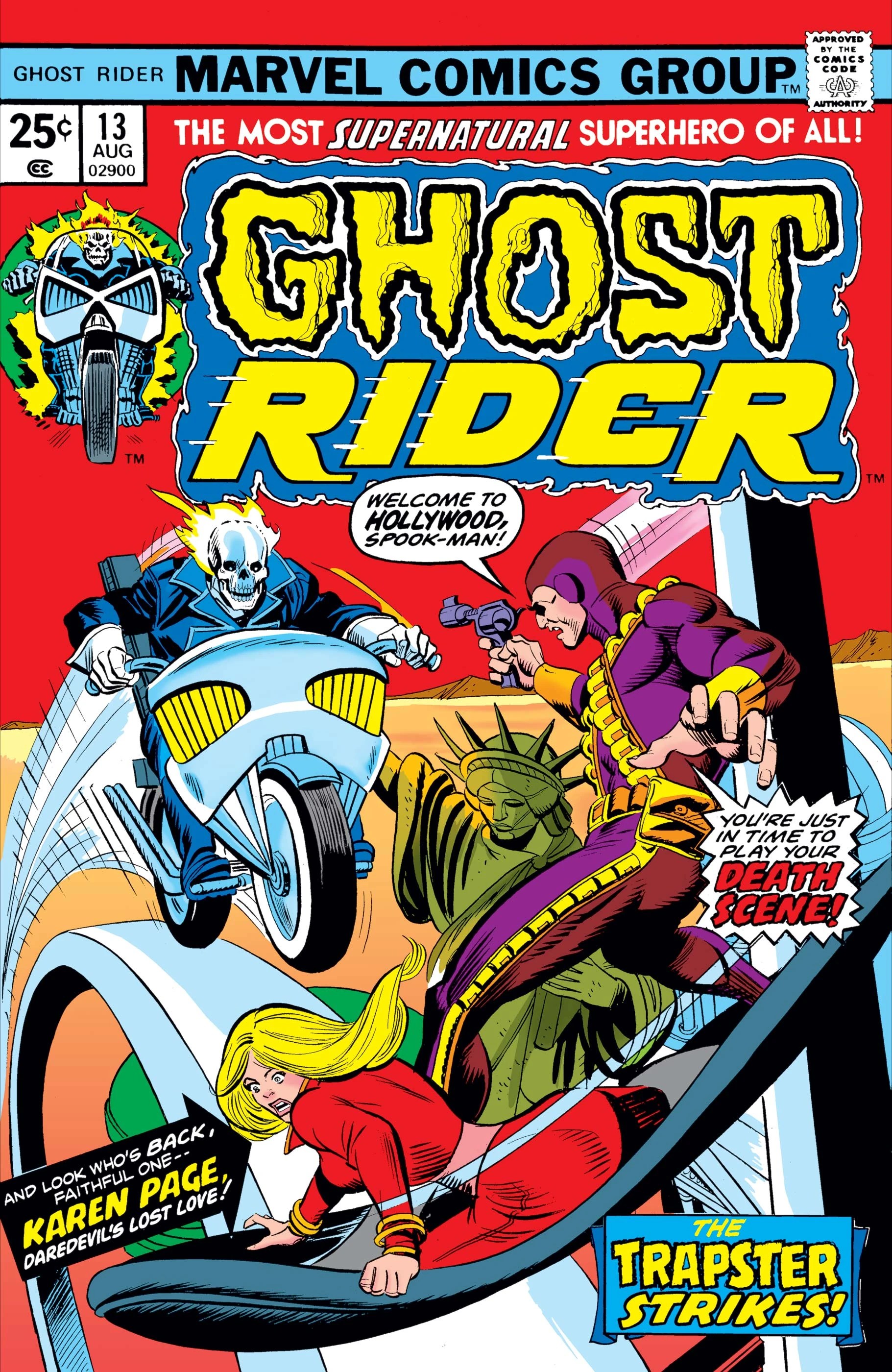
Cover to Ghost Rider #13 (Aug., 1975). Art by Gil Kane and ?.
Meanwhile, over in the regular Ghost Rider series, Isabella and her collaborators were getting the titular hero involved with some well-established non-supernatural denizens of the Marvel Universe, including the Hulk and the Trapster (as well as one ghost, that of the World War I hero the Phantom Eagle). Issue #13 saw Johnny Blaze take a job in Hollywood as a stuntman for Delazny Studios, where he encountered not only a reformed former foe of Daredevil called the Stunt-Master, but also DD’s ex-girlfriend Karen Page — who, as you may remember from one or more of our old posts, had left her secretarial job in New York after breaking up with Matt Murdock and moved to L.A., where (of course) she had immediately found success as a screen actress. Along with Karen and the Stunt-Master, Johnny Blaze picked up a few other new supporting cast members courtesy of his latest gig, including Karen’s stunt-double Katy Milner, and a nice young married couple named Wendy and Richard Pini — yes, that Wendy and Richard Pini, though they were portrayed here as studio employees, rather than the comics-fans-soon-to-turn-pro they actually were in 1975 (for the record, the Pinis’ signature project, Elfquest, would ultimately debut in 1978).

Cover to Ghost Rider #15 (Dec., 1975). Art by Sal Buscema and ?.
All of these new players would figure into Ghost Rider #14-15’s two-part adventure featuring the return of the Orb (a villain who’d been first introduced in Marvel Team-Up #15 [Nov., 1973], where GR had co-starred with Spider-Man). In the second half of this story, the Orb wounded Katy Milner and captured Karen Page, but was ultimately taken down by the Ghost Rider. A furious Johnny Blaze was prepared to beat his defenseless foe to death, but was brought up short by the intercession of Karen Page and… someone else (art by Bob Brown and Don Heck):

We should note here that while this is the first “real” appearance of Johnny’s “friend” since issue #9, he’d been mentioned and shown in flashbacks several times in the interim. Clearly, Tony Isabella hadn’t forgotten about the character — or, for that matter, about Satan. And so, following a fill-in story by other creators in #16, Ghost Rider #17 saw the “friend”‘s prediction about our hero’s soon getting his chance to beat the Devil once and for all come to fruition. (And just in case you’re wondering, the other impending showdown alluded to on the page above — the one against the Greek god Pluto — would be chronicled in Champions #3 [Feb., 1976]).
Writing in her Masterworks intro, Isabella described her intentions for the three-part storyline beginning in #17:
Ghost Rider #17-19 were intended to be the conclusion of the story I had been working toward since I introduced the “friend” over a year earlier. Johnny would be tested as never before, risking all to save a loved one, even at the cost of his own soul. Ultimately, when all seemed lost, he would accept Jesus as his Lord and Savior, albeit not in so many words.
Aware of this development’s sensitivity, Johnny’s salvation would be written in non-denominational Marvel-speak. The result would be his defeating Satan once and for all, or for at least as long as I was writing the book. It would make the final transition of Ghost Rider from a supernatural super hero book to a super hero book with very occasional supernatural overtones.
I was thinking of Joe Simon and Jack Kirby’s Stuntman with Johnny as a white-hat cowboy in the gray world of Hollywood. The only nods to his being a born-again Christian would have been the addition of a minister to the cast and a very occasional church scene. Otherwise, it was going to be crazy stunts, human interest and super villains.

Cover to Ghost Rider #17 (Apr., 1976). Art by Rich Buckler and Dan Adkins.
Ghost Rider #17 was also where your humble blogger jumped back on board Johnny Blaze’s ride, metaphorically speaking — mostly, I think, because of the cover’s featuring the Son of Satan (whose series I’d continued to follow through its Marvel Spotlight run and on into its own title) — that, and its promise that, at least for this one issue, GR was going to be getting back to fighting the hordes of Hell, as I preferred.
As the story begins, Johnny Blaze is reporting to work at Delazny Studios, only to be told that the television program he works on has temporarily shut down, in part because of Katy Milner’s “serious” injury. This doesn’t make sense to our hero, who knows that the Orb’s bullet merely “grazed” Katy — so he calls up his new pals, the Pinis (art for this and the next two issues by Frank Robbins and Vince Colletta):
This is probably a good place to mention that, as of issue #13, Johnny Blaze transforms into the Ghost Rider in the presence of danger, rather than at nightfall. Got that? OK, so — for all of GR’s Satan-spawned powers, exorcism is not really in his wheelhouse; however, he does know a very good exorcist, and thus proceeds to put in a call to Daimon Hellstrom. By the time this issue’s special guest star arrives, however, Katy Milner’s entire hospital room has been transformed into a Hellscape, and our heroes are required to violently subdue the multiple demons who’ve been possessing the young woman before they finally manage to reach her bed…


Cover to Ghost Rider #18 (Jun., 1976). Art by Rich Buckler, John Romita, and ?.
The story continues into issue #18, as Johnny Blaze finds “The Salvation Run!” filled with a variety of obstacles that, illusory or not, mess mightily with his head. Among them are the figures of his estranged girlfriend, Roxanne Simpson, and her late father Crash, followed by a number of his enemies from past adventures… and that’s not even the worst of it. Rather, this is:

Johnny may still be unwilling to give his “friend” the name he knows belongs to him (as is Tony Isabella). But in depicting this individual being crucified, our storytellers have made it even clearer than before who we’re dealing with here. It’s virtually impossible to imagine any reader of 1976 not “getting it” at this point, no matter how obtuse they might have been up to now,
The Ghost Rider proceeds to take out the villains one by one, until only the native American sorcerer named Snake-Dance is left…


The sudden appearance of the Thing is rapidly followed by those of GR’s other super-friends, including Spider-Man and the full roster of the Champions. By the time Spidey strings him up in a web, and the Black Widow turns him back into his human, powerless form of Johnny Blaze, our hero’s spirit has been pretty well crushed. Which is where we find him on the opening splash page of Ghost Rider #19…


Wait, what’s this now? Johnny’s “friend” was nothing but a trick of Satan all along? That… can’t be right.
While I don’t know for sure that this happened, it’s easy for me to imagine that, back in May, 1976, my eighteen-year-old self paused here, then flipped back three pages to confirm that the script for this issue had indeed been credited to Tony Isabella — presumably the same Tony Isabella who’d written the two previous chapters of this trilogy, not to mention the story in GR #9 that had introduced the “friend” in the first place. Something had clearly gone very wrong — but what?
Here’s Isabella’s account from her 2020 Marvel Masterworks introduction:
It [i.e., the entire “friend” plotline, culminating in Johnny Blaze’s “salvation”] was approved by three different editors: Roy Thomas, Len Wein and Marv Wolfman. They all knew where I was going with the story. They were all on board with this plan. Alas, Marvel in those days was frequently a place of chaos, and, in that chaos, my well-crafted plan was upended.
An assistant editor was grievously offended by my tale. Taking it upon himself, he pulled it from production and rewrote it to both change my ending and pretty much all of the key Johnny/Satan bits from my entire run. I know this to be true because the individual in question told told me to my face what he was doing.
I’m not going to dwell on that beyond stating my opinion that the rewritten story makes no logical sense. Disappointed fans have been asking me what happened for over four decades. I shrug my shoulders and tell them what was supposed to have happened.
Perhaps due to the exigencies involved in writing for an official Marvel Comics publication, Isabella has been circumspect here in not revealing the identity of the “assistant editor” involved in rewriting her story; however, in several other venues, including a comprehensive article written in 2000 that’s available online here, she’s been clear that the person in question was the late Jim Shooter. A note in the letters column of Ghost Rider #19 thanking Shooter “for stepping in with a scripting assist this issue” pretty well confirms that identification.
For the record, Shooter himself acknowledged his role in the incident on a number of occasions, including in the comments section of a 2011 post on his personal blog, and also in a 2016 video interview — though, as might be expected, his version of events doesn’t completely align with Isabella’s. We’ll get into the “she said/he said” of the matter later in this post — but for now, let’s go ahead and see how “Resurrection”, as published, ultimately played out…


The rejuvenated Ghost Rider makes the most of his unexpected chance, but he’s still outclassed by the “archdemon” who calls himself the Challenger. After three pages of so of valiant resistance, it appears that Johnny Blaze’s number has finally come up…


In Jim Shooter’s rewriting of Tony Isabella’s original resolution, instead of being saved by Jesus Christ, the Ghost Rider escapes Satan’s power… how, exactly? Per his own musings, Johnny Blaze doesn’t quite understand what’s just happened — and neither do we readers.

OK, maybe I should have mentioned this earlier, but there’d been a little romantic tension going on between Johnny Blaze and Karen Page in recent issues; the two had even shared a kiss at the end of issue #13. But in #17, during a rare moment of downtime while waiting for Daimon Hellstrom to show up at the hospital, Johnny had come to realize that he was in fact a “one-woman man“, and that woman was Roxanne Simpson. Unfortunately, he’d had no chance yet to discuss this with Karen, and thus… ooh, awkward!
Actually, it’s a lot worse than awkward, as the distraught Karen flees from the distressing sight of Johnny smooching another woman right into serious personal jeopardy, in the form of an old Daredevil villain named Death’s Head — who, in addition to be Karen’s father, is supposed to have died back in DD #57 (Oct., 1969). This all goes down in a two-page “Prologue” which, along with closing out this issue, sets up a crossover between Daredevil #138 and Ghost Rider #20 — a crossover that was originally conceived by Tony Isabella but was in the end written by Marv Wolfman, as Isabella left GR after this issue, and would soon thereafter be out the door at Marvel Comics completely. (For what it’s worth, your humble blogger bought both parts of the crossover but remembers very little about them; in any event, their contents are largely irrelevant to our present discussion.)
And now, with GR #19-as-published behind us, let’s return to the question of why and how Jim Shooter –at this time a 24-year-old comics pro who, prior to coming to work for Marvel in late 1975, was best known for his writing for DC Comics in general, and for DC’s “Legion of Super-Heroes” in particular — became involved in altering the conclusion of Tony Isabella’s Ghost Rider storyline in the first place. The following first-person account comes from Shooter’s 2016 video interview (please note that your humble blogger has lightly edited YouTube’s auto-generated transcript in the interest of readability, as well as made a few minor abridgements [indicated by ellipses]):
I was the brand-new associate editor, and and I was it was my job to edit all these books that were coming in, and look at the plots, look at the scripts, look at the pencils, try to head off any major catastrophe mistakes, so we weren’t correcting things finished and lettered in the production department. So, I don’t know how soon after I started doing this, but an issue of Ghost Rider comes in — I guess it was scripted and penciled at that point, maybe even lettered. So I read it, and I read some back issues just to find out what was happening, and Tony Isabella had been doing this storyline where several times a figure who appeared to be Jesus Christ, who seemed to be Jesus Christ, would show up and kind of almost magically rescue Ghost Rider or whatever. He identified himself as “a friend”, and a lot of it was fairly blatant that this was Jesus Christ.
Well, in this issue which was the wrap up of that storyline, this first issue that came across my desk, in the end it turns out it really was Jesus Christ, and that between him and Ghost Rider they chase the Devil away, and God grants Ghost Rider his powers by divine intervention, so he can keep being the Ghost Rider. And it basically established that the Marvel Universe is a Christian universe. And I thought that didn’t sound right [laughs] so I mean like I didn’t really have enough authority to really, just, you know, I wanted Marv’s approval before I did anything about this. So I went and I showed this to Marv and he was outraged and I’m thinking, like, didn’t you see this coming? No, apparently not.**
So I guess I called Tony, and I said, “You can’t do this, Tony.” Apparently Tony had become born-again or something, I don’t know. Anyway, for some reason he wanted this and he wanted it badly, and I finally said, [you] can’t do this. I said if you won’t fix it, I will. When God comes down and grants you your powers, that’s not just the acknowledgement of Christianity — that is, this is a Christian universe. There is a God, [there is] Jesus Christ, they’re running everything. It was ham-handed; let’s put it that way. It was like having on panel in a Marvel comic book proof that all other religions are false [laughs], and it just didn’t seem like some place we should go in a Marvel comic book. And so, like I said, with Marv’s blessing… I fixed it.
And what I did was I changed the ending of the story. I had some redrawing done, rewrote the ending of this story to make it that this whole thing with Jesus Christ was actually a deceit perpetrated by Mephisto and it was all false. It was all set up for Ghost Rider, and it was Ghost Rider himself who overcomes Mephisto and retains his powers because he’s still the demon, the Spirit of Vengeance, and you know, try to make it make sense in the Marvel Universe, and that’s the way the story ran… That was my training when I was at DC. [Editor] Mort [Weisinger] explained it: look, you’ve got all kinds of readers all over the world, all kinds of people, all different. You can’t just exclude this group, or alienate these guys…
Any third-party attempt to adjudicate between Isabella’s and Shooter’s conflicting accounts of this incident is constrained by one unfortunate fact; Isabella’s original script for Ghost Rider #19 is not only unavailable, but evidently no longer exists. (In her 2000 article “No Heaven for Superheroes”, Isabella wrote, “I’ve never been able to turn up a copy of my original script for ‘Resurrection.’ It was probably lost in all the relocation I did back then.”) That said, Isabella has consistently asserted that the language she used to describe Johnny Blaze’s salvation by Jesus Christ was (in the words of her Marvel Masterworks introduction) “non-denominational Marvel-speak”; Shooter, on the other hand, characterized the script as establishing “that the Marvel Universe is a Christian universe” (though, to the best of my knowledge, he never claimed that Isabella’s text actually included the names “Jesus” or “Christ”, or even “God”).
But even if we’re unable to subject these competing claims to a thorough forensic analysis, there are some observations worth making based on the facts that we do have. For me, perhaps the most salient has to do with what else was going on in Marvel’s comics of this time — most particularly, what was happening in Tomb of Dracula, a title both written and edited by Marv Wolfman. As we’ve discussed in a couple of recent posts (including the one immediately preceding our current entry), Wolfman and his artistic collaborators, Gene Colan and Tom Palmer, had very recently launched what would ultimately prove to be a twenty-six part story arc, involving Count Dracula’s attempt to pose as Satan and establish his own church, while also taking a wife and siring a son.
Much of this took place under the watchful eye of a painting of Jesus (who was never identified by name, but didn’t need to be — at least, not for anyone familiar with the traditional depiction of Christ in Western religious art), which Dracula tried in vain to remove from the deconsecrated church in which it hung…

One issue later, on the occasion of Dracula’s wedding to the beautiful Satanic cultist Domini, we got a strong indication that Dracula’s seeming helplessness against what appeared to be a mere pictorial representation of the Son of God wasn’t just a momentary fluke…

From Tomb of Dracula #46 (Jul., 1976).
OK, so a couple of tears falling from a painted eye could be taken as simply a bit of artistic license on our storytellers’ part. But then, in the very next issue, we have the following full-page splash, which comes in the midst of the mystic rite by which Dracula and Domini intend to conceive a child:

From Tomb of Dracula #47 (Aug., 1976).
Surely there can be no doubt as to who is being referred to on this page as “the one who simply watches“, or “he“, even if his name is never spoken. And to be absolutely clear: these are the words of the story’s omniscient third-person narrator, so subjectivity doesn’t enter into the equation.
Later in the story, it’s strongly implied that “he” offers forgiveness to Domini’s estranged father, who tries to stop the conception rite via a murderous rampage. And, on the story’s final page, Domini is shown to be thinking to herself that “he” has interfered even more directly in the rite itself, so that in nine months, the son she bears “will not be the Devil’s son at all.”
For the record, this issue was released to newsstands on May 4, 1976 — just one week ahead of Ghost Rider #19.
As I’ve already noted, these three issues of Tomb of Dracula were the opening chapters of a lengthy storyline that would extend virtually to the end of the title’s run. I’m loath to get too deep in the woods of a narrative that I expect to be covering in some depth over the next couple of years, so suffice it to say that the story could hardly be said to become less religious as it progressed. And that religious theme evidently remained important to Marv Wolfman, long after he’d stepped down as Marvel’s EIC — enough that he was willing to go toe-to-toe with the Comics Code Authority over it. As he related in an interview conducted in July, 1978, and published in The Comics Journal #44 (Jan., 1979):
I have not had an issue, almost, go by, since I introduced Domini into the storyline that I haven’t been censored by the Code in one fashion or another. The entire “Dracula-speaking-to-the-Christ-painting,” there is not one line of copy in any of those pictures of Dracula and the painting, that was what I wrote. I did all the rewriting, but that is not the initial copy… And not that anything was in there that should have been censored; every single one of them was Dracula realizing as he’s speaking to the picture of the Christ that he’s losing and that he was being defeated and that there’s no way for him to fight. And as I’ve tried to point out more than once to this Code, it’s perfectly permissible to show Hell and Satan and damnation, but you can’t show God winning.
Wolfman went on to describe how the Code had objected to the very name of the character Domini (which came from a Latin word meaning “of the Lord”), adding:
But then again, one of the strange reactions I received in speaking with [Code administrator] Len Darvin, whom I happen to like, I just think that his job is a job that should not exist, is that I’m Jewish and he’s Jewish and he’s telling me that it would offend Catholics. Now one of my friends happens to be a very religious Christian and I usually checked out things with him first because my knowledge of the Christian religion is probably one step below my knowledge of Judaism, which isn’t great…*** Anyway, he approved of everything, and I’ve gotten letters from priests who’ve agreed with what I’ve written. I spoke with some other religious people who are comic book fans and they have all felt I was handling the Christian religion positively, and yet, one Jew is telling another Jew, “That’s not good.” I couldn’t argue with him, because you couldn’t point that out. It just doesn’t work. It just doesn’t work at all. It bugs me, ’cause I’d like to do a religious storyline and with Dracula I think it’s vital that religion be mixed into the storyline…
I don’t know about you, but these don’t sound like the sentiments of someone who, as an editor, would have been “outraged” by another Marvel writer using Christian elements in a story, in the manner described by Jim Shooter. Unless, perhaps, Tony Isabella really did go to extremes in her script for GR #19, unambiguously identifying Johnny Blaze’s “friend” as Jesus Christ, and describing Johnny’s salvation experience with the very specific, sectarian sort of language you’d find in, say, a vintage Jack T. Chick tract.
But let’s give Shooter the benefit of the doubt, at least for a moment, and assume that this is what Isabella did. If so, the question becomes: was the right way to handle the situation to rewrite the script for “Resurrection” so extensively that it retroactively upended everything else Marvel’s readers knew about the “friend”, going all the way back to Ghost Rider #9? Couldn’t the story have had a resolution where this mysterious character had a role in securing the hero’s deliverance, without getting into any explicit “born-again” business? Something like what had gone down before in GR #9 — or what was going down at this very same time over in Tomb of Dracula? It’s hard for me to imagine anyone arguing seriously that Shooter’s “fix”, whether approved by higher-ups at Marvel or not, was the only way to deal with this problem caused by Isabella’s script — assuming, again, that there even was a problem.
In 2000, Isabella wrote:
I did not then and do not now feel this story was in any way improper. In a comics universe where Satan exists, even the non-Christian reader should be able to accept the presence of a force opposing the Adversary. My own beliefs notwithstanding, I looked on this as mythology, not theology.
Fifty years after the fact, that assessment sounds about right to this non-believer.
Back n 1976, of course, my disappointment with the outing of Johnny’s “friend” as a Satanic deception was more personal, and probably more deeply felt — and that was without my having any inkling of what Isabella had planned for the future. Would I have continued reading Ghost Rider if the character had indeed become a born-again, churchgoing Christian (however vaguely that might have been indicated)? It’s possible — although, since I’d already given up on the character once, when Isabella first began steering the series in a more conventionally superheroic direction that, by her own account, was only going to become more focused, I have my doubts. Maybe if a more appealing (to me) artist had succeeded Frank Robbins as the book’s regular penciller, I’d have given it another chance, but that’s not how things went down. (For the record, both parts of the crossover with Daredevil that immediately followed Ghost Rider #19 were drawn by a young up-and-comer named John Byrne, but he didn’t stick around.)
As for Tony Isabella, you could say that she landed on her feet; since, soon after leaving Marvel Comics she (with artist Trevor Von Eeden) would create DC Comics’ first African-American superhero to star in their own title, Black Lightning — an achievement which, if only in terns of its historic significance, arguably puts the bulk of her Marvel work in the shade. (Whether or not the author herself sees that as a reasonable tradeoff all these years later, I have no idea.)
Taking a wider-angle view from that same historical perspective, this episode can be seen as a portrait-in-miniature of the general anarchy that prevailed at Marvel Comics in the early-to-mid-1970s. Fostered in part by an editorial structure that required a single staff person to oversee the contents of as many as forty color comics in a given month, a sense of creative freedom encouraged freelance writers and artists to take big swings, often with impressive results. Unfortunately, that same anarchy also appears to have resulted in an extravagant number of blown deadlines, requiring the emergency use of reprints and fill-in stories that made no one happy; it may also have allowed certain novice editorial staffers a freer hand to shape the contents of Marvel’s books than they might have had if their bosses hadn’t been so overstretched, though that’s pure speculation on my part.
More specifically, the way the episode ended can be taken as a harbinger of things to come, as Marvel’s editorial staff tried to get a stronger handle on things. That process would only come fully to fruition in 1978, when the editor-in-chief position passed to one Jim Shooter. But the ongoing efforts had an impact on the company’s heretofore freewheeling ways well before that, with Tony Isabella’s departure from Marvel followed in short order by that of another writer, Steve Englehart… though that, naturally, is a topic for another post — one that’ll be coming your way ten short days from now.
*For those not already aware of this fact, the writer known to comics readers for over half a century as Tony Isabella came out as transgender in February, 2025. In a 2/11/25 blog post, Jenny Blake Isabella announced her intention to write under both the names “Jenny Blake” and “Tony Isabella” going forward, noting that she did not consider the latter to be a dead name and would (at least for the time being) continue to present at conventions and autograph fans’ comics as “Tony”, as well as let her credits for her earlier work stand as originally published. Bearing that in mind, I’m referring to her as “Tony Isabella” in this historically-oriented post, while also using her present-day, authentic pronouns.
**To the best of my knowledge, the only public statements Marv Wolfman has ever made concerning this matter were in his sworn testimony given in 1999 in Wolfman vs. Marvel Characters, the case in which he unsuccessfully sued Marvel for ownership of the character Blade. At that time, Wolfman said he didn’t remember the Ghost Rider incident at all, but also said that if Shooter had brought a matter involving “the words of Jesus Christ” to his attention, it would have been “a very very incredibly minor thing that I would have made a decision in about an eighth of a second or gone to Stan [Marvel publisher Stan Lee]...” (Wolfman’s complete testimony was published in The Comics Journal #236 [Aug., 2001] and is available online through subscription. Relevant excerpts are also available via a 2016 blog post by R.S. Martin.)
For the record, Jim Shooter claimed in his 2011 blog comments that Stan Lee was himself aware of the Ghost Rider situation and that he, as well as Wolfman, considered it “inappropriate” to have the hero “redeemed by Christ in the flesh, on panel.”
***Many issues prior to the beginning of the “Church of Dracula” storyline, in Tomb of Dracula #27, Wolfman had established that the Jewish Star of David was just as efficacious against vampires as the Christian cross or crucifix, strongly suggesting that both religions were equally valid, at least where the power to oppose supernatural evil was concerned.
I never bought Ghost Rider, though somehow Marvel Team-Up no. 15 found its way into my collection, probably because the villain the Orb looked interesting to me.
“The friend” subplot in Ghost Rider has been well documented online on years past, with different artists making him look almost East Asian in some issues. The “theology” and dialogue in GR no. 19 does not align with Biblical precepts for a number of reasons, however. Yes, it’s too bad Jim Shooter sabotaged Tony Isabella’s attempt to move the feature into a new direction. It would have been just as easy to revert Ghost Rider back to its original concept in later issues, so Shooter’s suddenly changes come across as a knee jerk reaction, rather than a thoughtful redirection of the storyline.
From 1972 through the rest of the ’70s I saw a number of the Spire Christian comics, most of which were drawn by veteran Archie artist Al Hartley. While I liked some of the books these comics were based on — the Hiding Place by Corrie ten Boom, God’s Smuggler by Brother Andrew, and the Cross & the Switchblade by David Wilkerson — the tone of the comics adaptations was clearly geared for *very* young readers.
On the other hand, at the same time my older brother brought home a stack of Jack Chick comics tracts circa 1974. Some of them I found to be really unnerving, and I was and am a born again, Bible-believing Christian. The tone of some of Chick’s storylines was a bit harsh and severe, especially for an unsuspecting nine year old who was suddenly given a stack of these. There are some that I like, but my opinion remains unchanged about others. Regardless of one’s stance, Chick is reputed to have been the world’s most published author with over 500 million of his tracts having been printed in numerous languages, sold, and distributed in worldwide.
Did you ever own any of the Spire or Chick material in the ’70s, Alan?
As I noted in my blog post, the DC and Marvel Comics have the look of Christianity but not the substance. Which I’m fine with.
I did see some Chick Tracts as a kid. Even as a Christian, I did not find them convincing.
I don’t remember exactly how old I was (somewhere around ten-ish, I know) when the small town Southern Baptist church my family attended dismissed the usual Sunday night service so its members could attend a big evangelistic rally at the grandstand at the county fairgrounds. Dunno who the evangelist was – they clearly modeled their ministry on Billy Graham’s, but my county was too insignificant to attract any heavy hitters. At any rate, my parents dutifully dragged the family the twenty miles to the crusade, despite our attendance at the Sunday night services at the local church having been sporadic at best. (Sunday mornings, of course. Sunday nights, we’d go maybe once or twice a month. Wednesday night prayer meeting, once in a blue moon.)
All the kids in attendance were given a comic book on entry, and the one I received was one of the Spire-licensed Archie comics. However, I was too young to understand things like licensing deals or suchlike, so I thought it was just a regular Archie comic. As I sat in the grandstand reading it instead of paying attention to the evangelist’s sermon, I was a little surprised to discover that Betty was a super-pious Christian who spent most of her time fretting about her friends’ eternal souls. While maybe a bit more of a goody two shoes compared to the unambiguous vixen Veronica, Betty had never come across as being especially religious in the Archie comics. But while it was a bit of a surprising development, I was able to go with it, because by 10 or whatever age I was I had already begun to notice that for the majority of Christians, Christianity only really mattered at church and that the rest of the time they were the same cussin’ and gossipin’ and otherwise sinnin’ horndogs as all the other heathens. So I could accept that Betty had secretly been a born again Christian all along during the Archie gang’s usual teen antics.
But then in the course of the comic, Archie got saved!!! This was mind-blowing to me, as that changed everything. How were upcoming issues of Archie going to deal with this? Would Archie become devout? Would he finally choose his wholesome sister-in-Christ Betty over that worldly temptress Veronica? Would he annoy the hell out of Jughead by constantly inviting him to the Bible study he was organizing at Pop’s Malt Shoppe? Would there be a Filmation cartoon Archie’s Prayer Warriors?
Then in the following weeks and months, Archie comics kept coming out, and there were no references to Archie’s conversion. He continued being a feckless youth up to all his old tricks, never once forgiving Reggie and telling him he loved him and prayed for his soul. Betty continued showing up in the tiniest bikinis allowed in 1970s kids’ comics, stopping just short of mud wrestling Veronica to get Archie’s attention. Her piety went back into hiding.
It was all very confusing to a kid who, as I said, had no understanding of such things as licensing deals and thought I’d just been handed a regular Archie comic. It seemed very weird to feature such a major development and then never mention it again, but with no follow-up in the Archies I continued reading, all I could do was shrug my shoulders and wonder what the heck that had all been about.
Fifty some-odd years later, as an old cynic who’s watched the evangelicalism he was brought up in transform into lunacy that dismisses everything Jesus taught in the Sermon on the Mount as being “woke,” I can see the whole episode as being an unintentionally realistic portrayal of the majority of conversion experiences I’ve witnessed in my life. A major, supposedly life-altering decision, followed by business as usual within a couple of weeks and the Bible only brought up when it can be used to support the convert’s pre-existing attitudes.
And I have to confess, even as a good Southern Baptist boy, I was glad Betty’s secret Christianity had no bearing on her habitual wearing of tiny bikinis.
Oh, the Chick Tracts.
I don’t think the Spire material ever made it into Brazil to any significant extent, but the Chick tracts did. I suppose you could say they had an impact on me.
They thought me not to trust Christian discernment, because it failed them. More than that, it failed them to such a significant degree that it was possible for children such as me to happen upon such obvious hate-inspired material without warning or comment.
In retrospect, that episode may have been an early, perhaps decisive reason for me to decide that I had to call myself an atheist so that no one would assume that I could be one of the people who found that vitriol worth of writing or reading.
On a more positive note, it also helped in making me realize that there is a world of distance between religiosity – which I then as now define as some form of useful, constructive activity – and belief.
That, or adults were odd creatures that went out of their way to avoid achieving clear definitions and understandings of the very words that they insisted on using. Or both.
Probably both. In retrospect, almost certainly both.
Adults are weird.
Here are some examples of the character, though fair-haired and “beige-pink” skinned, still has some Asian features:
http://www.marvunapp.com/Appendix3/thefriend.htm
“Did you ever own any of the Spire or Chick material in the ’70s, Alan?”
I bought pretty much all of the Spire Archie comics, MoB — at least, all the ones I ever saw. And maybe a couple of the others (I certainly at least flipped through most of those on sale at the Baptist Book Store). I also went through a brief period of being weirdly fascinated by the Chick tracts, probably around 1974, and owned quite a few.
“Naturally, once the deal was struck Satan double-crossed our hero, arranging for Crash to die violently in a cycle stunt gone wrong before his disease could take him. ” Which is what should have happened after Mephisto saved Aunt May … but I digress.
2)Delazny studios — a Roger Zelazny reference? If so was there a point or just using the name because it sounds stereotypically Hollywood?
3)Frank Robbins, sigh. I’m sort of used to his art on Invaders, but nowhere else.
4)As to the substance of your post, another great write-up, and of a very controversial moment. I actually like the idea that Satan getting Johnny’s soul in this specific situation hinges on Johnny despairing enough to give up (I’ve heard variations of that idea often enough). And the idea the crucifixion was an illusion — sure.
However to retcon that Satan never had any real lock on Johnny’s soul, which seems to be the part of the point, is a bridge too far. I can’t but think Shooter not only wanted to “fix” the ending, he wanted to retcon out much of what had happened before, which foreshadows the kind of sweeping editorial mandates he’d put in as EIC (Wolverine has never killed anyone! Jean Gray must die, but Galactus is a force for good!). I’m guessing Ms. Isabella had enough sense not to cross the line into full Chick tract mode. And that if changes were necessary, something could have been worked out.
It’s not the only time I’ve heard of things like that in that era — according to the Kirby Collector, some of Marvel’s staff made unauthorized changes to Kirby’s work too (Kirby was his own editor. Some people didn’t like that).
As for the religious nature of the DCU and MU, I blogged about that a while ago: https://atomicjunkshop.com/whatever-gods-there-be-theology-in-the-dcu-and-mu/
There are so many examples that you never touched on that time and space wouldn’t permit me to cite, Fraser. Here are two DC covers from 1970 and 1972 which I’m sure you’re well acquainted with:
https://static.wikia.nocookie.net/marvel_dc/images/8/8a/The_Flash_Vol_1_198.jpg/revision/latest?cb=20170413023238
https://dc.fandom.com/wiki/Green_Lantern_Vol_2_89?file=Green_Lantern_Vol_2_89.jpg
Familiar with both of those, you’re right.
And of course there’s the crucifixion of Adam Warlock on Counter-Earth.
Am I the only old timer who loves Robbins’ art?
Nope, there’s another old timer right here who actively collects all the Robbins he can find. Love it!
Can I say yes and no? I detested his art on everything he touched at Marvel. That is until Giant-Sized Invaders #1 which was a perfect fit for his style. From that point on, I never wanted to see anyone else on that series.
I don’t think I was aware of Robbins prior to Giant-size Invaders #1, but I loved that comic and vividly remember reading it at a cub scout meeting. Anytime I came across his work afterwards I bought it… whether I liked the character that much or not at all. I liked him best inked by Frank Springer. I get why folks wouldn’t like his work, but it really worked for me.
I liked him on The Shadow and on Mystery stuff and Batman but less at Marvel.
I did like how his Cap was influenced by Simon & Kirby.
Hated him replacing Kaluta on the Shadow.
People who know WWII better than me say he’s incredibly accurate on period detail in Invaders.
I can’t imagine liking Robbins’ work on anything. I don’t believe I’ve ever seen his work on the Invaders, but I can’t imagine I’d like it any more than his awful work anywhere else. I cried when he replaced Kaluta on The Shadow. Literally cried. And they were not tears of joy.
I didn’t cry but I can understand anyone who did.
On this I agree. I was first introduced to Robbins as a writer and thought his Batman stories were pretty good. I remember wondering why, once I saw his artwork, anyone would ever want to go from being such a solid writer to such an awful artist?
Sorry, dunno what happened, but this comment was supposed to go below the discussion about Robbins as a writer. Oops!
I liked his Milt Caniff-inspired work on the Johnny Hazard newspaper strip in the 1940s-50s, but not his comic book work of the 1970s.
Why in God’s name did I buy Ghost Rider but not Tomb of Dracula? Going along with the religious undertones of our commentary, my “Catholic guilt” made it easier purchasing a supernatural character with more tradition superhero trappings over the Lord of Vampires. I also appreciated the appearance of the “friend” in #9. I mean, if we had pages of a goofy looking Satan adorned in all red with silly horns, why not a couple panels of Caucasian Hippy Jesus?
But I wasn’t fooled. This was a lower-tier book where the lead character faced lower-tier villains (i.e. The Orb, Trapster, Aquarius and so on). But with Jim Mooney doing the art, it also made sense to have him doing traditional superhero work over supernatural which was decidedly not his strength. So, being a bi-monthly series and having a bit of a crush on Karen Page from those old Daredevils, I stuck around.
That is until Frank Robbins arrived. With respect to his fans, let me tactfully say that his kinetic style and renderings seemed quite incompatible with Ghost Rider. While I liked Tony Isabella’s writing, I was ready to move on but wanted to see the conclusion of this story.
Not knowing one iota of the behind-the-scenes drama, what I read simply an incomprehensible mess. The art and writing seemed two different words with no connection to one another. I gave the issue no further thought other than this was “adios” for me.
Once my eyes savored the feast of John Byrne’s art in the next issue, I never picked up another issue of the Ghost Rider. But having the right artist proved to be a key aspect that was also missing in the 70’s. While I never read Ghost Rider’s 90’s revival, just flipping through the pages with all those chains, the hot bike, that flaming skull, he could have been fighting the Clown from the Circus of Crime and still looked totally bad ass!
Speaking of bad ass, huge props to Alan on this review! No idea how you tied years of the Ghost Rider together into a linear, engaging narrative, but nail it you did!
Great point Rick…the 90’s revival of Ghost Rider is a great looking book, all the pages are blacked out giving it a really ‘dark’ (figuratively speaking) aesthetic. There’s not a lot I’ve kept from the 90’s but i did keep that series
I met Tony Isabella briefly at Pensacon in, I guess it was 2001 or so and they were very nice. We talked about Black Lightning a bit-that being the one thing about them I was really aware of, being a DC guy and all-but would have loved to ask about Ghost Rider, if I’d known about it. The Dracula storyline I was familiar with through my dalliance with Doctor Strange, but despite my fascination with religion and how it overlaps in secular stories and art, I never read either ToD or Ghost Rider. Dracula because it was a horror comic and I wouldn’t find my way into a appreciation of horror as a genre until I read my first Stephen King novel in the eighties. I guess that was also part of the reason for my ready dismissal of GR. Ghost Rider was just another horror book that glorified Satan and the powers of Darkness and this little church boy wasn’t interested in any of that. Of course, it could have also been the art. Can it ever be said that the art on a book denigrated as badly over the years as on Ghost Rider? Imagine starting out with the wonder of Mike Ploog and winding up in the trash heap with Frank Robbins (sorry Steve That Was Always Right, you can place me firmly in tghe NO Frank Robbins group)? What a comedown.
Of course, I also never heard any of the BTS gossip, but I’m not surprised that Shooter, even so early in his career, was a d!ck about it. From stories I’ve heard from on professional or another in this article or that, Shooter was convinced that he knew best at all times. Big Jim may have been the one to tame the chaos in the Marvel Bullpen and pull it out of the free-wheeling sixties and seventies and into the corporate eighties, but from what I hear, no one thanked him for it. You never hear anyone fondly reminiscing about Shooter’s reign at Marvel. Stan and Roy were beloved. Shooter was not.
Anyway, one man’s opinion, right fellas? Anti-Ghost Rider, anti-Frank Robbins, anti-Jim Shooter, that’s me! Maybe I should just shoot some baby ducks while I’m at it (sorry, Howard). I did appreciate Isabella’s story about how Steve Gerber helped her get GR out of the corner he’d been painted into. The two Steves (Gerber and Englehart) were always a class act. Thanks, Alan!
Very hard to get this right in a popular medium; Ghost Rider gained his powers from a Satan-figure presented in a very Christian (rather than Jewish or Islamic) context.
Obviously, the solution to Johnny Blaze’s problem would be G-d’s intervention (and impliedly G-d in a Christian, rather than a Jewish or Islamic (or for that matter, a Hindu, Buddhist or Zoroastrian) context.
If you are NOT a Christian, you are likely to be offended. This makes the Christan view of the Incarnation cannon in the Marvel Universe.
On the other hand, if you are a Christian, you are likely to take offense either because you think this trivializes the Incarnation or because what is presented is not your faith’s view of the Incarnation.
Isabella was writing from an Evangelical Protestant view, here. This is NOT the view of, say, Catholics, Eastern or Oriental Orthodox Christians, “main-line” Protestants (such as Episcopalians, Lutherans, Methodists or Presbyterians) , Hutterites (Amish, Brudderhoff, or Mennonites) or more recent Christan groups like the Latter-Day Saints or Adventists or Jehovah’s Witnesses.
Hard to imagine anyone NOT being offended, even if they respected Isabella’s sincerity in doing this. (It clearly came from Isabella’s deep convictions, and it was a logical approach given the overall concept.)
Maybe, the better answer would have been more the idea of G-d’s (more general) mercy and forgiveness (which is somewhat universal among the faiths).
Isabella was a solid writer, who created interesting characters and had a lot of innovative concepts (It, the Living Colossus really didn’t sell but was an interesting way to present reprinted giant monster stories and had a really unique set up with the special effects guy, working in the “Industry.” his run on Daredevil was notable, since Isabella was the only one to see Fury and SHIELD as “street-level” heroes).
Not everything interesting works; this was an example.
Tony Isabella grew up Roman Catholic, dabbled in evangelical Christianity, and is currently transgender, using the name Jenny now (see Wikipedia entry).
https://tonyisabella.blogspot.com/2016/01/alter-ego-137.html?m=1
MoB, I think you must have missed the footnote where I explained the approach I was taking in the post to Jenny Isabella’s name and pronouns.
Thanks for the additional information on her religious background, though.
Yes, I did miss it. Was is there in your initial post?
Yes, it’s the first of the post’s three footnotes, which are all indicated by hyperlinked asterisks in the main body of the post.
“Hard to imagine anyone NOT being offended…”
John, I thought I was pretty clear in the post that, as an Evangelical Christian believer in the mid-1970s, I was not at all offended by what Isabella was doing; in fact, I appreciated it.
Sorry if that’s hard for you to imagine, but those are the facts.
I likewise took no offense, though I was a lot less devout than Alan. I was a little confused to have Jesus wandering into the strip without explanation.
I don’t think the author meant any offense.
However, I thought it kind of trivialized faith and I also wondered if you could make Marvel’s G-d, the Christian one (even if trivialized).
But people don’t always agree about art.
With all due respect, John, I think you missed the point of my response.
One would expect an editor-in-chief to believe he knew best at all times. I don’t have much time for the crusade against Shooter: while I do think it was ham-fisted of Jim to kill Isabella’s plan to have Ghost Rider find Jesus, I’m pretty sure that the mid-‘70s chaos at Marvel would have been reined in one way or the other. For every super-cool story that a Gerber, McGregor, or Englehart snuck into mainstream comics, there were a bunch of missed deadlines and flying-by-the-seat-of-our-pants dead ends. One could attribute Marvel’s golden hour in the late ‘70s and early ‘80s solely to creators like Claremont, Byrne, and Frank Miller, but, as much as those creators butted heads with Shooter, Shooter oversaw that moment, and oversaw it well. Stan and Roy were beloved in the early- to mid-‘70s because they were editors in name only, while the inmates were largely allowed to run the asylum. Of course some people resented Shooter for doing his job. If you’re used to being allowed to do whatever you want, and all of a sudden a new boss stops letting you do that, of course you’re probably going to resent it.
As for Frank Robbins, while young me in the 1970s didn’t know what to make of his exaggerated, cartoony, Milt Caniff-influenced style, because I couldn’t place it in the context of either of my two favorite artists of the time, Jack Kirby and Neal Adams, as an adult, I love Robbins’ art, and think that Robbins’s style was perfect for moodier, oddball characters such as the Shadow, Morbius, and Ghost Rider. Mike Ploog and Frank Robbins are great in very different ways, but they are both great.
Adult me likes Frank Robbins’ work quite a bit… although I am not too keen on him being inked by Vince Colletta, as he is on these issues. I regularly follow the “reruns” of the Johnny Hazard adventure strip that Robbins wrote & drew on the Comics Kingdom website, and I really enjoy it. I definitely feel that Robbins had a gift for rendering beautiful women.
I hate to jump on the “I hate Vince Colletta” bandwagon, but I do think that Vince’s style was particularly ill-suited to mesh with that of Frank Robbins. Robbins had a heavy, thick, expressionistic line, while Colletta preferred to ink in thin lines with a pen instead of a brush, I think, as we see in his treatment of women’s hair, which to me is kind of the signature “tell” of his inking style. I know that Mike Grell complained about Colletta inking Grell’s pencils on Warlord, but I think that Colletta’s style actually did kind of mesh well with Grell’s cross-hatching, and it just doesn’t work with Robbins’s aesthetic.
“One would expect an editor-in-chief to believe he knew best at all times. ” Well at the point of GR 19 Shooter was an assistant editor, a position which (according to what I’ve read, at least) did not have the authority go ahead and rewrite the issue the way he did.
More generally, as someone who’s been edited in various positions, an editor in chief should not assume he knows best; good editing involves listening to counter-arguments and occasionally conceding.
I will give Shooter credit for getting schedules back on track. I also hated most of his creative decisions back when he was in charge. But of course “was Jim Shooter a good or bad EIC?” is one of the questions that frequently starts flame wars, up there with claims Stan Lee or Jack Kirby deserve all the credit for their collaborations.
By many accounts, Mort Weisinger, under whom Shooter worked when he broke into comics as a teenager writing the Legion, was a bully who was mean to his writers and artists for no reason other than he liked being mean (although I’d argue that at least part of Weisinger’s motivation was trying to make the Superman family books good, at least as Weisinger defined the term). It is said that hurt people hurt people, and maybe Shooter learned to be a bully from Weisinger, and, once he became an editor himself, simply treated his writers and artists the way he had been treated by Mort, but I don’t think that’s the whole story, I do think Shootet cared about the books that came out under his editorship, as witnessed by Shooter telling John Byrne and Chris Claremont that Jean Grey couldn’t just get off scot-free for vaporizing an entire planet, she had to pay a price for that and die herself. Byrne and Claremont had originally planned to depower Jean and put her in coma, but, in accounts I’ve read, Shooter said no, she has to die. Maybe that was the right call, maybe it wasn’t, but I don’t think Shooter made that call just to be mean or to assert his authority as the boss, he made it because he cared about the work being done.
I’ll repeat that. in my opinion, creative people who are used to being left to their own devices to run wild will naturally resent any editor or authority figure who steps in and does his or her job, and, in my two cents, that resentment is what largely fuels the “Shooter was a tyrant” point of view. As others have noted, introducing Biblical Jesus as a character in the Marvel Universe, while a cool idea in some ways, was likely going to lead to a host of problems both large and small for the company, and I can’t say that Shooter was wholly wrong to push back against Isabella’s original idea.
Not to belabor a point I tried to make in the original post, but if “Biblical Jesus” was perceived as a problem for Marvel in Ghost Rider, it seems it would have been perceived as a problem in Tomb of Dracula as well. But, of course, that book was Marv Wolfman’s baby, and at the time we’re talking about, Wolfman was Jim Shooter’s boss.
You’re right about that, and it’s a fair point to note that Marvel wasn’t consistent on this point. Before the Son of Satan, the Silver Surfer battled “Mephisto,” which gave Marvel some plausible deniability that it wasn’t presenting Biblical Satan. But aside from putting Biblical Jesus in Ghost Rider perhaps eliciting blowback from parents or from the Comics Code, putting Biblical Jesus in Ghost Rider kind of calls into question the premise of the Marvel Universe. It’s like the issue of Journey into Mystery where Thor goes to Vietnam, which inadvertently raises the question of “Why don’t the Avengers just stop the Vietnam War and all other wars around the world?” Putting Jesus in Ghost Rider raises the similar question of “Why do we need the Avengers at all if Jesus is back? If he can forgive Ghost Rider, why can’t he heal Galactus’s hunger?” Maybe that’s looking at the whole question of fictional universes from far too literal a perspective, but I do think the Marvel universe works better when, say, the Silver Surfer is an allegory for Jesus, than it would if Jesus was just another miraculous character in this world along with the Watcher and all the rest of the superpowered and cosmic beings in this world.
As Kurt Busiek pointed out in the intro to the first Astro City TPB, this is the fundamental logic gap in superhero comics: if they handled things realistically, the world would look nothing like ours, and the fantasy the world is almost like ours is part of the charm.
Case in point, Mephisto, whom you think is a better option. Where Satan in comics is typically bound by some sort of rules, Silver Surfer showed Mephisto can just show up and trash a city if he feels like it. So why not do more of that? But then we wouldn’t be setting the stories in almost-our-world.
I get no sense the Friend was intended as Jesus returning. I don’t get the feeling the Friend would then have run off, healed the sick, etc; he’s simply intervening as a counter-weight to Satan’s scheming.
I can’t reply to fraser’s comment that he gets no sense that the Friend was meant to be real Jesus – because the replies have gotten too deeply nested? – but it couldn’t be clearer from reading the story that the Friend is in fact real Jesus – and, as Alan pointed out, Isabella later confirmed that in the Marvel Masterworks introduction. You can debate whether or not including real Jesus in the Marvel Universe is a good or bad idea, but I don’t think you can debate that Isabella meant for the Friend to be read as real Jesus.
Clarification: I’m not saying he wasn’t Jesus, only that he wasn’t Jesus returning a la the Second Coming — just dropping in to help Johnny out, then presumably he goes back to Heaven. As far as I know this is not something in orthodox Christian theology but it’s quite common when pop culture deals with Christianity.
It is not unknown in orthodox (of any denomination) Christianity.
There is a Catholic folk tradition that if you help someone in trouble that person might be J-s-s.
I assume this draws from Mathew 25:40.
I’ve upgraded the level of “nesting” from 6 to 10 — let’s see if that helps! 🙂
Also, Jesus is an active character in Isabella’s story and a symbolic presence in Wolfman’s Tomb of Dracula story.
If Isabella had made the “friend” more of a presence and a “light” that acted off screen, Shooter might have objected less . . . .
Personally, I think that there’s little meaningful difference between “active character” and “symbolic presence” in how these different stories incorporate the figure of Christ. But, as you wrote elsewhere, people can disagree about art, and Shooter might well have seen things more like you do.
No question Weisinger cared about making his books good and profitable (within the limited age range he assumed comics appealed to) — checking sales figures and reusing tropes (e.g., Legion of Superheroes becomes babies) that sold well. I do not think that is the reason for his bullying — lots of editors who are passionate are not bullies (“it’s part of his process” is a common excuse for bad behavior on the part of show-runners, producers, etc.).
Did that influence Shooter’s approach? While he was authoritarian, I don’t recall anyone accusing him of bullying, so who knows.
Fred Hembeck has written about how Shooter balked at publishing the “Jim Shooter Destroys the Marvel Universe” parody book he’d previously greenlit. Having read it when it finally came out, I wonder if he had qualms about seeing Weisinger portrayed not only as the villain (brainwashing Shooter to destroy Marvel from within if he ever went to work for them) but as a complete moron. But that’s 100 percent speculation.
Over time I’ve come to think Shooter didn’t make as awful a call on Jean’s death as I initially thought (I still go back and forth). But resurrecting her for X-Factor (I presume he must have given the nod), despite all the rationalizations It Wasn’t Really Her was a terrible idea and I’m in sympathy with Claremont hating it. Also Shooter showed far more sympathy to Galactus (who’s inarguably more of a murderer) and to his own creation, the Beyonder, destroying dozens of worlds in the Microverse (inflicting us with Secret Wars and Secret Wars II — there are advantages to being your own boss).
In the end, Jean came back because Jean and the X-Men make money. Simple as that. But, again, whatever one thinks of Shooter’s original mandate that Jean must die to be punished for her crimes, to me that mandate came from a place of Shooter caring about the stories Marvel was telling rather than from a place of Shooter simply telling Claremont and Byrne what to do for the sake of bossing them around.
They could just as easily have gone with Dazzler, the original plan before they figured the “Jean wasn’t the Phoenix force” workaround.
I don’t think “Shooter cares about the stories,” which I will assume he did, disproves any of the negative stories about him.
I think asking if Shooter had the authority to do that at that point, before he became EIC, is a valid point.
It is possible that if Marv Wolfman or Archie Goodwin had pushed back a bit (or even say Isabella and Shooter down to work out the issue), Shooter might have been a different EIC (for good or ill).
Given his Weisinger influence, I’m not surprised Shooter was a “strong” EIC.
For good or ill, he did a lot of notable and financially successful work at Marvel and Valiant . . . and was ‘forced out” in both organizations.
I suggested on Twitter to Sean Howe, the author of the seminal book on the history of Marvel, that Shooter’s story would be an exceptional business book.
In 1976, I didn’t have any particularly strong feelings about religion. Both of my parents came from southern Baptist upbringings but during my childhood we only very rarely went to church, not even once a year, likely in part because we moved around so often and at this point we were still living in Naval Station Treasure Island, San Francisco, although due to move to Lemoore, CA, before the next semester of school started. Although I became an atheist decades ago, I think Shooter’s rewriting of the story was rather ham-handed, much like Byrne’s re-writing of Marvel lore in later decades. I usually found Isabella’s writing to be average at best, usually reasonably entertaining but there aren’t any stories of his that I recall ever considering particularly outstanding. I had started collecting Ghost Rider regularly with issue 10, although I’d gotten a few earlier stories. But somehow, the Ghost Rider as more or less regular superhero struck me as a bit off, and I got to prefer the weirder stories of later years as a sort of wandering warrior who gets into scrapes of some sort wherever he goes, but generally acts as a spirit of vengeance, as he sees it. I also preferred it when G.R. had less of Johnny’s persona and was no longer “acting” spooky but genuinely became very spooky, and without caring what anyone else thought about it.
What a mess. I honestly do not know if Isabella should have made the Friend so out-and-out such an obvious representation of Jesus, yet at the same time I also do not think Shooter should have taken it upon himself to completely alter Isabella’s script and reveal that the Friend was just a cruel hoax perpetrated by Satan.
With the benefit of hindsight, I do wonder if perhaps it would have been much better if Isabella would have just had the Friend show up that one time in Ghost Rider #9 to save Johnny Blaze, and then never appear again, instead of becoming a recurring character.
I was raised Jewish, but for many years I consider myself a non-denominational spiritual individual. I do think that it is regrettable that in mainstream superhero comics there are so many figures & representations of Satanic evil repeatedly appear, seemingly unopposed by any sort of divine for good. But, yeah, every time you bring God into the discussion, certain people unfortunately get up-in-arms because it does not precisely conform to their exact belief in who or what the Almighty is supposed to be.
One of my favorite superhero stories was in Savage Dragon #30-31, which saw the main character sent to Hell, and then saw God appear to fight the Devil to save his soul and then have a discussion about life & faith. I really loved that. Erik Larsen was, of course, able to get away with this because it was a creator-owned series. I covered that story on my blog a few years ago:
https://benjaminherman.wordpress.com/2022/10/26/super-blog-team-up-savage-dragon-goes-to-hell/
There was also the Son O’ God series drawn by Neal Adams in National Lampoon, and a few other takes on Jesus in underground comics. And Mad Magazine’s Don Martin did a humorous bit on Moses’ magic power to part water.
I am a big fan of Rick Griffin’s Christian comics and illustration work. He started out illustrating psychedelic rock concert posters, album covers, and the like in the 1960s, became a born again Christian in 1970, and subsequently created a lot of material in underground comix, album art, etc.that reflected his faith in Jesus Christ:
https://www.rickgriffindesigns.com/christian-art
It’s probably just me, but Daimon Hellstrom’s thoughts on the Ghost Rider’s nobility reminded me a lot of the Sub-Mariner’s appreciation of Daredevil in *Daredevil* #7.*
The Moving Finger writes and having written moves on, thus suggesting that Karen Page must have something to do with it.
The Defenders called on the Son of Satan in dealing with Nighthawk in “Musical Minds.” If Daimon isn’t available, who do Marvel heroes look to for exorcisms?
I have no idea, but it reminds me that one of Jim Shooter’s creations for the Legion of Super-Heroes, Princess Projectra, was a medium on her home planet Orando.**
Saturday mornings are always a little better because of your writings on comics, Alan. Thank you for another ripping return to those thrilling days of yesteryear.
I’m eager to see what you tackle next.
*
Published in 1965, read by me in *Marvel Super-Heroes* #27 in 1970.
**
As we learn in *Adventure Comics* #357, which introduced the Controllers.
Of course, in that Defenders story, Damien wasn’t of much help because Kyle Richmond hadn’t been demonically possessed, his problem being that his brain had been removed and replaced with Chondu’s. But it is interesting to see in the history of Marvel Comics in the 1960s onward, how when one character is introduced and has a particular power or training, there will often be an upsurge in stories in which that particular skill set or power is required in other mags so that the character can be called upon to help and make a guest appearance. One example is Matthew Murdock, who made a few guest appearances in other mags, with or without his costumed alter ego, because he was an attorney – and, yep, in that same extended storyline in the Defenders, he was called upon to help Valkyrie out of her legal jam, and DD didn’t show up at all. Damien also was called upon to help out in Howard the Duck, wherein things naturally went hilariously askew.
It is probably in part of the checkered way in which I got introduced to Ghost Rider stories, but I can’t really think of him as a very coherent character this early on.
I mean, Gary Friedrich wrote six issues of Marvel Spotlight and four of Ghost Rider introducing the character alongside Crash and Roxanne Simpson, Linda Littletrees and Snake Dance. In all fairness, those were entertaining and had an attractive level of edginess, but it is hard to see how they could be perceived as solid foundation for an ongoing without some significant reestructuring – and even then there were more than a few sudden changes of characterization, particularly for Linda.
Who – I see no point in trying to hide it – was a far bigger draw for me at the time than Johnny himself. I strongly suspect that the way she looked under Tom Sutton’s art had something to do with it. Go figure. And then her role is very emphatically ended. And then she returns suddenly and with only half an explanation. And then she is gone again without comment or explanation.
Comes Ghost Rider #5 and the original writer is suddenly gone, sort of mid-story, with two new writers taking his place. While Tony Isabella starts writing the book with #6 and soon becomes the “de facto” regular writer, she is not alone at first and there is a fair number of fill-ins in the way up to #19. By my reading this was a very tentative period, with lots of quick changes to the supporting cast, to Johnny’s powers, to the status quo itself. It just wasn’t very clear whether this was a horror comic, a superhero comic, some hybrid or something else still.
We should also consider that around this time Johnny was very much becoming more of a conventional superhero in role, down to being a founding member of the Champions.
Introducing Jesus as a supporting character over that background can be made to work, but there are major challenges. Starting with the premise itself. What exactly makes Johnny the protagonist when his enemy is Satan and his ally, his self-entitled friend is Jesus? Can that be attempted cleanly without dabbling into cans of worms that we have no reason to expect that Marvel wanted to deal with?
It is probably a bit of a no-win situation. Put Jesus on panel and you can’t help but run the risk of appearing disrespectful or worse. Make him the main character and you have tossed out the book’s genre and protagonist to a quiet corner. Make him a co-star and you are being sacrilegious and blaspheme. Make a supporting character out of him and you are flirting with satire even if you do not mean to. All that besides the potential for alienating either Christians or non-Christians (or both). Have you folks learned about how difficult it has been for Pepsi and Coke to deal with the Middle Eastern markets? And how can you make a regular series out of Jesus & friend attempting to find and exorcise the devil anyway?
Shooter may or may not have been disrespectful or rude, and I followed plenty enough of Isabella’s online publications to know that she is a gentle soul, but it is just not at all clear that the book could go forward without _some_ form of claim that the Friend was not Jesus after all – or at least could not be counted to return.
Linda Littletrees certainly was great eye-candy.
I may be in the minority but the artwork by Robbins and Colletta is FIRE!!!
It worked on Invaders, IMO. Those early issues of that 1970s book were great fun. I don’t think it was half bad in the Batman vs Man-Bat stories either.
But it is something of a niche-oriented style.
Now, Frank Robbins as a writer, that is something else. He ought to be remembered more often for his Batman scripts.
I agree. He was as much a part of the early bronze age Batman as O’Neil, but he got completely overshadowed.
Some of his stuff there was kind of “TV Cop Tropes” but he had some clever ideas: like Batman/Bruce Wayne being involved with compensating crime victims . . . .
I also liked Steve (“Shotgun”) Smith, who was a bit of a take on The French Connection’s “Popeye” Doyle . . . .
He was a bit weaker on his Atom and Flash work as Fox and Broome were going out the door . . . .
His Flash was utterly painful to read (and really offensive in the Samuroid two-parter). As a writer he definitely did better with someone down to Earth like Batman.
I thought “Victims Inc.” was a great concept. Apparently we were in a minority — someone quoted in TwoMorrows’ “Batcave Companion” said when the Bat-books dropped it, nobody wrote in asking for more.
One of Batman’s strengths is that he can fit into a TV cop show set up or an old-school mystery well.
“Victims Inc.” was probably a bit before its time.
It might have been more popular in the mid-1970s, around the time of Death Wish.
“Samuroid” was not a bad idea; it sort of took the Rogues Gallery in a new direction. But the execution did not work and it did not work in a way that did not seem to follow from Robbins other work . . . .
I don’t think timing was the problem — Dirty Harry was 1971 and he channels the same rage Charles Bronson would a few years later. I just don’t think helping victims connected with people as much as pounding the shit out of the perps did.
Regarding Johnny’s pondering “why does Satan want my soul so much?” I wonder if that was part of Isabella’s story and would have been answered therein, or something Shooter through in to kind of lampshade his opinion of GR’s premise.
The obvious answers to me would be that when Satan bought Johnny’s soul it was one of a 100 deals he made that afternoon. When Johnny “cheated” him, that made it personal and Satan doesn’t let go of what’s his.
Minor point on that regard: in Ghost Rider’s origin IIRC Johnny’s escape has nothing to do with Roxie’s purity, it’s her having taken a crash course in the occult to the point she can shield Johnny’s soul with magic of her own. The “purity” aspect was Ms. Isabella’s retcon. Though I don’t think it’s inconsistent (we can assume her magic didn’t work and it was purity all along) and probably makes better sense (I don’t think she ever showed magical skill again).
From a certain perspective, those early Ghost Rider stories were lots of fun in how varied the readings of certain key scenes can be.
In Marvel Spotlight #5 there are no more than four panels dealing with Satan reclaiming Johnny’s soul and Roxanne intervening on Johnny’s behalf. There is just enough detail to inform us that she had read his books without his awareness and that she somehow knows how to perform an “ad hoc” ward worded as a threat based on a soul’s purity and on “the forces of good within her” right there and then.
It is implied on her immediate speech to Johnny that her presence will keep protecting him from losing his soul, and far as anyone can see on the page that is indeed the truth…
… until Ghost Rider #8-9, when she is tricked into removing that protection and in effect Friend steps in to provide his own protection in conspicuously more vague terms. More vague for readers and IMO even more vague for Johnny.
While much is said about that issue being the first appearance of Friend, not enough is said about how deeply #8-9 redefine Ghost Rider in other ways. His powers and his access to them change, we are told outright that nothing that Satan says can ever be trusted (which is fair enough, particularly given that this is a fictional series) and even Roxanne’s role is put into doubt. Whether that is a good or a bad thing is a matter of expectations IMO.
Well the fact he’d already double-crossed Johnny to kill Crash established that from the get-go. Marvel brought up this point when someone wrote in complaining they were promoting Satanism – both Son of Satan and Ghost Rider show Satan is evil and doing business with him is a sucker bet.
Well I thought #17 was terrific, and #18 had it’s good moments ( eg Black Widow as a vampire) but #19 was the normal letdown of a conclusion of a multi-part storyline. It was not bad, but completely nonsensical if taken in conjunction with #9.
Art is ok, though not Robbins’ best. For me the trouble with GR as a comic is that hardly any of the artists showed real passion for the thrill of motor-cycling. Recently I re-read DD#58, and it has the most awesome full page illo of Stunt-Master tearing through NY on his bike. I don’t know how Gene did it, but you can feel the speed. No-one really captured that in GR, not even Ploog and Starlin.
And so it’s goodbye Tony at Marvel, who, while never quite the super-star writer, did some good turns on the Living Mummy, DD, Powerman and a couple of nice issues ( vs the Hulk and the Phantom Eagle) on Ghost Rider, and it’s hello Jim. I have never quite decided whether Jim entering Marvel was Mort’s master plan to destroy Marvel, or an ingenious scheme to build a better DC by having all the writing talent relocate there!
As for talent loving Marvel with Stan and Roy as editors there, I’m sure that Jack and Steve and Wally and Joe and Jim could attest to that, and boy, was Steve impressed when Roy came in in the middle of his Celestial Madonna saga to write GS Avengers#1! That being said, although Stan lost a lot of talent, he attracted the likes of Gene, Johnny and Big John, and put together some great art combinations: Jack n Joe, Gene and Tom, Gil and Johnny. Roy brought together a wonderful array of writers, for which I will be forever grateful.
ps disappointed that the Legion of Monsters did not turn up in #18. That would have been monstrous fun!
Alan, did you ever mention in any of your Ghost Rider posts that he had a predecessor of sorts? Blazing Skull was a Timely (pre-Marvel) Comics character in 1941:
https://comicsarcheology.com/index.php/2024/05/05/mystic-comics-5-blazing-skull/
During the Midnight Sons era, they did a Ghost Rider annual spotlighting Blazing Skull. Delightful, with a real pulp/Golden Age feeling.
Yes, I mentioned the Blazing Skull in my Marvel Spotlight #5 post.
Like many, thanks to t’internet I’d heard of these shenanigans. ‘BTS’ stuff rarely made its way over to the UK while collecting in the 1980s and 90s. You had to rely on London and similar city comic shops to get any whiff of gossip: it’s probably where I encountered the Kirby/Lee controversy firstly.
As a student I couldn’t afford to do things like conventions — which weren’t a widespread thing yet apart from London; maybe a few elsewhere. I attended some comic marts which preceded them — or read the trade magazines like Comics Journal.
You guys have rehearsed all the arguments; I really don’t know what to make of Jim Shooter.
Great piece and comments, as usual.
I never heard any chatter back in the Bronze Age — didn’t attend cons, didn’t buy fanzines, etc.