Justice League of America #136 (November, 1976)

Welcome to our coverage of the middle chapter of 1976’s Justice League of America/Justice Society of America crossover event, guest-starring “Shazam’s Squadron of Justice” — i.e., the Fawcett Comics heroes that DC had licensed the rights to a few years previously.  Although if you missed last month’s post about JLA #135, you might want to go back and catch up on things there before digging into today’s entry — because, as we’ll soon discover, this comic’s very own writers opted fifty years ago not to offer even a brief recap of this frankly overstuffed storyline’s first installment — and this blog is opting to take its cues from them.  Hey, fair is fair.

Before getting into JLA #136’s interiors, however, we’ll take a moment to note that — not counting last issue’s floating headshot — this issue’s cover by Ernie Chan and Frank Giacoia features the first appearance of the Golden Age/Earth-Two Batman on a comic-book cover since — well, whatever your personal headcanon holds to be the last published issue of Batman, Detective, or World’s Finest featuring the OG Caped Crusader.  And now, on to our main event:  Read More

Justice League of America #135 (October, 1976)

Half a century ago, July, 1976 brought the return of one of my younger self’s favorite comic book traditions of those bygone days– the annual team-up event between the Justice League of America and their forerunners from the Golden Age of Comics, the Justice Society of America.  This particular iteration was the fourteenth such team-up to appear since DC Comics had kicked the whole thing off back in 1963, not to mention the eleventh for your humble blogger, who’d first come aboard in 1966.  And though you couldn’t tell it from Ernie Chan’s cover, Justice League of America #135 had an additional numerical distinction as well, as it presented the first chapter of what would eventually emerge as only the second JLA/JSA event up to that point to occupy three full issues, two having been the norm ever since JLA #21 and #22 had inaugurated the tradition way back when.  Read More

All-Star Comics #62 (Sept.-Oct., 1976)

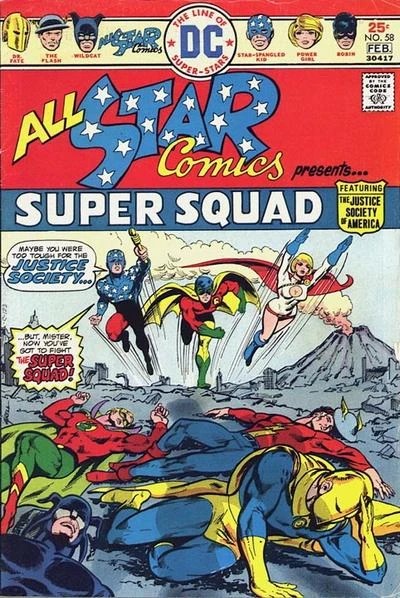
Cover to All-Star Comics #58 (Jan.-Feb., 1976). Art by Mike Grell.

Cover to All-Star Comics #59 (Mar.-Apr., 1976). Art by Ernie Chan.

Last October, we took a look at All-Star Comics #58 — the first issue of DC Comics’ revival of the title which had played host to the original superhero team, the Justice Society of America, back in the Golden Age of Comics — as well as its immediate follow-up, issue #59.  Together, these two premiere installments presented a single story that established writer/editor Gerry Conway’s vision for updating the JSA for success in the comic book marketplace of the mid-1970s — a vision that involved taking the aging, veteran heroes who’d traditionally made up the ranks of the Justice Society (a large roster represented here by a core group of Flash, Green Lantern, Hawkman, Dr. Mid-Nite, Dr. Fate, and Wildcat) and teaming them up with a trio of younger champions of the right: Robin, the Star-Spangled Kid, and a brand-new character called Power Girl — under a new, not-quite-official umbrella name, the “Super Squad”.  Read More

Detective Comics #439 (Feb.-Mar., 1974)

As of November, 1973, it had been twenty-seven months since the last time I bought an issue of Detective Comics.  (For the record, that issue was #416, featuring the fourth appearance of Man-Bat.)  There hadn’t been any conscious “drop” decision involved in this long dry spell between purchases; like a lot of other titles, Detective was simply one of those books I made an individual buy-or-not-buy choice about every time I saw a new issue on the stands.  I’d check out the cover, glance at the credits for the Batman story, note who Bats was fighting this go-around — maybe even see who was starring in the backup feature (there was always a backup feature back then) — and if one or more of those aspects grabbed me (or, if the spinner-rack pickings were really slim that week, even just mildly interested me), I bought the comic book.  Read More

Justice League of America #65 (September, 1968)

When last we left the non-costumed, non-codenamed, but nonetheless quite formidable supervillain T.O. Morrow — at the conclusion of the first half of 1968’s Justice League of America-Justice Society of America summer team-up extravaganza — he’d just managed to kill all the current members of Earth-Two’s JSA (some of them for the second time that issue), and was preparing to head back to his home world of Earth-One to similarly wipe out the JLA — secure in the knowledge provided by his future-predicting computer that the only way he could be stopped was if the Red Tornado intervened; and since the Red Tornado was 1) his own android creation, and 2) also dead, he was sitting in clover, as the saying goes.  Read More

Justice League of America #53 (May, 1967)

I’ve written before on this blog — several times — about my admiration for comics writer Gardner Fox’s reference library — a library I don’t really know anything about, but the existence of which can (or must, even) be inferred from the assortment of off-the-wall factoids (mostly, but not exclusively, related to mythology and folklore) to be found scattered throughout his Sixties ouevre.  The Justice League of America story featured in today’s post — “Secret Behind the Stolen Super-Weapons!” — is another sterling example of this penchant of the prolific scripter’s; but before we jump right into the story, let’s take a moment for a look at the cover.  (It’ll be brief, I promise.)     Read More

The Brave and the Bold #70 (Feb.-March, 1967)

For the first several years that I read and collected comic books, I had only the vaguest notion that there ever been a publisher called EC Comics.  I didn’t know that, before the advent of the Comics Code Authority, there had once thrived a skillfully-executed line of horror, crime, science fiction, and war comics that were, beyond their other attributes, much more graphic than anything one would ever find on the spinner racks of the mid-to-late ’60s.  You see, the Code was established in 1954, and EC’s last comic book was published shortly thereafter, in early 1956 — while I wasn’t born until 1957.  And though by 1966 I was a regular reader of Mad magazine, I had no clue that Mad was in fact the sole survivor of EC’s line, converted to a magazine format in 1955 to evade the Code’s strictures.*  All of which I offer by way of explaining that if the 70th issue of DC Comics’ The Brave and the Bold had included creator credits (which it didn’t), I would not have recognized the name of the book’s penciller, the great EC Comics artist, Johnny Craig.     Read More

Hawkman #13 (Apr.-May, 1966)

Hawkman was the fourth member of the Justice League of America on whose solo adventures I eventually decided to gamble 12 cents, his having been preceded by Superman, Batman, Green Lantern, and the Flash.  (Wonder Woman, the Atom, and Aquaman would eventually follow, though unfortunately Green Arrow had already lost his supporting slot in World’s Finest by this time, and I wouldn’t get around to checking out House of Mystery until well after its doors had shut on the Martian Manhunter.)  Most of what I knew about the Winged Wonder came from Justice League of America #41, where I’d learned that both Hawkman and his wife, the similarly attired and identically powered (but perhaps slightly smarter) Hawkgirl, were alien police officers from the planet Thanagar, operating undercover on Earth for reasons I didn’t quite understand yet. Read More

Justice League of America #41 (December, 1965)

Before re-reading this comic in preparation for this blog post — probably the first time I’d cracked its cover in at least three decades — I had been remembering it as a more typical example of the JLA stories of the period than the first one that I’d bought and read, the philosophical and essentially villain-less “The Indestructible Creatures of Nightmare Island!” in JLA #40.  As it turns out, however, this issue has a good bit more in common with its immediate predecessor than I’d previously recalled.  Like in that story, the main action here turns upon a character manipulating people’s attitudes and behaviors by artificial means.  However, in “The Key-Master of the World!” (uncredited, but produced by the book’s regular creative team of Gardner Fox, Mike Sekowsky, and Bernard Sachs, according to the Grand Comics Database), the manipulation is limited only to the titular heroes rather than affecting the whole world, and the perpetrator’s intent is malicious, rather than benign.  Read More