
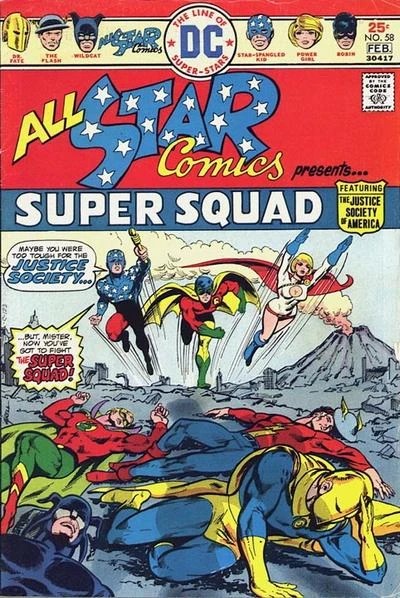
Cover to All-Star Comics #58 (Jan.-Feb., 1976). Art by Mike Grell.

Cover to All-Star Comics #59 (Mar.-Apr., 1976). Art by Ernie Chan.
Last October, we took a look at All-Star Comics #58 — the first issue of DC Comics’ revival of the title which had played host to the original superhero team, the Justice Society of America, back in the Golden Age of Comics — as well as its immediate follow-up, issue #59. Together, these two premiere installments presented a single story that established writer/editor Gerry Conway’s vision for updating the JSA for success in the comic book marketplace of the mid-1970s — a vision that involved taking the aging, veteran heroes who’d traditionally made up the ranks of the Justice Society (a large roster represented here by a core group of Flash, Green Lantern, Hawkman, Dr. Mid-Nite, Dr. Fate, and Wildcat) and teaming them up with a trio of younger champions of the right: Robin, the Star-Spangled Kid, and a brand-new character called Power Girl — under a new, not-quite-official umbrella name, the “Super Squad”.
That vision began to fracture somewhat as early as the very next issue, #60, as Robin was conspicuous by his absence — as indeed he would continue to be, all the way through #65. On one hand, this was a logical adjustment, given that this iteration of Robin — who’d made his four color debut all the way back in 1940, after all — could hardly be considered a representative of “youth”, even in 1975. Still, it undoubetly weakened the whole rationale behind the “Super Squad” concept, which, after being mentioned briefly in dialogue in the first couple of issues, quickly became relegated to appearing only in the cover and splash page logos… and eventually vanished from those, as well.
Also changing with issue #60 was the makeup of the series’ creative team, as penciller Ric Estrada was replaced by Keith Giffen, a relative neophyte who at this point had just a handful of professional credits to his name, all at Marvel Comics. Of course, Estrada’s work had been visually dominated by its inker, Wally Wood; and Wood’s distinctive style would continue to set the general look and feel for All-Star‘s artwork, with the contribution of Giffen — who, like Estrada, provided layouts for Wood to finish, rather than complete penciled art — being evident mostly in his use of non-standard page layouts.
Decades later, in an interview for a special JSA-themed issue of the fanzine Alter Ego (#14 [Apr., 2002]), Giffen recalled how Gerry Conway had hired him based on his portfolio samples:
I guess Gerry responded to the fact that I seemed to know my way around a story… Looking back on where I was at that point, I certainly wouldn’t have hired me. I still think they were responding to the fact that I had a rudimentary sense of storytelling, and they knew that I was still going to be inked by Wood. I could have drawn stick figures and it still would have looked good.

Cover to All-Star Comics #60 (May-Jun., 1976). Art by Ernie Chan.

Cover to All-Star Comics #61 (Jul.-Aug., 1976). Art by Ernie Chan.
Like issues #58 and #59, All-Star #60 and #61 presented a single story — one that pretty much stood alone, relieving us of the need to go through an extensive recap here. All you really need to know before digging into issue #62 is that in the course of our heroes’ ultimately triumphant battle against the villain du jour (an irradiated astronaut calling himself Vulcan, Son of Fire), Doctor Fate was gravely injured… a situation we’ll find the team still very much involved in dealing with at the beginning of issue #62.
Well, and there’s one other thing it’ll be helpful to be up on, as well — this brief interlude from issue #61, which helps tee up #62’s “A” plot. As we join the scene, which is set at the private Gateway City museum of archaeologist Carter Hall (aka Hawkman), Carter has just been told by his colleague, Dr. Arthur Kliburn, “This time, you’ve gone too far!”

The pink bubbles in that last panel are, of course, a harbinger of very bad things to come in issue #62. But before we jump right into that book to see how this plays out, a word about its Ernie Chan-drawn cover — which, as you’ve probably noticed, gives as much attention (if not more) to the return of a particular Justice Society of America member who’d yet to appear in the revived All-Star Comics. as it does to the story’s villain. That’s right, folks: “He’s back! The Golden Age Superman in action again!”

Kal-L vs. Kal-El, as depicted on Neal Adams’ classic cover for Justice League of America #74 (Sep., 1969). (And if you can tell which is which, you’re a better fan than I am.)
Of course, as regular DC readers were already aware, it hadn’t really been all that long since the Golden Age Superman had last been seen in action. Setting aside the question of just when the adventures of Earth-Two’s Man of Steel had stopped appearing in the first place (a somewhat thorny issue, given that Superman, Action, et al, were published continuously through the end of the Golden Age into the beginning of the Silver, and that the whole idea of “Earth-Two” was a 1961 retcon), the OG Supes had turned up for four of the annual summer get-togethers between the JSA and their Earth-One compatriots, the Justice League of America. The first of those had appeared in 1969, in JLA #73–74; the second had followed in 1970 (#82-83), while the third arrived in 1971 (#91–92). The Last Son of Krypton-Two had taken the next summer off, but was once again featured in 1973’s event (#107–108). That one had come out just three years prior to the publication of All-Star #62 in June, 1976 — not exactly what you’d call a vast span of time. All of that having been said, none of it meant that the return of Kal-L (that’s the Earth-Two spelling of Superman’s Kryptonian name, for anyone not already in the know) in the context of DC’s new JSA series wouldn’t still be eminently welcome to the character’s fans.
And now, without further preamble, let’s get on with “When Fall the Mighty”:

This was the last “All-Star Super Squad” story that would carry Gerry Conway’s name in the credits. As we’ve discussed in previous posts, Conway had departed DC in the spring of ’76 to return to his previous employer, Marvel Comics — which left assistant editor Paul Levitz (who’d previously helped out on the writing of issue #59) to pick up the slack.
In his own interview for Alter Ego #14:, Levitz explained how his credit here for “patter” essentially translated to “script”:
Gerry had left to go back to Marvel. I hated doing #62, because at that stage I had no sympathy for Keith [Giffen]’s work (ironic, isn’t it, given the quantity of work we later did together on Legion [of Super-Heroes]) — and I vividly remember dialoguing that job in three hours one night…
Beginning with the next issue, Levitz would be flying solo as writer — a status he’d maintain for the rest of the feature’s run, not counting a couple of upcoming issues partly or wholly plotted by Wally Wood — while Joe Orlando would come on board as the series’ new editor.

Artist Walt Simonson had pioneered the use of the Egyptian ankh symbol in association with Doctor Fate in 1st Issue Special #9 (Dec., 1975), a one-shot solo outing produced by Simonson and writer Martin Pasko (and edited by Gerry Conway) that had been released just a couple of weeks prior to All-Star Comics #58. The ankh had been noticeably absent in the Estrada-Wood artwork for #58 and #59, but had popped up in both of Giffen’s first two issues. Whether its inclusion was driven by Giffen or (somewhat belatedly) by Conway, I can’t say; but the distinctive imagery would be used pretty consistently in artistic depictions of the sorcerer from Salem henceforth, including in the later “Dr. Fate” solo backup feature in Flash, which was written by Pasko and drawn by Giffen.

The page above is a good example of Giffen’s early proclivities towards innovative, eye-catching page layouts. As he recalled in 2014 for Alter Ego #14:
George Pérez was stretching his creative legs over at Marvel, starting to play around with panels. It was a time where any kind of visual experimentation, as long as it moved the story, was not only tolerated, but actively encouraged. I really think it charged up the writers, too, because when you use a six-panel grid, à la Jack Kirby, the storytelling there could be dynamic, it can be solid, but there’s something about the panels almost becoming part of the story that got a lot of people very excited about comic books as a visual format.
Of course, the ideal situation probably falls somewhere in between… I still think that a lot of our experimentation with panel design actually reflected nervousness or inadequacy: “Oh, I don’t think my drawing is good enough. Okay, can’t I just play a little with the visual rules?” I think we were also the first generation that came in very heavily influenced by film and TV. We were the first visually-oriented generation.
We were beginning to understand the concept of not only juggling the camera, but we were also turning into the sound bite generation. We were getting a lot of the French film, the whole auteur thing, which came rolling down on us, different ways of telling the story, moving the camera around, panning shots. The stuff that Steranko did [in the 1960s] barely scratched the surface of this new vision.
It was just a lot of fun back then…

Like the Earth-Two Superman, our new arrival Hourman had been seen in several of the annual JLA-JSA team-ups, beginning with the first one back in 1963; he’d also had the distinction of being showcased alongside Dr. Fate in two 1965 issues of, um, Showcase, as well as of headlining a single solo backup in a 1968 issue of The Spectre. He was, in other words, as much of a Justice Society mainstay as any of the other World War II-era heroes who’d appeared in the revived All-Star thus far. For that reason, his fans were likely happy to see him show up in this issue; on the other hand, that last narrative caption in the set of panels shown above might also have caused them to be at least a little apprehensive.


At this point, our storytellers stretch out the suspense a bit by returning to the hospital just long enough to show us Hourman’s being taken aback by the bickering of Wildcat and Power Girl (“This isn’t the Justice Society I remember!”), then giving us a quick shot of Hawkman still worriedly winging his way home, before finally returning to the darkened museum and the prowling Dr. Kliburn (you knew it had to be him, right?)…


In his Alter Ego interview, Keith Giffen gave Gerry Conway the credit for the basic notion to “make the flashlight beam a character in this sequence”; though, in response to a prompt from interviewer Roy Thomas, he allowed that it was probably his own idea to incorporate the flashlight’s roving spotlight into the lettering of Kliburn’s subsequent scream.

For the record, this scene is the first post-Golden Age appearance of Shiera Sanders Hall. Sadly, neither Conway nor Levitz, nor any other writer, seemed interested in having her resume her Hawkgirl career in present-day continuity; the only time we’d see her suit up in DC’s Bronze Age comics would be in the 1940s-set All-Star Squadron, a few years further down the road.
At this juncture, the story quickly cuts away to show us Flash and Green Lantern desperately racing across the ocean towards Egypt, then returns once again to the hospital for an update from Doc Mid-Nite on Doc Fate’s condition:


In his first three JLA-JSA team-ups, the Earth-Two Superman had been depicted as essentially identical to the “modern” Earth-One version in most, if not all, meaningful ways. Things had begun to change as of 1973’s “Crisis on Earth-X” two-parter — ironically, the first such team-up event in which the Golden Age Supes participated without his counterpart also appearing — as, for the first time, JLA artist Dick Dillin drew the indisputably older iteration of the character with graying temples, as well as drawing a more “retro”-styled version of the hero’s famous “S” emblem; meanwhile, writer Len Wein subtly gave him a somewhat more brash characterization than Bronze Age fans were used to from Big Blue. Still, outside of a brief reference in Mike Friedrich’s script for JLA #91 letting us know that Earth-Two’s Clark Kent was no longer a mere mild-mannered reporter, but was in fact now the editor of Metropolis’ Daily Star, we’d gotten little indication of what everyday life was now like for a Superman who had at least a couple of extra decades of experience on “ours” — at least, not until this scene.

Fifty years after I first laid eyes on it, the page above remains one of my favorites from the entirety of the 1970s Justice Society revival — perhaps my very favorite. It’s just a wonderful sequence on so many levels, with art and text that perfectly combine to pay loving tribute to the heritage and legacy shared by every iteration of the Superman character — while also elegantly and economically letting the audience know that when the citizens of this Metropolis look up in the sky, they see a guy who leaps tall buildings in a single bound, rather than someone who can fly to the far side of the galaxy and back without breaking a sweat.

I’m fairly certain my younger self had no idea in June, 1976 whom this hooded mystery man would eventually turn out to be — though, being the Arthurian legends superfan that I was, I’m sure I’d have been very excited if I had actually managed to figure it out. (Wait, did I just give it away? Damn.)


Despite the credit given solely to Giffen and Wood in the key’s number 11 (“a hearty hand for Keith and Wally”), the neat cutaway diagram of the JSA’s headquarters’ underground facilities was (according to Giffen in Alter Ego #14) the brainchild of Gerry Conway.

Concerning the nostaligia-fueled visualization of Superman we find in this as well as later issues of All-Star Comics, Keith Giffen had this to say, back in 2014:
The one thing I will take credit for in All-Star Comics is that Superman face — that [Joe] Shuster face. That came from me — because, to me, that is Superman. To me, no one should ever know what color Superman’s eyes are because he’s always squinting. I liked them, especially when Wally followed through on it. The only thing I didn’t do that I wish I had done was, I didn’t have him doing the Wayne Boring jog.


As with the “Look… up in the sky!…” moment earlier in the story, Superman’s dialogue in that last panel evokes some of the most familiar and beloved elements added to the character by ancillary media, such as theatrical cartoons and radio drama.


It’s a very nice character bit to show how angered Power Girl becomes at Zanadu’s “hurting Superman” — we understand that for all the grief she’s been giving her cousin, she still cares about him a great deal.

Well, there’s certainly a lot going on as this issue comes to a close, isn’t there? Gerry Conway has set up so many overlapping plot threads here that a casual reader in June, 1976 might briefly have wondered if they’d somehow picked up an issue of Marvel Comics’ Avengers by mistake. And perhaps that wouldn’t have been all that surprising, given Conway’s long prior history at Marvel (coincidentally, the just-returned writer/editor’s first work on Avengers was already on the stands at this point, having been released a couple of weeks before All-Star Comics #62). But would Paul Levitz — a younger creator who’d only worked professionally for DC — follow along the same line as he took over the full writing chores? As we’d see in the months and years to come, the answer was basically “yes” — although that, too, might not have been a surprise to those who knew of Levitz’s extensive background in comics fandom prior to his turning pro, since, as editor of The Comic Reader, he’d clearly had to pay attention to what Marvel was up to as well as DC.
But, in any event, we now have to bid goodbye to the All-Star Super Squad for the next couple of months — though it won’t be that long at all until we meet up again with some of your favorite Justice Society of America members. Indeed, our coverage of 1976’s annual Justice League-Justice Society team-up begins in our very next post; and believe me when I say that, regardless of its other qualities, no one is ever going to accuse this story of being plotted like a Marvel comic. But for more, you’ll have to show up next Saturday; I hope to see you then.
https://tombrevoort.com/2017/07/03/a-new-issue-of-all-star-comics-greeted-me-at-the/
Small mistake by either Conway or Levitz in the last panel and following caption: the team that the controlled Wildcat intents to name isn’t the Injustice Gang (a team that Alan mentioned a few times already, including in January’s review of the Superman/Spider-Man team-up, and that debuted in “Justice League of America #111”, a couple of years prior to this issue) but rather the Injustice _Society_, which goes back to 1947’s “All-Star Comics #37”.
Granted, conceptually the two supervillain teams are not too dissimilar to each other. But the memberships are very different, and the Injustice Society proved a lot more resilient and long-lasting than its Earth-One counterpart.
Wood’s inks here are absolutely solid and professional—-not what one would expect from someone who was allegedly “burned out” at that point in his career. He really took Keith Giffen’s pencil drawings up several levels in quality. I also like some of Giffen’s page layouts.
The two men really paid homage to Joe Shuster’s Superman (at the time that DC was finally about to do right by Siegal and Shuster thanks to Neal Adams’s efforts).
I missed these at the time, but as a Legion fan this is very interesting, excellent stuff.
Somehow I’m just now noticing that Alan seems to be crumbling the Helmet of Nabu on the splash page. At least I don’t think that’s damage the helmet took in the earlier fight, or Kent would be in even worse shape than he is. I guess I assumed the helmet was made of sturdier stuff, plus protected by an enchantment, so this would be impossible? Anyway good luck beating it back into shape.
I also have a feeling we should know who those two guys are that are working late and talking about a broken statuette in that one panel.
Gotten and Wood made a great team. I may prefer Superman’s “retro S” here to the one DC later settled on for the character.
GIFFEN and Wood. @#$%& auto-correct.
Hi, Alan!
Great write-up. I had forgotten how many issues of this series Cinway had a hand in – and, given the shorter production time Marvel had compared to DC, it’s not a surprise that his time at DC would seem to overlap with his return to Marvel. (Compare that to the nearly six months we’d have to wait for a new Steve Englehart story at DC.)
Had also forgotten how, even at this juncture, SO MANY plot threads were set in motion here. Levitz would really pick up on that once he took over the plotting, both with the Justice Society and the Legion of Super-Heroes. He would carve out a pretty distinctive niche at DC with those two series, and I’m not sure he gets enough credit as a writer. Even with this script, supposedly written in three hours (!), he worked in some neat little character bits. And the Superman introduction was just golden.
At this stage in his career, Giffen was REALLY leaning into the symmetrical page layouts, not unlike Starlin. I actually vividly remembered that shot of the guy’s scream being part of the artwork. Cool stuff.
One question – on that one page of the signal going out, there’s a panel if two guys working in an office late at night. I’m sure that’s an in-joke. Does anyone know who they’re supposed to be? Conway and Giffen?
Cheers, everyone! Happy lead-up to the Fourth of July!
Hard to tell about those two “civilians.” I suspect Keith Giffen drew Gerry Conway and Wallace Wood, and Woody added a moustache to Conway and a beard to his own likeness.
All-Star Comics #62 came out just a few days before I was born! In fact, today’s my birthday! I’m 50 years old! That means going forward all of the comics Alan will be blogging about actually came out during my lifetime. Of course, it’ll still be several years until I was old enough to actually read any of them, much less have the money to buy them 🙂
*Ahem!* I read this one in the 2006 trade paperback collecting All-Star Comics #58-67 and DC Special #29. I’ve re-read that collection several times over the years, as I really enjoy the stories collected in it.
This is a pretty good issue. I do think the bickering between the various JSA members is a bit overdone, but still, it’s definitely an exciting story with a lot of cool characters & plotlines. You can definitely see the influence of Marvel-style plotting & characterization here.
I also feel at this point early in her existence Gerry Conway & Paul Levitz unfortunately do seem to be establishing “bickering” as Power Girl’s defining character trait. I’m glad she later developed into a more nuanced figure.
Keith Giffen does some interesting layouts in this issue. It’s a good glimpse of the quality, innovative artist he would later grow into. And the finished artwork by Wally Wood is amazing.
Best wishes and many happy returns!
I wasn’t a Giffen fan until he started at DC. I remember it as the faux Kirby thing he had going on and perhaps it was not liking the Defenders stories he did at all. Here though, he’s well on his way to becoming the iconic artist he was meant to be. Kara and Ted’s bickering already had lost all its appeal for me here. It’s too bad Batman wasn’t included because his and Superman’s cover appearances would have drawn more casual readers and kept this series around longer.
Issue #61 of All-Star Comics was one of the earliest comics that I read, and I have a copy of it today. I remember finding the plot with Vulcan incredibly confusing, but was also struck by Wally Wood’s art. Alan’s post says this better than I can, but, as an adult, I find the pairing of Giffen and Wood here fascinating – as Alan notes, Giffen isn’t doing much more than providing experimental page layouts, while Wood is doing 90% of the drawing. If I could read this issue fresh today without seeing the credits, I’m not sure I could intuit that Giffen was involved in any way. As Giffen puts it in the interview Alan quotes, he could have drawn stick figures and Wood would have made them look good.
Because of my nostalgic attachment to this as one of my first comics, and to Mike Grell as one of the first comics artists I liked and whose style I recognized, I’ve always wanted a copy of issue #58 because of that striking Mike Grell cover, one of his best efforts in my opinion, but of course it’s a “key” issue because of the first appearance of Power Girl and I can’t pick it up for five bucks the way I can pick up all of the issues around it.
I’ve also read that Giffen (at the time) was less than happy with Wood’s inks, but later saw that as absurd/
Jose Delbo said the same thing when he was pencilling Wonder Woman—-that once Wood inked it the art looked like pure Wood.
I’m sure editors were well aware that certain artists, when inking others, had such a strong personal stamp to their work that the penciller would all but vanish. Alfredo Alcala is another example.
“To me, no one should ever know what color Superman’s eyes are because he’s always squinting.” Giffen! On the money.
That’s the sort of thing to make me think that I shouldn’t blame Giffen too much for what happened to Amethyst.
By the way, “the proper study of mankind is man” isn’t actually the claim of a philosopher, but of a poet, Alexander Pope in *An Essay on Man.*
Know then thyself, presume not God to scan;
The proper study of Mankind is Man.
Plac’d on this isthmus of a middle state,
A being darkly wise, and rudely great:
With too much knowledge for the Sceptic side,
With too much weakness for the Stoic’s pride,
He hangs between; in doubt to act, or rest,
In doubt to deem himself a God, or Beast;
In doubt his Mind or Body to prefer,
Born but to die, and reas’ning but to err;
Alike in ignorance, his reason such,
Whether he thinks too little, or too much:
Chaos of Thought and Passion, all confus’d;
Still by himself, abus’d, or disabus’d;
Created half to rise, and half to fall;
Great lord of all things, yet a prey to all;
Sole judge of Truth, in endless Error hurl’d:
The glory, jest, and riddle of the world!
Go, wond’rous creature! mount where Science guides,
Go, measure earth, weigh air, and state the tides;
Instruct the planets in what orbs to run,
Correct old Time, and regulate the Sun;
Go, soar with Plato to th’ empyreal sphere,
To the first good, first perfect, and first fair;
Or tread the mazy round his follow’rs trod,
And quitting sense call imitating God;
As Eastern priests in giddy circles run,
And turn their heads to imitate the Sun.
Go, teach Eternal Wisdom how to rule—
Then drop into thyself, and be a fool!
There is philosophy in that, I guess, and a later author, who was decidedly a philosopher, Isaiah Berlin, wrote a collection of essays called *The Proper Study of Mankind.*
A funny thing about Hourman: this is a character who took a leave of absence from the JSA in *All-Star Comics* #8, never to reappear, and even in the revival begun with *JLA* #21, he had to wait four years to return in #55. Yet by the tenth anniversary mark, he’d appeared five times, while someone who missed only two issues in the Golden Age, the Atom, had appeared only three.
You could really get a skewed sense of the original JSA series in “All-Star” from the JLA crossovers, as well as from the ’70s revival. I remember how startled I was when I finally learned, years after I first started reading about the team in the Silver Age, that Superman and Batman had never made more than a couple of what amounted to cameo appearances, or that Black Canary was a relative latecomer who took Johnny Thunder’s spot, or that Wildcat had barely ever shown up at all.
Yes, we should totally blame Giffen for his treatment of Amethyst. I certainly do.
This is all like attending a dinner party where I have only a vague knowledge of the guests. Being a Marvel guy at this time, there’s no way this series came within a “beep” of my comic-buying radar. I sort of knew the JSAer’s from their JLA crossovers. But even now having read much of Geoff Johns JSA work, I still don’t really know Power Girl, Wild Cat or Dr. Midnight all that well. As a result, just as it would be my etiquette at such a social gathering, I’ll be cordial, but cautious in my remarks.
That said, I will add that it provided quite comforting to have the older Superman make an appearance. Having just read William Bernhardt’s excellent and incredibly informative “The Superman Wars,” I particularly appreciated Giffen’s squinty take on the Man of Steel.
All these years later, I’m still not sure what to think of Power Girl. Just don’t tell her I said that. I will also add that I am able to finally offer kinder words on Gerry Conway for his work on this series – which I prefer over criticisms of the recently departed. It’s also fun to note that although Paul Levitz doesn’t see it yet, he and Keith Giffen’s paths will indeed cross in the future to provide some outstanding comics.
It would also be a gross breach of manners not to thank our host Alan for a dinner party that turned out to be a remarkably enjoyable experience.
Let me also wish Ben Herman a very Happy Birthday! Along with Tom Brevoort’s, Ben’s is another blog I heartily recommend!
Wow! Thanks for posting about All-Star Comics #62, one my favorite issues when I was a much younger comics reader. (It’s been 50 years? Nah, it can’t be!) That whole sequence with Clark Kent at the Daily Star is so iconic not just for that gorgeous Keith Giffen/Wally Wood art but also for Paul Levitz’s script. It is as close to a perfect sequence I’ve seen in comics in…what? You say it’s been 50 years? If you say so. (But I won’t!)
This issue captured my imagination in a way my then young mind had never experienced in comics before. This was a formative issue in my still nascent comic book habit and I appreciate your post giving me a chance to relive that experience.
Next week begins the JLA/JSA crossover with Earth S? I’m looking forward to it.
I bought All-Star Comics # 58, 59, and 61 when they were first published, but I missed this issue and the next before I began to become more of a regular collector. Four months before in February, I had begun to collect every issue of Secret Society of Super-Villains, and by February of 1977, I had begun to collect other team books like the Invaders and the Freedom Fighters. As much as I loved the JSA members, I found Wally Wood’s art to be too cartoony for my tastes; also, at 10 years old, I wasn’t quite as captivated by Power Girl’s physique as some of you older guys were. I wouldn’t become a serious fan of All-Star until the Levitz/Staton/Layton issues starting with # 66.
A few observations: GL refers to Dr. Fate as his “best friend”, but to my knowledge, there were no references to this special relationship either prior to this story or afterward. At this point, the only non-JSA story in which they were shown together was in Showcase # 55. If anything, it would been more of a valid claim for Hourman to describe Fate as his “bestie, given their two-issue stint in Showcase # 55-56.
This story was my first reference to Gateway City, which appears to be the location of both JSA headquarters and the estate of Carter and Shiera Hall. Years later, I would read the Spectre’s 1960’s series in which Jim Corrigan would call Gateway his home. And just three years later, Gerry Conway would depict Mr. Terrific as also operating out of Gateway City. I believe one later iteration of Gateway City would be in the John Byrne era of Wonder Woman. Gardner Fox had depicted Black Canary as located in Park City (Brave & the Bold # 61), Starman in Federal City (Brave & the Bold # 62), and the Spectre in Gateway City (starting in Showcase # 61), while Mike Friedrich depicted Wildcat as operating out of Knickerbocker City (in Spectre # 3).
I believe that this story included the first mention of Carter and Shiera (Sanders) Hall as a married couple, following the earlier Silver Age mentions of married couples Jay & Joan (Williams) Garrick, Kent & Inza (Kramer) Nelson, Rex & Wendy (Harris) Tyler, and Larry & Dinah (Drake) Lance. In the next couple of years, we readers would also learn of the nuptials of Bruce & Selina (Kyle) Wayne and Clark & Lois (Lane) Kent.
Even rereading these issues a few years ago, I didn’t appreciate how creative the layouts were. I appreciate art more than when I was a kid but I still react to it, to a large extent, as a tool for telling the story.
Wally Wood I don’t appreciate at all. There was something off about it when I first read these, and there still is. Partly the iconic posing of Superman (which he did a couple more times, IIRC) — look, standing there! It’s … Superman! — felt more forced than iconic. I never felt this Superman was somehow more special than the Earth-One.
That said, this was a lively issue as everything goes south. “Injustice Gang” is not only wrong, as someone pointed out above, but the name never sounded right on either Earth.
I presume the name Zanadu was taken from Coleridge’s “Xanadu” though I can’t see any thematic connection.
Well, first of all, Happy Birthday to Ben on his birthday yesterday. My birthday is today and Alan’s is next week, so I guess we’re all celebrating this. FYI, the comics that DC released the week I was born in 1957 were: Adventure Comics #240, Superman, Batman #107, Superboy, and Action Comics #227. It’s sometimes surprising to remember that, even at my advanced old age, Superman and Batman are both older than me by the same difference as Alan and I are both older than Ben.
But I digress. I didn’t read this book back in ’76 because I thought the Justice Society wasn’t as exciting as the Justice League and didn’t give the stories a chance. I wish I had. Conway did a much better job than I normally expected from him in juggling all of the many overlapping plot points. Just goes to show what he could do when he tried. I was never a huge Giffen fan, but while the work here is really 90% Wally Wood, Giffen’s page layouts are excellent and quite inventive. Loved the flashlight trick.
All in all, a great issue. I also loved the chiseled Supes face with the squinty eyes and standing arms akimbo in the doorway, as well as the other tributes to Superman’s storied history. That one page of Clark, alone at the Daily Star, silhouetted as he turned into Supes in the supply closet is one of the best pages I’ve ever seen from those days.
As to what I didn’t like, the bickering between Power Girl and Wildcat, et al. seemed forced and far meaner than the situation called for. I get that Ted feels like the “kids” are replacing the “old-timers,” but considering how many of the kids he mentored and taught basic hand-to-hand fighting to over the course of his career (including Batman), you’d think he’s be more supportive. And yes, I also noticed Hawkman crushing Doctor Fate’s irreplacable helmet. Not cool, Mr. Hall. Not cool. Thanks, Alan!
The idea of Wildcat as trainer to heroes was not a thing at this point. IIRC that retcon didn’t take hold until Johns’ JSA revival.
Nor is the Earth One Wildcat who shows up in Brave and the Bold Batman’s trainer pre-crisis, in case anyone was going to ask.
Mike Friedrich began to hint at that way back in SPECTRE #2 IN 1967 and Paul Levitz followed up by reintroducing Grant’s Gym in .a JSA story. In Adventure Comics in 1979.
I say again, training kids and training superheroes are two separate endeavors. They fit but seeing Spectre 3 as laying the groundwork — no, I don’t buy it.
The idea that Wildcat was going to retire to train new heroes starts back in 1967.
The idea that Ted Grant had been doing that came in the late 1990s.
It probably came from Roy Thomas’s idea that the same guy had trained several non powered heroes from All Star Squadrr on the early 1980s.
No, in 1967 he was just running a gym and working with underprivileged kids. Commendable but there was nothing to suggest he was training a new generation of masked mystery men.
This is wildly speculative, but how about Carl Gafford and Ben Oda as the two ‘diligent workers in some still-lighted offices’? There is no specific reference to the book being late or in danger of becoming so, but Paul Levitz says he wrote the script in three hours one night after Conway’s apparently abrupt departure, and Gafford and Oda get particular mention in the credits, so who would be working late to finish a book apart from the colorist and the letterer? Pics of Carl Gafford match the long dark hair, beard and glasses of the guy holding the statuette/figurine, but I couldn’t find any shots of Ben Oda at this point in history. The thing that seems odd is that they are described as ‘diligent’, but they appear to be chatting rather than doing any actual, you know, work, such as coloring or lettering. An in-joke within an in-joke?
I’m flip-flopping about the iconic treatment of the Golden Age Superman. The first page showing his costume-change was really nice, but then following it up with the ‘arms akimbo in the doorway’ dramatic entrance, and then following that up with the squinty-eyed ‘this is a job… for Superman!’ did start to feel a bit forced, or overdone. Also a bit of an anti-climax seeing as he gets zapped as soon as he actually goes into action.
Also agree that it feels off that Alan Scott suddenly declares that him and Kent Nelson are besties when it’s never been hinted at previously. Hawkman and Dr Fate, with their shared Egyptian/supernatural backgrounds, would have made more sense.
Just like the last post, it feels like Alan’s reviews were more interesting than the actual run of comics (thank you sir!). I enjoyed this series, but never quite enough to be bothered if I missed an issue.
Meanwhile, my comics purchasescover dated October 1976 were Warren magazines—-Creepy no. 83 and Eerie no.78 (for Wrightson’s frontispiece). I shared the link for this Creepy issue before, but for those who missed it this issue had a stellar lineup: several classic stories written by Bruce Jones with artwork by Wrightson, Heath, Williamson, Infantino, and Corben, topped off with a reprint Frazetta cover that is a much clearer reproduction than the original cover in the mid ’60s:
https://archive.org/details/warrencreepy-083
…plus artists Jose Ortiz and John Severin, and writers Bill Dubay and Cary Bates.
Looking back, this may have been one of my favorite All-Star issues! As I recall there was plenty of chat from the fans (via letters delivered the old-fashioned way!) about the wonderful sequence at the Daily Star (Almost saying “A great metropolitan newspaper.” Loved that!) The sequence with Zanadu throttling his victim was actually chilling to me today; that face! That mouth! And just like in 1976 it took a moment to realize the panels were a scream! Thanks a lot for wonderous memories! (Geez! Was I ever that young?) Oh, and were those two workers in the office the signal beam flashes through who I think they were?
jeff, so far we’ve had Gerry Conway and Wally Wood, and Carl Gafford and Ben Oda, proposed for “those two workers in the office”. Who are *your* picks?
“Chuckle!” You should round up the usual suspects! Start with the book’s credits and go on from there! (Or was one of them Stan Lee, doing a cameo? 😀 )
Okay, seriously, one of them looks like Cary Bates.
Nice issue! Frightening villain, interesting layouts, great finishes plus the return of the Shuster Superman, marred by a bit too much Marvel style bickering. Conway achieved a lot as a editor and writer-editor in his entry year at DC; such a pity it all went south from this point on. I don’t feel his reputation ever recovered from his short editorial stint at 1976 Marvel.
This is a quote from Harlan Ellison’s notorious 1979 interview, published in The Comics Journal:
“Who the hell would’ve known that Gerry Conway would single-handedly ruin the entire comics industry? He’s a classic example of the deification of no-talent in all industries. He’s not good, but he has it in on Thursday. And that’s all they care about. You know, fill them pages.”
I don’t agree with Harlan here, as Gerry had some early victories with Amazing Spider-Man nos. 111, 121-123, and 149, to name a few, and even his Swamp Thing issues weren’t bad. Otherwise…
His run on the WW II WW era was excellent. And I did love Atari Force.