
Fifty years and three months ago, DC Comics’ releases for November, 1974 featured this house ad, hailing the upcoming debut of a new hero…

So new a hero, in fact, that the guy apparently didn’t even have a name yet.
Though perhaps it would be more accurate to say that his name was a matter of some dispute. As an item published that same month in the DC Comics news section of The Comic Reader #112 explained:

 “What the heck was ‘the Steranko TALON’?”, some of you may be wondering. Others, however, may recall our earlier blog post about Marvel Comics’ Savage Tales #3 (Feb., 1974), which included a couple of illustrations by artist-writer Jim Steranko featuring his sword-and-sorcery hero of that name. Originally previewed in 1968 in the fifth issue of the “pro-zine” witzend, an actual story featuring the character had yet to materialize (a statement that remains true a half century on, incidentally), but Steranko claimed dibs on the name, nevertheless. Ultimately, the matter was resolved informally, with the maverick creator withdrawing his complaint and agreeing to provide a basic logo design* for the new DC character’s replacement name — Claw — in time for the following news item to appear in December’s issue of The Comic Reader, #113:


Cover to Weird Worlds #10 (Oct.-Nov., 1974). Art by Michael W. Kaluta.

Cover to Ironjaw #1 (Jan., 1975). Art by Neal Adams.
The brief brouhaha over the title of DC’s newest foray into the heroic fantasy genre was only the latest step in an oddly torturous road from conception to fruition. As we previously discussed here some eighteen months ago, the germ of what eventually became Claw the Unconquered evidently began as an attempt to revive the defunct Weird Worlds title via a fantasy-forward revamp of its last headliner, Howard Chaykin’s science-fiction swashbuckler, Ironwolf. Editor Joe Orlando worked on this idea with one of his regular writers, Michael Fleisher, but ultimately decided not to use the resulting script; however, he gave the writer to shop the property elsewhere if he wished…which Fleisher indeed proceeded to do, with the end result being Atlas Comics’ Ironjaw, a barbarian comic that ended up beating Claw to market by three months. Following this misfire, Orlando approached another young writer, David Michelinie, who was at this time writing both Swamp Thing and “Unknown Soldier” (in Star-Spangled War Stories) for him; presumably starting over from scratch, rather than continue with the “Ironwolf” angle, Michelinie and Orlando ultimately came up with a character concept that the editor was happy with.
All in all, it was a long road to take for a barbarian fantasy hero who, based simply on the initial impression made by DC’s original house ad, looked to be a rather blatant knockoff of the Marvel Comics version of Robert E. Howard’s prototypical barbarian fantasy hero, Conan the Barbarian. I mean, the guy had the mane of long black hair, the beefy (and mostly bare) build, the furry loincloth… OK, fine, he also had a furry neck-ruff, not to mention what looked like some kind of metal glove… but still.
According to Michelinie, the strong visual resemblance between Claw and Conan wasn’t his idea. As he related to writer Mark DiFruscio for a retrospective on the series published in Back Issue #43 (Aug., 2010):
I wanted to make Claw as different as I could from Conan, even though Conan was one of the reasons Claw existed. So in my first script I called for Claw to be “…well-muscled, though lithe as opposed to brutish — that is, more of a Tarzan type than a Conan.” But Ernie had his own idea of what a barbarian should look like and the character ended up looking pretty much like Conan in a white fur loincloth.
“Ernie” was of course Ernie Chan (aka Ernie Chua), the Filipino-born artist who’d been freelancing for both DC and Marvel since 1972, but was these days working pretty exclusively for DC. It seems fair to say that not only did Chan indeed have “his own idea of what a barbarian should look like”, but also that that idea was greatly influenced by the depiction of Conan regularly delivered in Marvel’s comics by artist John Buscema — especially in the fifteen issues of Conan the Barbarian that Chan himself had inked over Buscema’s pencils over the past few years, beginning with issue #26 in February, 1973, and ending (for now) with #43, in July, 1974.
Was editor Joe Orlando — or anyone else among the higher-ups in the DC offices — concerned about the strong visual resemblance between Claw and Conan? If so, your humble blogger hasn’t been able to find any record of it. Perhaps DC’s brass felt that with so many other sword-and-sorcery heroes having been introduced into the market of late (and with more on the way), this new hero’s obviously derivative qualities might slip by unnoticed. Or, conversely, they might have hoped for a sales boost from fans who loved Conan and wanted something as much like him as possible; perhaps, with fingers crossed behind their backs, they even hoped to benefit from a little market confusion between the characters… though, naturally, this is all speculation on my part.
In any event, the obvious similarities between Claw the Unconquered and Conan the Barbarian were only underscored by Chan’s cover for the debut issue, which featured the same visual element of a scantily-dressed young woman reclining at the hero’s feet that had adorned a myriad of Conan paperback and comic-book covers since the mid-1960s. Yep, it looked like if there was to be a strong distinction made between DC’s new adventurer and his famous predecessor, it would have to be made on the narrative level, within the comic’s pages…


Alrighty, then. Conan for sure doesn’t have one of those.
Having had his unusual physical attribute inadvertently revealed, Valcan (aka Claw) briefly considers making a hasty departure; ultimately, however, the need to fill his belly keeps him in his seat… though that’s clearly not going to be enough to keep him out of trouble…


After dispatching another of the would-be assassins with his recovered sword, the outlander turns to the last man standing…

Naturally, Valcan makes a clean getaway before the guards arrive. But the innkeeper, Tarmag, still seeing a way to still profit from this debacle, isn’t quite ready to call it a night…


Occulas’ name is plainly derived from the Latin word oculus, meaning “eye” — which, given the distinctive yellow peeper he shows off to us in that last panel, is very much on the, er, nose.

The old king certainly seems to be a very well-informed ruler, doesn’t he? Does he actually know the name of every single person in his kingdom, no matter how humble? Perhaps we might imagine that Kregar of Kanon Wood performed some special service for his monarch in times gone by. Or, alternatively, maybe Pytharia is a lot more sparsely populated than one would assume from what we’ve seen so far.


The “orphan of destiny” trope was of course a very well-worn one prior to its appearance in Claw’s origin tale; indeed, DC Comics readers had seen a variation of it just one month earlier, in Jack Kirby’s “Atlas” yarn for 1st Issue Special #1 (though we should note that, given the timing, neither Michelinie nor Kirby is likely to have been aware of what the other writer was up to).

It’s curious, given the general assumption of agnatic primogeniture in regards to fantasy kingdoms inspired by ancient or medieval European history, that the precise nature of the relationship between the old king and his successor, Occulas, is never specified. Could it be that David Micheline — or Joe Orlando, or someone else at DC — was a little leery of depicting an act of outright patricide in a DC comic in 1975, even one involving the story’s primary villain? It’s an interesting question (well, interesting to me, at least).


When Claw asks the young woman why she’s helping him, she explains that her master was a cruel man, and she’s glad he’s dead. “For that, I owe you much more than gratitude!” (Nudge nudge, wink wink.) She then asks Claw why Tarmac and these others would be after him in the first place, to which our hero replies: “I know not, girl. In matter of truth, I know little of my own existence save for the events of the past few days!”


The revelation that the elder god Kann is in actuality an eldritch tentacled monstrosity is, of course, right out of the playbook of Robert E.Howard; indeed, this entire sequence could easily be mistaken for one in that other, Howard-adapting barbarian comic that Ernie Chan used to work on.


It’s an unspoken, but effective, irony of the story that our hero, who knows nothing of his past beyond the last few days, is unable to take satisfaction in the death of the man who brutally killed both his parents many years before.
Claw tells the still-nameless young woman that he currently has less use for her charms than a good horse; nevertheless, he’s loath to leave her to the mercy of the city’s soldiers, and so he allows her to accompany him.

Is it cold of Claw to abandon his comely, if murderous, companion to be devoured by wild animals? I guess, but it’s pretty hard blame him, seeing as how she’s now betrayed him three times (even if he only actually knows about two of them). And hey, he could just be kidding about those jackals, right?
 Fifty years after my first reading of this comic book, I don’t clearly recall the specifics of my initial reactions to it — but I figure I must have liked it well enough, since I bought the next issue… and the one after that, and the one after that, all the way up until the title’s cancellation with Claw the Unconquered #12 (which was actually its second cancellation… but more about that in a minute). The way I figure it, my seventeen-year-old self probably thought both the story and the lead character were a little too generic to get very enthusiastic about; still, the mysteries surrounding Valcan’s origins, and his connection to King Occulas, were moderately intriguing, and Ernie Chan’s art hit the same comfortable spot that the Buscema-Chan team’s art had with Marvel’s Conan. In other words, the book was just good enough — and the selection of other comics available for satisfying my sword-and-sorcery genre fix slim enough — to keep me buying it.
Of course, as the series progressed, David Micheline would have more opportunities to create daylight between his hero and Claw’s famous forebear (although the book remained pretty much a dead ringer for Conan, visually speaking, for as long as Chan stayed on the book). The first major development along this line came on the final page of issue #2, where a rogue named Gofflok, who’d attempted to assassinate Claw at the beginning of the story prior to getting pulled into inadvertently sharing an adventure with him, opted to take another shot at the dirty deed. It was virtually a reprise of the epilogue in issue #1, except this time our hero had no nearby pool in which to spy the reflection of the blade being raised behind him…

 So, yeah… that’s not very Conan-esque at all. And this wasn’t even the extent of what the thing on the end of Valcan’s right arm was prepared to do for him (or should that be to him?), as we readers would learn four issues later, when, two-thirds of the way through Claw #6, the barbarian adventurer found himself trapped by a sorcerer in an ever-constricting circle of black fire…


Cover to Michael Moorcock’s Stormbringer (Lancer Books, 1967). Art by Jack Gaughan.
Once the uncanny vacuum had sucked up and extinguished the equally uncanny black flames, Valcan regained his senses (as well as control over his upper right extremity), and the villainous sorcerer was dispatched. Again, there’s not very much of Robert E. Howard’s Conan to be found in all of this. But here’s the thing; while these developments were successful in setting Micheline’s hero further apart from one famous sword-and-sorcery hero, they also brought him an equivalent ways closer to a different one: namely, Michael Moorcock’s Elric of Melniboné, in whose stories the hero’s magical, soul-stealing black sword named Stormbringer sometimes acted with a mind of its own, occasionally satisfying its vampiric appetite on Elric’s own friends, even as it gave him the strength and vitality he needed to overcome his enemies.
David Michelinie has been forthright about the influence of Moorcock’s fiction on his own work, both in Claw the Unconquered and elsewhere. In the same 2010 Back Issue article that we quoted from earlier, the author acknowledged that while the only Conan material he had read at the time he was writing Claw was that published in Marvel’s comics, he had “read lots of Elric”. Asked specifically about Moorcock’s influence on the creation and development of Claw’s demonic hand, Michelinie replied:
The demon hand was a direct result of my love of the Elric stories and the whole Stormbringer dynamic. The idea of a hero whose greatest power is one he loathes to use, is even afraid to use, is so strong and intriguing that I couldn’t help wanting to explore it myself. Of course, I tried to make my take on it and the details surrounding the conflict as different as possible from Michael Moorcock’s brilliant creation, and that led me in directions that I didn’t expect, and found both challenging and exciting to work with.

Cover to Michael Moorcock’s Corum: The Coming of Chaos (White Wolf, 1997). Art by Don Maitz.
While Elric and Stormbringer were evidently the primary inspiration for Claw and his claw, it’s probable that another, somewhat less better known hero created by Moorcock, Prince Corum Jhaelen Irsei, had some influence on Micheline as well. In the 1971 novel The Knight of Swords, Corum loses his left hand in an act of violence, after which he replaces it with a sorcerous “artifact” — an inhuman six-fingered appendage called the Hand of Kwll. Like Elric’s sword (and Claw’s hand), the Hand of Kwll provides Corum with power, but also seems to possess a degree of independent sentience.
In fairness, we should note that Michelinie did distinguish Claw’s claw from its antecedents in Moorcock’s fiction by giving it a twofold nature that those earlier objects lacked. First, there was the demon-hand itself, which, in addition to being able to cast magical spells of which Valcan himself had no knowledge (as seen in issue #6), was also shown over the course of the series to have a corrupting influence on its human “host”. Second, there was the concealing red gauntlet (eventually revealed to have been made out of the mythical metal “oraculum”), which was capable of acting on its own volition to protect its wearer from physical harm (as seen in #2), but also served to shield our hero from the demon-claw’s evil influence.
Still, even with some original elements added to the mix, it was hard for the well-read comics fan of the mid-to-late ’70s to get away from the notion that they’d seen most (if not all) of this stuff before — if not via the heroes of Moorcock (whose Elric, we should note, had already found his own, direct way into American comics, if only briefly, back in 1971-72, when he’d guest-starred in Conan the Barbarian #14–15), then by way of Marvel Comics’ Warlock, in whose series artist-writer Jim Starlin was working his own angle on the Stormbringer trope in a superhero/science-fantasy context, more or less simultaneously with Michelinie’s efforts.
And the influence of Moorcock’s ideas on Claw the Unconquered went well beyond the “cursed sword/hand” business. Even as we readers were learning more about the nature and capabilities of Valcan’s sinister appendage, Micheline was also revealing that the scope of the conflict between the hero and his nemesis, King Occulas, was much broader than had been apparent in the first issue, where the yellow-eyed villain had seemed concerned with no greater prize than the throne of a single kingdom, Pytharia. In issue #4, Occulas let slip that what he truly sought was nothing less than the “ultimate domination of the fifteen worlds!” — while elsewhere in the same story, a new traveling companion for Valcan, Prince Ghylkin of the Thousand Hills, offered our hero (and us) a quick lesson in “multilinear cosmology“, explaining that “life exists in this universe on many levels, on many planes of reality“, and revealing that he himself was a native of one of these other planes.
 Of course, longtime DC Comics readers were already familiar with the concept of parallel worlds (Earth-Two, anybody?). But they might not have ever come across the term “multiverse” — which Michael Moorcock had first used in a 1963 science-fiction novella, “The Blood Red Game”, then gone on to integrate into a conceptual framework that would ultimately encompass virtually all of his fiction — at least, not until they read that word coming out of Occulas’ mouth in a panel of Claw the Unconquered #7 (see left). In an article published in Alter Ego #92 (Mar., 2010), comics historian John Wells called this “the first use of that term [i.e., multiverse] in a DC comic book” — and as far as I know, he’s right (though, just to be clear, I haven’t personally verified the assertion by poring over every DC comic published between 1963 and 1976).

Art by Keith Giffen and Ernie Chan.
By issue #9 (Sep.-Oct., 1976), Michelinie was prepared to show most (if not quite all) of his cards, with a story that finally gave us not only a complete origin narrative for Claw, but also explained his overall significance to, well, everything:

Art by Keith Giffen and Bob Layton.
OK, maybe not every bit of that exposition is cribbed from Moorcock — but enough of it is that the British fantasist could probably have found a lawyer to take his case, had he been inclined to sue DC Comics for copyright infringement back in the day.
The speaker in this scene — one of the self-described “Gods of Elder Light” — goes on to tell Valcan how one of the hero’s ancestors had been a sorcerer who, despite his good intentions, had inadvertently invoked a demon that, though ultimately driven back to its netherworld, had left something of its essence behind in the sorcerer’s blood. This taint was made manifest in a clawed right hand — a family curse that had been passed down from father to son, its dormant power growing ever stronger, until it finally resided with our hero. Learning that the bearer of the demon’s claw was a threat to his own dark masters, the “Shadow-Gods”, Occulas had attempted to extinguish the family line; but the infant Valcan had been rescued by the Gods of Elder Light, and thereafter raised to manhood by them in their home dimension, receiving martial training (and, of course, his oraculum glove) so that he could serve as their champion, the opposite number to Occulas. But when they attempted to dispatch him back to his home realm, the Shadow-Gods had interfered, casting a spell that robbed him of his memory — and left him pretty much in the state we readers first met him, at the beginning of Claw #1.
As you may have noticed already, David Micheline had a new artistic collaborator on hand for the delineation of all of these cosmic goings-on. Ernie Chan had ceased drawing Claw’s adventures after issue #7 — though he hung around long enough to ink the following two issues’ covers over the pencils of the series’ new regular artist, Keith Giffen. Giffen, who was near the beginning of his professional career when Claw #8 came out, may have been a less polished artist than Chan; but his penchant for extravagant imagery and unconventional page design probably made for a better fit for the series Claw was now becoming than the previous artist’s more grounded, traditionally illustrative approach would have.
To help mark the beginning of the title’s new direction, Giffen even updated its star’s look a bit, swapping out his white neck-ruff for some pieces of chain mail, and his white loincloth for a pair of brown briefs. It was all too little, too late, however, as DC decided to pull the plug on the series. Getting word that the end was coming, Michelinie and Giffen resolved to wrap things up in issue #10 with a final showdown between Claw and Occulas. Such a story was actually completely written and drawn; and then, DC decided at the last minute that the ninth issue would be the title’s final one, after all, and that last story was left with no place to appear.
 That might have been the end of it, except that about a year and a half later, DC was looking to expand its line; and the company’s treasurer, after noticing that the last two issues of Claw the Unconquered (i.e.,, those that had been produced by the Michelinie-Giffen team) had sold markedly better than their predecessors, gave the go-ahead to bring the book back. And so, in January, 1978 — almost three years to the month since its debut — Claw returned to the spinner racks. Behind its striking Joe Kubert cover, however, issue #10 featured not the long-anticipated, already-finished closing chapter of Claw’s struggle with Occulas, but an interim tale DC had directed Michelinie and Giffen to produce to reintroduce the character.
  Readers would have to wait two more months, then, for the release of Claw #11, where the creators’ original conclusion to Valcan’s saga — which ended, not too surprisingly, with King Occulas being defeated and slain — saw print at last. Among its other aspects, this story featured the one and only appearance in a Claw story of an additional refinement to the hero’s appearance, as Giffen put his long dark hair in a braid for the first and only time (though, as you’ll notice if you cast your eyes to the right, one braid somehow became two on Kubert’s cover). If nothing else, this issue made a stronger visual distinction between Claw and Conan than we’d ever seen before, or would after; unfortunately, it did nothing to resolve another problem that had plagued the character ever since his debut… namely, that to the extent that Michelinie had given him any personality at all, it was a poor-quality reproduction of Conan’s; one in which the original’s dourness seemed to come through just fine, but virtually none of his sense of humor did.

Text by David Michelinie (from a plot by Michelinie and Bob Layton); art by Rich Buckler and Tom Sutton.
Meanwhile, concurrent with the revived Claw the Unconquered, Michelinie was writing other series for DC; one of these, the futuristic space-opera title Star Hunters, allowed him the opportunity to bring one last major element inspired by the fiction of Michael Moorcock into the world of Claw, though not in that hero’s own book. In Star Hunters #7, the titular outfit’s leader, Donovan Flint, learned of “a war that had raged since a time beyond time, between forces of light and darkness for control of a series of dimensions called the multiverse!” As Flint filled in his comrades about how this war had to be fought by “mortal surrogates”, a montage panel showed scenes of conflict involving: 1) the “sword-and-planet” heroine Starfire (whom Michelinie had co-created with artist Mike Vosburg, and who’d starred in eight issues of her own title in 1976-77); 2) some soldiers in what looks to be World War II (the milieu in which another DC hero scripted by Michelinie, the Unknown Soldier, did his thing); and 3) our old friend Valcan, shown here rocking his Kubert-bestowed double-braids.
Once again, readers who knew their Moorcock would recognize where Michelinie was going with this; along with the multiverse, another key concept linking together most of the English author’s novels and short stories was the Eternal Champion — a being who existed in multiple worlds and in multiple heroic incarnations, the latter of which included Elric and Corum, among several others. Per his comments to Back Issue‘s Mark DiFruscio in 2010, Michelinie had hoped to eventually write a graphic novel teaming up several of his characters as aspects of a single multiversal hero… but he never got that chance, as just two months prior to the release of Star Hunters #7, Claw the Unconquered was cancelled for a second time… a victim of the infamous “DC Implosion” that saw the publisher drastically reduce its line in mid-1978.
 Behind one more Joe Kubert cover, the twelfth and final adventure of Claw‘s original run began with its hero somewhat at loose ends following his triumph over Occulas. Falling in with a band of mercenaries, Valcan almost immediately had his oraculum glove stolen by several of his new “comrades”. Subsequently deciding he was probably better off without the thing anyway, Claw opted not to pursue the thieves — but soon thereafter, his demonic hand began to assert its evil influence, causing the warrior to act more cruelly and callously, and ultimately leading him to slaughter a surrendering enemy — a man who had himself spared Claw’s own life earlier in the story. In the end, it was all too much for our protagonist…

Art by Keith Giffen and Bob Layton.
As that “Next issue on sale…” slug at the bottom of the page indicates, there was no mention of the series’ cancellation anywhere in the comic. In retrospect, of course, this finale certainly feels like an appropriate ending; after all, how would one continue a book called Claw the Unconquered when its titular hero no longer had a, well, claw? But, ironically, history had repeated itself with Claw‘s second cancellation; indeed, one could even say that it had exceeded itself, as this time, there had not been just one story already written and drawn that now had no avenue for publication, but two.

Art by Al Milgrom.
Both of those stories did eventually see “print” after a fashion — though only as part of Cancelled Comic Cavalcade #1, one of two extremely limited, black-and-white “ashcan” editions produced by DC simply to establish copyright over material left homeless by the Implosion. As Tom Brevoort has generously offered comprehensive looks at both Claw stories on his blog (see here and here), anyone who’s curious can see that major creative changes would have been in store for the title, had it continued. Keith Giffen had departed immediately after completing Claw #12, so the story meant for #13 was drawn by Romeo Tanghal; meanwhile, David Michelinie hung around just long enough to see Valcan’s demon-claw reattached to his forearm (though the red gauntlet remained MIA), and then he was gone too, leaving the final OG Claw story to be scripted by Tom DeFalco.

Joe Kubert’s cover illustration for the never-published Claw #14, as presented in Cancelled Comic Cavalcade #1.
Looking back at these stories today, my 67-year-old self wonders if the 100% turnover in the creative roster would have been enough to convince 21-year-old me to finally drop Claw the Unconquered, had such an opportunity actually been provided. Perhaps, and perhaps not. As I’ve already written, Claw had been just good enough to keep me buying it over a three-year period, so maybe I’d have held on for a while longer; obviously, there’s no way I’ll ever know for sure.
As we’ve previously done with a couple of other DC characters who made their debuts in the early months of 1975 — Beowulf and Atlas, to be specific — we’re going to wrap up this post with a quick rundown of Claw’s later DC Comics appearances. Your humble blogger must admit to some surprise at just how long it is, given that the barbarian hero’s original series only lasted twelve issues — none of which have ever been reprinted (or made digitally available) in English, as far as I can tell. On the other hand, that’s six more issues than Beowulf got, and eleven more than Atlas, so maybe it’s not so surprising, after all.
Valcan’s first official post-cancellation appearance came three years after the publication of Claw #12, via a backup strip in the 48th issue (Aug., 1981) of DC’s most successful sword-and-sorcery comic, Warlord. Writer Jack C. Harris restored Claw’s claw even more quickly than Michelinie had done in the unpublished Claw #13 (and gave him back his gauntlet, to boot), in what one supposes was intended to be the first installment of an ongoing (or at least occasional) feature, but which only had one further episode, in Warlord #49, after which Claw returned to obscurity.

Cover to Primal Force #3 (Jan., 1995). Art by Matt Haley and Tom Simmons.
Over a decade later, Claw resurfaced for a few cameos, courtesy of DC’s Vertigo imprint; first, in Sandman #52 (Aug., 1993) and #56 (Dec., 1993), where he was shown to be among the time-and-space-tossed travelers sheltering in an establishment called the World’s End; then, in Swamp Thing #163 (Feb., 1996), where it was implied that he and several other DC fantasy characters were naught but figments of the imagination of DC’s first sword-and-sorcery hero, Nightmaster. The 1990’s also saw the debut of a new, different Claw — a modern version, who did his thing in the short-lived super-team book Primal Force. This iteration of the hero was John Chan, who dressed in armor, swung a sword, and sported a demon’s claw at the end of his right arm — a sinister appendage that might have been the same one as that previously borne by Valcan of Pytharia and his family, but then again, might not have been.
Moving into the next millennium, we find Valcan making his first non-Vertigo appearance since the ’80s in Creature Commandos (2000 series), the 4th issue of which found the CCs joining forces with Claw, here a rebel leader on the extra-dimensional world of Terra Arcana; Claw hung around as a supporting character on through the conclusion of the eight-issue storyline. Five years later, he was back doing cameos — well, one, anyway, in Day of Vengeance #1 (Jun., 2005) where he was once again a patron at a dimensional-nexus drinking establishment — though this time it was the Oblivion Bar, run by none other than Jim Rook, aka Nightmaster — an interesting conceit which, intentionally or not, split the difference between Claw’s Sandman and Swamp Thing appearances of the ’90s.

Cover to Red Sonja/Claw #1 (May, 2006). Art by Alex Ross.

Cover to the 2007 collected edition of WildStorm’s Claw the Unconquered; art by Andy Smith.
One year later, Claw got his first real headlining gig since 1978, as DC’s WildStorm imprint joined forces with Dynamite Entertainment to produce the four-issue miniseries, Red Sonja/Claw. Given Valcan’s low profile over most of the preceding three decades, you kind of have to wonder if this project’s origins were driven by someone really, really wanting to revive the traditional teaming of Sonja with Conan the Barbarian — in whose Marvel-published comics the Robert E, Howard-derived heroine had of course begun her own comic-book career back in 1972 — but ended up having to settle for that other long-haired, bare-chested swordsman when the rights to Howard’s barbarian adventurer couldn’t be secured. (Of course, I could be wrong about all of that.) In any event, sales on the mini’s early issues must have been at least decent, as WildStorm followed it up immediately with a solo Claw the Unconquered series which ran for six issues.

From Wonder Woman (2006) #21 (Aug., 2008). Text by Gail Simone; art by Aaron Lopresti and Matthew Ryan.
Back in the DC Universe proper, Claw’s next outing came in Wonder Woman (2006 series) #21-23 (Aug. through Oct., 2008); we actually talked about this one a bit in January, as it also guest-starred two other heroes from DC’s sword-and-sorcery class of 1975: Beowulf, and another fella whom we’ll be discussing in detail next month. (Yes, your humble blogger is still being needlessly coy. Just humor me, OK?) Two years later, Claw got an even more extensive 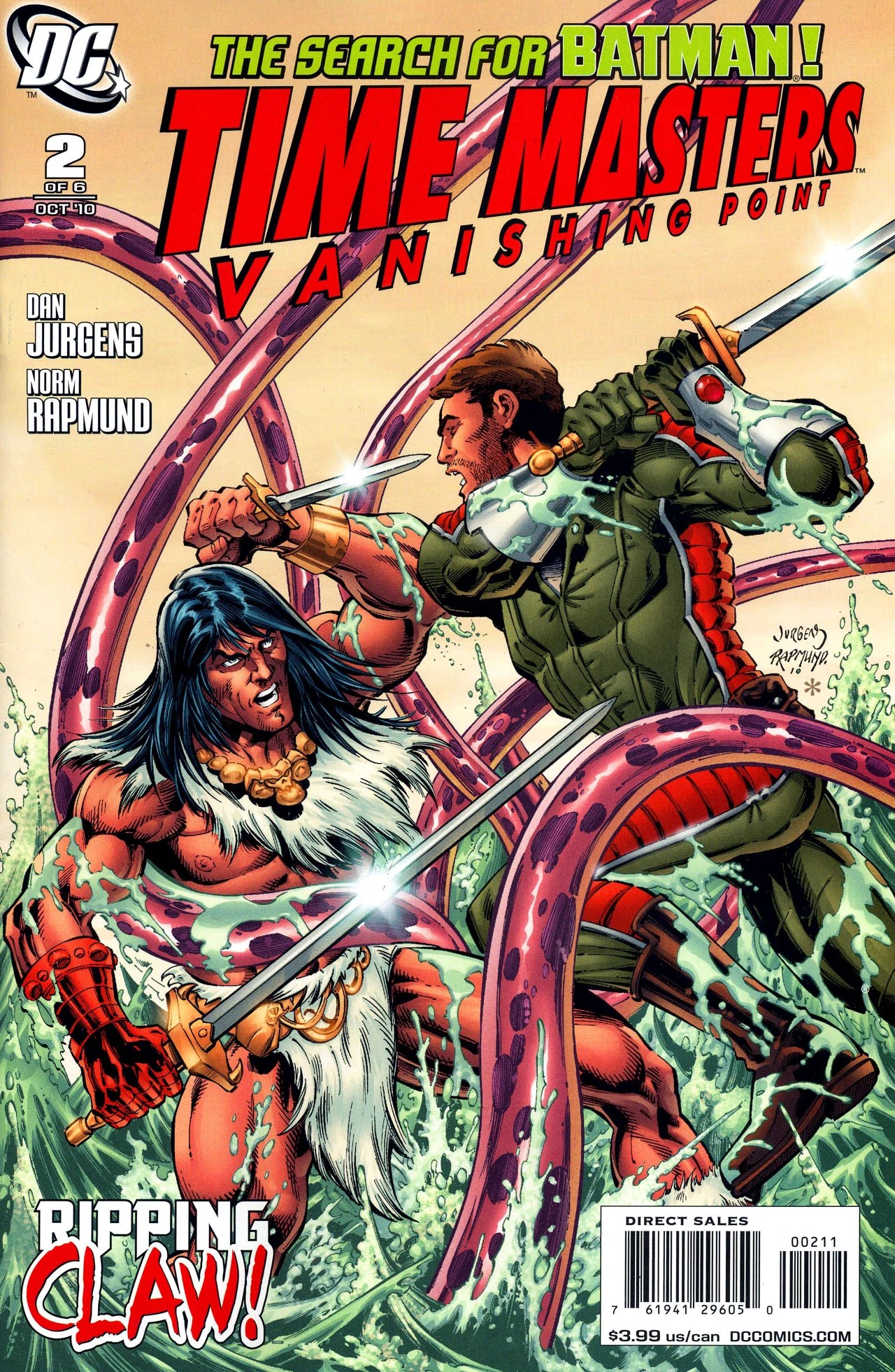 showcase as he played a supporting role in all six issues of Time Masters: Vanishing Point — along the way teaming up with not only Rip Hunter (as seen on the Dan Jurgens-Norm Rapmund cover for issue #2 [Oct., 2010], shown at right), but also Superman, Green Lantern, Booster Gold, and even Starfire — the sword-and-planet version, that is, which means that at least one small part of David Michelinie’s late-’70s dream of teaming up characters he conceived of as being aspects of the same eternal hero finally came true, after a fashion.
That Time Masters mini represents the last major hurrah for Claw the Unconquered, at least to date. Unlike several of his genre-fiction peers (including both Beowulf and That Other Guy from the 2008 Wonder Woman storyline), he didn’t receive a reboot in DC’s “New 52” era, and so might be thought to have been snuffed out of existence in the wake of 2011’s Flashpoint event… except that he’s turned up for brief non-speaking cameos at least a couple of times in the last half-decade — first in Flash Giant (Vol. 2) #5 (Jul., 2020), then in Dark Nights: Death Metal #5 (Jan., 2021). It seems like there’s still a place in DC Comics’ multiverse(s) for David Michelinie and Ernie Chan’s wandering barbarian — and assuming that his original series really was the place where DC’s readers were first introduced to the “M”-word, that seems entirely appropriate.
*It should be noted, however, that, according to the same entry in the Grand Comics Database that provided the factoid I just shared, the final, published version of Claw the Unconquered”s distinctive logo was produced by Gaspar Saladino.
That Claw house ad bears a resemblance to the one used for Bat Lash several years earlier – ‘Will he save the West … or ruin it?’.
Alan, that’s one hell of an article – you must still be catching your breath! I’m glad someone else noticed the Corum connection, too! Claw’s hand (against his will) killing a man who’s spared his life’s clearly inspired ( to be polite ) by Stormbringer killing Nikorn the merchant ( a man whom Elric liked, and who also spared his life), in ‘The Stealer of Souls’. To go off at a tangent, the depicted castle’s clearly modelled on Alcazar de Segovia! Oh, and, were it a Conan tale, that treacherous ( backstabbing – literally! ) girl would have been a princess in disguise, who – at the conclusion – would thank Conan by suggesting he rule her kingdom as consort – which he would flatly refuse! Then again, the bill-post on the tree allows for Kwai Chang Caine-style assassination attempts/bounty hunters in subsequent issues, should the writer become stuck for storyline ideas!
Phillip
I remember the house ad and first issue of Claw, but never bought it, as it seemed like such a Conan knock off. Seeing these pages, though well drawn, doesn’t change my mind. I had no idea Claw lasted for a dozen issues. That’s impressive, actually, considering how Sword of Sorcery (adapting Fritz Leiber’s Fafhrd & Grey Mouser stories, with new material) didn’t last beyond five issues.
I know I read every issue of Claw but for the life of me can’t recall more than a small portion of what you described. I wasn’t a firm follower of writers rather than artists yet so I’m surprised looking back Chan’s artwork wasn’t a deal breaker. Other than as an inker once or twice, I always disliked Chan’s work. There was just some weird thing going on in my head I guess since despite a dislike for most non-super-hero books from the Big Two, during this era I bought and enjoyed a number of titles like Claw and Starfire from DC.
Wow, I had no idea Claw had such a long life! I remember the book when it came out–Steranko’s logo was eye-catching, even if the book itself wasn’t–but I had no idea the character ‘s run lasted for as long as it has. Even if you only look at the 12-issue run, and not the numerous cameos and guest-starring roles the character would play over the years, that’s still more than most Conan-lite characters ever got, which was undoubtedly due to the skills of David Michiline and the inspiration he found in the Eternal Champion mythos. I do remember my initial thoughts on seeing Claw #1 in 1975, Alan, and it was “Phaugh! Another Conan rip-off!” and I don’t believe I ever cracked the cover.
Still, might have been a fun ride if I had. While the initial story we had to look at here was fairly rudimentary, story-wise, and little more than the Conan pastiche I was afraid of, it did grow up into something more interesting down the road. Good for you that you stuck with it, Alan, certainly on behalf of those of us who didn’t, and haven’t even thought of the character once in the last fifty years. Thanks!
I recall seeing Claw the Unconquered on the racks but in 1975 still had about 6 years to go in my pure Marvel Comics phase and, as it was, I hadn’t yet gotten a single issue of Conan the Barbarian – I wouldn’t wade into those waters until about another two years when I was 14 and had a bigger allowance to splurge. But my 12-year-old self hadn’t gotten into the Sword & Sorcery genre at all, and I doubt I even thought about Claw being largely inspired by Conan. I was also still entirely unaware of Elric as well as of the works of Moorcock, although at some point in the mid-70s, maybe in the LoCs for Warlock, I began to see references to him, and in the 1980s, I did get, and enjoyed, several of his novels. Of course, my current self immediately noticed that Chua’s rendition of Claw looked pretty much like Conan’s identical twin – same face, hair and physical build. And reading Claw’s reaction to the attempted “pickpocketing” of his money pouch made me instantly reflect on Dave Sim’s first issue of Cerebus, wherein the savage aardvark sliced off the hand of the miscreant who dared lay that hand on his tail after he’d entered a tavern. As you referred to, Claw’s personality was also that of a much more dour Conan. At least, MIchelinie did make some efforts to differentiate Claw from Conan with his magic clawed hand, even if that meant borrowing quite a bit from Moorcock and thereby echoing what Starlin was doing in Warlock, although that was about all the two series had in common.
The artwork of Chua/Chan was excellent, even given if clearly heavily influenced by Big John Buscema. IMO, he did a great job when embellishing Our Pal Sal’s layouts over in the Incredible Hulk a few years later.
As glimpsed through your overview of the series, it had some intriguing elements, but apparently not enough to keep it afloat on the marketplace. It’d be a few more years before DC came up with a more successful counterpart to Conan, with Mike Grell’s Warlord, who didn’t so closely resemble Conan, although he did borrow a variation of Thor’s helmet!
https://www.budsartbooks.com/wp-content/uploads/2020/04/product_a_v_avolt-alfredo-alcala-voltar-portfolio-prints.jpg
Alfredo Alcala’s Voltar predated Frazetta’s Conan paperback book cover paintings by several years, running in serialized form in Filipino comics, beginning in 1963. He looks like Conan with a Viking helmet.
Some of these stories were reprinted in English in the late ’70s/early ’80s, but not many.
That Claw but as yet nameless advert teaser sure looks like a name was pulled at the last minute with all that empty space.
This particular post raised a very general question for you, Alan, and anybody else who wants to comment (I don’t know if the subject has been discussed in detail before, and I hope it’s appropriate here). Alan, you provide some impressive research about this character’s ‘later DC Comics appearances’, and I wondered if you were still actually reading DC (or Marvel) comics or had researched the information online.
I describe myself to workmates and any other interested parties as a ‘lapsed’ comic book geek, seeing as I haven’t bought more than a handful of new comics in the last 10-15 years. Back in the 1970s/1980s, I was buying 10 or more comics every week, but my interest nowadays tends to be exclusively in the comics I bought back in the day, and more in behind-the-scenes issues of how my favourite creators worked, company politics and the like (I’ve written a couple of articles for Twomorrows’ Jack Kirby Collector©, for example).
So, my very general question is: do you still buy and read comics regularly? If so, is there any title or current creators you would recommend? If you stopped reading regularly, as I did, do you remember when, or why? For myself, I stopped reading DC comics regularly after (what I thought was) a particularly disingenuous editorial by Paul Levitz, and stopped reading Marvel at about the same time when I realized that Brian Michael (Emperor’s new clothes) Bendis wasn’t going to stop misunderstanding and abusing favourite characters in the Avengers. Nowadays, my only regular read is the aforementioned TJKC and sites like this one. So, what about you, Alan, and you guys that comment regularly here? I kind of get the feeling that a lot of you are (like me) more invested in the stuff that Alan covers here than the current crop of comics.
Do you think there will be a site like this one in 50 years’ time for the new material coming out today?
Great questions, Mike! First, as specifically relates to “Claw”, the information on the latter-day stuff reflects a mix of research and first-hand knowledge. For example, I read the “Time Masters” mini when it came out, but I still haven’t read the Wildstorm/Dynamite material and probably won’t, as it doesn’t look very appealing to me. On the other hand, I got interested enough in reading *about* the “Wonder Woman” arc featuring Beowulf, Claw, and TOG that I bought and read the digital trade collection. That’s not at all atypical of the way a post comes together here.
To answer your more general question, yes, I still read current comics. Not nearly so many as I was reading in 1975, but it’s a rare week that goes by that I don’t pick up at least a couple. (And by “pick up”, I mean “download”, as I do virtually all of my reading digitally these days, due to my tired old eyes.) Like Steve Mc., I tend to follow writers over artists; current favorites include Al Ewing (Immortal Thor), Mark Waid (Batman & Superman: World’s Finest, Justice League Unlimited) and Tom King (Wonder Woman, various minis), but there are plenty of others whose work I enjoy as well. I do hope that some of your fellow commenters will weigh in with some further recommendations of their own, if only to give you a wider range of possibilities of things you might want to check out (and maybe some that will be a better match for your own persoanl taste than my choices might be; you see, I happen to be a fan of Bendis’ “Avengers” run. :-0 ).
Will people be talking and writing about today’s comics in fifty years? I dunno, but I sure hope so. (Actually, I worry about whether people will be writing — or reading — *anything* in fifty years, but maybe we shouldn’t go there.)
In my case, I stopped collecting floppy issues in the late ’90s, and even then wasn’t getting nearly as many as I had in early 1980s. Many titles I had been collecting for over a decade I gradually quit getting circa 1986.
As to whatever may be happening in 2075, I’m very likely to be long gone by then, hopefully expiring peacefully and without having witnessed our world decline into dystopia – or an invasion of Martians looking for fresh meat! They’re well past their scheduled invasion date according to the War of the Worlds forecast.
Your story is very similar to mine, Mike. I bought and enjoyed mainstream comics from the late 60s until the late 80s, and I’m still passionate about them. My purchases these days tend to be collected editions of 40s, 50s, and early 60s material, as well as books about old comics and their creators, and publications such as Alter Ego and TJKC.
Something happened in the late 80s. The mainstream no longer resonated with me after that time, and I have no interest at all in current material. Not really sure why. I look at it from time to time, but it feels kind of alien to me, even the characters I grew up with feel at a considerable remove now. I imagine this is fairly common among our age group.
Old Farts Assemble!
I stopped in ’93; not even the Sandman could keep me buying. Like Chris, I turned to fanzines to keep me happy ( thanks John Morrow!), and returned briefly for Alan Moore’s ABC comics at the turn of the century. I subsequently discovered Darwyn Cooke (especially the Parker books) and re-discovered Don Rosa; I really rate what Jonathan Hickman did with the FF and am now enjoying the Bronze Age by Shanower. But there is so much still to unearth from the 60s, 70s and even 80s! Last year I read Russ Heath’s Sea Devils and the early Andru/Esposito Metal Men for the first time, and today I discovered an issue of Teen Titans spotlight by Evanier and Spiegle. I really liked what this team did on Blackhawk and Crossfire in the 80s, so finding this gem was a wonderful surprise. And Alan has inspired me to re-read a lot of what I read 50 years ago, so I have been in a Lee-Kirby Ditko (from British Marvel and Italian editoriale Corno) paradise for the past 2 and a bit years. This year I am looking forward to seeing again Adams’ X-men and Steranko’s Nick Fury, plus lots of what Marvel put out in ’75.
I’m fond of the Sea Devils. And the Evanier/Spiegle Blackhawks too.
Yes. Sea Devils! Wonderful Russ Heath art, and those beautiful grey tone covers. And the Evanier Spiegle Blackhawk is one the great overlooked runs in comics. Great choice of artists for the Detached Service Diary back-ups, too.
Some thoughts on the Sea Devils I posted at Atomic Junk Shop: https://atomicjunkshop.com/sea-devils-rebooted/
I doubt we’d see a fifty years later blog in 2075, only because there are far more comics produced now than there were in 1975, and they sell in far lower numbers in 2025 than in the Bronze Age. Price point and international distribution were key factors in the ’70s. It was easier for a comic book (or TV series) to gain a large audience in those days. Now there are so, so many vying for viewers’ attention that very few ever become a “mega hit,” let alone an enduring classic.
I read the first two issues of Claw, but my local store stopped carrying it after those issues and I never was able to track down further issues. I was into the Sword & Sorcery genre at the time, so I picked up whatever related comics I could find. I did think he was Conan-derivative, but the claw was definitely intriguing.
I liked Claw.
The first two issues seemed like a Conan -type thing but the third issue gave it a separate identity the female centaur who wanted to be fully human.
Michelinie (I think correctly) probably saw Moorcock’s Multiverse meshing well with DC’s. Although he and Layton soon decamped to Marvel (over an issue with the Star Hunters IP), I think. he was better suited to work with DC’s IP.
It is odd how much Claw and Stalker stuck with various creators as witnessed by Gail ,Simone’s use of the characters in the WW arc mentioned and Robinson and Goyer’s use of Stalker in the JSA reintroduction in 1999.
My own take on Claw: https://frasersherman.com/2019/04/03/looks-like-conan-lives-like-elric-claw-the-unconquered/. Though astonishingly in listing Bronze Age sword and sorcery books, i forgot Warlord
I spotted the Moorcock resemblances but those were a plus. At the time I liked Moorcock’s stuff way more than Howard’s, partly because I’d read Conan in the late 1960s/early 1970s Lancer editions and the added stories padding them out were mediocre.
My current-comics reading started tapering off in the early 00s as DC’s Showcase editions began appearing. 500 pages for $15 vs. less than a hundred? No contest. Endless reboots and retcons also make it harder to feel at home in the DCU/MU and that detachment makes me more critical — I’m not invested enough in today’s Batman or Superman to sit through Tom King or Bendis working on them.
I do read assorted comics TPBs at the library. And having acquired the apps of both companies to continue my Silver Age rereading I inevitably read some of the current stuff. World’s Finest, the new Metamorpho, the now shuttered Immortal Hulk. If it sucks, it doesn’t cost me anything extra but time.
Marvel (I suspect Jim Shooter) sized Ernie Chan up as being a better inker than a penciler, after he left DC in 1976. I also suspect Shooter might have had the same assessment of Dave Cockrum, but the success of the New X-Men kept that particular genie out of the bottle.
Hi John, imo it often depends on how fast an inker is with the pencil. From memory, Shooter gave inkers quite a lot of opportunity to change course and do full art….I can think of several Sinnott only, Wiacek only and Palmer only covers, Sinnott did the John Paul II book from Marvel, and Dan Green did a Dr Strange GN; Chan did full art on some Savage Swords. An inker who I though was a terrific penciller was Frank Giacoia, who did a couple of nice looking Avengers; Dan Adkins was good too ( although often taking Wally Wood’s maxim about swipping a bit too lierally); but both were slow (as I understand it). You tended to be an inker at Marvel if the pencil art was not dramatic enough, or you were too slow. Two artists I can think of who came on board to ink, and ended up as headline pencillers: John Romita and Sal Buscema. Others came to pencil but ended up inking: Reinman; Sinnott; Palmer; Stone; Shores. All these were under Stan…so maybe my point is that Shooter was far more prepared than Stan was to give artists a chance.
It appears to me that in 1974 management at DC decided that the reason that Marvel was doing better than they were was not because of the quality of the product, but because of Conan. and they then went into S&S big time. They wanted Buscema, but as JB was unwilling to move publishing house, they went for the next best thing, which was JBs inker on Conan. Chan was a really nice, detailed inker: I saw the original art to the cover of Conan #30 a few years ago, and the inks over Gil Kane were phenomenal; Chan’s pencils and storytelling don’t really stand-out to me though, and his Batman definitely did not appeal. In fact, Chan’s art on Batman kept me away from Batman at the time. Anyhows IMO Chan was directed to model Claw on Conan… too much of a co-incidence to be otherwise.
In his Barbarian Life vol 1, Roy Thomas mentions that he ‘didn’t appreciate’ the resemblance to Conan that Ernie Chan brought to Claw.
I always thought DC should have had Chan inking superman after Anderson left; maybe, Dillan on World’s Finest.
When someone like Giordano or Royer or Garcia-Lope inked Chan on Batman, it was alright but (unlike Ditko or Cockrum) I thought Chan put down too many blacks when he inked. It looked almost blotchy and unlike the detailed inks he did on Kane or Buscema’s work.
Giacoia did great pencils and inks on JLA at the end but was not fast enough to sustain it. That might have led Thomas to have him try to do that on The Avengers in the early 1970s,
Frank Giacoia pencils on JLA? I don’t think that was a thing, John.
No, it is a typo on my part,
Giacoia drew the JSA at the end of the All-Star Comics run, Rather nice art. https://www.comics.org/issue/8698/; https://www.comics.org/issue/8554/
I had thought he also inked The Avengers stories he penciled, but he didn’t.
Easy typo to make!
Claw was a fave of mine as a kid; I believe I found the first few issues at a garage sale, as I often did with “slightly before my time” series in upstate NY. A couple of years ago, I re-acquired several issues, and was a bit turned enough by how many of the tales ended with a woman proving to be “evil” and/or betraying Claw. As a kid in the 70s, this oddly misogynistic pattern didn’t stand out to me, natch, but it did make me pause in my fervor to re-collect the entire series. Ah, well, I am heading to a comic shop today…maybe I’ll pick up a few more if I can find ’em 🙂
Even though Frazetta’s paperback cover painting for Conan the Adventurer, published by Lancer in January, 1967 was the primary inspiration for the subject matter (but not the composition) for the cover of Claw no. 1, it is just another in a long line of male power fantasy images with a submissive “babe” at his feet. Even this 1972 movie poster has the same mentality (for a very different marketing demographic):
https://filmartgallery.com/products/superfly-super-fly-300#mz-expanded-view-827203731693