
As longtime readers of this blog well know — actually, as anyone who just started reading it three posts back has likely already sussed out — your humble blogger was very partial to superhero team books back in the day. In the particular period we’re currently dealing with (i.e., in and around 1976), either Marvel or DC Comics could drop a new team title (or revive an old one) and it was all but a sure thing that I’d sample at least one issue. There were a couple of exceptions, both on the DC side (the new Freedom Fighters and the revived Teen Titans, for the record); but, generally speaking, you could throw a bunch of costumed characters together, slap a group name on them, and my younger self would feel compelled to take a look — even in cases where the team seemed to have no real reason to exist (yeah, I’m looking at you, Champions).
One team making its debut in the mid-1970s that unquestionably did have a very solid concept behind it was Invaders. The brainchild of Golden Age überfan Roy Thomas, it could be described as the Timely Comics take on DC’s Justice Society of America that never was… at least, not during World War II. In the actual comic books published in the 1940s by the company later to be known as Marvel, the five superheroes who would comprise the core lineup of the Invaders didn’t get together in a team setting until All Winners Comics #19 — a comic which came out in the fall of ’46, well after the end of hostilities between the Allies and the Axis. But hey, never mind all that; in the spring of 1975, the “Timely Age of Comics” was getting a Modern Marvel Makeover.

Cover to Giant-Size Invaders #1 (Jun., 1975). Art by Frank Robbins and John Romita.

Cover to Invaders #1 (Aug., 1975). Art by John Romita.
Like another Marvel hero-team concept starting out around the same time — the All-New, All-Different X-Men — the Invaders had not one launch, but two. Coming into being at the tail end of Marvel’s roughly one-year-long foray into giant-sized comics, the new/old team managed to appear in a single issue of Giant-Size Invaders before the publisher’s plans changed, and they were slotted into a new, regular-sized title instead; unlike their mutant colleagues, who simply picked up their old title’s original numbering with #94, the Greatest Superheros of World War II managed to score a second #1, just two months after their first.
Somehow, my younger self managed to miss the first of those two first issues (though I picked it up as a back issue in relatively short order, if memory serves), but I got the next one, and had no trouble jumping in with what was a relatively straightforward concept: In the early days following the entry of the United States into the Second World War, five heroes — Captain America and his sidekick Bucky, the Human Torch and his sidekick Toro, and Prince Namor, the Sub-Mariner — are drawn together by circumstance to foil a Nazi plot involving the Third Reich’s own super-powered operative, Master Man. At the end of the episode, British Prime Minister Winston Churchill suggests that the inadvertent allies remain together to fight the Axis threat, and the Invaders are born.
This premise, combined with the inherent appeal of the main characters as well as my general appreciation for Roy Thomas as a writer (sure, he’d long since been knocked off his perch as my favorite Marvel Comics scribe by the two Steves, Englehart and Gerber, but I still enjoyed his stuff) was enough to mitigate my general lack of enthusiasm for the series’ artist, Frank Robbins. Also making Robbins more acceptable to my personal taste in the specific context of Invaders was my sense that what I saw as the crudity of his style didn’t seem all that far removed from the relative crudity of much (though by no means all) of the Golden Age comics art that I’d seen up to this point. Robbins’ approach to superheroes, which I found jarring in a contemporary-set comic like Captain America or Ghost Rider, was easier to accept (if not exactly embrace) as simply being “old-fashioned” when applied to a period piece set in the Forties.
Invaders would never be my favorite comic book — not even close — but it had enough appeal to keep me buying and reading for the majority of its forty-one issue run (for the record, I bowed out with #34, right after the team met the Mighty Thor and a young Victor von Doom). And while my memories of most of the series’ storylines have faded over the years, a few still stand out — and none more so than the one we’ll be looking at today, which introduced both Baron Blood and Union Jack to the Marvel Universe.
 This one’s actually a three-parter, with the ostensible main topic of our discussion, Invaders #8, being only the middle chapter. So our coverage will commence with Invaders #7 — where, behind a cover pencilled by the co-creator of Cap and Bucky, Jack Kirby, and inked by Frank Giacoia (albeit with probable touch-ups by John Romita, per the Grand Comics Database), “The Blackout Murders of Baron Blood!” is brought to us by the series’ regular creative team of Thomas and Robbins, with Vince Colletta on inks.
As our story begins, the Invaders are stationed in London, England, helping to protect the British capital from an aerial assault during the city’s mandatory nightly blackout. After the attack has been successfully repelled, the dependably human-averse Namor heads for solitude in the waters of the River Thames, while his comrades set out to grab a bite and relax a bit at one or more of London’s “G.I. spots“, as Bucky calls them. Or at least Bucky, Toro, and U.S. Pfc. Steve Rogers do — their fellow Invader, the Human Torch, begs off, saying he’d rather be alone for a while. It seems that he’s feeling a little blue over the fact that, despite his moniker, he’s the only member of the team who isn’t the least bit human — after all, even the Sub-Mariner had an ordinary Homo sapiens dad — but is, rather, an android. (The Torch’s synthetic nature seems to have hardly ever come up in the course of the Torch’s Golden Age adventures; but it was clearly something that we readers of the ’70s would expect to see addressed in a modern Marvel comic, and Thomas readily obliged us.)
The Torch begins a solo perambulation of the darkened, rubble-strewn London streets, and presently…


Momentarily distracted, the Torch is taken off-guard when his foe — who helpfully identifies himself as “Baron Blood” — employs one of the traditional powers of the vampire, “the mystic control of the elements“, to conjure up a mighty wind which temporarily snuffs out the hero’s flame. The Torch quickly re-ignites, but then…


This time, the Torch manages to stay aflame, at least long enough to execute a soft landing; but the vampire makes a clean getaway. The hero then goes to see to the young woman and her fellow Civil Defence Service volunteer, Derek; she’s only shaken up, but he’s been injured badly enough to need emergency medical help, and so…

This, incidentally, is the last we ever see or hear of the unfortunate Derek, which makes it interesting that Thomas and/or Robbins went to the trouble to give him the distinctive attribute of lameness. Perhaps our storytellers were trying to indicate the toll that the war was having on ordinary Londoners, though there’s no direct evidence of Derek’s disability being war-related.

Something that I’m not sure I ever noticed when reading Invaders in the Seventies, and of which I still might have remained unaware but for Tom Brevoort mentioning it on his blog a few years back, is that while Frank Robbins generally goes for authentic period detail in his representation of the WWII era, he nevertheless routinely gives his male characters what Tom calls “big 1970s hair”. This is true whether we’re talking about teenage boys like Bucky and Toro, young adult men (OK, androids) like “Jim Hammond”, or even older gents like Lord Falsworth.
Having been born in 1917, Robbins was hardly unaware of how most men had actually styled their hair in the early ’40s; so you have to figure this was the result of a conscious decision, made either by the artist himself or by Roy Thomas — perhaps in an effort to help the strip look a little less dated to contemporary readers. It’s a choice that a more realistic or illustrative artist might have had trouble getting away with, but which the expressionistic, exaggerated approach of Robbins mostly makes work.

Despite the script’s assertion that the Torch is already familiar with “the famous ‘masked spy-buster’ of World War One“, this is in fact the very first appearance (or mention) of Union Jack in a Marvel comic. For the record, UJ has the distinction of being Marvel’s first patriotic-themed British superhero to make it to newsstands, beating the somewhat better-known Captain Britain to the punch by six months.

Like Union Jack, the other members of “Freedom’s Five” are appearing here for the very first time — with the important exception of the Phantom Eagle, who’d debuted in his very own tryout strip in Marvel Super-Heroes #16 some eight years prior, and had turned up in a couple of stories since then.

“If he’s truly returned,” Lord Falsworth continues, “then the Nazis of today have gained a most fearsome ally!” That’s all the Human Torch needs to hear; he immediately takes to the sky to write a summons to his teammates in the form of a flaming “V for Victory”…


Per “Rascally Roy”‘s query, my younger self had given little if any thought to the question of how the vampires of the Marvel Universe disguised their extra-long and pointy canine teeth to pass for human; nor, I suspect, had Tomb of Dracula scribe Marv Wolfman, nor any of the many other Marvel writers who had or would turn out vampire yarns for the publisher, for the simple reason that I don’t recall Thomas’ “fake choppers” solution ever coming up in any other story.
Once the four heroes already assembled have been joined by Namor, they proceed on to the manor house, where the unflappable Lord Falsworth calmly instructs his butler, Hotchkins, to set four more places for dinner. Meanwhile, his daughter Jacqueline extends the hospitality of the household, most particularly to Captain America — a move that appears to cause the Human Torch some mild consternation…


We’ve now come to the centerpiece of our post, Invaders #8, which sports another fine cover by Kirby and Giacoia — the strongest of the trilogy, in your humble blogger’s opinion. Past the cover, Thomas and Robbins continue their tale with “Union Jack Is Back!” — though Vince Colletta has been replaced as inker by Frank Springer.
Per Roy Thomas’ comments in an interview published in Alter Ego #70 (Jul., 2007), Colletta’s departure may have had an affect on the sales of the Invaders title, as well as on its look. After noting Robbins’ general lack of affinity for the approach to depicting action that fans expected from a Marvel superhero comic, Thomas continued:
…when Robbins had to do Kirby-style action, where Jack would draw people really straining when they leaped and punched — well, Frank’s version of it came out a bit more rubber than steel. It wasn’t quite right for Marvel, yet it was so good on its own terms, so I figured, “Maybe if I got it inked in a more Marvel style — !” …I got what I still feel is a good idea — having Vinnie Colletta ink The Invaders. Of course, that made it poor Frank Robbins, but it made it look more like the other Marvel books… He’d take off some of that rubbery look that might’ve stopped people from taking Robbins’ stuff as seriously as they wanted to take Marvel Comics.
It worked. I don’t know if it’s total coincidence, but those seven or so issues Vinnie inked sold quite well. Then he left to become the assistant art director at DC… And I made Frank Springer the Invaders inker, and the result was a much closer approximation of Robbins’ style. And the sales immediately dropped. I don’t blame that on Frank Springer, because that’s what we wanted him to do. For whatever reasons, the sales declined, even though we’d just introduced Union Jack and we had Kirby covers. The book never really recovered…
While I don’t specifically remember my younger self’s reaction to the changeover from Colletta to Springer on Invaders, what I do recall about my personal taste in general would lead me to believe I considered it a net loss — though not nearly so much as to make me drop the book. And that’s a good thing as far as this post is concerned, since it means we can continue with our narrative.
We rejoin our heroes and their new, aristocratic acquaintances at dinner, which is already in progress…

At a prompt from Captain America, Lord Falsworth tells the company how he first encountered Baron Blood back in World War I, explaining how, following a successful mission behind enemy lines, he’d been summoned back to London to meet with no less a personage than his nation’s Prime Minister, David Lloyd George…


After making the ascent to confront Baron Blood atop Tower Bridge, Union Jack soon discovered that his foe wasn’t simply playacting at the bloodsucking-creature-of-the-night bit…


Jacqueline Falsworth is in no mood to listen to the Invaders’ attempts at placation; after angrily challenging her father to tell their guests why she feels the way she does, she excuses herself from the table…

Lord F. hasn’t yet told his nephew that his aunt’s been dead for two years? Assuming that John’s appearance on the stairs at the end of issue #7 wasn’t the first time the two Falsworth men had seen each other face to face in all that time (and the story makes it pretty clear that it wasn’t), that seems unlikely enough to be nonsensical. I mean, I’m familiar with the concept of British reticence, but surely there are limits.
Accepting Lord Falsworth’s invitation to spend the night at the manor house, the Invaders resolve to begin patrolling for Baron Blood the following evening. The next morning, Captain America apologizes to Jacqueline for what went down at dinner the night before. He assures her that none of the Invaders relish war, and he’s sure her father doesn’t, either; but Jacqueline still has her doubts. She confesses her anxiety that her aging pops might try to get involved in the current conflict…


Once back in London, the Invaders split up so as to more efficiently search for Baron Blood, with Cap and Bucky hitting the streets, Subby plumbing the depths of the Thames, and the Torch and Toro taking to the skies. It’s the latter duo who first find success… or so it initially appears…


Union Jack lunges at Baron Blood with his silver knife, intending to finish the job he’d begun two decades before. But the vampire is too fast, and punches UJ to the ground, instead…


“…but don’t be sure which one!” I guess Roy Thomas thought he might lure some readers into speculating that maybe one of the five veteran Invaders was going to take a temporary leave of absence from the team, rather than jumping right to the otherwise obvious (and, in the end, completely accurate) conclusion that the Invader who would reach his “End” in Invaders #9 would be the old guy whom we’d never heard of before this storyline, and who was besides the only member of the team whose post-WWII fate wasn’t already well known. I doubt the ploy was all that effective; but nice try, anyway, Roy.
 We begin our look at issue #9 with the cover — another fine job by Jack Kirby, though there’s a different Frank on inks for this one than for the previous two — i.e., Springer, rather than Giacoia. Turning to the book’s interiors, we find the same creative team of Thomas, Robbins, and Springer in place for our tale’s conclusion.
“An Invader No More!” begins with the early morning return to Falsworth Manor of six Invaders, where before there’d been but five. And while our six costumed heroes are all pretty stoked about this latest development, not everyone else is nearly so happy. Jacqueline Falsworth, in fact, is thoroughly pissed off — and she’s also pretty sure she knows who to blame…


Union Jack has everything worked out as to which Invader should patrol where — but team leader Captain America throws a wrench in those plans, explaining that UJ needs to remain at the manor to stand guard over Jacqueline, should her assailant return. Reluctantly, he agrees; and soon thereafter…


What followed was just what you’d expect — after hypnotically forcing John Falsworth to drop his cross, Dracula put the fangs to him, rendering him a lifeless corspe… at least for the time being…

This flashback sequence would have been a really good spot for Roy Thomas to explain why the newly-vamped John opted to give himself an alias and wear “a mask and fancy get-up” (to borrow the Torch’s phrasing from issue #7), as well as to answer the even more intriguing question of how he acquired the ability to fly without first becoming a bat; alas, he failed to do so. A few years after this, however, an entry in The Official Handbook of the Marvel Universe #13 (Feb., 1984) explained that German intelligence had given John his code name, while also noting that his costume “helped inspire terror in his victims”; the same article went on to speculate that John’s transformation into a vampire might have “awakened in him a latent psionic capacity for self-levitation”, which I guess is as good as any other explanation for the flying business.
And now, back to Baron Blood, whom I so rudely interrupted in mid-sentence…


The Baron’s hypnotic power is no good against the Torch’s “blinding, bedazzling light!” But what he really wants is Jacqueline, and so he grabs her up in his arms and flies out of the window and away. The Torch attempts to follow, but Blood has called up a rainstorm which weakens the hero’s flame enough for the vampire to land a hard kick that sends him falling to Earth. He lies there unconscious for a time, reviving only when a no longer mesmerized Union Jack comes upon him, and demands to know where his brother has taken his daughter. A still dazed Torch can give the distraught father no certain answer, but does at least know the general direction the vampire and his intended prey were heading: “Over that way…!”


While still holding Jacqueline with one arm, Baron Blood breaks off a stalactite from the cavern ceiling and hurls it at his brother, knocking him off his feet. He then leaps forward to finish the kill…


Following Cap and Namor’s unsuccessful attempts to take down the Baron, you’d expect the Torch (with or without Toro) to have a go next — but, for whatever reason, that doesn’t happen. And so, in the end, it’s up to the badly injured Union Jack, Lord Falsworth, to try one last time to save his beloved daughter from a fate arguably worse than death…


Cover to Invaders #11 (Dec., 1976). Art by Jack Kirby and Frank Giacoia.

Cover to Invaders #12 (Jan., 1977). Cover by Jack Kirby and Joe Sinnott.
It would actually be the issue after next that would see the arrival of “a new and startling Invader”, as issue #10 — just the third to be released on the new, monthly schedule the title had advanced to as of #8 — fell victim to the Dreaded Deadline Doom that regularly bedeviled Marvel Comics in the mid-’70s, so that it was forced to feature the reprint of a Golden Age yarn from Captain America Comics #22 (Jan., 1943) rather than the new story we were expecting. But, soon enough, the month of September, 1976 brought us Invaders #11, in which we bore witness to the origin of Spitfire — aka Jacqueline Falsworth, whose life was only saved by a blood transfusion from the Human Torch which, wouldn’t you know, combined with the residual effects of Uncle John’s vampiric bite to give Jacqueline the power of super-speed. Naturally, she immediately chose to deploy that power in the service of the Allied cause as an Invader… though it wouldn’t be until the following issue, #12, that she’d actually adopt the name Spitfire (after the famous British fighter plane) and don a red-and-yellow costume befitting her new role.
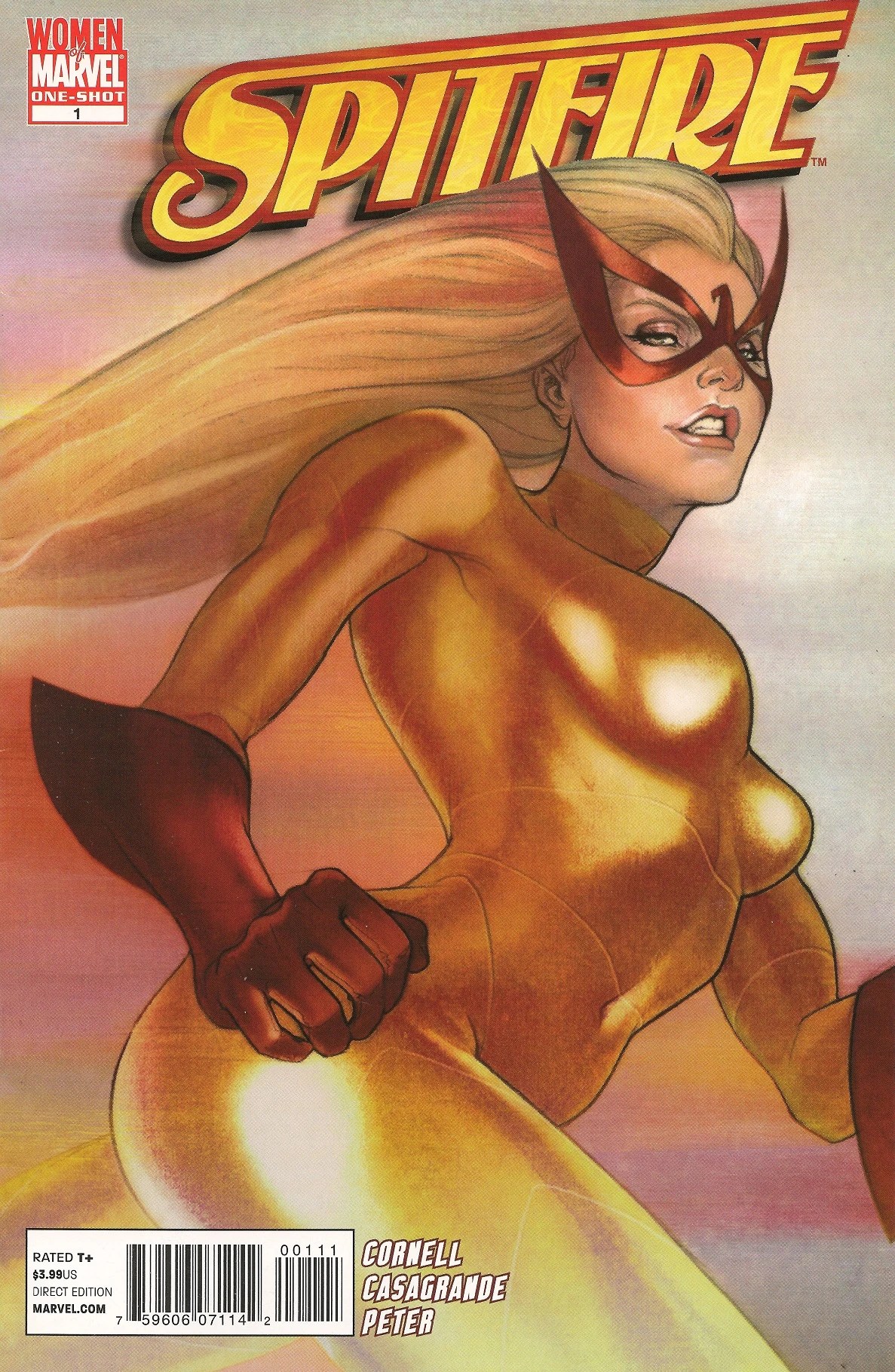
Cover to Spitfire #1 (Oct., 2010). Art by Jenny Frison.
Jacqueline — or “Jackie”, as she’d come to be more familiarly called — would remain a part of the Invaders title through to its end. If memory serves (and it may well not), the “romantic triangle” between her, the Torch, and Cap never amounted to much, which is probably just as well; if you’re only going to have one woman on a super-team (which was the case for most of the Invaders’ original run), she should function primarily as a valued teammate, not as a source of interpersonal friction. She’d go on from there to have a postwar career as well, eventually getting a rejuvenating shot in the arm that has allowed her to continue to be a player in the Marvel Universe to this very day.
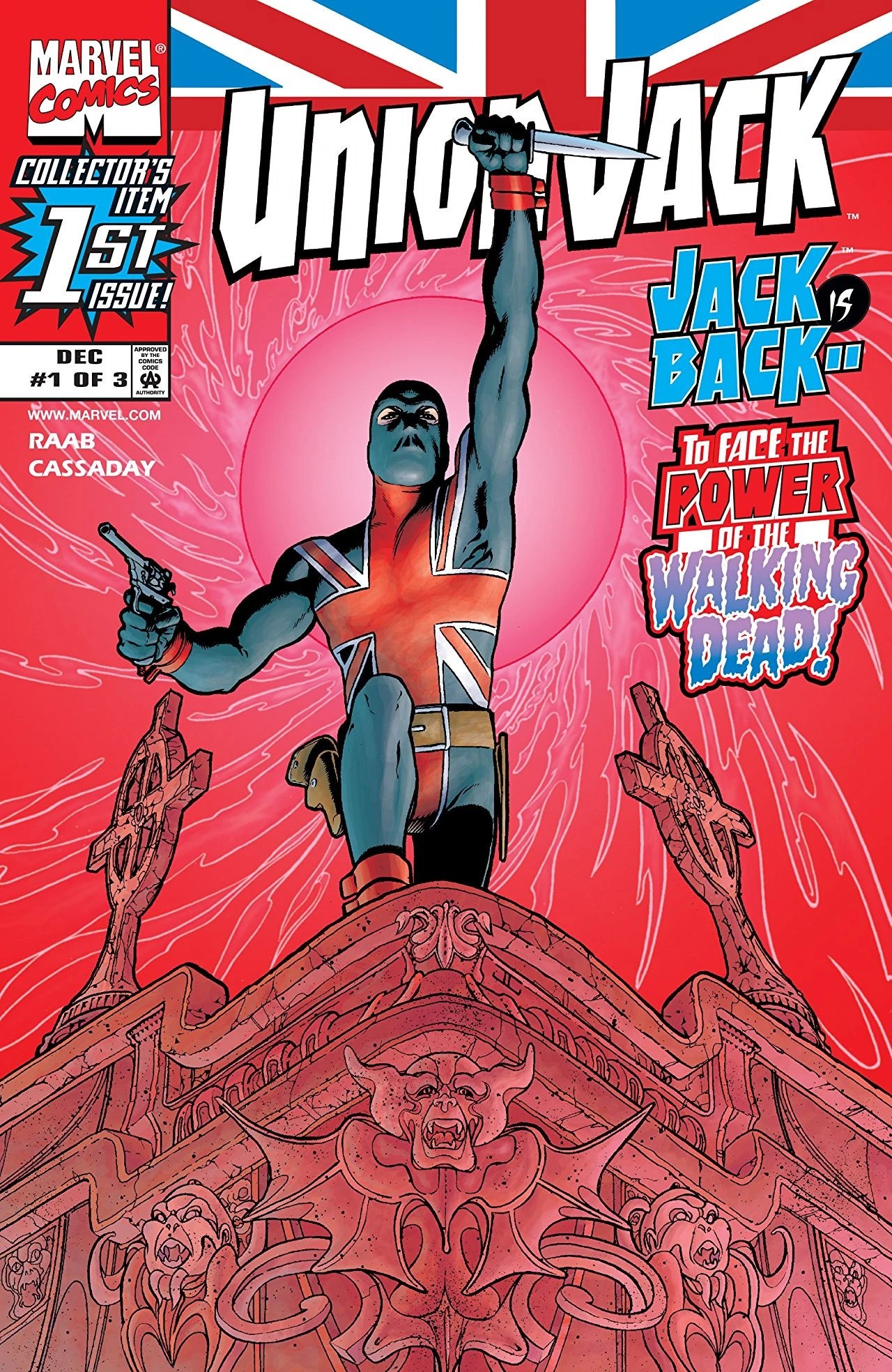
Cover to Union Jack (1998 series) #1 (Dec., 1998). Art by John Cassaday.
As for Union Jack, the unfortunate Lord Falsworth (whose first name we’d eventually learn was “James”, just in case you’ve been wondering) would never walk again following the events of Invaders #9. However, he’d pass his mantle down to his son, Brian, who like his sister, eventually joined the Invaders. Unlike Jackie, however, Brian’s postwar exploits would reach an early terminus, with Roger Stern and John Byrne revealing in Captain America #254 (Feb., 1981) that he’d died in an auto accident in 1953. Nevertheless, the identity of Union Jack would, concurrent with the passing of James Falsworth in that same storyline, be taken up by Joey Chapman — a friend of the family whose working-class origins may readily seen as providing some needed balance in the field of patriotic UK super-people, given that the family that produced Marvel’s Captain Britains, the Braddocks, are virtually as aristocratic as the Falsworths. Chapman would carry the legacy of Union Jack into membership in the Knights of Pendragon and the New Invaders, as well as a couple of self-titled miniseries; like Spitfire, he remains active in the modern Marvel Universe.

Cover to Avengers (2023 series) #16 (Sep., 2024). Art by Joshua Cassara.
That leaves us with the black sheep of the Falsworth family, Baron Blood, who — unsurprisingly, for anyone who’s read (or watched) a vampire story or two — has ultimately proved to be practically as resilient as his sire, Count Dracula. Returning to the pages of Invaders for a second round in #39-41 — the three issues that closed out the title’s original run — John Falsworth was resurrected in modern times by Stern and Byrne in Captain America #253 (Jan., 1981), the first half of the two-part storyline that also featured the debut of the third Union Jack. He’s managed to hang around (upside down, one can only assume) ever since, holding on to his sobriquet even in the face of attempts to claim it by three other vamps (one of them a female). As of this writing, his most recent appearance has come in connection with Marvel’s recent vampire-forward “Blood Hunt” crossover event, via a three-parter which ran in Avengers (2023 series) #14-16.
In this story, Steve Rogers leads a pick-up team of auxiliary Avengers against his old foe, who’s leading a horde of fellow fangers who share his fascist ideology. Mid-way through the first chapter of the arc, one of Captain America’s comrades, Hercules, bemoans the circumstances that ever allowed vampires to come into existence in the first place; this prompts a mild but memorable rebuke from Cap, whose words seem a pretty appropriate way to end this post about Invaders issues #7 through #9 and their legacy:

From Avengers (2023 series) #14 (Jul., 2024). Text by Jed MacKay; art by C.F. Villa.
“…I’ve never known a good Nazi.” Still fine words to live by, if you ask me.
The cover of #11 is one of my favorites.
This was a fun series until Roy stepped back and had Donald Glut take over the writing (about the time you left, I think). I think Roy did better with All-Star Squadron though.
I loved the detail about the teeth. It’s surprising given details like that and the sun-protective Nazi treatments Roy didn’t explain the flying. I wonder if it’s less of a bother for younger fans discovering this book — vampires flying in human form is a common thing in more recent years (e.g., Forever Knight).
You’re right about the idea nobody told John about Falsworth becoming a widower. And it’s not like the lack of ignorance is even necessary for the story.
I missed the giant and the first two issues but thereafter got every issue right up to cancellation. Like you, I was really not a fan of Frank Robbins art on other comics but, again like you, I thought that it really worked well in a comic set in the Golden Age of the 1940’s.
I really enjoyed the unofficial crossover between the Invaders and the Freedom Fighters where both teams fought the Crusaders (who were duplicates of the other team) which was published later in the year. I don’t expect you will be blogging about that but it would be fun to revisit it.
With regard to Derek being lame, I expect that was to indicate that he was a youngish man who was not fit for active service, otherwise he should have been in the army, navy or airforce.
The Phantom Eagle was also a Fawcett character who appeared as a sidekick to the Commando Yank in Wow comics. I don’t know if there was ever any link made between them and I don’t believe the original ever appeared in any DC comics after they acquired the rights to the Fawcett characters.
Finally, at the end of issue 9 I fully expected Jacqueline to become the new Union “Jack” or “Jacq” as I had expected her to be named. Also, I was wrong on that one – in hindsight, I dont think the Union Jack costume would have fitted well over her feminine torso!
Weren’t those the issues with Alfie, the cabbie with the Cockney accent and the cute Ghost Girl? Think those may have been my final issues of the series.
Yes, those were the ones. In issues 14 and 15 the Invaders fought the Crusaders, who were analogues of DC’s Freedom Fighters ( The Spirit of ‘76 – Uncle Sam, Ghost Girl – Phantom Lady, Captain Wings – The Black Condor, Tommy Lightning – The Ray, Dyna-Mite -Dollman and Thunder Fist – The Human Bomb).
At nearly the same time in issues 7 and 8 of the Freedom Fighters comic they fought their own version of the Crusaders who were analogues of the Invaders (The Americommando – Captain America, Rusty – Bucky, Barracuda – Namor, Fireball – The Human Torch and Sparky – Toro).
I don’t know any of the background of how the unofficial crossover came about so if anybody has any insider knowledge I’d love to know.
Brian, you’re actually right on target with what Roy Thomas initially intended to do. He revealed in Alter Ego that his original idea was for Jacqueline to take over the role of Union Jack from her father. But then he realized that the costume would not look as good on a female character, so he conceived the Spitfire identity instead.
“With regard to Derek being lame, I expect that was to indicate that he was a youngish man who was not fit for active service…”
Now, why didn’t I think of that? D’oh!
I could kind of see why Roy wanted Colletta inking Robbins, as Valiant Vinnie had a tendency to blanderise everything he touched, thereby blending the pencils into the Marvel house style, but from a purely aesthetic perspective, Frank Springer was by far the better choice as inker, being more in tune with Robbins’ style. Robbins inking his own pencils would have yielded the best results. Ah well…
Thus began the run of issues that turned me into a Robbins fanatic. I’d previously enjoyed his Shadow and Batman stories, but my taste had been insufficiently developed to fully appreciate him. In ’76 I finally understood his approach and began to seek out and collect his work.
The switch from Kaluta to Robbins on The Shadow was one of those AAAAARGH moments in my Bronze Age life. But that’s what makes horse-racing.
While I can’t say I was a fan of his on Invaders I did accept it as the book’s house style.
I think I’ve said it before in these comments, but I agree with you – when I was a boy in the 1970s, I did not get Robbins’s style at all, but, with time, I have come to understand and appreciate what he was doing, and now he is one of my favorite artists. I think Roy’s comments about Vince Colletta rendering Robbins’s style more palatable to readers like my young self are a bit of a cheap shot, in particular when he blames Robbins for the title’s falling sales when Colletta was no longer around to force Robbins into the Marvel house style.
Robbins was closely associated with two other vampiric characters, Man-Bat and Morbius, so I would say that Baron Blood was right in his wheelhouse. I think Robbins’ cartoony style also works well for Jacqueline and Lord Falsworth, even if the latter has big 70s hair, I still find it a plausible look for an aristocrat.
As a boy in the 70s, I was fascinated by World War II – I remember checking out books about Rommel and the Pacific theatre from the library, to the point where I got reprimanded for reading “too many war books,” but, in the 1970s, World War II was roughly as close at hand as 9/11 is today, and it was definitely a living memory in that there were plenty of adults still around who had lived through it, and I was definitely interested in it. And the war was still everywhere in pop culture, from Hogan’s Heroes to movies such as Patton and A Bridge Too Far. I find it interesting that Roy Thomas was born in 1940, and so was maybe just barely old enough in 1945 to remember the end of the war, but probably didn’t have many first-hand memories of it. Yet he got swept up in the nostalgia for the war, nowhere more so than in this series. But superhero comics as a whole were a product of World War II, from Captain America and the Human Torch battling Hitler, all the way to the Fantastic Four still battling Hitler, in the guise of the Hate-Monger, in the mid-1960s. More broadly, the Fantastic Four’s arch-nemesis Dr. Doom was pretty clearly an allegory for lingering tensions from the war, as his imaginary country of Latveria could be read as either an allegory for Nazi Germany or one of the Warsaw Pact Eastern European countries under the yoke of the Soviet Union, or both, as suited the needs of any given story. Going further, Magneto would of course later be retconned as a concentration camp survivor, once again demonstrating how the shadow of World War II lingered into the comics of the 1980s and 1990s. Having said all that, I find Thomas’s treatment of the war throughout these excerpts from Invaders #7 through #9 pretty heavy-handed and didactic, as when the Human Torch muses on how all Londoners, “young and old, rich and poor” are “doing their part” in the Blitz. Pretty clearly Thomas is writing from the perspective of someone not old enough to remember the war firsthand, and just spouting the received party lines of the day about it.
Thomas’s penchant for imaginary history gets even funnier with the introduction of Freedom’s Five, the super-team of World War One!, which I find pretty laughable, not least in Lord Falsworth’s assertion that his mission as Union Jack was to infiltrate behind “Bosche” enemy lines as an undercover operative – dressed in giant British flag. Yes, that costume would be sure not to attract attention from “Jerry,” Roy. But Roy loved to make up these bonkers imaginary historical superteams such as the Liberty Legion. Not every forgotten Timely character needed to be reworked in modern Marvel continuity.
I remember Robbins’ art on Morbius too. No, vampires were not in his wheelhouse.
Don’t think I gave it much thought while reading the story in 1976 but now the notion of the Freedom Five strikes me as ridiculous, as does spying in a costume based on the British flag. I can’t help but imagine this FF charging against the German army and getting immediately shot down in shreds. A bit like the last episode of the Black Adder series set in WWI. Black adder and his troops were ordered to go “over the top” to meet their doom in trench warfare.
In fairness to Roy and Frank I always took the scene of them charging across No Man’s Land (or wherever it was) as symbolic rather than realistic.
That said, I do think Roy was wildly optimistic asking readers if they’d like to see a Freedom’s Five series set in the Great War. Even the WW II Liberty Legion didn’t have legs enough to support a book (and I say that as someone who likes the LL).
Heck, The Phantom Eagle had not taken off (sorry!!) on 1068.
The Brits did have a tradition of sending recognizable British operatives behind enemy lines, going back to Wellington ‘s use of “Exploring Officers” in. Spain during the Peninsular Wars.
Ah, the Marvel Universe, where the power of super speed can be acquired by mixing a vampire bite with a blood transfusion from an android(!), or, alternatively, by an injection of mongoose blood. Take yer pick…
There’s a parody of the Whizzer’s origin in one of Bob Burden’s Mysterymen books, where we learn the team speedster became “the 17th fastest man alive” after drinking radioactive cheetah blood as a fraternity hazing prank.
Back in the 1990s, Marvel kicked around the idea characters like Bob Frank were mutants whose mutation, like DC’s metagene, enabled them to survive things like mongoose blood injections and then gain powers from them. It didn’t catch on — IIRC there was concern it cheapened the X-Men mutant brand.
I don’t think there’s much to choose between the Colletta and Springer inks, maybe Springer for the more solid blacks. Both had already had lengthy careers and they gave the artwork a certain vintage feel (is ‘dated’ too harsh?) which suited the setting of this series.
A lot of Robbins’ cartooniness is visible here. When Cap is thrown out of Namor’s flagship in #7, he looks like he’s trying to run up the side of the panel, but his little legs aren’t long enough. In contrast, it would have been nice to see the splash page for the following issue, #10 – seven characters visible only through the cockpit struts of Namor’s flagship, all clearly laid out in a nice bit of storytelling/design work.
I always noticed the anachronistic ‘big 1970s hair’, maybe because from around the mid-seventies I’ve always had a skinhead (buzz?) cut. I don’t think the hairstyle was imposed by Roy Thomas or Marvel, as it’s visible over at DC on Robbins’ Shadow series as well (where I much preferred the first few issues with Mike Kaluta as well).
This might also be one of the only series where I’d like to have seen Jack Kirby drawing someone else’s stories, not just doing covers.
Kirby would have been great on this!
I think the Robbins/Colletta pages look ok and the Robbins/Springer pages look great. Love that red panel that’s just UJ’s gun barrel and a close up of his eye.
That said…. I loved GS Invaders back in the day…. I don’t think the Colletta inks inhibited my enjoyment in any way, shape or form.
Btw Alan… I think they perhaps made Derek lame to suggest that SHE was helping him along and not the other way round. Absent the cane she ends up looking more like a damsel in distress.
That’s a good point, David.
I enjoyed this series, Alan, and still find much to like in the issues you’ve so ably presented here.
Roy Thomas’ love for the material shone through, and he kept in check his penchant for smarmy in-jokes and his tendency to become “inebriated with the exuberance of his own verbosity”, to borrow a splendid put-down from Benjamin Disraeli. The stories were fast-paced and action-packed, as breathlessly exciting as a Saturday morning film serial.
Frank Robbins really shone on this strip, especially once Frank Springer came on board. I’d hated Robbins on Captain America, came to appreciate him a little more during his brief stint on Power Man, and finally got where he was coming from on Invaders. The British setting and the period detail – vehicles, uniforms, buildings and so on – suited his style really well.
And Jack Kirby’s covers, mostly undistinguished during this period, were splendid here.
I didn’t even mind this title’s occasional deadline troubles, as the Golden Age reprints that resulted had a bit of novelty value.
In all our previous debates regarding the artistic merits of Frank Robbins’ work, his defenders have all rallied ’round the cry of “His work looks great on The Invaders!” Never having seen an issue of The Invaders, I was at a disadvantage, but no longer. I have seen The Invaders…and am not impressed.
Don’t get me wrong, those first eight issues with Vinnie Colleta on the inks are fairly palatable. But thiat’s because the Vin-man hinks with such a heavy hand that everything he inks looks more like Colleta than whoever did the pencils underneath. That may suck if the pensciller is say, Walt Simonson or Neal Adams, but it’s perfect for Frank Robbins! Cover him up, Vinnie! “Take the rubber out,” as Roy Thomas said. Get rid of the awkward poses and the questionable anatomoy. Away with the overly-arched eyebrows and the chunky cheekbones. In this case, the more Colleta-looking, the better.
Of course in issue nine, Frank Springer takes over the inks; an occurence that seems to me (in the haze of my fifty-year memory) to happen so often, I’m tempted to ask what Mr. Springer was being punished for. This is the Robbins I know and loathe; the unnatural hair curls and flips, the feet he never seems to know what to do with, the legs that stick out into space for no reason. We’ve said it all before and while some of you like it just fine (as Fraser said, that’s what makes a horse race), I can’t stand it.
Hey, did anyone else notice that when Robbins does a close-up of Baron Blood, he looks like Bat-Mite? Look at it again, and tell me I’m not right.
Anyway, now that I’ve seen The Invaders, my opinion hasn’t changed. Frank Robbins’ art makes me want to call up the spirit of Don Heck in a seance and apologize to the man. Profusely, for every bad thing I ever said about him.
As for the story, I don’t guess it was too bad, but isn’t this book supposed to be about the heroes in WWII? Didn’t seem to get much WWII in these stories, but maybe the war comes into play elsewhere. I half-expected to be told that Thomas ret-conned in later stories so that Baron Blood was actually Dracula after all, but I suppose not.
The oldest comic in my collection is an issue of Strange Tales from 1963 that features Iron Man and the Original Human Torch and other than the whole “Vision’s body thing,” I don’t know much about Torchy. I did enjoy finding out a little bit more here. Thanks, Alan!
If anyone sees me trying to suppress a laugh today, it’s because I’m imagining myself at that same séance where you call up Don Heck’s spirt to offer apologies.
WW II is very much part of the Invaders. However they did spend IIRC more time fighting off Nazi super-attacks on Great Britain or the US than “invading” Nazi held territory. Something I recall Namor complaining about at one point.
I’ll try to let go of my defense of Frank Robbins after this post – I certainly get why many readers don’t like his style, but if one wants to see an awkward pose and questionable anatomy, look at Jack Kirby’s cover for Daredevil #43, depicting Captain America throwing a punch at DD in a contorted, drastically-foreshortened, anatomically-impossible pose worthy of Robbins. But it works, because drawing doesn’t have to be photorealistic to work. To the contrary, cartooniness and stylized exaggeration can work just as well. In 1975 I was eight years old and recoiled from Robbins’s style because, to the extent I had a childish aesthetic sense at all, or recognized any artist’s personal style at all, I was drawn towards the photorealism of Neal Adams and Mike Grell, and didn’t understand who Milton Caniff was, or why Caniff drew the way he did, or why Robbins drew in that same expressionistic style, and so on. Further, as an adult, while I still love Grell’s work, I recognize that he had his own tendencies towards wonky anatomy, and that even Adams didn’t draw in a wholly realistic style, either. Drawing is inherently cartoony, no matter how realistic it may appear to be on a superficial level.
I like Robbins for his leaning into the inherent artificiality of art.
I’m a little puzzled here, Don. Surely Strange Tales starred the Johnny Storm Human Torch, and Iron Man featured in Tales of Suspense.
Apologies – that reply to Don ended up in the wrong place.
I’m aware that was the norm. Nonetheless, I have the book. I can only assume it was an outlier that reprinted some older stories when new stories weren’t available. If WordPress allowed it, I’d attach the cover, but alas, that isn’t possible.
Well, now you’ve really got me curious! Got that issue number handy, Don?
No, and given that my house tends to look like the season finale of Hoarders on a good day, it’ll be a hot minute before I can find it. Still, find it, I will…some day…eventually…when hell freezes over….OK, this may be a bigger job than I thought.
I don’t think Strange Tales featured any reprints until the tail end of the 70s run reprinted some Dr Strange. Also, the Original Human Torch did not appear in any comics between the end of the Atlas Hero Revival and his return in the 1966 FF Annual (not even reprints). You have me foaming with curiosity now, Don. No pressure, any time in the next ten minutes will be fine…
I looked in the boxes I have ready access to last night, Chris, and didn’t find it. The rest of my comics got put into storage ten years ago when my daughter and her family moved in with me and who knows when I’ll be able to look. I will admit the possibility that maybe the book wasn’t Strange Tales. I looked up a bunch of Strange Tales covers from the sixties last night and they didn’t look the same, so it may be that in the fog of old age I’m mis-remembering the title. Not mis-remembering the book itself, but it’s possible I forgot the title and subsituted Strange Tales in my head and over the years have turned that into head canon. I’ll keep doing Google searches for 60’s Marvel covers and see if I can find it. I apologize for making you foam…
Fantasy Masterpieces started featuring GA Torch reprints from #7 on. None of them appear to reprint Iron Man stories.
Thanks for looking, Don. Please let us know if you have a lightbulb moment.
Hey, art is in the eye of the beholder, but as a 9 year old in 1975 I responded very positively to Robbins’ art in much the same way that I responded to Ditko or Kirby. It was all at once ugly, beautiful, hard charging, individual, convincing… and honestly weird….and still told the story well. I’m making a generality here, but I think most comics fans prefer art that tends towards more naturalistic and anything that smooths out rough edges and sands down expressionism is considered a plus. It’s an industry bult on house styles after all. Robbins brought an intensity that few comic artists had in those days to my eyes.
Thomas described Robbins as “rubbery” which is accurate… but it’s still solid comics to my eyes. Weird… and cool.
The current penciller of Fantastic Four (Pat Poutin) is not exactly to my taste, but I can’t help but think that his weird visual energy doesn’t catapult the story. Art that makes you Itchy can be good. Your mileage may vary.
David, you’re probably right that the majority of comics fans prefer art that tends more to the naturalistic end of the spectrum than the expressionistic one. I’d just add that not all expressionistic styles are the same (actually, I suppose that’s part of the point). As Roy Thomas suggested in the interview I quoted, Kirby’s stuff was expressionistic, too — it’s just that his approach came across as “steely” while Frank Robbins’ was too “rubbery”, at least in some viewers’ eyes. I myself am a big fan of Kirby — and other expressionistic, “cartoony” artists like Steve Ditko, Joe Staton, and Darwyn Cooke — while remaining fairly cool to Robbins’ stuff. But, as frasersherman noted elsewhere in the discussion, that’s what makes a horse race.
Well put Alan. Yep… people like different stuff.
My first impression of Ditko’s version of the Hulk was that he made ol’ Jade Jaws look rubbery. I didn’t get that impression from how he drew Spider-Man or Dr. Strange, but Hulk did, more comical than frightening. Weirdly, when Ditko inked Kirby’s Hulk, as in Hulk #2, the Hulk looked very frightening and powerful, like he’d just as soon rip your arms out as lend a helping hand.
Ditko was more rubbery than Kirby… but so was everyone else.
Beautifully expressed, David. I’m in full agreement. As much as I admire the craftsmanship of, say, Adams, Wood or Williamson, their work, being representational, doesn’t thrill me like the more expressionistic artists you cite, along with Grandenetti, Stallman, Sutton, Estrada, etc.
Thanks. Love those guys.
I liked Sutton as well… he was definitely an “itchy” artist.
Reading a Golden Age comic was like reaching into my grandparent’s dish of wrapped candies. Underneath the wax, it could be a decent treat or it could be something that you immediately want to toss away.
I say that because it seemed that Roy Thomas sought and obtained the former with his creation of The Invaders. Surprisingly enough, in doing so, he finally found a “home” for Frank Robbins. (Can anyone imagine what the artist was thinking with some of that impossible poses and gestures?)
As a kid, I enjoyed the first several issues of this book for that reason. It was with the Baron Blood issues that my interest began to lessen – primarily because I found his visual appearances simply too silly to consider him a genuine threat. But I also liked the addition of Spitfire and Union Jack as well as the other characters enough to stick around another year or so.
Looking back and considering the world today, I do wonder if Roy Thomas should have given readers a truer sense of the vivid horrors of World War II. Reading this as a young teen, I knew that Nazi’s were bad. But I had little inkling of the devastation they wrought across Europe – including the bombings of London – to say nothing about the unspeakable atrocities of their concentration camps.
I also realize we’re talking about a comic book published in the 1970’s where portraying such horrid realities would have been difficult. Nor do I have a clue if such a series would have even sold. My thoughts are more a recollection that it wasn’t until a few years later that I learned just how significant and how dreadful a war that was. And today, the fear that overlooking or forgetting the lessons of history could lead us as a world down such a frightening path again.
But this is a comic book review that should end on a far less ominous note. Let me do so by offering my thanks to Alan for a well-researched and engaging review of a long-forgotten comic book!
In 1976, DC published a short-lived series called Blitzkrieg that looked at the war from the German point of view, and didn’t shy away quite so much from the atrocities of war – the first story in the first issue depicts German soldiers knowingly killing Polish civilians, among them women and children, and justifying their actions in killing “Polish vermin” by asking “Have not our *own* men been shot by civilians?” The tagline on the cover read “We dare to be different – searing battle sagas of World War II as seen through enemy eyes!” but, unsurprisingly, this point of view was too different for mainstream comics in 1976, and the series was cancelled after only six issues. But for better or for worse, Blitzkrieg probably hit closer to the truth of World War II than the cotton-candy fantasy spun by Roy Thomas in the Invaders.
Marvel’s “War is Hell” was also a grim series, though a very poor one: https://atomicjunkshop.com/war-may-be-hell-but-marvels-war-is-hell-isnt-quite-that-awful-not-quite/
I thought it contained some interesting things., like a story set in the Russo-Finnish War and a story about the Poles winning some battles when they figured out the tactic of getting into tough terrain, letting the tanks pass and ambushing the Infantry..
It was early Chris Claremont,so it reflected him
But the supernatural aspect worked against the war comics look. John Kowalski quantum leaps into a different body each issue, then narrates while his host carries him along. The pointlessness of him distracts from the war story.
It was sort of Deadman meets Two Fisted Tales, but I also think this might have been how it was sold to Marvel as supernatural comics were in vogue them (1974-’75).
And the first issue, which was Jenny Isabella and Chris Claremont made Kowalski more than an everyman — there’s a backstory which I anticipated would play a role (he’s an accused traitor, an alleged coward — though nothing in the story bears the cowardice charge out). Then it was all Claremont and a new editor so I’m thinking they switched directions. Which is not to say the original concept (if I’m right) would have worked for me either.
Blitzkrieg is a gem of a comic book. Superb Ric Estrada art!
There have certainly been comics that sought to portray the reality of war – Harvey Kurtzman’s war comics at EC in the early 1950s opened the door, and Warren’s Blazing Combat in the 1960s covered similar ground and used many of the same artists. But, for me, two of the finest examples in this genre were created outside America.
First, Charley’s War, by Pat Mills and Joe Colquhoun, ran for almost 300 weekly instalments in Britain’s Battle Picture Weekly from the late 1970s through the early 80s. It’s an overtly anti-war story that follows working class Cockney lad Charley Bourne from his enlistment in the British army in 1916, through the Battle of the Somme and all the subsequent horrors of the Western Front. Thoroughly researched and powerfully written and illustrated, it’s not overtly gory but doesn’t flinch in its portrayal of life through the eyes of a British Tommy in the “war to end war”.
And second, C’etait la Guerre des Tranchees (It was the War of the Trenches), published 1993, is a stunning graphic novel by French writer/artist Jacques Tardi. His art is influenced by the “clear line” style of Herge (of Tin Tin fame), but he uses it to superb effect to tell the story of World War One from the French point of view.
More recently, of course, Garth Ennis has worked with numerous artists to produce comics that give a more realistic look and feel to the war genre.
I read the first volume of Charley’s War thanks to the local library. It’s very good. I’d read more if they had them (and if I get some spare cash may just order them).
Enemy Ace does a good job conveying that good, honorable men die and that war is a butcher’s business. As it’s the air war, it’s a very different environment from the ugliness of trench warfare.
I don’t know, I feel like there’s so much fantasy & suspension of disbelief involved in the mainstream (i.e. Marvel and DC) superhero genre that attempting to show “the vivid horrors of World War II” is just going to result in a gigantic clash of tones.
The instance that comes to mind where this definitely occurs is an issue of Captain America written by Dan Jurgens and drawn by Jerry Ordway that was published in 2000, volume 3 #32. It’s a flashback to the Battle of the Bulge, and for several pages Jurgens & Ordway show scenes of absolute horror & bloodshed. Then, suddenly, Cap, Bucky, and the Howling Commandos come charging in to the rescue, and the tone completely changes, with Cap quickly & single-handedly beating up a whole bunch of German soldiers. It was total mood whiplash, going from gritty war to superhero fantasy in the space of a page, and for me it just did not work.
So, no, I feel like Roy Thomas putting the Invaders onto the brutal, blood-soaked battlefields of World War II would just have highlighted how ridiculous the characters actually are. It was much better to pit them against a succession of super-powered Axis agents, where they remained in the realm of the fantastic.
Another instance of the sort of tonal clash you mention occurs in Journey into Mystery #117, where Thor improbably travels to Vietnam, and, as Donald Blake, is taken hostage by a parody of a Communist soldier. While the script implies that Thor could be killed by a big enough artillery explosion, the story raises the question of why Thor, or the Avengers collectively, don’t simply travel to Vietnam and end the war, and end all wars around the world. If the Fantastic Four can push back Galactus, or the Avengers can defeat Kang, and so on, it seems odd that, in the 1960s Marvel Universe, the cold war still rages on in Vietnam or Eastern Europe. That war and all of the other problems of the world still exist in a world filled with superheroes requires a suspension of disbelief.
Another example of this sort of tonal clash is the first Wonder Woman movie with Gal Gadot, which, from memory, struck me as similar to the issue of Captain America you mention insofar as the film depicts the horrors of World War I trench warfare and poison gas pretty vividly, and then Wonder Woman shows up like a one-woman deus ex machina to make everything right, and it’s just not plausible.
As Kurt Busiek said, this is a common problem with comics — if we embrace the logical impact of superheroes on the world they’d no longer be adventuring in a world that appears somewhat like ours. As you say, it’s a point on which we have to suspend disbelief to keep reading.
Having them end the cold war by overthrowing the Reds isn’t that realistic either, though. As we’ve seen in the real world “overthrow the dictator” doesn’t automatically lead to a triumph of democracy and freedom (one of Jenny Isabella’s inspirations for Shadow War of Hawkman was that overthrowing the dictator who’d conquered Thanagar didn’t fix things there).
I definitely feel that DC Comics in the Bronze Age effectively sidestepped the question of why their superheroes didn’t just quickly end World War II, by having Hitler using the Spear of Destiny to prevent the JSA and friends from setting foot in any territory controlled by the Axis powers. Good solution to the problem by Paul Levitz.
While Levitz pitted the JSA against the Spear in their (finally revealed) origin, I think Roy Thomas established it was the bulwark against magic-based superheroes intruding in Axis territory, which took out the top dogs.
Superman wondered why he’d be affected by the magic more than, say, Atom or Hawkman. I wondered if Roy was setting up for an explanation of why Superman’s vulnerable to magic, but if so he never got around to it.
The Spear’s pop culture history is interesting. Just a generic holy relic (it shows up in the Grail castle stories) for centuries until Trevor Ravenscroft wrote a 1972 book claiming it was the key to Hitler’s rise to power. Then DC picked that up for a series in Weird War Tales, which led to Levitz using it in the JSA story (and one Barry Sadler incorporated it into his series Casca the Legionary), which led to Roy giving it a bigger role, then it became the weapon that can kill the Spectre …
Thinking about it, yes, you’re correct, it was Roy Thomas who came up with the idea that it was the Spear of Destiny (and the Holy Grail, too) that prevented the JSA and other heroes from attacking the Axis-controlled territories. Well, whatever the case, it was a good solution to explain why the JSA didn’t just end the war in no time flat.
Fully agree on that. I liked the bit that Seigel & Schuster did during the war to explain to readers why Superman couldn’t just end the war himself – breaking the 4th wall, if my memory serves, he explained that – duh! – he’s a fictional character and can’t materialize in our world to solve our real problems or win our wars. Only well-led and equipped soldiers, sailor, marines and airmen could win the war and it would be a discredit to them for Superman or any other such fictional character to be shown ending the war entirely on his own, even in the fantasy world of comics.
Fighting characters like Master Man, Baron Blood and Warrior Woman was certainly a sideshow to the genuine war, but that still made more sense than showing the Invaders charging into battle against a German army. BTW, I hadn’t thought about that trio of baddies being analogs of the National Big Three of the WWII era but it seems sooo bloody obvious in hindsight! Roy being Roy, he just couldn’t resist doing that sort of thing, another variation of having the Avengers go up against the Squadrons Sinister or Supreme.
Gotta say, I did enjoy the series while it lasted and was rather sad but not too surprised when it sputtered out, as happened with nearly every new series that started in the 1970s. Some lasted much longer than others, but few lasted into the ’80s, never mind the ’90s, although a few were relaunched in those decades. Invaders lasted longer than many others, but eventually they bit the dust too. I haven’t checked out any of the later relaunches.
The Invaders miniseries from 1993 was actually pretty good, I thought. I blogged about it a few years ago.
https://benjaminherman.wordpress.com/2023/02/03/it-came-from-the-1990s-the-invaders-miniseries/
There’s a chapter of the *Monster of Society Evil* serial in which Captain Marvel joins the military in liberating an Axis-held island, but it’s a rare example.
The Big Red Cheese enjoys himself so much in the campaign that I can almost hear Robert E. Lee saying that it is well that war is so terrible, or we should grow too fond of it.
By the way, the Dragon King’s enchantment doesn’t seem to affect Johnny Quick, whose speed comes from a “Magic Formula.” Maybe someone was thinking of the Speed Force in the ealry 1980s…
Technically though, his power isn’t magical: it’s a formula that sums up all of time and space mathematically which makes it easy to move through it at accelerated speed. Which is gibberish, but it’s clearly math/physics gibberish.
The Invaders! Alan, I didn’t know you had followed this series in real time, because you never blogged about it before now. Glad to see these issues spotlighted here, now.
I put together a complete run of the Invaders series in the 1990s and early 2000s, scouring the back issue bins at conventions and comic shops. I remember my thrill when, after over a decade, I *finally* had the entire series in my collection… and then a short time later Marvel at long last began reprinting them in trade paperback collections! Oh, well, at least by having all the original issues I can read the letters pages, which is pretty interesting, to see how readers at the time reacted to the series.
Baron Blood, Union Jack and Spitfire are all great characters. It’s not surprising that they’ve had longevity far beyond this series. So, kudos to Roy Thomas and Frank Robbins for their work in conceiving & designing them.
Fun fact: Thomas later recounted in his magazine Alter Ego that he devised several of the Nazi villains in Invaders as a sort of “Evil Justice League.” Master Man was a stand-in for Superman, U-Man for Aquaman, Baron Blood for Batman, and Warrior Woman for Wonder Woman.
So, regarding Robbins’ work on Invaders, I feel he was very well suited to render the 1940s period elements of the series. I’ve subsequently begun following “reruns” of Robbins’ great Johnny Hazard newspaper adventure strip on the Comics Kingdom site, which started in June 1944, so he definitely knew how to accurately depict the costumes, vehicles & technology of World War II. Also, I’ve always felt that Robbins drew beautiful women, and that’s on display here with Jacqueline Falsworth. I am not a fan of Vince Colletta’s inking over Robbins, though. I do feel that Frank Springer was a bit of an improvement (sorry, Roy Thomas) but, honestly, I wish Robbins could have inked his own work on Invaders.
One thing that now stands out to me about the climax of issue #9: Union Jack pries the boulder off of his legs, inadvertently sending it flying in the direction of Baron Blood… and it takes four panels for it to cross the cavern and smash into him! Superhero comic book timing is a funny thing.
Anyway, Alan, I hope you will be blogging about more issues of Invaders in the future.
IIRC Master Man’s name of Willie Lohmer was meant as a pun on Arthur Miller’s Willie Lohman — a pathetic nobody until he got the magic juice.
It’s actually Willy Loman (there’s a revival of *Death of a Salesman* on Broadway right now, with Nathan Lane and Laurie Metcalf as Willy and his wife Linda), but given that Willy’s salesman model was Dave Singleman, it makes me think that it’d be fun to see Master Man fall to German-American Dave Tausenden, whose name would reflect that he is “ein Mann unter tausenden” (a man in a thousand).
Think it means anything that Willy’s boss is Howard Wagner, Jr.? Maybe the Valkyries know.
P.S. I forgot to say, great Jack Kirby covers on all three of these issues! It’s nice that Roy Thomas was able to get Kirby, who actually worked on the 1940s Timely superhero stories, to contribute to this series in some small capacity.
The thing that always bugged me about the end of this story is in what vampire lore is a stalagmite through the heart fatal to a vampire? Sure, it would’ve been plenty uncomfortable for Baron Blood, but if I recall that era’s rules for Marvel vampiredom as established by Tomb of Dracula in the 70s, rock to the heart ought not to have done the job. Wood to the heart, in the form of stakes, Blade’s blades or Rachel Van Helsing’s crossbow bolts, was definitely deadly to vamps, as was silver to the heart, fire, beheading and sunlight. I don’t remember what the darts Quincy Harker fired out of his wheelchair were made of, but I’m assuming they were wood or silver. But a chunk of rock was never established as a method for vampire slaying. I guess the argument could be made that getting a stalgmite through the heart destroyed it to the point that it would kill even a vamp, but if that’s the case, the vampire hunters were kind of dopey for worrying so much about always having wood or silver weapons on hand when any old sharp object would’ve gotten it done.
Spitfire in the Invaders and Darkstar in the Champions both made their debuts at roughly the same time (one month apart, it looks like – well, technically Spitfire wouldn’t appear until a few months after Darkstar, but civilian Jacqueline Falsworth showed up a month before Darkstar), when I was 12 almost 13, and I guess that was the prime age for me, as those two blondes have been my great comic book crushes for the last 50 years.
Back in 1976, I’d only read one book about World War II – a humongous American Heritage tome with plenty of pictures, and I hadn’t yet read much of anything about The Great War, but in the 50 years since then, well, I’ve read a few dozen books either mainly about the wars or biographies of many of the main players in them (as well as quite a few about the U.S. Civil War and Lincoln). Anyhow, as a concept, the Invaders appealed to me, even though I wasn’t all that keen on Robbins’ artistry but it did grow on me. As with all the other Giant-Size mags, I didn’t get G-S Invaders #1 (my one source of comics at the time never got any of the Giant-Size mags so even if I had the extra money for them I still couldn’t have gotten them), but I did get the first regular issue and I’m fairly sure I got the whole run until it got the axe, by which time it had pretty much run out of steam anyhow, IMO. although there were still some interesting elements, including the story regarding our shameful internment of Japanese-Americans for no other reason than their ethnic heritage. There was plenty of bigotry within pretty much every nation involved in WWII, but the atrocities committed by the Nazis and their collaborators throughout Europe and by the Japanese in China, all fueled by bigotry were staggering. And even if not quite as horrific, the vast bloodshed of the First World War was also deeply disturbing. All of which makes me difficult to get back into a mindset wherein I can truly enjoy Thomas’s fantasy tales mostly set on the fringes of the war zones – certainly within range of the bombs falling on the UK as in this tale but not within the regions where the ground battles were at their most intent and soldiers and civilians were dying by the thousands.
And in this modern era wherein AI is a recurring topic in the news, I find Thomas’ handling of Jim Hammond’s feelings of longing, angst and jealousy intriguing. I’ve certainly suffered such pangs myself as a real human being. In Thomas’ fantasy realm, Phineas Horton appears to have created something entirely on his own in his laboratory that aside from being able to magically burst into flames and capable of flight, this android thinks and has the feelings of a Homo sapiens. And in a time period when actual Homo sapiens were being treated abominably due to entrenched beliefs that they were somehow subhuman, vermin.
Just a few thoughts that come to mind in response to Alan’s great overview of this Baron Blood trilogy. A sort of mingling of the classic horror films of the 1930s which seem so tame and pale compared to the genuine horrors of the 1940s.
I never had the problem some of y’all did of finding Invaders too soft on the horrors of war, as it’s not a war comic. WW II has been the setting for all kinds of stories — romance (The Clock), home-front drama (Since You Went Away, Summer Without Boys), comedy (Hogan’s Heroes, Buck Privates), spy thrillers, science fiction … and superheroes.
So Jim Hammond thinks he has “…perfectly simulated flesh, bones and blood” as per the dinner scene at the start of Invaders #8? At this point within canon the Vision being the reborn Human Torch had already been established (and would be again, thanks Kurt Busiek), so did continuity-conscious Roy not recall his (and Neal Adams’) own work in Avengers #93, that didn’t appear to show anything remotely human-like at the ‘centre of the android’?
Quite often with Alan’s splendid reviews, I’m driven to hunt out the relevant issues of a series if they’re easily accessible, so I found my copy of Invaders #7. Someone on the letters page pre-empted what I said above about how it might have been nice to see Jack Kirby drawing a full issue or two, not just covers, and the editorial response (presumably from Roy himself), said that that would be great as ‘Jack WROTE and drew some of Cap’s earliest adventures in the 1940s’. Apologies and all due credit to Joe Simon, but oh, for those more innocent times when credit was more generously (and sometimes more honestly) given, even if in this case it was not entirely accurate.
The obvious explanation is that Neal Adams had fun drawing the strangely non-human Vision innards.
The best retcon would be that Ultron installed some alterations in the process of the Torch-to-Vizh transition. Or just ignore what his insides looked like in Avengers 93
I think Neal Adam’s approach was somewhat more realistic. That Horton could just “create” from synthetic materials a nearly perfect replica of a human being, including the brain, neurons, etc., with only that one bizarre “defect” just strikes me as a touch too far. But, then, this is all fantasy and even many aspects of the origin story of Superman are entirely fantastical.
Apologies for jumping down here, but the thread above was getting too thin to read 😊
Don : Could it possibly have been ‘Marvel Collectors’ Item Classics’ you were trying to recall?
No Golden Age Torch, but it did feature early FF with Johnny Storm, Iron Man in Tales of Suspense and some Tales of the Watcher so Uatu got some cover appearances and might have put you in mind of Strange Tales? MCIC didn’t start until 1966, and the line-up wasn’t settled until maybe 67. Browse some of those covers, it was the nearest I could find to your description.
Agree with Fraser (and Kurt B) and everyone above, you have to allow that however powerful your heroes are, they can’t solve most real-world problems without radically affecting the nature of their societies. You’d end up with the conclusion to Alan Moore’s Marvelman/Miracleman (or possibly the Authority), where the heroes would end up shaping their world.
I always tried to give The Invaders a fair shot, but Robbins art just wasn’t for me.
Invaders was a charming series. My introduction to Jim Hammond and to the idea of Namor and Captain America as regular team members (I had no access to Avengers stories at the time, and Captain America stories back then rarely even mentioned the Avengers, let alone his membership).
I am not generally a fan of Frank Robbins’ penciling, but it works here, bringing a measure of raw, maniac energy to most scenes. Roy Thomas’s scripts generally delivered as well.
Alan, you missed out the splash page of #8, which was simply amazing.
I never particularly liked Frank Spinger’s art, but he brought a care and attention that helped elevate Robbins’ pencils. But for some really great inking on Robbins I recommend you all turn to Fear # 27, where Lenard Starr applied the brushwork to Robbins’ pencils. Like several of you, I have been converted to Robbins over the years, and now prefer his version of the Shadow to Mike Kaluta’s!!
I find Roy’s comments a bit disingenuous. He was part of management that hired Robbins as an artist ( and not as a writer). I find his comment indicating that Kirby covers were a strong commercial feature of interest. DC never used Kirby as a cover artist!! Although not particularly vocal about it, Roy was a big Kirby art fan, and I read ( somewhere) that the cover of #8 was presented to Roy by Kirby and was ( and maybe still is) on prominent display in the Thomas household.