

Cover to Savage Sword of Conan #1 (Aug., 1974). Art by Boris Valejo.
It’s been a while since we discussed Red Sonja on this blog — since the 50th anniversary of the publication of Savage Sword of Conan #1, to be precise, and that was back in June, 2024, a full two years ago — so before we jump into the main topic of today’s post, it’ll behoove us to spend just a little bit of time tracking what the She-Devil with a Sword had been up to between her appearance(s) in that black-and-white comic magazine and her sixth solo outing as a headliner in the second volume of the color “showcase” comic title Marvel Feature. Beyond that, a brief recap of the heroine’s earlier history may also be useful, both as a primer for anyone out there not already thoroughly familiar with Big Red, and as a refresher for those who are. (Though if you do already know all this background material backwards and forwards and choose to skip the next couple of paragraphs, that’s fine. After all, how will the rest of us ever know?)

Illustration of Red Sonya by Roy G. Krenkel for a collection of Robert E. Howard’s historical fiction, The Sowers of the Thunder (Donald M. Grant, 1973).
We’ll start with a fact of which most everyone reading this probably is already aware: namely, that the character of Red Sonja is in large part, though not entirely, the creation of the pulp fiction author Robert E. Howard, who, all the way back in 1934, had included a sword-wielding, pistol-packing, Ukrainian-born female mercenary named “Red Sonya” as a character in his “The Shadow of the Vulture”, a historical adventure yarn set in 1529. Decades later, a version of that character found her way into Marvel Comics’ take on another, rather more famous REH hero when writer/editor Roy Thomas and artist Barry Windsor-Smith adapted “Shadow” for Conan the Barbarian #23 (Feb., 1973), changing the story’s setting to the Hyborian Age, converting its lead male character (a German knight named Gottfried Von Kalmbach) into Conan the Cimmerian, and, last but probably not least, spelling Red Sonya’s name with a “j”.
Why ditch the “y”? As Thomas would explain many years later in his introduction to the trade collection The Adventures of Red Sonja, Vol. 1 (Dynamite Entertainment, 2005):
I believe I felt that, if she were to be a possibly continuing character in Conan, it might be best to make her a bit more of a “new” character by changing the spelling of her name, ever so slightly. That way, Red Sonya-with-a-“y” would continue to exist, pristine and untouched, in the crumbling pulp pages of old magazines (and in the inevitable and welcome reprints), while Sonja-with-a-“j” was a blank slate, on which I could write and Barry could draw whatever we would.

Cover to Conan the Barbarian #24 (Mar., 1973). Art by Barry Windsor-Smith.
From Conan #23, Red Sonja-with-a-“j” stepped right into the following issue, which brought readers the Shazam award-winning “The Song of Red Sonja”. And then Windsor-Smith left Conan for the second time, and Sonja got put on the shelf for more than a year, until Thomas brought her back in the aforementioned debut issue of Savage Sword of Conan. There, in addition to sharing an adventure with the book’s titular star, Sonja also appeared in a short tale of her own, illustrated by Esteban Maroto — the artist responsible for designing the scale-armor bikini which, for better or worse, would become central to the character’s best-known look.
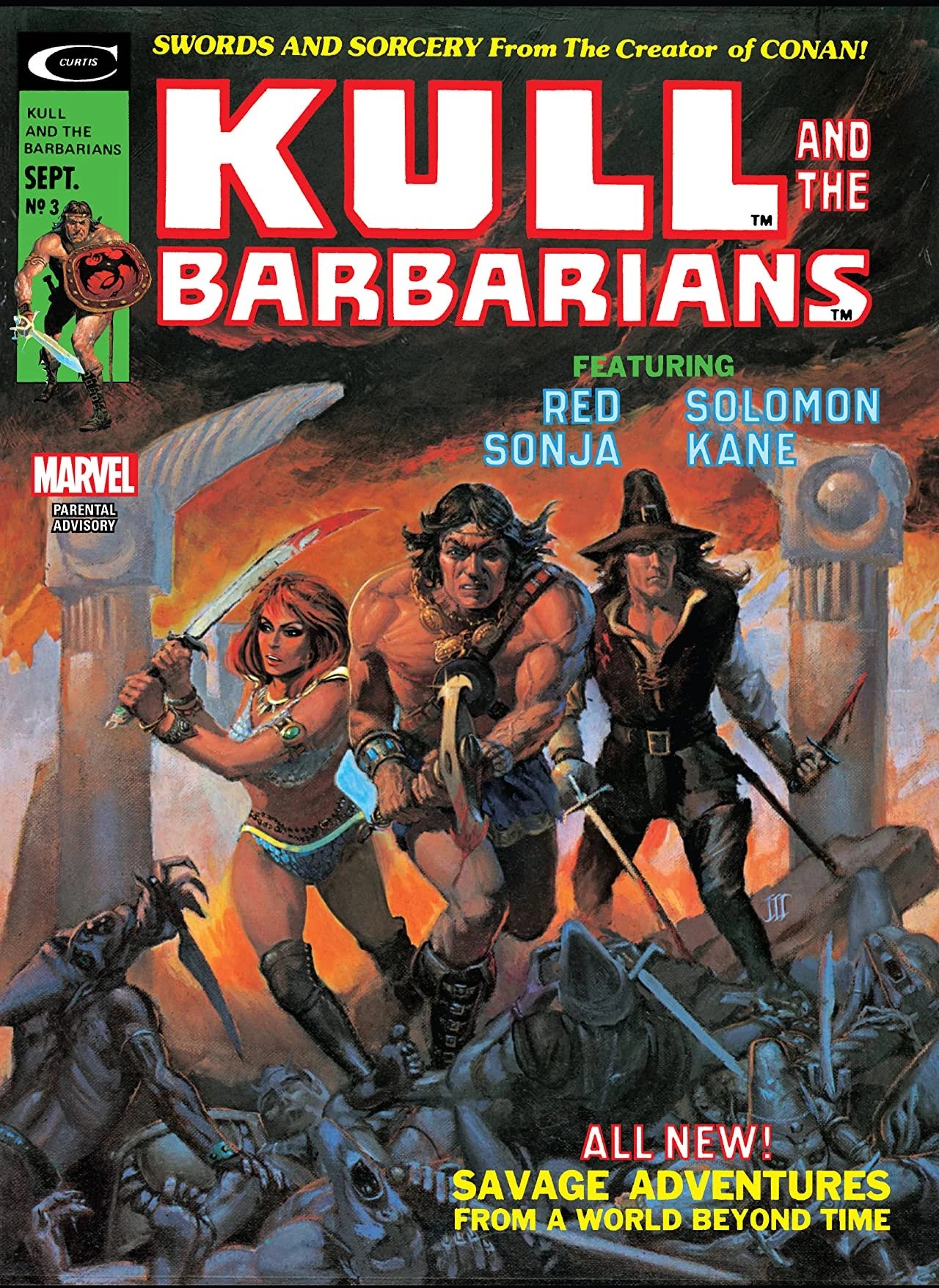
Cover to Kull and the Barbarians #3 (Sep., 1975). Art by Michael Whelan.
Sonja’s team-up with Conan continued from SSoC #1 directly into two issues of the Cimmerian’s monthly title (#43-44) with her next solo adventure appearing as a backup feature in the same book just a few issues later, in Conan the Barbarian #48; all four of these stories were drawn by John Buscema. From there, Red made another foray into the field of black-and-white comics, appearing in the second and third issues of Kull and the Barbarians — an effort by Marvel to see if the success of Conan in the B&W format could be extended to a title featuring some of Robert E. Howard’s lesser known heroic fantasy characters. Alas, it couldn’t, at least not in 1975, and the third issue of KatB was also the last; still, you couldn’t fault the artwork in either of the Red Sonja stories, both of which were illustrated by Howard Chaykin.

Cover to Marvel Feature #1 (Nov., 1975). Art by Gil Kane and John Romita.
But even as Kull and the Barbarians was sputtering out in the marketplace, Marvel — or, at least, Roy Thomas — was doubling down on Red Sonja. Released just two weeks after KatB #3, Marvel Feature (Vol. 2) #1 presented one new eight-page tale by Thomas and Dick Giordano, backed by a newly colored reprint of the first Sonja solo story from Savage Sword of Conan #1. Interestingly, despite his eagerness to promote the character, Thomas wasn’t immediately available to script the Hyrkanian swordswoman’s full-color exploits on a regular basis (though he was in place as the series’ contracted editor from the get-go); even the brief new story he contributed to MF #1 was an adaptation of “The Temple of Abomination”, another historical fantasy tale by Robert E. Howard. From issue #2 through #5, while all the stories were new, they were also all written by Bruce Jones, a young creator who’d previously done some work for Thomas in Savage Sword of Conan as well as in the short-lived black-and-white anthology title, Unknown Worlds of Science Fiction.

Cover to Marvel Feature #2 (Jan., 1976). Art by Frank Thorne and (maybe) John Romita.
Marvel Feature #2 also featured the arrival of the artist who’d ultimately prove to be the definitive illustrator of Red Sonja in her Marvel years: Frank Thorne. Thorne was a veteran journeyman who’d been working since the late 1940s, drawing syndicated newspaper comic strips as well as stories for various comic-book publishers. In 1975, my younger self knew him best for his DC stuff, which included Korak, Son of Tarzan and a single “Spectre” story in Adventure Comics (which, inked by regular “Spectre” artist Jim Aparo, came out looking mostly like Aparo, at least to my eye); I’d also enjoyed his take on Dracula in Atlas Comics’ Fright #1 (Jun., 1975).
I can’t say that Bruce Jones’ four Red Sonja stories made a huge impression on me (not that they were bad); as for Thorne’s art, I generally enjoyed it, although I wasn’t entirely sold on his rendition of the series’ star. While she was certainly attractive, I felt then (and to some extent still do) that the somewhat cartoony “baby-doll” facial features he gave her made her look too young, and less seasoned than the experienced soldier-adventurer she’d already been established to be.
Whatever I thought back then, none of it stopped me from continuing to buy and read the book — though I imagine that I was at least mildly gratified to see the return of Roy Thomas to writing duties with Marvel Feature #6. And that seems a good cue for a segue — so, after pausing just long enough for a quick scroll back up to the top of the post to again admire Thorne’s cover for the issue, let’s proceed to explore our main reason for gathering here today…

As indicated by the credits, Frank Thorne not only pencilled and inked this story, but lettered it as well; like Alex Toth and Jim Aparo, Thorne was among the relatively few American comics artists of this era who preferred to do all three of those jobs whenever possible.


Having temporarily blinded Sonja, the man-jackal presses his advantage, leaping onto his intended victim and knocking her to the ground. But she reacts swiftly, sending him tumbling over her with a kick, then encumbering him with her cloak…


Detail of panel from Conan the Barbarian #7 (Jul., 1971). Art by Barry Windsor-Smith and Dan Adkins.
Karanthes is a character drawn from “The God in the Bowl”, a Conan story by Robert E. Howard that Roy Thomas and Barry Windsor-Smith had adapted for Conan the Barbarian #7, back in 1971. There, the priest of Ibis (whose name was spelled “Kalanthes” by Howard, by the way) was only referred to in another character’s dialogue, never actually interacting with Conan or the story’s other characters; nevertheless, Windsor-Smith went to the trouble to fully design him for the single panel in which he “appears”, and Thorne has clearly used that design as reference for his own interpretation of the character.
Karanthes’ reverent description of his god as “Ibis the invincible” is a cheeky reference on Thomas’ part to a Golden Age superhero published by Fawcett Comics. (I could tell you more about him here, but that might spoil our upcoming coverage of his Bronze Age revival via 1976’s Justice League of America/Justice Society of America annual team-up event So, if you’re curious, be sure and come back in early July for that post.)

“You have heard, no doubt, of the fabled iron-bound Book of Skelos.” Like Karanthes/Kalanthes, this eldritch tome was another direct reference to the stories of Robert E. Howard, who’d first mentioned it in the story “The Pool of the Black One”, originally published in 1933. It had been mentioned in other stories as well, but there’d never been many (if any) details given regarding its contents, the number of copies in existence, and so forth — meaning that Thomas and his fellow Hyborian Age chroniclers had a mostly blank slate for how they used it in the comics.

“… since I raided the king’s palace in Makkalet!” This is a callback to the misadventure Red Sonja shared with Conan back in the 24th issue of the Cimmerian’s color title.

Sonja might or might not have much prior experience with “Messantia, capital of Argos”, but the same couldn’t be said of the readers of Marvel’s sword-and-sorcery comics — at least not those who’d read Conan the Barbarian #57‘s “Incident in Argos”, the story which had kicked off the “Queen of the Black Coast” sequence currently running in that title, which had appeared just nine months previously.

Regardless of what I thought of Frank Thorne’s visualization of Red Sonja as a character, there was no denying his ability to expertly stage and choreograph an action scene for maximum suspense and excitement, as we see on the pages that follow…

This sequence is an obvious riff on the familiar modern urban legend of “sewer alligators” — well, up to the point where the beasts are magically transformed into half-reptile, half-human creatures, anyway…


Sonja’s gambit is successful in sending one of the crocodile-men swirling down the drain to his likely doom — but it also leaves her dangling helplessly from a chain, seemingly easy prey for the last remaining of the uncanny creatures…


Oh, wait — did I forget to mention earlier that this issue is the first chapter in a five-part crossover between Marvel Feature and Conan the Barbarian? Yeah, that’s happening. Evidently, once Roy Thomas was able to resume writing as well as editing the Red Sonja strip, he was determined to give the fledgling series the greatest possible chance for commercial success by linking its storyline to that of its much better-established companion title for a few months. And who knows? Maybe it even worked, at least for a while, since the She-Devil with a Sword moved into her very own title immediately thereafter.
But all that’s still a ways in the future. For now, just be sure and return in a week’s time for our coverage of the crossover’s next installment in Conan the Barbarian #66… though you should of course also come back three days before that, for a completely unrelated post that I’m sure you’ll enjoy just as much (I hope so, anyway).
I had a huge crush on Frank Thorne”s Red Sonja back in the day and scant wonder (as Roy Thomas might have said). That is one beautiful looking comic book. Thorne was also a superb visual storyteller. In fact, the only bum note in the issue is the Romita-ised Conan face in the final panel. The Romita obsession with clenched teeth strikes again.
Does that cover also look a little like JR Sr might have worked on the face?
Definitely. However, it looks like he at least made an attempt to match Thorne’s style, so it’s not as jarring as the usual ‘Romitarising’.
Tempting though a chainmail bikini might have been for my 13 year old self, I had never got into buying S & S mags but this got me thinking. Aside from the long running Millie the Model romance mags and similar , was Red Sonja the first Marvel (mostly non superpowered ) female heroine to have her own mag? Ms Marvel didnt come along til early 77.
Shanna, Night Nurse and the Cat all had their own titles in 1972, although none were particularly long-lived.
So on the cover (and probably quite often elsewhere) Sonja calls herself a ‘warrior born’. Nice, but blatantly incorrect if we have to tolerate her nasty little origin story, and that she wasn’t a warrior until after she was a rape victim who took a vow of chastity unless she got beaten up by a man first. Talk about things that don’t age well and weren’t too pleasant to begin with.
In my head canon, the capable (but flirty), experienced warrior Red Sonja who appeared in Conan #24 rode off after that issue and was never seen again. This is some other redhead trading on the Sonja brand-name. Very capable (but blatantly sexist) artwork, some halfway okay stories but I think even back in the day I was troubled by the character’s supposed origin and motivation.
I read Night Nurse a couple of years ago. Surprisingly good — I wouldn’t expect an early 1970s comic book to deal with things like doctor burn out and drug dealing.
Agreed.
While “I won’t bed a man who isn’t tougher than me” has its own issues, it worked well enough. The origin we got later did not.
I’m glad you liked Thorne but I never did and bought very few of his Sonja stories. And while Conan’s gear never bothered me, to this day I can’t stand her chainmail bikini.
I don’t dislike Thorne’s style now as much as I did fifty years ago (especially not after spending the earlier part of the week re-living Frank Robbins). He’s good at drawing women and his page composition is excellent here, but there are times it seems like he’s in too big a hurry and I really dislike the way he draws Sonja’s hair. As for the chainmail bikini, it IS impractical, but it also is sexy as hell, which is undoubtedly what Thomas wanted from the character when he gave the assignment to Thorne in the first place. And it IS iconic; you see a swordswoman in a chainmail bikini, even if the drawing is in black and white so you can’t see the color of her hair, and you know you’re looking at Red Sonja.
As for the writing, it always bothered me that, for the most part, all these barbarian stories went largely the same. “Mysterious magical figure hires barbarian to do the impossible. Against all odds and defeating several arcane threats, said barbarian does the impossible. Barbarian is either betrayed by the mysterious magical figure or loses the treasure in some other way and moves on to the next adventure.” There are exceptions to this, of course, and sometimes the stories that follow this plot almost to the tee are excellent anyway, but it does make for a certain predictability. That said, Roy absolutely wrote these characters better than anyone else in those days and Conan’s popularity as a comics character is as beholden to Thomas as it is to BWS. Thanks, Alan!
The issue before this one – Marvel Feature #5, “The Bear-God Stalks the Night!” is a good example of this series wringing an excellent story out of the formulaic plot you mention, but, as someone else noted, superhero comics are nothing if not repetitive, and all genres of fiction follow conventions. That doesn’t stop creators from doing something fresh with those conventions, and, in the case of Thorne’s Sonja, even when the story of any given issue is less compelling, there are still those pretty pictures to look at.
Yes, formula is primarily a problem if you’re not into the genre. For someone who is there’s a lot more nuance and variation. To a non-comics nerd, Superman and Spider-Man might look interchangeable, not to people like us.
I associated Frank Thorne with some good (if slightly undistinguished) war and western (the long running Tomahawk and end-stage Son of Tomahawk book) at DC. I guess his work on Korrak indicated that DC saw him as having potential for “adventure strip” kinds of things . . . .
Not a bad artist, looking at his work now, I see some similarities to the work of Pat Boyette (although not all his male characters look like George C. Scott, as Boyette’s did).
I was a bit surprised by his brief incarnation as a “cult” artist.
To repeat points made above, I think that Thorne’s artwork is amazing and that Sonja’s chainmail bikini is sexy as hell, but as the scans posted above illustrate, I do think that Thorne’s linework was particularly poorly served by the poor printing quality of the plastic plate era of comics in the late ‘70s. There are lots of color plate alignment errors in these comics as well, and the coloring is often muddy overall. I have the first seven issues of Marvel Feature, minus this one issue that Alan discusses here, and it is frustrating to read them and have to fight through the printing problems to see the beautiful work that Thorne put down on his original pages. I believe there are several Artist’s Editions of Thorne’s work on Red Sonja, but they are out of print and go for crazy money on the used market, but I’d still like to track them down one day to see Thorne’s work better presented.
For some reason, that “muddy” effect you referred seemed prevalent throughout the latter part of the 1970s in Marvel comics. Haven’t read any explanation for that.
Around this time, I believe Marvel and DC switched from using metal printing plates to plastic plates. I also think the quality of the inks used to print the comics was adulterated. Marvel and DC comics from roughly 1968 to 1972 often look really good, despite the inherent issues with newsprint and the four-color printing process. Around 1976, though, printing quality fell off a cliff. As I said adove, I find these printing quality problems to be particularly apparent on Thorne’s run on Red Sonja. When DC went to Baxter paper on select titles in the early ‘80s, it was a massive and much-needed upgrade to the look of the books.
Don hits the nail on the head for me with barbarian comics. Although I never minded whatever book I picked up, there seemed a “sameness” permeating throughout all of them. (In fairness, I supposes someone could say the same about superhero comics.). I’m also glad that everyone picked up on the “chainmail bikini” looking quite enticing, but being both impractical and sexist. Like most everyone else, I liked Thorne’s art on the few issues I picked up – other than the “sex kitten” approach to Red Sonja. Thanks again, Alan!
Alan, I’m curious, did your teenage self ever run into any serious problems from your parents with you purchasing the Red Sonja comic books featuring her in all her sexy chain metal bikini glory?
I do like Frank Thorne’s artwork a lot. He definitely had a career renaissance in the mid-1970s due to his work on red Sonja, and from that point on he specialized in his depictions of sexy women. I agree that there do appear to be some printing issues here with the cheap newsprint not picking up all of his intricate linework. But I still think his art on this story is very attractive.
Even though I have several of the Dark Horse trade paperbacks reprinting the original Conan the Barbarian comic books from Marvel, I never had an opportunity to read the Red Sonja / Conan crossover due to the fact that Conan and Sonja are owned by two separate companies, and Dark Horse didn’t get the rights to use Sonja from Red Sonja, LLC, so these issues were all omitted from the DH collections. So, Alan, I’m glad you will be spotlighting these issues, so I can finally see what this story was about!
Years back Brian Cronin explained on CBR how this unfortunate legal mess came about:
“In 1985, a follow-up to Arnold Schwarzenegger’s hit Conan films was released, called Red Sonja, with Schwarzenegger playing a Conan substitute called Lord Kalidor and Brigitte Nielsen taking on the role of the She-Devil with a sword, Red Sonja
“While the film did not prove to be that big of a hit, it did lead to the Howard Estate to spin the character off into her own company, Red Sonja, LLC.
“This was presumably done to make it easier to license the character separately from Conan for stuff like posters, animated series and things like that.
“Marvel continued to have the license to the character, though, until they gave it up soon before they gave up the Conan license in 2000.
“However, that proved to be a problem later on when Conan Properties, LLC was purchased by a different company, leaving the rights to Red Sonja now separated from Conan.”
https://web.archive.org/web/20190423151716/https://www.cbr.com/marvel-red-sonja-conan-deal/3/
“Alan, I’m curious, did your teenage self ever run into any serious problems from your parents with you purchasing the Red Sonja comic books featuring her in all her sexy chain metal bikini glory?”
None that I remember, Ben — but by the time I was in college, they weren’t really paying that much attention to my comics purchases. I *had* gotten in trouble a few years before this when Mom got a look at one or more of my Warren magazines, so I probably tended to keep the racier stuff out of sight, regardless.
In my household, it was my dad who brought home the genuinely racy material, particularly when he came back from long cruises while serving in the Navy. I remember once, circa 1977, when he came home and plopped a box on the living room floor with filled with magazines like Hustler and Swag and other hard-core porn, rather shocking to my then 15 year old self! Then there was the time my uncle Tim (dad’s youngest brother who did a two year stint in the Navy, joining out of necessity to avoid going to prison after having been caught bootlegging alcohol in a “dry” Texas county) came to visit with an album called “Country Porn” by Chinga Chavin. Yeah, my parents both came from Southern Baptist backgrounds, but, well, it didn’t exactly fully take with either of them.
Frank Thorne was still in “Joe Kubert” mode when he drew Korak at DC and Red Sonja at Marvel: great page layouts, great figure drawing, good storytelling, *but* . . . some (intentionally) chunky inkwork on surfaces that, at times, looks rushed or under-developed. Can you imagine if Dick Giordano, Klaus Janson, or Berni Wrightson had inked these pages? They would add that missing component, some much needed surface textures and variant line weights.
But it was the “less is more” and rough-hewn surfaces that Toth, Kubert, and Thorne were selling—-but I prefer Frazetta, Adams, and Wrightson whose work had so much mood and feeling to it.
P.S. My only other complaint about Thorne’s work here is that he made Red Sonja’s eyes unusually cartoonish and large (not quite manga size, though).
Frank Thorne and Wendy Pini are linked because Pini famously cos-played Red Sonja in the 1970s, to the point of making her own real chain-mail bikini to wear to conventions – I believe I recall reading an interview with her in which she noted she had to line the inside of the bra with leather or some other fabric, because the metal was otherwise too cold to wear – but they are also artistically linked, Thorne was a big influence on Pini, and, to get to my point, Pini picked up on Thorne’s big manga eyes and incorporated that look into her depiction of Cutter and the other elves of Elfquest.
Actually, it is “scale armor,” rather than “chain-mail,” although scale armor is generally sewn into a leather or cloth garment. (Mrs Pini had the right idea historically.)
Only ever got a couple of Red Sonja’s solo comics back in the day (and only got Conan #24 decades later). Frank Thorne’s artwork is very fine and fitting for these sort of escapist fantasy tales. And, of course, evoking other fantasies among certain male readers! I did love Sim’s parody of Sonja in Cerebus, Red Sophia and the earth-pig’s nonchalant reaction when she took off her chainmail bikini to expose her heaving breasts to him. As of June 1976, I still hadn’t added any sword & sorcery comics to my collection but would start getting Conan the Barbarian within the coming year as well as those issues of Red Sonja. Still, I was never big fan of the genre, although I did enjoy the variant of the genre represented by the Elric comics of the 1980s, maybe simply because I found Elric a more interesting character than Conan or Kull, etc. And when I finally got some samplings of Barry Winsor-Smith’s famed run, I much enjoyed his renderings of the brooding Cimmerian and his adventures.
Yeah, the chainmail bikini was ridiculous. However, if you think of it in this manner… Conan ways pretty much always shirtless, armor less. Why? Probably because it enhanced speed of movement, both running and flexibility (twisting, turning, reacting.) So maybe its the same for Red Sonja, except for obvious reasons she can’t be totally shirtless. She even comments on it in this issue herself “Glad I wear light armor on the road.”
Anyway, I was never much of a fan of Thorne for the reason Alan mentions “too cartoony.” However, looking through this issue all these years later I must say he’s actually pretty good. Great composition, poses, very vivid, very dramatic. Kind of skimps on backgrounds though. As for the story yeah it’s formulaic as Don Goodrum mentions. It’s why I loved the War of the Tarim in Conan 19- 26 (I think.) It was about people, conflict, war, with a minimum of magic. Much more effective than the standard, “chase for magic artifact” that was so overdone. To me it’s one reason Game of Thrones was so great, sure it had magical elements but it never overdid them.
I’m looking forward to seeing the next chapter though. Conan stuck between two strong willed, assertive women. What could go wrong?
Conan is supposed to be proto-Celtic and the Romans wrote that the Celts often fought naked.
However, the Romans eventually replaced Hellenic and Hellenistic armor types with Celtic iron chainmail and iron helmets (in addition to replacing he Greek Xiphos short sword with the Celt Iberian Gladius).
So this might have been an overstatement.
As mentioned above, scale armor (like Sonya’s was mostly sewn on to a leather or quilted cloth arming coat.
Okay, this is a funny coincidence. Shortly after reading Alan’s blog post, I went with my girlfriend Michele to a small comic con in Brooklyn early this afternoon. Lo and behold, one of the comic book dealers had some issues of The Erotic Worlds of Frank Thorne for sale. I might have gotten them, except the guy was asking $25 each!
Well, anyway, a number of years ago Michele bought a copy of Frank Thorne’s book Drawing Sexy Woman, which was published by Fantagraphics in 2000. It was an informal autobiography of sorts, with Thorne’s recollections about his life complemented by several dozen illustrations of lovely ladies.
I do think it’s pretty interesting that in the mid-1970s, after toiling in the comic book biz for nearly three decades on a variety of solid-but-unspectacular material that probably fell under the radar of most of fandom, thanks to his Red Sonja run Thorne was able to completely reinvent himself as an in-demand erotic fantasy artist. Considering that a lot of freelance artists unfortunately find themselves in their later years scrambling for work, I certainly can’t blame Thorne for embracing this new direction for his career.
In hindsight, my buying a complete run of the Marvel Feature Red Sonja was what Tom Brevoort refers to as “subsidizing mediocrity.” I did not like Thorne’s art, and I’ve never cared for Bruce Jones’ writing, but it was a Conan spinoff so my completist teen self couldn’t let go.
Did Marvel ever reprint the Frank Thorne Red Sonja stories? They’re so gorgeous. It’s prob out of the question now since they no longer have license to the REH characters (again).
Not only can Marvel not reprint the Frank Thorne Red Sonja stories, there’s an issue of Marvel Team-Up pairing Spider-Man and Red Sonja (I believe the premise is that Mary Jane gets possessed by the spirit of Red Sonja) that is omitted from the otherwise complete run of Marvel Team-Up on Marvel Unlimited, because Marvel no longer own the rights to Red Sonja.
One thing I don’t understand about Marvel losing the rights to Conan and Red Sonja is how Titan Comics, that now owns the license to put out new Conan comics, somehow acquired all of Marvel’s copyrights and original art to put out new omnibuses under the Titan imprint of the Conan stories Marvel originally published in the 1970s and beyond. I presume Dynamite, who now owns Red Sonja, could do the same with her Marvel back catalog, and I believe Titan has published a facsimile issue of at least one of Thorne’s Marvel Red Sonja issues, but it seems like a modern trade paperback collecting Thorne’s relatively short run on Red Sonja would do well.
Dynamite has reprinted the Thorne Red Sonja material in a couple of different formats. The one I’m most familiar with is “The Adventures of Red Sonja”, a 3-volume trade paperback set that uses modern, “modeled” coloring. The second is an oversized and very pricey “artist’s edition” in black and white, of which some pages are shot from the original art while others are “decolorized” from scans of the original comics.
For more info, see:
https://www.dynamite.com/htmlfiles/search2.html?0=19&next0=&KMPZ=red+sonja
https://aeindex.org/reviews/frank-thornes-red-sonja-art-edition-vol-3/
thanks!
Thanks for the tip, Alan. I knew about the Artist’s Editions, but did not know about the Adventures of Red Sonja recolored trade paperbacks.
As I said above, I find it fascinating, and hard to believe, that Dynamite is entitled to reprint Marvel’s original Sonja comics from the 1970s. I can understand *Marvel* not being able to reprint those comics anymore after Marvel lost its license with the Howard estate, but it seems odd that they have to let the new licensee, Dynamite, reprint Marvel’s old licensed material that Marvel created in-house.
Perhaps Dynamite pay a fee to Marvel for the use of the material created by Marvel?
Similar things have happened before. When DC had the Doc Savage license they put out a Showcase TPB of Marvel’s B&W Doc Savage series.
There is pre-Sonja Thorne art, and post-Sonja Thorne art. I just really liked the Sonja Thorne art. It was a great springboard for him, in fame and fortune. Thorne, aka the Wizard, had many ladies artistically in his post Sonja phase (Ghita, Ribbit, Moonshone McJugs etc), but in reality he was a one woman man, married to Marilyn for over 50 years. They both passed away on the same day.
Great books – thanks for posting!