
Back in June, I closed out my post about Doctor Strange #18 — the last issue of the series written by Steve Englehart — with the observation that while there would be great Dr. Strange comics following that author’s departure, they’d mostly achieve that status more on the basis of their artwork than of their writing. I also noted that the first such book, Doctor Strange Annual #1, would be coming up for discussion as early as October.
But now that this story’s moment has actually come, I feel the need to qualify my previous assertion, at least a little bit. That’s because as magnificent as the pictures produced for it by artist P. Craig Russell undeniably are, their impact is virtually impossible to separate from what Russell also brought to the project as its conceptual originator and primary plotter; in other words, as a writer. Ultimately, this comic is a remarkable work of the literary as well as the artistic imagination.
The project that would eventually see print in October, 1976 as the 35-page “…And There Will Be Worlds Anew!” had a long, and not entirely untroubled, road both to completion and to publication. Its genesis had come some three years before, in 1973, at a time when Russell, who’d broken into the comics industry as an assistant to his fellow Ohio-based artist Dan Adkins a year or so earlier, had decided to take a break for a few months to finish school. During that period, he began work on a comic book story, simply for his own enjoyment. As he explained years later for an interview published in The Comics Journal #147 (Dec., 1991):
…I started it just to do something. Originally it was an Iron Man story. The first page I did, without sounding too pretentious about it, is the first page [of comics artwork] I consider to be “me.” Not just a rehash of swipes. It was the first one with any kind of personality to it, that seems to be my work. It was this other weird dimension. Doctor Strange pops into this strange looking Dr. Seuss/Frank Frazetta-cloned world; they were two big influences at the time. I did two drawings on the page that night, and I just knew I wanted to do something different.
In a 1997 text piece written for the graphic novel Doctor Strange: What Is It That Disturbs You, Stephen?, the artist described what happened next:
In a few months I had twenty-some pages of a projected sixty page story with three mystic sisters, a “mad” wedding and a final “mad” scene as a mystic city collapsed about a deranged sorceress.
I took this first part to Marvel’s offices during the Fourth of July New York City Comic Convention. Then editor Roy Thomas accepted it on the spot (didn’t I think I was the center of the universe) and it then sat in a drawer for three years…
 As things turned out, however, those twenty pages didn’t exactly stay locked in a drawer that whole time; at least a couple of panels were appropriated and reworked for use in an otherwise unrelated Doctor Strange story by Steve Englehart and Frank Brunner (see here for more details). And another image related to the story — evidently intended to serve as a cover for one of its prospective three installments — was published in 1974 as the cover of the 7th issue of Roger Stern and Bob Layton’s fanzine, Contemporary Pictorial Literature (CPL), as shown at right.
Otherwise, however, the project lay languishing, even as Russell resumed his freelance career at Marvel — picking up assignments for such titles as Fear (featuring Morbius, the Living Vampire), Giant-Size Master of Kung Fu, Son of Satan, and, most critically, Amazing Adventures (featuring Killraven, Warrior of the Worlds). Coming on board the latter series as its regular penciller with issue #27, Russell quickly blossomed as an artist, as the fantastical storylines and futuristic landscapes provided by writer Don McGregor gave him the opportunity to draw on his primary influences — Symbolist painting, Art Nouveau design, early 20th century book illustration, and so on — in a way that such earlier Marvel gigs as Marvel Feature (starring Ant-Man) and Iron Man never could have.
 For may of those who were savvy enough to pick up on it while it lasted — a group that, alas, didn’t include your humble blogger, back in ’74-’76 — McGregor and Russell’s “Killraven” would ultimately be counted as one of the high points of American comic books published during its era. But there weren’t enough such fans to sustain its continued existence at the time, even as a bi-monthly, and the last issue of Amazing Adventures, #39, would ship to newsstands in August, 1976 (see cover at left).
Naturally, the cancellation of AA left Russell with time on his schedule; fortunately, someone at Marvel — likely Marv Wolfman, who was now editing as well as writing Doctor Strange — recalled (or found) those 20 pages still languishing in an office drawer, and reached out to the artist about using them as a basis for the first-ever Doctor Strange Annual. As Russell recalled decades later for an interview published in Comic Book Creator #22 (Winter, 2020):
He [i.e., Wolfman] said, “Let’s use these 20 pages and we’ll do another 15,”… We got together and came out with the story that rounded it out, about a 35-page book. So, I inked those 20 pages from three years previous and did the new 15, inked the whole thing, and colored it.
Turning a projected 60-page story into a 35-page one obviously required some adjustments to Russell’s original plot; notably, his original conception of “three mystic sisters” had to be whittled down to two, and both his “‘mad’ wedding” and “final ‘mad’ scene” were cut, as well. The story was also integrated into the regular series’ ongoing continuity; so, despite my having told all you regular readers back in May that I had no interest in revisiting the run of issues of Doctor Strange that immediately followed Steve Englehart’s departure, I feel obliged to give you at least a rough sense of the main events preceding the Annual before we get into its otherwise self-contained narrative. So, here goes.

Cover to Doctor Strange #20 (Dec., 1976). Art by Ed Hannigan and Tom Palmer.
As you may recall, in the first post-Englehart issue of Doctor Strange, #19, Marv Wolfman had introduced a new set of adversaries for the Master of the Mystic Arts: a mysterious cabal of hooded dudes who called themselves the Creators, along with their primary agent, Xander the Merciless. While these figures remained in the background throughout #19, the menace they represented came to the fore in the following issue, #20, as Xander attacked Strange and his lover/disciple, Clea, at the Museum of Natural History. During the battle that ensued, Clea became separated from Strange and was driven amnesiac; then, as our hero pursued his enemy into another dimension, she was taken into police custody. Ultimately, Strange defeated Xander; but in the meantime, a confused Clea had lashed out with her own sorcerous powers to break out of jail, and was now being confronted by a group of armed and angry cops.
 That’s pretty much all you need to know (maybe a little bit more, even) before diving into Doctor Strange Annual #1 — though, before we turn to the opening splash page, let’s take just a moment more to scroll back up to the top of the post for another look at the book’s cover, which was both pencilled and inked by Dave Cockrum. On its own terms, it’s a perfectly acceptable piece of work, produced by a talented artist who was knocking out much better covers for X-Men during this same period; still, it’s unfortunate that Marvel rejected the cover that had been prepared by the story’s primary creator (see left) — a completely new piece by Russell, unrelated to the illustration that had already appeared as the cover of CPL #1 — which, if nothing else, better represented the comic’s contents than did Cockrum’s. (For the record, following some trademark-and-copyright-effacing alterations, the piece eventually did see print in the 10th issue of the independent comic witzend).
And now, without further ado:

Based on what he’s said in interviews, it seems reasonable to assume that the page above is the new splash he was obliged to draw in 1976 due to the original 1973 piece having already “appeared” (at least in terms of its layout) in Doctor Strange #1. That said, that earlier piece, which depicts Dr. Strange as seem through his Sanctum Sanctorum’s window, seems to fit better between pages 2 and 3 of the Annual — which leads me to wonder if our present page 2 was originally supposed to be page 1.


“The Temple of Man” and “The Book of Knowledge” are such generic names that one might suspect that they were originally placeholders that, for whatever reason, ended up making it into the final script; on the other hand, maybe either Wolfman or Russell were familiar with the French esoteric researcher Schwaller de Lubicz and his theories about the Luxor Temple in Egypt. And either, or both, could have been fond of a certain set of children’s encyclopedias published by Grolier, as well. Who’s to say?


Russell evidently used photo reference of a real-world edifice for his “Temple of Man”, though I don’t know exactly which one; I can tell you is that it appears to be an example of the Nagara style of Hindu temple architecture, as found in India, but that’s about it. (In any event, it’s definitely not Egypt’s Luxor Temple.)

Dr. Strange resolves to go directly to the Temple’s Library, where he can consult the Book of Continuous Writing — a tome in which everything that happens in the Temple is transcribed in real time. But before he can take more than a few steps, a voice speaks from behind: “You’ll find nothing there, Strange. You hear me? Nothing!” “Who –?” asks the startled sorcerer.

As Dr. Strange, Sargor, and the unnamed acolyte make their way through the Library’s corridors, the former ponders whether the Ancient One already knew of the priests’ murders… and if so, why he didn’t mention it. Could there be a link between the murders and Clea’s disappearance? Whatever the truth might be, our hero can’t shake a growing sense that something very, very wrong is going on here…


I’m not certain when the “enlarged Eye of Agamotto used as a portal” bit had last been seen prior to this story, but its return is quite welcome, in any case. In its original form, of course, it’s a quintessential Steve Ditko visual — one so arresting and memorable that the graphic design firm Hipgnosis felt compelled to nick it in 1974 for the cover of the U.S. release of Al Stewart’s Past, Present, and Future album.


While the Cloak of Levitation wraps itself securely around Lectra, Strange begins to pull free from her trap. But the sorceress is hardly cowed. She quickly disentangles herself from the cloak, and then, raising her hands, sends a burst of magical energy his way…

This is probably a good place to make note of the fact that Russell had already drawn one “Doctor Strange” story that, while published well before this one, in Marvel Premiere #7 (Mar., 1973), can’t have been completed all that long before he at least started work on our present tale. So it’s interesting that his work in that earlier comic gives little indication of the visual imagination and flair for design demonstrated on virtually every page here.
Part of the discrepancy may be attributable to the fact that, in “The Shadows of the Starstone!”, Russell was illustrating an almost entirely earthbound, Lovecraftian horror-type story written by Gardner Fox. There was also the matter of the inking, handled by the tag-team of Mike Esposito, Frank Giacoia, and Dave Hunt… though, to be honest, Russell’s own facility with inking early in his career, as represented by his eight-page job in Giant-Size Master of Kung Fu #1 (Sep., 1974), also left something to be desired. (We should note, however, that by 1976 his skills in this area had improved considerably, so that his being allowed to ink as well as color his now three-year-old pencil art helped make the first half of Doctor Strange Annual #1 look mostly consistent in quality with the fifteen all-new pages produced for the story’s conclusion, as well as with the artist’s more recent work in “Killraven”.)
And then there’s the greater feeling of freedom that appears to have resulted from Russell’s having begun this project in 1973 working entirely on spec — a feeling that happily led to his exceeding what had previously seemed to be his limits. As he later told interviewer Jon B. Cooke for an interview published in Comic Book Artist #6 (Fall, 1999):
…I think part of what was happening, I know for myself and I think it’s true for a lot of people, you’ll do your best work if you don’t feel that someone’s looking over your shoulder and judging it as you’re doing it. When I did that, I did it on my own. I didn’t even know if it would be sold, or that they would buy it, I just did it.

Lectra is surprised by Dr. Strange’s capabilities, yet remains confident that she has more than enough power to best him; meanwhile, Strange is equally certain that he has power sufficient to stop her…


Even as he continues to defend himself against Lectra’s mystic bolts, Dr. Strange recognizes that it’s imperative for him to block her control of her world’s physical matter if he is to ultimately triumph…


 Russell’s image of the imprisoned Clea may signify different things to different viewers; for some, it may suggest the crucified Christ; for others, Leonardo da Vinci’s Vitruvian Man. For all I know, the artist may have both in mind, or neither. But I’d be surprised if he hadn’t seen British occultist A.E. Waite‘s drawing of “The Sacred Tree of the Sephiroth” from his 1929 tome The Holy Kabbalah (see right), or something very much like it, at least once. (I could be wrong, of course.)
Seeing no other option, Dr. Strange agrees to Lectra’s demand to accompany her. And so, he follows her when she leads him across Phaseworld’s bizarre landscape to the vessel that will carry them to her island of Allandra…


By my count, that last page was the 20th one — so, presumably, everything we see from here on out was written, pencilled, inked, and colored in 1976.


Lectra assures Strange, “We shall find time for your witch later. But now a city wishes to greet you…”


At first, Lectra deflects Dr. Strange’s question, preferring to brood on the certainty of Phaseworld’s doom. But he persists: “You did not tell me how your world is ending, Lectra.”


We should note here that the names of both of Allandra’s royal sisters are slight variations on those of two famous princesses from Greek mythology and tragedy: “Lectra” being derived from Electra, and “Phaydra” from Phaedra.


Marv Wolfman’s script may refer to the transformed swan as “a man” — but I feel pretty sure most readers are going to look at this guy with the big feathery wings and a literal halo around his head and immediately think “angel”. Just sayin’.

Like the two princesses, the name of the swan-man is derived from classical mythology, “Tempus” being a Roman name for Caerus, the Greek personification of opportunity and luck (as well as being the Latin word for “time”).

And now, the truth is out. The schemes of Lectra have nothing to do with the disappearance of Clea at all (not that this should come as a surprise to anyone who’s read Doctor Strange #20 prior to picking up the Annual).
I may be imagining it, but the word balloon at the bottom of the first panel shown just above looks like it was lettered in a different hand than that of the credited John Costanza — or, at least, was done by him at a different time than the rest of the dialogue. Which makes me wonder if Wolfman had originally forgotten to explain how the murdered priests — and, really, the whole “Temple of Man” sequence — fit into Lectra’s machinations. (Not that the explanation makes much sense — but at least it’s something.)


Cover to Doctor Strange #22 (Apr., 1977). Art by Frank Brunner.
And so Doctor Strange goes tumbling out of the dying Phaseworld, and out of Doctor Strange Annual #1, into… well, not into the next regularly scheduled bi-monthly issue, Doctor Strange #21, which would arrive on stands in November, 1976 featuring an unplanned reprint of Doctor Strange (1968 series) #169 instead of the expected new story. (Oops.) For Marv Wolfman and Rudy Nebres’ continuation of what Marvel editor-in-chief Archie Goodwin would eventually dub “the Creators Chronicles”, readers would have to wait until January, 1977, and DS #22’s “Mind Trip!”, in which Strange finally tracked down the missing Clea, though not before her magical rampage had extended beyond a few cops to endanger a whole lot of innocent bystanders. Ultimately, our hero had to enter his lover’s mind to cure her amnesia-cum-madness, after which he used his magic to set everything to rights with no real harm done.

Cover to Doctor Strange #28 (Apr., 1978). Art by Frank Brunner.
Of course, that still left the menace of the Creators to be dealt with — a task that ended up taking the Master of the Mystic Arts another six issues to complete, and which saw multiple changes in the series’ creative team before the end. Wolfman was out as both writer and editor after #24, handing off the saga’s writing chores to Jim Starlin (who also contributed to the book’s artwork here and there during this period). Starlin himself only hung around through #26 (which turned out to be Nebres’ last issue as well), leaving it to fledgling writer Roger Stern, in collaboration with artist Tom Sutton, to finish off the whole thing in issues #27 and #28.
Ironically, this saga, which had kicked off in #19 with Stephen Strange losing his position as Sorcerer Supreme — clearly an attempt by Marv Wolfman to reset the series more or less back to where it had been before the beginning of Steve Englehart’s run — ended with Strange restored to that role… although the implication was that he’d never not been the Sorcerer Supreme, actually. On DS #28’s final page, Clea observes that, judging by the immense magical might he’s just now demonstrated in defeating the Creators and their cosmic benefactor, the In-Betweener, Stephen must be as powerful as he ever was. In response, he tells her: “A sorcerer’s power is in his knowledge — and once gained, it is never lost.”

From Doctor Strange #28. Text by Roger Stern; art by Tom Sutton and Ernie Chan.
Funny how things work out sometimes, isn’t it?
But in talking about Doctor Strange #28, we’ve jumped all the way ahead to January, 1978. Let’s rewind just a bit, back to October, 1976, and to the response of my younger self to Doctor Strange Annual #1 at the time of my first reading. As I’ve already mentioned, Russell’s work on “Killraven” in Amazing Adventures over the past couple of years had eluded me completely; and while I’d enjoyed the other stuff of his I’d seen well enough, I’d had no idea of what he was actually capable of producing. With this one comic, however, he immediately became one of my favorite comics artists.
Which was kind of ironic, in a way, since his artistic output was about to become rather more sporadic and harder to find than it had been at any time since 1974. While Russell (and/or his collaborator Don McGregor) had occasionally fallen prey to the Dreaded Deadline Doom during their Amazing Adventures run, fans could generally expect to get a new hit of Russell every couple of months or so while that book lasted. That level of accessibility was about to change, however; and this appears to have been, at least in part, the result of a choice the 24-year-old artist himself made in the aftermath of completing Doctor Strange Annual #1.
As Russell recalled in 2019 for his interview in Comic Book Creator #22:
I did something other people consider cutting your throat at Marvel… You know the word balloons on the Doctor Strange art, my first year, they were keeping the artwork and then they started returning it and gave a portion to the writers.* Don McGregor never took a single page. He said, “You’re the artist. This is your work.” I got all that back. So when I did the Doctor Strange with Marv Wolfman, he wanted his cut and that just infuriated me! So, all the lettering was done on paste-ups… When the artwork, I took it all home and took all the word balloons off. I returned all the word balloons in a brown paper bag.
…When you take off the word balloons with the rubber cement, they’re all curled up like potato chips, so it filled the whole bag. Wasn’t like a flat file. I said, “Here’s your share of the artwork; it’s the word balloons that you wrote.” That could’ve absolutely ended my career at Marvel… But I was starting to get into the ground-level stuff. I couldn’t see beyond next month. You’re young, you’re independent, and something will come in, and it did. [chuckles] There was work at other places…
 At least for the next few years, those “other places” would indeed mostly come by way of such “ground-level” publications as Mike Friedrich’s Star*Reach. Fortunately, by age nineteen I had enough access to the collectors’ market via mail order, conventions, and so on that this wasn’t the deal-breaker it might have been just a few years before. That meant that when Russell’s next full-length opus, Parsifal, appeared in 1978, I’d be there to pick it up… which also means that, come 2028, you’ll be able to read what I thought about it. Here’s hoping that most of you find that something to look forward to.
For the record, P. Craig Russell would eventually mend fences with Marvel Comics, and while he’d never pencil another long run of a single title, he’d nevertheless turn out a fair amount of work for the publisher over the decades. In terms of “mainstream” Marvel properties like Spider-Man, the Fantastic Four, the X-Men, and even Doctor Strange, that work would be mostly as an inker; that said, he’d also produce the odd special project here and there, beginning with his and Roy Thomas’ adaptation of a Michael Moorcock “Elric” story, The Dreaming City, as Marvel Graphic Novel #2 in 1982.
 One such project that we’ve already mentioned in passing — the 1997 graphic novel Doctor Strange: What Is It That Disturbs You, Stephen? — all but demands that we say at least a little more about it before we wrap up this post, since, despite its very oblique title evidently coming from a line writer Gardner Fox had Clea deliver on the opening splash page of Marvel Premiere #7, it’s essentially a remake of Doctor Strange Annual #1 itself, produced by Russell in collaboration with writer Marc Andreyko, colorist Lovern Kindzierski, and letterer Galen Showman.
In his afterword to the book, the artist explained the book’s genesis and development:
Over the years I tried to interest various editors in reprinting the book [i.e., DSA #1], and then in the spring of ’96 found myself with an unexpected gap in my schedule. Marc Andreyko… suggested resubmitting the book, with added pages to present to editor Bob Harras. Bob gave an immediate go-ahead. After 20 years it seemed suddenly so very easy.
Then I pulled my original ‘stats’ and looked at the old artwork… and realized everything needed to be redrawn..and rescripted… and re-conceptualized.
And that’s what we did. I finally got my “mad” scene with a picture I’ve been carrying around in my head since 1973 (glad to get that out of there)…
Alas, no “mad” wedding.
Maybe in the 2016 version.
Coming in at 48 pages, Doctor Strange: What Is It That Disturbs You, Stephen? clearly isn’t quite the story that its primary creator originally conceived of as needing three 20-page chapters to adequately tell, way back in 1973. Besides its not including a “‘mad’ wedding”, there are still only two witchy sisters involved, rather than three; and, for the most part, it actually follows the plot of Russell and Wolfman’s 35-page version pretty closely, with the major additions coming in the form of some backstory for the sisters and the swan-man, as well as Russell’s long-cherished “‘mad’ scene” for Electra (as she’s called in this version). Otherwise, the main difference is that the person Dr. Strange is out to rescue really is a prisoner of the wicked sorceress, rather than that all being a ruse — though it’s our hero’s friend and manservant Wong who’s been kidnapped in this version, rather than Clea.
While not every single page in “…And There Will Be Worlds Anew!” has a direct match in the longer “What Is It That Disturbs You, Stephen? or Mourning Becomes Electra”, quite a few do. I’m choosing to close this post by indulging myself in sharing three side-by-side comparisons with you, as follows:

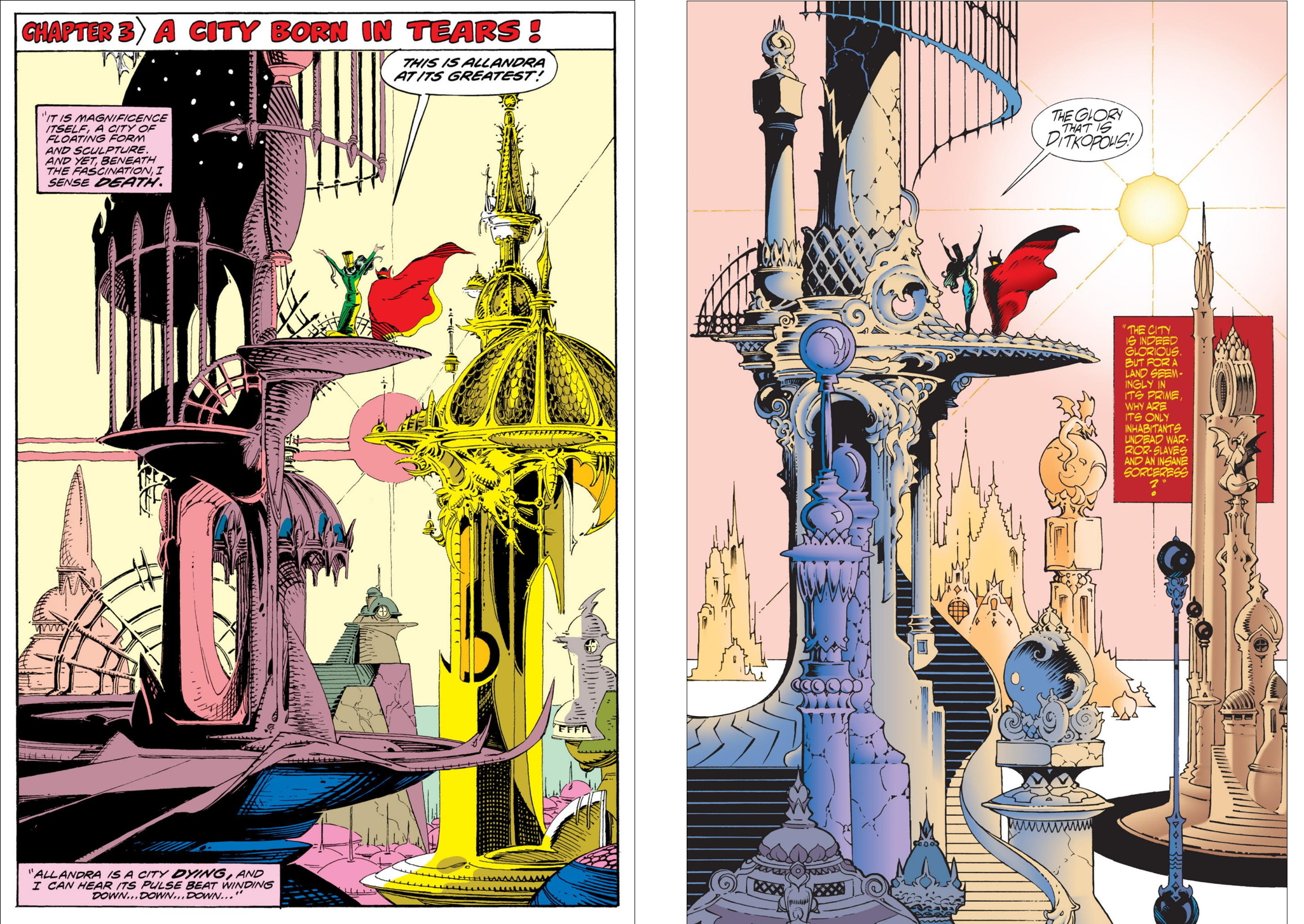

For me, these comparisons provide a fascinating insight into the evolution over time of one very talented artist’s unique vision. I hope you enjoy them as well.
*Per this 2011 blog post by the late Jim Shooter, Marvel’s policy of returning original artwork to creators according to a formula splitting the total number of pages between pencillers, inkers, and writers began around 1974, during Roy Thomas’ tenure as editor-in-chief. With minor adjustments, the formula remained in place until 1980, when, in his own words, the then-EIC Shooter “changed the artwork return policy to eliminate the writers’ share and adjusted the penciler/inker and pencil breakdowns/finisher split to make them fairer.”
Dr Strange has always left me cold. I can’t enunciate why; I have simply never been able to appreciate the character or enjoy issues of his title. However, that hasn’t stopped me thoroughly relishing your dissection of Marvel Treasury Edition #12. I may never have liked the Dr Strange books, but that doesn’t mean I should forego my regular Saturday lying-abed appointment with your wonderful blog.
Fifty-odd years ago Mr Gresty, my English teacher at Sandbach School for Boys (Cheshire, England), told us that a good piece of writing should amuse and edify. Week in, week out you achieve that objective with seeming ease. Thanks for taking the time to do this and for giving me – and others – the opportunity to enjoy the results of your labours each sennight
What a smashing flashback and background info, too. Thanks very much for this. Russell’s work enthralled me back when I read US comics more regularly, and this item reminded me why. Cheers!