
We’ve discussed in previous posts how writer Marv Wolfman liked to play the long game in Tomb of Dracula — and that was nowhere more evident than in his handling of the subplot involving Deacon Frost, the mysterious white-haired vampire first seen all the way back in ToD #13 (Oct., 1973): a mere forty issues prior to the climactic wrap-up of the storyline in the comic we’ll be looking at today.
 It had been in that issue that readers had learned the heretofore unknown “secret origin” of Blade, the vampire slayer, as it was revealed therein that his personal immunity to vampire bites was the result of his mother having been killed by a white-haired vamp while she was giving birth to him. Blade had dedicated his life to tracking down and eliminating that particular bloodsucker (see right), though he didn’t mind staking (um, make that wooden-knifing) any others he might come across along the way.
 A year later, in Tomb of Dracula #25, Wolfman and his artistic collaborators Gene Colan and Tom Palmer had introduced a brand-new character: a private investigator named Hannibal King who had himself been turned into a vampire by the same still-nameless white-haired fiend who’d killed Blade’s mom while he was working a case, several years before. Having resolved never to prey on the innocent, King had continued to ply his trade, while never ceasing to hunt for the “stinking killer” who’d cursed him to his undead fate. We readers now understood that Blade and King had a mutual enemy, though the two men themselves remained completely unaware of each other, so far as we knew.
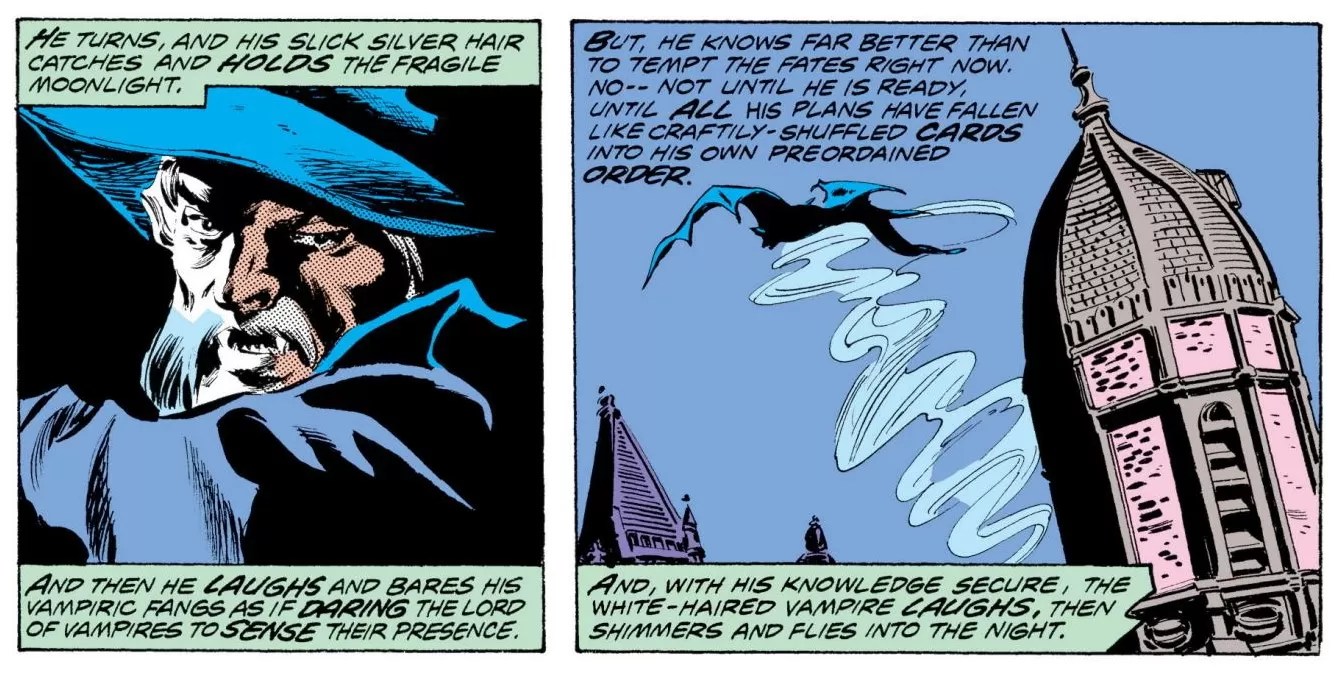
 “Whitey”‘s first non-flashback on-panel appearance came eight months later in issue #33, where we learned that he was stalking none other than Dracula himself. He turned up again one issue later (see right), then again in #42, after
 following Dracula from London in the UK to Boston in the U.S. — though his ultimate goal in pursuing the Lord of Vampires remained opaque.
Issue #42 brought another major development, however, as Blade had in his turn pursued Whitey across the pond, as well — and though the knife-fighter ultimately found himself caught up in the series’ “A”-plot, involving the struggle of both Dracula and his habitual enemies against the diabolical brain-in-a-box called Doctor Sun, he did at least catch a glimpse of the object of his lifelong revenge-quest, lurking on a Boston rooftop (see left). This near-confrontation effectively moved the White-Haired Vampire plotline off the back burner and put it on, well, the middle burner. (Look, it’s a big stove, OK?). Two issues later, we got one more check-in with the elusive villain as he continued to stalk Drac…
…followed a few pages later by yet another major development in the storyline, as Wolfman and company finally tugged on a plot thread they’d left hanging since issue #25, and returned Hannibal King to the stage:

We’ve recounted the more recent events in the saga of Deacon Frost (whose name, we’ll note for the record, was finally revealed in Tomb of Dracula #45) in considerable detail in several recent posts. So we’ll just hit the critical story beats here — though if you’d like a more thorough account, please feel free to check out our coverage of issues #45, #47, and #50–52 before proceeding (the rest of us will never know the difference, after all).

 So, in brief: following the inevitable fight scene, Hannibal King finally convinced Blade they were on the same side, and they went after Frost as a team. Following a lead, they ultimately came across not their quarry, but an evil, vampiric doppelgänger of Blade himself, who, after a desperate struggle, magically absorbed the vampire slayer into his own body, evidently destroying him. Evil Vampire Blade then pursued King, who led him to a big fancy party simultaneously being hosted by Dracula where Frost secretly (?) was a guest (the first time the Frost plotline had directly intersected with the book’s current main “Church of Dracula” story arc, we should note). Frost swiftly turned into mist and fled, eluding KIng; in the meantime, Dracula fought E.V. Blade and, after much ado, staked him to death. Sometime later, King and Blade’s other friends buried his remains, and that would have seemed to be the end of that — except that Hannibal King had a nagging feeling that the one true Blade might not really be gone, after all…
And that brings us to Tomb of Dracula #53, and to the story that a blurb on the Colan-Palmer cover calls “The Fanatical Fury of Deacon Frost” — although, as we’ll see once we turn to the opening splash page, the “official” title is actually the somewhat less frenzied-sounding “The Final Glory of Deacon Frost”. Either way, this plotline has finally, indisputably, been moved to the front burner — so let’s take off the lid, and see what our storytellers have cooked up for us…

Another blurb on the cover has promised us an appearance this issue by “A Surprise Shock Star!”, and, as evidenced above, our storytellers have wasted no time at all in bringing said star on stage: it is of course Daimon Hellstrom, the “famous exorcist” also known (to us, if not yet to Hannibal King) as the Son of Satan.

“Exactly how was he turned into a vampire, King?” Daimon inquires. That prompts the detective to offer a recap of recent events (brief, but doubtlessly helpful for anyone else arriving late), at the end of which the exorcist asks one more question: “And this is the third night since Blade was absorbed?” “Yeah,” confirms King.


Some months back, we discussed how Gene Colan generally went for a standard, rectangular-grid page layout when drawing Tomb of Dracula, per the specific request of writer/editor Marv Wolfman, who felt it made for a more Gothic atmosphere. So it’s interesting to see him loosen up in this present issue (at least in certain scenes), utilizing the less regular, more-freewheeling panel designs that were familiar to readers of his work on Doctor Strange, or, more recently, Howard the Duck.


There’s a weird discontinuity in these last two panels, as what’s described in Hannibal King’s voiceover narration doesn’t sync up properly with what the art and dialogue are showing and telling us. In the first panel, the staked Blade doppelgänger still clearly has his head attached to his shoulders. The dialogue between the three characters in that panel leads directly into the next panel, in one continuous conversation — which ends when Daimon Hellstrom shakes Blade’s hand and says goodbye. So when, exactly, are King and Hellstrom supposed to have had time to cut off the doppelgänger’s head and stuff it with garlic? It’s a small matter, I grant you — but it’s indicative of a sloppiness that, I regret to say, is going to dog this story on through to its conclusion.
Anyway, let’s bid our own fond farewell to the Son of Satan — though only for a short while, as we’ll be looking at the eighth (and final) issue of his own short-lived title this coming Wednesday. Mark your calendars!
Our storytellers now turn their attention to the titular star of our show, Dracula, whom we find saying nighty-night to his very pregnant wife, Domini, just before he slips out for a bite…

Turning into a bat and soaring over the Boston streets, Dracula soon spies what he expects will make a fine dinner — a young woman, apparently walking alone. But then a young boy runs into view, catching his mother up, and Drac immediately changes his mind…


We’ll have to wait a couple of issues to learn more about the vampire lord’s “special plans” for his latest victim, as this is the last we’ll see of Dracula for the remainder of this issue. Rather, our story now returns to the characters with whom it’ll stay for its remaining ten pages, as Blade’s joyous reunion with his lover, Saffron, is interrupted by a clock-watching King. Work must precede play, alas…


Back in November, 1976, my younger self probably took the revelation of all these doppelgängers in stride; fifty years later, however, I have a few questions. To start with, if Frost “always” creates at least one vampiric doppelgänger whenever he drains a victim’s blood, and he’s been at this for over a century, there should be hundreds if not thousands of them by now, going back to the unfortunate Ilsa and Helmut from his origin story. So where are they all? And just what’s involved in the mysterious process by which they come to be? Back in issue #45, Blade and King were told how Frost had to dig up a grave to retrieve what we’re now told was only Blade’s “prime” double; if he can reproduce new doppelgängers as easily as it now appears he can, what was that all about? And so on.

Blade’s expressed strategy of “switching” opponents — of having him fight King’s doppelgängers, and vice versa, so they have a better chance of avoiding absorption by an evil twin — is quite reasonable. So it’s interesting that we never actually see them doing that. Instead, with the exception of the bit shown in the last panel above, where Blade throws a knife to dispatch a King double, Colan and Palmer give us image after image of Blade-on-Blade and King-on-King hand-to-hand fighting… which, despite the odds, somehow goes a whole lot better for them than Blade’ struggle against a single doppelgänger did back in issue #49. Go figure, huh?

So much for Deacon Frost’s doppelgänger “army”. But, as we were speculating earlier, he’s had over a century to build it, so maybe this Boston operation was just one base in an international network of similar sites? Yeah, he says “armies“, plural, in that last panel, so that tracks pretty well. All he needs to do now is mist-up, drift back up to the surface, and then bat-wing it outta town, so that he can hole up and plan his next strike…

…no, wait a minute — he’s going further down? Why would he do that?

OK, then, a “jar of deadly fungus“. Not sure how biological warfare fits in with the armies of vampire doppelgängers in Frost’s master plan for world conquest, but I guess it makes sense to him. Or maybe the former chemist just dabbles in this sort of thing as a hobby, keeping his hand in, as it were. Anyway, it looks like a classic stalemate now, doesn’t it? How will King and Blade resolve this dilemma?

Um, let me get this straight. Knowing that if their foe drops or tosses his jar, the result will very possibly be their flesh rotting from their bones, our heroes nevertheless tell caution to hold their respective beers and simultaneously launch their wooden knives at Deacon Frost’s chest. And those knives’ combined weight/momentum somehow knocks the supernaturally strong vampire completely off balance, so that he crashes into the bank of machinery located oh-so-conveniently just behind him, which in its turn violently explodes on impact… yeah. Right.

Alrighty, then… so, I guess that jar of deadly fungus was just a bluff on Frost’s part. Or that it was completely immolated in the conflagration. Or that it was made of very resilient material, and also sealed extremely well, and is in fact still lying intact, “safely” buried in the rubble of Frost’s underground lair. Or… you know what, let’s stop there. Because I’m getting a little weary of doing Marv Wolfman’s work for him, to be honest.
In any event, this is the end of Deacon Frost, at least so far as this run of Tomb of Dracula is concerned (later creators would, naturally, have other ideas). And considered as the “Final Glory” of a character who’d been hanging around in the background of this series for over three years, I have to say that it’s pretty much a dud.
Judging by the evidence, Marv Wolfman seems to have had no real idea where he wanted to go with Frost when he first introduced him in Tomb of Dracula #13, trusting that he’d figure that out when he got there. And so, perhaps, when the busy writer/editor did finally reach that point, he was too caught up in plotting the current overarching “Church of Dracula” plotline to have much creative juice left over for poor ol’ Deacon Frost. (Inexplicably, to my mind, Wolfman doesn’t even bother to capitalize on the grim irony of the fact that Dracula, whom Frost had pegged as his number one target as far back as ToD #33, never even becomes aware of his self-proclaimed foe’s existence. I mean, talk about your low-hanging fruit.)
Still, regardless of how it’s happened or why, Wolfman has failed to stick the landing here, in a way that — at least for this reader — is unfortunately reminiscent of the less-than-fully-satisfying conclusion to the series’ last major arc, the “Doctor Sun” saga, in issue #42. Like our current storyline, that one’s narrative ended with a bunch of stuff blowing up real good; also like it, the dramatic impact of that explosive climax came off as more of a wet firecracker. Given the generally excellent job the writer has done over the course of his run in developing and interlacing various plot threads to maintain reader interest and build suspense, it’s disappointing that he has this kind of difficulty when he finally has to deliver a payoff.

The sloppiness I mentioned earlier seems to have infected even the coloring by Marv Wolfman’s then-wife Michele, who manages to forget that Blade and Saffron are Black in both the first and last panels of this final page. Yeesh. (UPDATE, 11/7/26, 3:15 pm: Per a note by Blake Stone over at the Marvel Collected Editions Message Board, I’ve checked my physical copy of ToD #53 and have verified that Blake and Saffron were in fact colored correctly in the first panel of the last page in the original printing. My apologies to Ms. Wolfman for the error, and my thanks to Blake for the correction.)
As I indicated earlier, I was probably less harsh in my judgment of this issue at age nineteen than I am at age sixty-nine. There are multiple reasons for that, I think, but they mainly come down to the fact that, half a century ago, I was buying and reading a whole lot of comics every month, and not necessarily expecting every one to be a masterpiece… or even to be all that much above average, especially when compared to all the other books that had come out in the same week. I’d have picked up Tomb of Dracula #53, read and enjoyed it for what it was, and then moved on to Son of Satan #8 (plug!) or whatever else was next in the TBR stack.
And, truth to tell, there are things about this issue that I continue to enjoy today. The artwork by Gene Colan and Tom Palmer is as atmospherically appealing as always. Storywise, the opening sequence with Daimon Hellstrom still holds up. And the Blade-King foes-to-friends bromance shtick, as old hat as it was even in 1976, remains kind of fun. In the end, it’s hard to feel too bad about those two guys finding closure for the traumas they both have been living with for so long (if “living” is the right word to use in King’s case).
Anyway, we’re finally done with Deacon Frost. But Christmas is coming, and with it the birth of “The Son of Dracula”… so be sure to return to this space to join us for that blessed (?) event, just a few weeks from now.
I found this pretty compelling when I read it in the Essentials collection 15 or so years ago. And the emotional arc of the two men finally balancing the scales and bonding with each other still works. But yeah, you’re right about the plot holes.
I don’t think there’s anything implausible in a comic-book medical researcher on vampirism coming up with deadly fungus as a sideline but I agree it comes out of left field as presented.
I guess we never learn what Frost wanted from Dracula as it doesn’t seem necessary for his plans or his vampire research.
Well, the jar couldn’t have been ‘sealed extremely well’ because there’s fumes or vapour coming out of the top when it is first shown. Hmmm, visible fumes – from a fungus? When Frost goes backward into his hi-ex machinery, his head, right arm and the jar all disappear. In the next panel (“the cavern erupts in a fireball which consumes everything it touches”), Frost’s body has regrown his right arm and a head of hair, but I would bet that this figure was redrawn for some reason. The finishing of the hair and hands doesn’t look like anything Colan or Palmer would do. Maybe the original rendering of the dead body was too much for the comics code? Anyway, the fireball ‘consumed everything it touched’ so presumably that put paid to the fungus.
Agree with you and Fraser about the plot holes, and that Blade and King’s bromance was nice even if it was old even then. For all the long-term build-up of the Blade/Frost/King battle, this did feel like a bit of a letdown and a fairly formulaic supervillain-style end for Deacon Frost. Still, I enjoyed it more than the last couple of issues.
The sloppiness of the colouring on the final page doesn’t just extend to Caucasian flesh tones for Blade and Saffron. In the top panel, H. H. Harold’s hair is green.
I wonder if the army of clone-vampires was something Colan or Wolfman came up with at the last minute? As Alan points out, there ability to absorb Hannibal and Blade doesn’t affect the fight much; if Frost had simply summoned up a couple of dozen clones from his past victims the fight would have played out much the same.
So perhaps they started with that idea, then thought of how cool an army of Blade/King clones would look and went with it. In a novel they might have reconsidered but comics don’t give you as much time to look and go “Nah, go back to the old plan.”
Pure speculation on my part obviously.
I can’t help feeling that Frost, and by extension Wolfman, missed a trick in the big fight scene. Presumably if the production of a vampire doppelgänger was an automatic byproduct of Frost taking a victim, and he could mysteriously make as many duplicates of these as he wanted, he had a limitless supply of duplicates of Blade’s mother at his disposal. If he’d thrown these into the fray instead of a bunch of new Blades and Kings, it would have raised the emotional stakes (no pun intended) enormously – imagine Blade having to confront, and kill, a vampire version of the mother he’d never known. I think Colan and Palmer could have gone to town on such a scene. Ah, well.
Damn. That is a good idea and one that would have added considerable emotional weight to this otherwise lackluster story.
While most of Alan’s reviews of this title have had me regretting that I was not collecting Tomb of Dracula at the time, this issue falls under the category of “Not So Much.” Everyone’s picked up on plot holes large enough for a colony of bats to fly through and Colin’s brought out an overlooked plot point that would have ratcheted up the tension by several degrees. All of which seem to me another indictment against the Writer/Editor model. As we’ve all talked before, these reviews focus on an incredibly chaotic time for Marvel. Still, one can only imagine what the quality of their monthly comics could have been had there been stronger editorial input. Not heavy-handed dictates but even another set of eyes or sounding board. Someone to help nudge this into what would have been a compelling story in lieu of the headscratcher we’re talking about today.
Of course, these are the thoughts of an individual under the influence of several cups of hot caffeine preparing for a busy Saturday. What would have been my thoughts on this issue 50 rotations around sun ago? As I was already starting to lose interest in collecting comics, I suspect TOD #53 would have nudged me that much closer to devoting my hard-earned lawn mowing earnings towards music instead of four-color adventures.
Once again, my thanks to Alan for a delightful review! I am not a fan of the Son of Satan. But I have complete faith that his review of that comic will absolutely amaze me.
Missed this one 50 years ago but certainly enjoyed your review, Alan, even if the mag itself didn’t quite live up (or die down?) to expectations. As with a few other writers, seems Wolfman had too many plates spinning at once (including the other mags he was writing) and while trying to put the Deacon Frost plate down didn’t really have a satisfying way to conclude it but just pulled out a lot of disparate ideas to try to heighten the drama but didn’t really quite gel. The army of Blade & King doppelgangers in particular wasn’t all that well thought out and that they were taken out so easily and quickly just indicates they were incredibly inept or Wolfman/Colan got bored with them and, deux ex machina, they were gone! And obviously Wolfman intended some sort of dramatic conflict between Dracula and Frost, without ever explaining the reason for Frost’s grudge against Drac, but that was all just dropped. Still, the odd friendship that developed between Blade & King was a bit of fun.
Tomb of Dracula still had another 17 issues to go before the curtain came down, but I wonder if Wolfman felt ToD might get the axe at any time and opted to whittle down some of the subplots that had been ongoing for years at this point to then turn more direct attention to Dracula and his family as the mag went into its twilight era.
“Because you demanded it!” is always a funny (and disingenuous) cover blurb.
I remember being greatly disappointed with the “new” Swamp Thing logo on no. 23, cover dated July 1976, followed by the “Because you asked for it!” blurb, indicating a move away from the the moody horror theme to a more super-hero oriented approach (it lasted only one more issue).
As always… an enjoyable review. I was an on and off again TOD reader…. more off than on.
Is it addressed in the story why Deacon Frost, an immortal vampire, slowly aged over 110 years?
I’m pretty sure it’s not, David.
Okay, yeah, reading your blog post, Alan, I agree with you, there’s some good here, and some bad.
Chris Claremont is generally thought of as the American superhero comic book writer to really popularize long form plotting. But as you explain here and in other Tomb of Dracula entries, Marv Wolfman was also doing it back in the mid-1970s. I feel he probably got better at it when he was working with George Perez on New Teen titans in the early 1980s.
Like yourself, I really do wonder how, exactly, does Deacon Frost create all of these vampiric doppelgangers? And they all come complete with clothes! It’s pretty dodgy plotting, to be sure.
As you indicate at the end, Frost did not stay deceased. Well, nobody stays dead at Marvel Comics, not even the undead. I was actually introduced to Frost in the Blade “Crescent City Blues” special published in 1998 written by Christopher Golden and penciled by Gene Colan. It’s actually a really good story, although I don’t remember if it ever explains how Frost came back from his fiery demise. It’s been a long time since I read it. And, of course, there’s the much younger-looking movie version of Frost played by Stephen Dorff in the Blade movie released the same year.
By the way, I wonder if Colan used the Dracula movie from 1931 for reference when he penciled that 2/3rds splash page of Blade and Hannibal King entering Frost’s lair.
73563.jpg (1200×800)
What’s coming is no better.
I definitely disagree with you there, Steve, but we’ll see what everyone else thinks! 🙂
No offense to Alan or anyone else who finds enjoyment in them, but I really dislike Marvel’s supernatural comics. I don’t know if it’s because of the inevitable “superheroing” of them, such as Damian Hellstrom in his red cape and yellow boots or just the quality of the stories, but I’ve never cared for them and despite the excellent care with which Alan writes them, these reviews haven’t done much to change my opinion, and the huge plot holes in this issue don’t help matters. For a story that began forty issues ago, I found the climax of Blade and Hannibal King’s search for Deacon Frost extremely disappointing and anti-climactic. And the plot holes and lapses in logic make it feel like Wolfman wasn’t all that interested in it either. And we’re looking at Son of Satan on Wednesday? Alan, you’re killing me. Can’t we take a break and look at a Superman or Spider-man book instead? I need a break.
Five months from now he’ll be reviewing Star Wars no. 1, I’m sure. But until then . . .
Werewolf By Night never got a cape and my aging memory says he was allowed a lot more wins than the others of his ilk.
Moon Knight showed up in a few WWbN issues sporting a cape.
And Hangman was essentially a costumed villain but the point was Jack Russel never put on tights. Moon Knight was also just a costumed adventurer and not a gussied up supernatural until later.
You’re right that the Furball By Night avoided capes or tights. But he did have Iron Man appear in two issues towards the end. #42 sporting a stunning Dave Cockrum cover. Obviously, Marvel was trying what they could to keep their horror books afloat.
IIRC they were quite open that at that point they were shifting him into a more superheroic mode to see if that would keep him viable — he gained control over his shapeshifting after helping the Three Who Are All, for instance.
“Can’t we take a break and look at a Superman or Spider-man book instead?”
No chance of subbing in a proper superhero for Wednesday, Don, but I’ve got Justice League of America coming next Saturday. Does that help?
Although our collections from 50 years ago didn’t entirely overlap, I still enjoy the variety of the sort of mags you got and choose to review, even those I’ve never read myself. And just as your tastes appear to have changed as you grew into early adulthood, so would mine as I grew older. And a lot of things I would have entirely overlooked or just glossed over in the days of my youth, may now strike me as ridiculous or even offensive to my older sensibilities. But, still worth revisiting, I believe, to remember aspects of popular culture as it was all those decades ago and those of us old enough to have experienced it firsthand to recall as best we can our thoughts at the time and how our outlooks have changed since then.
I found Son of Satan less enjoyable than Gerber’s Marvel Premiere run but I’m looking forward to Wednesday. And yes, Saturday as Englehart debuts on the JLA.