
Your humble blogger would like to begin our look back at this rather special issue of Howard the Duck with a note of great admiration for its cover, which is probably my favorite in the whole run of the title. Just lovely, iconic work from the title’s regular art team of Gene Colan and Steve Leialoha… plus Marvel Comics art director John Romita, who pencilled the central image of Howard, according to a 2023 Facebook post by Leialoha. And thanks mostly to the faux newspaper headlines — doubtlessly the contribution of writer Steve Gerber — it’s a damn funny cover as well.
Turning to the book’s opening splash page, we find our storytellers picking up their narrative in the immediate aftermath of “The Duck and the Defenders”, which had appeared in Marvel Treasury Edition #12 just a couple of weeks earlier:

As you’ll recall, the adventure Howard’s just now finished sharing with Marvel Comics’ premiere (OK, only) non-team featured the attempt of a group of would-be supervillains to make a name for themselves by assassinating the All Night Party’s candidate for U.S. president — i.e., Howard. Will the help of Dr. Strange and friends, Howard and his companion, Beverly Switzler, have survived that experience — but as the page above makes ominously clear, while Dr. Angst and his absurd associates may have been the first out of the gate in the race to kill our hero, they won’t be anywhere near the last…


Fortunately for our dazed duo, help arrives in the very next moment in the form of their recent acquaintance/benefactor (?), country music star Dreyfuss Gulch, whose Rolls-Royce limousine screeches up to the curb. “Hurry, y’all!” Gulch calls as he throws a door open. “Muh bullet-proof glass will protect ya! It’s been tested by North Carolina women!”


The “warped mind” in question belongs to one G.Q. Studley, whose secretary refuses to pass Howard through, explaining that her boss is currently in conference “about the Duck campaign”. But when an understandably irate Howard (“Lady, I’m the blasted Duck!”) lunges across her desk to reach the switchboard, she calls for help — and Studley dispatches a couple of thuggish-looking escorts in response…

The reading audience of 1976 didn’t have to reach too far back to recall actual, real-life assassination attempts against either presidents or aspirants to the office; in 1972, independent candidate George Wallace had been paralyzed by an assassin’s bullet, while, more recently, President Gerald Ford had survived two separate attempts on his life, in 1974 and 1975.


I have no idea if Gerber (or Colan, for that matter) had any real-life model in mind for G.Q. Studley; Mad Genius Associates, on the other hand, was a familiar name to all of us Howard fans of ’76 who’d shelled out for an official HtD campaign button and/or portrait, because we’d had to send our money through the mail to “STEVE GERBER, c/o Mad Genius Associates, Room 806, 850 Seventh Avenue, New York, NY, 10019”. At the time, I’m sure I assumed that MGA was just another name for Gerber himself; however, according to an interview given in 2019 by Gerber’s friend and fellow writer, David Anthony Kraft, that wasn’t quite the case:
Mad Genius was a studio partnership of Jim Salicrup and me. Steve was no part of that but Steve rented space from us and he was our friend so he was there a lot. We had an office on 7thAvenue and he needed a place to stuff buttons and hang out and watch Mary Hartman and whatnot. We had great times…
Alas, we’re not given a peek at the Marvel-Earth version of the Mad Genius Associates offices in this issue; rather, immediately following the phone booth scene, the storyline jumps forward in time to a point where MGA have clearly been on the job for a while…

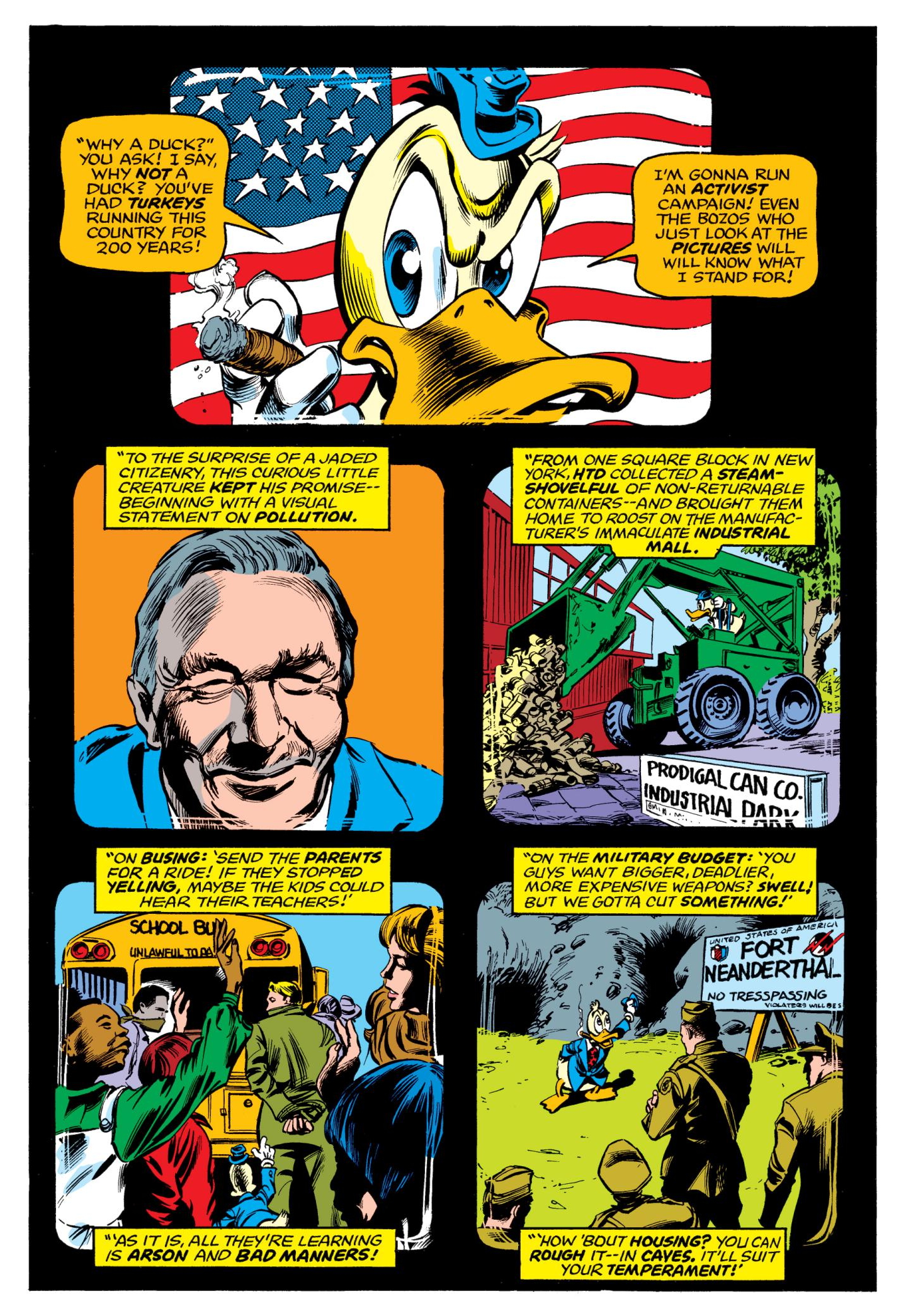
While a good amount of Gerber’s political satire still hits home after fifty years, some of it really doesn’t hold up very well at all — due in large part, I believe, to our author’s having bought into a particular populist notion that (as frasersherman put it last month in a comment on HtD#7), “if it wasn’t for politicians, running the country would be perfectly simple.” Indeed, if the last ten years of American political life have proved anything at all, it’s that the “wisdom of the common man” has been greatly exaggerated. And so, though I’m disinclined to go through each and every one of Howard’s specific policy positions with which I have a quibble, there are a couple that I don’t feel I can let pass without comment.
For one, there’s Howard’s hot take on school busing, which in its implied bothsidesism is facile to the point of flippancy. To my mind, Gerber’s “Send the parents for a ride!” is too cute by half, the words of someone who hasn’t really considered the issue with any kind of depth at all. (And yes, I’m treating Howard as a mouthpiece for Gerber; based on everything I’ve ever read by or about the man, in interviews and so on, I think that’s fair.)
We’re on firmer footing with the following page, where Gerber ably lampoons both of 1976’s major party candidates — with Colan and Leialoha’s strong visual support, of course. (This was Gerber’s second go at Gerald Ford within three months, following his use of our 38th prez as a supporting player in Defenders Annual #1 back in August.)

For those too young to remember, the real-life Walter Cronkite always signed off from his CBS evening newscast by saying, “And that’s the way it is;” Walter Klondike’s addendum, “take it or leave it,” is, of course, pure Gerber.

This isn’t the first time we’ve seen this curly-haired, freckle-faced fellow before… nor, for that matter, is it the first time that Beverly has seen him, as he was the bellhop who delivered a cryptic message to her and Howard’s Plaza Hotel room in issue #7 (and whose hand she kissed in lieu of a tip). Later, we saw him pass another such message to Howard while working as a waiter in a nightclub; then, one last time, hanging around the All Night Party’s convention floor as the delegates declared Howard their presidential nominee. But while his initial actions could be construed as his trying to warn Howard and Beverly about the impending danger of the bomb that ultimately went off in that issue’s climax, the violent animosity towards all waterfowl that he demonstrates here makes one wish that Bev had a better memory for faces than she evidently does…

For any reader of this issue who still hasn’t worked out the pun behind Dreyfuss Gultch’s name, hopefully the shorter version so prominently displayed on his ranch’s sign will do the trick…


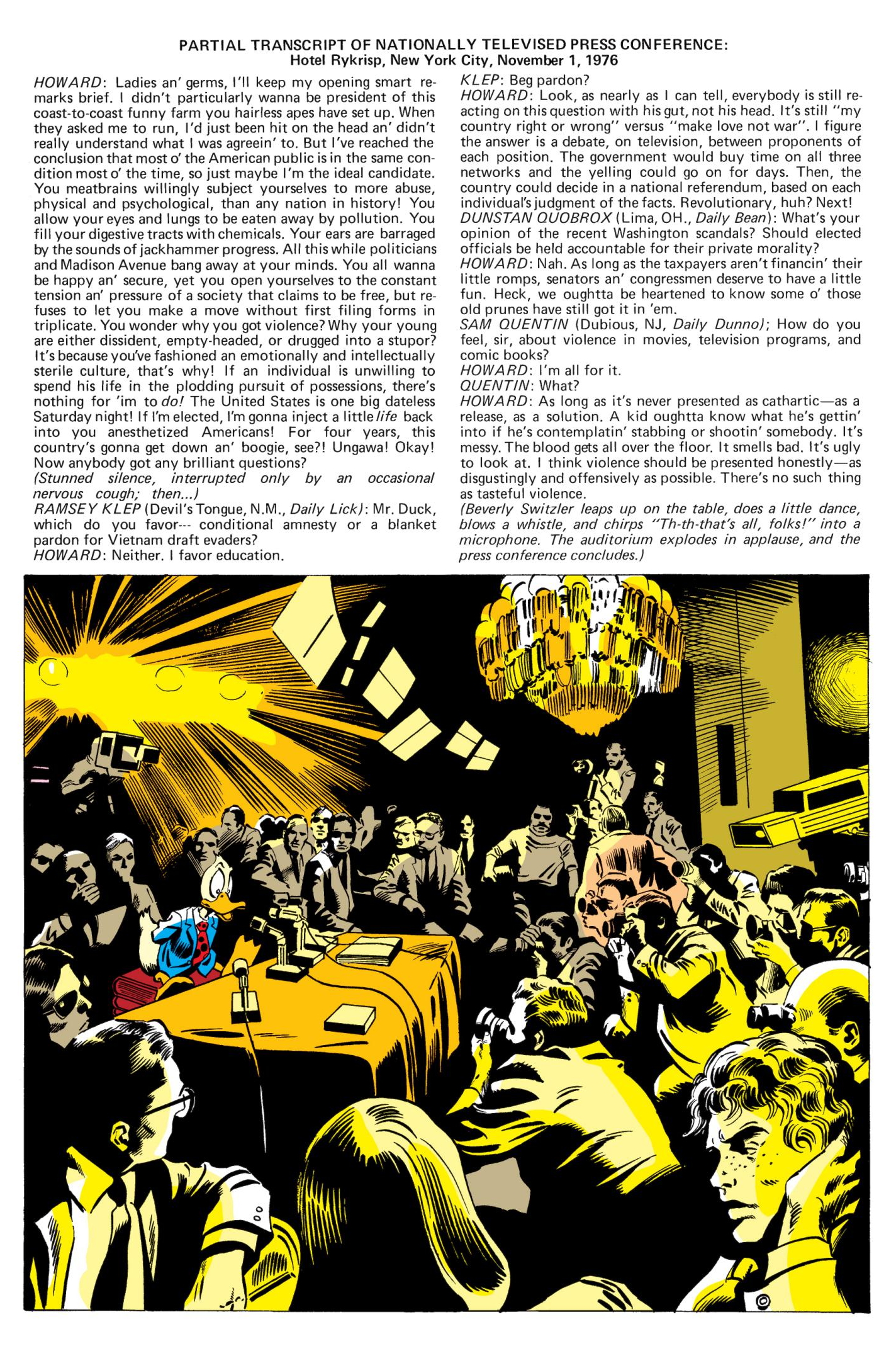
There was a time, about a year or so before this, when it seemed almost every month would bring readers another Marvel comic by Steve Gerber featuring at least one page of illustrated typeset text. I believe that this is the first one such we’ve seen in quite a while, at least in an all-new story (though the recap/framing sequence created for the recent Marvel Treasury Edition #12 reprinting of Howard’s introduction in Fear #19 and Man-Thing #1 had used the device).
Nestled within this big mass of text is another position statement I feel obliged to comment on: Howard’s proposed solution to the question of amnesty for Vietnam War draft evaders, which is simply to provide Americans with “the facts” of the matter and then have them vote in a referendum. Again, we have the populist assumption that, provided with sufficient information, the electorate will soberly exercise their Solomon-like “judgment” and make the right decision; and, again, the last ten years have proven that facts, by themselves, are not enough to convince a great many people about the truth of something, assuming you can even get them to pay attention to the facts in the first place. (Besides which, putting every controversial issue to a popular vote isn’t the way representative democracy is supposed to work.) In consideration of all of the above, Howard’s cocky “Revolutionary, huh?” doesn’t strike me as clever — just smug.
Oh, well. We’ll move on… though not before noting yet another sighting of the Bellhop (as we’ll call him henceforth) among the attendees at the press conference.
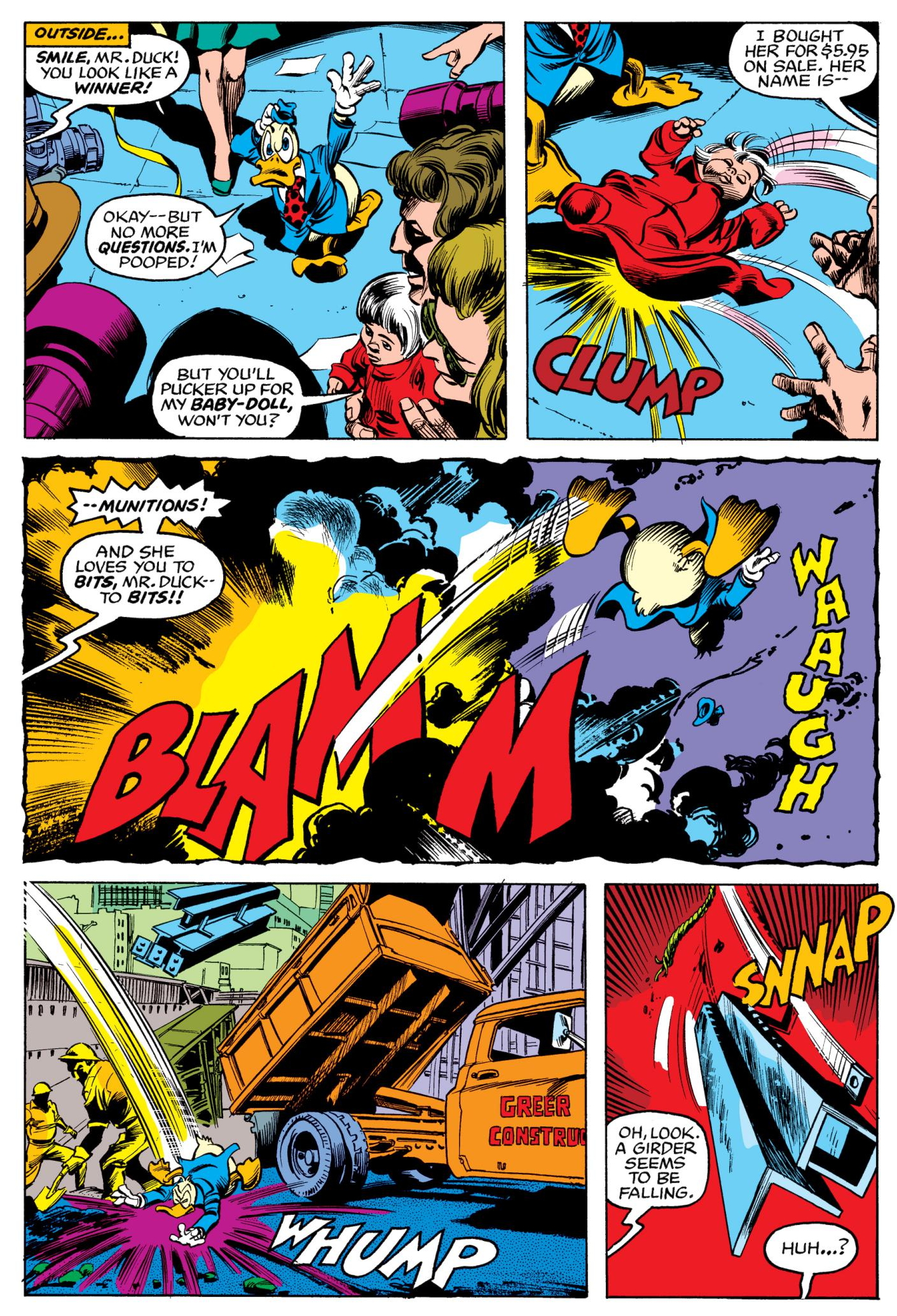

In a manner reminiscent of his Doctor Strange work, Gene Colan abandons the standard rectangular-grid page layouts he’s used elsewhere in the issue just for the one page above, choosing instead to employ irregular, jagged panel borders that accentuate the chaotic nature of Howard and Beverly’s run through the “gauntlet of special interests”.

Ah, for the days when a plain vanilla sex scandal — two consenting adults, of different genders, caught on camera in a compromising position — was enough to end a political career. The whole notion seems so quaint now, in an era in which one of our two major political parties has made it clear that concerns about personal sexual morality are only relevant in regards to the other side’s candidate.
But this is 1976 we’re talking about, here; and so I hope it’s not a spoiler for anyone out there when I break the news that this incident does, indeed, spell doom for Howard the Duck’s campaign for the presidency. We’ll have more details when we do our next Howard-centered post, probably a couple of months from now — but I wouldn’t want any of you to go to bed tonight believing that the 39th President of the United States had been an irascible talking mallard, even on Marvel-Earth.
In closing, I’d like to express my hope that I haven’t been too hard here on Howard the Duck #8, which I still consider to be an extremely well drawn, and mostly well written, work of comic book entertainment. Admittedly, I was a little surprised — and disappointed — to find, upon my re-reading of this comic book that I’ve held in great fondness for half a century, that it didn’t hold up as well as social commentary as I’d expected it would. But I think that this is at least partly an inevitable result of how much the political environment has changed in the last fifty years. Back in 1976, “liberal Republican” wasn’t yet an oxymoron, and while you could hardly say it didn’t matter whether Gerry Ford or Jimmy Carter won the White House, it didn’t seem like the fate of the nation (and maybe the world) was at stake. Compare that to our present, extraordinarily fraught moment, when a sober historian like Timothy Snyder can write that next Tuesday’s U.S. midterms represent “probably the most consequential election since the eighteenth century”, and it doesn’t feel at all hyperbolic.
Still, the only way out is through, right? So have a happy (and hopeful) Halloween, everyone, and I’ll see you on the far side of November 3rd.