All-Star Comics #63 (Nov.-Dec., 1976)

Our half-century-old topic of discussion today picks up its ongoing storyline in the immediate aftermath of the previous issue,  So, if you’re not already familiar with what happened in All-Star Comics #62, you might want to go catch up via our post about that one before proceeding, as we’re going to jump right into this installment’s action without worrying about a recap… just as soon as we’ve finished looking at this issue’s cover, that is.  (One thing worth noting about said cover is that while it’s clearly dominated by the style of inker Wally Wood, it was actually pencilled by Rich Buckler — an artist who was returning to DC Comics after some four years working primarily for that publisher’s main rival, Marvel.)  And now, on with the show…  Read More

All-Star Comics #62 (Sept.-Oct., 1976)

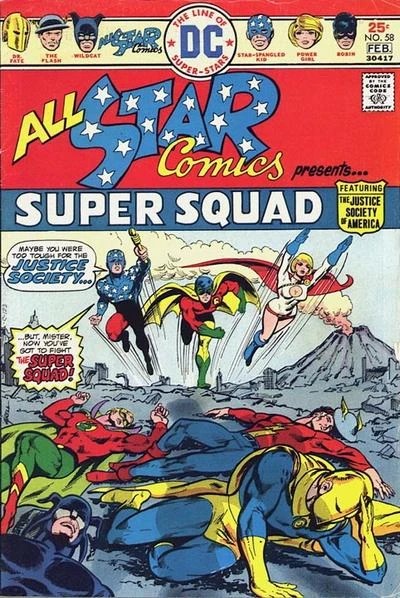
Cover to All-Star Comics #58 (Jan.-Feb., 1976). Art by Mike Grell.

Cover to All-Star Comics #59 (Mar.-Apr., 1976). Art by Ernie Chan.

Last October, we took a look at All-Star Comics #58 — the first issue of DC Comics’ revival of the title which had played host to the original superhero team, the Justice Society of America, back in the Golden Age of Comics — as well as its immediate follow-up, issue #59.  Together, these two premiere installments presented a single story that established writer/editor Gerry Conway’s vision for updating the JSA for success in the comic book marketplace of the mid-1970s — a vision that involved taking the aging, veteran heroes who’d traditionally made up the ranks of the Justice Society (a large roster represented here by a core group of Flash, Green Lantern, Hawkman, Dr. Mid-Nite, Dr. Fate, and Wildcat) and teaming them up with a trio of younger champions of the right: Robin, the Star-Spangled Kid, and a brand-new character called Power Girl — under a new, not-quite-official umbrella name, the “Super Squad”.  Read More

All-Star Comics #58 (Jan.-Feb., 1976)

In October, 1975 — just a little less than a quarter-century since their last headlining appearance in All-Star Comics #57 (Feb.-Mar., 1951), and about half that time since their revival in Flash #137 (Jun., 1963) — the Justice Society of America finally returned to newsstands in their own book.  The premiere superhero team, not just of DC Comics but of all comics, was at last back in full force, ready to reclaim its former glory.

And it had Marvel Comics to thank for the opportunity.  Read More

Adventure Comics #438 (Mar.-Apr., 1975)

The issue of Adventure Comics we’re going to be looking at today was the eighth in a row to feature the Spectre as its headliner, and as such, might well have been taken by a casual browser of the spinner racks in December, 1974 as simply offering more of the same.  Yet this issue departed from its immediate predecessors in at least a couple of respects, beginning with its title logo.  In response to recent commercial trends, as of the Spectre’s third outing (issue #433), DC Comics had started slapping the word “Weird” above “Adventure” on the venerable series’ covers.  That was an adjustment which made good sense as far as the Astral Avenger was concerned… but wasn’t quite as good a fit with the King of the Seven Seas, Aquaman, who began a run as Spec’s backup in issue #435Read More

Justice League of America #102 (October, 1972)

Fifty years ago, this issue brought the conclusion of the tenth annual Justice League-Justice Society summer team-up extravaganza — a special event which also served to commemorate the League’s reaching its 100th issue milestone.  Making the occasion even more memorable, this JLA-JSA get-together was the first to take up three whole issues; it also featured the unexpected return, after twenty-seven years, of yet another DC Comics superhero team: the Seven Soldiers of Victory.

Or maybe that should be most of the Seven Soldiers of Victory, since one of the key mysteries of the storyline concerns a lonely grave standing on a Himalayan peak, with a stone marker inscribed to an “Unknown Soldier of Victory”.  As of the conclusion of JLA #101, small teams of Justice League and Justice Society members have retrieved four out of seven of the time-lost Soldiers (or Law’s Legionnaires, as they’re also called) — the Crimson Avenger, the Shining Knight, Green Arrow, and Stripesy — with three more left to go.  So who’s buried in the Unknown Soldier’s grave?  Is it Vigilante?  The Star-Spangled Kid?  Speedy?

The answer, as many of you reading this already know, is:  none of the above.  Which is, and simultaneously is not, a cheat.  But we’ll get to that soon enough — just as we’ll get to the solution to the separate mystery posed by Nick Cardy’s superb cover (his best yet for the title, in the opinion of your humble blogger) — who else among our heroes is doomed to die?  Read More

Justice League of America #101 (September, 1972)

The fifty-year old comic book that’s the subject of today’s post features the middle chapter of the three-month-long celebration of Justice League of America‘s reaching its hundredth-issue milestone, as well as of the tenth annual summer event co-starring the JLA’s predecessors from the Golden Age of Comics, the Justice Society.  Your humble blogger is as eager as the rest of you to jump back into the story by writer Len Wein, penciller Dick Dillin, and inker Joe Giella — but before we do, let’s take a good, close look at the cover by Nick Cardy.

Like all of the other JLA covers of this era, it features a left-hand column of League members’ floating heads (this particular issue also includes a right-hand column of JSA heads as an added bonus).  But unlike virtually any other such cover, there are only three full-time active members of the League included in this group of five — the presently non-powered Diana Prince being on a leave of absence, while Metamorpho is only a “reserve member”.  That meager number is the max number of “official” JLAers appearing in the story as well. Read More

Justice League of America #100 (August, 1972)

In the spring of 1972, Len Wein had been writing comics professionally for almost four years.  The career trajectory of the 23-year-old fan-turned-pro had thus far taken him from writing scripts for DC titles like The Adventures of Jerry Lewis, House of Secrets, and Hot Wheels, to similar work at other publishers including Marvel, Skywald, and Gold Key (Star Trek being among his gigs at the latter outfit), and then back to DC, where he’d been scripting Phantom Stranger for about a year, among other assignments.  But his experience with the publisher’s best-known super-heroes had largely been limited to a single issue of Teen Titans, one Batman story in Detective (both co-written with his friend Marv Wolfman), and, more recently, a smattering of tales in Superman, Flash, World’s Finest, and Adventure.  So you can imagine his surprise (and excitement, and trepidation) when, out of the blue, editor Julius Schwartz asked him if he’d like to write Justice League of America on a regular basis:  Read More