
Our half-century-old topic of discussion today picks up its ongoing storyline in the immediate aftermath of the previous issue, So, if you’re not already familiar with what happened in All-Star Comics #62, you might want to go catch up via our post about that one before proceeding, as we’re going to jump right into this installment’s action without worrying about a recap… just as soon as we’ve finished looking at this issue’s cover, that is. (One thing worth noting about said cover is that while it’s clearly dominated by the style of inker Wally Wood, it was actually pencilled by Rich Buckler — an artist who was returning to DC Comics after some four years working primarily for that publisher’s main rival, Marvel.) And now, on with the show…

As detailed in the opening page’s credits box, artists Keith Giffen (layouts) and Wally Wood (finishes) are continuing in their same roles from the last three issues. Elsewhere, however, we have some changes, as the exodus of Gerry Conway, the original guiding force for the revival of All-Star Comics, is now complete. Credited for both plotting and editing the previous issue, he’s now been completely replaced as writer by Paul Levitz (who’d provided the actual script for #62), while Joe Orlando has taken the editor’s chair.
Interviewed in 2002 by Roy Thomas for Alter Ego #14, Paul Levitz explained why he — already the assistant editor of All-Star — hadn’t simply replaced Conway in that role as well:
I talked Joe into editing the book so I could write it. At that point DC had no writer/editors, and God knows I wasn’t competent to be one, anyway. Joe humored me.
Levitz also told Thomas that his getting even the writing gig likely benefited from the recent dismissal of Carmine Infantino as DC’s publisher:
If Gerry had left during Carmine’s run, I probably wouldn’t have gotten the chance; but I had the good fortune to be sucking up far more writing assignments than I should have as he left, and “JSA” was a high priority to me.
Before moving on from this page, we must also make note of an apparent mistake that, having first been made in ASC #62’s “Next Issue” blurb, gets compounded by the Fiddler’s dialogue here: namely, the identification of Earth-Two’s Injustice Society (last seen active under that name in 1975’s Justice League of America #124) as the Injustice Gang — a name which, as a couple of commenters on our issue #62 post pointed out, belongs by rights to an assemblage of Earth-One villains who first banded together in 1974’s JLA #111. If you want to get technical, there’s no reason why the Earth-Two bunch couldn’t have decided to rebrand themselves (it’s hardly as though there aren’t plenty of other names already shared between characters on those two worlds); still, it seems more likely to be a momentary mental lapse on the part of writer Levitz… especially since, as we’ll see, the group’s original moniker gets deployed before the end of the story.

Under the spell of the Fiddler’s music, Wildcat believes he’s fighting an opponent in a boxing match before a cheering crowd. The music, and the trance it induces, continues until Hawkman goes down and doesn’t get up again…

The Fiddler has been a member of the Injustice Society ever since the group’s second outing (in All-Star Comics #41 [Jul., 1948]), and he’d participated in their most recent escapade (as chronicled in JLA #123-124). Solomon Grundy, on the other hand, is a new recruit; though he’d faced the Justice Society on his own back in ASC #33 (Feb-Mar., 1947), as well as in both 1966’s and 1971’s JLA/JSA summer crossovers, he’d never been a team player before this story. His most recent appearance had been in Superman #301 (Jul., 1976) — where, as alluded to in his dialogue in the last panel above, he’d been stranded on the moon… although the script for that story had strongly implied that the satellite involved was the moon orbiting Earth-One (to which Grundy had teleported himself earlier in the story), not Earth-Two. That latter aspect wouldn’t necessarily have been an issue for the Fiddler, whose invention of a “portable vibrator” enabling travel across the dimensional barrier separating those worlds had been established in the very first JLA/JSA crossover, back in 1963 — and, of course, we can easily imagine that the Injustice Society has other resources that could have handled the moon-to-earth part of the trip.


For the record, we’re on page 6 of our story — and that second-from-last panel is the last we’ll see of Solomon Grundy not just for this issue, but for the entire run of this JSA revival series. Which makes you kind of wonder why Paul Levitz opted to include him in the first place. Maybe the young writer was afraid that whoever succeeded Infantino as DC’s publisher would pull him off the book, and he was determined to work in as many of his favorite characters as he could, while he could… though that’s pure speculation on my part.


As previously noted in our ASC #62 post, the idea of modeling the Earth-Two Superman on the eternally-squinting version of the hero’s co-creator, Joe Shuster, appears to have originated with Keith Giffen — though Wally Wood’s legendary mastery of lighting effects (aided and abetted by Carl Gafford’s sympathetic coloring) clearly puts his stamp on the interpretation as well, as is especially evident in the panel above.

A guy on a winged horse, huh? I’d sure like to think that this teaser, combined with issue #62’s scene featuring a guy with a horse doing some shopping in an Egyptian bazaar, was enough to clue my younger self in to the identity of next issue’s Special Surprise Guest Star… but I have no idea, honestly.


Hourman may be able to take comfort in the idea that Kent Nelson laid down his life for a good cause, but Dr. Mid-Nite takes a more melancholy view. “There are no good deaths, Hourman,” says the Justice Society’s resident physician, “no good causes in which to die. In the end, there’s only death… and that’s what we’ve fought so hard to prevent.”
And then, the somber mood is suddenly interrupted:


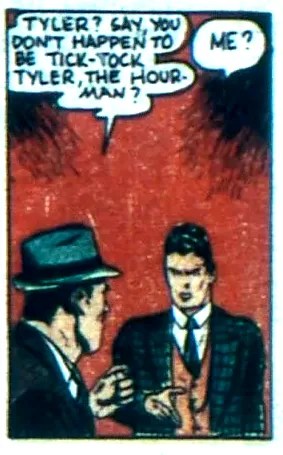
From Adventure Comics #49 (Apr., 1940). Text by Ken Fitch; art by Bernard Bailey.
The Star-Spangled Kid’s addressing Hourman as “Tick Tock” on the above page nods to the latter character’s earliest days, when he was regularly referred to as “Tick-Tock Tyler, the Hour-Man” — and if you think that a superhero who wished to maintain his status as a “mystery man” was asking for trouble by attaching his own actual surname to his costumed identity’s moniker, the people at DC seemed to have caught on to that idea as early as his second adventure, in which a police detective posed the obvious question to biochemist Rex Tyler (see right). (My thanks to my fellow blogger Dan Hagen for this particular nugget.)

Knocked from the sky, Zanadu crashes through the roof of the JSA’s headquarters to land in the team’s meeting room. Once Hourman and the Kid have followed him down, the villain declares that rather than follow through on his original intent to destroy the city, he will focus all of his power on them instead. “Prepare for your death, mortals — and for a scream that will be heard around your puny world!”


If any further proof was needed, the preceding sequence has made it clear that this book’s creative team has received the memo sent by Martin Pasko and Walt Simonson via their spectacular “Doctor Fate” solo story of the previous year. Never again in this series will we see Dr. Fate portrayed as an ordinary ol’ magician in a cape and helmet; rather, he’ll be consistently depicted as he is here: an awesome immortal champion of the forces of Order.

Like the Fiddler, the Icicle has been associated with the Injustice Society (ahem) since 1948’s All-Star Comics #41. As to whether his mysterious associates are fellow veterans, or (like Grundy) brand-new additions — or maybe a mix of both? — well, we’ll just have to wait a couple of months and see.
This was Keith Giffen’s fourth outing as All-Star Comics‘ layout artist — and, as things turned out, his last. By his own recollection (as given to Roy Thomas in Alter Ego #14) the news that he was losing the assignment came while Gerry Conway was still on board as the title’s editor:
Gerry at one point said to me, “Woody’s having so much fun on the book that he wants to do it solo.” But Gerry didn’t throw me into the street. He had something waiting for me, but what was I going to say? Like I felt kind of good. Like, wow, I kind of got Wally Wood charged up. [laughs]
Later in the same 2002 interview, Giffen offered further details about his departure, saying, “Gerry had Kamandi or some other book lined up for me.” But in fact, Giffen had begun drawing Kamandi several months prior to this, while still in the midst of his All-Star run. It seems likely that Giffen was misremembering the circumstances a bit, as his very next gig after ASC would actually be Marvel Comics’ The Defenders — another super-team series, which, beginning with its 42nd issue (arriving in spinner racks in September, 1976) would feature his layouts — as well as the scripts of its new writer/editor, one Gerry Conway.
And, in fact, that’s pretty much how Conway himself remembered things, in his own Alter Ego #14 interview:
I gave Keith the [All-Star Comics] assignment based on his samples. Like Ric [Estrada, Giffen’s predecessor], he had a very strong design/storytelling sense, though his draftsmanship wasn’t as polished as it later became. Nobody would use him, but I thought he’d do a kick-ass job, and I’d like to think I was right. I later brought him over to Marvel*, where he penciled The Defenders for me, I believe.
Keith Giffen would in fact remain on Defenders for a full year — 12 monthly issues — during which time he would indeed develop and grow as an artist. Somewhat ironically, his stint on that book ended up being a good bit longer than that of Conway, who’d be leaving the title after only four issues — and leaving Marvel Comics to return once more to DC, just one month after that — though that’s a topic we’ll need to reserve for discussion in future posts, naturally.
*Actually, Giffen had already drawn a few one-off strips for Marvel before taking on Defenders; but Conway did give him his first regular, ongoing series assignment at the publisher.
Great cover – DC always had great covers and especially in the 70s. Thanks for posting.
As seen on the issue of Hercules Unbound that came out in July of 1976, Wood was a good inker for Buckler.
These digital reprints do wonders with the visual quality of the interior pages! If only they had looked this way in 1976…
It was an interesting dynamic with Wood and Joe Orlando. Orlando was his artistic apprentice in the early 1950s, and even his solo E.C. Comics stories still bore the stamp of Wood.
By the mid-1960s Orlando had switched to more of an editorial role, first at Warren, and then at DC Comics, making House of Mystery and House of Secrets into Code-approved comics that bore some similarity in format to the anthology stories of Warren’s Creepy and Eerie. Wood did occasional work for his former apprentice, now editor, on these, as well as on later titles, such as this one. It seems they had a good working relationship, despite the “swap” in who had the more senior role.
Didn’t Orlando pass DD on to Wood in the mid 60s once he had had enough of Stan’s rework requests?
IIRC, yes. Then Wood walked away because Stan didn’t give him enough credit on plotting.
Orlando showed great loyalty to Wood, despite any personal issues. Right before Wood lost an eye to a stroke and blood pressure issues in 1978, Orlando planned to bring him back to DC.
A solid story but as I said in an earlier post, the Wood/Giffen combo felt very stiff and wrong to me. Still does. For whatever reason Wood’s superhero work never clicks with me.
Also, and I guess I’m in a minority here, the emphasis on the Earth-Two Superman in this stretch of the series didn’t work for me at all. Sure, he’s the start of the genre, iconic, blah, blah blah but Superman’s got his mug plastered all over DC (yes, the Earth-One Supes but still) — I was way more interested in the rest of the JSA.
I liked that aspect then.
While it might have been Giffin’s idea, Wood always had a fascination for Superman going back to the parody in Mad.
I agree that the figures seem stiff but that felt right to me for depicting the golden age heroes and I really enjoyed the solo efforts of Wood in the coming issues. Although Superman said he was resigning at the end of this issue, he still managed to make appearances in most of the remaining issues in the run.
Alan, I noticed that you mentioned the dismissal of Carmine Infantino in the text. Are you going to go into detail in any of your upcoming posts as to the circumstances behind what happened? If not I’d appreciate any of your other contributors filling me in on what happened. I know he was replaced by Jeanette Khan but don’t know how that came about. Thanks in advance.
There’s a lot that has been written on it, both on this blog and elsewhere on the ‘net.
Mark Evanier shares about it here:
https://www.newsfromme.com/2013/04/06/more-about-carmine-infantino/
In short, DC was getting clobbered by the mid ’70s with lower sales, higher prices, a paper shortage, and Marvel flooding the market with books. As DC’s publisher, Carmine Infantino was blamed for this, and in 1976 he was given one hour to clean out his office desk while accompanied by an armed guard. The event traumatized him for life.
Jim Warren heard of this, and offered Carmine an office of his own at Warren Publishing and all the artistic assignments he could want. It was a most gracious gesture. Carmine later went to the West Coast to do some character design for Hanna-Barbera, then back to NYC to work in comics as an artist once again.
Carmine Infantino claimed to have written the “flying around the earth to change time” finale of the 1978 Superman film, but his name was removed from any credits once he was fired as DC’s publisher two years earlier. Who knows? As author of The Godfather, Mario Puzo’s name certainly carried more weight.
Jenette Kahn was selected as DC’s new publisher due to her success with comics-related children’s magazines Dynamite and/or Bananas (I forget which).
I’ve met both of them on several occasions.
P.s. It was Dynamite. Bananas was also published by Scholastic, but Jenette was only involved with the former.
Jenette’s run as DC Publisher is well regarded and righly so, but she went through her own share of misfortunes, the most visible probably being the DC Implosion that looms in the not-so-far future.
As I remember it, a key difference between her and Carmine Infantino was her communication style. She was much more visible in the comics’ pages than Infantino ever was, perhaps because it was perceived as a style that worked well for Marvel.
Infantino would return to both Marvel and DC eventually, but only as a penciler IIRC. Most notably, he was the main penciler for Spider-Woman’s original series during its early issues, and also returned to Flash in the 1980s, doing a lengthy run that went all the way to the titles’ cancellation during Crisis.
The oddness of his style as he aged worked better with Spider-Woman than Flash, I think.
The overall impression I get from various interviews & commentaries was that Jenette Kahn was much more willing to take chances on different properties & genres than Carmine Infantino was. As has been observed on Alan’s blog and in the comments in the past. it can be argued that Infantino was way too quick on the trigger when it came to cancelling new titles before they had an opportunity to really make an impression on the marketplace. His axing Jack Kirby’s “Fourth World” titles is also now regarded as one of the most short-sighted decision in American comic book history.
I feel like maybe Infantino was just too long entrenched in the comic book biz to really shake DC Comics up. Kahn was younger and she came from outside the field, so that gave her a fresh perspective and a willingness to experiment. I’m glad she survived the infamous Implosion because DC under her aegis saw a great deal of growth and innovation in the 1980s and 90s.
According to TwoMorrows’ book on the DC Implosion, Kahn and Neal Adams dated for a bit. As far as I know, Infantino and Adams were never a couple.
🤣 Adams says Infantino told him in the late ’60s that he (Neal Adams) was going to “be his spark plug, and made a number of promises that never happened.” Neal also said sales were better than expected on Green Lantern/Green Arrow, so that was another series that was needlessly cancelled (for four years, anyway).
Jenette Kahn had a *much* younger boyfriend with her at one of DC’s Christmas parties in the late ’80s, but that’s another story.
Comics blogger Brian Cronin wrote some years back that sales were indeed better than people realized: people working for the distributors were diverting some of their GL/GA returns and selling them off the books to people who’d missed them (or like so many people in comments never got them in their neighborhood). It’s possible the same thing happened with Kirby’s Fourth World.
That is considered very likely and may be background for the emergence of the direct market.p
Kahn enacted some positive changes in DC Comics… but for this reader, that mostly ended in 1985/86 when she listened to Marv Wolfman and flushed 50 years of continuity down the drain. While the goal, to streamline and simplify things, was commendable… it led to worse continuity and endless reboots.
I’m a great admirer of COIE but yes, “reboots will make things better, continuity doesn’t matter” was the wrong lesson to take from it.
I agree that the cure of COIE was worse than disease.
As the 21st century explosion of “not in continuity” and “absolute” versions has shown, DC realized a little too late that yes, you can have alternate versions of the same character without audiences giving up.
I thought that Infantino early strategy of revitalising DC by making the artists editors was inspired. And in the early 70s DC had the prime pick of artists: Kirby, Adams, Toth, Kubert, from the Philipines Redondo and Nino, and amazing up and coming talent Wrightson, Kaluta, Chaykin. I am sure that I have left out a few as well. But somehow Marvel still out-maneuvered DC! The Superman revamp ran out of steam, the mystery-horror fad ended, war books became passe, and DC didn’t know how to get the best out of Kirby’s inventiveness.
Funny to think that Infantino also helped both Kaluta and Wrightson out of the industry.
He seemed to let a poor understanding off business get in the way of a real feeling for the artistic side of it.
Infantino got off to a good start as Editorial Director and later publisher, but could not sustain it.
The common explanation is that he tended to second-guess himself (and others).
Bringing Kirby over (really back) was great . . . but he did not trust it, same with ERB properties, CPT Marvel, The Shadow, etc.
Thanks for bringing back memories of High School me reading this on my Grandparent’s apartment balcony (after buying it earlier in the day!) Good days made even better by cool comics like this one!
Giffen was nowhere near being the creative powerhouse he would be some day so Wood was an exceptional stopgap. Without some like Wood, I really disliked Giffen’s art for some time to come. It didn’t help that the scripts he had to bring to life on Defenders were usually sub par. Still, I wouldn’t trade this era for anything seeing as how they were the stepping stone to the great things he would accomplish with LoSH, Ambush Bug, and the rest.
But still. Portable vibrator? *snerk*
I suppose they count as believable technology. Sort of.
https://tombrevoort.com/2017/09/02/i-bought-this-issue-of-all-star-comics-at-my-usual
How in the world did All-Star Comics survive more than a handful of issues?
That’s not meant as a criticism to any of the creators. But from my outside view – and I was a clear Marvel reader at this time – what would it take for a series like this to capture enough sales to make it? It’s my thought that every superhero team needs a clear “tagline” to define them. Fantastic Four – family. JLA & Avengers – big guns teaming up. X-Men – mutants protecting a world that hates them. Invaders – WWII heroes beating up Nazis. The Defenders – Quirky heroes in weird stories.
All-Star Squadron – “Golden Age superheroes living on Earth Two with older versions of established heroes” does not glide easily off the tongue. Add to that having newer talents manning the ship and it would seem quite a challenge to keep this book afloat.
Still, kudos to Levitz, Giffen and Wood (who is clearly not a newer talent!) for doing what they can to make this all work. I agree with Frasherman and Brian that the art’s nearly plywood and plasterboard stiff. But still, beneath that veneer are hints of where Giffen’s talents would take him. Nor is it lost on me that some years later, both he and Paul Levitz would do remarkable work on the Legion of Superheroes – who’s tagline is” teen superheroes of the future!”
If nothing else, I got to enjoy several pages of Solomon Grundy. That make Rick happy! As does finishing a morning run to find another delightful review from Alan awaiting me and a pot of coffee!
Speaking for myself, the JSA were figures out of that legendary Golden Age. The very fact they only appeared as guest-stars here and there made them more intriguing. I didn’t lose any sleep over them not having a different role from the JLA. Though I know the idea every team should have a different mission statement was out there (it was a criticism leveled at Marvel’s Champions for instance), I don’t think that many people cared.
You make a valid point. I think it depends on the characters and talent. If a series had been launched in 1993 that starred Wolverine, Ghost Rider and Punisher with Jim Lee drawing it, I think he could have them simply playing poker for four issues and still outsold most everything else. The “tagline” becomes a more viable question when the next creative team arrives. Who are these characters and why are they together?
That I hadn’t thought about the Champions underscores my point. “Marvel second-stringers trying to make a go of it in a city not named New York” is also a less appealing tagline. But then, as a reader, I know I resumed collecting it once they had Dave Cockrum covers with John Byrne art inside. Even when the villain was a swarm of bees.
Ah, Swarm, the comic-book take on the imminent invasion of America by the Killer Bees.
The idea of the Champions as heroes who look out for the little guy wasn’t a bad one. Except of course, they didn’t do anything that looked different from any other team — fighting super-villains, stopping doomsday devices, fighting Red super-agents, etc.
Completely agree with you about their revised mission statement and that they didn’t do a great job living up to it. But then holding to such a code would be difficult. Do they deal with a slum lord or an alien invasion? For that matter, it would be hard to see Hercules dealing with street level crime. Of course, this was also a team that failed to stop the Stilt-Man. 🙂
A lot of Silver Age stories actually delivered on the “help the little guy” aspect — the JLA helping an impoverished family find a lost fortune to save their home (JLA 6), Green Lantern getting involved in an animal cruelty case (GL 19). It would be much harder to do on a regular basis.
All in all….Champions was a fun/odd book… but what a bunch of leftovers. That last issue with Byrne inking Tuska shows what that guy could do with a dynamic inker though.
I so loved the two Champions issues featuring the Swarm. Both Bill Mantlo and John Byrne were at the top of their game there.
There were several interesting and effective storytelling choices helping.
* The visuals were consistently dynamic and pristine.
* Iceman had a bit of spotlight – unrelated to the main plot, but effective in making him a character we wanted to learn more of.
* An ominous reference to previous opponent Rampage.
* Developments on the “faulty equipment” plot.
* Good use of the sheer terror of the oponent as a concept, perhaps best illustrated by Angel’s arrival at the scene in the last few panels of the first issue.
* Skillful advancement and presenting of new plot seeds – including one that would only be resolved in the Black Widow feature in Marvel Fanfare about six years later.
* And Swarm’s own uncanny valley personality – just human enough to be at top scare level.
They also gave all the protagonists some nice characterization and scenes. Even Ivan.
While the concept of Swarm was definitely Bronze Age silliness, John Byrne’s visuals definitely provided a much more ominous appearance. Likewise, Bill Mantlo did a nice job of adding to the horror aspect of the character.
I dunno, Rick — I think that “the OG superhero team” is actually a pretty good tagline. It’s absolutely unique to the JSA, which is more than you can say about most of the others, IMHO. 🙂
It’s long surprised me, given how successful the JSA was, that we didn’t see more imitators. Besides Seven Soldiers of Victory there were two appearances of the All-Winners Squad and I think the Fawcett heroes gather together once or twice. And that was it.
I think in the old days the super-hero team concept was very different from what we’ve come to expect. The Golden age JSA stories I’m familiar with have them meeting and then members bolting off for what amounts to individual adventures in so many chapters.
As did the Seven Soldiers. With both teams, the final chapter would be a group thing, though. And the JLA “break into teams” format was a variation of the same.
But that still doesn’t explain why other companies didn’t hop on the bandwagon.
I bought a few of these and I agree. The action in this one never builds. A prolonged Wildcat vs Grundy fight would have been way more interesting than Grundy being overpowered by Powergirl and Superman without breaking a sweat or making a fist. How is Powergirl more fierce than Superman when the panels show them acting in unison? As you say… the art is stiff… but it’s still largely appealing.
You can really see hints of Keith Giffen’s later work on Legion of Super-Heroes in these pages, with the mastery of both conventional but ambitious grid layouts and dynamic storytelling choices, IMO most visible in the flying characters’ stances.
In the context of DC at the time this was actually a pretty strong, post Stan Lee (or maybe fairer—post Thomas/Englehart) comic. The characterization isn’t subtle but the tone and the continuity—Dr. Fate’s Pasko/Simonsonization being the important one, as you pointed out—was notable.
Ben Oda’s lettering makes it feel like a real DC comic, not a knockoff of the Marvel house style. Levitz has been reading his Englehart Avengers, judging from the captions.
I suspect a lot of this issue was inked by Wood’s assistants. Or alas, Wood with a hangover. It’s not as strong as the previous one at all. Power Girl’s expressions are just blank in some of these panels.
Giffen is the not so secret sauce.
15 year old me didn’t care about the “super squad”. Dr. Fate, OG Hawkman and squinty eyed Supes are still awesome! Sure there was a lot of Superman at DC but post Denny O’Neil it was all blah.
I read All Star Comics when it returned, but it was never one of my go-to’s at the time. I loved the JSA, but I guess I preferred the small annual doses that we used to get in JLA…..just a personal preference, mind you. I did like the addition of Star Spangled Kid and Power Girl, though.
I did read most of this arc….distribution being what it was in my small MS town…and I did appreciate Keith Giffen’s efforts (I ended up buying a lot of his work, via Kamandi and the Defenders and it was cool to watch him develop) as well as Wally Wood’s and was really excited a bit later when Wood took over pencils briefly. The dreaded distribution problem plagued me through some of this run, alas.
Sorry, I used to post as bluesislove infrequently…..this gravatar thing has taken over. 😑
Pretty good, enjoyable chapter of the JSA’s Bronze Age revival.
Gotta agree with Alan, the Golden Age Superman as drawn by Keith Giffen & Wally Wood looks great.
Also, nice use of Doctor Fate by Paul Levitz here, as Fate is the one to finally defeat Zanadu, incorporating (as Alan notes) some of what Pasko & Simonson had done with the character recently.
I do have to admit, for a number of years I’ve thought it was a fairly big coincidence that the Fiddler was doing, um, something or another in Tokyo at the exact same time that Zanadu was attacking the city. But it suddenly occurred to me that we can always rationalize it by saying that the Fiddler, being a career criminal, has no qualms about taking advantage of a disaster caused by another menace in order to further his own plans… whatever they happened to be! So, where’s my 50 year old No Prize? Oh, wait, wrong company. Never mind 🙂
One other thing I only just noticed: not only is poor Sheira Hall held hostage for this entire issue, she doesn’t even have a single line of dialogue. Power Girl is the only female character to say anything in the entire issue. It’s no wonder someone (Joe Staton? Bob Layton?) later suggested to Levitz that they add another woman to the team, so Kara would have someone of the same gender to talk to, which of course led to the introduction of the Huntress.
All criticisms aside, as I said at the beginning of the comment, I liked this chapter. I’ve reread the two JSA trade paperbacks several times over the years because these are some genuinely fun stories.
IIRC it was Joe Staton who pushed to add Huntress (or A female character at least)
The Huntress made her debut in DC Super Stars #17 and All-Star Comics #69, both of which apparently came out the same week in late August 1977. So, if Alan read either one of those when they were first released then maybe he’ll be blogging about the details of her creation a year from now.
I’m looking forward to it.
Thankfully, Ben, I bought both books new. 🙂 I’m definitely planning to devote a whole post to DC Super Stars #17, and I’m sure ASC #69 will at least be covered in conjunction with another issue (or issues) of the series, even if I don’t end up giving it its own post.
One hundred thousand local residents were scared by Xanadu, but he only seemed to affect Caucasian-Americans and Asian-Americans. Xanadu evidently left African-Americans unimpressed.
“Right on, baby!” (said Tyroc of the LoS-H).
Interesting to see Giffen’s work just before he became, er, ‘inspired’ by Kirby, and well before he became, er, exceedingly ‘inspired’ by Jose Munoz.
There, I expressed it tactfully.
🤣 118 panels?!? “I was just *experimenting*,” he told the judge in a U.S. court of law. The Comics Journal had a field day, printing side by side pages of that infamous issue of Ambush Bug next to Jose Munoz’ Alack Sinner.
Giffen had no idea that Gary Groth would secure the North American rights to Munoz’ work and reprint it at Fantagraphics—-but he found out the hard way.
“He said he wasn’t
attempting to steal from Munoz, but
had unconsciously absorbed Munoz’s
style ” Ah, the classic plagiarism defense (“I read that story years ago and must have unconsciously seized on a memory of it when I crafted this new tale.”).
I guess Giffen had a photographic memory and ‘unconsciously seized on’ over a hundred images by an artist who, at the time, was conveniently little-known in the US. I’m sure the court found that totally convincing.
I very much enjoyed seeing the JSA in their very own book in All-Star Comics, but my very favorite issues were the Levitz/Staton run from # 66-74. While I was a fan of any JSA roster, my favorite members were most of the ones who had no JLA counterparts: Hourman, Starman, the Sandman, Mr. Terrific, Dr. Mid-Nite and Wildcat. Of the others, Dr. Fate and the Spectre were simply too powerful and less interesting to me, and Johnny Thunder just seemed too foolish. I did enjoy Flash and Green Lantern, as their unique costumes differentiated them from their Earth-One parallels. Hawkman, Wonder Woman, Hawkman, the Atom, Superman and Robin felt like bland duplicates, although I did like the latter’s 1967-1975 costume. One of the many reasons that the JSA/JSA/Seven Soldiers three-parter in JLA # 100-102 was one of the best team-ups was because it featured one of the JSA’s biggest rosters with so many of my favorites. The same would be true of All-Star Comics # 69, so I very much look forward to Alan’s review of that issue one year from now.
I really used to enjoy seeing the Earth-Two heroes show up every now and then for the novelty/nostalgia factor they represented. Being a huge Green Lantern fan and following all of Hal Jordan’s adventures on the regular, it was fun to see Alan Scott show up every now and then to get in on the action. Same with Jay Garrick and the other heroes who didn’t have Earth-One counterparts. I especially loved it when the Earth-Two Superman or Batman showed up to give us a peek at what our Supes and Bats lives might look like in the future. Unfortunately, the key to my enjoyment of those stories was the fact that they didn’t come along very often. The annual JLA/JSA team-up was the main highlight and that was just enough to keep things special. In the late seventies, however, Thomas and others started dragging these old heroes out of mothballs every month as this old team got their own book and a tune-up or that old hero guest-starred in the pages of his young counterpart’s mag, and it ruined what originally made those appearances special for me. I didn’t read this book when it was new b/c seeing the JSA on a monthly basis only made it clear that they were a lesser prelude to the JLA and the two books were almost identical in terms of their adventures and how they were constructed.
As to the art, I agree that Giffen’s layouts are great, but otherwise, his efforts are completely swallowed by Wally Wood. I don’t blame Giffen for taking the chance to go draw Kamandi or The Defenders. Thanks, Alan!
For me this was the only decent offering of the month from DC. Completely uninterested in any of their other comics of the line…..Marvel was so much more engaging and exciting during this period….with more thrilling covers.
Despite the stiffness, I liked Giffen’s art…until he got too wrapped up in Munoz. Find it strange that Conways said KG could not get any work…he seemed to be popping up all over the place…Sword in the Star, WoodGod, Sons of the Tiger just to name a few.
Today I also read Strange Tales # 156, which had a brilliant take by Steranko on Wood from his EC SF peak. This issue of All-Star, although appealing, only had a small percentage of that sublime Woodwork.