
As was discussed in detail in our post about Marvel Preview #4 several weeks ago, by 1975 all four of the black-and-white comics magazines with which Marvel Comics had made a big push into that market just two years before were winding down. But Marvel was far from throwing in the towel on the B&W format itself. Accepting that the early-’70s horror boom that had inspired the launches of Dracula Lives and its ilk was pretty much over, Marvel now looked to other genres for new titles that could replace those that had made up the “Marvel Monster Group”.

Cover to Marvel Preview #2 (Jun., 1975). Art by Gray Morrow.
As part of that realignment of the magazine line, in February, 1975 Marvel launched Marvel Preview — a quarterly showcase title which could be used to explore the viability of new characters and concepts in the marketplace without committing to an ongoing periodical publication schedule, Following the first issue’s collection of stories and articles centered on the Erich von Däniken-derived theme of “Man-Gods from Beyond the Stars”, the second issue featured as its headliner the Punisher — a character who’d been introduced as an antagonist for Marvel’s premiere superhero back in Amazing Spider-Man #129 (Feb., 1974), but who’d clearly been inspired by the success of the ongoing series of Executioner novels by Don Pendleton, as well as its numerous imitators. By the time Marvel Preview #2 arrived on stands in April, 1975, the Punisher had made two more appearances in ASM, along with one in Giant-Size Spider-Man; but despite these latter stories presenting the Punisher as more of an uneasy ally of Spider-Man than as his enemy (GSSM #4 even gave him co-star billing with the web-slinger), there were clearly limits to how thoroughly the potential of a character like the Punisher could be explored within the confines of a Code approved color comic book, circa 1975. At that time, at least, the less restrictive black-and-white magazine publishing category looked like a much better fit.
Marvel Preview #2 was fronted by a 32-page “Punisher” story written by the character’s co-creator, Gerry Conway, and illustrated by Tony DeZuñiga; that story was followed by a lengthy interview with Exceutioner writer Don Pendleton, a choice of feature that made Marvel’s interest in appealing to the large audience for contemporary “men’s action-adventure” fiction even more evident. Bringing up the rear, however, was something a little different — a 13-page story by Len Wein and Howard Chaykin that owed more to the heroic pulp fiction of the 1930s than to the current vogue for well-armed and very lethal vigilantes.

The Punisher and Dominic Fortune, as drawn by Howard Chaykin for the inside front cover of Marvel Preview #2.
As we’ve previously covered in yet another earlier post, the character of Dominic Fortune, “brigand for hire” had his origins in another pulp-inspired protagonist — the Scorpion — whom Chaykin had developed in 1974 for the short-lived comics publisher Atlas/Seaboard. Kicked off the Scorpion title after its second issue, Chaykin had taken himself and his ideas over to Marvel, where, with a bit of help from Wein, he’d reworked his original character concept, dropping a mystical angle involving the hero’s immortality and changing the setting from New York to Los Angeles. As already noted, Fortune wasn’t cut from precisely the same cloth as the Punisher (or, for that matter, the Executioner) — but in terms of both modus operandi and milieu, the two characters clearly had more in common than either did with a costumed superhero like Spider-Man. As an overall entertainment package, the combo looked like it could work.
And apparently it did work — at least to the extent that the sales of Marvel Preview #2 justified the spinning off of its overall concept, as well as its featured characters, into a new title of their own: Marvel Super Action. As the editor of Marvel’s B&W line, Archie Goodwin explained in a text piece (“Behind the Action”) that ran on the inside front and back covers of MSA #1, this new bi-monthly magazine was to be built on the template established by MP #2. It would cover-feature the Punisher as its main attraction, while utilizing Dominic Fortune as a backup strip; it would also continue to court the men’s action-adventure genre audience with text articles covering that field. But, as a tweak to the initial concept, there’d be an additional new continuing character introduced into the mix — an action heroine, called the Huntress, whose presence would help moderate the magazine’s testosterone level a bit, if nothing else.
All of these features were in one stage of production or another when, as Goodwin recounted in his editorial, things went somewhat awry:
SUPER ACTION was on the printing schedule as a bi-monthly book when a little something called the recession caught up with us. Or, more accurately, caught up with everyone. During such a period, money is a bit harder to come by and you do some hard thinking before you readily part with it. We see this in many of the letters we get from dyed-in-the-wool Marvelites who desperately want to keep up with all of our titles and are finding it harder and harder to do… Production costs pretty much dictate what we have to charge for a magazine. So, lacking a good deal of control in that area, the decision was made to cut back on some of our titles instead. Naturally, MARVEL SUPER ACTION was affected by this. Rather than place an untried bi-monthly on already burgeoning newsstands, we decided to go with the one-shot you’re looking at and see if your reaction to it is as great as the enthusiasm we feel.
One other decision was made that ultimately affected the contents of Marvel Super Action #1 in a significant way:
The book was rolling towards production… Then, black-and-white production manager Len Grow — who has the unenviable task of riding herd on the chaos created by us editorial types, seeing it through to engraver and printer, and seeing it done something like on time — stepped in to inform me that the Powers-That-Be had decided since SUPER-ACTION was a one-shot, it would make a better package uninterrupted by advertising.
Great. Fond as I am of body-building and mastering the manly art of self-defense, the opportunity to do a book without commercial interruption seemed pretty fine to me. Only… What was going to go into those blank pages? Everything was already planned and in the works, carefully designed to mesh with the book’s theme and continuity.
What, indeed, would fill those extra pages? Well, at the risk of being overly coy about the contents of a fifty-year-old periodical, your humble blogger is going to hold off on sharing that informational nugget until we come to that nine-page strip in the natural of course of our progress through this issue. For now, I’ll just say that it really doesn’t fit in very well at all with the rest of Marvel Super Action #1’s content… but is probably my own personal favorite thing in the book, regardless.
And now, without further preamble — except to note that, with 76 pages of content to cover, this blog post is likely to be one of the longer ones — let’s turn past the painted cover by Bob Larkin, as well as the table of contents and other prefatory material, and get on with the show — starting with the book’s 20-page lead story…

As we’ve already mentioned, the first Punisher solo story had been written by the character’s co-creator, Gerry Conway. But Conway had left Marvel to return to rival DC Comics earlier in 1975, so editor Goodwin — whose previous experience scripting gun-toting protagonists included the newspaper comic strip Secret Agent X-9 (aka Secret Agent Corrigan), Gil Kane’s one-shot black-and-white magazine His Name Is…Savage, and the “Manhunter” strip in DC’s Detective Comics — took on the authorial role, here, as well.
Meanwhile, Tony DeZuñiga, who’d handled the art for that earlier story solo (or who was at least credited that way) was joined for this job by his fellow Filipino artist, Rico Rival. Most of the standard sources credit DeZuñiga with pencilling and Rival with inking; however, to my admittedly inexpert eye, there seems to be much more of DeZuñiga‘s style in the early part of the story, while the latter portion looks more like Rival’s solo stuff… but, who knows.


While Conway and DeZuñiga had offered a longer version of the above sequence — which of course forms the crux of the Punisher’s origin story — in Marvel Preview #2, the scene that immediately follows it is new, as is the critical new information it contains:

The detective, Laviano, tells the bereaved Marine captain (who won’t be given the name Frank Castle until 1985) that he believes that, even if they’re never directly charged with the captain’s family’s murders, the five men responsible will face justice… eventually. “Sometimes, it’s taxes. Sometimes for bribery… Sometimes they kill each other… It ain’t much, Captain, but it’s all I can offer for now!”
“Fine, Lamiano!” replies the man who’ll soon be known as the Punisher. “I guess you’re a good cop! Just like I’m a good Marine… only I’ve been fighting in the wrong war!”
The story’s next page brings a change in the narrative voice, as the captions begin to present entries from the Punisher’s “War Journal”, rather than excerpts from his dialogue with Audrey. Still, we’re obviously dealing with the same time frame of the vigilante’s early days…

After showing us the Punisher’s success in helping himself to a sackful of syndicate cash (leaving multiple dead bodies in his wake, naturally), the story shifts scenes to the police station where Laviano works, as the detective learns from his superior that the file on the Marine captain’s family’s murders has gone missing. In other news, the captain himself has been officially declared a deserter. “So he’s chucked his whole career for a little personal vengeance,” Laviano’s boss opines.


Frank Costa is angry with his brother Bruno for not having killed the ex-Marine along with the rest of his family — because now the man isn’t just after the specific gunmen who killed them, like the late Hannigan and Allegre, but is going after syndicate operations across the board. “So far the organization is out about two million! They don’t want to be out any more!”


“The Mechanic” seems like the sort of character you’d expect other writers to pick up on for use in later stories; to the best of my knowledge, however, he’s had no further appearances.


Bruno Costa’s reference to Charles Bronson movies may simply reflect the fact that he was probably one of the top two or three action movie stars of the mid-Seventies, and his films did tend to have a lot of gunplay in them. But Archie Goodwin may also be nodding specifically to Death Wish, the hit 1974 film featuring Bronson as a family man turned lethal vigilante; while that movie had come along a little to late to have directly influenced the creation of the Punisher, it was certainly part of the same pop-cultural trend.
Meanwhile, the scuba-diving Punisher has arrived at his destination. As he states in his War Journal entry, “Frank and Bruno Costa’s Punta Verde retreat was designed to be impregnable. And so it might have been…”

The explosion is only the beginning of the mess that the Punisher and Mechanic have made. As it lies upon the surface of the water, the burning oil is swiftly moved by the currents, and soon threatens to surround the entire retreat with a wall of fire. And at least one of the besieged killers, Matt Skinner, isn’t planning to hang around for that to happen…


Once inside the room, the Punisher finds himself alone — but he can hear footsteps hurrying down a nearby set of stairs. Following the sounds, he descends to the aquarium room below… where he still finds no one, though large spots of blood on the carpet suggest that at least one of the bullets he fired earlier found its intended target…


Yeah, the riff on Jaws that our storytellers offer up here is pretty outrageous; still, in the wake of that movie’s unprecedented box office success (which was ongoing at the time this story was written and drawn), you can see how it might have been virtually irresistible.


I can’t recall if my eighteen-year-old self was surprised by the plot twist involving Audrey when I first read this story, back in 1975; and I doubt that I was startled when, her duplicity and evil intent having been revealed, the Punisher ultimately took her out. Nevertheless, I do remember that the cold, abrupt manner of the killing was shocking to me, even in a black-and-white comic magazine. I may not have loved this story — the Punisher wasn’t the kind of character I was ever going to be all that enthusiastic about — but I’ve certainly never forgotten it.

Cover to Punisher #1 (Jan., 1986). Art by Mike Zeck and Phil Zimelman.
Whatever its merits, this second solo Punisher story would ultimately prove to be the last such — at least for the next ten years. The sales figures for Marvel Super Action #1 have never been released, as far as I know — but whatever they were, they weren’t good enough to convince Marvel to continue the title as a regular series. (Although, to be fair, Marvel didn’t launch any more new ongoing B&W books until Rampaging Hulk, in December, 1976.) So the Punisher went back to his old color-comics stomping grounds as an antiheroic guest star, appearing with Captain America and Daredevil as well as Spider-Man, until he was finally granted his own five-issue miniseries in October, 1985. By that time, the Comic Code had loosened up enough to let the Punisher be the Punisher, more or less — although I suspect that Frank Castle’s eventual multitude of fans may have had to wait until the 2004 debut of his series published under Marvel’s adults-only MAX imprint for another moment quite as viscerally arresting as the climax of “Accounts Settled… Accounts Due!” was in 1975, at least for this reader.
Next up following the conclusion of the lead Punisher tale is another story running a full 20 pages (which, incidentally, was more than a “book-length” story in a regular-sized Marvel color comic was getting in those days). It introduces the new heroine we mentioned earlier, the Huntress — who, as it turns out, isn’t really a “new” character at all… though just who she actually is, and where Marvel’s readers might have seen her before, won’t be revealed for a few pages yet…

The script for “Red-Eyed Jack Is Wild!” was by Mike Friedrich, who also seems to have been the primary creative talent behind the development of the Huntress; as acknowledged in Archie Goodwin’s editorial, Friedrich had “decided to draw upon a character he’d helped develop while scripting the color KA-ZAR comic, and wound up revamping her totally.” The art, meantime, was by George Evans and Frank Springer. Evans was a longtime comics industry veteran best known for his 1950s output for EC Comics, where he’d been a mainstay of their crime, horror, and war titles. Not yet being familiar with that work, in 1975 I knew him primarily for his contributions to the first issue of DC’s “weird humor” comic Plop! and a couple of issues of Marvel’s Super-Villain Team-Up, featuring Sub-Mariner and Doctor Doom. My younger self had enjoyed the Plop! story but had been less impressed by his SVTU efforts.
As regards the strip we’re looking at today, I found (and still find) Evans’ work here to be solid graphic storytelling, his style working well with the story’s gritty and (relatively) grounded subject matter — the kind of material that was probably more in the artist’s wheelhouse than the conventional superheroic stuff Marvel had had him handling recently. It’s still a little rough-hewn for my personal taste, but I’m pretty sure that’s down at least as much to Frank Springer’s finishes as it it is Evans’ pencils.

Wait, did she say “SHIELD agents”? Aren’t they supposed to be the good guys?

The guy in the plaid jacket — the only one of the S.H.I.E.L.D. agents still conscious — manages to steal away and scramble back to his home base, eluding the Huntress… or, at least that’s what he thinks:


Yes, it’s Bobbi Morse — who, as the dialogue above indicates, was last seen hanging around with the Lord of the Savage Land, Ka-Zar (more precisely, she was last seen in the Ka-Zar story featured in Savage Tales #8 [Jan., 1975]). We’ve previously discussed in some detail the rather improbable evolution of this character, who first showed up in Astonishing Tales #6 (Jun., 1971) as a nameless, apparently clairvoyant brunette, only to be thereafter molded into a blonde, S.H.I.E.L.D.-employed biologist called Dr. Barbara Morse, before being transformed even further (on Mike Friedrich’s watch, naturally) into the ass-kicking “Bobbi” Morse, aka Agent 19 — so we’ll refer you to our Astonishing Tales #12 (Jun., 1972) post for more information concerning her journey to date.
Returning to our present narrative, after putting his copy of the classic 1972 soundtrack album The Harder They Come on for a spin, the S.H.I.E.L.D. agent we now know to be named Scott asks his former classmate 1) why the heck she’s started wearing a costume; 2) why she attacked him and his companions just now; 3) how she even knew about their secret money-exchange meeting in the first place; and, finally, 4): “Are you with SHIELD now — or against us?”
“I can’t quite answer that anymore, Scott!” Bobbi replies. “It’s a long story…”

Bobbi tells Scott how Congressman Kirk asked her to consider working for his committee on the inside of S.H.I.E.L.D. Originally she balked at the idea of working against her friends, but then Kirk asked: “Was it a friend who just murdered Mr. Zarate, Ms. Morse?” Bobbi had to concede that it wasn’t.

Per Archie Goodwin’s editorial, the Huntress’ costume was designed by George Evans, “with a bit of kibitzing from Mike [Friedrich] and myself”.


Prior to my most recent re-reading of this story, I’d completely forgotten the bit about “Ms.” being translated into Spanish as “Seña”. (Based on an admittedly limited amount of Internet research, this presumably Seventies-era innovation doesn’t appear to have become a permanent addition to the Spanish language — though of course I may be wrong.)
Bobbi follows Scott and Santana, staying out of sight, but keeping close enough to overhear the latter man demand to know why the latest payment hasn’t been made. Scott tries to tell him that with the current Congressional investigation, things are just too hot for S.H.I.E.L.D. right now, but Santana’s not buying it…

Bobbi swiftly makes the few wardrobe adjustments needed to change from her evening-out ensemble to her Huntress costume, then hops in her car to follow Santana’s…


The Huntress finds the opulent interiors of the mansion all but deserted, which briefly puzzles her before she remembers that just about everyone must still be at the party…


Santana bristles at Colonel Sanjha’s tone, but nevertheless assures him that there’s been only a brief delay. Sanjha sniffs that he hopes that’s the case, as it would be a bother to have to find a new sponsor. “So much more paperwork!” he exclaims, and then signs off.

Incensed, Santana orders Rojo-Jo Joaquin, aka Red-Eye Jack, to kill Scott immediately. The Huntress, still playing possum on the floor, recognizes her cue for action — and, so, as Joaquin takes a long stride over her prone form on his way to murder her ally…


If the last-minute interpolation of Angela Santana into the climactic action of the story seems a little awkward, there may be a reason for that. According to Archie Goodwin’s editorial, Mike Friedrich had originally meant for this first adventure of the Huntress to be a two-parter — a plan that had to be amended once the decision was made to publish Marvel Super-Action #1 as a one-shot:
By restructuring the story and adding some pages, he [Friedrich] and George [Evans] were able to turn it into an effective, complete-in-one issue adventure yarn.
Goodwin’s assessment of the final product’s success may be mostly true; still, it’s understandable that some rough patches from the “restructuring” would show, and the truncated role of Señora Santana is probably one of them.


Cover to Marvel Team-Up #95 (Jul., 1980). Art by Frank Miller and Bob McLeod.
Complete in one issue? Technically, yes — but, given how this story’s Rolling Stones-quoting conclusion plays out, it seems reasonable to speculate that Friedrich hoped to continue the Huntress’ crusade to clean up the corruption at S.H.I.E.L.D., somewhere, sometime. But, as we’ve already noted, there never would a Marvel Super Action #2 — and, as things turned out, this proved to be Friedrich’s last published script for Marvel, besides. So it ultimately fell to another writer, Steven Grant, to tie up the loose ends of this story in Marvel Team-Up #95, published over four years later. By that time, however, the name “Huntress” had been co-opted by DC Comics for another new superheroine (though, to be fair, DC could reasonably be said to have a prior claim on the name, which had also been the moniker of a supervillainess who fought Wildcat back in the Golden Age) — and so, some ideas that Grant had been working on with Marvel editor Mark Gruenwald for a new recurring foe for Spider-Woman got ladled on to Bobbi Morse, instead, and the Mockingbird was born. From there she’d of course go on to an (ultimately ill-fated) partnership with Hawkeye, as well as to serve several stints with different iterations of the Avengers, and also to log the occasional solo adventure — never quite making it to the “A”-list, perhaps, but nevertheless having a perfectly respectable career as a costumed adventurer that continues to this day.
Next up in MSA #1 is a five-page illustrated text article written by Dan Hagen, entitled “Execution, Destruction, and Other Entertainments”. As indicated by its subtitle, it’s “an overview of the Executioner and related paperback series” — which might sound simple enough, but in 1975 was actually a pretty huge task if one wanted to be comprehensive, as the author himself observed:

Ultimately, the article would cover sixteen different series, according to a handily included checklist — so I’d say we all owe Dan Hagen thanks for reading all those paperbacks way back then, so that the rest of us never had to. (In the interest of full disclosure, Dan and I have been friends online for years; among other things, that allows me the pleasure of reporting that he survived all those cigarettes and beers as well as the crappy paperback novels.)
We now come to that nine-page comics story which wasn’t originally intended to be in Marvel Super Action #1 at all, but got added to the package after the decision was made to release the magazine as a 76-page ad-free one-shot. For a further introduction, we’ll return once more to Archie Goodwin’s introductory editorial:
And that brings us to “Ugly Mirror on a Weird-World [sic],” nine pages of sheer fantasy by Doug Moench and Mike Ploog originally done for MONSTERS UNLEASHED but left homeless for some time now in one of our inventory cabinets. It’s too good a job to have that happen to it. So I decided to use it to fill the remaining pages of SUPER ACTION. It’s out of place here, totally unlike any of the other material, obviously not meant to be keeping the company I’ve dropped it among at all… and damn nice to have in these pages anyway.
Over forty years later, writer Doug Moench recalled the genesis of his and Mike Ploog’s “homeless” story for a “Weirdworld” retrospective in Back Issue #96 (Jun., 2017):
I’d dialogued my 20 pages for the day or whatever and wasn’t tired… And so they were always bugging me for more six-, seven-, eight-, and nine-page horror stories for Vampire Tales and Tales of the Zombie and whatnot. And I thought, “Well, I’m not tired so I’ll knock out a seven-page black-and-white thing,” and figuring I would come up with another Zombie or whatever. And instead, I found that [WeirdWorld] coming out and I thought, “Jeez, what is this? And are they going to take this?”
…And they had never rejected anything I’d ever given them, but I was sort of cringing on this one, thinking, “Well, what if it isn’t ‘monster’ enough?” I turned it in when I came in one morning, and then I was goofing around in the Bullpen, talking to people and maybe went out to lunch with some people, came back, and [then-editor of the Marvel magazine line] Marv [Wolfman] came rushing down the hallway and he said, “Your WeirdWorld — I love that story!” And he said, ‘I have the perfect artist for it,” and I’d heard that a thousand times. “I’ve got the perfect artist for this thing,” and it’s almost never true. But in this case, it turned out to be absolutely — he was dead-on.
That “perfect artist” was, of course, Mike Ploog. By the time “An Ugly Mirror on Weirdworld” was finally published in November, 1975, the Moench-Ploog team was already a familiar pairing to the readers of Marvel’s black-and-white line, as their ongoing collaboration on a serial for Planet of the Apes had been appearing on a semi-regular basis since June, 1974. But, according to Moench’s recollections for Back Issue, the piece we’re about to look at predated all of that, and was in fact the very first time they’d worked together.*

(Before we go any further, a word about the decorative border you see at the top of the page shown — which, in this story’s original printing, appeared at the top of every page. Since I’m not reproducing the complete nine-page strip intact in this blog post, I’ve opted not to include the borders past page one; still, given that they do contribute to the overall aesthetic effect of “An Ugly Mirror…” in its original presentation, I feel they should at least be mentioned.)


Given little choice, Tyndall set out on his quest before noon the next day…


After descending into the valley, Tyndall proceeded into the skeletal, cobwebbed “shrine”, entering first through its mouth…

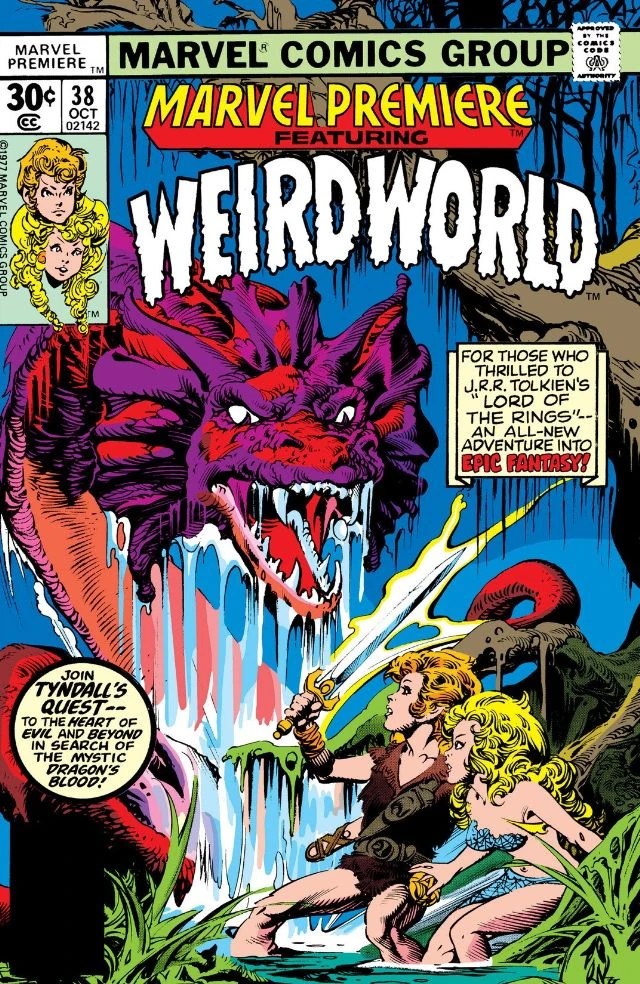
Cover to Marvel Premiere #38 (Oct., 1977). Art by Dave Cockrum and Rudy Nebres.
Doug Moench — who, incidentally, declared in 2016 that he had not been consciously inspired by the works of J.R.R. Tolkien in the writing of this story (though he did allow that he’d read The Hobbit at some time beforehand) — seems to have conceived of this first “Weirdworld” story as a done-in-one affair. But, according to Archie Goodwin’s editorial in Marvel Super Action #1, even prior to its publication, a follow-up had already been not only commissioned, but completed, “…and will be appearing one of these moons in our color showcase book, MARVEL PREMIERE. Watch for it.”
My Tolkien-loving younger self hardly needed to be told twice. I would definitely be there for Marvel Premiere #38… even if it did take close to two years. And since the odds of that book getting its own blog post in July, 2027 are about as good as they can be, I’ll postpone any further comment about it, as well as the later history of the “Weirdworld” characters and concept, until then.
And that brings us to the fourth and last comics story of the issue: a 15-pager starring Dominc Fortune, written as well as drawn by Howard Chaykin:

As we mentioned earlier, the very first Dominic Fortune story had been a collaboration between Chaykin and Len Wein, the latter of whom co-plotted as well as scripted that adventure. This time, however, Chaykin was handling the scripting on his own — though, per comments made by Archie Goodwin in his editorial for this issue, as well as by Chaykin himself in an introduction to the first two Fortune tales’ reprinting a few years later in Marvel Preview #20, Wein did contribute somewhat to the plotting, despite not getting an official credit.

Most of what one needs to know to enjoy this story can be picked up as one goes along — though, having said that, someone who hadn’t read the first Fortune yarn in Marvel Preview #2 might be a little confused as to what’s actually going on in the scene that immediately follows the title page…

What’s that you say? You’re one of those who didn’t pick up MP #2? All right, then… please be advised that Dominic Fortune (born David Fortunov) makes his home on a gambling ship anchored off Los Angeles, just outside the three-mile limit. Said ship, the Mississippi Queen, is owned and operated by one Sabbath Raven — yes, the young woman we see briefly in the top panel above — to whom our hero pays rent. But Dominic is a gambler himself, and due to his frequent losses, is usually several months in arrears to Sabbath… which is one of his primary motivations for taking on jobs like the one we see him doing here for the fictional movie mogul Len Sandler (not to mention three unseen colleagues of the latter, from whose first names one might reasonably assume to be the not-so-fictional Harry Cohn, Jack Warner, and Sam Goldwyn). And now you know.
Returning to the Queen, Dominic confers with Sabbath, telling her that the “financial advisor from the east” in Sandler’s film reel is actually Olga Cimaglia, “number two in the New York mob”. Dominic and Olga already have a history, so Sabbath offers to go to New York to investigate…


As they drive away from the scene, Noble Flagg tells Olga Cimaglia that she shouldn’t worry that he was too hasty in using their mysterious machine: “I know this town. The loonies, they’ll buy anything. We tell ’em it’s the hand of God, they’ll buy it. We start the crusade — and the quakes — tomorrow.”

On Olga’s orders, Jack goes to the Queen — and, pretending to be a way-down-in-the-hole gambler desperate to make a getaway, manages to get access to Fortune’s cabin. But luck is with our brigand-for-hire, as a surprise visit from Len Sandler allows him to get the drop on Jack and take him down. Then, just as the scuffle ends, the phone rings…


Olga never gets to finish that last sentence before being gunned down by Flagg (gee, that name’s got kind of a ring to it, doesn’t it?). Then, as the helicopter lifts off. the film star-turned-terrorist fires wildly in all directions, hoping to hit Fortune, but failing to do so. And then, when he’s run out of bullets…


Well, that was a rouser, wasn’t it? And delivered at such a breakneck pace that you might not have even noticd that Chaykin never really explained how Flagg found out in the first place about that guy in the Nevada desert (remember him?) and his earthquake-making machine. Hey, if you need those kinds of details, just make ’em up yourself, OK? We’re too busy enjoying a thrill ride here — something which the artist/writer’s bravura graphic storytelling and flair for period color makes very easy to do.

Cover to Marvel Premiere #56 (Oct., 1980). Art by Howard Chaykin and Terry Austin.
Like his Marvel Super Action cohorts, Dominic Fortune would have a future extending well past this one-shot — though, as with most of those others, it would take a few years for that to come to flower. The character’s next appearance would be in Marvel Preview #20 (Winter, 1980) — an issue which, as previously noted, merely reprinted the first two Dominic Fortune stories (albeit with a brand-new Chaykin cover). That appearance was evidently well-received, however, as it soon led to a new series of full-color yarns (drawn by Chaykin, but written by Denny O’Neil) starring the character, which ran as backups in Marvel’s Hulk magazine, starting with issue #21 (Jun., 1980) and continuing through #25 (Feb., 1981). Concurrent with this run, Fortune made his regular color-comics debut in Marvel Premiere #56, headlining a story produced by Chaykin with the assistance of Len Wein (co-plotter), David Michelinie (scripter), and Terry Austin (artwork finisher). That level of involvement of creators not named Howard Chaykin presaged what the coming years would bring for Dominic Fortune, as he’d soon find himself thoroughly integrated into the Marvel Universe, making appearances alongside the likes of Spider-Man and Iron Man; most of these stories wouldn’t feature Chaykin’s direct involvement at all, although he’d turn up for the odd project here and there, such as S.H.I.E.L.D. #11 (Dec., 2015), which guest-starred Fortune in a story drawn by Chaykin and written by Mark Waid.
And that brings us to the end of Marvel Super Action #1. Well, almost. As we noted previously, this was a no-ads package — and so a Howard Chaykin illustration that was probably initially designed as a frontispiece (similar to the one he’d earlier done for Marvel Preview #2) graced the back cover, instead:

It seems pretty obvious that the illustration, if not the accompanying copy, was produced prior to the “Weirdworld” strip being added to the magazine’s contents. Which was possibly for the best, given that Chaykin has never shown much affinity for the kind of fantasy represented by that story. (Though it still might have been interesting to see him have a go at drawing Tyndall of Klarn.)

Cover to Marvel Super Action (1977 series) #1, (May, 1977). Art by Jack Kirby and Syd Shores (adapted from the cover of Captain America #100).
We’ll close this lengthy post with something of a correction — namely, that our earlier assertion that there never would be a Marvel Super Action #2 wasn’t entirely accurate. That’s because, some time after having made the decision that the world wasn’t ready for a men’s action-adventure genre-oriented black-and-white comics magazine, Marvel also decided that Marvel Super Action was too good a title to go to waste. And so, not much more than a year after the release of Marvel Super Action #1, the publisher brought out… Marvel Super Action #1. This incarnation leaned more heavily into the “Super” part of the title, being a standard-size color comic that reprinted old Marvel superhero stories — originally from Captain America, then, beginning with issue #14, from Avengers. The series ran for 37 issues, not ending until August, 1981.
Taking into account the recycling of the magazine’s name along with the later revivals of all four of its features, I’ll offer the observation that if (for whatever reason) one were to compare the OG Marvel Super Action #1 to a slain buffalo, then one would also have to acknowledge that, when all was said and done, Marvel at least used every last bit of the animal.

Poster art for The Lord of the Rings (1978 animated film) by Mike Ploog.
*In an interview conducted for Roger Ash and Eric Nolen-Weathington’s Modern Masters Volume 19: Mike Ploog (TwoMorrows, 2008), Ploog himself recalled the timing of his taking on the “Weirdworld” assignment somewhat differently, indicating that he’d come to it only after he’d already worked with animator Ralph Bakshi on the 1978 film The Lord of the Rings. But (and with all due respect to Mr. Ploog), that seems unlikely to the point of impossibility, given that Bakshi’s film doesn’t appear to have even begun production until 1975; on the other hand, there’s no issue to be taken with Ploog’s more general statement about his suitability for “Weirdworld”:
It’s my kind of story. I love the fantasy stuff. I did Wizards
and The Lord of the Rings with Ralph. I love that kind of material.
I remember Marvel Preview no. 2, but do not recall this one. Chaykin and Ploog are the highlights to me. Rico Rival was a solid artist, but I prefer Tony de Zuniga on his own.
So much work went into drawing these pages, and at rates that hardly justified their intensity and effort that went into them. These artists clearly loved their craft, so it wasn’t just about the money. In the pre-computer/digital art era it was much harder – and far more time consuming – to generate comics pages at this level of quality.
Howard Chaykin now is a shadow of his former self. He admittedly cranks out 20 pages per month, every month, to keep pace with his financial needs (remember, freelance artists in the United States do not accumulate social security income for their retirement years and have no pension/401K).
Freelance artists pay self employment taxes like any other self employed person and receive social security.
When writing off studio space in your home, business travel, art supplies, etc. a lot of these freelancers ended up owing little or nothing to the IRS, and therefore accruing little or nothing in the way of social security funds.
Self employment taxes are a separate tax from federal and state income tax. Some freelancers who generated little income and didn’t last for more than a few years might have been hobbyists and never filed, but I doubt an artist with as long a career as Howard Chaykin doesn’t pay self employment tax every year.
You’d be surprised. I could name some top artists with the Big Two who have purchased silver age key comics as tax write offs in lieu of paying Uncle Sam. Neal Adams wrote off *groceries* and openly said so.
I think we’re arguing around each other. If you’re filing taxes as a freelance whatever… you’re expected to pay self employment taxes and you can only claim a loss for so many years. If they’re evading taxes than that’s a different story… but social security is not a benefit that is denied freelancers who file.
I brought this up because of the grim plight for most freelancers in comics vs. staff employees, and why Chaykin is compelled to complete 20 pages monthly at a time in his life when most of his non-freelance peers are enjoyment their retirement and only working by choice.
For example, someone in the US who earned $60,000 in 2024 had $3,720 (6.2%) held for social security. A freelancer who earned that same amount in 2024 had to pay $8,475.73 in self-employment tax, barring any deductions. 12.4% of that s-e tax went to social security, totaling $1,017.08—-and 99.9% of freelancers have tax deductions (studio space, utilities, business meals and travels, art supplies, etc).
Compare the annual $3.7K that a staffer paid into social security, as opposed to a freelancer who most likely paid well under $1K per year, and you see a great disparity in what their respective soc sec payouts will be at age 67 (or 71, if 120% is desired).
Indie comics have notoriously low pay rates, and Chaykin’s star has diminished quite a bit since the height of his creator profile in the 1980s. I wish him and other freelancers in comics all the best.
“An avalanche of violent adventure! ”
Who’s writing these blurbs ? Fredric Wertham?
🤣 This sounds like “pulse pounding” Stan Lee-type hyperbole to me—-just some good copy to sell mags.
Werthan would be more “This book is a wet mudslide of oozing, torrid passion, engulfing innocent young readers … excuse me, I need to be alone.”
I was struck, seeing a retrospective in an Overstreet guide, by how much Chaykin loved those double-breasted tunics….
have no idea why I bought this because I can’t stand the Punisher. I share the point of view is rather than being a hero, the dude is a homicidal villain whose victims are largely other villains. I also can’t suspend disbelief that countless innocent bystanders haven’t been killed or maimed by his actions. The prostitute part was good writing until the end though. She’d asked what she did to bring any info back to her clients about whether Frank had an organization they needed to deal with makes sense. It also was better than flashbacks without an excuse to frame the backstory for new readers and add to it. What loses me is the clumsy attack. That’s the best she could come up with a sociopath as successful as Frank? The bullet that killed her was from Frank but the cause of death was page count in the end.
I liked Chaykin’s stuff back then and it’s a good reminder he was once more than a fetish artist. I would have preferred immortality than sons and grandsons who look like his clones and mimic his behavior but oh well.
I also read Bobbi Morse’s whole journey to Mockingbird and enjoyed it immensely, even if I did forget about her during the times she didn’t see print early on. The future elopement with Hawkeye was especially fun compare dto usually hype and overblown circumstances of most superhero weddings. One thing I do wish was different is that I much prefer the Huntress’ costume to the Mockingbird one. Too bad the MTU issue hadn’t happened sooner! The daughter of Batman and Catwoman following daddy’s footsteps would have happened with a different name just as easily as Mockingbird.
These stories are all entirely new to me. I got (and still have) that first appearance of the Punisher in ASM #129 for 21 cents, but never got any of his solo stories. Reading the excerpts above, I did find it a bit odd that Frank Castle would engage in the services of a Call Girl. Somehow, just based on the stories I have read featuring him (in ASM, Captain America & Daredevil), it seemed out of character for him to indulge in carnal delights — he seemed too dead serious in his mission of vengeance for such behavior or to do something that would make him in any way vulnerable to a stranger. Of course, the twist ending explained that! He was staying in character all right. BTW, my dad (who turned 30 in 1970s) had a few of those Executioner novels. I remember seeing them around the house, but I never read any of them myself and I don’t recall that at the time I ever realized the Punisher I was reading about in some of the “funnybooks” I was collecting was based on the title character in those books my dad read.
Chaykin’s Dominic Fortune was an entertaining enough romp and based on his style at the time, seems easy to figure why he was determined to be a good fit to do the Star Wars comics adaptation, as Fortune had the feel of an old-time serial of the 1930s but with 1970s modernist touches and sensibilities. Also, Fortune bore some similarities to Han Solo.
Moench & Ploog’s Weird World reminded my both of Tolkien’s Lord of the Rings as well as Wendy & Richard Pini’s later Elfquest series. I don’t recall Ploog ever doing a standard superhero mag, but he was certainly versatile in other realms of fantasy comics art.
The Punisher never made sense to me.
He was a Vietnam era Marine Captain. As I recall, he was an 03 officer (infantry)., no prior enlisted service. He was close to getting out when his family was killed, That would be about 5 years in if he were USNA or 4 if he were an NROTC Scholarship guy. He probably had a few years more but probably was not close to being a Major, so probably under 8 or 9 years.
Unless he were a Recon Marine, he would probably have been a Platoon Commander a couple of times, been a Company XO and a Battalion Staff Officer (adjutant, Logistics Officer or Assistant Operations Officer) and a Rifle Company Commander or a Weapons Company Commander, maybe a Headquarters Company (or some combination of those billets.
Probably an excellent marksman and hand-to-hand combatant (even before the current Marine Corps Martial Arts Program [“MCMAPs”] . . .. but what does this guy know from running agent nets or electronic surveillance or modifying weapons?
None of that makes sense for a Marine infantry Captain.
An Army Special Forces (18 Series) Captain, especially if he were a prior service SF guy, who had been a Weapons or Intel Sergeant? It would make more sense.
Further, Marines (outside of the Force Recon/Raider world) are not lone wolf types. They are highly skilled and the epitome of professional . . . but they stay in their lane.
I had the experience once of trying to integrate Marine analysts from a MEF and Intel types from a JSOPTF . . . . oil and water To say the least..
.
Commander Benson once made a similar point about Captain Savage: a sub commander doesn’t have the skills to lead the Leatherneck Raiders strike force and the Navy’s unlikely to waste his specialized abilities by putting him in charge of a surface vessel
Hey Alan, in your research…is this the first time they use the ‘Journal Entry’ – it says Number One! For Punisher fans…that’s pretty cool!
The “War Journal” device had definitely been used before, in Marvel Preview #2 (and maybe elsewhere) — but getting to read “Entry One” in the form of a flashback is still pretty cool, I think. 😉
I read this on the stands (I did that a lot) because I vividly remember Huntress and somewhat remember Dominic Fortune. I’m not surprised I skipped Punisher, having no love for him, but it’s hard to believe I skipped over Weirdworld. It’s very much to my taste, though I’m surprised the Realm of Shadow apparently has no connection to the vampires (but then, the world is weird, right?).
Bobbi Morse’s story is very much ripped-from-the-headlines. In 1975 the Church Committee revealed the CIA had carried out unauthorized assassinations, operated illegally inside the US, spied on American citizens and dosed unwitting Americas with LSD to judge it’s effectiveness as an interrogation tool (one victim died). Suggesting SHIELD had the same problems was an inspired idea, though the lack of follow-up indicates I’m a minority on that. Rereading now, I notice they don’t indict Fury (or by implication Dum-Dum or Jasper Sitwell) but imply there are rogue elements at work (smart move — completely discrediting SHIELD would be a waste)..
Santana’s scheme reflects the ongoing effects of OPEC flexing its muscle over America’s oil supply, though I find it clunky that the mastermind behind a middle-eastern takeover is running a South American spy network. And I’d bet the folksy senator chatting with Bobby is modeled on Sam Ervin, who took point in a lot of the Watergate hearings.
Thanks for the historical context regarding the Church Committee, fraser, which clearly eluded me in 2025 just as much as it had in 1975! Regarding the model for Congressman Kirk, you’re probably right that Sam Ervin played a part, though I think that the”fat old Southern politician with a quaint fashion sense” was already a common stereotype before Ervin came to prominence in the Watergate era. Also, it now strikes me that giving the Congressman the surname “Kirk” — an old Northern British word for “church” — may have been an intentional nod to the Church Committee on Mike Friedrich’s part.
You have a point about Southern politicians, though I don’t think most of them were portrayed as the good guys rather than stuffed shirts.
They did follow up on the corrupt SHIELD storyline, but it had a very long gestation. It came to a head in the 1988 Nick Fury vs SHIELD mini-series, which I felt was a terrible misfire.
I haven’t read it but I’ve heard nothing good about it. Was that the Deltite Conspiracy thing?
Was “An Ugly Mirror on Weirdworld” reprinted in Marvel Premiere #38? It was certainly re-printed somewhere because I have memories of reading it (but not the rest of this book) and those memories are of a story in color. I was a big Ploog fan at the time, thanks to the Bakshi movie, Wizards, and certainly would have sought this book out, had I known this story was in there.
I’ve never had strong feelings about the Punisher. I get where he comes from; no one who saw Death Wish could ever say that they don’t get where he comes from, and when confronted with his presence in a magazine, I confess to an ability to loose myself in the cathartic violence of it all and just have fun. I will admit that I enjoy Jon Bernthal’s performance as the character on TV and appreciate the way they tied it into a commentary on the current military-industrial state and the way it fails our boys and girls who risk their lives for our country. I’ll even cop to admitting I liked the Thomas Jane version of the character in the film with John Travolta. Both, I thought, were well-made projects that looked for ways to re-conceptualize the character so that he wasn’t just a murderer (they fail, of course, but he IS, just a murderer after all). My main issue with Punisher as a comics character, was that writers tended to use the inherent violence of the book as an excuse not really tell a story, but merely provide a trigger (you see what I did there) for Frank to do what he does best. All the characters in any given Punisher story are inherently bad guys, so we’re not supposed to feel bad when they get killed. The main thing that stood out to me in this story was the off-shore oil rigs. I suppose the MCU might not be as environmentally-conscious as our own reality, but there are no off-shore oil rigs off the coast of Florida and never have been. Archie didn’t do his homework.
The Huntress story was OK, though I like Bobbi Morse better as Mockingbird. As for Dominic Fortune, I love Chaykin and always have, but why would a soldier of fortune dress like a pirate? And those trunks he wears over his pants–look at how baggy they are. I hated that about the design. Otherwise, Chaykin was really starting to get into the groove that would ultimately take him over the top in the 80’s with American Flagg.
Though not a book I would’ve read in 1975, I don’t mind reading it now, if for no other reason than to broaden my horizons. I look forward to your review of Marvel Preview #38 and the Weirdworld. Thanks, Alan!
Don, I don’t think that “An Ugly Mirror on Weirdworld” has ever been reprinted in color — on the other hand, the sequel in Marvel Premiere #38 does include a recap, so maybe that’s what your memory is latching onto?
And thanks for pointing that out about there never having been any oil rigs off the Florida coastline — I had no idea!
The ever useful GCD site lists the story reprinted in collected editions in 2015 and 2019.
Thanks, Marcus — although, for the record, the first of those reprints was definitely in black and white. I suspect the second one was as well (though I don’t know that for sure).
I KNOW that I bought this book in the UK, but for the life of me can’t remember whether it was from a newsagents in Chester in 1977 or from a comic dealer (who happened to live in my home town) in 1979.
I do still have it, but reading your article today reminded me of how fifteen (or seventeen) year-old me struggled with the Huntress story, disliked the Weird World offering, liked The Punisher (except for that awful shark scene), but loved Dominic Fortune… even though I’d never previously come across.the character.
Weird thing: We were in Scotland last week and about to set out on a hike. The weather was unseasonably sunny and I reminded my wife to remember her “cheaters”. She gave me a questioning glance and I immediately launched into an explanation of how I’d first learnt that it was a 1930’s alternative term for sunglasses from “The Messiah in the Saddle Resolution”. Once again, I received that pitying look – perfected over thirty eight years of marriage – reserved for when I go on about something I gleaned from comic.
Once again, thanks for the memories.
As for the ending of The Punisher story, in the words of Mickey Spillane (a former Timely Comics wrier), “It was easy.” (See also the 1966 Matt Helm movie, The Silencers.)
Amazing ( Dominic Fortune and Weirdworld) to amazingly awful (Punisher and Huntress).
However much I tried to get into the Punisher and Huntress features they bored me no end….it may have been to do with the art on both, which resembles mud on a bad day! Goodwin’s script never really never get’s out of the starting blocks, and Friedrich’s script, after a good opening page, just drifted. Evans did not follow up on how Bobbi Morse looked like in her previous appearances in Ka-Zar and Savage Tales; in form and character she a completely different character who just shared a name. Really time wasted by the talents involved….Modesty Blaise for these type of stories is/was so much better! But Ploog and Chaykin really shine, and prove themselves here masters of the wash technique. Apart from that Chaykin really likes the name Flagg!