
Welcome to the third of our posts commemorating May, 1976 as “Marvel Milestone Month“. Following our looks at Captain America #200 and Thor #250, this time around we’re taking on the “Spectacular 150th Anniversary Special” issue of Avengers… although we’ll actually be spending more time on the following month’s issue, #151, since the “official” milestone issue turned out to be a disappointing misfire… unless, of course, you really were jonesing back then for an incomplete reprint of Avengers #16 (May, 1965) fronted by a mere six pages of new material from writer Steve Englehart and artist George Pérez.
What had gone wrong? Even before one dug into the issue, the cover offered an oblique clue — at least, if you knew how and where to look. Sure, if you’d been following the series, the assortment of heroes depicted by Pérez and company thereon made perfect sense — these were the current candidates for a revised Avengers roster, after all, per the membership drive that had kicked off a little over a year before — and so did that big question mark in the background. But if you happened to be coming to this title as a newbie, or had simply been away for a while, that same question mark might well have left you puzzled. You might have thought something was missing — as indeed it was, according to the Grand Comics Database, which reports: “To the right of the UPC symbol there is a circular balloon that has been blacked out. This circle originally contained the words “.. Featuring a Far-Out New Avengers Line-Up!’… The original cover without the circle being blacked out was in the 1977 Avengers Style Guide from Marvel.” No wonder that the cover’s final blurb — the one beginning “All This” — reads like a non sequitur in the published version.
So, the decision to run a reprint in what was to have been a special revealing-the-new-lineup issue worthy of its numerical milestone status was clearly made late in the game, while the book was already in production. Again, we have the question: what had gone wrong? Unfortunately, fifty years after the fact, there’s still no consensus; and at this late date, it seems unlikely there ever will be. But while we’ll be getting into the thorns of the long-running controversy later in the post, for now let’s simply open to the comic’s opening splash page, assuming unto ourselves the same blissful ignorance that most of Avengers #150’s readers in May, 1976 (your humble blogger included) were, of necessity, then laboring under…

A few things to take note of here: first (and probably least), since Avengers was not, in fact, 150 years old, this story should not have been called a “sesquicentennial celebration” (nor, for much the same reason, was it in any sense an “anniversary special”, as the cover had claimed). Second, the list of credits integrates the names of the personnel who worked on the reprinted material used in the issue — i.e., scripter Stan Lee, penciller Jack Kirby, inker Dick Ayers, and letterer Artie Simek — without actually acknowledging that their contributions come in the form of a partial reprint of Avengers #16, which seems kinda sneaky to me. Third, the other two inkers credited, John Tartaglione and Duffy Vohland, hadn’t previously been involved with embellishing Pérez’s Avengers work, which suggests that they may well have been drafted in to work on this job at the last minute (for the record, Tartaglione would ink the next issue as well).
Fourth, and finally, the person credited as “editorial-ememdator” for this issue, Archie Goodwin, was at this time the editor of Marvel’s black-and-white magazines — or, at least he had been, up until this month. Meanwhile, the editor-in-chief of Marvel’s much larger color comics line was — or had been — Marv Wolfman. And if you look at the credits for the remainder of Marvel’s May, 1976 four-color output — with the exception of reprints, as well as those books produced by specially contracted writer/editors like Roy Thomas, Len Wein, and Jack Kirby — the name listed as those comics’ editor is Marv Wolfman. That makes Avengers #150 a definite anomaly… but if you’re wondering why that might be so, I’ll have to ask you to put that question in your pocket for the time being; for now, let’s get on with our story…


Half a century on, the dialogue in this scene still makes me smile. Having written the Avengers for almost four years now, Steve Englehart had a firm handle on the members’ individual personalities and voices, so that their shared affection and humor feel completely genuine.
The Scarlet Witch’s wry invocation of the “Lady Liberators” calls back to Avengers #83, and its less-than-successful attempt to deal with the subject of “Women’s Lib”; meanwhile, the other footnoted reference, to Iron Man #85, commemorates the welcome departure of Iron Man’s nose (the origins of which we previously discussed here).


With this last page, Englehart and Pérez establish the basic structure for this story (or, at least, what would have been the structure, had things gone as originally planned), as we see the Avengers’ here-and-now deliberations alternating with Dan Rather’s Sam Reuther’s recounting of the team’s history, with thematic parallels between the two narrative tracks subtly woven in — as demonstrated here by Thor’s role in the team’s founding being mirrored in the present by his stated intent to leave…
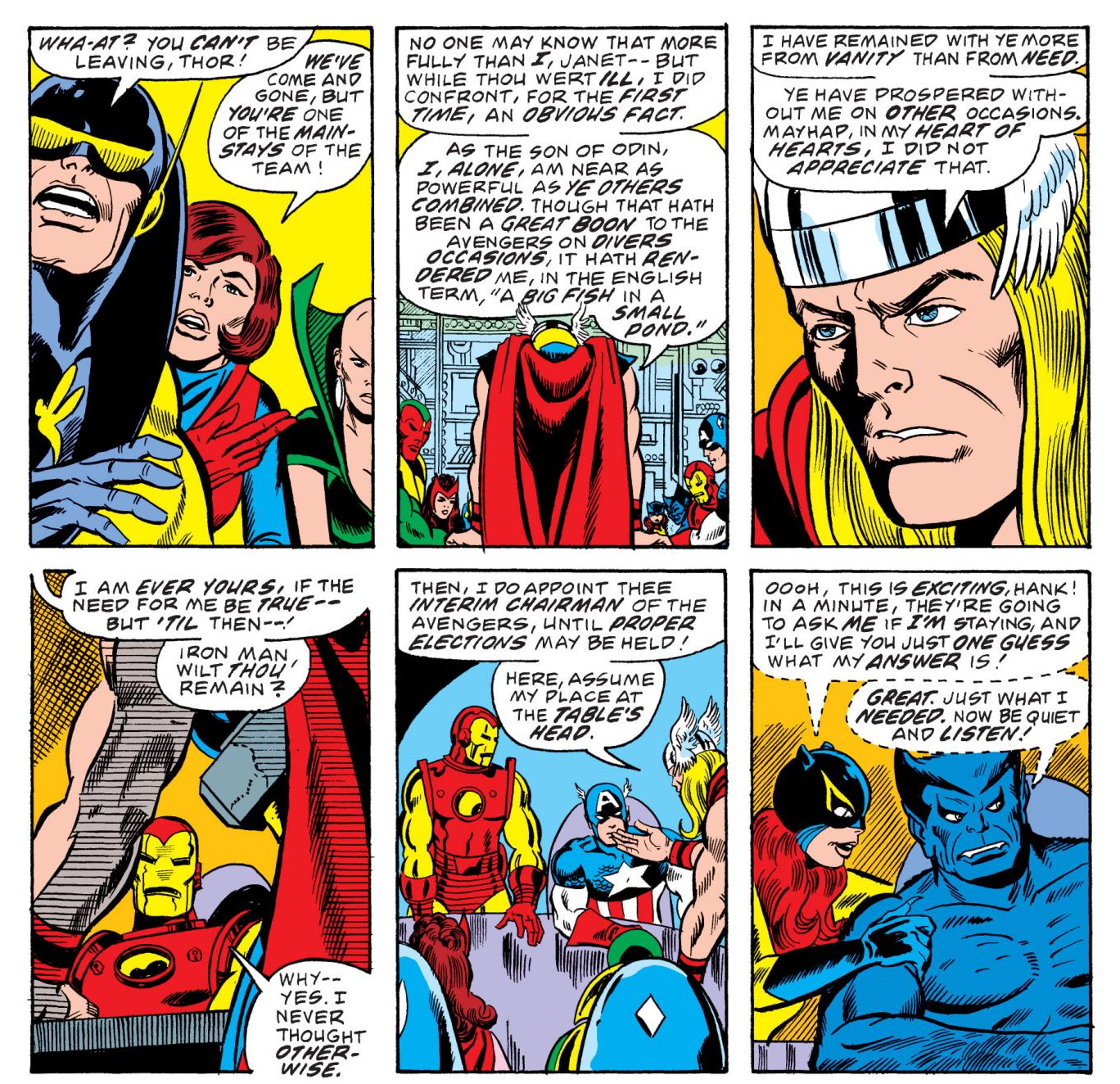
Englehart had set up Thor’s departure pretty well over recent issues, as we’d seen Moondragon needling the God of Thunder about his “slumming” amongst mere mortals, with things finally having come to a head in the previous issue’s conclusion of the “Serpent Crown” saga. I wasn’t very happy about it — as all regular readers of this blog know, Thor was, and still is, my favorite Marvel Comics hero — but I figured that it wouldn’t be forever. (And I was right, of course. For the record, Thor’s next adventure with the team would occur just eight months after his forthcoming exit, in issue #159 — although I should note he didn’t formally rejoin the team at that time,)

There’s some wonderfully understated storytelling going on in that last tier of panels; Iron Man’s resigned but rueful comment about wishing “that nobody’d put this idea in his [i.e., Thor’s] head” is clearly aimed at Moondragon — but rather than directly indicating this by showing the Golden Avenger looking pointedly at the priestess of Titan, Pérez subtly draws attention to Moondragon’s role by foregrounding her seated, obscured figure, while setting Iron Man in the far background, as distant and detached from her as the panel will allow.
Next, Iron Man’s question for Captain America leads directly into — what else? — Reuther’s rundown of the Avengers’ rescue of Cap from the ice in Avengers #4…


Cover to Avengers #16 (May, 1965). Art by Jack Kirby and ?.
And here, of course, is where things run right off the rails, as what should have been a brief recap of the Avengers’ first major roster shake-up turns instead into an unannounced and unexpected (not to mention incomplete) reprint of that event’s original presentation in Avengers #16. Yes, it’s a classic story — and if Avengers #150 had been a double-sized issue in which this content was presented as a sort of “bonus” to a regular-length new story, Marvel might have gotten away with it. As it was, however, this was a big disappointment to me as a reader at the time, and it still rankles a little, even after all these years. I’m inclined to think I’d have felt that way even if I hadn’t already read the original, 20-page “The Old Order Changeth!” the last time Marvel had reprinted it (in Marvel Triple Action #10 [Apr., 1973], if you’re wondering); but, if course, I’ll never know for sure.
Anyway, we’re going to skip over the bulk of the next twelve pages, returning just for the last panel, and the accompanying “Next Issue” blurb:

 If there was one bright spot in having to wait until June for the revelation of “the long awaited new Avengers line-up” in #151, it was that the conclusion of the story was going to need another cover on more or less the same theme as that of #150’s — and that when that cover appeared on the racks, it had been drawn by none other than the title’s co-progenitor, Jack Kirby. Your humble blogger actually prefers this one to Pérez’s job for the “real” milestone issue, though I can see where some might think it focuses too much on the team’s “Big Three” to the detriment of the other team members. But, to each their own, as we’re fond of saying around here.
We turn now to the issue’s opening splash page:

And that’s also where we’re going to pause for a bit, so as to provide some further background information for what we’re going to find as we make our way through Avengers #151 — beginning with an explanation as to what in the world the name of Gerry Conway is doing in the credits of this “misplaced Marvel masterpiece”. Hadn’t Conway left Marvel less than a year earlier to go work for rival DC, after being passed over — unfairly, in his opinion — for the job of Marvel editor-in-chief? Indeed he had. But in the time since then, Marvel had burned through not one, but two EICs, with the most recent incumbent, Marv Wolfman, following in the footsteps of his friend Len Wein in finding the job too mentally and physically exhausting to continue. The man who’d held the job before either of them, Roy Thomas, had subsequently been approached about returning to the fold, and had more or less agreed to do so. But then, at something close to the last minute, Thomas decided he’d really rather live in Los Angeles, CA, where he’d recently been vacationing — and recommended that Marvel hire Gerry Conway instead. The Marvel brass decided to go with that, and so it came to pass that the then 23-year-old Conway returned to Marvel triumphant, ensconced at last in the job he’d wanted so badly… though, in the end, he kept the position for only a few weeks.
We turn now to the letters column of Avengers #151, the bulk of which was taken up by an “Apologia” that may have been written by Gerry Conway — though it’s just as likely to have been the work of assistant editor Jim Shooter, who (as readers of our Ghost Rider #19 post from earlier this month may recall), had come to that position during Marv Wolfman’s tenure as Marvel’s editor-in-chief:

Steve Englehart has been forthright in offering his account of how he came to part ways in the spring of 1976 not only with Avengers, but with Marvel Comics in general. It’s a story he’s related in various venues, and in various degrees of detail, over the past five decades; the following version, one of the earliest I’ve found, first appeared in an interview that was published in The Comic Times #2 (Sep., 1980). It begins with Englehart explaining how his disaffection with Marvel had been growing for some time prior to the flashpoint that came during the process of creating Avengers #150:
There began to be decisions made not by Stan Lee as the top of a bunch of creative people, but by Stan Lee as the bottom of a bunch of businessmen. And he began to really put his energy up into the business end of it rather than down into the creative end below. And the corporate influence became greater and greater…
They began to say. “Next year you have to make 10 percent more profit.” And they didn’t care how you did it. They didn’t have the slightest concern with what was in the books, they were just interested in the bottom line.
So we began to start hearing, “Well, you can’t do that anymore. We know you did it, and we know it sold, but we prefer to make it a little simpler, a little smoother now,” and things like that.
It came to a head in April of ’76 when Gerry Conway became the editor for just three weeks. He called me up and said. “I wrote The Justice League when I was at National, I’m the editor at Marvel now and I want The Avengers.” And I said, “Hey, I’ve been writing it for 4 years. and it’s been selling.” And he said. “Yeah, but I’m the editor. I’ve got the power and I’m taking it.” And I said, “Well, like hell. I don’t have to put up with this.”
I had no plans ever to leave Marvel. I mean, I wanted to be a Marvel comic writer. We used to laugh at DC, and I found myself in a real sort of schizophrenic thing, sitting there sort of watching myself saying “Well, then fuck you, I quit.” And part of me was shrieking “Do you realized what you’re doing?” Because I was cutting myself off, right there.
In another interview published around the same time, in Comics Feature #5 (Sep., 1980), the writer offered further details concerning his actions following his fateful phone call with Gerry Conway:
I was halfway through [scripting] that issue [i.e., Avengers #150] when Conway called me up and I quit. What I did, actually, was sit down and write the last eight pages in five minutes, with the most outrageous dialogue. I just said, “I’m going to get this out of here,” and wrote just silly shit. It wasn’t a real Avengers comic book, it was just dialogue for the sake of dialogue. I remember Yellowjacket said to the Wasp, “Marry me and we’ll raise little Avengeritos.” Then I realized that that was no good because they’d just rewrite it. Better I should make them go reprint for the 150th issue. I’m not shy about taking my revenge when I get screwed, but I don’t carry it around with me for months afterwards. In the heat of the moment I said, “We’ll make them go reprint and to hell with them.”
Speaking on behalf of the eighteen-year-old me who bought that comic book new off the stands, unaware that it was 2/3 reprint material, all I can say is: Gee, thanks, Steve.
The late Gerry Conway’s version of events was, not too surprisingly, quite different. This account originally appeared Back Issue #45 (Nov., 2010):
[Avengers] was perennially late to the printer, which was costing Marvel a lot of money… I asked Steve for a commitment to have his next plot for The Avengers in by Friday, so that George Pérez could get started on it by Monday. I gave Steve a Friday deadline for one reason — so that, if he didn’t make it, I’d have time over the weekend to plot a replacement issue. I made it clear to Steve this is what I’d do. He agreed to have the plot in by Friday.
According to Conway, he didn’t receive Englehart’s plot by the agreed upon day.
I called him, and he denied he’d ever made any commitment to delivery by Friday — as far as he was concerned, George didn’t need the plot until Monday, so he wasn’t going to deliver a plot until Monday. When I told him this wasn’t what we’d agreed, so I was going to write a replacement plot myself, and he’d have to miss an issue, Steve responded [that] a fill-in story would ruin the overall storyline, and he accused me of trying to take over the book. He said if I insisted on doing a fill-in, he’d quit.
Well, if I was going to have any authority as an editor, I had to do what I said I’d do. Maybe someone else would have backed down and given Steve another chance to deliver his plot by Monday. I didn’t feel I had that option. So Steve quit The Avengers.
Which of these accounts comes closest to what actually happened fifty years ago? That’s not my place to say. It’s worth noting, however, that neither contradicts the account given way back in June, 1976, in Avengers #151’s letters column. After all, Steve Englehart acknowledged in 1980 that he’d turned in the second half of #150’s script late on purpose, thereby forcing the issue to go part-reprint. The only real question is about what happened on the phone between him and Gerry Conway to prompt that action on his part.*
Speaking of #151’s lettercol, you may have noticed that, towards the end of the “Apologia”, Marvel challenged readers to identify which pages of that issue had been written by Englehart, which by Conway, and which by Jim Shooter. According to a follow-up in the letters column of Avengers #154, no respondent got the breakdown completely right — still, Marvel published the full attribution therein, and we’ll be using that information to identify who wrote what as we proceed through the story (though, as we’ll see, even here some of the facts are in contention).
We jump back into things at the beginning of page 2 — which, like the opening splash before it, was scripted by Gerry Conway.

We haven’t looked at an issue of Fantastic Four lately — so, for anyone confused by the Thing’s physical appearance in the scene above, be advised that at this time, Ben Grimm had been temporarily “cured” of being the Thing in FF #167 after prolonged exposure to gamma radiation emitted by the Hulk. Subsequently, Reed had presented the human, non-powered Ben with a “Thing suit” so that he could continue superheroing with the team. None of it had anything to do with the Avengers — though I suppose you could argue that, given the FF’s status as the “first” super-team of the “Marvel Age of Comics”, having at least one member show up in a “Greek chorus” capacity made a certain sort of thematic sense. (The fact that George Pérez was also drawing Fantastic Four at this time may have lent some creative synergy to the idea.)
One small note regarding Conway’s script for this last page; it seems highly unlikely that Sam Reuther could have received “reports” that Thor was planning to leave the Avengers, seeing as how the only person he’d spoken to about it before announcing it to the team just now was Moondragon. But, whatever.
We come now to Steve Englehart’s first page for this issue — which, as you can see for yourself if you take a moment to scroll up and check, would have slotted in perfectly after the last “new” page of Avengers #150, right down to the interrupted sentence:

From here, it’s over to another Conway page…

Unlike the earlier pages by Avengers‘ new writer (and editor), this one actually does count as one of the “story spots” mentioned in the issue’s lettercol, pulled together by Conway and Pérez and intended to “lead into future issues”. And since I’m not expecting to post about any of those future issues (at least not in any depth), I’ll go ahead and note that the distressed gent shown above is Bob Frank, aka the Golden Age super-speedster known as the Whizzer, who’d been established by Roy Thomas back in Giant-Size Avengers #1 as being the birth father of Wanda and Pietro Maximoff, aka the Scarlet Witch and Quicksilver. (This “fact” would of course be retconned just a few years later, but in 1976, it was canon.) Like the other pages added to Englehart’s original script, it breaks the originally established pattern of cutting from the Avengers’ meeting room to Reuther’s broadcast and back again — but it’s hard to see how else what remained of Englehart’s script for #150 could have been padded out to fill an issue without extensive rewriting, and Conway at least tried to keep the new “story spots” connected to the main narrative, as demonstrated above by his cutting from a scene highlighting Wanda to one featuring her supposed dad (whose next appearance, by the way, will be in Avengers #153).
And now, back to Englehart:


This “story spot” page scripted by Conway foreshadows yet another upcoming development, the return of the Living Laser (who is of course the unidentified orange-gloved figure talking to the unnamed general in the scene above). Never mind that Marvel’s readers of the time thought that the LL had been killed stone dead in Captain Marvel #35 (an issue which, incidentally, had been written by one Steve Englehart); as would be revealed in Avengers #153, that so-called “Living” Laser had in fact been an android duplicate. Again, the scene is thematically linked to the main storyline by making reference to LL’s unrequited passion for the Wasp — one of the two Avengers currently under the spotlight…

Moving on from the Pyms, Sam Reuther next briefly discusses three heroes who had a chance to join the Avengers, but didn’t — Spider-Man, Sub-Mariner, and Daredevil — before proceeding to several others who did take the plunge…

This page by Englehart is followed by another of Conway’s; as with the earlier scene with the Thing, this next one offers the perspective of another hero-team — one that, in 1976, was just as new and untried as the Fantastic Four were old and experienced. Of course, we’re talking about the Champions, who’d already been name-dropped (twice) by Englehart on the page above…

Hercules and the Black Widow continue to reminisce about the good old days for another few panels, and the page ends with Johnny Blaze musing, “I guess everyone needs a friend — even a Ghost Rider!” Then it’s back once again to the main story…

Don’t feel too relieved, Shellhead; Moondragon will return a little more than a year from now, for Avengers Annual #7. (And that won’t be the last you see of her, either, sorry.)
According to the Avengers #154 letters column, the page above is the last scripted by Steve Englehart; all of the text in the next four pages is the work of Jim Shooter, with the page following after that having been written by Conway, and the one after that (which is the story’s final page) by Shooter. On his own personal web site, however, Steve Englehart claims to have written all six of the story’s concluding pages. Clearly, at least one of these statements is less than completely accurate in one or more respects; again, it’s not my place to say which. In any event, no one seems to dispute that Englehart’s original plot for Avengers #150 is what’s ultimately driving the narrative in these final scenes.


I don’t think that the mystery of just where Thor, Moondragon, were headed ever gets addressed in Avengers — but five months after this issue, readers of Defenders #44 (which was plotted by Gerry Conway) would learn that their destination was Moondragon’s former home, Titan.


Wonder Man?! Now. that’s what I call a shock ending… or at least it would have been, if a Marvel Bullpen Bulletin published the previous month hadn’t already given the game away. Oh, well; perhaps some readers had already forgotten about that spoiler by the time the event actually arrived, an issue later than it was originally supposed to.**
As to why Marvel was bringing Wonder Man back at this particular time, it seems to have been at the instigation of none other than Marvel publisher Stan Lee. The first hint of this being the motivation appears to have emerged at a public appearance Lee made a couple of years later (later transcribed and published in The Comics Journal #42 [Oct., 1978]), during which the Man expressed his displeasure over DC Comics’ recent (relatively speaking) introduction of a character named “Power Girl”; given that Marvel already had a character named Power Man (two, actually), Lee thought this was bad form:
You know, years ago we brought out Wonder Man, and they sued us because they had Wonder Woman, and me, being a gentleman (Laughter), I said okay, I’ll discontinue Wonder Man. And all of a sudden they’ve got Power Girl. Oh boy. How unfair.
In his 1980 Comics Feature interview, Steve Englehart confirmed that the revival of Wonder Man was a direct result of the Power Man/Girl business:
Wonder Man was created in Avengers #9 and DC had objected loudly. Stan said, “Okay, I won’t do this character any more.” But then DC created Power Girl, and Stan said, “Let’s do it.” It was just petty inter-company jealousies. They just told me to bring the character back, but that was just when I was leaving the series so I didn’t have much to do with it.
 Beyond the end-of-issue scene depicting WM’s literal return — and setting aside the character’s earlier turn as a member of the “Legion of the Unliving” during the “Celestial Madonna” saga — Englehart’s contribution to the Wonder Man revival project extended only as far as plotting the next issue, #152 (the Jack Kirby-Dan Adkins cover of which you can check out at left). Gerry Conway handled the actual scripting tor that one — which, as it turned out, didn’t do much in the way of providing answers to the mystery of Simon Williams’ resurrection. Nor, it must be said, did the remaining issues of Conway’s run as Avengers writer, which would terminate in December, 1976 with issue #157. Wonder Man literally shambled his way through those issues, slowly regaining something like his original human consciousness and will, but the explanation for how and why he’d returned to the land of the living in the first place would have to wait for Conway’s successor, Jim Shooter (and for a future installment of this blog).
Avengers #152 was also the first to bear Gerry Conway’s name as the editor of record — though by that time, he’d already left the editor-in-chief position at Marvel Comics. According to what he told Back Issue in 2010, he’d held the latter, bigger job for “about a month and a half”; according to Steve Englehart, it was closer to three weeks. However long it actually was, Conway was in and out so quickly that his ascension never got announced in the monthly Marvel Bullpen Bulletins; nor, as best as I can tell, was he ever credited as “editor” on any Marvel comic released during this period that he didn’t also write. Even Avengers #150, with which he must have been editorially involved at some point, carried an editing credit only for… Archie Goodwin, the man who’d ultimately succeed Conway as Marvel’s EIC (see? I told you we’d get back to that anomaly eventually).
Evidently, the conflict Conway had with Englehart over Avengers was not atypical of his interactions with other creative personnel during his brief reign. As he said in 2010:
Being pretty young I probably wasn’t as smooth in my dealings with the writers and artists as I might have been… I met a great deal of entrenched opposition and resentment from some people whose egos were offended by the idea I’d been put in charge. Maybe that was because I’d left Marvel for a year and then returned to the top job. Maybe it was because of my personality. Whatever the reason, the hostility I encountered made the job intolerable…
Upon exiting the editor-in-chief position, Conway appears to have negotiated a version of the same “writer/editor” contract enjoyed by his predecessors Roy Thomas, Len Wein, and Marv Wolfman — though one which had him working on a greater quantity of titles in comparison. (In October, 1976 alone, Marvel released an eyebrow-raising seven comics both written and edited by Conway.) That inevitably brought with it other conflicts, since in order to provide Conway with his contracted quota of titles some reshuffling was necessary. One particularly unfortunate example was the unwilling departure of writer Steve Gerber from Defenders — though that’s another topic we’ll save for discussion in a future post.

Cover to Avengers Annual #6 (1976). Art by Jack Kirby and Dan Adkins.

Cover to Avengers #155 (Jan., 1977). Art by Jack Kirby and Al Milgrom.
For now, let’s return to Conway’s tenure on Avengers. At the time his issues originally came out, I found the drop-off in the quality of writing following Englehart’s run to be practically painful; recently, I re-read all of them to see if my older self would view them more favorably, and I’m afraid my assessment hasn’t changed much. Conway doesn’t appear to have had very many new ideas regarding what sort of adversaries the team should battle, or the kind of situations they should get mixed up in. Along with the aforementioned handling of the mystery of Wonder Man’s return — which pretty much amounted to kicking the can down the road — and the return of the Whizzer, we also saw Earth’s Mightiest Heroes get involved with Doctor Doom and the Sub-Mariner in a crossover with Super-Villain Team-Up, as well as what appeared to be the return of yet another long-absent hero, the Black Knight, but really wasn’t. Otherwise, the most substantial development that happened over the course of the run was the return of the Living Laser, something my younger self was hardly inclined to get excited over; what was more, that particular storyline ended up involving the Serpent Crown from Counter-Earth, which Englehart had in fact seemed to have forgotten all about at the end of Avengers #149, and therefore needed to be dealt with — but about which Conway didn’t really seem to have any interesting notions of his own. Beyond what I saw as their plotting deficiencies, I had another major problem with the scripts, in that the characters’ voices no longer sounded quite right to me; dialogue that had come across as genuine and natural during Englehart’s run had now taken an unwelcome turn towards the stilted and cliched.
I don’t mean to suggest by all of this that none of the Avengers stories published on Gerry Conway’s watch had any entertainment value; the artwork, mostly by the ever-improving George Pérez or the always-reliable John Buscema, was generally excellent, and in a visual medium like comics that obviously counted for a lot. And, to be honest, I kind of hate to come down too hard on Conway; not simply because he’s no longer with us and so can no longer come to his own defense, but because of how hard he could be on himself in regards to this era in his latter years, such as in his 2015 introduction to Marvel Masterworks — The Avengers, Vol. 16. That collection begins with issue #150 and ends with #163, thus bracketing Conway’s stories between the last of Englehart’s and the earliest of Shooter’s; in his intro (which bears the title “When Chaos Was King”), Conway describes some of the problems he found upon taking the editor-in-chief position in 1976, then goes on to say:
I tried to bring some order to the chaos. I failed. My inexperience and poor social skills resulted in several writers and artists quitting when I tried to enforce editorial oversight. One of the writers who quit (and who hasn’t spoken to me more than once in the nearly forty years since) was my friend, Steve Englehart.
That’s why the volume of Marvel Masterworks you hold in your hands was a sad one for me to review in preparation for writing this introduction. To me, it marks the nadir of my career at Marvel, and, I think, the nadir of Marvel’s experiment with its non-editorial editorial system. Everything that went wrong with Marvel’s books in the mid-Seventies is in evidence here: inconsistent art (in the thirteen Avengers issues there are five different pencilers, not counting the reprinted Kirby art in issue #150, and God alone knows how many different inkers), story arcs that fail to develop, awkward collisions with other titles, and a general sense that things are out of control. Which they are.
As the editor and writer for most of the stories here I take the blame for that, but I share the blame in part with the system that gave me my chance to rise and subsequently crash. It’s a system that was inherently unstable, but when it worked, it worked brilliantly…
It’s hard for me to disagree with either point of that last statement of Conway’s — either the brilliance or the instability. As I’ve said before, my younger self would likely have been fine with Marvel just delaying going to press for a month (or even more) when a book was late, giving the creators time to finish their work, rather than going with a reprint or other fill-in — but in the American comics industry of the mid-1970s, that option wasn’t on offer. Given the actual economic realities of the time, I’m still inclined to think that the brilliant comics we got were worth all the downsides caused by the instability… though I’m pretty sure that not everyone who reads this will agree with me about that.
There’s one more factor to bear in mind, and it’s this: if Steve Englehart hadn’t left Marvel when he did in 1976 and gone to DC Comics, chances are we’d have never been graced by his subsequent runs on Justice League of America, Mister Miracle, and (last but definitely not least) Batman in Detective Comics. And that would have been a real loss to the field. Does that mean that everything worked out for the best, after all? I don’t know, but it’s something to ponder, at least.
Before wrapping this long post up, I’d like to note that, despite the valedictory tone that’s pervaded much of what I’ve written here, we’re not quite done with Steve Englehart’s 1970s Marvel work on this blog. Still to come are his latter issues of Doctor Strange and Captain Marvel, and even a Thor Annual — though I’m afraid you’ll have to look elsewhere for an analysis of his Super-Villain Team-Up issues, sorry.
But before we can get to any of those, we still have Marvel Milestone Month to wrap up — and if Avengers #150/151 may be taken as signaling the end of an era, our fourth and final commemorative comic can, in its way, be considered a harbinger of the Marvel age that was to come. I hope you’ll return this Saturday for our look at X-Men #100 — or, as one might dub it, “The Eve of the Phoenix”.
*Adding yet another wrinkle to the difficulty of figuring out the timeline of these events, Englehart’s decision to quit seems to have come while not only Avengers #150, but also the preceding issue, #149, was still making its way through production, I base this assertion on a 2010 blog post from former Marvel staffer and writer Scott Edelman, who therein shared a portion of the original art for #149’s final page:

(Needless to say, Steve Englehart’s “Dear Bullpen” message didn’t make it into the published version.)
**Prior to letting the secret of Wonder Man’s return slip in May, 1976’s’s Bullpen Bulletins, Marvel had already leaked the info to the audience of its in-house fanzine, FOOM — the 12th issue of which included a brief roundup of Avengers news that closed with the following tidbit:

Cover dated December, 1975, FOOM #12 appears to have been produced prior to Marvel’s decision to run a fill-in story in Avengers #145-146 — something which obviously had to affect both the planning and scheduling of future stories, and which may explain this news item’s announcement of the team’s upcoming lineup change as coming not in #150, but in #149, with the milestone issue focusing instead on the return of Wonder Man. Having said that, it’s hard for this reader to imagine that the baldly celebratory atmosphere of the story that eventually did appear in #150-151 was ever meant to be a mere lead-in to the “true” commemoration of the numerical milestone — which, assuming it was anything like the story that ultimately ran in #152, would seem way too grim and downbeat for such an occasion. On the other hand, Steve Englehart might have originally had wildly different ideas for how the basic ideas of “choosing a new team” and “Wonder Man returns” would play out over these two issues; in any case, I doubt we’ll ever know for sure, one way or the other.
Hi, Alan,
And this – is the book I’ve been dreading revisiting.
(Oops – that went out before I was finished.)
Alan, you did an exemplary job going over the “he said/he said” controversy over this issue, and the subsequent fallout. I would add a few things:
* I believe the plot that Conway demanded from Englehart was not for the regular AVENGERS title but for the Annual that was going to come out a few months later. Perhaps someone else can confirm or contradict that?
* The reason why no one correctly identified the “real” scripters in #151 was because the text piece had an error. It said that one page was scripted by Shooter, but in the letter column to #154, the same page was identified as being written by Englehart. Talk about putting your thumb on the scale.
* A wise man once said, “There are three sides to every story: Yours, mine, and the cold hard truth.” For all my well-documented love of Englehart’s writing, I have to acknowledge that he’s something of an egotist, and I can picture him – let’s be kind- offering a version of the story that makes him look good.
* At the same time, as you note, Conway was credited with writing SEVEN books, in one month, including the two highest-profile team books at Marvel AND creating a wholly superfluous second monthly SPIDER-MAN book, for no other reason (I assume) than that Len Wein was contractually committed to AMAZING SPIDER-MAN and Conway wanted to re visit the character where he did arguably some of his best work. That sure seems like a power grab to me.(And for the record, I’ve always felt that the launch of SPECTACULAR SPIDER-MAN marked the beginning of the end of the Marvel I knew. It’s one thing to have Spider-Man in a team-up book. But having a second monthly title? That sure smacked of the bifurcation of SUPERMAN/ACTION and BATMAN/DETECTIVE, and I thought that was something Marvel didn’t do.
* Speaking of those SEVEN titles that Conway wrote, I seem to remember that just about all the letter columns of those books (including the idiosyncratic DEFENDERS) promised a return to “more conventional superheroics” or something like that. It was almost laughable how they were identically phrased they were. I took “conventional” to mean “boring,” and I think I was generally correct. Conway’s scripting may have been professional and literate, but even his most creative work seldom reached the innovative heights of an Englehart, a Gerber, a McGregor, or a Starlin.
* Finally, though I agree that we ended up with some terrific DC stories overr the course of the coming 18 months, the fact remains that Englehart left Marvel with many, many unresolved stories still to tell, and his abrupt departure from those books broke my 17-year-old heart even more than all the girls (and their name was legion) who never wanted to go out with me.
Sigh…
I suspect that at some level even Gerry Conway himself wished that he could dare a bit more in some of his writing. Maybe he felt rolecast into what I just described in Thor #250’s comments as a reliable worker who turned out (as you put it) conventional-slash-boring stories every month.
Factually, he was the writer in Avengers in the next few issues and in Justice League for most of 1976 and most of 1978-1986. If I am not mistaken, the list of regular writers for either book was rather short in both cases at those times. Similarly for editors-in-chief at Marvel. And regular writers for Spider-Man. He was also the third regular writer for Daredevil, after Stan Lee and Roy Thomas.
My point is, it must make one feel a bit insecure if not hurt outright to keep being mentioned alongside those people yet not quite reaching similar recognition (which is IMO what ended up happening). Maybe that was one reason why he kept seven ongoing writer gigs around this point in time, several of them almost automatically visible (Batman? Avengers? Justice League? The JSA and their original book from the Golden Age? Spider-Man? That is a veritable who’s who list, and becomes even more so if we peek a bit further). It can’t help that he got caught in the period of rotating editors-in-chief at Marvel and was then called back for a less prestigious work here in Avengers #150-151 – and as something of a cleaner-up, no less.
No wonder he created Firestorm and Steel (later Commander Steel) in 1978, then had both enter versions of the Justice League. It is probably healthy for someone in such a situation to attempt to have and promote his own creations. It is probably less healthy that those were part of the DC Explosion, which somewhat diluted their visibility and of course ended up as a prelude to the DC Implosion.
Interestingly, Steve Englehart wrote the Justice League of America from #139 to #150 – yes, only twelve issues, and not all of them at that – and there was a discreet but noticeable line at the very last panel pointing out that he was leaving not only the book but also the industry for the time being. Several of those issues apparently had no editor credit, while others had both Julius Schwartz and ENB credited. We are not too far in time from the historical moment when Jenette Khan became the first woman and youngest head of DC ever, either.
What I am saying is that there are several and varied signs that Marvel and DC – right now, I think that mostly DC – were at something of a state of identity and direction crisis as of 1975-1979, and Gerry Conway may have been caught by that a bit more significantly than most.
Good points.
“he created Firestorm and Steel (later Commander Steel) in 1978, then had both enter versions of the Justice League.” I think that’s a common thing, putting your canceled character into a team book. Steve Englehart wrote the Beast’s strip, it got canceled, Englehart brings him to the Avengers. Grant Morrison’s Aztek got canceled, Aztek joins JLA. Chris Claremont wrote Ms. Marvel and Carol Danvers was a supporting character in X-Men for a while.
It is plenty common _now_. Not nearly as much in 1980, not for the Justice League of America.
As of Justice League #179 there were exactly eighteen members in all before Firestorm – and I am including Snapper Carr, Metamorpho and the Phantom Stranger in that count. They about as many years of existence in real time as members and former members combined. Zatanna even says that it is a relief to no longer be the most junior member.
Yes, Metamorpho _was_ a member. He _did_ accept the invitation in #42, albeit only as a “standby member”, a category that was quickly forgotten about and that apparently was only ever applicable to himself. He made a return appearance a few issues later in that capacity and then promptly became known for being one of the very few people to refuse membership (alongside Black Lightning and arguably Phantom Stranger).
I would have sworn that in #110 the Stranger identifies himself as a member. After I read Wein saying he never accepted membership I went back and checked. Wein was right, I was confusing #110 with a later writer having the Stranger say he’s a member.
I keep a list of comings and goings of the roster of the original volume of JLA (1960s-1980s).
Here is what I wrote about Phantom Stranger:
“Phantom Stranger joined the team, but
was always difficult to
contact or meet. His full appearances
are in issues #103, 110, 139, 145, 146, 156,
157, 211-212. Cameos in #150, 200, 210,
231. His statements of recognition of
membership are in Wonder Woman #222
and later in JLA #146.”
Metamorpho comes back for JLA #100 in 1972 . . . . (as does Adam Strange, also an honorary member . . . .
The rescue of the Seven Soldiers of Victory, right? I had forgotten about that. It helps that Elongated Man and Diana Prince of Earth-One are also present there despite not being members.
Stan Lee (and Jack Kirby) put The Hulk into The Avengers . . . .
I knew I was missing one. And Stan and Don Heck brought Hank and Jan back into the Avengers less than a year after Sub-Mariner took their Tales to Astonish slot.
Definitely a misfire and a bit of a dismal end to Englehart’s Avengers, which was probably a contender as my favourite title at the time.
Back then I’d have definitely been Team Englehart regarding the somewhat conflicting events leading to his abrupt departure. I recall a fanzine interview (possibly The Comic Times one you refer to), where he told his side of the story, and was then also allowed back the following issue to rebut the replies from Roy Thomas or Gerry Conway, effectively giving him the last word on the subject. I cheered then, but nowadays I’d agree with Bill that there are three sides to every story, and that Steve E was ‘something of an egotist’ – a tactful understatement, possibly?
The link to Scott Edelman’s blog post was interesting as he dealt with the handwritten margin note below Steve’s ‘Dear Bullpen’ caption (apparently from George Pérez), where George says he needed the plot for the annual ‘immediately’ or he couldn’t do it. That does seem to tie in more to the version of events related by Gerry Conway.
That said, I still think the Apologia in #151’s letter page was and is somewhat snide, unnecessary and unprofessional. It starts out being carefully anonymous and discreet about how an (unnamed) writer or artist might overcommit themselves, but jumps to “… when STEVE FAILED…”, so we’re left in no doubt as to who the Bullpen thinks is to blame. They may even have been right, but it feels wrong to be so public about saying so. Reminds me of when Dave Cockrum left the LOSH, and got slated as an ingrate in an editorial comment.
Other than that, what did you think of the play, Mrs Lincoln? Not much, really. A recap of past events, almost a clip show, with some occasionally nice team interaction doesn’t make for much of an anniversary issue (even if it had been done in one, as intended). I also thought bringing back Wonder Man cheapened his original heroic sacrifice.
I’d say the subsequent move to DC seemed to have a good effect on Englehart’s writing. He certainly seemed more enthusiastic than he had for a while at Marvel. I even wouldn’t mind if he’d switched sides sooner, if it would have spared us the very poor Red Skull/Sam Wilson and Clea/Ben Franklin plots.
The worst treatment of a departed creator was when Robert Loren Fleming left Thriller, which had been his baby. When letter writers complained the book had lost something, a couple of responses sneered that Fleming had just suckered them with his arty style and the books had been mediocre. I’ve no idea what the story behind that was.
We’ll never know how either Red Skull/Sam WIlson OR Clea/Ben might have played out. I like to think the latter, in particular, might have given us something thought-provoking or at least satisfying.
Yes, Englehart was clearly shooting for something big in his Occult History of America. I’d have liked to see that play out too.
Even more, I would have wanted to three-parter that was going to follow the Occult HIstory: Dr. Strange and Shang-Chi, illustrated by Frank Brunner.
That could have worked better than Stephen/Dracula.
I agree (possibly, an unpopular opinion).
I thought Englehart had been losing interest in his Marvel work for a while, after the end of the Kang Saga, to be honest.
It also seemed like some things he was reading were starting to slip into his comics (his LaRouchian treatment of VP Rockefeller in the Avengers and his treatment of SecState Kissinger in Supervillain Team-Up were things that WERE in the zeitgeist in the Election Year of 1976 but did not add much here.
He did not take that to DC but did fine character work and incisive plotting.
I liked where Conway initially took The Avengers, but it petered out before he went back to DC. Sean Howe’ book on Marvel gives further insight into this period.
Finally, didn’t Dick Ayers pencil and ink Avengers #16 over Jack Kirby’s layouts. (There did seem to be more Kirby in those layouts than usual, but he is credited for “layouts.”
I definitely don’t see Englehart losing interest but that’s what makes horse-races.
I like a lot of Conway’s Bronze Age work (I think his WW II Wonder Woman run is underrated), not at all his Avengers.
It does.
I had a sense that ending the Kang story was a let down for him.
I also had a feeling he thought he had painted himself into a corner on CAP with the Falcon.
I also had some sense that he was not thrilled with some of his new assignments (Skull the Slayer and Supervillain Team-Up).
He apparently lost a Prisoner comic series to Jack Kirby that did not see print anyway, I believe.
The JLA-type story that preceded this and his use of The Shroud in Supervillain Team-Up might indicate he was already talking to someone over there at DC (or they were talking to him).
From what little I’ve read, Skull was a “someone has to write it” assignment. Don’t know about SVTU but at least the Shroud was interesting.
The Kirby Prisoner did not see print though it’s available in deluxe hardback now I believe.
You can buy an oversize coffee-table art book that includes not only the Kirby version of PRISONER #1, but also the Gil Kane pencils with Englehart’s script! There’s even a forward by Englehart explaining how this was going to be the last thing he wrote for Marvel in 1976. (He also noted that Joe Staton actually did layouts for the story.)
Engelhart makes the interesting point that Patrick McGoohan, with his high forehead, kinda already looked like a Kirby character.
I know the hardback is out there (yay!) but I’ve yet to see a copy I can afford (boo!).
Was Englehart the one who wrote the ‘everything you knew was wrong issue’ or the ‘just kidding, everything you knew was right’ one of Skull.
The former. The Tower of Time was created by the alien Slitherogue, all the cast but Skull dies, then he teams up with the Black Knight. Then Bill Mantlo undoes all that. Blogged about it at Atomic Junk shop: https://atomicjunkshop.com/a-product-of-its-time-but-not-in-a-bad-way-skull-the-slayer/
t’s too bad Englehart just did one issue IMO because it was the single good issue. Completism kept me onboard and the only reason I recall the series to this day is that issue and how godawful the Two In One wind up was.
I liked it well enough I’m glad I picked up the TPB some years back. No regrets about not buying it new.
In his Web site, Englehart admits that he doesn[t remember how he got the SKUL job, but he never felt any empathy for the character. It wa supposed to be an ongoing gig, but after one issue, the SUPER-VILLAIN TEAM-UP book became available, and he jumped at the chance to do it, partly because it got him the chance to work with Herb Trimpe again. (He loved working with Trimpe on HULK in 1973.)
As for the Shroud, he explains that he created the character to be somewhere between the villains (Doom, Subby) and the heroes. It was to be a cross between the Shadow and the Batman, and since he was a Marvel writer, he figured he would NEVER get to write Batman, so this was as close as he would come (other than his brilliant script for that one issue of DETECTIVE COMICS). It was not because he was “already” talking with people at DC.
“Finally, didn’t Dick Ayers pencil and ink Avengers #16 over Jack Kirby’s layouts.”
I followed the lead of Avengers #150’s credit box in identifying Kirby as penciller and Ayers as inker, but you’re right — the original credits for #16 attribute only the layouts to Kirby, with Ayers credited for “artwork”.
I thought I remembered that . . . .
Thanks.
As far as I can remember, I enjoyed 150-151. Had I know the writing order changeth I’d have been less sanguine
I’d never read “The Old Order Changeth” so I didn’t mind the inclusion, and it felt like it fit thematically. Ditto the cuts to Hercules and Natasha; Ben Grimm wasn’t as relevant, but I thought it was funny. Though Bobby and Warren’s dialog about Hank sounds very off, as if they’re talking about “Say, where is the Mimic these days?”
I also liked the touch of the Living Laser still not grasping why Laser/Wasp never became a thing.
The next issue with more of Wonder Man and then the annual worked okay for me. After that … Yeah, Conway’s run was unmemorable for me. Also he and Shooter gave us a string of stories where a single foe (Tyrak, Graviton, a deranged Ant-Man) took down the team easy. That was annoying and repetitious both, especially as the foes were crappy.
I wonder if Hank’s reluctance to rejoin was Shooter’s idea as it plays into him snapping and becoming Ultron’s pawn a few issues later.
I agree with Bill above that Conway’s scripting on Avengers was dreadful. Wein’s Thor may have felt by-the-numbers but I didn’t actively dislike him.
I would imagine the behind-the-scenes truth is somewhere in the middle. Obviously Englehart’s blurb shows he was getting pissed off about something — one of those sales-centric directives he talks about? — even earlier. The argument over the ending of 150 could be explained as both him and Conway misinterpreting what each other said (“If you don’t make deadline I’ll write it.” “What, you’re going to replace me as writer, you SOB?”). As you say, Alan, we’ll never know.
I agree without Englehart’s JLA and Detective runs the comics world would be a worse place. Much as I liked his Mr. Miracle I don’t know that it was long enough to have the same significance.
I know that a lot of readers love Jim Shooter’s work on Avengers, but I agree with you, he had too many stories where the team was easily defeated. I feel like Shooter was much more interested in exploring over and over again what would happen if someone ordinary gained awesome god-like powers (Graviton, Korvac, Molecule Man) than he was in actually writing the Avengers as an effective team.
That’s a good assessment. His fixation on Molecule Man always baffled me — even with added character work, the dude wasn’t interesting.
Graviton became more fun when Kurt Busiek used him in Thunderbolts.
The part about increasing returns may have actually been “Don’t have things late to the printers since the penalties take the book into the Red, even if they sell.”
Englehart had a few of those and Shooter (rather than Wein, Wolfman or Conway) fixed that . . . and ultimately got sacked by corporate for some combination of losing popular creators and not getting along with upper management.
In commercial art of any kind, “I don’t want it good, I want it Tuesday” is always there . . . .
Steven Grant once said the rule of thumb is that great creators are fast, easy to work with and talented; two out of three will ensure a steady gig. In the long run, he added, nobody’s going to care about 1 and 2 — it’s the talent that will keep people reading you or gasping at your art long after you’re retired or dead.
True, but some people only get appreciated later, like Don Heck.
Also true, though I remain one of those who mostly dislikes Heck.
I think Heck’s work eventually fell out of favor during his career, but he no doubt was a popular artist in the 50’s and 60’s. To a lesser degree.. the same could be said of Jack Kirby… an artist who was undoubtably popular for decades and fell out of favor late in his working career and is now revered.
I think Heck was a popular artist in the 50’s and 60’s and his work fell out of favor during his working career… to a lesser extent the same thing happened to Kirby.
Apologies for the redundant post!
I will agree that as an anniversary issue this was hardly epic but I think that’s part of why I like it. A low-key look back at the team through Steve’s eyes was something different from the clashes of titans we got in JLA 100 or Avengers 100. Not necessarily better but not bad at all.
What I liked (or should I say “would have liked”) about the anniversary issue as it had been intended is that it would have combined two hallmarks of Englehart’s writing: a) Respect for the team’s rich history and b) the character interaction that gave his stories resonance.
By the way, I’m glad Alan noted the subtle way George positioned Moondragon’s chair in that one panel where Iron Man laments his friend’s decision. THAT is the kind of cool storytelling that really saddens me, because we’ll never know if the Englehart-Perez team might have evolved in as satisfying a way as, say Wolfman-Perez would later do.
He was a great layout man . . . .
Moondragon is a character I keep thinking of. Her use at times feels like a succession of teases, with plenty of hints of things to come that often don’t really end up fully clarified.
Very much and her later use in Avengers by Jim Shooter did not help . . .. .
Hey Alan, I owe you! We have company at the house and your post gave a good excuse to exit to my home office for a few minutes to “take care of some work emails.” Thanks!
Anyway, my immediate synopsis of Avengers #150 is that “this one hurt.” It was not only the end of an era for me with this title, but it also poured quite a bit of cold water to the diminishing fires that fueled my interest in comic books. I mean, I’d just read Avengers #16 in Marvel Triple Action a few years earlier. To have it complete their highly touted anniversary seemed a slap in the face.
Nor did #151 excite me. Kirby’s cover may have been the highlight and I really didn’t care for it. Perez’s art was fine, but not up to his typical standards. And hey, did they think any of us were going to get excited about the old Whizzer guy and the Living “yawn!” Lazer?
Alan’s also being polite about the Conway issues. I’d have dropped the book had it not been a subscription. Sure, Perez’s art dazzled, but that was about it. John Buscema’s art seemed as though he were going through the motions. (With all due respect to the recently departed, Conways work on Iron Man around that time brought that title to a new low as well.)
In the “Finger Pointing Department,” having met Steve Englehart, I tend to go with his ego inflating whatever account he gave. Nonetheless, we’re also talking about a couple of guys in their 20’s. Not every action or decision I made during that decade of my life was a good one. It underscored the need for real adults in the Marvel Bullpen.
“What’s that, Honey? Yes, I’m just about done and ready to hear all about the excitement of comparing Minnesota’s soil to Iowa’s. Be right down!”
Alan, can you hurry that X-Men #100 review? Not sure when our company’s leaving…
I remember Ramona Fradon saying in an interview she had a similar reaction to discovering how young and casual the Marvel editors were (“I prefer DC — editors sit behind their desks, not on them!”). She also wasn’t a fan of the Marvel method once she realized it was extra work for no pay.
Which is why it largely faded out . . . .
Ironically, the first issue of the FF that I began collecting was the one she drew with the Thing taking on Thundra. I had no idea her history, but learned of it later and certainly respected her work.
Oy vey! What a train wreck.
I first read Avengers #150 and #151 when they were reprinted in Avengers vol 3 #27, which came out in February 2000. Which meant that, yes, the Lee & Kirby material originally from Avengers #16 was a reprint of a reprint! Anyway, at the time I remember thinking how bizarre it was for the #150 anniversary issue to be mostly a reprint. I don’t think, though, that I began to get an understanding of just how badly things had gone wrong behind the scenes until a few years later, when I saw Steve Englehart’s comment about this issue on his website, where he stated:
“I was halfway through scripting this issue when an editorial shift at Marvel drove me and several other writers out the door, so the last half of the book is a reprint.”
So, who was at fault here? Half a century later, I doubt that we will ever know for absolutely certain. Englehart and Gerry Conway’s conflicting accounts are a real-life Rashomon. I have no doubt that both Englehart and Conway believed they were giving the unvarnished truth when they recounted what had occurred back in 1976.
If I had to venture a guess, based on everything that’s been documented by Alan here in this post, and what was written & stated over the years, it sounds like it was a combination of Englehart being in danger of missing a deadline (which had already happened with Avengers #136, and maybe also with Avengers #145-146, although that one may have been due to George Perez getting sick) while also letting his ego get the better of him, and Conway just being too young, cocky, inexperienced & lacking in interpersonal skills to effectively do the job as Marvel’s newest editor in chief. In other words, I guess it was the perfect storm for a disaster like this one to occur.
Regarding Conway’s short run on Avengers, I have not read most of it, but the bits & pieces I have I found underwhelming. I agree with Alan’s assessment of it. Conway in the 1970s was very hit or miss. He had a lot of talent & potential, but he also wrote some real stinkers. I do think that Conway would later grow into a consistently good writer who produced a lot of quality stories.
I think I bought both 150 and 151 at the same time during a beach trip. Since I was not familiar with Avengers 16 the reprint didn’t bother me at all. The only negative memory I recall having is being upset that Thor was leaving the team. I had been following the book since #127 and to my 10 year old self it seemed like a monumental change! But I liked Ironman being put in charge and I generally liked this grouping.
To me the most surprising thing about the Dreaded Deadline Doom is that it doesn’t happen more often. To turn out these books on a monthly schedule must be a crushing grind, and, aside from his titanic creativity, it’s amazing that Jack Kirby drew 102 consecutive issues of the Fantastic Four – plus annuals! – without ever having to resort to a reprint. Love or hate Jim Shooter, over time he largely fixed the problem of missed deadlines and reprints, and, while there was clearly a loss of some of the freewheeling spirit that made the high points of mid-‘70s Marvel so high, at some point you just want to pick up a new issue of a book and not read a reprint or a slapdash salvage-job-by-committee.
The last issue of The Avengers that I had bought prior to this one was #120 in late 1973. At that time Marvel UK started publishing a black and white Avengers reprint comic which chronicled the saga of The Avengers #1. The downside of this was that someone somewhere decided that there couldn’t be two Avengers comics on the stands in the UK so the decision was taken not to distribute the new US Avengers comics here. I was devastated as The Avengers was my favourite Marvel title and I had decided only a few months before this to collect every new issue. The UK reprint title lasted until August 1976, when it was amalgamated with another Marvel UK comic. The first new US Avengers comic that was then distributed in the UK was #153. I clearly remember the joy of finding it within the bundle of new Marvel comics that had been shipped in October 1976. I had just become a student at Aberdeen University that month and now being in the “big” there were loads more shops and newsagents who sold comics and I was so pleased that I was less likely to miss an issue of any of the titles that I was collecting.
So I had missed all the Celestial Madonna and Serpent Crown Sagas and the revelations that The Whizzer was the father of Pietro and Wanda. The last I knew, Swordsman and Mantis were still members of The Avengers and I was totally unaware that the Beast, Moondragon and Hellcat had been featured.
Being starved of The Avengers for almost 3 years meant that I was overjoyed just to have any Avengers at all and the new issues featured art by Pérez then I was going to be very happy. I had caught his work on the first few issues of the short lived Inhumans title and was a fan from there on. So I didn’t find the Conway of Shooter issues to be a let down because I didn’t know what I had missed. Very quickly after buying #153 I was able to pick up # 151 and 152 as back issues. I really enjoyed the character interplay in #151 and the potted history of the Avengers which filled in gaps in my knowledge of the team. Of course, being in the UK I had no knowledge of the behind the scenes machinations with the creative teams and have only learnt about them from your blog in recent months. Many, many thanks Alan for all that you do and the time and effort you must put in to researching all of this.
I should have mentioned that this is the first time I’ve seen Avengers #150. I think that I would also have felt disappointed with the reprint section of it as I had previously read the story in Terrific #21, the first UK black and white comic to reprint the adventures of The Avengers way back in September 1967.
This was a very disappointing experience back in May 1976. I had read Avengers 16 as a back issue several years earlier, and if one was reading Avengers for several years now, one would have even seen Avengers 16 reprinted in Marvel Triple Action in 1973 (as Alan did). So the last thing I wanted to see was an unadvertised reprint in a so-called anniversary issue, and a story I was quite familiar. This was May 1976. There was no internet and I had no access to comic shops or fan magazines at this time, so had no idea what had happened here, so was pretty unhappy. I don’t think I realized for several months that Steve Englehart left Marvel entirely and since I wasn’t reading DC comics at this time (and not for several years) it would be awhile before I realized that he went over to DC.
What happened was really a shame because in a very brief time, Steve and George had achieved a nice synergy on this series. But when Steve decided to quit the Avengers, he essentially quit everything he was writing, and that included Dr. Strange, Captain Marvel and Super Villain Team-Up. I understand you’ll be discussing Dr. Strange and Captain Marvel so I won’t comment on those series. Steve’s departure from SVTU was unfortunate since he was the fourth writer on the series and was trying to make some sense of that series, but it only lasted for another 6 issues after he left (maybe no one could have saved that series).
As to the dispute between Englehart and Conway, like you and others, Alan, I didn’t know anything about it until the interviews that came out in 1980-1981. There was some sort of running dispute between Conway and Englehart that was in the Comics Journal in 1981 about Steve’s departure from the Avengers. Unfortunately there is no escaping the fact that, whatever the reason, Englehart deliberately caused a deadline problem on issue 150 so that it would go reprint. That is really disappointing as that affected the readers. The whole situation was just very unfortunate. There does seem to be plenty of blame on both sides and we’ll probably never really know the whole story.
In various interviews Englehart has mentioned that he had many unrealized plans for Dr. Strange, but not much about the Avengers. He suggested he was looking forward to doing some character work with Hank and Jan, but nothing else that I can recall. It would have been interesting to see what he would have done with Wonder Man, and whether he would have really written out Hellcat so quickly since he seemed to like her.
As to Avengers 151, it seemed to hold together ok, although the Conway pages were a little overly melodramatic (such as with the Whizzer). And at this time the Living Laser was a grade B villain who was usually associated with groups like the Lethal Legion (and would be again just a year later in Avengers 164). The Living Laser would be elevated into a major threat years later in the pages of Iron Man. I decided to continue with the Avengers, although that “Apologia” in 151 really threw Englehart under the bus. The main reason I stayed was that I hoped to see the return of Perez, who did come back for Avengers Annual 6 and 154-155. I found the stories to be just ok but the art was quite good. Conway had some trouble with the character “voices”… They didn’t sound quite right. What’s interesting is that Avengers 156, written by Shooter but plotted by Conway was quite good, and Shooter showed an immediate understanding of the characters. The story that was a real mess was Avengers 157, Conway’s last issue. This story had a statue of the Black Knight coming to life, acting like a crazed lunatic and attacking the Avengers for no clear reason. It was strongly hinted that a mysterious someone (possibly Ultron?) had brought the statue to like but I don’t recall if that was ever explained.
Similarly it seemed to take forever to have some sort of explanation as to how Wonder Man was revived. It may have had something to do with his brother the Grim Reaper, or Ultron, or both. I just don’t remember anymore.
And yet I did stay with the Avengers for several more years, and would say that Shooter’s first run especially with Perez, was another great period for the series. If you will be discussing that eventually I look forward to it.
Thanks for another excellent review Alan.
Over in the Marvel Appendix entry for the Black Knight statue (and, boy, is that a whole other can of worms there) eventual Avengers scribe & master of continuity Kurt Busiek explains that it was Ultron who revived Wonder Man. If you scroll to the bottom of the entry, Busiek’s detailed reasoning is laid out. But, yes, as Busiek admits, it’s never actually made clear in the stories because of the behind-the-scenes creative turmoil.
http://www.marvunapp.com/Appendix2/blackknightstatue.htm
Have to wonder how Englehart would have handled Wonder Man considering how he wrote him when he was resurrected during the Kang story line and it wasn’t his idea to bring him back. Would he have been an even bigger prick than Pietro?
I continued reading due to completism but the only runs I could say hit me like Englehart’s were Shooter’s and Bendis’. Once I stopped being a completist I only pick up an Avengers title for the writer and not the characters or if it has a good hook like when Cannonball and Sunspot were featured.
With all the messes they got into, we might be seeing in Issue 200, instead of a blockbusting special, we’ll be seeing a unpublished Charlton apatation of the “Space:1999” episode, “Star Child”! Yeah, I’ve seen that on You Tube, and that have me laughing!!!
BTW, I’ll be glad to see X-Men #100, and the Beginning of the Phoenix Saga next time , and for the following 38 issues.
“When Egos Clash!” The behind the scenes turmoil that made the comics world shudder! I was mightily disappointed as a 13-year-old reading Avengers 150 and discovering it was mostly a reprint of a story I’d already read in another reprint just about 3 years earlier. Yechh! Oh, well. And then came all the “blood and thunder” in the pages of The Comics Journal a few years later as Roy, Gerry and Steve all got into it, lambasting one another in print. All too sad. Our creative heroes can be as prone to all too human frailties as anyone else. At least George Perez’s art continued to shine. And I loved Iron Man’s thoughts in regard to Moon Dragon as she came off as oh sooo godly and above everyone else. Actually, I was more sad to see Hellcat depart than Thor. I had a hunch Thor wouldn’t stay gone all that long, but I had come to enjoy Patsy’s repartee with Hank McCoy. A bit silly, yeah, but fun, IMO. She just wasn’t quite the same when she switched over to the Defenders. She just shone much brighter under Englehart & Perez.
Funny to think that although there had been many changes in the lineup over the prior 149 issues, but this was only the second time a big thing was made about it. One hundred issues earlier, the active membership was chopped down to just Hawkeye, Wasp and a depowered Goliath, although in the very next issue the Big Three dropped by and Henry Pym got his mojo back and could grow really big again. And within the next few issues the Black Panther and Vision would join the ranks. In later years, much bigger deals were made about line-up changes, including those that came about because there were too many Avengers and a few had to go.
Was rather sad to see Englehart himself depart, especially under such circumstances and in such a temperamental huff. I could understand his frustration and anger, but not exactly professional behavior. And Gerry’s return to greater power and prominence, writing so many titles each month, as if he was the second coming of Stan Lee! In retrospect, not all that surprising he didn’t last long. That Shooter would become the longest lasting heir to Lee’s mantle in the Bronze Age was more unexpected, and he was within a couple of weeks of being a year older than Conway and with much the same experience of having started writing comics while still a young teenager.
Avengers issues 150 & 151 represented a change to ye olde order in more ways than one, not just to our beloved Assemblers but to the Marvel “Bullpen”. The previous five or so years had seen the rise of new blood in the ranks, some innovations, excitement, chaos, and more weirdness than usual for the “House of Ideas”. Over the next few years, things seemed more reigned in and in a few ways, Marvel began to seem more like DC with new female heroes based on older male heroes, as well as that additional Spider-Man title, emulating the multiple Superman and Batman titles, although at least Marvel still refrained from adding Spidey to the Avengers.
I’ve enjoyed your overviews of the Englehart-era Avengers, Alan, and looking forward to whatever opinions you may have on the upcoming Shooter era, as well as on Englehart’s brief but celebrated runs on several DC titles.
Since Avengers was one of the original titles that actually started at no1 as opposed to Thor and a few others , if you’re going to have a signficant number issue for what should be a flagship title, to make such a mess of it is unforgiveable. I do recall buying FF 180 which was an unexpected reprint issue. At the time , my young self would have have had to lump it , but looking it back it sort of shows contempt for the regular readers. I was mostly unaware of Shooter’s influence good or bad at the time , but boy, did they need someone to get a handle on not having to resort to reprint issues.
It seems like this ‘milestone anniversary month’ wasn’t to everyone’s tastes and we’ve had some mixed reviews, although X-Men #100 will probably raise the bar. Still, maybe if we sneak a peek 50 issues into the future, we might just count our blessings.
Avengers #200 will be infamous for the execrable Ms Marvel storyline and abuse.
Thor #300 will have fans everywhere saying “why?” and “is it over yet?” (and “you should have left the Eternals alone”).
X-Men 150 was nice enough (back with the same writer/artist team), but I’d be surprised if many people rate it higher than #100.
Captain America #250 will have the celebrated ‘Cap for President’ tale, which was a favourite of many (unfortunately, not me), and probably would be voted the best of the bunch.
I don’t know if they were all still published in the same month, but it would be nice to see everyone back here in what, 2030, to find out? Alan, just think of all the work you’ve got to look forward to!
While I know the finished plot of Avengers 200 was a Hail Mary after editorial shot down the original (Carol gives birth to the Supreme Intelligence!), there’s a lot of sexism leading up to it. Ms. Marvel disapproves of Wanda and Vizh leaving to start a family, then presto, she’s pregnant, guess that will teach the career woman what’s important, huh? Still not as bad as the Marcus mind-control/impregnation story we got.
There’s a history of specfic ignoring the rapey aspects of plotlines like these so the creators are not unique (which is not an excuse): https://frasersherman.com/2020/09/29/alien-pregnancy-sexism-and-rape-some-thoughts/
Can’t wait! 😀
One thing that I liked in #150-151 was the effort at showing the impact the very existence of the Avengers had on both everyday people and other superteams. The scenes with Ben Grimm and the Champions were welcome by me, as was the brief discussion of the people who chose not to join. It brought proper attention to how much of a benchmark the group was.
“Shotz Beer” was a reference to the then-popular Lavern & Shirley TV Show
Meanwhile, Neal Adams – who had drawn those beautiful Kree-Skrull war issues of the Avengers five years earlier – was now fully ensconced in Continuity Associates, and clearly took on “we’re only in it for the money” assignments like Chartlon’s Six Million Dollar magazine. Neal did some nice covers for numbers one and two, and the Crusty Bunkers handled the interior art for the first three, but the quality is wildly inconsistent —- far more than was normally so for the Crusty Bunkers. I suspect by 1976 Neal was taking on some very new (and unrefined) talent under his tutelage there at Continuity, and he let them have at it on projects like these to “hit deadline.” Neal would pencil and ink a few choice heads and figures, then let other hands do the rest.
Solo pencilled stories by Neal Adams were becoming rarer and rarer after 1974 and before the 1980s, the one great exception being Superman vs. Muhammad Ali.
https://files1.comics.org//img/gcd/covers_by_id/34/w400/34910.jpg?502338312305575681
https://files1.comics.org//img/gcd/covers_by_id/34/w400/34911.jpg?-6459561222461126741
He did a number of excellent covers for DC around that time (hitting the standa in. September of 1076), perhaps done to promote the Superman v. Ali project.
He also did some uncredited work on. Protege’s projects, like his work on the Hawkman/Calculator story by Marshall Rogers or his assists on the Buckler/Rubinstein CPT Comet/Tommy Tomorrow story.
Until. The. 1080s, he did this—his assists on Dave Cockgrum’s Giant Sized A engers #2 or his inking th Andrei Superman figures in ink on Superman/Spider-Man. . . . .
I own the Art of Neal Adams nos. 1 & 2 and the Neal Adams Treasury nos. 1 & 2, all of which were released in the mid to late 1970s. These volumes permitted his comics fans to see some of the advertising and caricature work of his that they had likely missed (including myself). In a few pieces I saw his drawing beginning to slip, ever so slightly. This was more evident when he drew Ms. Mystic no. 1 and, by the 1980s, very noticeable with his Continuity Comics offerings. Neal still drew some beautiful single images here and there, but his comics stories never again had the special >oomph< that they did in the '60s and '70s. Part of the problem is that he had many uncredited assistants from the 1980s onwards on what were allegedly solo Neal Adams stories. But those first two decades of his comics career I greatly treasure, as do so many others.
As a teen reader, I fondly remember Steve Englehart’s run with Justice League of America. It still stands up today. On the other hand, I associate Gerry Conway with Justice League Detroit, the lowpoint of the DC flagship book. It also marked the beginning of DC giving its loyal fans the middle finger in hopes of attracting new readers. It’s a mistake DC is still trying to make amends for 40-some years later.
Despite the horror of JL Detroit, most of Conway’s run on the book was good. I think the problem was he was running out of steam and decided the problem was the cast, not himself.
Then the character who initiated the change in story left!
Yes, Conway was annoyed that having created a team that wasn’t appearing on other books so he had more control over them, he suddenly lost the team founder.
The JLADetroit stories in general had an Avengers # 16 vibe in general.
Sort of a sense of. trying to do slower stakes, more character driven book
The difference is that Stan Lee emphasized the Kookie Quartet were a team to reckon with even without the might of the original team. As I wrote elsewhere (https://frasersherman.com/2018/12/05/giving-us-the-bush-leaguers-gerry-conways-detroit-justice-league/) Conway never seemed to take his team seriously as worthy replacements. J’Onn defeats the Overmaster singlehandedly. J’Onn defeats Amazo singlehandedly. In 238 the Detroits come to the rescue when the classic League is defeated … and fail. It takes the villain’s brother to kill him.
I read about Englehart’s Marvel departure (as well as Gerber and MacGregor) in a Comics Reader blurb. A “Beatles break up” moment for me. Interesting to see that it hit others similarly.
My favourite bit of Avengers #150 and #151…the Avengers #16 reprint! A daring and courageous decision to change the line-up by Stan & Jack, plus excellent art from Kirby and Ayers…in fact probably my favourite piece of Ayers art. #16 cover inks imho by Sol Brodsky.
Feel a bit for Conway. Very inexperienced and coming in as editor in an almost impossible situation. He was a shot in the arm as editor at DC, and I felt he was no longer the same as a writer after the Marvel debacle. Who was advising him? What targets was he given?
A sad end to Englehart’s impressive run….whatever the provocation, it was really immature and unprofessional to deliberately cause a reprint.
I feel that to some degree Thor’s leave of absence was pressaged by his savage fight with Kang in Giant Size Avengers #3, which Alan reviewed about a year and a half ago.
https://50yearoldcomics.com/2024/11/27/giant-size-avengers-3-february-1975/
Yeah, I can see where that episode could have started the gears spinning in Steve Englehart’s head, if they weren’t already doing so.