

Cover to Metal Men #46 (Jun.-Jul., 1976). Art by Dick Giordano.

Cover to Metal Men #47 (Aug.-Sep.). Art by Walt Simonson.
Six months ago, we took a look at Metal Men #45 — which, back in January, 1976, was the first all-new issue of the title to have been published since 1969. Featuring the long overdue reunion of the robot superheroes with their creator, Dr. Will Magnus, that comic had been written by Steve Gerber and illustrated by Walt Simonson. But Gerber’s effort was a one-off; with the following bi-monthly issue, #46, editor Gerry Conway took over scripting duties as well. This creative lineup remained in place only through #47, as by the time #48 finished making its way through production, Gerry Conway was no longer at DC Comics. As we’ve discussed in several previous posts, Conway had been lured back to his former employer, Marvel Comics, to become editor-in-chief; production schedules being what they were, however, his name continued to appear in DC’s books even as his situation at Marvel evolved from being EIC to becoming the writer/editor of a smaller slate of titles.
Such was the case with the subject of today’s post. Behind a striking cover by Simonson (who had taken over this duty with issue #47), the opening splash page credits let us know that Martin Pasko — who’d previously collaborated with the artist to great success on “Dr. Fate” in 1st Issue Special #9 (Dec., 1975) had come on board as scripter. Meanwhile, Simonson himself had picked up a co-plotting credit, shared with the departing Conway (who was also credited as editor).

The story’s title, which appears to play on that of a 1971 movie starring Dustin Hoffman, offers a good indication of Pasko’s overall approach to the series, which would feature a generally lighthearted tone without regularly steering into outright comedy.
Also worth noting before we move on, I think, is the credit given to writer/editor Robert Kanigher as the Metal Men’s creator; setting aside the question of whether it was fair to leave out the characters’ original artist, Ross Andru, it’s a notable example of a comics publisher formally recognizing the creator of a company-owned property at a time when it wasn’t at all routine.

As alluded to in the panels above, Doc Magnus is still recovering from the brainwashing he’d been subjected to way back in issue #40 (Nov., 1969) of the original series, which had turned him into a villain for a time. Restored to his right mind (more or less) at the end of #45, the robotics genius is still struggling to get back on top of his game. Meanwhile, a subplot that had run through the last couple of issues, involving Platinum (aka Tina) behaving flirtatiously with all of her fellow Metal Men, seems to have run its course — meaning that Tina is once again romantically fixated on just one person — i.e., Doc.


Back in 1976, my younger self knew Eclipso pretty much from just a couple of stories — one being the 1973 Justice League of America adventure referenced just above, and the other being the villain’s “team-up” with Batman from way back in Brave and the Bold #64 (Feb.-Mar., 1976). But despite never having dipped into his own series (which had run in House of Secrets #61-80, published 1963-66) I’d always found Eclipso intriguing, both for the whole “Hero and Villain in One Man” concept, and for his brilliant character design (originated by Lee Elias in HoS #61, then refined by Alex Toth in #63).


At the time this story first came out, I knew the British comedy troupe Monty Python’s Flying Circus solely from their 1975 film Monty Python and the Holy Grail (which I loved, by the way); not too many months after this, however, my good friend Ken Rhodes introduced me to their record albums, and I was both surprised and delighted to learn where this page’s “No one expects the Spanish Inquisition” bit had come from.

The next Metal Man to leap into the fray is Tin; unsurprisingly, Eclipso simply tosses the brave but generally ineffectual little robot aside, virtually without effort. Iron, on the other hand, proves a bit more of a challenge…


Speaking as a retired librarian, the sad fate of my fellow information professional in the scene above hits just a bit harder than it did for me back in July, 1976.

For anyone wondering, If It’s Tuesday, This Must Be Belgium was a 1969 comedy film about a group of Americans on a whirlwind tour of Europe.


After landing their craft, the Metal Men and their companions begin to explore the (presumably Incan) ruins, all the while wondering not only what Eclipso plans to accomplish here, but also how long it might be before he shows up; as it turns out, however, they don’t have to wait very long at all…


Dr. Bruce Gordon goes on to explain to his new allies (as well as to any readers unfamiliar with his origin narrative) how he’d originally come to Diablo Island to photograph a solar eclipse — only to fall afoul of Mophir, a tribal magician who feared that if Gordon tried to capture the image of his people’s sun-god, that god would destroy the island. The scientist and the sorcerer fought, and Gordon was cut by Mophir’s Black Diamond — the same diamond that now serves as Eclipso’s weapon…

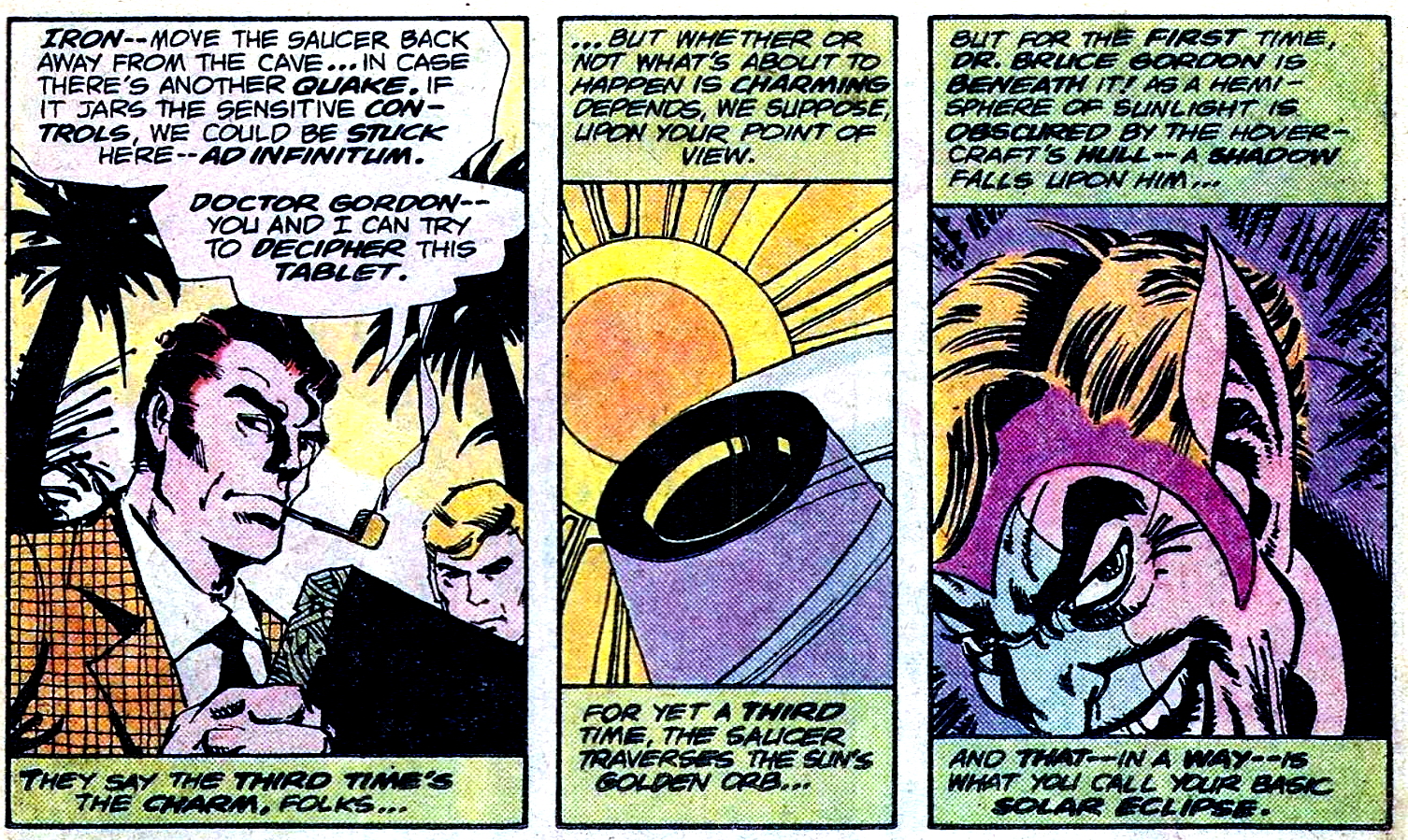
In the earliest “Eclipso” stories in House of Secrets, it took an actual, natural solar eclipse to bring forth Bruce Gordon’s evil alter ego. But that quickly proved too confining for the feature’s writer, Bob Haney, and it wasn’t long before all sorts of “artificial” eclipses were being contrived to help move the story’s plots along… a tradition that our storytellers proudly (?) continue here.
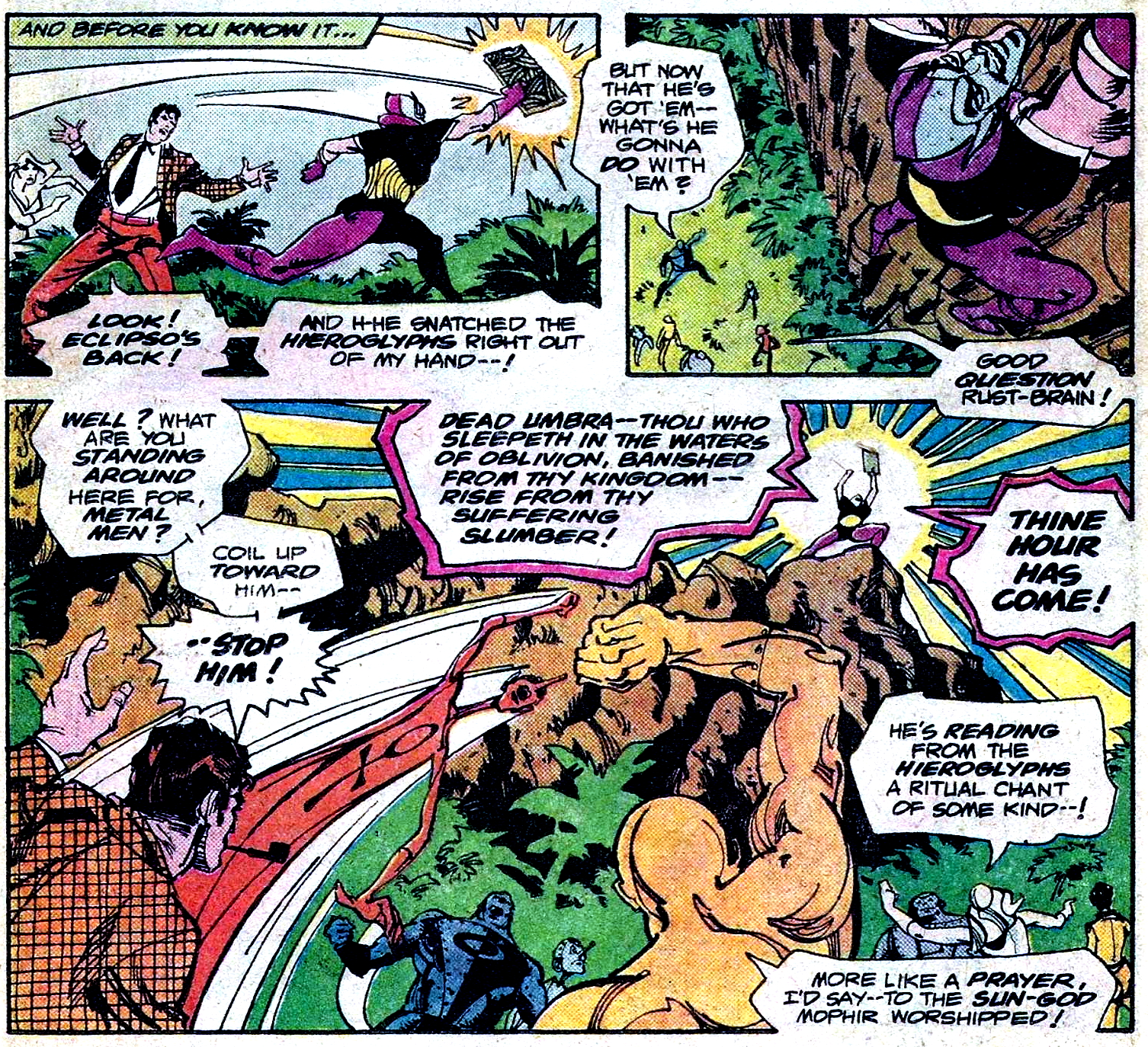


This final full-page splash panel is a knockout, allowing for Walt Simonson — who’s been doing a terrific job drawing other artists’ characters throughout the issue, no question — to finally show us what he can do when designing one of his own. But we’ll have to wait for the next issue to see Umbra revealed in full — as well as to see how well Simonson and Martin Pasko will stick the landing of this two-parter, once they’re out from under the last vestiges of Gerry Conway’s shadow. Your humble blogger hopes it won’t be considered too much of a spoiler to let you know that the two creators will meet that challenge admirably — though, of course, that’s just his opinion. You’ll have your own chance to weigh in come September, when we check out “”The Dark God Cometh!” in Metal Men #49. I hope to see you then.
Great looking art, storytelling, and panel/page design from Walt Simonson here! He seems to be exhibiting more Alex Toth influence in his work this time around; I suspect he was armed with a number of Toth’s old House of Secrets/Eclipso issues from the ’60s when executing this.
I well remember the Manhunter backups Walt did with writer Archie Goodwin in Detective Comics, and all the awards it won at the time, but Metal Men slipped under my radar.
If only the printing in this online version of MM with its solid blacks had appeared in 1976. Instead, the interiors were dark gray at best. I suspect it was a money saving move on DC’s part, as my comics collection from the years leading up to the end of 1974 had luscious, deep black in the inked areas of covers as well as interior art.
The copy I own has dark blacks. Not quite as deep black as these scans, but definitely black and not gray.
As I’ve said multiple times, I didn’t think much about art as a teenager. I really enjoyed Simonson’s work yet I suspect I’d have summed this up as Great Story without expressing that it was also Great Art. It was.
Completist note about the title:
In the 1971 *National Lampoon* parody of *MAD,* the table of contents promises a movie satire called “Who is Harvey Kurtzman and Why Is He Saying Those Terrible Things About Me?”
We don’t get it, but there is “Citizen Gaines.” One man’s “Rosebud” is another man’s “Satire.”
To use the language of *Eclipso* in the 1960s, “Good atoms, was this delightful reading, Bruce!”
“Great stars, yes, it was, Simon!”
“Mi casa de secretos es tu casa de secretos.”
Hi, Alan! Belated Happy Birthday, and belated Happy Fourth, everyone!
Oh, this was a FUN one! And it, along with Dr. Fate story of the previous year, made me sit up and take notice of Martin (dubbed “Pesky” in his letterhack days) Pasko as a writer. Kinda ironic since your previous write-up of JUSTICE LEAGUE OF AMERICA was making me think that perhaps he WASN’T that great shakes as a writer. Oh, how fickle we fans can be!
But this was a delight. I still remember laughing out loud at the Spanish Inquisition line. (Monty Python was BIG in my circle in high school, even before the HOLY GRAIL.) Re-reading it, I also saw Pasko try to give some shadings to the established, rather one-note characterizations of the Metal Men. Yes, Mercury is a hothead, but he also will jump right into a fight. Yes, Tin stutters, but he’s plucky enough to figure out how to stop Eclipso. Yes, Lead is slow but he also has a sense of humor.
Can’t say enough good things about Simonson’s art here, with its innovative design and its incorporation of sound effects into the art. (E.g. the “Zoooooooom” in the rocket trail.) I forget which issue, but I remember a villain escaping in some kind of water spout with the sound effect “Sluice” in the water, and one if the Metal Men saying “There he goes, slicing up the spout.”
As I recall, the Pasko/Simonson team didn’t last too long on this title, as Walt would later start doing THOR with Len Wein, Pasko would start writing SUPERMAN, and Conway would be back with a rather lame set of stories. The title petered out after that, but we had some good times before then!
Cheers!
There’s a classic sound effect in the previous (I think) issue where someone’s trying to chisel a Macguffin out of its plastic casing without triggering the guardian, Chemo. The visuals: taptaptaptaptap, then slightly louder taptap then TAPTAP then CRACK. Crack was very bad.
It was issue 47 and the four panels are:
TAPTAPTAP
BOPBOPBOPBOP; POUNDPOUNDPOUNDPOUNDPOUNDPOUNDPOUNDPOUND
BREAK.
Looking back, it’s brilliant, if unintended, foreshadowing of Walt’s DOOM subplot during his run on The Mighty Thor.
Gaspar Saladino man! His lettering approach fits in smoothly with Simonson’s. These pages are _designed_! Lots of energy.
The panel recap with little Green Arrow and Flash getting tossed around by Eclipso (as well as a little Bat-cape) is also awesome.
Don’t we have Staton in our future? Awesome artist but totally wrong for this book. Pasko was just there as far as young Steve was concerned but sites like this show that I should have held him in higher esteem because he did work like this.
Yes, Staton drew a run of Metal Men. I thought his slightly cartoony style was just right for the book. It just paled in comparison to the brilliant Simonson run.
Happy Hump Day to Everyone!
Y’know, every time I see the Metal Men, I immediately see either a fun and exciting animated series or a slightly offbeat, but absolutely entertaining movie. I say that because they have such a vivid visual dynamic. The colors and personalities of the robots balanced with a rather formal – even stiff – Will Magnus and those funky tweed jackets with that pipe (which isn’t a good idea!). Just find some wonderfully dorky DC villain – and I mean that in a complementary way! – and let everything unfold in a light-hearted manner.
That’s a meandering way of saying to add me to chorus of praise for this Metal Men #48! Although I’m not sure I was smart enough at the time to have appreciated this little gem of a comic, I certainly do now. Even then, Walt Simonson’s art had that unique energy that almost had it jumping off the page. Just what’s needed for a rather quirky series like this! Kudos as well to Pasko for his writing!
My thanks again to Alan for brightening up a busy Wednesday! In his honor, I raised my cup of coffee earlier to that poor librarian who met such a sad demise in this review.
It’s funny but when I read the first Showcase collected edition I realized Will almost never smokes a pipe in the stories, even though his headshot on the splash page shows him with one.
The Metal Men were indeed visually appealing, which made it baffling that this aspect of the book was so downplayed during the Sekowsky era. That was when the team adopted human guises and there was far less emphasis on outrageous but fun physical transformations, which kind of defeated the point of the characters. Pasko and Simonson took the book back into that visual dynamic, and it was all hugely entertaining.
It does fit with his WW — depowered and human — and when Sekowsky worked on Supergirl he also weakened her powers.
Simonson’s pencils are, of course, fabulous here. As we have come to expect.
It is easy to overlook how inspired this match-up was; Eclipso is such a disturbing, tragic character that the contrast with the essentially immortal Metal Men and their social hardships really works.
As much as I considered myself a Simonson completist who bough everything he drew, I didn’t get all of the Metal Men books. Dunno why. Maybe the local Jr. Food Mart just didn’t carry them. Regardless, fifty years isn’t too long to wait for a look at such a great book.
Simonson does a great job here, even though his work only really shines in larger panels and full-page spreads. At this point he hadn’t really begun to experiment with caligraphy yet, but you can see the beginnings of it. As for the story, it came together pretty well and held together all the way to that cliffhanger on the last page. Are there any limits to what Eclipso can do with that Black Diamond? Does it just generate darkness and beams of force or does it do more than that? I can’t remember ever seeing his skill set explained.
Loved the old movie references. I used to have a t-shirt that said, “Nobody ever expects the Spanish Inquistion,” that I wore until it fell apart. SIGH. Thanks for the run down, Alan. Take care, everyone!
That’s pretty much it. His eclipsed side uses it to create darkness, his “light” side can generate the force blasts. He also retains Bruce’s tech skills. Some stories would occasionally give him freak powers of some sort as they struggled to vary the formula.
I don’t know what this says about me, but I took my first date to “Monty Python & the Holy Grail.”
Was she willing to go out with you again? If not, you’re probably better off.
Simonson was credited as calligrapher on issue #46.
I thought the fact that the Metal Men were solid metal with their circuits being gaps in that metal was a clever touch.
It seemed like more of a Pasko or Simonson thing than a Conway thing.
Pasko was a solid writer; he and Alan Brennert did some fun work a few years later on the first season of Buck Rogers . . . .
I’ve never read this one, but it seems like it was a fun, exciting story, with some distinctive work by the up-and-coming Walter Simonson. That final splash page with Umbra rising from the depths is definitely striking & dramatic.
Eclipso was definitely a major threat to the Metal Men. but if he wanted to be really dangerous, he should have threatened them with… THE COMFY CHAIR! 🙂
I’m definitely in the minority here, sorry.
Simonson captured high energy/power like nobody since Kirby (and without plagiarizing him!), he had a great design sense and sound story-telling chops, but his style, post-Manhunter, is still a bit too exaggerated/cartoony for me (something that would lessen the impact of his Thor run, IMHO). I’d still agree that the last page reveal of the big bad Umbra is totally as good as it gets.
I’m not overwhelmed with the story here, either. Felt like a lot of unnecessary contrivances and page-filling just to get to Diablo Island. All the ‘clever’ pop culture-referential titles fell flat for me as well, and are especially dated with 50-years’ hindsight.
I never had any nostalgic fondness for Eclipso or his appearance or the “Hero and Villain in One Man” concept behind him – I think Bill the Shat did it better in ST TOS’s “The Enemy Within”. Also seems odd to me that the most powerful worshipper of an evil SUN-god would have a weakness like … bright light. Really? That vulnerability also undermines any real sense of threat, if he can be defeated by anyone with a torch, a flare-gun, a light-bulb, etc.
Impressed that Will Magnus managed to keep his pipe in his mouth throughout most of the story, and could talk without removing it. Reminded me of Steranko drawing Steve Rogers with a pipe in the opening scene of CA #110. Not something you saw a lot of, even back then.
I believe Walt Simonson kept the pipe in Will Magnus’ mouth as a tribute to (or poke at) Metal Men creator Robert Kanigher.
This is a Joe Kubert drawing of Kanigher:
https://static.tvtropes.org/pmwiki/pub/images/kanigher.jpg
and here is a photo:
https://cafans.b-cdn.net/images/Category_37101/subcat_255870/LCosJuFa_2712252119481gpaiadd.jpeg
Thanks for the info, always nice to learn something new. Looking at it now, it seems like Will Magnus was always drawn to quite closely resemble Kanigher. Do we know if Kanigher had a thing for tweed jackets as well as pipes?
This is my first exposure to this comic. I’d gotten a few issues of Metal Men years earlier, so I was at least familiar with them. Anyhow, this was a decent enough story for the opening chapter. Yeah, some aspects are rather silly, but not all that atypical circa 1976, for either Marvel or DC. Did like Simonson’s art, which was in his own unique style. To my perception, during his first run on Thor, solely as artist, his own style seemed rather muted and more an echo of John Buscema’s style. Between then and his 2nd run on Thor, the only other sampling of his artwork I saw was the X-Men/Teen Titans special, which was definitely in his style, albeit with a few clear homages to Kirby. That at least prepared me for his stunning return to Thor as artist & writer, which I came to feel made for a return to greatness to the mag not seen since the height of the Lee/Kirby run circa ’65-’69. Back to the Metal Men mag, even with the goofy bits it was entertaining enough.
BTW, I was only turned on to Monty Python via an airing of Monty Python & the Holy Grail in the summer of 1975 after I got my own little b&w tv set an just happened to come across it while flipping through the channels. I forget exactly what scene I came in at but I whatever it was kept me from going to another channel and I was enthralled throughout the rest of the film. A bit later, as the tv series began being aired on PBS, I watched those too and loved their style of comedy. Saw Idle and Cleese in person during their tour about 10 years ago (Cleese joked it was his “alimony tour”).
I started watching on PBS before the movie was a thing. Mind totally blown. By the time I got to college everyone could quote from the series, and the movie.
Hi Alan,
I finally got around to visiting your blog and saw your post about Metal Men #49, which linked to this post. Metal Men is one of my favorite comics and back in the eighties I attempted to collect a complete run of the title. Unfortunately, I am missing some issues (including #47, so it would have been great for me if you had posted about that one). Since I have issues #48 and #49, I read them before reading your posts. When I read this post, I realized that you are posted almost the complete story, but I was surprised that you left out parts of 3 pages. I would be interested to learn why you did so.
Your scans look very good, with the colors looking more vivid, although some are not the same as in my copy (I have the same issue when I make scans). May I ask what type of scanner you use?
Regarding giving Robert Kanigher credit for creating the characters in the title (and which he is also credited for in issues #46, #49-56. I don’t own issue #47, but I would assume he received credit. Issue #50 is mostly an edited [and, in my opinion, poorly recolored] reprint of issue #6, so Kanigher receives writer/creator credit). However, on the last page of issue #45 the story is dedicated to Kanigher, Ross Andru and Mike Espsito for creating the Metal Men.
I didn’t recognize the reference the title of the story made, but I did get the other two references. You mention hearing the Spanish Inquisition skit on one of Monty Python’s albums; have you seen the Flying Circus skit? And speaking of their record albums, have you ever played The Monty Python Matching Tie and Handkerchief record? The second side has two grooves, so you get different skits depending on which groove the needle drops into.
I have read several Eclipso stories, probably including Eclipso: The Darkness Within, since it was a company-wide crossover when I was actively buying new comics. So, I knew about him, but I best remember the version in the Stargirl TV series.
I also think the final full-page panel looks fantastic. I become a Walt Simonson fan with his run on Thor. I don’t know when I bought these issues of Metal Men he was the artist on, but at the time I originally read them I didn’t notice. So, it’s nice to reread these issues and be able to appreciate his artwork on them.
Hi, Sean, and welcome to the blog! In answer to your questions:
I’m pretty liberal with how much of a given comics story I include in these posts (maybe too liberal?), mostly because I think the original material is generally a lot more entertaining than my synopses. That said, I’m uncomfortable with incorporating a full, complete story for reasons both legal and ethical.
Virtually all of my scans of original comics (as opposed to modern reprints/digital reproductions) have been, ahem, found on the Internet. Quite often (though not always) they go through some tweaking in my computer’s graphics editing program for color correction, improved contrast, and so on. (I use Graphic Converter, for what that’s worth.)
And yes, I did eventually see the TV version of the Spanish Inquisition sketch, albeit several years after listening to the album edition. And I am the proud owner of a Matching Tie and Handkerchief vinyl LP, and have been duly initiated into the mysteries of side 2’s double groove. 🙂
Thank’s for your reply to my questions. I understand about how much of a comics you include scans of.
I have generally only scanned covers of books and comics as I have many that aren’t available online. I use PaintShop Pro myself, which is generally pretty good.
When I first listened to my Matching Tie and Handkerchief vinyl LP I was a bit confused why side 2 was have as long as side 1. I thought I might have zoned out and mossed some sjits, so I immediately played it again and was surprised to get hear completely different skits. I always felt I was lucky that happened.