
Today’s post may be the most self-indulgent one I’ve ever written. I mean, I could be wrong; but something tells me that not many of this blog’s regular readers have been waiting with bated breath for me to follow through on the promise I made in this space, one year ago this month, to post about the Warriors Three issue of Marvel Spotlight when its 50th anniversary arrived in July, 2026. And I get it; these are indisputably “niche” characters, with a very, shall we say, select fanbase. So, if you’re thinking about skipping this one, I won’t blame you. Honestly. (Though you should be sure and check back in on Saturday, when we’ll be discussing the first appearance of Phoenix in X-Men #101, because I know you wouldn’t want to miss that.)
Still here? Great! Happy to have you. And now, on to business:
As I’ve written here many times before, the Mighty Thor is my very favorite Marvel hero — a status he’s held for more than five and a half decades (and, at this late juncture, seems likely to retain). Over virtually all of that time, my favorite members of his substantial and colorful supporting cast have been the trio of Asgardian stalwarts who finally got a shot at being headliners in the comic we’ll be looking at today: Fandral the Dashing, Hogun the Grim, and Volstagg the Voluminous.

The Warriors Three made their first cover appearance, as well as their modern-continuity debut, in Thor Annual #2 (Sep., 1966). Art by Jack Kirby, Vince Colletta, and others.
All three of these characters had first turned up in Journey into Mystery #119 (Aug., 1965), where they were introduced as shipmates of the God of Thunder in a multi-part quest storyline in the “Tales of Asgard” backup feature. While not originally presented as a tight-knit trio, their creators Stan Lee and Jack Kirby soon began to handle them as such, and they quickly became fixtures in “Tales”, even after the saga they’d initially been created for ended. When the “Tales of Asgard” feature itself finally reached the end of the road in Thor #145 (Oct., 1967), Lee and Kirby evidently couldn’t bear to leave these guys behind; having already brought them into the Son of Odin’s present-day continuity with Thor Annual #2 (Sep., 1966), the two creators didn’t take long in making them a regular part of the monthly Thor series’ lead feature, with their first such appearance coming in issue #155 (Aug., 1968); by that time, they’d already been further integrated into the Marvel Universe via a guest appearance with the Hulk (Tales to Astonish #101 [Mar., 1968] and Incredible Hulk #102 [Apr., 1968]).

Panel from Silver Surfer $4 (Feb., 1969). Text by Stan Lee; art by John and Sal Buscema.
Given that I didn’t start reading Marvel Comics on a regular basis until late 1967-early 1968, most of this had gone down before my time. While I’d gotten a single brief glimpse of the Warriors Three in my own first issue of Thor, #158, my real introduction to the characters came in another title entirely — the classic Silver Surfer #4 (Feb., 1969). My younger self took to Fandral, Hogun, and Volstagg immediately; and I continued to thoroughly enjoy them whenever they showed up in one of the issues of Thor I occasionally purchased. By the time I finally committed to buying Thor every month (I probably wouldn’t have used the word “collecting” back in 1970 to describe my comics purchasing habits, but that’s essentially what it was), the Warriors Three were appearing in virtually every issue — and that was just fine by me.
Of course, it took me a few years to catch on to the fact that these characters were not only not “authentic” Norse mythological figures, but were, to a large degree, knockoffs of character types drawn from other sources entirely. Fandral was a take on the swashbuckling persona of Hollywood film star Errol Flynn, while Volstagg — especially in his earliest appearances — was based on William Shakespeare’s great dramatic creation, Sir John Falstaff. Meanwhile, Hogun had a clear “Genghis Khan” kind of vibe. (Although the only inspiration for the Grim one that Stan Lee ever owned up to, to the best of my knowledge, was the American movie actor Charles Bronson. If you say so, Stan.) Still, even if the Warriors Three weren’t what you’d call original, that didn’t prevent them from being lots of fun. And over my first few years of collecting Thor, I came to take them for granted; they were an essential part of the Thunder God’s comic-book milieu, and as such they’d surely always be around.

The boys are back! From Thor #240 (Oct., 1975). Text by Bill Mantlo; art by Sal Buscema and Klaus Janson.
Which made it a real bummer when, following Thor #218 (Dec., 1973), the series’ regular writer at that time, Gerry Conway, either got tired of the trio or just plain forgot about them; in any event, they never showed up again through the remainder of his run, which ended with #238. By that time, my younger self might well have become resigned to the idea that Fandral, Hogun, and Volstagg would never grace the pages of Thor again, as silly as that notion seems to me now. So it came as a delightful surprise when, in the second post-Conway issue of Thor, plotter Roy Thomas (with the aid of scripter Bill Mantlo and artists Sal Buscema and Klaus Janson) brought them back; indeed, I was so delighted by this development that I did something I hardly ever did (then or later), and dashed off a letter of comment to the Marvel offices, expressing my strong approval of same, and expressing my hopes that this wasn’t just a cruel tease. And, lo and behold, Marvel actually printed it in issue #244 — along with a couple of additional missives by other fans championing these long-unseen characters — as a lead-in to announcing the upcoming appearance in Marvel Spotlight of “a super-saga starring Fandral, Hogun, and Volstagg entitled WARRIORS THREE”.
This news was music to your humble blogger’s ears, naturally, but one still had to wonder — given that Marvel had very recently been fine with keeping the Warriors Three on ice for a whole twenty-two months (practically a lifetime as far as my eighteen-year-old self was concerned), what had suddenly made the House of Ideas spark to the idea of giving my boys a shot at their very own feature? While I have no hard evidence for this, I feel fairly certain that at least part of the impetus was the box-office success of a couple of recent movies — 1973’s The Three Musketeers, and its immediate follow-up, The Four Musketeers (1974).

Poster for The Three Musketeers (1973). Artist unknown.
It’s true that, to the best of my knowledge, neither Stan Lee nor Jack Kirby (nor anyone else at Marvel) ever owned up to Alexandre Dumas’ classic crew of adventurers having had a direct influence on the Warriors Three. And perhaps there hadn’t been any such when Stan and Jack first brought Errol Flynn, Charles Bronson, and John Falstaff on board the Odinship, back in Journey into Mystery #119. Nevertheless, it seems logical to assume that there must have eventually been some influence exerted on Lee and Kirby (and their successors) by Dumas’ 1844 novel and its myriad adaptations — and that such influence started fairly early on. Setting aside the simple math of “three rollicking fighting-men”, the personalities of the Musketeers map onto the Warriors Three pretty neatly (for the record: Aramis=Fandral; Athos=Hogun; Porthos=Volstagg), with Thor’s role being analogous to that of Dumas’ focal character, D’Artagnan. And if we limit ourselves purely to the cultural context of the mid-1970s* — well, seeing as how Marvel brazenly lifted one of Marvel Spotlight #30’s two cover blurbs (“It’s one for all — and all for fun!!”) directly from one of the 1973 Three Musketeers movie’s marketing posters (see right), I believe I may safely rest my case.
(Incidentally, as long as we’re already talking about our comic’s cover, this seems as good a time as any to note that while some sources indicate it was produced by the same art team that illustrated the story within — i.e., John Buscema and Joe Sinnott — at least one asserts that the pencils for the piece were contributed by Rich Buckler. Honestly, it looks more like Buckler’s stuff than Buscema’s to me, but what do I know?)
Anyway, we’ve probably had enough preamble to our main event at this point — so what say we go ahead and turn past the cover to the story’s opening splash page:

We’ve already mentioned our story’s art team of Buscema and Sinnott; joining them as the book’s writer is Len Wein. Wein and Buscema were also working on the main Thor series at the time, of course; meanwhile, Sinnott had only just recently left that assignment, having turned his inkwell and quill over to Tony DeZuñiga with Thor #248 (Jun., 1976).
Speaking of recent doings in Thor, those of you who read last month’s Thor #250 post may recall that, at the end of that issue, all three of our principals — as well as Thor himself, and most of the rest of his supporting cast, besides — were in Asgard, celebrating the Golden Realm’s delivery from the bane of Mangog. So what are Fandral, Hogun, and Volstagg doing back on Earth already? Hey, no worries on that score — Mr. Wein is about to let us know precisely where this story fits into the main title’s ongoing continuity…

The intrepid cabbie who’s made the fateful decision to respond to Fandral’s hail begins to have second thoughts from the moment his passengers crowd into the back seat…

In later years, John Buscema would assert that he generally disliked drawing modern-day scenes, much preferring to delineate such exotic locations as were provided by Marvel’s Conan comics — and by Thor “when it was in Asgard” (Alter Ego #15 [Jun., 2002], p. 11). One suspects that he was therefore less than thrilled by all the mundane automobiles, buildings, fashions, etc., he was required to render for this story — though, of course, he (and Sinnott) delivered a thoroughly professional product, nonetheless.


Unfortunately, as Mary Miller reaches for Fandral’s outstretched hand, her foot slips — and though he still manages to grab onto her, both go tumbling off the ledge, to their apparent doom…


Leaving Mary to wait in the taxi, while cabbie Myron J. Maxwell stands guard, our heroes proceed to the jewelry exchange’s entrance…

The Warriors Three may be dismissive of this “ragged one” — but when he assures them he can get them through the establishment’s stout wooden door without alerting the thieves within, they allow him to have a go…


However, once all the miscreants have been unmasked, Arnold is not among them. At this point, our heroes’ new associate reveals that he saw “that skinny kid with the glasses” take off earlier…

Upon arriving at the waterfront, the Warriors Three opt to let Ragland T. Peppermill be their guide as they commence their search…


Naturally, given that this isn’t merely a Comics Code-approved book, but a superhero-adjacent one as well, the brilliant swordsman Fandral doesn’t get to do as much slicing and dicing as Conan might, given the same circumstances; rather, it’s all “flat of the blade” action, just as was previewed on the cover.


Ah, the lovable drunken bum. Still an acceptable comedic trope in 1976.
In a few moments, our heroes have finished mopping the floor at McGinty’s with their adversaries, and are ready to move on to the next location wherein they might seek news of the missing Arnold. Just how many taverns are there in this area? Around eighteen or so, asserts Ragland. “Nay!” objects Volstagg. “Must we repeat this madness eighteen times again ere we finally locate fair Mary’s betrothed?”


Several decades later, Len Wein remembered this story with what some might seen as an inordinate degree of fondness; in Back Issue #71 (Apr., 2014), he avowed that, “In many ways, Warriors Three’s ‘A Night on the Town’ remains one of my favorite stories ever,” going on to say that the tale “was just such a joy to write.” Those are some pretty big feelings to lavish on a done-in-one comic book yarn with such small stakes — but one loves what one loves, and who am I to argue with our story’s author? I enjoyed Marvel Spotlight #30 thoroughly when it first came out — even if (like John Buscema) I’d really have preferred an Asgardian adventure to this New York City-set number — and I still get a kick out of it. Not to mention that I did my level best to support the idea of an ongoing Warriors Three title by dropping an extra 30 cents to acquire a second copy.

Cover to Marvel Fanfare #34 (Sep., 1987). Art by Charles Vess.
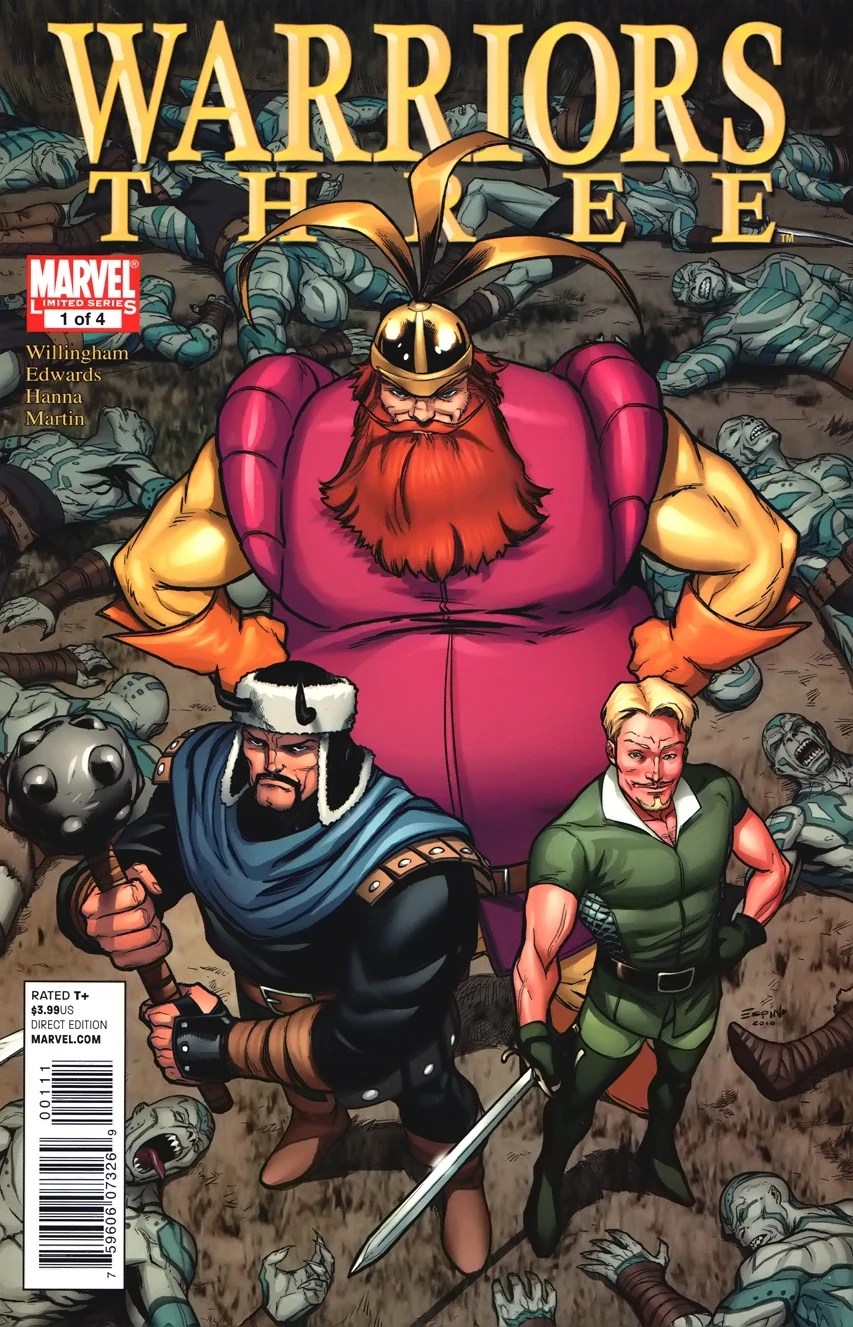
Cover to Warriors Three #1 (Jan., 2011). Art by Salva Epsin.
Evidently, there weren’t enough other hardcore W3 fans out there who did the same, as Fandral, Hogun, and Volstagg wouldn’t be given another shot as headliners… at least, not until 1987-88, when they took over the anthology title Marvel Fanfare for a four-issue stint. With a humorous script by Alan Zelenetz and absolutely lovely art by Charles Vess, this Asgardian romp was right up your humble blogger’s alley. Alas, this one didn’t spawn a continuing series, either — and afterwards, there would be another, even longer wait (until 2010-11, this time) for the guys to get another go at topping the marquee. This time, they actually got title billing — although Warriors Three turned out to be a four-issue miniseries, rather than an ongoing. Written by Bill Willingham and illustrated by Neil Edwards, Scott Hanna and others, the story found the trio mixed up with some agents of A.I.M. (Advanced Idea Mechanics) as well as more traditionally mythological figures as Fenris Wolf; while it didn’t work quite as well for me as Zelenetz and Vess’ effort had, I was still happy to support it, and would have sprung for more installments, given the opportunity.
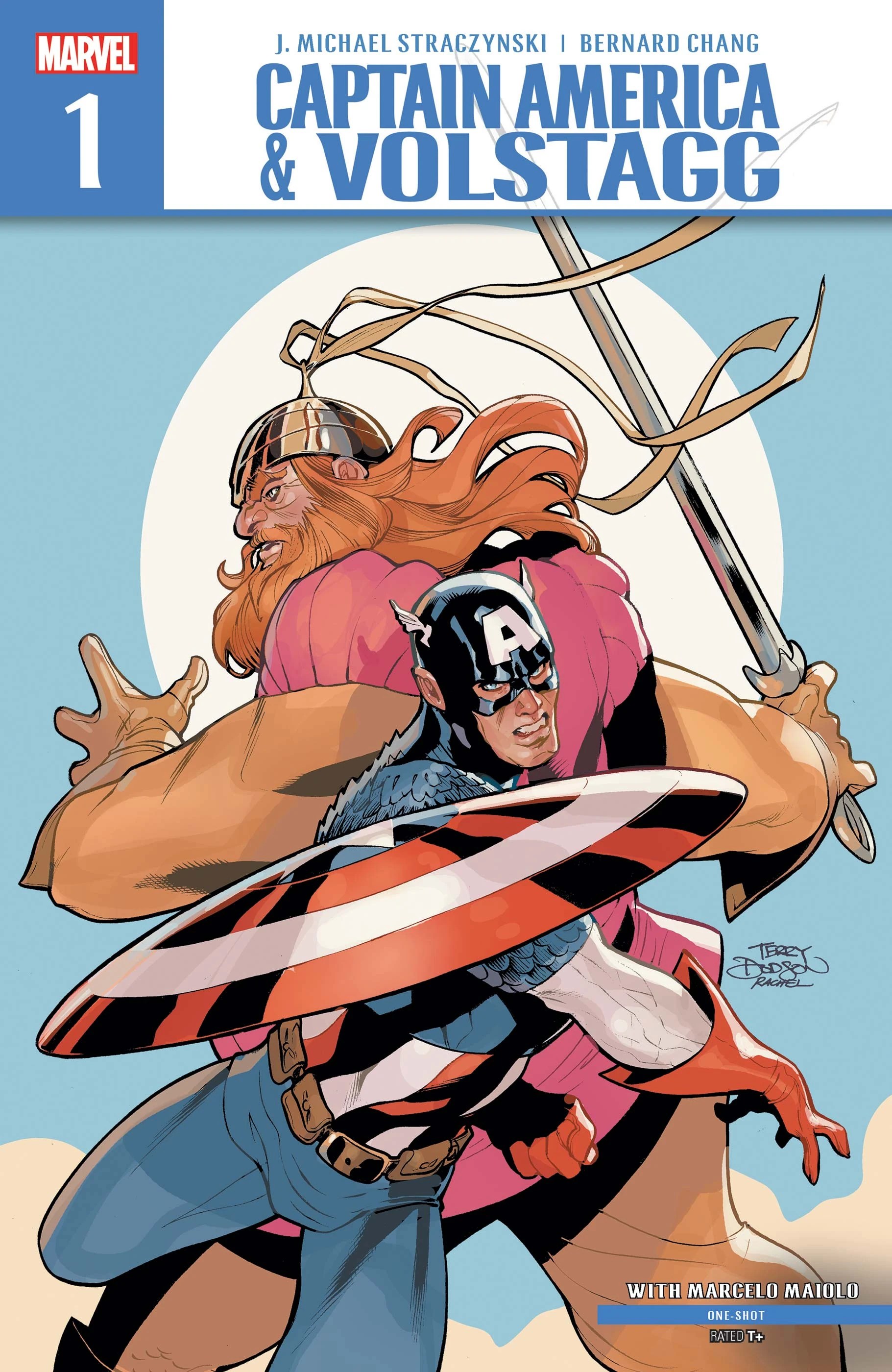
Cover to Captain America & Volstagg #1 (Apr., 2025). Art by Terry and Rachel Dodson.
Before, between, and after these outings, one or more members of our valiant band have also headlined the occasional backup story in one Marvel comic or another; Volstagg even got to co-star in a one-shot with Captain America, just a little over a year ago (see right). But their main gig has continued to be as supporting characters for Thor in the Son of Odin’s own title, which is probably as it should be. Though there have been times when they haven’t shown up for a while (shades of 1973-75), they always return eventually.

From The Mighty Thor (2017 series) #17 (May, 2017). Text by Jason Aaron; art by Russell Dauterman.
Which isn’t to say that there haven’t been any changes over the decades. In 2017, during a period of time when Volstagg was too busy with his duties as a Senator in the Congress of Worlds to fight alongside his friends, writer Jason Aaron brought another longtime member of Thor’s supporting cast — the warrior woman Hildegarde, a creation of writer Gerry Conway and artist John Buscema first introduced in Thor #195 (Jan., 1972) — into the previously all-male ensemble. A couple of years later, Volstagg returned, and Hildegarde stayed — and the group are now known as the Warriors Four. Does that adjustment alter their earlier “Three Musketeers” dynamic? Maybe, but it seems to be working well so far. After all — The Four Musketeers was a good movie, too.

Cover to DC Special #22 (Jun.-Jul., 1976). Art by Luis Dominguez.
*Even as Marvel was tapping the recent popularity of the Three Musketeers indirectly via the Warriors Three, its rival DC Comics was going right to the original source. Beginning in March, 1976, the publisher released four consecutive issues of DC Special headlining the literary swashbucklers in all-new adventures, with backup support provided by Robin Hood and the Viking Prince (who appeared in reprinted stories drawn from DC’s archives). For anybody who might be wondering, your humble blogger bought and enjoyed all of ’em.
Hi Alan,
I had a suspicion you’d be writing this one up! I found it rather silly but oddly enjoyable on its own terms. The Buscema-Sinnott art helped, of course. It seemed that Len Wein was going for the kind of thing Lee and Kirby would do a lot, having the gods interact with mere mortals. Remember Thor at the soda shop? (Though truth to tell, those soda shops were probably a thing of the past for teens in the mid-to late 1960s, whenever it appeared. I always suspected that scene was Stan and Jack indulging their own nostalgia.)
I guess my one issue with these guys was how one-note they were – as were several Asgardians. Balder at least had his tortured love for Karnilla. But all we really know about the rest is that Falst – er, Voltagg is big and blustering, Fandral is dashing, and Hogun is grim. That’s it. (Although – I seem to recall a panel – by Conway? – that hinted at a woman in Hogun’s life. As far as I know, that was never followed up. Anyone else remember that?) There’s a sitcom superficiality to this story that just didn’t do it for me.
But hey, if you dug it, then Len & Co. did their job! And yes, goofy fun is what we need every now and then.
Cheers, everyone!
“Although – I seem to recall a panel – by Conway? – that hinted at a woman in Hogun’s life.”
Bill, I think you’re recalling a scene from Thor #195 where Hogun indicated his romantic interest in a woman to Thor and co.; it was indeed written by Conway, as was an earlier scene elsewhere in the same issue where Hildegarde told Sif *she* was sweet on one of Thor’s three pals. I always assumed they were talking about each other — but, as you also correctly remembered, it was never followed up on by Conway (which was not at all atypical of his Thor run, alas).
If you’d like to relive the moment, I reviewed that issue here: https://50yearoldcomics.com/2021/10/06/thor-195-january-1972/
Hah! I had it right! Who says my mind is going just because I’m 67? (Or, as my middle school students insist on saying, “6-7!!!!!”) I can remember dialogue from 50-plus-year-old comics like a champ! Just don’t ask me when my line of credit payment is due…
At 64, I know the feeling, Bill, all too well!
Alan, you can be as self-indulgent as you like when the reviews are this informative and entertaining.
Like I commented in your year-ago post, I’m pretty much convinced that the cover is by Buckler not Buscema.
Also think that Stan Lee’s recollection of creating the Warriors Three himself, and who he based them on, is at least open to question, especially when he was in conversation with the (quite probably) not very impartial Roy Thomas. Wasn’t Jack Kirby thought to be plotting his own stories by mid-1965, and introducing characters like the Silver Surfer without Stan’s prior knowledge? And wasn’t Kirby more of a noted cinephile, and more likely to have been influenced by Charles Bronson, Errol Flynn and/or the Douglas Fairbanks or Gene Kelly versions of the Three Musketeers? Not even sure about Bronson being a factor – there is a 1961 film titled ‘The Mongols’ featuring Jack Palance with very Hogun-style ’tache and hair, and Kirby has been noted as using Palance as a basis for other characters (like maybe Darkseid).
I’d agree with you, Alan, that I was fond of the Warriors Three when I first encountered them (but I lack your encyclopaedic knowledge and don’t remember when that was). Less fond as time went on, for exactly the reason Bill notes above. One-note is almost an understatement. Dashing. Grim. Voluminous. Repeat. There has been some half-hearted attempts to inject some personality, like the suggestion of romance for Hogun that’s been noted, or Simonson’s introduction of Volstagg’s wife and many children, but at least until I stopped reading most comics these guys were still basically one-dimensional.
I wish that the Warriors Three had been given a better ‘solo’ outing than this one. It’s fairly dull and by-the-book, the action scenes were formulaic and the comedy elements weren’t terribly funny. The Groucho Marx-styled names with middle initials, ‘Myron J. Maxwell’ and ‘Ragland T. Peppermill’ were just grating.
I wasn’t particularly a Warriors Three fan, but this book was fun — I bought it off the stands too. I can believe Wein loved it; it’s different from the usual superhero adventure and not something you could do with most characters. Even the average sword-and-sorcery hero, and Marvel had a few of them, wouldn’t be having this much fun. Ditto most street level characters.
I particularly liked Fandral rushing up to help Mary in the one scene.
It’s a fair point that they were one-note, particularly Volstagg; Simonson did a good job making him more than a buffoon. As another possible influence, he reminds me a lot of Andy Devine’s tough-talking braggart sidekick to John Hall’s Ali Baba in “Ali Baba and the Forty Thieves”
In the 1980s Southern Knights indie series, creator Henry Vogel gave his swordswoman Connie a psionic sword — slice it through someone’s arm, it goes temporarily numb but no permanent damage — because he was tired of sword-wielding heroes who don’t get to stab anyone.
Self-indulgent? I say thee nay, friend Alan! This was a joy to read.
Back in the day, I enjoyed this issue even more than the concurrent X-Men goings-on. Exquisitely drawn and wittily scripted lighthearted, frothy fun. I was certainly up for all that at age 14. And still am!
I enjoyed the try-out books from both Marvel and DC in the 70s. I liked the idea of new and obscure characters getting a chance to shine, and there were some absolute gems – including the very next issue of Spotlight.
Also appreciated the mention of the DC Special Three Musketeers feature. I have those, and they boast some lovely art by George Moliterni and Lee Elias.
Fun recap of an issue I’ve never read! I confess to an inordinate fondness for Marvel Premiere and Marvel Spotlight, because the reader never knew what cool concept (or, more likely, inventory story) would show up next. Tigra, Man-Wolf, Paladin, Alice Cooper?! Sign me up.
And the DC Special issues with the “3” Musketeers and Robin Hood were a nice repackaging of older material, even if the insides weren’t quite as exciting as the covers promised.
Actually, the Musketeers strips in those DC Specials were new material. The rest of the package was reprint.
If you can’t indulge your love of a comic, in your own blog, especially one which very well might have been created as a result of a printed letter then what are we doing here at all?
According to the Hallowed Ranks Of Marveldom you remain a Quite Nuff Sayer.
Excelsior!
This is the comic that changed my life!
Or so I thought.
Yes, I agree with Bill and others that the Warriors Three are not the most complex characters Marvel ever created. Ditto in regard to professional if not incredibly inspired art by John Buscema and Joe Sinnott.
But what had distinguished this book for me was a line from Fandral about not wasting time watching some fictional adventures on TV when the three of them could be carving adventures of their own. That line has stuck with me ever since. To that point that I cannot binge watch anything. I consciously limit myself to how much time I spend in front of the television. Not that I’m saving lovely women from attempting suicide or engaging in bar fights. But even if it’s as mundane cleaning the garage or tinkering with my two blogs, I feel that I’m doing something productive in lieu of being a coach potato.
And having read through Marvel Spotlight #30 after reading Alan’s delightful review – I cannot find that panel! Obviously, it must have been in an issue of Thor prior to these three getting shore leave in NYC. Either that or that line was a figment of my imagination and I’ve hours upon hours of TV to catch up on!
Either way, Alan, feel free to indulge at our expenses any time you want!
I have the same problem with binge-watching. My maximum viewing time for just about any show—no matter how compelling—is two episodes (maybe three if it’s snowy outside).
Beyond that, I start to feel guilty about the time I’m wasting that could be better spent doing just about anything else. Like responding to people on Alan’s blog! 😉
You definitely understand what I go through! 🙂
I can’t binge watch tv but I could sit and watch films on DVD or streaming for four or five hours without a qualm.
My wife can do that. And me? I grumbled buying tix to Christopher Nolan’s Odyssey this weekend because it’s 3 hours long. No hope for me. 😉
Rick, I believe that you’re recalling a scene from Thor #246. The line is in the first panel on page 2, and it goes like this: “How canst thou waste hours on end, observing the tiring antics of the tiny beings who do dwell within yon box — when rather thou couldst be carving new legends of thine own?”
Funny thing about memory, though… Like you, I remembered this line as being spoken by Fandral. But it’s actually spoken *to* Fandral — by Volstagg! Believe it or not!
Volstagg to Fandral? Wow! I owe a core principle of my life to someone who used to be treated as comedy relief? Still, a good line is a good line. Rest assured, I’ve now updated my mental coding complete with the Old English. Can’t wait to see my wife’s reaction when I utter those words to her the next time she’s binge watching some show!
Owe you one, Alan!
Nice write-up on this one-off story that I also purchased way back when. Thor’s Asgardian supporting cast was for me, what made his title worth purchasing. When Thor’s comic focused more on Midgard and eschewed his fellow Asgardians, I tended to lose interest. So. while my passion for superheroines drew me more toward The Lady Sif, Karnilla, Hela, and Hildegarde (and man, was I ever stoked to see her pop up again — talk about decades of being benched) Balder and the Warriors Three were also a lot of fun, and I appreciate any effort to give them the spotlight, although I too would have preferred an adventure of more… impact.
By the way, do you have a favorite amongst the three, or do you enjoy them most as a collective? Hogun was always my favorite, and I appreciated when they tried to give him a bit more personality.
“When Thor’s comic focused more on Midgard and eschewed his fellow Asgardians, I tended to lose interest.” You may have been a minority. I remember a late 1960s lettercol that said if Namor or Thor spent too much time away from the mortal/surface world, sales dipped.
Yes, I’ve read that too. Not me. I loved the stories in Asgard or outer space.
Same here. 🙂
I’ve always been slightly partial to Fandral, Michael C.. Just a sucker for that “Errol Flynn as Robin Hood” persona, I reckon.
Yep. The Warrior’s Three are stereotypical, two-dimensional and also a heck of a lot of fun. I was never the Thor fan you were, Alan–all the thee’s and thou’s on top of Stan’s already purple prose made my teeth ache–but I would have enjoyed this when it came out in ’76, if I’d seen it. One of the things I really appreciate here was Wein not turning Volstagg’s fighting style into outright cowardice. Why would Fandral and Hogun hang out with Volstagg if he was an out-and-out coward? Sure, the Big Guy was more of a lover (of food and wine) than a fighter, but he was there for his friends when it counted, and that’s the important thing. Other writers in the past, have made too much of Volstagg’s supposed cowardice, when it makes much more sense to look at it as “bravery from another point of view.”
Hogun, though, what the heck do you do with a guy whose only character trait is being Grim? Sure, it’s a stereotype, just like “dashing” and “voluminous,” but what do you do with it? Marvel didn’t even know what to do with him in the movies! I understand the comparison to Charles Bronson, though. Hogan has the same kind of “I’ve been hit in the face too often by a chair” look that Bronson has and it makes sense. I know! We can team him up with the Brothers Grimm and call him a long-lost relative or something and send them out to right wrongs in Fairy Tale Land. No, fine, I’m open to better ideas.
The fear always seemed to be that W3 would be lacking somehow without their big Asgardian straight man, Thor. Odinson always provided grounding for his friends that could be lacking when he wasn’t around, yet here, trapped in New York and trying to get it to make sense according to Asgardian rules of honor and civility, Thor’s presence would have been superfluous and distracting. Have fun looking for Firelord, Thunder God! We’re having a Boys Night Out in Midgard!”
Thanks, Alan, for a fine intro to a comic I don’t think I ever knew existed. Maybe if I’d plunked my quarter down as well, we could all be living in an alternate future celebrating Warriors Three #100, the giant double-bag extravaganza in which Hogun finally cracks a smile. Hey, I can dream…
I didn’t mention it in my comment, but Walt Simonson did stellar work in fleshing out not only Volstagg, but Hogan. He did by having Volstagg’s daughter, Hildy, have a crush on him. As she was a child, this was certainly innocent. But with little touches like him bringing her a NYC baseball cap after the Surtur War, his stone-faced demeanor cracked just enough. The only W3 that he didn’t really do much with was Fandrall.
Simonson’s portrayal of Volstagg as an older guy with some wisdom was nicely executed.
Lee & Kirby hinted at that in their stories.
Volstagg was a great warrior, grown “older and fatter” (as Richard Boone described his Hec Ramsey character, versus his hero. Paladino).
Their were probably interesting character bits to be had in why these very different men were so close.
Did Hogan realize that he needed the balance represented by hanging out with the joyous Fandral and the family man volstagg?
That’s one aspect of Simonson’s run I loved – how he fleshed out the personalities of several Asgardian characters who had been around for 20 or so years, even making Skurge, the Executioner, shine prior to his famed last stand.
It was a fun one off but I never would have followed an ongoing. They had supporting characters stamped on them thoroughly.
It’s kinda Ok as one-off but clearly wouldn’t have been sustainble in their own title for very long. Other than a gang of semi competent Earthly thugs to tackle, you couldn’t really see them taking on most seriously evil villains. Also for Gods, I don’t think they really had any superpower (which worked Ok in the limited range of the story). Not that I wasn’t keen on the extended family of Asgardian characters for Thor to bounce off from . They were great as supporting characters up to a point.
The Gods among Men mismatch does seem like the sort of off-centre Marvel spin off that TV series have ran with for better or worse in past years though. With the right blend of numor and action it might work, until the second season eventually gets cancelled.
Obvously the Falstaffian character was well established before, but from a cinematic influence (given the other two had possible links) I was very much reminded of Orson Welles’ role in Chimes At Midnight whereby he uses his increasing girth (as he did in Touch of Evil) but Kirby created the character around a year before the Welles film was released so doubt it was a direct influence.
Was Arnold based on Roy Thomas or was he just a random, blond guy with glasses?
I wondered about that too.
Robin Hood, Genghis Khan and John Falstaff walk into a bar…
*Ahem!* Alan, no need to apologize for a “self-indulgent” blog post. I mean, one of my favorite Marvel Comics characters is Mantis, so I totally get how someone can have a huge amount of enthusiasm for what others might regard as fringe characters.
I’ve never been a huge fan of Thor. A couple of years after I first started reading comics regularly, when I was in high school in the early 1990s, I did start following the Tom DeFalco & Ron Frenz run on Thor, and that briefly ignited my interest in the character. I picked up a bunch of back issues of the series at a comic con in NYC, including several from the Walter Simonson run, as well as, coincidentally, Thor #244, although I’m sorry to say that I don’t remember reading your missive in the lettercol. But after DeFalco & Frenz departed Thor, I followed them over to the Thunderstrike spin-off, and I dropped the main Thor title. Oh well.
I’ve always thought the Warriors Three were a bit silly myself, but I can totally understand why you love them. I guess they do make good foils for Thor. And they have a nice mix of personalities.
A few years back, I did pick up the Tales of Asgard collected edition that reprinted the original Stan Lee & Jack Kirby stories. Garish modern computer recoloring aside, I enjoyed it for the vintage Kirby artwork, although the plotting was definitely meandering. But, yeah, it was interesting to see the original stories that introduced Fandral, Hogun, and Volstagg.
As for Marvel Spotlight #30, it seems like a fun story. A gang of loan sharks slash jewel thieves are a very minor threat for a trio of Asgardian warriors, but I guess the fun is in seeing the three of them in the very “fish out of water” setting of mid-1970s rundown Manhattan. I will admit, I chuckled at the scene of Volstagg saving Mary Miller from going splat on the pavement by catching her with his enormous bulk 🙂
So, yes, pretty enjoyable work by Len Wein, John Buscema and Joe Sinnott.
Am I correct that this issue is the very first story to actually refer to Fandral, Hogun, and Volstagg as the Warriors Three?
I believe that it was, Ben, although I can’t swear to the fact. (And I call myself a fan!)
I’m going to say it was the first time because I recall my surprise when someone not too far in the future referred to them as the “Warriors Three” – not realizing that they were now an official Marvel Group. I’d also wondered if they earned any bonus points or received special status as a result.
From Wikipedia, “Fandral, Hogun, and Volstagg first appeared in Journey into Mystery #119 (Aug 1965) and were created by Stan Lee and Jack Kirby.[1] They are first referred to as the “Warriors Three” not in a story, but in the letters page of Thor #244 (February 1976).[2]”
Yeah, that tracks. I went back and looked at that page, and neither I nor the other correspondents who mentioned Fandral, Hogun, and Volstagg use the phrase in our missives. And then the editorial reply announces it in all caps. It’s pretty clearly the debut of “Warriors Three” as a collective name for the three characters.
This is just another example of the vagaries of an aging memory. Clearly, I must have realized back in 1975 that the name originated in Thor #244’s letters column — you might even say I was “present at the creation” — but half a century later I’d forgotten that completely. 🙂
But the Warriors Three will still drink a toast to your missive on their behalf on the page on which they were finally bestowed their collective title. Volstagg might even drink three or four toasts!
I’ve a nice shot of rum now that I raise in your honor, Alan! Sorry I didn’t pour enough for you, Fred. But there’s always a next time.
I’ve never seen this before but based on the panels above… the only close to godlike thing that happens is Fandral climbing up the side of the building. Volstagg could at least take it on the chin from the thug at the bar to show some credentials I think. They could almost just be regular guys on their way to the ren fair. Good premise for a one off and solid art… but I don’t think it would leave me wanting more.
I loved this one when it came out. I was 15 at the time. I had a group of friends who frequently came over to read my large collection of comics. I remember enthusiastically passing this one around. Somehow it stood out for me as a special one. I haven’t thought about it in almost 50 years. Thanks for the reminder!
I got this mag when it was new on the racks and quite enjoyed it. Sure, it was hardly deep and the story not all that memorable, but still a light, fun read and jolly enough to get at a couple of chuckles from me. They do seem an unlikely set of friends – Fandral is the only I can imagine really enjoying living it up with the ladies, while Volstagg feasts and tells tall tales and Hogon broods and looks for an excuse to smack someone down with his mace. I think a series that delves deeper into their personalities and the bonds that hold them together could be very interesting, under a great writer & artist team. In essence, the come off as “average” Asgardians who just happened to hook up with Thor on an imperial quest and all became best buds despite their differences. As to Hogun, I can see the possible inspiration from Jack Palance, although as typically drawn, he more closely resembles Charles Bronson. I do recall the Tales of Asgard giving some focus on Hogun’s background, to at least give some explanation for his dourness as most of his people had been wiped out by Mogul of the Mystic Mountain and the forces under his control.
I remember that when I read the Tales of Asgard collection with the Lee & Kirby stories, I was surprised to learn that Hogun wasn’t originally Asgardian. But I guess he’s still an immortal like a lot of the other inhabitants of that dimension. I don’t think Hogun’s origins gets brought up much, if at all, by subsequent writers on the Thor series.
In any case, I agree that it could be interesting to give the Warriors Three a miniseries where they were developed into somewhat more three-dimensional characters.
I doubt anyone conjured up a scene as such but I’d think despite not having been born an Asgardian, based on his long and steadfast duty on behalf of his adopted home, Hogun would be regarded as much an Asgardian as anyone born to the realm.
Hell (or Hela?), if Loki, the offspring of foes of Asgard, adopted into the royal family and for some odd reason treated as a legitimate heir to the throne, could be regarded as “Asgardian” despite his many crimes against his father, brother and the realm, Hogan certainly deserves the honorific even moreso. Actually, it is rather bizarre that Odin ever deemed Loki fit to be anywhere in the line of succession, seemingly forgetting that Loki is not biologically related to him at all but is adopted (I often got the feeling that Lee and other Thor scribes forgot as well!). Of course, in the real world, many genuine royal scions who ascended to thrones turned out to be horribly incompetent even if they weren’t outright evil, as was also too often the case. And many Roman emperors adopted the men they intended to become their heirs, usually because they either had no sons of their own. Still, many emperors came to power by violently overthrowing their predecessors. Not exactly a good method of determining who gets to be in charge.
Yes, I got this one too 50 years ago. I had been a semi regular buyer of Marvel Spotlight, depending on who was featured on the cover but there was no way I was going to miss this one. The cover was so distinctive with the solid white background and the light blue background of the Warriors Three logo. It seemed fresh and enticing. I enjoyed the antics of the Warriors Three as supporting characters in Thor and was very pleased to see them starring in there own comic and hoped it would lead to an ongoing book, but alas not to be.
This comic would have been on sale in October of 1976 in the UK. That was a momentous month for me. It was the month that the farm boy left the farm and went up to the “big” city to go to university to study chemistry. It was the beginning of adult life and have to look after myself but it also opened up many doors. The city had lots of shops that sold comics so it meant that I was much less likely to miss an issue so the holes in my collection became fewer thereafter. It also opened up the possibility of buying back issues. There was a publication in the UK called Exchange and Mart. I wonder how many of your UK readers remember it? It was printed on newsprint and consisted solely of classified adverts. One of the sections within it was American Comics. You could send off a stamped, self addressed envelope to a seller and they would send you back a list of the back issues they had for sale. Here was my chance to fill in the holes in my collection and get them sent directly to my university Halls of Residence. Over the next few years I would fill in many of these gaps until Comic Shops started to appear on the streets in the UK and changed the landscape again!
I remember Exchange and Mart well, Brian. I was just starting to buy back issues from mail order dealers around this time, too.
I think the magazine became an online-only publication sometime in the early 2000s. Might still exist as far as I know.
Just googled it and it still exists but only for cars and other motor vehicles
Interesting trivia note about the Three Musketeers and Four Musketeers: the Salkinds (later of Superman fame) shot them as one movie, paid everyone for one movie, then released it as two movies. This led to the Screen Actor’s Guild introducing the “Salkind rule” which says no, you can’t do that.
The Salkinds really did pull a lot of dodgy BS over the years. Firing Richard Donner from Superman II when it was mostly completed and attempting to screw Marlon Brando out of his share of the gross receipts were just the tip of the iceberg. I consider it poetic justice when the Salkinds turned on each other and the son sued the father in 1993.
I didn’t know that but yes, justice of a sort.
They cheated Kidder too, which is why she didn’t return for Superman III.
I was the third person to comment on this thread, but it never showed up. In the spam folder, Alan? 😉
I just checked and I don’t see it there, MoB… sorry!
Thanks for looking. Mine was a short message, echoed by several others, so no loss. 🙂
Thanks for the insight into this issue that I had completely missed, Alan.
PS: I love your song “The Year of the Cat” too…
I think his song “Carol” is better, though.
That was *Alistair* Stewart, kirk g, but no worries. People get us mixed up all the time!
Fifty years later, Marvel is relocating from NYC to Burbank, CA and has a new editor-in-chief Stephen Wacker.
Sad to see the Big Two leave the city that birthed comic books almost a century ago.
Only about 55 years after Johnny Carson made the same move.
Johnny Carson was wildly successful. It made sense for him to be in California where his entertainment industry guests were.
Marvel and DC Comics sales are quite low compared to their glory days. Real sales figures are hard to come by, but the continued closure of comic shops across the US is a good indicator. DC’s LA offices have had the “hot desk” model for the past few years. There’s really nothing to visit. I have heard from top pros at both companies for the past ten years that the merchandising, not the comics themselves, are what brings in the revenue for Marvel and DC Comics (I’m not referring to the movie companies). The comics themselves are there for research and development, and as storyboard guides. In a moment all that could change on a high level exec’s whim, and be shut down. Many of these titles are loss leaders, and can be used as a tax write off for the Big Two for short intervals at a time. Whenever there are major losses of income, top editors or even publishers – like Dan Didio at DC – are forced out.
Ever since I bought this issue way back when, I have always gotten a kick out of the panel where Hogun sticks his knife at the reporters nose and says “those who blindly thrust there noses into the affairs of others are apt to lose their sense of smell”.
Hogun the Grim indeed!
Great fun and a comic that for me becomes more enjoyable each passing decade! Alan, most of your commentators seem to be of like mind, and of course you note that Len had a ball writing the boys’ night out, but what was Big John thinking about when he drew the mid-panel on page 7…..of the dog sniffing the water hydrant?? A strange choice, and reminds me of the dog background Ditko added to his Creeper cover on the previous year’s First Issue Special.
I am of the camp that sees Kirby having taken the 3 Musketeers as his inspiration for the Warriors 3, I must say that Big John and Joltin’ Joe produced some amazing Errol Flynn type expressions on Fandral, especially page 13 panel 4.
Cover does appear to be by Buckler…must have been one of his last before jumping over to DC.
Alan, do they make comics like this anymore?
Maybe not *quite* like this one, Spirit! But I still find a great deal to enjoy in contemporary comics.