
With this post, we’ll be resuming our coverage of writer Chris Claremont and artist Dave Cockrum’s half-century old “Cassidy Keep” storyline in X-Men right where we left off in July — so, if you didn’t read our post about issue #101 at that time (or just need to refresh your memory), you might want to check it out before proceeding. Also along the lines of housekeeping notes, we’ll be discussing the story’s conclusion in #103 in this post as well, so please plan accordingly.
Turning from issue #102’s striking cover (pencilled as well as inked by Cockrum) to its opening splash page, we find Sam Grainger rejoining the creative team as inker following a three-issue absence:

Grainger’s return to the title comes on the heels of efforts by Frank Chiaramonte (issues #99 and #101) as well as Dave Cockrum himself (#100). Given a choice, your humble blogger would pick Cockrum as his own embellisher over the competition; but if the selection has to be between Grainger and Chiaramonte, my preference is for the slicker, cleaner lines of the former. (As always, your mileage may vary.)

When I first read this story back in 1976, I really wasn’t sure what to make of Black Tom Cassidy. He sported a costume (at least I assumed that this purple and red getup wasn’t what he considered street clothes) and he appeared to have powers of some kind (I may or may not have remembered the one brief scene in X-Men #99 where we’d seen him fire a deadly force blast from his wooden club, given that it had been published a whole six months earlier, and that we hadn’t seen his face or heard his name at that time). Based on those facts, he was pretty obviously a supervillain; so why the heck didn’t he have a proper codename? “Black Tom Cassidy” might work fine for the bad guy in a historical swashbuckler (which, in retrospect, seems to have been one of the character’s primary inspirations), but it just didn’t cut it in the modern Marvel Universe, as far as my nineteen-year-old self was concerned. Eventually, I’d come to recognize this as a recurring quirk of characters co-created by (or simply associated with) Chris Claremont; but in 1976, it was mildly disorienting.

It was almost certainly too early in the history of the signature Colossus/Wolverine battlefield maneuver for anyone to have thought of this at the time as being a “reverse fastball special” (the real deal had only been introduced two issues earlier, after all) — but, in retrospect, that’s precisely what it was.

Wolverine immediately leaps to the attack, hoping to slash the Juggernaut to ribbons, but his intended prey knocks him away with ease. Meanwhile, Nightcrawler’s efforts to rouse Storm to action prove equally fruitless…


Back in 1976, we readers were about to learn that everything we thought we knew about Storm (as little as that admittedly was at this point), was, if not exactly wrong, then at least decidedly incomplete…


We’ve discussed in previous posts how Chris Claremont, after inheriting the All-New, All-Different X-Men first introduced in Giant-Size X-Men #1 by Len Wein and Dave Cockrum, very quickly set about filling in details in the various characters’ backstories. The expansion of the origin of Storm, aka Ororo — excuse me, Ororo Munroe — is the most dramatic and elaborate such “filling in” we’ve seen to date; it’s also one that never seems to have sat particularly well with the character’s co-creator, the aforementioned Len Wein, who as early as 1982 made this comment in an interview for The X-Men Companion: I: “The fact that he [Claremont] gave Storm Modesty Blaise‘s origin… bothers me tremendously.”
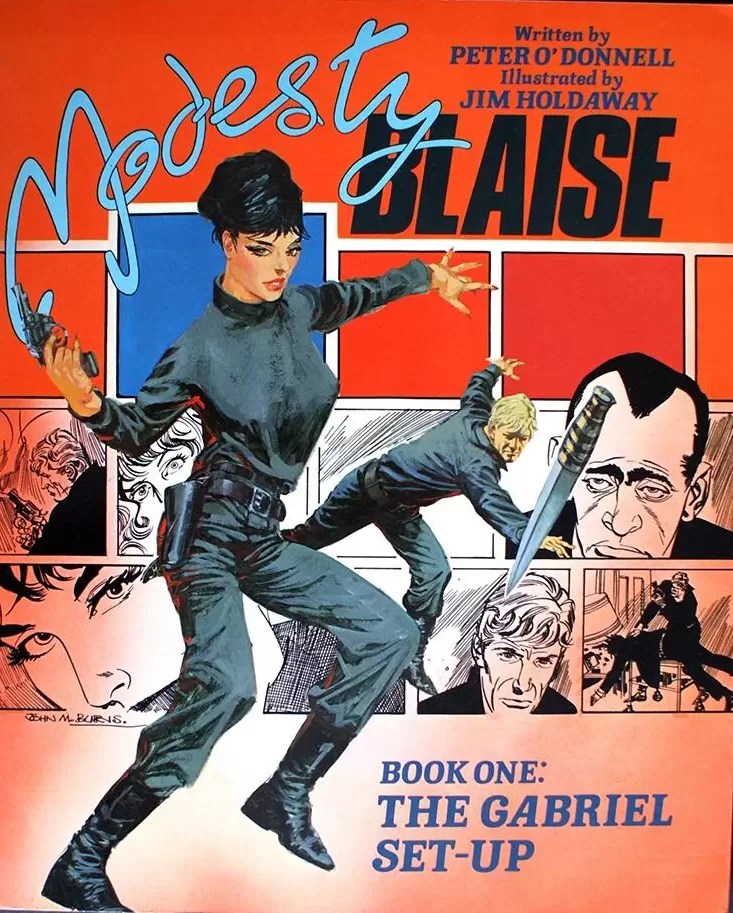
Cover to Modesty Blaise — Book One: The Gabriel Set-Up (Titan Books, 1984). Art by Jim Holdaway.
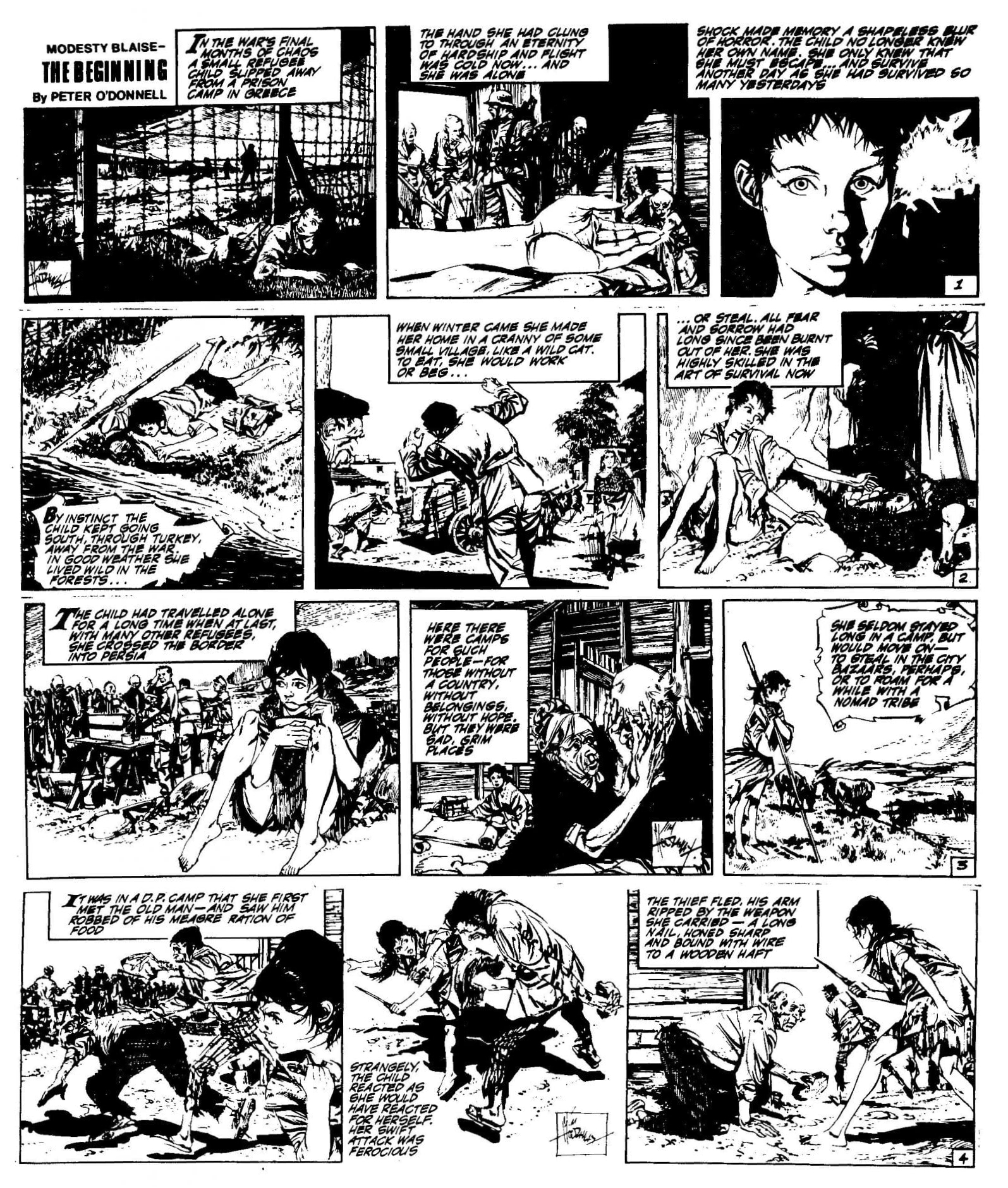
An excerpt from Modesty Blaise’s origin sequence from her newspaper strip. Text by Peter O’Donnell; art by Jim Holdaway.
Modesty Blaise? For anyone unfamiliar with that name, she’s the heroine of a eponymous British newspaper comic strip originated by writer Peter O’Donnell and illustrator Jim Holdaway in 1963. A wealthy European adventuress with an extensive criminal background — and no evident mutant superpowers — Ms. Blaise hardly seems a likely analogue for Storm. But the parallels in their respective fictional backgrounds are so striking — and so extensive — that it’s difficult to imagine that the earlier work had no influence on the latter (for supporting details, see right).
A couple of decades after his X-Men Companion: I remark, in Alter Ego #24 (May, 2003]): Wein elaborated on his reasons for disagreeing with Claremont’s additions to Ororo’s origin narrative
Of course I disagree with it… it’s plagiarism! [laughs] What I had in mind was what you saw in the very first story. The only origin that matters is, “Hey! I was born different!” My origin was the origin you first saw: she was born with powers and manifested them living somewhere in an African village and was mistaken for a god. She was the goddess of this area. You don’t need more than that. I’ve always resented Chris’ stealing Modesty Blaise’s origin so blatantly.
A couple of years after this, Claremont was asked to comment on his motivations for his changes to Storm’s backstory for an article in Back Issue #8 (Jan., 2005); while he didn’t specifically address the Modesty Blaise issue (in fairness, he may not have been asked about it), he did offer the following general observations:
I think the deriving rationale was to make her that much more accessible to our core audience… to give her some point of contact, of anchorage, whatever, with the United States. In Kurt [Nightcrawler] we had a totally foreign character [from Germany]. Banshee is Irish. Wolverine is Canadian, for whatever that’s worth. For me, anyway, I thought it would be some more positive change or direction to give her a bridge to the New World, so to speak…
While I don’t want to come down too hard on Chris Claremont for remarks he made over two decades ago, a couple of questions do occur to me: Wasn’t it somewhat counter to the whole idea of internationalizing the X-Men to be so quickly concerned about increasing the team members’ “anchorage” with the U.S.? Especially since Scott Summers, Jean Grey, and Charles Xavier were all still around? And why single out Storm for a previously unknown American connection, rather than any of the other “foreign” X-Men?
Another point made by Claremont in the same piece strikes me as more worthy of consideration; namely, his discomfort with “the idea of African tribes, even a remote African tribe, in the ’50s, ’60s, ’70s, worshipping someone like her [Storm] as a goddess.”
The aspects of Tarzan that made it remotely plausible in 1910 were fraying at the edges by the time you got to the ’30s… and if you advance it to the ’50s or ’60s [or ’70s], the growth or the intrusion of modern technology and society into even the hinterlands of Africa made that kind of fantasy less plausible.
This is definitely a valid point, but there’s a major problem with using it as a justification for the whole Harlem-to-Cairo-to-Kenya retcon — and that’s that nothing in the new material actually addresses the matter of the Serengeti tribespeople accepting Ororo as a literal goddess — a concept which remains entirely intact at the end of this issue’s flashback.
Fifty years ago, I’m pretty sure that my younger self took all the new information about Storm’s history in stride. Storm was still a new character, after all, having made her debut just a little more than 1 1/2 years before this, and having only appeared so far in a whopping ten comic books (counting this one); thus, my personal understanding of the character was still very much being formed. (There was also the fact that I knew nothing about Modesty Blaise at that time, so Claremont’s appropriation of her origin didn’t register with me at all.) Today, however, I’m inclined to see the whole business as having been a bad idea on Claremont’s part — partly due to the frankly egregious swiping from O’Donnell and Holdaway, but also because the “streetwise” aspect added to Storm’s character via this interpolation doesn’t really fit all that well with the “innocent” element that had already been established — and that Claremont himself would continue to refer to with some frequency.
At any rate, since we were discussing the X-Men’s American connections/members just a little earlier, let’s use that notion to segue back into our feature presentation…


From Marvel Premiere #21 (Mar., 1975). Text by Tony Isabella; art by Arvell Jones and Vince Colletta.

From Iron Fist #1 (Nov., 1975). Text by Chris Claremont; art by John Byrne and Al McWilliams.
Unlike Professor X, your humble blogger had previously made the acquaintance of Misty Knight… though I’m not at all certain I recalled the occasion at the time I first read this story. The character had first been introduced by writer Tony Isabella and artist Arvell Jones back in Marvel Premiere #21 (Mar., 1975) — which, as it happens, was the very issue with which I stopped following the “Iron Fist” feature then running in that book. I’d thus missed Misty’s reintroduction by Chris Claremont and John Byrne several months later in Iron Fist #1 (Nov., 1975), as well as her succeeding appearances as a regular member of that book’s supporting cast — and so I may or may have not made the connection between the young Black woman I’d seen briefly throw down with Danny Rand in MP #21, and Jean Grey’s previously unheard-of roommate.
Those who had been keeping up with Iron Fist, however, might have wondered just what the odds were that two such extraordinary people as the mutant superheroine formerly known as Marvel Girl, and the ex-cop/current P.I./bionic-arm-equipped ass-kicker soon to be known as a Daughter of the Dragon, would have randomly stumbled across each other in the teeming metropolis of New York City — presumably via either an ordinary “roommate wanted” ad or some other, equally mundane means… but, hey, I suppose stranger things have happened in the Marvel Universe.

As we previously discussed in our X-Men #101 post, while the rebirth of Jean Grey as Phoenix had been heralded on the issue’s cover, that plotline had subsequently suspended a little over halfway through the story in favor of setting up the present Ireland-set adventure. So it’s nice to see Claremont and Cockrum giving the matter some attention here, however briefly.

Like Xavier, we readers had last seen that face in the context of a dream the mutant mentor was having at the beginning of X-Men #97, a whole five issues (and ten months) earlier. This scene represents an escalation of this seemingly dormant plot thread on at least two levels — first, it’s obviously quite ominous that the Prof is starting to have these episodes in his waking hours; second, we’re given a clearer look at the alien pilot’s face this time… enough to at least hazard a guess that this mysterious individual may be female…

Nightcrawler may have eluded Juggernaut’s blows for the moment, but when Wolverine leaps again to the attack, he’s not so lucky; Cain Marko backhands him across the face, stunning him. And then…

Eh, what? Where’d the rest of Kurt Wagner get off to?
Just in case you’re wondering if inker Sam Grainger (or colorist Bonnie Wilford) made an error in that last panel, the very next page quickly clarifies that we did indeed see — or, if you prefer, didn’t see — what we thought we did/didn’t…

Black Tom Cassidy professes to be surprised that his cousin Sean — whose previous employment with the international police agency Interpol is here revealed for what I’m pretty sure is the first time — hasn’t asked him any of the obvious questions, such as: Who broke both Tom and Juggernaut out of prison? Who financed and facilitated their turning Cassidy Keep into a high-tech death-trap? “In short, who paid us to kill the X-Men?!”


Well, things look pretty dire for our heroes right now, don’t they? Back in 1976, we fans of course had to wait a whole two months for the release of X-Men #103, but today, we’re just going to roll right on in.
 We’ll start with an appreciative word concerning the issue’s cover, which like its immediate predecessor was both pencilled and drawn by Dave Cockrum. Among its other qualities, the cover serves as a striking counterpoint to the earlier piece, showing Storm as just as dominant and active as #102’s cover (and contents, for that matter) had depicted her as submissive and ineffectual. This contrast is lent further emphasis via the red-and-pink background coloring, which differs sharply from the green, black, and yellow scheme employed two months before. (This is probably a good place to note that all of the X-Men covers from around this time have exceptionally strong coloring — making it a shame that the uncredited artist[s] responsible evidently remain unknown to this day.)
We’ll skip the issue’s splash page, pausing only to note that the creative team of Claremont, Cockrum, and Grainger remains in place, and pick up the narrative as Nightcrawler, who’s presently being carried unconscious through dark passages of the castle by his diminutive rescuers, begins at last to stir…


Kurt realizes that the description of Black Tom’s boss sounds an awful lot like Eric the Red — the villain who, after somehow suborning former X-Men Havok and Polaris, had attacked the current team back in X-Men #97. (And he’s right, of course, as Cockrum and Grainger’s artwork in that last panel above makes quite clear.) “But first things first,” he tells his new allies. “We need a plan to rescue my friends.” At that point, however, he’s interrupted by one of the leprechauns, who’s curious about Nightcrawler’s having turned partially invisible earlier. Kurt tells the little man he must be mistaken, assuring him, “I can’t do anything like that.” “Don’t tell me, boyo,” comes the reply. “I saw it.”

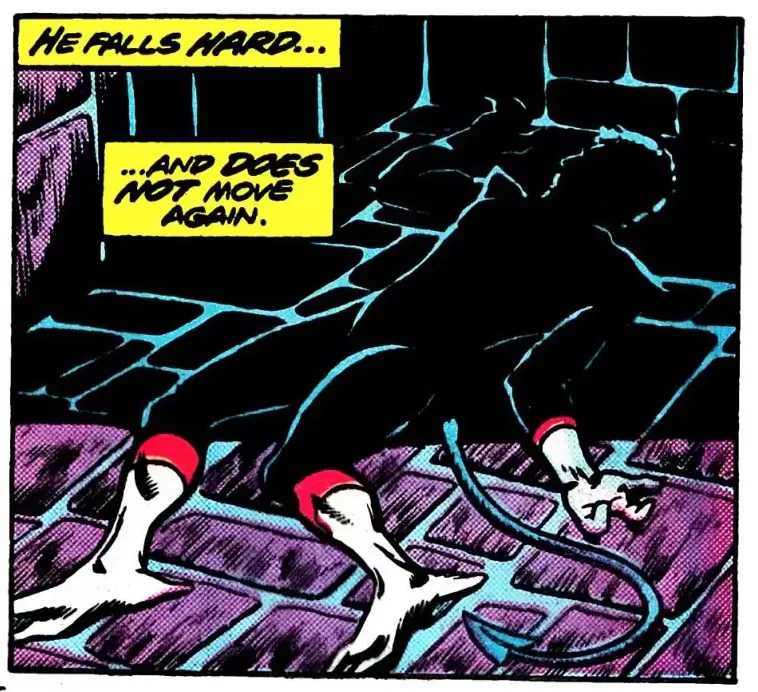 So, wow, huh? This seems like a pretty impressive new power — even if it only works when our hero is in shadow (and even then, he’ll have to shut his eyes to be fully invisible). But next to nothing will be made of it in the months and years to come; and by the time this storyline gets reprinted in Classic X-Men, someone at Marvel (probably Chris Claremont, as he was still writing the main “X-Men” title at the time) will evidently decide that the whole thing had been a bad idea in the first place. As shown at right, the “where’s the rest of him” panel from issue #102 will be extensively retouched for CX-M #10 (Jun., 1987); and the whole sequence from #103 in which Kurt, Eamon, and the leprechauns discuss and demonstrate the former’s invisibility ability will be excised completely. Oh, well; easy come, easy go, I guess.

Juggernaut doesn’t see why Black Tom needs to use a fancy-schmancy glove to put the hurt on his stepbrother Charles Xavier’s students — he can do that just fine with his bare hands! Not so fast, says his partner…


“Professor X” goes leaping and bounding about, eluding Juggernaut’s lunges and punches, while Black Tom is puzzled: “I thought you said Xavier was a cripple?!”


Back inside the castle, the leprechauns dig the unconscious Nightcrawler out of the rubble of the destroyed lab and drag him off to (relative) safety without Tom and Juggy noticing. For their part, the villains lug the still-captive Banshee up to the top of Cassidy Keep, while on the ground below, Storm utilizes her Cairo-born lockpicking skills to get those metal boots off Wolverine’s legs…


Colossus follows up this more standard, if impromptu, fastball-special move by beginning to scale the castle walls, digging his fingers and toes into the solid stone for purchase. It’s a slow process, which is made even more onerous when Juggernaut starts breaking off heavy pieces from the battlements and hurling them at the young X-Man’s head. Meanwhile, Storm’s aerial assault is met by fire from energy-cannons built into the castle turrets; as she uses her own lightning powers to return fire, the weather of the surrounding area responds, “creating — in an instant — the worst Atlantic gale in living memory.”

It seems like we’ve taken note of significant “firsts” in every post we’ve written to date about the All-New All-Different X-Men, and here we have another one: the very first use of the name “Logan” to refer to the Canadian mutant hero we’ve heretofore known only as Wolverine.

Banshee immediately releases a sonic blast that pulverizes the stone floor below Juggernaut, sending him crashing down to the level below. Of course, all Cain Marko has to do to return to the fray is climb the steps back up to the top — but, with excellent timing, Storm, Colossus, and Wolverine all simultaneously converge on the scene to block his way. That means that, at least for the next few moments, the Cassidy cousins are going to be going at it one-on-one…


Earlier in this post, I mentioned that I wasn’t quite sure what to make of Black Tom Cassidy when I first read this storyline, half a century ago; I might add that I also was somewhat bemused by the behavior of Cain Marko on this issue’s last page. I wasn’t used to seeing supervillains portrayed as having redeeming qualities — at least, not to the extent of being willing to sacrifice themselves to save a friend — and, to be perfectly honest, I wasn’t sure I liked the idea of being asked to feel sympathy towards a character who’d previously shown himself so willing to torture and murder other people. Fifty years later, I’m better able to appreciate Chris Claremont’s attempts to present a more nuanced portrayal of his stories’ “bad guys”.. although I’m frankly still loath to actually sympathize with such characters. (Nuance can only take you so far, IMHO.)
In any event, this brings us to the end of another event-filled, historically significant X-Men adventure… although as that last panel makes quite clear, we’re nowhere near the end of the long game our storytellers have been playing at least since issue #97. And the very next chapter of Claremont and Cockrum’s ongoing saga will bring us yet another historically notable event: the premiere confrontation of the ANAD X-Men with the OG outfit’s oldest and most enduring enemy, Magneto. We’ll be taking that one on in January, 2027; I hope to see you then.
Hi, Alan,
Revisiting this story reminds me of the simultaneous pleasures and frustrations of this book.
The pros: Great character interaction. I’ve always criticized the bickering and in-fighting of Stan Lee’s tenore on AVENGERS, and I still feel it weakened the characters. Here, though, a lot of the tension rather understandably came from the most pugnacious hero, Wolverine, rather than being a mire general intramural snarkiness. I appreciated that, as well as the way Claremont seemed to parcel out the various back stories of the characters.
The cons: You mention the “long game” that Claremont and Cockrum were playing. Perhaps a bit too long? This was a bimonthly book, but the guys seemed to treat it as a monthly, trusting us to remember details from almost a year ago. As much as I appreciate long-term planning, the pacing of a bimonthly needs to be different. I think Claremont was much more comfortable when the frequency was upped a few issues down the road.
Someone on Facebook recently reposted the cover of #102, and I remarked hating Ororo’s “damsel In distress pose. I had forgotten that was actually a plot point in the story. Had also forgotten this was where we first heard that Wolverine was “Logan.” Interesting. (By the way, I had no idea about Modesty Blaise’s origin story and how Claremont ripped it off – er, was heavily INFLUENCED by it. Not surprising, though, since Chris wore his Anglophilia on his sleeve.)
As for the art, I agree with you about preferring Grainger’s inks. But can we agree that the best inker for Cockrum was, in fact, Cockrum? Unless it’s Neal Adams. (Cf. GIANT-SIZE AVENGERS #2)
By the way, I think that Kurt’s “vanishing in the shadow” was a bit that Cockrum threw in, since he was effectively co-plotting the book. Cockrum clearly loved the character of Nightcrawler, just as John Byrne would later clearly love Wolverine, and in those days of the Marvel Method, artist’s preferences had a big hand in what appeared on the page.
Thanks again for a great write-up, Alan! Happy autumn equinox, everyone!
I never read this issue, but as a Legion Of Super-Heroes fan I can agree about Cockrum’s artwork – his legion artwork inked by himself is amazing, among my all-time fave art – of course they were shorter and he had more time then to make it perfect-looking. A tragedy from my point of view he left in a huff over Superboy/Legion 200 artwork (DC being unreasonable not returning the original splash page) and taking his new characters with him. In an alternate universe some X-Men are Legionnaires!
Given that it was Cockrum’s LOSH work that first caught my eye, I can’t disagree with you about the overall art when he inks his own pencils. While it was DC’s loss with his departure, I have two thoughts to add. One, DC had already turned down Cockrum’s request to add new members to the Legion which I think included variations of Storm and Nightcrawler. And two, if not for their actions, we would have been denied not only the New X-Men, but also Dave Cockrum’s outstanding art in Giant-Size Avengers #2.
Oh yeah, that was spectacular. I forgot that was Cockrum.
Apparently with a tad bit of help from Neil Adams.
And other Crusty Bunkers. Adams’s work is most noticeable on the full-page shot of the team attacking the one robot powered by Thor and the final page of the story.
not to mention all the great X-Men movies that came later, and the animated show, which is where I came in to them! I didnt have enough pocket money to buy both DC and Marvel back in the day. You’d need a decent wage to buy comics these days, sadly!
Chris Claremont wasn’t the only one to borrow heavily from Modesty Blaise – the “new” Black Widow who first appeared in Spider-Man #86 and thereafter in her own strip in Amazing Adventures took a leaf from the Blaise book as well, in my opinion. As I wrote on another blog on the subject, “Natasha is an heiress, Modesty a former crime gang leader = both are independently wealthy. Natasha is Russian, Modesty is undetermined but Mid-to-Eastern European = exotic origins. Natasha has Ivan (quotes old Hollywood movies), Modesty has Willie (quotes psalms)…”
A quick look shows Gary Friedrich wrote her strip initially, then Mimi Gold…’twasn’t till AA #6 that I first read her, scripted by Roy Thomas…so who exactly might have had the inspiration to “borrow” various bits’n’pieces is anyone’s guess (of course, I could be all wrong and it was all a coincidence).
With comics shops still in the future, I had to depend on the vagaries of newsstands and newsagent’s shops for my comic fix, missing #102 initially, but still had no probably following the plot. It was only later someone pointed out the joke in naming Wolverine (tallest mountain in Canada, no? And Wolverine being all of 5’4” or thereabouts), the leprechauns really grated, and Nightcrawler’s invisibility-in-shadow felt like a tacked-on “Wouldn’t it be cool if…?” moment…but otherwise this was top stuff.
Given Natasha’s foreign origins were already established, I’m not so sure of the influence — Emma Peel is at least as likely. John Romita said the visual look was taken from the Golden Age Miss Fury.
However the idea Natasha is wealthy, glamorous and hangs out with the jet set was new to the reboot so maybe Modesty did play a role. IIRC, there was no explanation how she got the money; I figured skimming a little off the Kremlin’s ops budget.
Yep – in ’76, X-Men went non-dist in the UK from this issue until 108, much to my annoyance. As the comic was already a fan favourite, the dealers charged gouger’s prices for those issues and… Goddess help me… I.. paid the price. I… hurt. Those dealers… no quarter asked and none given… they were the best there were at what they did… They owned me… body and soul…
I see what you did there! Well played! (Though you might have worked in a “Yum.”)
And what those dealers did wasn’t very nice. That’s a fact.
Being gouged by back issue dealers? It comes with the uniform.
I loved the detail that Black Tom and Cain were buddies. The first indication is when Tom rips Cain a new one for falling for the Xavier illusion and Cain’s response, instead of “Shut up or I’ll squash you!” is “Sorry.” It didn’t make him nice but it did make him a more rounded person.
Generally I loved this issue. I didn’t have any trouble keeping track of the elements from some months back. Claremont has a point about the “goddess” stuff though as you say, he didn’t change that (one thing I liked about DC’s B’wana Beast in Showcase was that despite the White Jungle God aspect, Bob Haney really did try to portray an African nation transitioning from ancient tribal ways to modern technology and government). The claustrophobia was a good touch though it seems so intense, it’s hard to believe she was comfortable inside Xavier’s school either.
I liked the Nightcrawler vanishing in shadow detail. Didn’t know the reprint retconned it out.
The line about “talking Wolverines” foreshadowed the reveal that Wolverine was, in fact, an evolved wolverine (High Evolutionary’s work, IIRC). Then when Marvel whipped out a Spider-Woman one-shot to establish a trademark, they had her as a High Evolutionary-evolved spider so the evolved Wolverine was dropped (Marv Wolfman later retconned out that origin too).
The portrayal of Sean and later Moira as ancestral aristocrats with castles feels very old-fashioned. Families with that kind of estate in the late 20th century were usually drowning in debt from keeping it up and giving Stately Home tours to tourists.
I was surprised Alan didn’t cover the “talking wolverine” comment, besides a name he got a background story. Wasn’t it because Stan Lee didn’t like it that it was dropped? Which makes using it for Spider-Woman odd, but since it was done quickly for trademark purposes, I guess it didn’t matter as much.
They may have planned it first but once Spider-Woman hit the stands, someone at Marvel decided another hero with the same reveal would be a bad idea. Or so it’s been told to me.
I didn’t have a problem with Black Tom not having a nom du crime. He fit comfortably into the same vein of names as Lex Luthor and “Man-Mountain” Marko.
… the weather of the surrounding area responds, “creating – in an instant – the worst Atlantic gale in living memory.” This kind of hyperbolic extreme would become very familiar to anyone following Claremont’s dialogue tropes. Not just a storm, or a bad storm, but ‘the worst gale in living memory’. Ever. Until the next one.
The leprechaun Padraic not only throws in a significant first by somehow knowing Wolvie’s real name, he also appears to have modelled himself on Steve Gerber’s elf with a gun from the Defenders, AND he says ‘… maybe leprechauns don’t believe in talking wolverines…’. Was this maybe the last gasp of the hypothesis you discussed around X-Men #98, that there was some consideration to making Wolverine an actual mutated wolverine? And while I was typing this, Fraser Sherman got in first 😊
I was not a fan of the large super-hero team comics in decades past, especially by the mid- 70s where only 17 interior pages was a great detriment. If an artist like Neal Adams drew the Avengers or X-Men, however, those comics did make it into my collection.
By the way, Alan, were you still reading Howard the Duck at this point? Any upcoming reviews? No. 7 was cover-dated December 1976.
BY that time Howard was deep in his Presidential campaign. I can picture Alan waiting until closer to Election Day to get caught up. (Or not! His blog, his rules!)
I just want to see that splash page with Howard and Beverly together in a bath tub with the headline “Scandal Plunks Duck!”
…and you will, Rick.
Since you asked, MoB… my post about Howard the Duck #7 will be coming this Saturday, followed by Marvel Treasury Edition #12 (“The Duck and the Defenders”) a couple of weeks after that… and then, a few weeks after that, HtD #8. (Just in time for the midterm elections. 😉 )
Those reviews should unruffle more than a few feathers. 🙂
The revised origin of Storm in this issue reminds me why I don’t particularly care for Chris Claremont’s writing these days. When I was a (very serious) teenager, his use of characterisation appealed to me greatly, but now comes across as embarrassingly heavy-handed and often contradictory. The character bits he includes don’t seem to develop organically, but are clumsily shoe-horned into the narrative, as exemplified by the origin flashback in this issue.
Just yesterday I was pointing out in another venue that at this time the X-Men were in a position prone to opportunity, having been around plenty enough to have proper connections to much else in the MU (and thereby having a lessened need for establishing setting and plot hooks and more room for storytelling proper) while also having gained a considerable number of new characters with not fully established pasts that could be made into parts of histories to come. A nice plataform for a carefully curated mixture of revisitation, revelation, reinvention and full discovery of characters and plots both.
Claremont clearly embraced that opportunity, and naturally enough not every new opportunity was fully successful or even fully explored.
One part of that recipe was the introduction of characters of varied nationalities as new core members of the cast. That was commendable and took some courage; it is difficult to write characters that are distanced from one’s personal experience.
Learning now that Len Wein and Chris Claremont had different ideas about Ororo in particular (thanks for revealing that to me, Alan!) seems so logical in hindsight, and explains a lot. Len Wein created the character, but left it after only three stories. It fell to Claremont to develop her, and while I see Len Wein’s point, I feel that Claremont had a legitimate need to make Storm more relatable to himself as a writer and to the readers.
If we accept Len Wein’s origin for Storm at face value, the implication is that Storm lived at a hidden village in Kenya for most or all of her life, was born a mutant with weather control powers, and at some point was offered worship and accepted it. Then some stranger from a land she never even visited and that admits to having mental powers comes all of a sudden, tells her that she has broader duties, and she leaves for good to start a new life in a foreign land. Right after being told outright that she is no goddess and that she has been living in a fantasy.
There is only so much that can be done in a couple of pages, but we have to admit that such an origin was at best not very complete. For instance, while English is an official language in Kenya, it strains credulity that Ororo apparently has a better command of the language than Kurt or Piotr while having lived for presumably all of her life in a hidden village. In her original appearance she is more of a visiting character from a fantasy story than a superhero, yet she is easily convinced to remain in Westchester and take part in X-Men missions for no particularly obvious reason. Her most remarkable trait at that point is how swiftly she adjusted to a sudden and presumably brutal culture clash.
Claremont seems to have felt similarly. Storm has very few scenes or lines in #94-95 (issues co-written with Len Wein) and then jumps to the foreground in #96, the same issue that introduces Moira MacTaggert. She destroys the N’Garai cairn pretty much alone and seems to be less shocked by Kierrok’s sudden appearance than most, granting us a couple of panels of flashback to a time when she was a young child living with her mother in what is clearly an urban environment with some measure of western, arabic and muslim influences before her mother was killed by what seems to be either an explosion or an earthquake. You have to admire the economy of information delivered in a single panel. Incidentally, the first of those panels is difficult to reconcile with the sliding timescale – it pretty much implies that Ororo can’t have been born much later than the Suez Crisis of 1956, as confirmed here in #102.
Indeed, Claremont has revisited Storm’s fantasy elements very often since, stating time and again that she has strong magical potential and comes from a line of hereditary sorceresses that apparently all look just like Storm herself. One of those ancestors is even a character in his Marada the She-Wolf stories. Ayodele took those hints and ran with them mighty fiercely in the last three years or so.
Similarly, Nightcrawler is hinted to have magical elements to his powers here. Far as I know those Elves are still living at the Cassidy property. Not sure if Black Tom or Banshee know about that. Kurt’s shadow invisibility power will be reintroduced much later in Alan Davis’s Excalibur run.
This is the first I notice it, but Black Tom Cassidy’s appearance has many unexplained elements. The basic elements remind me of the Hellfire Club’s thugs, which may connect to Black Tom inviting us to wonder who was paying for this ambush. The color scheme also resembles the original Gamma Flight (introduced by John Byrne, I think) and other elements seem to be in imitation of Doctor Strange, who Claremont will come to briefly write in 1979-1980. Do we ever learn why exactly Tom holds that staff? His energy blasts seem to come from it, but presumably that is channelling of his mutant power.
Colossus seems to be confident in his own mastery of American English idioms, given how he reacts to the usage of the word “broad”.
Right until now I had not realized that the introduction of Misty’s bionic arm was probably meant as an explanation for her ability to throw Iron Fist to the floor in her first appearance.
At this time period Juggernaut and Black Tom Cassidy were rarely seem without each other. I assume Claremont was hinting at something, much as he later did with Mystic and Destiny.
I don’t get the same vibe from Tommernaut that I do from Raven/Destiny — they’re more a buddy team, an evil Starsky and Hutch or Crockett and Tubbs.
IIRC, Tom’s energy blasts channel through wood so yes, he needs the staff.
My impression is that Sean knows about “the families.” Not sure about Tom.
I agree with Frasersherman regarding Tommernaut (great name!). Cain Marko was a bully before grabbing that gemstone. As a result, it’s unlikely he had many real friends. Black Tom on the other hand, was more outgoing and smart enough to see the advantage of a buddy who potentially beat up the Hulk. And yes, that same Tom of Black uses the wooden cane to channel power because… who knows.
Another fun tidbit. Len Wein was also quite unhappy with what Claremont and Cockrum did with Wolverine. He’d pictured the Canadian mutant as a hot-headed teenager – not some older guy with sideburns.
I assume it’s the visual — it helps Tom stand out from the multiple mutants blasting energy from their hands or eyes.
2)Tom Brevoort had a post a while back on how much the “definitive” Wolverine differs from the original Weapon X agent.
Agreed on BTC. Otherwise, he is a bit bland. I didn’t know about that Wolverine post. I’ll check that out. Thanks!
Here’s the link: https://tombrevoort.com/2024/02/19/when-was-wolverine-wolverine/
Rick… Black Tom doesn’t use a cane. It’s a shillelagh… cuz he’s Irish.
I think the rub was that his bio energy only works when he’s touching wood and the like… I think he became more of a Swamp Thing type guy later on based on his connection to organic stuff. I think he might have been alright as Cain’s somewhat cool friend with an iffy power honestly.
“…she was a young child living with her mother in what is clearly an urban environment with some measure of western, arabic and muslim influences…”
Of all African nations Chris Claremont could have chosen, Kenya is 85.5% Christian. The 10% Muslim population are all ethnic Somalis who crossed the border into the northeastern part of Kenya. (Southern) Sudan, Egypt, and any number of African nations across the northern border would have been better choices for Claremont to choose if he wanted Arabic and Muslim influences, or northern Nigeria.
That may have been the point.
Remember, Kenya was established in Giant-Size X-Men #1, which was written by Len Wein without involvement from Claremont.
Claremont’s panels in #96 show a couple of people in clothing that is probably not meant to be representative of Kenya inhabitants. And indeed, here in #102 we are told that those scenes are from Cairo.
Presumably Claremont wanted to establish Ororo’s background there in Egypt (which he did) without necessarily contradicting the scenes written by Len Wein. Perhaps simply because it makes Ororo more relatable and her apparent quick adjustment to living in Westchester a little bit easier to explain.
Meanwhile, having lived for years in Kenya goes a long way towards explaining why Ororo understands and speaks English. I would expect her to have a noticeable accent, but I suppose by this point I am nitpicking. I feel silly saying that the thing that is difficult to disbelieve about a weather-controlling mutant that can fly under her own power and even create winds underground is that people don’t comment on her accent.
Of course, I meant “to suspend disbelief for”, not “to disbelieve”.
Also, I have thought about this a bit more and I think that Len Wein may have hinted that Ororo was fairly new at her role as weather goddess in Kenya. It is subtle, but the dialogue between Ororo and her worshippers suggests that the tribe may not be very certain about what it takes to convince Ororo to help – she has to point out that the animal sacrifice is unnecessary.
That would help explain why Ororo bought Charles’ pitch in Giant-Size #1 so quickly, and why (unlike Sunfire) she does not return to her established life and role right after rescuing the original X-Men from Krakoa. If the weather goddess role is recent or infrequent, she will not have a strong attachment to it and may be more open to explore new lands and situations.
However, that possibility is contradicted here in #102 – we are told outright that she was born in Harlem in 1951 from an American father and a Kenyan princess, moved to Egypt in the same year, lived there with her parents, lost them in 1956, was then raised by Achmed for up to seven years before deciding to travel by foot for about a year to Southwestern Kenya.
It is a very specific timeline and establishes that she was thirteen when she first arrived at Kenya, apparently in 1964 or so. Since it was a year long walk, it is likely that she did not have the ability to travel significantly fast with her winds at the time. Marvel Team-Up #100 establishes that she first met T’Challa during midway through that Journey and flew away from Andreas de Ruyter with him just minutes later, but maybe it was not as tiring or simply not very fast, or it took her the best part of a year to travel from Cairo to Ethiopia – or it was simply a retcon that she could fly at the time.
This issue is also arguably the first hint of Ororo’s affinity to magic, depending how you interpretat her scenes here and in #96. Her mother is a literal princess (perhaps an hereditary one) and her claim that she knows that Ororo is special and certain to understand what they are saying can be understood in several ways. More to the point, it is apparently correct. We will learn further ahead that she is indeed interested in seeing her former Harlem home again, and of course residing at Westchester makes that goal that much easier to achieve.
while it’s not a dealbreaker, it’s a fair point. Sean and Peter’s accents are obvious in their speech patterns, why not Ororo’s?
Perhaps she learned English by listening to the BBC World Service 🙂
For all we know Ororo may have a secondary mutant ability of learning languages. Or it turns out that a significant part of her mystic potential is an impressive and probably hereditary gift of uncanny memory and learning.
As of #102 here we are probably encouraged to believe that her father David Munroe simply practiced English often with his daughter and wife in those early years. Which is, of course, believable enough. On the other hand, I have to believe her English would decay significantly between ages five and thirteen. Then again, there are all sorts of conceivable unseen reasons why it could not, several of them rather mundane. The most obvious would be Achmed noticing her fluency and encouraging her to keep practice. It could be useful to have a child seeking English speakers who would perhaps have fatter wallets to steal and even the odd valuable secret to reveal.
Ororo’s backstory is certainly complicated, but the silver lining is that there are many potential storylines available for the making behind its corners. Come to think of it, Claremont may have recognized that and taken inspiration to give Gambit similar traits.
I liked the Nightcrawler becoming invisible in shadows bit. Seeing as how he was Cockrum’s favorite, it makes sense that he would have some surprises up his sleeve. Then Cockrum left, Byrne came in and the emphasis was placed on Wolverine.
So many wonderfully intriguing comments regarding what I consider my least favorite story of the initial Chris Claremont-Dave Cockrum X-Men that it’s to know where to begin. Let’s start with the why. Why was it my least favorite? I found the castles, leprechauns and a villain with a DC name an annoying distraction from what I considered a far more exciting story with bug-shaped spaceships, a more interesting villain with another DC name as well as wanting to know what in the name of character upgrades was happening with my favorite red-head not named Mary Jane or Pepper or Natasha.
I wouldn’t have minded so much has this book been monthly. But to put up with the unbeatable but less than exciting Juggernaut for sixty days was pushing it for me. (And yeah, I know part of the reason for this story was so that Claremont and Cockrum could figure exactly what Jean could now do.)
As for Storm’s origin, I didn’t know about Modesty Blaise as a kid reading this, but still thought this backstory only complicated her character in a needless manner. I also found it a bit silly in later issues that someone who’d learned to pick locks in Cairo as a child could now easily undo sophisticated electronic locks devised by uber-smart villains. That’s kinda like saying that since I learned to drive a car, I’m ready to now pilot a jet.
Although I didn’t know it at the time, that was an instance of Claremont being unable to leave an already solid character alone. There’s Illyana becoming a demon-whatever. Kitty becoming Shadowcat. Polaris turning into the She-Hulk’s third cousin. Mirage suddenly finding out she’s one of the Valkyrie. The list goes on.
While these two issues were not my favorite of this series, bear in mind that it’s the X-Men we’re talking about. At this time in my comic collecting, this title was far and away my favorite. Even issues such as #102 and #103 that faltered were head and shoulders above everything else I was reading at that time.
And thanks to our talented host, we have another Wednesday where all these thoughtful and informative comments can provide a delightful distraction on a wicked Wednesday workday.
I have no problem whatsoever in saying that Claremont has a strong tendency to overcomplicate characters, but this time I think it is justified.
Without some sort of urban background, by this point Ororo would be too close to a variation of Tarzan as a woman with superpowers. Oddly, that is pretty much what she became more recently. But it is a difficult character concept to write without falling into some problematic pitfalls, and all the more so as part of a team.
Yes, it brings the question of how come Ororo so rarely thought of the tribe that used to worship her since. Apparently that is just Claremont deciding to avoid that particular can of worms.
I dunno — a black woman in the Tarzan role is an entirely different kettle of fish as she doesn’t embody the “white jungle god” trope (or as a friend of mine puts it “non-native rain forest authority figure”).
I thought so too. Until I saw Al Ewing writing her in X-Men Red, that is.
But in the context of mid-1970s X-Men I think it would be difficult for Claremont to work with that concept while also telling the stories that he wanted to with the team. For the most part Claremont has chosen to write about Ororo as a mythical African figure or Ororo as a member of the X-Men, without much intentional overlap.
For decades now Claremont has been writing quite a bit of Storm as a magic-aligned character, mostly through references to her ancestors and in the “Lifedeath” stories. Ayodele did _something_ with that. I hope someday I will understand what exactly. But those tend to be stories about Storm the unquestionable protagonist, not Storm the team member.
So Misty Knight and Jean Grey roomed together for a time in NYC in the 70’s. Where’s the mini-series about that? Seriously, did Claremont ever do anything with this estoteric piece of information or was it just a continuation in his attempts to connect the dots of the Marvel Universe? It’s an odd juxtaposition of characters, but that’s Claremont for you.
I also thought Paidrac looked too much like Gerber’s murderous Elf in the Defenders. Certainly unintended and not meant to connect the X-Men with the Defenders in any way, but I’ll admit, it threw me out of the story for a second when I saw it.
Cockrum’s artwork looks great here, but as already commented on, he and Claremont were certainly playing a long game, storywise, weren’t they? Fortunately, they kept you busy in the here and now with plenty of reveals and plot twists, but it did sometimes seem to take forever for them to get to the point. I also thought the addition of the leprechauns was unnecessary. The whole business with Nightcrawlers invisibility is another flaw in the Marvel Method. The writer and illustrator can work out a plot, but then the writer is beholden to any darn thing the illustrator chooses to throw in after the fact, leaving the writer with the option of either fighting with the artist and potentially blowing the deadline, or making the most of it and retconning it out as soon as possible.
All in all, not the finest moment of the Claremont/Cockrum X-Men, but not a bad one, either. Thanks, Alan!
Misty and Jean as roommates did lead to Scott meeting and briefly dating Colleen Wing. And also to the delightful Iron Fist/X-Men crossover in Iron Fist 15.
One thing about the Claremont/Cockrum and Claremont/Byrne long game is, as you say “they kept you busy in the here and now with plenty of reveals and plot twists.” An individual issue of X-Men is usually enjoyable even without context, whereas Geoff Johns’ Green Lantern run (to use one example) any individual issue feels unsatisfying and insubstantial.
Oh my goodness! Watching Lanterns on HBO Max has me thinking back to Geoff John’s work on Green Lantern. I went from being thrilled with my favorite DC character Hal Jordan being redeemed and back in the glowing green saddle again. Thoroughly enjoyed Johns’ take on Sinestro and Jordan’s relationship. But once there seemed a ring for every color, it was – as some other critic put it – like opening a box of Skittles. That long-awaited GL series was a huge letdown for me. The only reason I stayed with it was the notion that I didn’t want poor sales to lead to some other writer trashing Hal Jordan all over again. I used always view Geoff Johns as a writer who would put together an issue that did whatever only to suddenly get exciting in the last page or two with some wild cliffhanger and/or reveal.
Eventually it got to the point even the six-issue arcs felt like footnotes to the Big Epic Story.
Besides what Fraser Sherman already mentioned, there was a further bit of cross-polinization due to Misty and Jean being roommates.
Misty guest-stars in future issues (due to some very unlikely coincidences, but still) and eventually that brings Luke Cage along to a short guest role as well.
I’m not sure of the specifics, but that may factor into the one time Luke Cage and Iron Fist fought the Living Monolith.
And, of course, the X-Men eventually inherited Sabretooth from Power Man/Iron Fist.
Chris just liked Misty is all the reason I see and that’s cool. He had her developed beautifully and it’s a shame lesser hands here and there have tarnished that.
There are those who like retro-wotsitting, that insist that Misty Knight was the African-American woman saved from a mugging by Spider-Man in Marvel Team-Up #1. To my mind, that one you would call clutching at straws (as well as maintaining the annoying habit of having to make absolutely everything in the Marvel Universe interconnected).
PS with that talk of Modesty Blaise, can I recommend it to anyone who doesn’t balk at reading reprint collections of British B&W newspaper strips. Peter O’Donnell’s scripting is quality work, and the artwork (by Holdaway, Burns, Romero et al) matches it.
The 1966 film is another matter. 😉
Seconding the Modesty Blaise recommendations. O’Donnell’s novels are also good.
The film My Name Is Modesty, retelling her origin, is good too. It was originally intended to fit in all the backstory that the scriptwriters couldn’t use in the Modesty film they were working on … which never happened, unfortunately.
Clutching at straws maybe, but it was Chris Claremont doing the clutching – in Marvel Team-Up #64 (Claremont and Byrne) the retcon became official canon when Spidey and Misty discuss the incident. As the Torch was out of uniform she didn’t recognise him, but referred to him in both issues as ‘the dude in the flying bathtub’.
Even when I first read this I thought the leprechauns secretly living in an Irish castle seemed like an odd element for 70’s Marvel. Like something out a 50’s Superman. Did they ever show up again?
“This place houses a hidden group” is an enduring comic book trope but Claremont mined it more than most possibly or am I being unfair?
I’m not clear on the timeline but what came first? These guys or Gerber’s Elf with a gun? Cuz Padraic looks just like him.
It didn’t strike me as any more absurd than, say, Asgardian gods hanging out in New York or Hulk battling a wendigo. For all that they’re presented in fiction mostly as comedy, leprechauns are a legitimate part of Irish folklore.
That sort of my point though… Marvel Asgardians aren’t traditional folklore Asgardians… they’ve been “Kirbyized” into something else. The leprechauns are presented more or less like they walked out a fairy tale and that feels tonally different for the MU. If the same thing happened in a Doctor Strange story it would likely be handled as some sort of metaphysical absurdity… here it’s oddly matter of fact. Points to Claremont and Cockrum for not being staid and uptight though.
Dracula had been plugging around for a while but it was clear that he wasn’t a particularly easy fit into the larger MU either.
we disagree, but things like “tone” can be very subtle and judgments correspondingly differ.
It’s not a thing that gets in the way of me enjoying the issue… more that it was a odd/bold creative choice in a book full of stuff. It’s a crowded castle.
“Did they ever show up again?”
Apparently, yes. See http://www.marvunapp.com/Appendix7/lepcaskeep.htm .
“what came first?”
The Elf with a Gun originally showed up in Defenders #25 (Apr., 1975), so he was very much first. Perhaps Cockrum and/or Claremont (with help from colorist Janice Cohen) were tipping their hats via Padraic’s look.
I don’t know, it’s a pretty standard image — the Keebler elf version of the fae. “Real” elves, as opposed to leprechauns, were usually portrayed in folklore as taller, more elegant and prettier.
Thanks!
It’s been quite a while since I look at this pair of issues in my copy of the Essential X-Men volume that collects them. Reacquainting myself with this storyline via Alan’s blog post, I found myself enjoying it again quite a bit.
My abiding memory of these issues, which has stuck with me since I picked up the trade paperback in the early 2000s, was discovering that we first learned Wolverine’s real name Logan (well, I still consider it to be his real name) via a leprechaun. That was such an odd, offbeat, comical way to introduce that information… at least it seemed to me in the early 21st Century, by which time Wolverine had certainly become both one of Marvel’s biggest characters and very serious, grim & gritty staple of the superhero genre.
It’s good to see Sam Grainger back on inking on this pair of issues. While, like Alan, I prefer Dave Cockrum inking his own pencils, Grainger’s inking is still a huge improvement over Frank Chiaramonte.
I had totally forgotten that Eric the Red had been the behind-the-scenes plotter who was responsible for sending the Juggernaut and Black Tom against the X-Men, and that the mad Shi’ar emperor D’Ken actually showed up this early at the end of issue #103. Yeah, Claremont really was already playing the long game with the X-Men title, weaving the upcoming Shi’ar storyline in and out of the book for quite a while. Must have been an excruciating process for readers picking this up bi-monthly back in the day, though. (And then that fill-in story in issue #106 showed up, meaning readers had a four month wait until the next chapter!)
I appreciate Alan sharing the excerpt from Modesty Blaise’s origin here. I was aware of Len Wein’s criticism of Claremont for retconning Storm’s origin to be so very close to that, but I had not realized quite how similar they were until now. I guess this was the sort of thing you could get away with back in the mid-1970s when the X-Men series was still flying mostly under the radar.
I agree with Alan that Claremont is good at making villains have certain admirable traits while still being, y’know, villainous. He’d really excel at this later on with Mystique and Destiny, who were both incredibly ruthless individuals who nevertheless cared deeply for one another. And, of course, eventually he’d also make Magneto a very nuanced antagonist… but that’s still several years down the road, since as I recall he was still very much the one-dimensional ranting megalomaniac of the Silver Age when he first fought the all-new, all-different X-Men. But more on that in January, right? 🙂
Arriving late to the party again, but I did get both of these issues off the racks at the NEX lo those 50 years ago. I wouldn’t have thought about it back then, but in many ways these early era ANAD X-Men is a bit like early Marvel from 1961 through early ’65, when Lee & the gang introduced so many new characters, as well as bringing back a couple of much older ones, and on many of them took a bit of time to figure out how to properly characterize them and find their voices and the extent of their powers, trying some things then entirely dropping them, etc. Of course, as was the case on many of the Silver Age mags that lasted into the Bronze Age, and often had writers that might last 2 or three years before switching out, Claremont did remakes of the greatest hits of the past — with stories featuring the Sentinels, the Juggernaut this go-round, and coming up next Magneto, rounding out the original X-Men’s most prominent opponents. Wein brought back Count Nefaria, although I’ve never read the story in which he bedeviled the OG X-Men early in Thomas’ first run, with a bunch of grade C baddies, all of which seems more like Roy flailing about with no idea of what to do with the mag and hardly a glorious moment in X-Men history. Claremont, on the other hand, is tying this all in within a grander story that would have a greater payoff than Thomas’ Factor Three “epic”. Of course, it also helped having first Cockrum and then Byrne on hand, two great artists bursting with ideas at the time. Maybe not everything fit in well, but I think it tended to give a level of excitement to the series that was sorely lacking from many of the other holdovers from the Silver Age and that hadn’t gone into hiatus for 5 years. Admittedly, at the time I loved all of them, but, yeah, with a half-century of hindsight, many of them don’t hold up all that well in comparison with some of the newer mags on the racks in 1976, although at least a few would see much brighter days in the not too distant future, with Daredevil and even Iron Man shining brighter than they ever did before.
Even that the Juggernaut was shown to care enough about his ne’er-do-well buddy to risk his own life for him was a fascinating development of the sort that had been lacking in any of the character’s prior appearances wherein he was just a blustering force of senseless hate. Juggy still came off as mostly one-note, but this gave him a bit of nuance not seen before.
At some point in the past, I have heard of Modesty Blaze – in an issue of the Comics Journal, I believe. I don’t recall if any LoCs to X-Mail in 1976 made any reference to the series and any similarities between her past and Ororo’s. Pretty bad timing for her to freak out when she did but at least she finally recovered in time to at least give Juggy a bit of a whacking.
The Leprechauns were a bit silly, I thought, and as an adult in my elder years now, I find it irritating how it seems just about every European character in the Marvel Universe has a castle and/or is somehow related to nobility. Well, I know a castle makes for a better setting for big battle than a small cottage that Juggernaut could have knocked down with his bad breath in two seconds!
Enjoyed reading your write-up of this mini-epic, Alan, as well as everyone else’s observations.
The X-Men’s first battle with Nefaria was hardly classic, but no worse than some of the Lee/Kirby stories (I don’t think the book got good until the two-part Juggernaut debut). Generally I think Thomas, being younger, got a better feel for the X-Men as a young group of friends.
2)The statement Juggernaut was risking his life, while it added to the drama, is just silly. This is a guy who walked from Korea to the US under the Pacific. Nothing can stop the Juggernaut.
3)There were people back in the day who wrote in letters complaining about the castles so you’re not alone.
Also very convenient that the castle happened to be on the edge of a deep sea along the coast.
https://tombrevoort.com/2022/02/12/bhoc-x-men-103/
Alan, you sly old dog! Here I was having read #102 ready to give my review only to find that you had tossed in #103 as well! As previously mentioned by some of your esteemed correspondents, these issues were not distributed in the UK, and so I only came across them as back-issues sometime in the early 80s. But even though I am not unknown for making comments on issues that you have reviewed years earlier, I didn’t want to wait another 5 or 6 years to read and comment on these……although I don’t have much really to say…apart from being taken aback by the over the top reaction of the prof to Cyclops in #102 when Scott refused to go over to Ireland. Other than that nice art, ok story and oh yes forgot to say that I didn’t mind at all Claremont’s homage to Modesty. I actually first saw Cockrum’s pencils on that in an issue of FOOM, and thought them cool. The slow peeling of the onion skin was what made the comic more noteworthy. And I liked that Misty Knight shared an apartment with Jean. Again the interweaving of plots and characters was cool, to me then, and even now.
I got issue #100 and then I started picking up the new issues maybe a year later in College. I grabbed the ones I missed at a used store. Then as now I was impressed with the character development. And I think the story holds up. (Except why didn’t Kurt ever notice the invisibility thing before? Surely he’d been in deep shadow before?) Thanks for the overview and the cool stories and artwork!