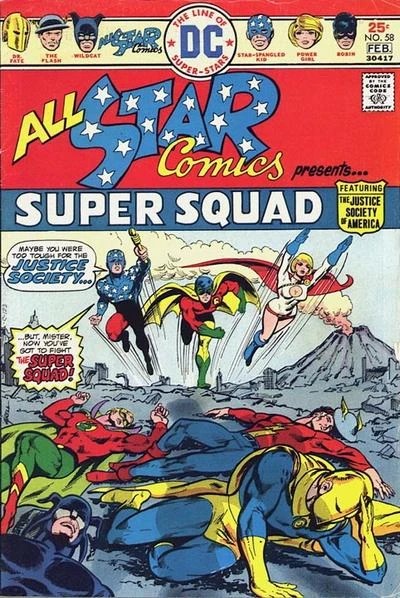
All-Star Comics #58 (Jan.-Feb., 1976)

In October, 1975 — just a little less than a quarter-century since their last headlining appearance in All-Star Comics #57 (Feb.-Mar., 1951), and about half that time since their revival in Flash #137 (Jun., 1963) — the Justice Society of America finally returned to newsstands in their own book.  The premiere superhero team, not just of DC Comics but of all comics, was at last back in full force, ready to reclaim its former glory.

And it had Marvel Comics to thank for the opportunity.  Read More

Justice League of America #123 (October, 1975)

1975’s team-up between the Justice League of America and the Justice Society of America was the thirteenth such event since the annual tradition had begun in 1963.  Over the years, DC Comics fans had been privileged to vicariously visit such parallel worlds as Earth-One, Earth-Two, Earth-Three, Earth-X, and even the short-lived Earth-A.  But there was one particular Earth that had been established as existing in what would eventually be known as “the DC multiverse” that had yet to be glimpsed in any of the JLA-JSA summer shindigs… though readers of those comics could hardly claim to be unfamiliar with the place.  After all, they lived there.

Of course, I’m talking about Earth-Prime.  Read More

The Brave and the Bold #112 (Apr.-May, 1974)

By my reckoning, DC Comics’ The Brave and the Bold was one of the first comic book titles I ever spent my own money on (for the record, it was preceded only by Superman, Detective Comics, Green Lantern, Justice League of America, Flash, and Lois Lane).  I bought my first issue, #64, in December, 1965 — drawn in, no doubt, by its irresistible Gil Kane cover — and BatB soon became one of my most consistent regular purchases as a nascent comics fan.  No, I didn’t buy every single issue, but that was true of virtually every other title as well (the sole exception in those early days being Justice League of America, to which I quickly subscribed).  The ongoing appeal of the book, of course, was that you were always guaranteed at least two superheroes for the price of one (sometimes, as with issue #65’s team-up between the Flash and the Doom Patrol, you got even more).  That wasn’t quite as good a deal as JLA, which might give you as many as ten costumed crusaders cavorting in the same story… but it was still pretty sweet.  Read More

Justice League of America #102 (October, 1972)

Fifty years ago, this issue brought the conclusion of the tenth annual Justice League-Justice Society summer team-up extravaganza — a special event which also served to commemorate the League’s reaching its 100th issue milestone.  Making the occasion even more memorable, this JLA-JSA get-together was the first to take up three whole issues; it also featured the unexpected return, after twenty-seven years, of yet another DC Comics superhero team: the Seven Soldiers of Victory.

Or maybe that should be most of the Seven Soldiers of Victory, since one of the key mysteries of the storyline concerns a lonely grave standing on a Himalayan peak, with a stone marker inscribed to an “Unknown Soldier of Victory”.  As of the conclusion of JLA #101, small teams of Justice League and Justice Society members have retrieved four out of seven of the time-lost Soldiers (or Law’s Legionnaires, as they’re also called) — the Crimson Avenger, the Shining Knight, Green Arrow, and Stripesy — with three more left to go.  So who’s buried in the Unknown Soldier’s grave?  Is it Vigilante?  The Star-Spangled Kid?  Speedy?

The answer, as many of you reading this already know, is:  none of the above.  Which is, and simultaneously is not, a cheat.  But we’ll get to that soon enough — just as we’ll get to the solution to the separate mystery posed by Nick Cardy’s superb cover (his best yet for the title, in the opinion of your humble blogger) — who else among our heroes is doomed to die?  Read More

Justice League of America #100 (August, 1972)

In the spring of 1972, Len Wein had been writing comics professionally for almost four years.  The career trajectory of the 23-year-old fan-turned-pro had thus far taken him from writing scripts for DC titles like The Adventures of Jerry Lewis, House of Secrets, and Hot Wheels, to similar work at other publishers including Marvel, Skywald, and Gold Key (Star Trek being among his gigs at the latter outfit), and then back to DC, where he’d been scripting Phantom Stranger for about a year, among other assignments.  But his experience with the publisher’s best-known super-heroes had largely been limited to a single issue of Teen Titans, one Batman story in Detective (both co-written with his friend Marv Wolfman), and, more recently, a smattering of tales in Superman, Flash, World’s Finest, and Adventure.  So you can imagine his surprise (and excitement, and trepidation) when, out of the blue, editor Julius Schwartz asked him if he’d like to write Justice League of America on a regular basis:  Read More

Justice League of America #83 (September, 1970)

As regular readers of this blog know, I went through a brief period at age 12, lasting roughly from the fall of 1969 through the spring of 1970, when, for one reason or another, I became disaffected with comic books.  By June, 1970, my interest in them was again on the increase, but I wasn’t quite all the way back yet; and one unfortunate consequence of this was that I failed to buy Justice League of America #82 off the stands when it was released that month.  Why was missing this one comic such a big deal?  Simply because it featured the first chapter of that year’s two-part team-up between the Justice League of America and their counterparts on “Earth-Two”, the Justice Society of America — an annual summertime tradition at DC Comics ever since 1963, and one in which I’d faithfully participated ever since 1966.  That mean that not only had I been buying and enjoying these mini-epics for most of the time I’d been reading comics, but for a significant chunk of my life, period.  Four years is a pretty substantial period of time when you’re only twelve years old, after all.  Read More

Avengers #58 (November, 1968)

By September, 1968, when the subject of today’s post came out, I was buying The Avengers semi-regularly.  Of course, “semi” literally means “half” (at least in the original Latin) — which is my way of saying that though I’d bought issues #53, #56, and the 1968 Annual, I’d skipped, or at least missed, issues #54, #55, and #57.  So, not only did my eleven-year-old self miss out on the debut of the Vision (in #57), but I was also completely in the dark about the malevolent robot who’d allegedly created him, Ultron-5, introduced in issues #54 and #55 as the mysterious leader of the “new” Masters of Evil.

Thus, when I came across Avengers #58 in the spinner rack, I may have been momentarily daunted.  Even if I had no obvious way of knowing that this issue tied into the Masters of Evil storyline from several months back, it was clear from the cover that the story was a direct follow-up to the previous issue’s Vision tale.

But the cover also made it crystal clear that the book featured appearances by Captain America, Iron Man, and Thor — the Avengers’ “Big Three”, whom series writer Roy Thomas wasn’t allowed to use as regular team members by the fiat of editor Stan Lee, but whom he nevertheless shoehorned into the book every chance he got — and I had been conditioned by now to recognize this as being something of a special event (if not necessarily a rare one).  And, in the end, that must have sold me.  I’d buy the book, and trust that the creative team — which included penciler John Buscema and inker George Klein, in addition to Thomas — would catch me up.  Read More

Atom #36 (Apr.-May, 1968)

What defines a comic book superhero as a unique character?  Is it a name, or a costume, or a power set?  What about a hero’s “secret identity”?  Does it even matter who’s wearing the costume?

For what it’s worth, I suspect that the majority of people reading this post have a general conception of “Superman” as a single, unique character, albeit one with multiple versions — “pre-Crisis”, “New 52”, “Golden Age”, and so on.  It’s probably the same with Batman, or Wonder Woman — or with Captain America, Iron Man, or the Mighty Thor, for that matter.  Even if these heroes undergo occasional costume modifications or power fluctuations — and even if someone else steps into their heroic role for a time in the service of a storyline — there’s still a sense of a core character underneath it all — an “ur-Superman”, an “ur-Batman”, and so forth.  Read More

Spectre #3 (Mar.-Apr., 1968)

As I’ve related previously on this blog, I first made the acquaintance of DC Comics’ Ghostly Guardian, the Spectre, in the pages of Justice League of America #46 (August, 1966), the first chapter of that year’s annual Justice League-Justice Society team-up.  From there, I followed the character into his third solo tryout appearance in Showcase #64 — and by the time I finished reading that issue, I was a dedicated fan of the character (which I remain to this day, just so you know).  After that, I picked up his next two appearances, in JLA #47 (naturally) and, some months later, Brave and the Bold #72, where he teamed up with the Flash.  And when — almost two years after his first Showcase appearance, and more than a year after his last one — DC finally released the first issue of the Spectre in his own title, I happily put down my twelve cents for that book, as well.  Read More

Justice League of America #56 (September, 1967)

This issue of JLA features “The Negative-Crisis on Earths One-Two!”, a story written by Gardner Fox and illustrated by Mike Sekowsky and Sid Greene.  It’s the second part of 1967’s Justice League – Justice Society team-up, an annual summertime tradition that DC Comics maintained from 1963 all the way through 1984.  I blogged about the first half of this tale a few weeks ago, and I’m sure you’re all eager to find out how our heroes get out of the mess they were in at the conclusion of JLA #55.  And we’ll get to that pretty soon — but first, I’d like us to spend a little quality time with the book’s cover.

To begin with, it’s just a great piece of work — one of the final, as well as one of the finest, products of penciller Carmine Infantino and inker Murphy Anderson’s long and profitable collaboration.  And as perhaps the first comic book cover to feature what would become an everlasting motif in the superhero genre — two line-ups of superheroes charging each other — it has historic significance as well.  Read More