
With this post, we’ve reached the final chapter of Marvel Comics’ five-part crossover between Conan the Barbarian and Marvel Feature (starring Red Sonja) — and as this installment’s cover by Gil Kane, Pablo Marcos, and John Romita makes clear, Conan and Sonja — not to mention Bêlit, Queen of the Black Coast — are going to be joined for the occasion by the third sword-and-sorcery star derived from the works of Robert E. Howard who was currently headlining their own Marvel color comic: Kull the Destroyer!

Cover to Kull the Destroyer #11 (Nov., 1973). Art by Mike Ploog.
Except that the Kull we find here, while true to the hero we find in Howard’s fiction, isn’t quite the same version that Marvel was then regularly presenting to comics buyers on a bimonthly basis. Indeed, we readers of the time hadn’t seen much of King Kull since the summer of 1973 — which was when writer/editor Roy Thomas had upended the direction of the series with its 11th issue, adapting Howard’s story “By This Axe I Rule!” but changing the original ending, so that instead of the hero defeating his enemies and saving his crown, he was himself defeated — and deposed. Kull the Conqueror had thereby become Kull the Destroyer, and the series’ titular hero had assumed the role of a wandering adventurer — a setup that made him much more like the better-known (and better-selling) Conan.

Cover to Kull and the Barbarians #1 (May, 1975). Cover by Michael Whelan.
Alas, if this new direction had any positive effect on the book’s sales at all, it wasn’t enough to make its continued publication profitable — and Kull the Destroyer was canceled with issue #15, published in May, 1974. But Marvel’s primary champion of the sword-and-sorcery genre in general, and of Robert E. Howard’s characters in particular — i.e., Roy Thomas — wasn’t quite ready to give up on the prototypical S&S barbarian hero. In March, 1975, Marvel brought out the first issue of Kull and the Barbarians, a black-and-white companion magazine to the successful Savage Sword of Conan. Intended to showcase other Howardian characters such as Red Sonja and Solomon Kane as well as to continue the saga of Kull’s quest to regain his throne, the publication only ran for three issues (the first of which was all-reprint) before Marvel once again pulled the plug.

Cover to Kull the Destroyer #16 (Aug., 1976). Art by Ed Hannigan and Pablo Marcos.
But Marvel still wasn’t done with Kull of Atlantis. May, 1976 brought readers the return of the Kull the Destroyer color comic, picking up its numbering right where it had left off two years prior. If the Thomas-authored text page that ran in KtD #16 was to be believed, a belated review of the sales figures of the title’s latter issues made its revival virtually a no-brainer. Apparently, the change in direction initiated in issue #11 had proved to be a good idea, after all — and #16’s storyline picked up the ongoing continuity where it had left off (which, for the record, had been in a story published following the cancellation of Kull and the Barbarians, in Savage Sword of Conan #9 [Dec., 1975]).
All of which, frankly, makes Thomas’ decision to reach back to Robert E. Howard’s original conception of Kull for his featured guest appearance in Conan the Barbarian #68 somewhat curious. Given that it was Thomas’ idea to shift the focus of the character’s comic-book incarnation in the first place, and that (by his own account) his instincts had just recently been commercially vindicated, one wonders why he found it preferable here to go with the “classic” Kull — i.e., the barbarian usurper of the civilized kingdom of Valusia — rather than the version that prospective new readers would find were they intrigued enough to search the spinner rack for the most recent issue of Kull the Destroyer (#17, which had come out in July).
Perhaps it was simply that Thomas realized that the “Conqueror” iteration of Kull made for a better contrast with Conan, at least at this stage of the latter hero’s life. And your humble blogger is glad that he did (then as well as now), both for that very good artistic reason, and also because I never cared much for the dethroned phase of Kull’s career at Marvel. As a wandering barbarian, he was simply too generic, with little but his REH pedigree to set him apart from Thongor, Claw, Dagar, or any of the other bare-chested sword-slingers who roamed across the newsstands of the 1970s.
But that’s enough catching up with Kull, at least for now. Let’s go ahead and turn to the first interior page of “Of Once and Future Kings!” — a title which of course plays on that of T.H. White’s famous 1958 novel of King Arthur. We find our story picking up right where the previous chapter, published in Marvel Feature #7, had left off — indeed, this opening splash is essentially a reprise of the splash that closed that issue, albeit “shot” by artist John Buscema from a different angle than that used by “Red Sonja” illustrator Frank Thorne:

We should note here that this issue represents one of the relatively rare occasions in John Buscema’s long and prolific career at Marvel when he inked his own pencils. By all accounts, Buscema disliked the work of most of the embellishers assigned to finish his work over the decades — not necessarily because he felt they were less talented than he was, but rather because the collaborations resulted in art that didn’t look enough like “his”, at least to his eye. Unfortunately, inking was a good bit slower than pencilling (especially when, as was frequently the case by this stage of his career, the artist was only doing layouts), so Buscema only rarely opted to take the economic hit that was the inevitable result whenever he did a full art job. In any event, it’s always interesting to see “pure” Buscema art, which generally has a rawer, more direct character than the material he produced working with others.


Karanthes calls on both Red Sonja and Conan to pursue the winged sorcerer-beast — though not until after he makes an offering to his god, Ibis, to ensure their ultimate success…

Following the priest’s bidding, Conan and Sonja mount up and ride after their airborne quarry. As they do so, they discuss recent events — thus allowing for a helpful recap for any regular Conan reader who skipped the story arc’s most recent chapter in Marvel Feature #7. Then, as the conversation returns to the adventurers’ present circumstances, Sonja marvels that the flight of the “Set-bird” is slow enough, and also follows such a course, that they can keep it in sight from the ground. “It could be a trap, of course,” Conan acknowledges…


Bulgar’s affronted subordinate starts first towards Conan, intending to take his sword, but the Cimmerian glares him down. Next, he turns to the less physically intimidating Red Sonja (“Dalzan has always been partial to redheads,” a caption informs us) — only to get her boot planted in his belly for his trouble. Observing the incident, Bêlit muses that there just might be more to this woman warrior than she’d previously thought…


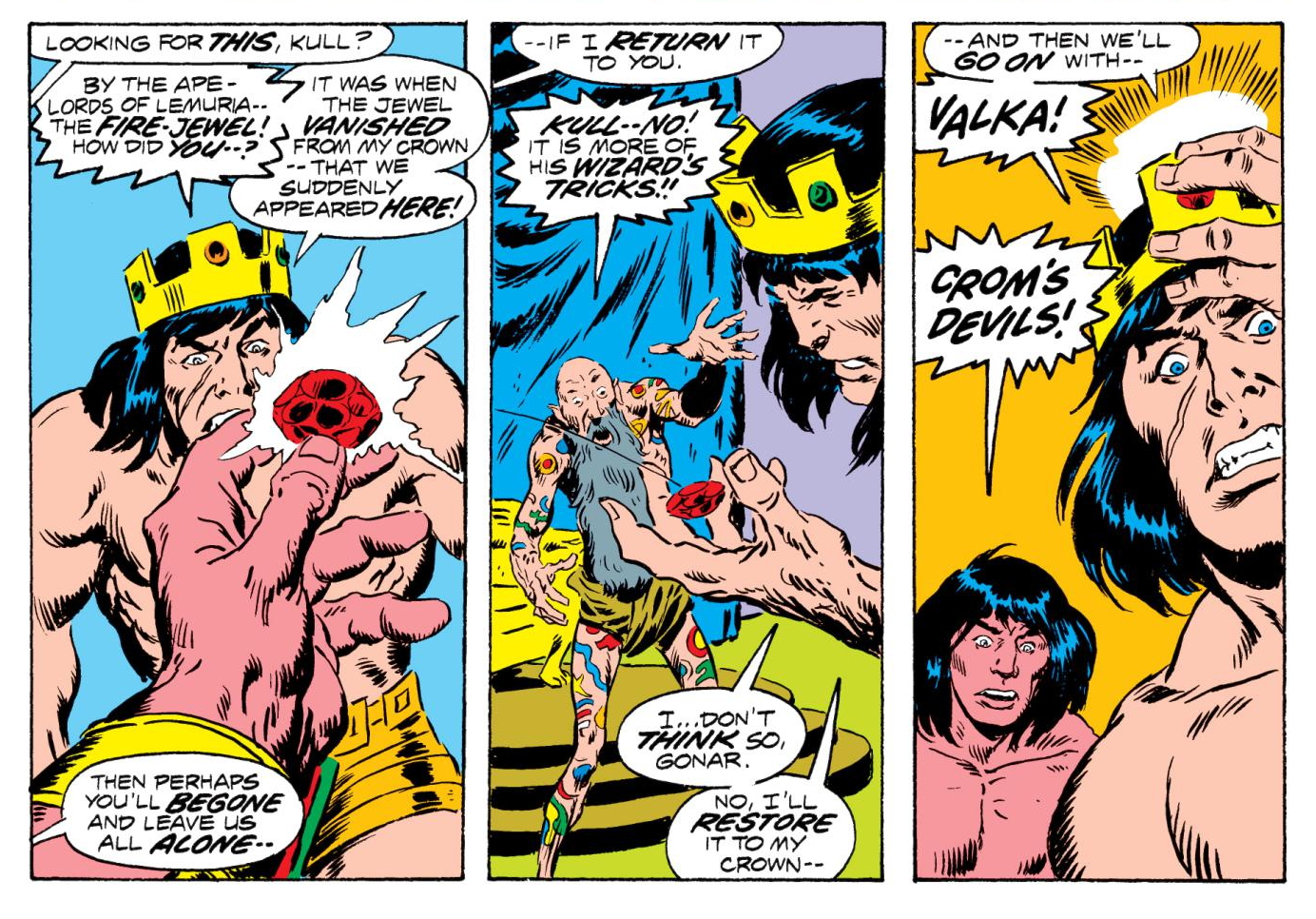
Brule the Spear-Slayer is a character taken directly from REH’s Kull stories who’d also be quite familiar to readers of Marvel’s Kull comics. Gonar, on the other hand, has a somewhat more complicated provenance. As Thomas explains in his 2019 book Barbarian Life: A Literary Biography of Conan the Barbarian, Volume Two:
As Kull’s chief advisor in this story I elected to use Gonar, who is a character in “The Kings of the Night” (a Bran Mak Morn story with Kull as a guest star), rather than a character who had appeared in any of the true Kull tales. Somehow, that “much-tattooed old man” seemed the right guy to put in, so I did.
Thomas may or may not be simply being cagey, here, but I figure that his inclusion of a character whose only appearance in the Howardian ouevre is in a story that teams up King Kull with another hero who’s supposed to have lived thousands of years later was a subtle way of tweaking any purists who might complain that having Kull and Conan meet was too “comic-booky”. (I could be wrong, of course.)

It’s interesting that Conan and Kull are given different skin tones; I suppose we can chalk it up to the Cimmerian being more “bronzed” from spending a lot more time outdoors than the king of Valusia, who probably has to be intentional about getting out of the palace for some sunshine, due to his royal responsibilities.

Of course, while REH might have used magical time-travel to bring his heroes Kull and Bran together across the span of millennia for “Kings of the Night”, one thing he didn’t do was have his heroes fight each other. That particular aspect of our story is pretty indisputably “comic-booky” — and what’s more, it’s particularly Marvel comic-booky, especially in the context of 1976.
Roy Thomas admits as much in Barbarian Life:
It’s often been said that the writers and artists of Marvel Comics strained too hard to get their heroes to fight each other, when often they should have been instant friends. And there is definitely some truth in that statement. Sometimes, the heroes seemed to fight only because Stan Lee (or later I, or other Marvel writers) felt that the readers wanted to see them fight. And since, by and large, the readers did want to see our heroes fight each other, we weren’t really wrong. It’s just that sometime it was all simply too formulaic, and not always adequately motivated.
However, Conan vs. Kull makes as much sense in the context of this story as Sonja vs. Bêlit does, or Conan vs. Bêlit in Marvel Feature #7. Each time any of the above pairs faced each other, there was always, I felt (and feel), more than enough reason to believe they would try at once to fight it out, rather than try to “reason together.” After all, in this story Kull has been time-displaced with his castle and his entourage, and has every reason to suspect that Conan and his females may be behind it… And Conan is no man to surrender his sword to a stranger who says he’s the fabled King Kull. After all, he may be lying — and who says the Cimmerian would give up his blade even to a Kull he knew was real?


Here’s more from Roy Thomas’ analysis of the Conan-Kull match-up, and his handling of it:
“Who’s stronger: Thor or the Hulk?”
This type of question, with its infinite varieties (using the Thing, Sub-Mariner, Iron Man, and other Marvel heroes, even before the Marvelians met Superman and his DC ilk), has always fascinated readers, even some who wouldn’t admit it once they pass the age of thirteen or so.
I myself would love it if an authentic Robert E. Howard story were discovered pitting these two against each other. But that wasn’t anything that interested REH or his 1920s–30s pulp-mag readers…
My own feeling is that Conan would be the winner, not just because he was generally described as being bulkier, but also because his sword prowess is more firmly established in the actual fiction of REH. After all, Kull is a king in all three of the prose tales published about him during REH’s short lifetime, and he doesn’t fight all that much in any of them — and certainly not against anyone of Conan’s caliber.
Well, maybe. And maybe Conan has to have the edge in the fight, ’cause he’s the bigger star, and it’s his book. At least that’s the way I remember these things generally going, back in the day.
But, in any event, the fight ends abruptly with no clear victor (that’s the Marvel way, after all)…
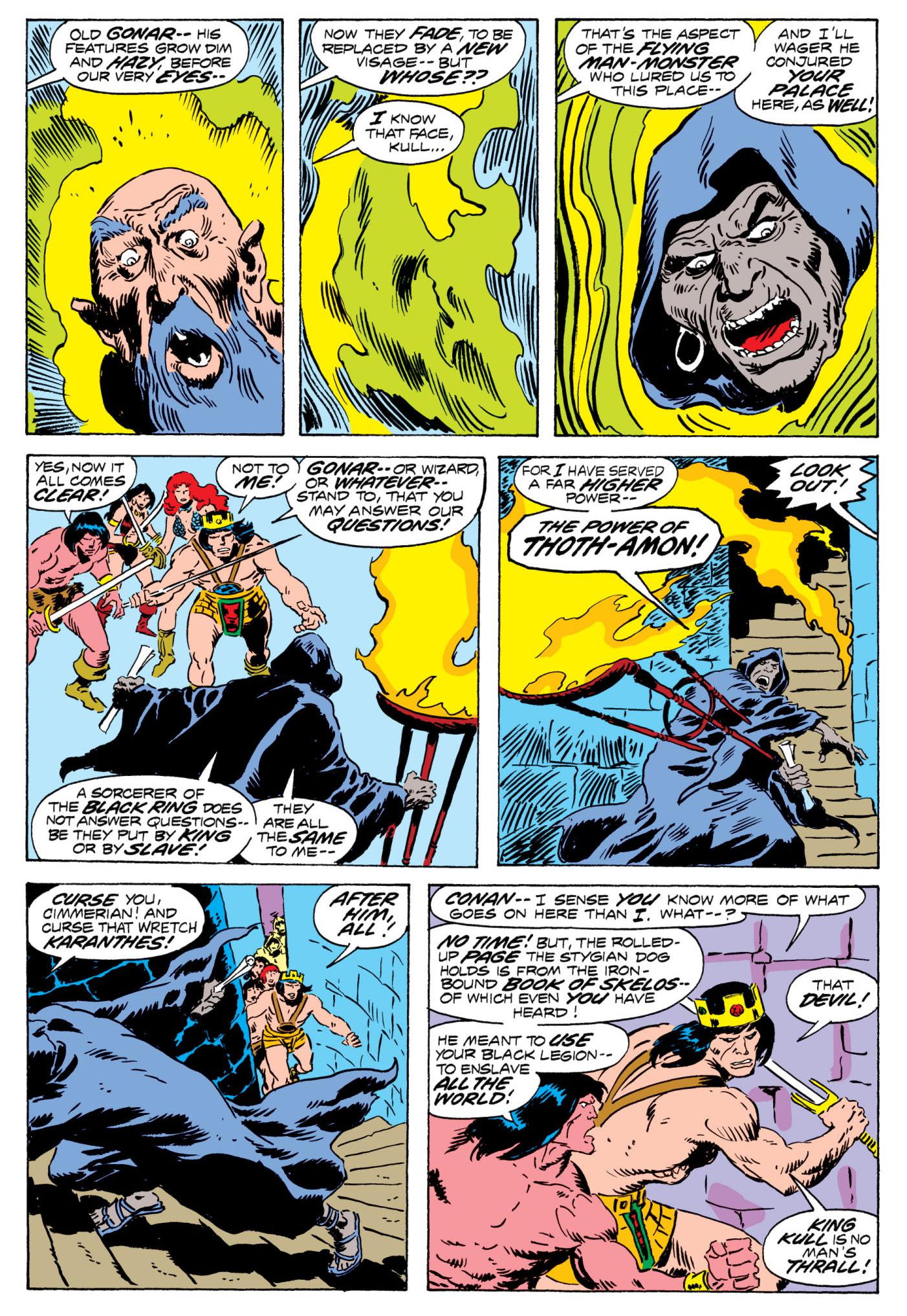


 Thoth-Amon’s cameo here visually echoes the first time he’d shown up in Conan the Barbarian, back in #7. As with that earlier issue’s equally visionary appearance (there rendered by Barry Windsor-Smith and Sal Buscema; see at left), a reader of the time might well wonder if the Stygian arch-mage had bona fide horns sprouting from his head — unless, of course, they’d read Conan Annual #2, published just a couple of months prior to Conan #68. That king-sized special had offered readers an adaptation of “The Phoenix on the Sword”, the only REH story to feature Thoth-Amon in the flesh — and, as indicated by Rich Buckler’s cover (see at right), it had made it clear that the horns seen both here and in Conan #7 are part of some sort of headdress, rather than being actually attached to the sorcerer’s skull. Ah, well — it’s still a cool visual.


And so we say goodbye to King Kull and company, as they return to… well, whenever in the Atlantean hero’s timeline the nameless Stygian’s spell had pulled then from. About all we can be sure of is that they won’t be appearing out of thin air on the first page of Kull the Destroyer #18, since that title will continue to follow the saga of a landless, throneless Kull — a stretch of adventures which might chronologically follow the episode we’ve just been reading about… or precede it. After all, one had to hope that Kull would ultimately defeat his arch-foe Thulsa Doom and regain his crown, so who could say? (As things turned out, Kull would eventually do just that — though not until July, 1978, when the 29th — and final — issue of Kull the Destroyer arrived on the stands.)

And so it ends. This final chapter of our five-part story arc definitely suffers from trying to accomplish too much in too few pages, leading to some regrettable results — for one, Conan’s co-star Red Sonja doesn’t get to do much of anything in it. (And is it just me, or is it odd that a multi-part crossover intended at least in part to encourage Conan the Barbarian readers to check out Sonja’s own series never pictures her on one of the Conan covers?) All in all, the whole saga suffers from some of the structural choices Roy Thomas has made, with over half of the five issues coming across like a prelude to the main event — a flaw that’s particularly noticeable when you read the whole thing through as a whole. That said, I’m pretty sure I found it to be mostly satisfying in its original serialized form back in the summer of 1976, and I still find a lot to enjoy in it, especially in its last two chapters.

Cover to Red Sonja #1 (Jan., 1977). Art by Frank Thorne.
From here, Red Sonja would be riding into her next solo adventure — which would appear not in the next issue of Marvel Feature (a title which Marvel was about to cancel for the second time in three years), but rather in Red Sonja #1… a development which suggests that the sales of Sonja’s headlining vehicle must have been fairly good even before the crossover. Frank Thorne would be staying on as artist, while Roy Thomas would be taking on assistants in the writing department, including Clair Noto and (at least for this first issue) Ed Summer (later to be known for his work on the first Conan the Barbarian movie).

Cover to Conan the Barbarian #72 (Mar., 1977). Art by Gil Kane. Ernie Chan, and John Romita.
Meanwhile, Conan and Bêlit would be returning to their life of piracy on the high seas… at least until Conan the Barbarian #72, when events would conspire to motivate Bêlit to launch her campaign against the usurper of her rightful throne in Shem somewhat ahead of schedule. That quest would continue (albeit with multiple digressions) throughout most of the rest of Bêlit’s tenure in this title; I hope you’ll join me for our look at its beginning, coming your way in December.
John Buscema could draw the human figure in his sleep, but this is the first time I’ve ever seen him almost swipe himself. Two years later How to Draw the Marvel Way was published, and there is a rear view of Spidey in it that looks awfully close to the back view of Conan in your second scanned page, and a another in a final panel of a page with King Kull and this drawing of the Sub-Mariner:
https://cafans.b-cdn.net/images/Category_74/subcat_162339/pm7xZqM1_2711141240381.jpg
When one drew as prolifically as Buscema did, some repetition is unavoidable, but this still surprises me somewhat.
Frank Frazetta once did a painting late in life, after a series of debilitating strokes, that really pleased his children—-then suddenly he wiped it out, realizing he had already painted a figure in the exact same pose many years earlier.
That cover to Kull the D #16 – the Kirby-esque leaping pose and poor anatomy, even the background ‘tiger-totem’ looks more Ron Wilson than Ed Hannigan to me?
Fraser Sherman correctly picked me up in the comments on the last chapter that all Marvel cross-overs or team-ups from this period are going to be unresolved stalemates, as you note and even Roy Thomas admitted. It just feels to me particularly noticeable in this whole story where we have one unresolved stalemate after another: Sonja/Bêlit: no clear winner, Conan/Sonja: no clear winner, Conan/Kull: no clear winner. What was the point of setting up this series of bouts anyway?
I loved John Buscema’s art as much as anyone, but I would have to admit that this looks like he was trying to avoid the ‘economic hit’ you mention, and complete this artwork in the time he would normally spend doing layouts only. I think this might be the poorest complete art job he ever did. Everything looks ‘bare’ and unfinished and the layouts are somewhat pedestrian (or over-used, as MofB notes). I’d liked to have seen each of the unresolved stalemates produce at least one poster-worthy full-page confrontation scene, especially here when all we got was a lower-tier panel of Conan and Kull in very static poses, and then a fairly tedious (and short) fight sequence. I very much doubt that any Nemedian chroniclers will be ‘singing about this grim tableau for untold eons to come’, unless they’re desperate for lyrics.
All in all, this whole story was a disappointment when it could easily have been a classic.
Ed Hannigan was hired to do a lot of cover layouts for Marvel in the mid-70s which other artists finished, such as Astonishing Tales no. 31 (with Deathlok, covered on this blog) and Giant Size Chillers no. 3, both of which were inked/finished by Berni Wrightson.
It seems slightly familiar so I think I read at least this installment. I liked Kull a lot more than I did the other three. I hazard to guess the battles never having a winner also has to do with not alienating fans of either character. I guess disappointing both camps was preferred.
I didn’t read this one when it came out, but knowing my 15-year-old self as well as I do, I would’ve stamped a big “OK” on it. Fun seeing King Kull and Red Sonja. Not as much hacking and chopping as I might have liked. It also had John Buscema art that was every bit as bland as I thought he was doing in both the Avengers and Fantastic Four at that time. And that would’ve been it. I can’t say there would have been any reason to read this one again.
Which is the true shame. Think about it. You’ve got Conan the most barbarianiest dude around. Paired with a scantily clad pirate who has the hots for him. Then there’s King Kull, who earned his throne by kicking serious ass. Add to all of that is the exciting force of nature calling herself the Red Sonja. Consider each of those headstrong personalities. All ready to initiate some slinging of steel with merely a wrong look. Toss in an enigmatic wizard and/or some visually appearing master wizards and you’ve got the ingredients for an outstanding crossover.
Imagine these past five issues with a story that pairs up Belit and Red Sonja for an issue that forces them to learn about one another. Picture Conan and Kull buddying up to tackle some nasty demon warriors – exchanging boastful commentary amid blows. Or actually having that parchment’s spell or power unleashing horrors that require all of them to somehow get past their squabbles to win the day.
Of course, such meticulous plotting was not Marvel in the mid-70’s. Given every other plate Roy Thomas likely had spinning, we’re fortunate he remembered enough about this story to keep the narrative straight and avoid having to stick a reprint somewhere into the mix.
Fortunately, we exist in a more stable world where once I’ve finished my Saturday morning run, it’s me, a pot of coffee, some cool music in the background (Talking Heads this morning!) diving headfirst in another amazing review courtesy of Alan!
“Structural choices,” indeed. As others have already done, I mourn what this crossover could have been as opposed to what it actually was. I understand the attraction of a five issue crossover between Conan and Red Sonja, but if you chop away the waste (bye, Yusef and Tara), you could have squirreled this down to a tight three issues: one, where Conan, Sonja and Belit meet and reluctantly team up, and then the two issue crossover with Kull. It could have contained all sorts of interesting character work, especially between Sonja and Belit and it would have been a good opportunity for Conan to get a look at his future self by way of Kull. Sigh. Comic book production in the 70’s was about speed and quantity and quality often came in third, if at all. As such it often produced poorly thought-out stories that settled around the lowest common denominator. It’s a shame. Thomas was a writer capable of far more than what we got here, and he certainly had the passion for the cast of characters, but it seems that, with his editorial duties and numerous other writing assignments, he just didn’t have the time to get this one completely right. Thank god, Big John took the time to ink his own work for a change. Aside from the novelty of the multiple crossovers, that really is the only thing to recommend this issue. Thanks, Alan!
I must have read this issue before but I have absolutely no recollection of it. Coming to it afresh, the story is ok but not great – although Conan was one of my favourites back in the day, this feels like a throwback to the period between Barry Windsor-Smith’s departure and the introduction of Bêlit, during which lots of stuff happened but the overall story didn’t really seem to progress.
It was nice to see King Kull back – like you, Alan, I thought the new direction that Roy Thomas introduced with “By This Axe I Rule” was a misstep. The tension between the barbarian Kull and his civilised-going-on-decadent subjects was what made the original series interesting and after that went away, the series lost its focus and individuality.
I wonder if John Buscema was being particularly vocal around this time about his dissatisfaction with his inkers – he also inked his own pencils on Fantastic Four 175, which had appeared the previous month. Unfortunately the results there were no better than they are on this story; both look careless and skimpy. The rendering of Sonja’s hair here is particularly poor – just a few random lines here and there rather than any attempt at modelling her crowning glory. I’m going to put that down to John rushing to make deadlines as there are plenty of examples of self-inked art from both earlier and later in his career that look infinitely better.
Thanks Alan!
Buscema probably thought that any fussy linework in Red Sonja’s would have turned to mud in that era of cheaper printing anyway. In many ways, the mid- to late ’70s was the nadir of comics for me. At least the magazines gave some of the artists better printing (and better pay). In the early ’80s the baxter paper made the printing a little better, but those *deep* black inks in the interior pages of the golden, silver, and early bronze age were gone, as were the rich hues used on covers in those prior time frames as well.
Thanks for yet another excellent review Alan. I am certain I found this to be an entertaining series of issues at the time, but you have of course, pointed a number of things that I am sure that I did not notice at the time such as that Red Sonja didn’t have much to do in Conan 68. Still, this crossover accomplished what I suspect was intended. I was not buying the Marvel Presents/Red Sonja series at the time, and I am fairly certain that I did buy Marvel Presents 7 as part of the crossover. I don’t recall if I bought Marvel Presents 6 although it did look familiar to me. It is interesting that there was no announcement at the end of Marvel Presents 7 that the next issue would be Red Sonja 1. I have the vague memory that I did buy Red Sonja 1 in October 1976, but I did not continue buying that series. I don’t remember why except that this was a very down time for my comic buying even of Marvel books. I was in college, and just seemed to have less time and interest. Also, I believe I was not much of a fan of Frank Thorne’s art, although I have come to appreciate him more now and he certainly draws a great and sexy Red Sonja. But you can certainly see his Kubert influences very clearly.
By the way, there is an inadvertent typo above. You discussed and showed a picture of Conan Annual 2 but referenced Conan Annual 1 (which was al reprint from 1973.
Regarding John Buscema penciling and inking Conan 68, he had previously done the same in Conan 38 and 39. This would be the last time he would pencil and ink an issue of Conan during Roy’s first run as writer (for reasons you stated above, and reasons that John stated in numerous interviews). However, John would pencil and ink numerous Conan covers later on, such as Conan 96, which was quite impressive. I thought this (68) was actually a nice looking issue. I mention that because the previous month, July 1976, John Buscema penciled and inked FF 175. The story, again by Roy Thomas, was fine. However something was off with the art. I don’t know if it was the printing but it just didn’t look right; it had a very rushed feel to it. Was it just because Joe Sinnott was missing from this issue? I don’t think so. If you compare FF 175 and Conan 68 it just seems like something went wrong, perhaps with the printing process. Of course, it could also be that Joe Sinnott was really integral to the FF series at this time.
It is also interesting to note that John Buscema was truly the preeminent artist at Marvel at this time. During this year, Roy brought John in to draw the FF Annual 11 with the Invaders. When there were deadline issues with the FF, John drew FF 173-175. John also was brought in to draw Avengers 152-153, and when Bob Brown was sick, John drew DD 136-137 and even drew the covers for those issues. However it appears that led to other deadline issues. Thor had to go reprint in September 1976 with Thor 254. And Conan 69 was drawn by Val Mayerik and the “Tribe”. This appears to have been a fill-in/flashback issue which could have been prepared for Savage Sword but just as easily could have been slotted for the color series.
Another interesting point: from Conan 44-68, there would be numerous different, and perfectly fine inkers for John Buscema, but no one that had stayed as long with him as Ernie Chan. And then Ernie Chan returned with John Buscema in Conan 70, and this time, Ernie Chan would stay with this series until the end of Roy’s first run as writer (and beyond).
I agree with your comments about Kull, Alan. I found the character much more interesting as King Kull. I remember seeing the new Kull 16 on the stands, but when I saw that he would just be a wandering character, I passed. Roy passed the scripting for Kull on to Doug Moench and then Don Glut while he continued to edit the Kull series, but I don’t believe that series could have been saved even if Roy was writing it.
One last comment: even though Roy decided not to return as editor-in-chief in 1976 he did have a little corner of series he was editing and mainly writing: a group of S&S series, Conan, Red Sonja, Kull and Savage Sword, and Fantastic Four and Invaders. By the end of 1976 he would add What If and relinquish FF, but in 1977 he would add Tarzan and Star Wars, so he was quite a busy man.
Thanks again for the review Alan and for noting that the so called villain of this story never even got a name!
Thanks for the catch on the typo, brucesfl! Fixed now. 🙂
About three years from now, “Knights of the Night” will receive a Marvel adaptation in “Savage Sword of Conan” #42. There we meet the true Gonar and also another one. Apparently REH was very fond of that old pet peeve of mine, the reincarnating person.
I must be quite the Roy Thomas fan at heart. I can see the drawbacks of this five-parter and I do find the art here rather unpolished (still, John Buscema). It is still a rather engaging story to me.
Don’t have much to add, although Buscema did a good enough job of making Conan & Kull physically distinct enough to tell them apart even without the differing hair styles and skin tones. But, yeah, anytime such characters get into such a brawl, it’ll usually end in a draw, some sort of cheat, or something will happen to distract them from the fight to confront someone else together. Although when it’s a serious mismatch, such as Daredevil taking on the Hulk, without any cheat to have Hulk transform into Bruce Banner before any real fight, well, DD survived but had to recuperate in a hospital.
As of August 1976, I still hadn’t gotten into adding any sword & sorcery comics to my collection and the contents of this story are all new to me. Entertaining enough with plenty of swords and sorcery. Amusingly, at my county courthouse probate department job, I recently came across a case of a decedent whose surname was Kull. A search on Wiki states that the name is of north German/Scandinavian origin and derives from a word meaning “hood” or “cowl”. The name “Conan” is of Gaelic/Celtic origin, from a word meaning “little hound” or “little wolf”, but with other meanings of being “high”, “wise” or “exalted”. I wonder if Howard was aware of any of these meanings to the names he selected or if he simply had heard of them and thought they sounded apt for his fictional barbarians.
Or maybe he liked Sherlock Holmes’ author.
Well, Arthur the Barbarian might have found that no-one would take him seriously…
Not even if he proclaimed, “I am King Arthur the Barbarian, King of the Britons, master of the realm and your king” in Graham Chapman’s most serious, stentorian and not silly at all voice??? Would they throw chickens, a dead cow and a large wooden rabbit at him?
Howard was proud of his Irish/Highland Scots heritage and even had some Gaelic.
Also, “Conan” is still used as an Irish first name, where it is seen as cognate to the English name, Walter.
“
“I’ve no great love for men who claim to speak for gods too far away to talk for themselves…”
That’s a pretty good line of dialogue that Roy Thomas gives Conan in this issue.
Anyway, recently in other installments of Alan’s excellent blog, we’ve been discussing that Steve Gerber probably had too many plates spinning simultaneously on his lengthy “Headmen / Nebulon” saga in The Defenders. I think that Thomas unfortunately had the same problem with his five-part crossover between Conan and Red Sonja’s titles. So, yes, I agree with Alan, there’s just too much going on. Especially considering the fairly superfluous chapter in the previous issue involving Yusef & Tara. And I agree, it’s unfortunate that both Sonja and Belit have very little to do in this final chapter.
Still, an epic swordfight between Conan and Kull is pretty exciting, especially as rendered by John Buscema turning in a rare job of full pencils & inks.
By the way, I noticed that we never did find out the name of the shape-changing sorcerer who was working for Thoth-Amon.
So, yeah, this crossover is not one of Thomas’ better efforts, but it’s not a complete washout, either.
I agree: that is a good line of dialogue from Roy, and it remains good advice. Beware of anyone who claims to speak for a god or gods, whatever the religion.
The UK has had some great men of God who made a lasting impact upon their and subsequent generations, such as John Wesley (founder of the Methodist church), Hudson Taylor (founder of the China Island Mission), C.T. Studd (famed cricketer-turned-missionary to the Congo), to name but a few. They were credible witnesses for Christ and did not deviate from the Scriptures (unlike a number of charlatans out there today who simply want your money).
It’s always been a problem, at least as far back as when Chaucer was writing about the Pardoner in the Canterbury Tales. Any organization, if it grows large enough, will generate rotten apples alongside the good fruit.
I agree with whoever said above this would have worked better with Belit/Sonja and Kull/Conan as allies rather than fighting.
I disagree with everyone who said this was the best we could expect — Roy did better at many points in Conan.
At the time I found this enjoyable enough but not one of their more exciting tales. While there are Howard fans who prefer the moody Kull and his somber stories to Conan, I’m not one of them (and I’m not alone. Conan’s a name to conjure with, Kull is bar trivia). I don’t think I ever read Marvel’s Kull and I only skimmed a couple of issues on the newsstand. So Conan vs. Kull didn’t excite me at all.
I like the Kull comic. I thought Andru & Wood and the Severins were wise in giving that book a late Roman/Romaioi vibe and Gerry Conway did some of his best early work on Kull, the since of an outsider learning to rule people of a different culture was palpable but did not ober shadow the story.