
Regular readers of this blog will recall how, three months ago, we celebrated “Marvel Milestone Month” in honor of four long-running Marvel series all having hit significant numerical markers in May, 1976. Today, we’ll be looking at yet another comic that signified a notable Marvel milestone of that year, coming out as it did on the fifteenth anniversary of the launch of the Fantastic Four title back in August, 1961 — although, as best as I’ve been able to determine, no one took much notice of that fact at the time.
As Roy Thomas writes in his 2014 introduction to Marvel Masterworks — The Fantastic Four, Vol. 17:
I wish I could tell you that in 1976 artist George Pérez and I planned FF #176 as an anniversary celebration of “The World’s Greatest Comic Magazine” marking a decade and a half on the nation’s newsstands. But we considered it just one more monthly issue — except that, by my lights, and those of quite a few other people since, it wasn’t.
Thomas goes on to note with some pride that Fantastic Four #176 has gone on to “become one of the most-reprinted issues of FF after the [Stan] Lee/ [Jack] Kirby era.” While your humble blogger can’t claim to have thoroughly fact-checked this assertion, the Grand Comics Database does indicate that the story has been reprinted some fifteen times… which seems pretty darn respectable for a regular issue of an ongoing series that doesn’t feature any major “key” events, such as the debut (or death) of a popular character. And speaking just for myself, this is the one issue of Fantastic Four published in the back half of the Seventies that I’ve always known I would write about, assuming the blog ever got this far.
So what’s so special about this one? Well, if you’re altogether unfamiliar with it, you can get a hint from a close examination of the issue’s cover by Jack Kirby, Joe Sinnott, and John Romita. For more details, however, you’re going to have to wait just a bit, as it’s been more than a minute since we last looked in on the FF, and there have been goings-on both “in-universe” and behind the scenes that it behooves us to touch on at least briefly before jumping into our main event.
First, let’s catch up on the changes on the creative side of things since our last Fantastic Four post, which was all the way back in June, 2024, and concerned issue #150 (another milestone, incidentally). As you may recall, at that time the series was being written by Gerry Conway and drawn by Rich Buckler, both of whom had been at those jobs for a while. Conway would depart the gig following #152; after a handful of issues scripted by Tony Isabella and Len Wein, Roy Thomas then came on board as both writer and editor, resuming a role he’d previously held for a short stint back in 1972. Buckler, on the other hand, hung around longer, but ultimately did bow out with #163, and was succeeded by George Pérez. It’s thus the Thomas-Pérez team, joined by perennial FF inker/finisher Joe Sinnott, that we’ll find in place for issue #176 — although it should be noted that several other talents had done some pinch-hitting over the most recent run of issues, including Buckler and John Buscema filling in on art, and Bill Mantlo doing the same on script.
Now, for the stories themselves. Looking back again to FF #150, you may remember that that issue saw the marital reconciliation of Reed and Sue Storm Richards following a fraught period of separation; despite that development, Sue’s temporary replacement, Medusa of the Inhumans, continued to serve with the team through #159, at which point the Invisible Girl returned to full-time active duty. Otherwise, the only major development affecting the team’s membership during this period was one involving Ben Grimm, the Thing.
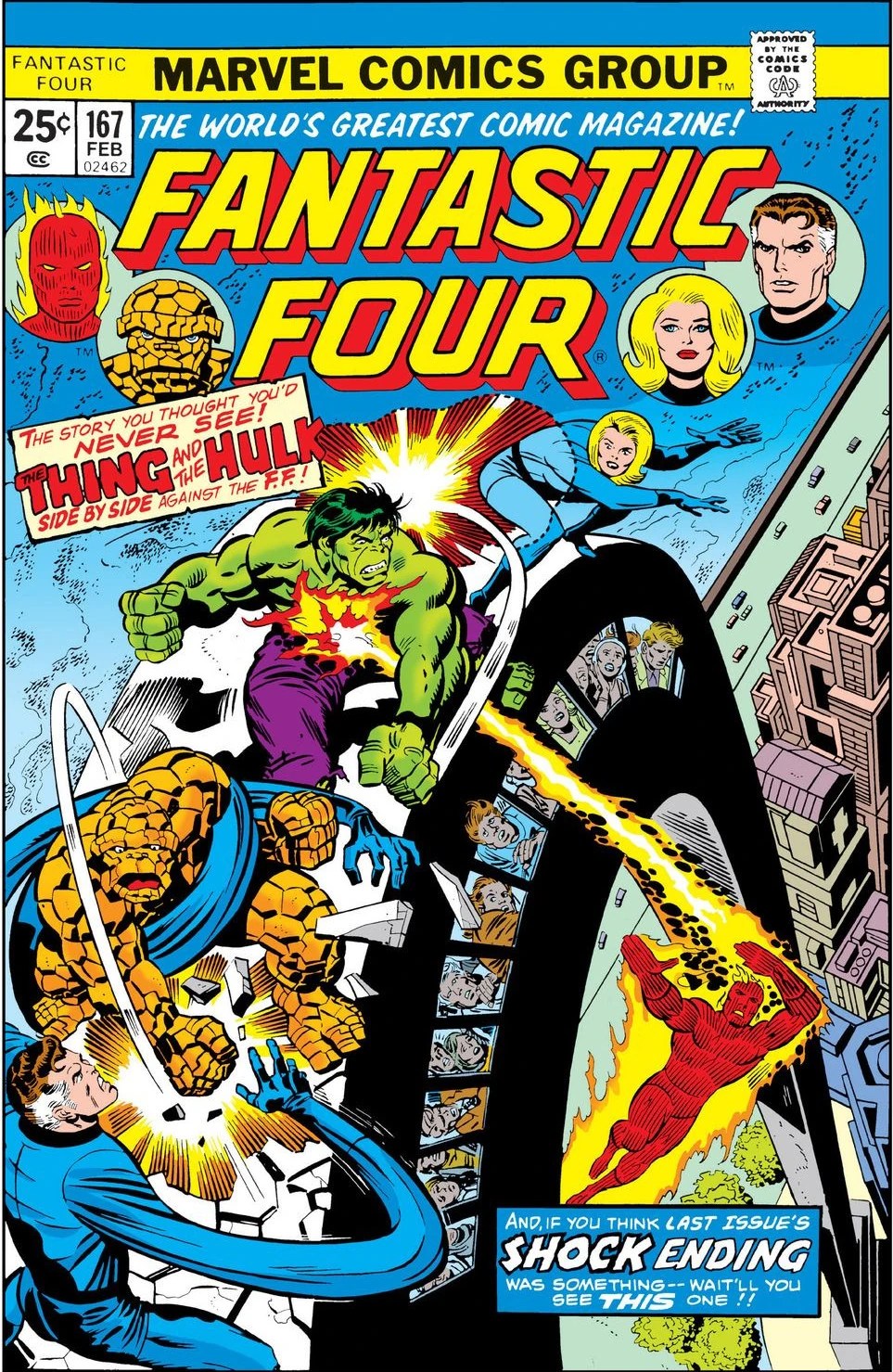
Cover to Fantastic Four #167 (Feb., 1976). Art by Jack Kirby and Joe Sinnott.
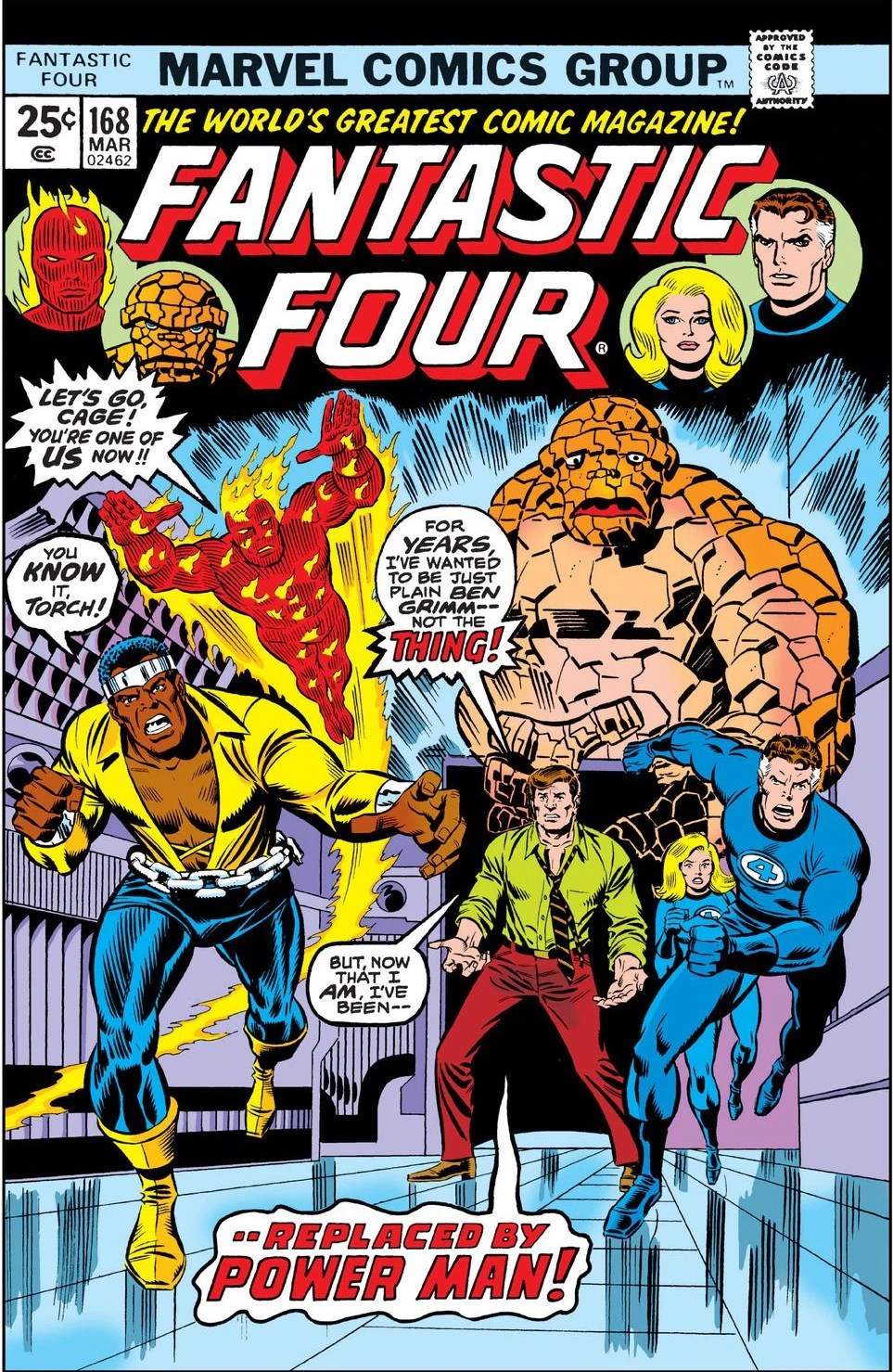
Cover to Fantastic Four #168 (Mar., 1976). Art by Rich Buckler and Joe Sinnott.
In FF #167, the latest confrontation between the Thing and his old sparring partner the Hulk — which had already taken a surprising turn by having the two heavy-hitters decide to stop pounding on each other and team up, for a change — ended with an even more startling twist, as prolonged exposure to the Hulk’s gamma-irradiated bod had an unanticipated effect on Ben, causing him to revert to his normal human self. You’d think that after almost fifteen years of moaning about looking like a monster, the guy would be celebrating the good news — but instead, he almost immediately caught a really bad case of the sulks when, in the very next issue, Reed hired Luke Cage, Power Man to replace him on the team’s roster. Thankfully for the mopey Ben, this turned out to be merely a temporary arrangement, meant to last only until Mister Fantastic could finish building his oldest friend a “Thing suit” — an exoskeleton that, when worn, would give Ben back most of the strength and durability he’d enjoyed as his old rocky self. First donning the suit in issue #170, Ben was on hand and ready to go for the kickoff of the title’s next big storyline in #171; continuing through FF #175, this arc led directly into our main topic of discussion today, so we’ll be spending a little time with it before turning to #176.

Cover to Fantastic Four #173 (Aug., 1976). Art by Jack Kirby, Joe Sinnott, and John Romita.
The Big Bad for this five-parter was Galactus, Devourer of Worlds, returning to our solar system intent on chowing down on one of its planets for what even in 1976 felt like the umpteenth time. There was an interesting wrinkle on this particular occasion, however, as the planet the Big G had selected to sate his appetite wasn’t our own Earth, but rather Counter-Earth — the more-or-less exact replica of our world that had been created by the nigh-omnipotent entity who called himself the High Evolutionary. Introduced by Roy Thomas and Gil Kane back in the first “Warlock” story in Marvel Premiere #1 (Apr., 1972), Counter-Earth had been pretty much out of sight and out of mind ever since its “savior”, Adam Warlock, left it to go gallivanting across the cosmos at the end of Hulk #178 (Aug., 1974). Evidently, Thomas had decided that if neither Warlock’s most recent chronicler, Jim Starlin, nor anyone else was going to make use of his co-creation, he might as well do so himself.

Cover to Fantastic Four #175 (Oct., 1976). Art by Jack Kirby and Joe Sinnott.
Summoned to Counter-Earth by the HE to help fight off Galactus, the FF were offered two alternatives by their old foe; they could find another suitable planet whose inhabitants would willingly (and unanimously) agree to be consumed by Galactus, or they could pick an equally suitable inhabited planet they themselves wouldn’t mind letting him eat. The latter option was essentially a non-starter, and though the team gamely gave the former a try, their efforts seemed doomed… that is, until the climactic scenes of #175. wherein the Invisible Girl came through with a planet whose populace were indeed ready and willing to be devoured. Taking these accommodating folks up on their offer before they could change their minds, Galactus proceeded to drain the planet dry — only to have an extremely negative physical reaction. As the FF and HE watched on the latter’s viewscreen, the purple planet-eater screamed in agony, then collapsed; in the end, he was only saved from extinction by the High Evolutionary’s technology, which transformed Galactus into pure inorganic energy… perhaps forever!

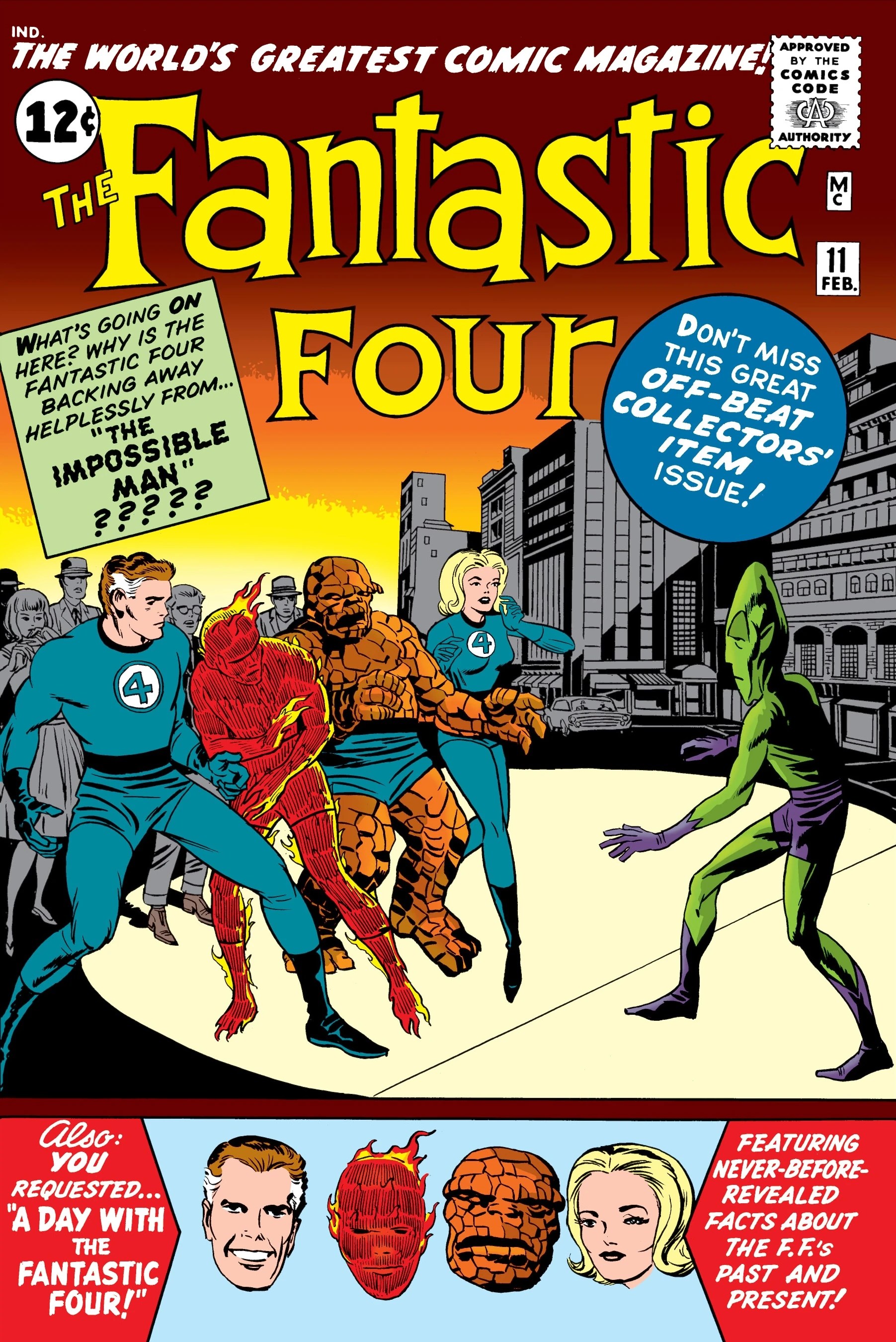
Cover to Fantastic Four #11 (Feb., 1963). Art by Jack Kirby and ?.
This was the second appearance of the Impossible Man, whose only previous outing had been all the way back in 1962’s FF #10. In that Lee-Kirby classic, the comical-looking alien from the planet Poppup had journeyed to Earth for a fun vacation — but though he was completely without malice, his particular notion of “fun”, lack of impulse control, and formidable shape-shifting powers had combined to make him an inadvertent menace. In the end, Mister Fantastic had managed to trick the Impossible Man into changing his holiday plans by getting everyone in New York City to ignore the antics of their strange visitor, thereby causing him to become bored enough to leave our planet… forever! (Now where have I heard that before?)

I’m sure it went right over my nineteen-year-old self’s head in 1976, but the one-two of “Good Lord!” and “Choke!” in that last panel is a not-so-subtle tribute to EC Comics — the 1950s publisher whose twist-ending short stories often ended with one or more characters making those same exclamations.
Anyway, after bidding farewell to the High Evolutionary and his right-hand man super-evolved ape, Gorr the Golden Gorilla, the FF boarded HE’s spaceship for the return ride home. Accompanying them — whether they liked it or not — was the Impossible Man.
En route, Ben Grimm began to feel unwell. Thinking it might help, he took off the helmet of his suit, prompting a comment from the team’s new hanger-on: “I always thought orange was your natural color.” “It useta be, pal,” Ben begins to explain, “but not any more.”

Once the transformation had begun, the rest went all to quickly. Within moments, Ben Grimm had once more become the one and only, genuine, original Thing — and his exoskeleton, shattered by the expansion of Ben’s once-more truly rocky physique, lay in ruins.
And that brings us at long last to Fantastic Four #176 — and the return of George Pérez on pencils and Joe Sinnott on inks (following John Buscema’s handling of both jobs in the previous issue) — just in time for them to show everyone they knew at Marvel Comics how good they were at drawing their likenesses… though maybe I’m getting a little ahead of myself, here. Ahem.


Reed recalls how, while the FF were battling Galactus on Counter-Earth, the world-eater had struck Ben with a powerful energy bolt. Though the bolt had seemed to do no harm at the time, it’s clear now that its effect was only delayed until the team were on the ship heading home, at which point “Ben suddenly burst out of the exo-skeleton… like a butterfly coming out of its cocoon!”

Perhaps Ben’s teammates seem a little callous in their attitude that Ben should just get over it, already — but in their defense, his incessant moping in the first issues immediately following his “cure”, when he seemed a lot more bummed out about being sidelined as a superhero than enthused about the opportunity to begin a new, normal life with Alicia, had become pretty grating.
As to the implication that he’s come back as a bigger, stronger Thing, I think we can chalk that up mostly to Roy Thomas not wanting it to seem as though the entire plotline had been entirely without consequence, and that the team was now returning to the same old status quo. That said, I don’t think much was ever made of the Thing’s “upgrade”, story-wise — I’m not sure it was ever even mentioned again, following Thomas’ run — so, for all practical purposes, it really was a return to the status quo. (Not that there’s necessarily anything wrong with that.)


“…hit the Lake near the 60’s…”
“…from the Zoo to Morningside Heights!”
For a guy who’d just moved to Los Angeles, Roy Thomas was sure being liberal with the New York City geographical references. Was he feeling homesick, already?

Johnny Storm hesitates to leap into the Lake, worrying that he’s too winded to hold his breath long enough to reach the submerged spaceship. But it turns out that he had no need to fret, as his sister Sue was able to enclose the vessel in a force-bubble before it hit the water, and it swiftly bobs back up to the surface, all occupants unharmed. Within a minute or two, the weary team — and their uninvited guest — are exiting the park…


I guess it stands to reason that even with all the superpeople slugfests, alien invasions, and other extraordinary events that have occurred in the Marvel-Earth version of New York over the years, there might still be at least one wiseguy who refuses to believe any of it until he’s seen it with his own eyes. It’s an amusing idea, at any rate.

Per a text piece Thomas wrote for FF #176’s letters page concerning this story’s genesis, the scene above was one of the earliest ideas he had for it — “mainly because I’ve always wished I could do that to somebody who edged into the crosswalk at a stoplight.” While one can certainly understand the cathartic appeal of such wish-fulfillment writing, this does seem a little excessive a reaction on Ben’s part — and the kind of thing that could make a reader more sympathetic to the ordinary citizens of the Marvel Universe on those infrequent occasions we see them call for the authorities to rein in these so-called heroes just a little. On the other hand, I may well be taking this story a good bit more seriously than its creators intended… so, moving on…

If only for the specificity of that “Conjure” T-shirt, I’d wager that June and her unnamed companion are based on some real-life personages then known to either Roy Thomas or George Pérez, or both… but I have no idea who that might be. Anyone else care to speculate?

Your humble blogger doubts that many –if any — readers of this blog need for me to identify the four gentlemen pictured in the last panel above; but, just to be on the safe side, from left to right we have George Pérez, Stan Lee, Roy Thomas, and Jack Kirby — a quartet of comics creators who, as noted by Thomas in his Marvel Masterworks intro, “in Real Life were never in the same room at the same time”, but whose appearance together here seems altogether fitting: the two men who’d originated Fantastic Four, side-by-side with their then-current heirs.
For those unfamiliar with it, the conceit that, in the fictional world we call the Marvel Universe, a company named Marvel Comics publishes licensed adaptations of the true adventures of the FF and other superheroes goes all the way back to Fantastic Four #10 (Jan., 1963) — just as indicated in “Rascally” Roy’s footnote, above. (Although that’s just talking about “modern” — i.e., post FF #1 — Marvel continuity; in fact, depending on how one views the canonicity of the comics published by Marvel [then known as Timely] during the Golden Age, it can be argued that the Stan Lee of Marvel-Earth started hobnobbing with costumed super-people as early as 1941.) Ever since then, fictional doppelgängers of Marvel staffers and freelancers have shown up every so often in the publisher’s comics… although this longstanding tradition may soon face some novel challenges, given the recent announcement that Marvel Comics will soon be moving its offices and attendant personnel to Burbank, CA, while its star characters like the FF, Spider-Man, Daredevil, etc., will presumably remain based in the Big Apple — thus making it a little harder for members of the two groups to cross paths.
But, we digress. Let’s return now to our story, picking up right where we’d so rudely interrupted that preeminent idea-man, Jack “King” Kirby, just as he was about to share his latest brainstorm…

According to Roy Thomas’ Masterworks introduction, negative fan reaction to the Impossible Man’s debut in FF #11 was the chief reason the character hadn’t appeared again since:
As a reader, I loved that story, which reminded me of a 1950s science-fiction novel, Martian[s], Go Home! by Frederick Pohl. I wrote and told Stan so, only to be advised that he was unfamiliar with that book.
So, naturally, when in the early ’70s I became one of the first post-Lee FF scribes, I wanted to bring back the Impossible Man. But I’d known, ever since coming to work for Stan, that in ’62 there’d been an outpouring of letters from fans who absolutely hated that yarn and never wanted to see Impy again! Stan took them seriously and wouldn’t let me use him in a story.
By 1976, however, Stan was more willing to accept the judgment of his writers and editors (and I was both), so George and I plowed ahead…

Evidently, the idea of Impy using his shape-changing powers to mimic aspects of Marvel’s heroes wasn’t part of Roy Thomas’ original plot for the issue. As he explained in the issue’s “The Story Behind the Story” text piece:
…as I was plotting the tale… [production manager] John Verpoorten and [art director John] Romita informed me that if I wanted Jack “King” Kirby to pencil the cover for F.F. # 176, I’d better give him a coast-to-coast phone-call right away and describe a cover scene to him…
So I called Jack. Yes, he said, he vaguely remembered the Impossible Man. The thin green guy with the pinhead, right? I said right. And here’s the important part: I asked Jack to have Impy, on the cover, using some of the gimmicks George and I had planned for the interior, such as hosing the Human Torch and hammering the Thing.
But, as Jazzy Johnny Romita always said: “Jack at his worst is better than most guys at their best!”
And not only is Jack seldom at his worst — but on this cover, he was definitely at his best!
A few days later, I got this strange penciled cover in the mail which was just what I’d asked, except that Impy was blasting the F.F. with hands shaped like Iron Man’s glove and Thor’s magic hammer! And there was even a note suggesting he could have shaped a fist like Captain America’s shield! Immediately I saw Jack’s reasoning: this was the Marvel Comics office, right? So why not have him using Marvel-type gimmicks?
Ten minutes later I was on the phone describing the cover to George, and we instantly decided (since George was just beginning to draw the last half of the book) to utilize Jack’s ideas…

That’s Marvel writer/editor Marv Wolfman coming into frame in the third from last panel above — while the legs extending into the panel from the other side apparently belong to his then-wife Michele, who happens to have been the colorist for this very issue.
As for “Jumbo” John Verpoorten, he was of course a longtime inker at Marvel, as well as its production manager — and while he never did any credited work on Jack Kirby’s adaptation/continuation of 2001: A Space Odyssey, he had recently embellished Kirby’s pencils on the first four issues of The Eternals, and had a couple of Captain America jobs with the King coming up soon after this, as well. (Sadly, Verpoorten wouldn’t have too many more opportunities to appear on-panel following this story, as he would suddenly and unexpectedly pass away just a year and a half later, in December, 1977.)

George Pérez’s graphic storytelling is just great throughout this whole story, using varying page layouts and camera angles to keep things visually interesting without ever sacrificing clarity, and also maintaining a breakneck pace that still leaves room for every gag to land.

In the first panel above, “Marie” can only be legendary penciller, colorist, and production staffer Marie Severin — an artist whose gift for likenesses had seen her pulled in on various occasions (sometimes credited, sometimes not) to keep Stan, Jack, et al “on model” for their cameos. (It’s an indirect testament to the talents of George Pérez and Joe Sinnott that one doesn’t miss “Mirthful” Marie’s touch in this story… well, not much, anyway.) Meanwhile, “Jim” might be either Jim Shooter or Jim Salicrup, both of whom were on staff at Marvel at this time.
The second panel includes a great visual gag regarding the high turnover in the editor-in-chief position at Marvel since Stan Lee’s promotion to publisher in 1972. Back in 1976, certain aspects of the joke likely went over the heads of virtually everyone who wasn’t actually then working for Marvel — since, to the best of my knowledge, Roy Thomas’ last-minute decision not to return to the job following Marv Wolfman’s departure (indicated here by the crossed-out “ROY THO” on the door) hadn’t been reported in the fan press of the time.

For what it’s worth, Archie Goodwin had been introduced as the new Marvel EIC with the preceding adjective “amiable” by no less a personage than Stan Lee himself in his “Stan’s Soapbox” column published one month earlier. On the other hand, whatever anonymous person had welcomed Goodwin back to Marvel in a “Marvel Bullpen Bulletin” published about a year before that had called him “Artful Archie”, so you can see why the poor guy might be confused.

In the first panel above, we meet both Marvel art director John Romita and writer/editor Len Wein, the latter of whom was at this juncture responsible for The Amazing Spider-Man, The Incredible Hulk, and The Mighty Thor… but who’d also be adding Fantastic Four to his slate in about eight months.

“Gerry” is of course Gerry Conway, who’d preceded Thomas as the writer of Fantastic Four — and who’d both gone to work for DC Comics and returned to Marvel in the months since then.

“Roger” is another character for whom more than one real-world model is possible. He could be either Roger Slifer, who’d come to work for Marvel in 1974, or Roger Stern, who’d joined the House of Ideas earlier in 1976. I’ll leave it to someone with more knowledge of how either of those guys might have been wearing his hair back then to speculate as to which identification is the more likely.

“Marvel Comics hasn’t got time to waste on silly-looking characters!” This Howard the Duck-centered gag carries an extra level of irony for those who’ve read Thomas’ Masterworks intro, in which he confesses that “the readers’ earlier [negative] response to Impy was the major reason I forced poor Steve Gerber to ‘kill off’ Howard at the end of his debut in a ‘Man-Thing’ tale — not my smartest move ever”

And thus ends an issue of Fantastic Four which, whether you consider it a milestone or not, remains a pretty special one, half a century later.

Cover to Fantastic Four #177 (Dec., 1976). Art by Jack Kirby and Joe Sinnott.
It’s worth noting that — contrary to Thomas’ assurance in that last panel that “offbeat time is over!” — the light-hearted spirit of FF #176 actually continued into the following issue, as the Frightful Four’s auditions for a new member was played largely for laughs, with applicants that included Captain Ultra (an impressively powerful figure who utterly collapsed in the presence of a struck match) and the Texas Twister (an over-the-top cowboy parody). Also turning up for the occasion, albeit under false pretenses, were a former Frightful, Thundra the Femizon, as well as another female adventurer, Tigra the Were-Woman — both of whom (along with the Impossible Man) would end up hanging around as supporting characters for a while. But the winning applicant for the supervillain team gig ultimately turned out to be none of the above — rather, it was the Reed Richards of Counter-Earth, who’d inadvertently stowed away on the High Evolutonary’s spaceship, unseen, back in #175.

Cover to Fantastic Four #183 (Jun., 1977). Art by George Pérez and Joe Sinnott.
In his previous appearances in Warlock, this version of Reed had been portrayed as a good guy — at least when not in the mutated form of his alter ego, the Brute. But an accidental bump on the noggin had turned him rotten, at least temporarily, and he contrived to dispose of “our” Reed, secretly trapping him in the Negative Zone (what, again?) while taking his place as the leader of the FF — and as the husband of Sue. Those developments (the latter one in particular) had some dark, even creepy implications — too dark and creepy for the more freewheeling mood of issues #176 and #177 to be reasonably sustained. Still, everything worked out all right in the end (though not before some additional strife involving Annihilus and the Mad Thinker had gone down), and following a last-minute reverse heel-turn by Counter-Reed, the one true Mister Fantastic was restored to his rightful place in the closing scenes of FF #183.
By the time that issue went into production, however, the Roy Thomas-George Pérez era of Fantastic Four had already sputtered out. The two creators were being spelled by Gerry Conway and Ron Wilson, respectively, as early as FF #179, after which missed deadlines forced #180 to carry an unscheduled reprint of #101. Thomas returned briefly for #181, but after that bowed out completely; ultimately, the plotlines he and Pérez had initiated were wrapped up in #182-183: two issues that required the efforts of seven, count ’em, seven writers — plotters Len Wein, Archie Goodwin, Jim Shooter, Rogers Slifer and Stern, and Ralph Macchio, plus scripter Bill Mantlo — as well as two artists, Sal Buscema and Joe Sinnott — to be brought to completion.
Happily, things settled down somewhat after that, as Len Wein took the reins as writer/editor, Pérez returned as penciller, and Sinnott stayed put on inks. Under their management, the saga of the Fantastic Four would continue — and, naturally, we’ll be checking in on the team’s future adventures here on this blog… though whether or not that’ll happen prior to their next bona fide numerical milestone, Fantastic Four #200, only time will tell.
Looks fairly entertaining, but I didn’t buy this one at the time.
I did have Marvel Treasury Edition no. 2, published in late 1974 (which reprinted FF no. 11’s Impossible Man story) and MTE no.11, also featuring FF reprints, published in 1976, and I was buying old copies from the Lee-Kirby run (and a few Marvel’s Greatest Comics reprints).
For me, even as a pre-teen in 1976, no one else could touch the Lee-Kirby pinnacle on FF, not even top Marvel artists like Romita Sr. or John Buscema who came in after Kirby left.
I think Jim is more likely to be Salicrup, as he doesn’t appear to be much taller than Marie Severin, and Jim Shooter was about 6’7″. The door to the EIC office with all the names on it was apparently real, as mentioned in a letters page a few issues later.
I had a little trouble getting hold of this issue, as it wasn’t distributed in the UK. That was odd, as the title was usually available in British newsagents (though there would be a hiatus a year or so later, when Marvel UK started publishing a Fantastic Four weekly title, so the monthly wasn’t imported). I ended up getting it from a comic shop for about twice what the regular cover price would have been.
Yeah, I remember. FF was distributed in the UK at the time, but this issue wasn’t, to my great frustration. It seemed back in the 70s that whoever was in charge of deciding on UK distribution was a total wind-up merchant.
My, but Ben Grimm has a great affection for Doc Savage, doesn’t he? (See *Marvel Two-in-One* #21.)
When I think of ripped shirts in comics, my first thought is of Sgt. Fury, who ripped his regularly, prompting a nice joke about it in #57. (And a good caricature of Roy Thomas, to boot!)
To be fair, when Ben was in trouble in World War II, it wasn’t the Howling Commandos who came to his rescue, but the Leatherneck (later Battlefield) Raiders, as you’ll see in *Captain Savage* #7.
It was Reed who met the future Mister Fantastic in *Sgt. Fury* #3.
Correction: it was Nick Fury who met the future Mister Fantastic in *Sgt. Fury* #3. He was Major Richards of the O.S.S..
Rama Lama Siancong…
I always felt that this was the chewing gum phase of FF. Just a numbing repetition of stuff… It’s something like seeing a version of the Beach Boys where they had become their own cover group.
There are even pleasurable moments when they play one of their old hits…
Alan, I enjoy your recaps even when I didn’t really love the comics. 🙏🏼
As for June with the “conjure” T-shirt, Roy Thomas oversaw the adaptation of Fritz Leiber’s Conjure Wife in June 1973 in Marvel’s short lived pulp digest Haunt of Horror:
https://www.facebook.com/share/p/19AB5Te3kr/
This still doesn’t give us the identity of either civilian character in this FF story, but it may provide a clue.
By all rights, I should not have liked Fantastic Four #176. When it came to my comic books at that time, I was dreadfully serious their content. No patience for that silly stuff when there were supervillains to be severely pummeled. Having read a reprint of FF #10, you could count me among the legions of those who hoped the Impossible Man to be banished forever from our four-color world.
Despite all of that, I absolutely loved this issue! For one thing, it was a huge break from the monotonous Big E vs Big G story that had consumed five issues of stalling before the latter put the hurt on the former in a few pages. For another, we finally had an artist who seemed to actually enjoy drawing this series as opposed to John Buscema going through the motions. Being a George Perez fan from the beginning, how could I not thrill to energy he brought to every panel. Then there’s the delightful of an inside peek at the Bullpen – the rare, inaccurate glimpse of the “sausage-making” process.
Alan’s quite correct that this enjoyable, lighter touch wouldn’t last much longer. Once a kid asked their parents if school would be closed if the FF were killed in #178, gone were Thomas and Perez, setting in motion an unsettled period for this book that extended past my patience as a collector.
Let me add that knowing this comic was the topic of today’s review, I pushed my morning run just that much more to savor Alan’s excellent work.
But one final question that’s bugged me for decades. What exactly was Michelle Wolfman doing – or insinuated at doing – that brought such alarm to her then husband?
I loved this issue (my brother bought it, I read it). Silly, but it worked. Both creators doing a fine job. Of note: 1)I’ve always figured Captain Ultra was a shot at Martian Manhunter — both tremendously powerful, both vulnerable to fire. 2)We saw Jack and Stan making up FF stories in #10 so obviously standards for what’s acceptable have changed over the years. I discuss this a little at Atomic Junk Shop, blogging about the Marvel Comics of Earth-616 (https://atomicjunkshop.com/my-letters-on-the-fan-page-silver-age-marvel-comics-on-earth-616-2/)
We’re finally getting to the point where I was buying and reading the same 50-year-old comics that Alan was buying and reading. If I didn’t buy this issue new off the newsstand, I got it as a back issue a few years later. I recently re-read this issue as part of a larger re-read of the FF from this era, and I don’t find the inside baseball stuff with real-life Marvel bullpen to be very clever. Not to make a martyr of Jack Kirby, but I don’t think he was ever one to hang out in the Marvel offices and shoot the breeze back in the heyday of the 1960s, and, by this point, he was in California more or less phoning it in for a paycheck, even though he couldn’t help but turn out interesting work, because the work of a genius always contains at least some interest. But I don’t find Roy Thomas’s portrait of the Marvel offices as “we’re all just one happy family” very convincing, nor do I care for Thomas’s writing in general – the previous storyline Alan mentions with Galactus and the High Evolutionary features everything I dislike about Thomas’s writing, namely a sort of mechanical connect-the-dots approach to previous continuity that resurrects forgotten characters such as Torgo just because Thomas was a comic book nerd who also didn’t want to create new characters under the work-made-for-hire umbrella, so he preferred to reshuffle the same cards in the already-existing deck.
I will say that this book is gorgeous to look at, and here is where Joe Sinnott really puts his stamp on the FF. George Perez was and is a great artist, but, if memory serves, there is an issue or two of his FF run where Sinnott was *not* the inker, and the end result looks nowhere near as good as it does here. Most notably, Sinnott does a lot to keep Sue “on model,” so to speak, to the point of redrawing her face and hair pretty noticeably.
I think you might be being a little too hard on Thomas with the “didn’t want to create new characters” knock, John, at least in this instance. After all, the same storyline that brought back Torgo also saw the debut of… Gorr, the Golden Gorilla! (OK, so maybe he and Pérez might as well have not bothered… but still!)
https://tombrevoort.com/2018/12/02/back-at-the-drug-store-i-was-astonished-and/
Jim is definitely Salicrup. Also, Gerry Conway’s face was certainly drawn by Marie Severin.
Thanks, Tom!
I agree with you about Ben. A couple of times during the Silver Age they had the Thing realize Alicia loves him, the public thinks he’s cool — he doesn’t need to be Ben Grimm any more. Except they couldn’t resist having him return to the well of angst to drink some more. And Ben kept guzzling for years …
I enjoyed this mag as a fun change of pace type of tale. I wouldn’t read the original Impossible Man story from FF #11 until maybe a couple of years later when I got the Marvel Treasury Edition that reprinted it, along with the abridged version of the Galactus Trilogy. In retrospect, I can easily see why Impy wasn’t too popular with most Marvel fans of the era, being a variation of the silly imp characters over at DC, Batmite and Mr. Mxyzptlk. Marvel was supposed to be above that sort of tripe! By 1976, I think most fans could take it more in stride, especially those familiar with Thomas’ penchant for waxing nostalgic for old comics, although in this era many old fans who became professional writers brought some of the most obscure characters from the early Marvel years. Of course, Perez’ great art certainly helped put this story over. And Kirby’s idea of having Impy use his powers to mimic aspects of various Marvel characters certainly added to the fun aspect. I also liked the still fairly lighthearted aspects of the follow-up with the ridiculous tryouts for the Frightful Four’s 3rd 4th member. All before things took a darker turn with the return of the Brute, aka Counter-Reed. Having him wind up subbing for the real Reed, cast off yet again into the Negative Zone, was truly creepy. All that and Reed himself losing his stretching powers for an extended period – rather convenient for Counter-Reed who didn’t share that particular power. Of the original, pre-Starlin run of Warlock, the only issue I had was # 6, which introduced the Brute, who looked incredibly ugly as penciled by Bob Brown, although it was amusing that his clothes magically transformed into bikini briefs as the Brute but back to fully clothed as Counter-Reed. I was rather irked that neither Thomas nor Perez stuck around long enough to complete that story line, although that sort of shifting in creative teams was happening far too often in this era of Marvel. At least Perez returned for another brief run with Len Wein.
Funny, the story with the Brute was the only one I got too.
Was that the issue with Dr. Doom as the good guy? That was the only one I had. But I believe the Brute appeared there as well. That must have been one nasty bump on the noggin for that version of Reed Richards to break so bad!
That’s the one although Doom appeared earlier. I don’t think it’s brain damage — Reed broke because the rest of the FF died or went comatose on their space flight, part of Man-Beast altering the history of Counter-Earth so there’d be no superheroes.
Oh, I always enjoyed the meta stuff, no matter what book it was in. You tell me that the FF will be fighting the Impossible Man in the Marvel offices and that all the creators would be there, and I’m all over that book like a long-lost uncle. The more meta the better, that’s my motto.
My memory of this particular point in FF history is a little fuzzy, so I don’t quite remember why the FF are so short of cash or why they got thrown out of the Baxter Building (I assume the reasons are connected), but if that was the case, where did the money come from to pay Luke Cage or build Ben’s Thing suit? Not really a serious question since comics logic has long since taught us not to worry about such things–they exist b/c the comic needs them to exist and that’s all we need to know–but I am curious.
As for the Impossible Man backlash, I was never caught up in that. I enjoyed him when Stan and Jack first introduced him and I enjoyed him here. I’m glad he wasn’t around for EVERY issue, as that would have gotten old quickly, but every now and then is OK. I was a lot more annoyed by Jack Norris in The Defenders than I ever was by the Impossible Man.
On the creative side, Thomas hits just the right level of meta-insanity for the story to work and Perez’s pencils are, of course, perfection. I do sometimes thing Sinnott’s inks have a tendency to make the art look more like John Buscema than Perez, but maybe that’s just me.
All in all, this issue was a nice palate-cleanser in between Galactus and the insanity (or is that inanity) of the Frightful Four. Thanks, Alan!
The “Roger” looks like Roger Slifer – there’s a 1974 pic of him online possibly from Foom with the headband –
https://bullyscomics.blogspot.com/2022/12/today-in-comics-history-november-11.html
Sorry actually 1975, according to the caption in the link.
LOL! This seems like a really great issue. I’ve never actually read FF #176, but I’ve seen multiple panels of it posted all across social media for many years. One of these days I really should pick it up from the back issue bins… or if that’s too difficult to find, there’s always those 15 different reprints of the comic to choose from.
Alan, thanks for sharing about how Jack Kirby’s great cover ended up inspiring Roy Thomas & George Perez’s work on the second half of the interior of this issue. I never knew about that.
Getting into comic books in the 1980s, I was not aware for quite some time that a whopping 14 years had elapsed between the Impossible Man’s debut and his second appearance. Impy was a pretty regular presence in the Marvel universe by the late 1980s. I recall reading a friend’s copy of New Mutants Annual #3 during the Summer of 1987, in which Warlock (the yellow techno-organic alien guy, not the mopey orange messiah guy) and Impy engaged in a monumental shape-changing contest across the face of the Earth.
Probably my favorite Impy story is What If? volume 2 #114, cover-dated Jan 1998, which presents us with the scenario “What if the Impossible Man obtained the Infinity Gauntlet?” And, yes, it’s as hysterically crazy a story as you can imagine.
By the way, I do have one of the FF issues that came out shortly after this one, #181, during the period when, as you say, the Thomas & Perez run had “sputtered out.” I bought that as a back issue about 15 years ago at a comic con in New Jersey where the legendary Joe Sinnott was a guest and had him autograph it.
My sense of humor with comics had drastically improved by the time that hilarious New Mutants Annual #3 arrived in ‘87. Clearly, every one involved had so much fun with Warlock and the Impossible Man doing mano y mano. And what can beat that angry boys spoiling for a fight panels from Alan Davis? Just hearing about that comic brings a smile to my face.
Chris Claremont is not a writer typically associated with comedy, but he’s scripted some pretty funny stories over the years, especially when he’s worked with Alan Davis.
I agree. Prior to this annual, most of his attempts at humor were more whimsical than anything else. I’m guessing the artist involved played a key role. Particularly as Davis joined him for Excalibur and Dave Cockrum’s touches way back on X-Men #154.
Now that you mention the Warlock/Impy clash, as I remember, Warlock won because he could change color and Impy couldn’t. So how did he disguise himself as Sue?
I guess Impy’s abilities weren’t clearly defined at this time and Claremont made it up for his story.
That’s pretty much it. In his debut in *Fantastic Four* #11, the Impossible Man could indeed change colors (and did)
I wonder whether the green and purple (calm down, Hulk) limitation was a nod of sorts to the shape-changing Plastic Man, whose costume colors always remained the same in transformations, but which never seemed not to fool his foes. (Don Thompson notes in *The Comic-Book Book* that in one story a pig is suspected to be Plas, but it’s actually a real pig painted to suggest that it might be the Pliable Paladin.*)
*
Don’t you miss the days when heroes had sobriquets like that? Ductile Detective, Sultan of Speed, Ghost Who Walks….
The Pinioned Paladin, the Hoodlum Harlequin … yes, I miss ’em. Though I’m pretty sure the Phantom is still the Ghost Who Walks.
So Able Alan Stewart would indeed be the Harried Historian? The Comics Chronicler?
Wow, I had never seen this, another great write-up Alan. My only preivous awareness of Impossible Man was a Saturday morning cartoon sometime in the early 80s where he said “I’ll be back in a flash with the cash!” — a sentence that to this day I say to myself maybe four or five times a year on average for whatever reason, picturing this green guy.
I occasionally mutter “Yeah, yeah, I’m hip, I’m hip” which was a line a Beatnik character used on The Flintstones one episode.
Thanks for reviewing this issue of the FF, Alan. I have very fond memories of FF 176. It was a lot of fun. It’s interesting that George Perez’s first FF issue was only a year earlier (FF164) but he had already grown tremendously and would only get better over the next several years. And yes, FF 177 was an equally enjoyable and fun issue. Roy Thomas has mentioned in interviews that he believes he actually enjoyed his second run on the FF (156-181) even more than his brief first run. I enjoyed that second run very much. In a recent article in Alter Ego 200, Roy noted that Gerry Conway actually plotted FF 179, and it was planned that Gerry would return to the FF at that time, but that was during the time in the fall of 1976 when Gerry abruptly left Marvel and returned to DC, and Gerry only wrote the first 3 pages of FF 179. Then Roy wrote the rest of FF 179 and also wrote FF 181. I must admit with Roy’s departure as well as George Perez’s eventual departure, my interest in FF started to wane, although I did stay around until well after FF 200. It was not exactly clear why Roy left the FF, although he would begin 2 new series in 1977, Tarzan and Star Wars, and began the new Wat If series at the end of 1976.
By the way, I am sure the panel with the editor in chief gag in FF 176 sailed right over my head 50 years ago. Thanks for bringing a smile to my face with this review Alan! And it was great to see that beautiful artwork again. Perez and Sinnott were a wonderful team.
Loved this when I was sixteen and I love it now! Thanks! So very, very 70s, especially the kid at the hot dog vendor with “The Fonz” on his shirt! Hey, am I the only one who sees a smattering of Mr. Mxyzptlk in Impy? Maybe that’s the real reason he doesn’t have a name; so he can’t say it backwards!
IIRC, there is a Superman comic from the late 90’s where Mr. Mxyzptlk is called from some other world where he’s enjoying messing around his “fantastic” new friends. Although exact images are not shown, some of the dialogue from FF #11 is used, clearly indicating writer-artist John Byrne’s intent to say that the Impossible Man and Mr. Mxyzptlk are one and the same.
Jenny Isabella (IIRC) had a column in Comic Buyers Guide where Mxyzptlk gloats that he’s found a new set of heroes to play with who don’t know his weakness. Isabella concludes it’ll work “because nobody would think of tricking the Beyonder into saying his name backwards!”
Well, who was it that Mxyzptlk initially resembled when John Byrne first reintroduced him during this relaunch of Superman in the mid-80’s? I think he even went by “Ben Yonder.”
Nice! I had not remembered that.
I enjoyed this back in the day, now the ‘inaccurate’ and myth-perpetuating portrayal
of the Marvel bullpen as one big happy family feels a bit disingenuous. I wonder if Jack Kirby agreed to (or even knew about) being portrayed as schmoozing sociably with Stan and Roy?
Never liked Byrne’s attempt to merge Impy and Mxy, or Mxy and the Beyonder. Felt too much like his other ideas of messing with established characters or continuity.
On the positive side, George Perez was really flexing his artistic muscles. A treat to look at, even if I don’t enjoy the story as much as I used to.
I understand what you’re saying about the Bullpen, Mike. You also raise a good point about Jack Kirby’s appearance in this comic. At the same time, can anyone blame Roy Thomas for wanting the buying public to see Marvel as a happy family? What would he or his bank account gain were he to offer a more accurate portrayal? Would that have cost him or job? If so, would DC have been as enthused to hire someone who aired dirty laundry?
Regarding Byrne’s actions, I tend to look at as either his having fun or perhaps taking a minor shot at Shooter with the One from Beyond.
And we are in complete agreement when it comes to George Perez’s art!
As far as airing dirty laundry, when Roy the boy did quit Marvel a few years later (‘no writer/editors here!’) the Comics Journal had a cartoon of him being stabbed in the back by Stan, Jim Shooter and Jim Galton(?) which RT publically approved and it didn’t put DC off when they hired him.
I hate typing on my phone! Driving home across three days from southern Spain to the UK, currently staying the night in northern France. Very nice area but murder for one -fingered typing!!
Please make sure you’re safe before you prove me wrong. And enjoy what has to be beautiful country. I didn’t know about the Comics Journal cartoon, but know that RT’s nose was bent way out of shape when Shooter ended the writer/editor status. But be safe and savor that location before humbling me. 🙂
Thanks, I was safe – I wasn’t driving and texting at the same moment (my fiancée drives, not me), I just don’t like not having a full size keyboard! Home now anyway after four days on the road 😊
If you’ve not seen it and you’re interested, google ‘Roy Thomas Comics Journal cartoon’ > Images, you can see the cartoon and RT’s ‘letter of endorsement’ side-by-side. ‘Bent way out of shape’ is absolutely correct.
For what it’s worth Kirby was the first guy to draw a mythical Marvel bullpen. I think it’s more of a bit than anything else… how the actual sausage was made would have been kind of glum.
It used to be a bullpen (boiler room) for many companies in the golden age, with drawing tables in a row in a large room. Probably the same for Timely/Atlas, though I know that by the late ’50s many post-EC artists worked from home (Williamson, Krigstein, etc.). Joe Maneely was Stan’s number one artist until his untimely (sorry, no pun intended) death.
I feel that Roy Thomas’s depiction of Jack Kirby in this issue was way more charitable than Kirby’s satirical depiction of “Houseroy” in Mister Miracle # 6.
That’s a very good point that I hadn’t considered, even though MM #6 is one of my favourite Fourth World stories. I might have to bite my tongue and walk back some of my objections.
I’d forgotten about that. Honestly, the part of me that taught sixth grade 30+ years ago wants to put some of those guys into “time-out.” But if that happened, we’d have one less thing to talk about. 😊
“You keep using that word. I do not think it means what you think it means.”
That quote comes to mind whenever I see Tigra referred to as a were-woman.
Surprised that Marvel kept using it well into her West Coast Avenger days, since the error was pointed out in the letter page of her series in Marvel Chillers earlier in ’76.
Were in werewolf is from Old English, meaning man, which gives were-woman a whole other meaning.