
With this post, we come to the third and final chapter of 1976’s Justice League of America/Justice Society of America crossover, featuring the formal induction of “Earth-S” — home to the characters formerly published by Fawcett Comics — into the greater DC Comics multiverse. Following the lead of this saga’s own writers, we’re not going to be offering recaps of the previous episodes — so if you aren’t already familiar with what happened in them, or simply need to refresh your memory, you might want to check out our posts on JLA #135 and #136 before proceeding.
And now, on to Justice League of America #137. We begin with the cover by Ernie Chan and Frank McLaughlin, which is almost certainly the best of the trilogy, mainly because its central image of Captain Marvel and Superman heading for an airborne collision is pretty darn hard to beat. On the other hand, the figures of the heroes watching from below are honestly kind of awkward — and the cheering posture assumed by Batman, et al, seems seriously at odds with Wonder Woman’s “super-killer” exclamation. Oh, well.
Turning to the story’s first page, we find ourselves once again in the hands of plotter E. Nelson Bridwell and scripter Marin Pasko (though, as we previously covered in our JLA #135 post, just how much of the script’s verbiage was actually penned by Pasko remains unclear), along with penciller Dick Dillin, inker McLaughlin, and editor Julius Schwartz:

This is a pretty unusual opening splash for a JLA/JSA crossover story, given that there’s no “roll call” of the various superheroes appearing therein. But perhaps that’s for the best, since there are a lot of heroes in this issue, and with the exception of the five pictured here — the two Green Lanterns, the two Flashes, and Ibis the Invincible — most of them are given very little to do. And, yes, I’m afraid that includes the two superstars whose upcoming clash has been previewed so tantalizingly on the book’s cover.

“Montreal’s Habitat“ was (and still is) an actual place: a model housing complex that debuted as a pavilion at the 1967 World’s Fair in Montreal, aka Expo 67. As best as I’ve been able to determine, “experimental” technology was never a part of Habitat 67’s design or function, making this story’s “futuristic community of utopian proportions” (to quote from the opening splash), a highly fanciful elaboration of the original concept behind its real-world model. It’s still an interesting, if highly improbable notion (never mind who invented all this cool new stuff, whose decision was it to restrict its availability to the citizens of Tomorrow?) — which makes it curious that, once past the rather generic sci-fi cityscape and bubble-topped cars depicted by Dillin and McLaughlin on this page, we see little evidence of advanced technology within the story. That, in turn, makes one honestly wonder why Bridwell bothered to include this model-future-city bit in the first place. Was it just that he really wanted to write a story called “Crisis in Tomorrow!”? Because it seems like kind of a waste, especially since it took that very evocative title off the table for the next year’s JLA/JSA summer event, which (for anyone who doesn’t already know), would co-star the 30th Century-based Legion of Super-Heroes.

Like the majority of Fawcett Comics supervillains seen in this storyline, evil robot Mr. Atom had been out of sight since that publisher shuttered its comic-book operation in the 1950s. First seen in Captain Marvel Adventures #78 (Nov., 1947), the evil robot’s last Golden Age appearance had been in issue #90 (Nov., 1948) of that same title. At the end of that adventure — which, incidentally, had found both the villain and Cap transported into the far-off future world of 2053 — he’d apparently been utterly destroyed. Clearly, he either survived that catastrophe, or King Kull has managed not only to bring him back to the present day (as the next page confirms he indeed has), but to reconstruct him, as well. Or, hey, maybe Kull snatched Mr. Atom from a point in his timeline before his final battle with the World’s Mightiest Mortal. We can only guess, since Bridwell and Pasko don’t see fit to tell us.

Back in JLA #135, we saw Shazam establish telepathic contact with Mercury and send him off to enlist an assortment of heroes from three Earths to oppose Kull — but we weren’t told how Mercury knew where and when Kull and his allies were launching their various attacks. In our post about that issue, your humble blogger hypothesized that the wizard was observing/listening to Kull as the villain proceeded with his schemes, and then mentally conveying that vital intel to the divine speedster… so it’s gratifying to see that, by this third and final installment, our story’s bona fide writers have decided to offer readers that very explanation. (Even if they do feel obliged to contextualize it with a deprecating remark by Ibis about “purely expositional dialogue”.)

As in JLA #136, our writers have contrived to put like-powered heroes together as mini-teams, for no good in-story reason. I have to confess that it works a little better for me this time around, if only because I’m always a sucker for seeing the Earth-One heroes like Flash and GL teaming up with their Earth-Two counterparts. And who can resist the idea of the latter Earth’s Flash, Jay Garrick, joining forces with the very Greco-Roman god he nicked his headwear design from?


Unexpectedly, the trio’s mutual assumption of Mr. Atom’s aura allows them to detect a previously unseen trail of dark particles, leading up from the ground to a spaceship high above. All three heroes immediately fly to tackle the power of the black aura at its source…


Evidently, at least part of the threatened building is devoted to a school of some sort. To my mind, this would have been an excellent spot to showcase some of that “experimental technology” referred to elsewhere in the script… but, no.


As with the Penguin and the Joker in this story’s previous installments, I’m going to assume that Brainiac needs no introduction to the readers of this blog. So we’ll simply note that, after employing “opposite” villainous duos in issue #136 — e.g., Joker and Weeper, Dr. Light and Shade — King Kull has opted to use villains of a more complementary quality this time around, seeing as how Brainiac and Mr. Atom, despite being very different in many ways, are at the end of the day both Evil Robots.


That “barium effect” was pretty darn creepy looking — but Green Lantern’s question regarding whether or not he’d actually been turned into “a walking skeleton” never gets an answer. So what was the point, exactly?
Oh, well, moving on… After scanning Brainiac’s mind, GL realizes that the humanoid computer’s black-aura technology is responsible for the current gravity-challenged status of many of Tomorrow’s citizens — so, after smashing the spaceship’s computer console, he picks up his Earth-Two counterpart to take the fight back to Earth’s surface…


I gotta say, “I’m rubber, you’re glue” strikes me as a very useful superpower.

Ahh, good ol’ Red Kryptonite. A mainstay of the “Superman family” comics of the Silver Age, sightings of Red K had become much more scarce in recent years.


Finally, the Marvel Family gets to see a little action. One may legitimately ask why it took so damn long, however, since Mercury had dispatched Johnny Thunder to Earth-S back in JLA #135 at the same time as he did the three sub-teams whose adventures have taken up the majority of pages in all three issues of this storyline. There’s no logical in-story reason for Johnny’s very direct and simple mission to have consumed as much time as it evidently has; but, for whatever reason, E. Nelson Bridwell (who, if you’ll recall, was the regular writer of Shazam! at this time) was bound and determined to keep the best-known and most popular of all the Fawcett Comics heroes out of the action for as long as possible in favor of highlighting Ibis and his fellow B-and-below–listers.
In any event, the Big Red Cheese has finally taken the stage, while the Big Red “S” has turned crazy-evil. So we’re finally set for the clash of titans trumpeted on this issue’s cover — a long-awaited fictional evocation of the real-world legal battle over the two iconic heroes that had helped put an end to Fawcett as a comic book publisher back in 1953.
Too bad we only have two story pages left to wrap this whole thing up, huh?


“A long-awaited meeting is once more deferred…” Yeah, in case you didn’t quite grasp that particular nuance, Superman and Captain Marvel never do actually “meet” in this story (let alone fight, or team up), despite what we were promised by the comic’s cover copy. Since Supes wasn’t in his right mind when he attacked Cap, the only individual he’ll remember encountering in connection with that experience is… Billy Batson.
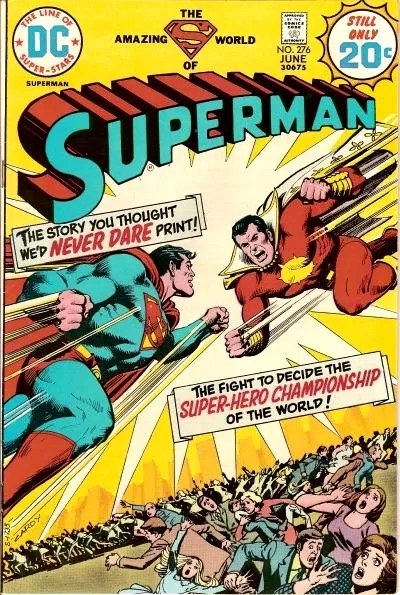
Cover to Superman #276 (Jun., 1974). Art by Nick Cardy.
Why in the world did DC want to keep deferring a proper meeting between their two most powerful heroes? They’d already teased readers at least twice before this; first, in a brief scene in JLA #103 (Dec., 1972) where Superman had fought a demon-empowered Captain Marvel lookalike; then, more significantly, in Superman #276 (Jun., 1974), where the Man of Steel had gone up against an obvious pastiche of the World’s Mightiest Mortal named “Captain Thunder”. According to an article by CBR’s Brian Cronin, Julius Schwartz — who was the editor of Shazam! as well as Superman at the time the latter story was published — felt that the sensibilities of the two characters were so different (with Superman’s exploits being more grounded than the whimsical and fanciful adventures Captain Marvel regularly got into) that the two heroes should never be featured in the same story; and so he ordained the creation of Captain Thunder as a more “realistic” stand-in. Perhaps Schwartz still felt the same way at the time he edited JLA #135-137; still, once he’d committed to the idea that Superman and Captain Marvel were going to appear together, for real this time, it’s hard to understand why he wouldn’t want Bridwell and Pasko to go all the way with the concept.
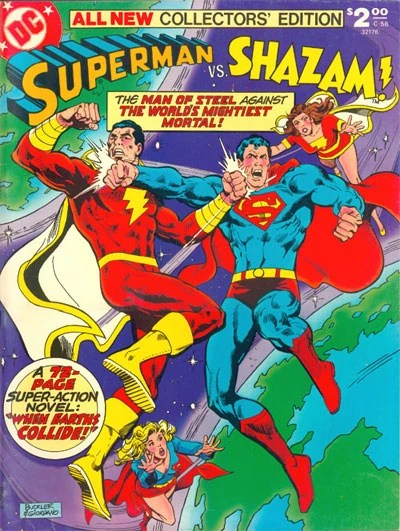
Cover to All New Collectors’ Edition #C-58 (1978). Art by Rich Buckler and Dick Giordano.
I’ve seen it suggested that perhaps DC was already planning a full-length “Superman vs. Shazam!” project and didn’t want their encounter in Justice League of America to step on its toes. I suppose that’s possible — although, given that the tabloid-size All New Collectors’ Edition #C-58 wouldn’t come out until February, 1978, that seems like an awfully long gestation time.* Still, it could have happened that way; in any event, that book’s 72-page Gerry Conway-Rich Buckler extravaganza (which, by the way, was edited by Julius Schwartz and E. Nelson Bridwell) would forever put paid to the idea that the twain of Superman and Captain Marvel should never meet.
But, I digress. Let’s return, if only briefly, to the summer of 1976, for a few last thoughts concerning Justice League of America #135-137. If you’ve been keeping up with the blog, you’re already well-aware that my contemporary, sixty-nine-year-old self has been less than impressed by this entire storyline: the 14th, chronologically speaking, of what would ultimately be 23 annual summer JLA/JSA team-up events — but one which (at least at this juncture) ranks near the bottom of your humble blogger’s personal list as far as entertainment value is concerned.
Still, as I’ve previously noted, that’s the perspective of a much older reader than Bridwell, Schwartz, and company were obviously aiming these comics towards, fifty years ago. If I’d first encountered this storyline as a nine-year-old — the age at which I’d avidly consumed my own first JLA/JSA crossover — I might well have had a much more positive reaction, such as the comments made by several readers in our discussions of the earlier chapters have indicated was their own experience, back in ’76. At that time, these then-young fans simply thrilled to the appearances of so many different superheroes (and supervillains) in one huge story, and weren’t disturbed by the narrative contrivances and logical inconsistencies I’ve been griping about here. And that’s a perfectly valid viewpoint, IMHO.
Of course, if I’m going to be completely honest, I probably wasn’t as hard on this story even as a nineteen-year-old reader in 1976 as I am today… not so much because my critical standards were less stringent (though they probably were), but because my expectations for any given issue of Justice League of America were considerably diminished from what they’d been just a few years before. As I’ve related in previous posts, I’d dropped JLA — once my very favorite comic book — as a regular purchase towards the end of Len Wein’s run as writer. Sure, I was bound and determined to come back each summer for the annual get-together with the JSA — but, in retrospect, that was mostly as an early exercise in nostalgia. I wasn’t anticipating all that much in the way of reading pleasure from these three issues of Justice League of America, so it was hard to be too disappointed by them.
No, by 1976, my tastes in superhero team comics were running much more to the likes of Marvel Comics’ Defenders and Avengers, where writers like Steve Gerber and Steve Englehart had made complex ongoing storylines, more sophisticated characterizations, and a well-expressed personal worldview part of the regular reading experience. I had little reason to believe that such sensibilities would be finding their way into Justice League of America any time soon… a fact that made the following tidbit offered up in JLA #137’s letters column by assistant editor Bob Rozakis not just surprising, but positively galvanizing:

Steve Englehart!? On Justice League of America!? Now that was something to look forward to.
Starting this November, we’ll be checking out whether it was worth the wait.

Cover to Shazam! #30 (Jul.-Aug., 1977). Art by Kurt Schaffenberger.
*In the interim, DC would publish yet another fakeout in the form of the Bridwell-written, Schwartz-edited Shazam! #30 (Jul.-Aug., 1977), which featured a fight between Captain Marvel and a faux “Man of Steel” who turned out to be a robot created by Cap’s arch-foe, Dr. Sivana.
Nothing could top the first and best face-off (sort of) between Supes and the Big Red Cheese in Mad no. 4 in 1953, as drawn by Wally Wood:
https://forgottenawesome.blogspot.com/2017/07/superduperman.html?m=1
This was the only part of the three issue team up that I managed to find on the spinner rack, so I came in very late to the story. I remember enjoying it, more for the introduction of the Fawcett heroes than for the story itself. I had loved the Seven Soldiers of Victory and Freedom Fighters team ups so I was always going to enjoy the introduction of a new (to me) pantheon of heroes from another publisher. I had known of Ibis because one of his stories had been reprinted in Detective Comics #441, one of the 100 page super-spectaculars in 1974 and it always puzzled me that DC didn’t reprint other Fawcett character stories in, for example, the Shazam super-spectaculars as they had done with the Quality Comics heroes that they had inherited.
I also expected the Fawcett heroes to start popping up elsewhere within DC’s comics, similar to the Freedom Fighters but alas, they were seen again for a very long time.
My memory may be fooling me but around this time I also managed to find a remaindered copy of Jim Steranko’s history of comics, volume 2 which focused on both Fawcett and Quality comics (amongst other) which reprinted many of their covers so I may have been familiar with Bulletman, Bulletgirl, Mr Scarlett and Pinky as well.
Recently I came across the publisher PS Artbooks who publish reprints of Golden Age comics in both Softee and hardback formats. As well as superheroes they also cover all the other genres of comics published in the pre-code era. I’ve bought the trade paperbacks of most of the Fawcett and Quality heroes that they have reprinted, so if anybody is a Golden Age fan, wants to read these stories and can’t afford the originals it’s worth checking them out.
Steranko is finally working on History of Comics volume 3. He has assistants helping with it. No publication announcement yet. Hopefully it won’t be a posthumous release.
I thought this was fun back when I was a kid and I think it’s fun now! Plot holes and all! Anybody remember the Captain Marvel/Supes clash and the Captain Thunder/Supes clash end the same way? In a burst of magic lightning/energy? Thanks for this!
That Superman-Captain Thunder clash was one of my first ventures into DC. I wasn’t sure if that wasn’t Captain Marvel. My disappointment was enough to discourage any further dabbling in the Big S’s book for quite some time.
Maybe Batman’s cheering posture is due to his somehow knowing this is the last issue in which he’ll endure the worst JLA-JSA team up to date?
If the impending DC Implosion can be viewed as Titanic steering unknowingly into its own destruction, then I see this crossover as a gala ball transpiring below deck with that iceberg looming in their near future.
We have three issues of the Justice League crafted as if several boys reached into their respective toy boxes ten years earlier, pulling out an assortment of heroes and villains, crafting an impromptu, near incomprehensible story where the goal seemed more about letting each various character have at least a few panels with minimal characterization or logic. I reference a decade earlier because had this story occurred in the early to mid sixties, I suspect it would have been better received by what was then a younger reading audience.
But that audience didn’t “outgrow” comics. They remained, expecting stories with greater depth, more vibrant characters and stronger continuity. This is where Marvel and DC diverged with the former crafting comics fully intended to attract and maintain that audience with the latter mired into a past that no longer existed. Hence the upcoming Implosion acting as an iceberg to their doomed luxury vessel.
Special props to Alan for not only writing such an engaging reviews, but also re-reading three comics that at my most diplomatic phrasing are “not incredible.” Added to that, his reviews introduced me to Bulletgirl – the one Golden Age creation whose smile could inspire me to put a cone on my head and fight crime!
Rick’s Iron Man blog is really worth visiting!
https://www.ironmanrevisited.com/blog
Marvel did have some ’70s kiddie fare, though, like Spidey Super Stories, a tie-in to “The Electric Company” PBS series with Morgan Freeman’s Easy Reader character appearing on the first issue’s cover.
https://tombrevoort.com/2017/09/10/summer-was-winding-down-when-the-mailman-brought/
The fact that you have dedicated THREE blog posts to meticulously examining these delirious, extremely nutty comics is, in itself, magnificent.
Thank you Alan.
ps: Habitat 67 is, indeed, pretty awesome. I think one needs to visit with a tour group because people actually live there. (OK I might have trespassed there just a few yards before the rent-a-cop kindly told me to scram.)
Well. As much as the JLA/JSA annual team-ups were an enjoyment I looked forward to all year long, this one was anticlimactic, to say the least. Two many characters, not enough interaction, all to service a weak story. What a disappointment this was. As Alan points out, part of this was a result of DC’s insistence that it’s books were primarily for 8-year olds and ignoring the college students and young adults who regularly read the Marvel books, which offered deeper stories and more mature content.
I realize Mr. Atom was a Fawcett hold-over, but couldn’t Dillin have redesigned him…at least a little? I don’t remember Dillin being all that great with robots in the first place, but Mr. Atom’s head looks like a left-over Bulletman helmet that someone repurposed. While Dick did a decent job making Cap or Shazam or whatever we were calling him at this point, resemble the C.C. Beck version of the character, he seemed overwhelmed by the sheer amount of heroes and villains he was being asked to draw.
Story-wise, Kull’s plan made no sense and it made no sense for all the other villains to go along with it. What was the goal? What did the other bad guys get out of it? Bridwell seemed to think that as long as he got 22 capes in one book, the story would tell itself, and sad to say, he was wrong.
Still, Alan’s insight and BTS stories make it enjoyable to go back and read once again, re-living the heroes and the stories we loved in our youth. Thanks, Alan!
Indeed, it is a difficult story to take seriously.
We are expected to believe that Kull has such fabulous means and reach as to restrain literal deities, obtain a rare fragment of red kryptonite and somehow knowing that its effect would be helpful for his purposes, contacting and convincing the likes of Queen Clea and Brainiac to play their parts… and yet somehow he fails to prepare for the possibility of Johnny Thunder paying a visit to Freddy Freeman and the Batsons?
Apparently he did not even make an attempt to restrain them or keep them under watch. Yet we see various accomplices building and operating incredibly dangerous (and expensive) devices, weird energy and magical effects, for no clear purpose beyond causing panic and giving the heroes of three Earths reasons to being busy opposing them.
How on Earth is that supposed to make sense? It can’t really. If we try, we end up concluding that Kull (and several other of the many villains) secretly had the same goal as the writers – causing appearances and teamp-ups among the heroes, including spotlights for the Fawcett heroes that were mostly unseen in the last 20 years or so.
It is fun for what it is, and it prepares the way for All-New Collectors’ Edition C-58. But in a very bureaucratic way that actively avoids developing the plots and interesting opportunities presented by the whole situation.
We don’t even have any indication on whether the Fawcett heroes can or want to keep contact with their colleagues from the other two Earths and vice-versa, despite how obvious a question that is. One would think that they would at least want to attempt to establish some sort of communication for emergencies, but apparently not, despite the sudden awareness of so many new potential allies and menaces.
As I said previously, I have to assume that DC editorial was at this point until uncertain of whether it wanted to take their multiple Earths to their logical conclusion – and, most likely, whether readers would even want them to. That is probably why there were so many feints and near misses on the way to C-58. To be fair, I think that it is a legitimate concern. Once you establish that Captain Marvel has the means to visit Earth-One and Earth-Two and ask for help from Superman, Doctor Fate and the Green Lanterns it becomes harder to believe that he is the last hope for his Earth when a serious menace appears. At this time Shazam! was arguably on a separate genre from the other superhero properties and it would be foolish to simply jump into crossovers without any gauging of reader interest and reception, much as it would be for (say) the romance, western or war comics of the time.
I’ll have to disagree with you that was a concern. It’s no different from the problems all the Earth-One stories face — why doesn’t Batman/Wonder Woman/Hawkman call in their JLA teammates whenever they face a problem they can’t handle?
Someone brought up the red k question in a later column and suggested Kull contacted the Superman Revenge Squad, who have expertise in predicting the effects of red kryptonite. It’s a rationalization, of course, but not a bad one.
I can’t recall where I read it but in one story, at least, it was mentioned that conditions have to be just right for the heroes to travel between Earths. I have to admit that I was 21 when these stories came out and I enjoyed them at the time. I was an avid DC reader at the time but had given up on Marvel save for Avengers and X-Men and the odd B&W book.
That’s a retcon. The Silver Age showed they could cross between Earths whenever, though Flash vibrated through at a specific spot in Central City. Denny O’Neil, IIRC, introduced the idea that it was only in a small period of the year that crossing was doable.
It’s funny – in a few decades’ time in Kingdom Come, Captain Marvel (the original, accept no substitutes!), uses his magic lightning as a weapon against Superman and it seems powerful and dramatic. Here, he uses the lightning against Supes and it feels a bit… silly, a plot contrivance to avoid an actual confrontation. Goes to show what a difference the mood and presentation can have. Now that I’ve seen Tom Breevort’s link, I see that he noted this as well.
Rick, glad I’m not the only one who thought this was plotted by two kids playing with their action-figures.
The Batman (of either Earth) is supposed to be a master of disguise, so if he wants to look like a cheerleader on the cover who’s going to argue with him? Unless he was around for some panels that Alan hasn’t shown here, the cover was his only appearance – in the two group shots all you see is the Batmobile, not the man himself (same for Wonder Woman, you only see her invisible plane). Bats, WW, Robin and the other Fawcett characters might as well have stayed at home for all they contributed to this issue.
Also especially noticeable in those group shots is a little bit of comic book illogic that always has to be hand-waved away or ignored: several super-speedsters, two essentially rocket-powered characters, two souped-up vehicles and several ordinary humans with no special powers, but they all appear to be going at the same speed and arrive where they’re going at the exact same time.
I seem to recall the Conway/Buckler Collectors Edition being a swipe-fest of epic proportions, to the point where Neal Adams might have expected to get paid for it.
Alan, you did very well with subject matter that maybe didn’t deserve the quality of your reviews. Thanks again!
That’s how I felt when Mike Grell took over Superboy & the Legion of Super-Heroes: so many Neal Adams swipes as to be positively embarrassing or infuriating, depending on one’s viewpoint. Neal should have collected a fee there, too.
I had collected S&TLOSH’s because of Dave Cockrum’s art. However, as much as I missed him, I took an immediate like to Grell’s art and remained with the series until an issue or two after he left. With that taking place during my first year of collecting, I had no idea that Grell’s work had borrowed (polite term) from Neal Adams as I was scarcely aware of who he even was.
All-New Collectors’ Edition C-58 (published in 1978), the first real fight against Superman and Captain Marvel, culminates with Marvel deciding to use the magical lightning against Superman because he realizes that magic is one of Superman’s weaknesses. Shazam convinces him not to.
Remarkably, there is no indication whatsoever that he remembers having done that maneuver in JLA #137, even though Steve Lombard and Lois Lane are shown to be aware of this storyline some forty pages prior. Marvel even claims to have taken the idea from Black Adam (it happened in Shazam! #28, roughly halfway between JLA #137 and ANCE #C-58).
I already lest quite a few comments on Alan’s retrospectives on the first two parts of this storyline, so I’ll try to be brief here.
When I read this in the collected edition three years ago, I was vaguely disappointed at the small role that Captain Marvel played, and at the non-confrontation between Cap and Superman. Only vaguely, because in 2023 the Marvel Family (or Shazam family, if you prefer) was well ensconced in the DCU, so I was very used to Cap interacting regularly with a great many of the company’s characters and had read some of the Cap vs Superman stories that had been published over the years. I imagine that if I had read JLA #135-137 half a century ago, I would have been much more disappointed at this resolution. I had thought it was an odd storytelling choice by plotter E. Nelson Bridwell, but Alan informs us that it may well have been editor Julius Schwartz. Whoever was responsible, I do feel it lets the story down somewhat.
I also recall wondering if Montreal’s Habitat was actually a real thing, but I wasn’t motivated enough to look it up. So, Alan, thanks for posting the link to Wikipedia. Of course, the real Habitat is much smaller and looks nothing like the huge domed futuristic city rendered by Dick Dillin. I wonder if Bridwell had heard about the Habitat, thought it sounded interesting enough to include in his story, but in those pre-internet days couldn’t find and reference to give to Dillin. Or maybe they just decided the real thing didn’t look cool enough and so decided to make up a different visual. I guess we’ll never know.
So, yeah, sort of an underwhelming conclusion to an overstuffed storyline. But, as Alan suggests, if one was nine years old in 1976, maybe one would have found this three-parter vastly more entertaining. Looking at it, though, I do agree that Steve Englehart’s imminent arrival on Justice League of America could not have been better timed, and I’m looking forward to Alan’s retrospectives on those issues.
So I’m the 9-year-old from 1976 (and I grew up just across the water from Habitat ’67, which looks more like the production of a child sloppily playing Jenga with blocks than the version depicted here). I absolutely loved seeing all these heroes appearing in the same book. That was Value-For-Money, on the same par with the thrill I got reading Crisis on Infinite Earths a decade later. In no way did I appreciate the sheer lunacy of the plot; I just luxuriated in “Heroes! Heroes! Heroes!” Yeah, Kull seemed like a pretty dumb villain and I couldn’t figure out what he was trying to do, but it didn’t matter. Where else in 1976 was I going to find so many HEROES???
Now that I’m 59, and I’ve had my bubble gently burst from Alan’s excellent review and all the well-written reactions here. That’s okay. People should expect quality when they lay down their hard-earned quarters.
HOWEVER, it turns out that I am right now reading for the first time the collection of JLA stories from #45 to #72, most of which were written by the legendary Gardner Fox and drawn by the reknowned Mike Sekowsky and HOLY COW is that stuff ever brutal to read!!! If you think this 3-parter has some plot-weirdness and some poor characterizations, look over those gems again. I mean no disrespect to comics royalty, but it is pure awful. Really, I worry I won’t be able to finish the book, even with the multiple beloved JLA-JSA team-ups included. I love seeing an extremely rare appearance by Mr Terrific and that second Robin uniform, but the story….? Ugh.
And just one last rebuttal to everyone dumping on this as the worst JLA-JSA meeting ever: does that include #113, where Len Wein wrote a story so disturbing about Sandman and Sandy that I am surprised Dr Wertham didn’t try to write a sequel to Seduction of the Innocent? That was something special.
Luckily Steve Englehart will soon come along and make everything better with HIS JLA-JSA team-up. Oh waitasecond…..
I appreciate you sharing your experience with this comic. I’ll add that you’ll get no argument from me regarding those early JLA stories. The few that I’ve read were more than enough to discourage me as well.
I will stick up for Silver Age JLA as one of my favorites. YMMV as the saying goes.
I’m with you on that one. I grew up on 60s JLA issues and still love those elegantly constructed (admittedly sometimes peculiar) stories that were always fun, and their great Sekowsky art.
I have a very different opinion of “The Creature in the Velvet Cage”. I found it to be a great character study of the Sandman, with the first explanation of why Wes Dodds switched costumes after his final Golden Age appearance in Adventure Comics # 102. While I agree that the twist at the end contradicts any in-story plausibility, I found (and still do to this day) that those last few panels were very touching in their poignant depiction of Wes’s display of pathos and haunting guilt.
As a ten-year-old in the summer of 1976, I found this three-part team-up to be relatively satisfying, especially the intro to the 6 non-Marvel Family Earth-S heroes. Looking back retrospectively, I’ve always wondered how the heroes of both teams originally determined which of their worlds would be designated in-story as “Earth-One” and “Earth-Two”. Maybe the Gardner Fox’s of both worlds arm-wrestled for the privilege of establishing the nomenclature precedent, and the Gardner Fox of Barry’s world, being younger and therefore stronger than his older counterpart, claimed first dibs on “Earth-One”. I’m picturing something along the lines of the cover of JLA # 74, but with both Fox’s in the place of the two Supermen, rather than the cover to issue # 137.
Alan, I believe that you meant to write the number “23”, rather than “22”, for the ultimate number of JLA-JSA team-ups that ran from 1963 to 1985.
As coincidence would have it, I was in Montreal just last weekend with my daughter, and we went for a ride on “La Grande Roue”, a Ferris wheel that rises 180 feet above the St. Lawrence Seaway. We got to spend 20 minutes as the ride made three complete revolutions, and so we had a wonderful view of much of Montreal at the topmost point. From there we could see most of Montreal and its farther reaches, so I imagine that we were looking right at Habitat 67 without even recognizing it. It was night-time with everything all lit up, so the panorama was breathtaking, but I was unaware until reading your review that we were looking at it. Oh well, I guess I’ll plan to go up there again with my daughter when I return to Canada in December.
Alan, I’m wondering if you’ll be covering JLA # 138 next month, with its stunning Neal Adams cover of a gigantic Adam Strange blasting the JLA with his ray-gun.
It is a nice Neal Adams cover on Justice League of America no. 138, though Superman seems to be in an unintentionally similar (but not identical) pose to Batman on the cover of Batman no. 251. Having a large figure on the left of both covers also invites comparison.
https://static.wikia.nocookie.net/marvel_dc/images/7/7d/Batman_251.jpg/revision/latest?cb=20200531001222
https://static.wikia.nocookie.net/marvel_dc/images/f/f1/Justice_League_of_America_Vol_1_138.jpg/revision/latest?cb=20140503091918
As stated by someone else in a prior review’s comments section, Neal Adams made a brief return to doing covers for DC which ran from December 1976 to early 1978.
His first, which was published at the same time as this JLA issue, is perhaps one of the most inane, and not quite up to his usual drawing standard:
https://static.wikia.nocookie.net/marvel_dc/images/8/83/Action_Comics_Vol_1_466.jpg/revision/latest?cb=20081231145516
Two months later he did one of his very best (in this late ’70s “return” series) for the same title. Too bad the printing softened the solid black inks a bit, and the colors are too washed out—a common problem with most of these later covers:
https://static.wikia.nocookie.net/marvel_dc/images/b/bc/Action_Comics_Vol_1_468.jpg/revision/latest?cb=20150327170752
This, for example, would have been a *great* cover if published five years earlier with better printing methods, and with more *earth* colors, so that only the warm, bright hues of the machine gun barrage stand out:
https://static.wikia.nocookie.net/marvel_dc/images/6/6a/GI_Combat_Vol_1_201.jpg/revision/latest?cb=20110902234904
This one was also a close contender for being on par with his best covers from 1967-73, the only hindrance being the cheaper printing methods of 1977:
https://static.wikia.nocookie.net/marvel_dc/images/a/ac/World%27s_Finest_Comics_246.jpg/revision/latest?cb=20120902144046
And this, cover dated November 1977, was probably the best of Neal Adams’ late bronze age “return” covers. I bought it off the stands and still have a copy:
https://static.wikia.nocookie.net/marvel_dc/images/9/92/Superman_v.1_317.jpg/revision/latest?cb=20081230025434
Besides Superman vs. Muhammad Ali (his final magnum opus in comics), Neal did his last DC cover (for a while) in July 197
July 1978 (cover date), a rather weak retread of his classic 1971 Superman no. 233 cover, Kryptonite No More!”
Thanks for the catch on “23” vs. “22”, Jay! (Fixed now.)
Alas, I didn’t buy JLA #138 new off the stands, so it’s ineligible for its own post. But since I did buy the second part of the Adam Strange story, which ran in #139 (along with Steve Englehart’s first Justice League tale), I can probably justify at least dropping in a scan of its cover in my upcoming post on the latter issue. 😉
Oddly enough your question was actually answered in a subsequent cross-over. A kid asks a policeman why the Earths are named the way they are. His reply is that because the existence of the various earths was discovered when Barry Allan crossed over to Jay Garrick’s Earth his was labelled Earth-One and Jay’s Earth-Two.
A couple of Roy Thomas’ stories from the 1980s shows some JSA members saying it should be the other way around.
The only thing I really remember about this team up was that I was very similar to when I watched the Shazam! TV series a couple of years earlier……you wait and wait and wait for Captain Marvel and he finally shows up in the last five minutes of the episode. I was glad to see Englehart arrive soon afterwards, too.
Like you, Alan, I did not hate this as a teen, though it’s definitely not peak JLA.
I simply assumed Tomorrow was one of those weird SF places that exist in the DC and Marvel Universe, like the Wild Area in Jimmy Olsen a few years earlier.
The lack of a steady writer between Wein and Englehart was a big part of the problem (https://atomicjunkshop.com/continuity-and-change-behind-the-scenes/) for JLA in that era I think.
I believe it’s high time Mr. Scarlet’s sidekick, Pinky, is given his due. We need a limited series that explores the motivation behind the Pink Crusader. A limited series that would build on who the character was in the past while dramatically moving the character into the future. This would be a series that changes the way we look at this character forever – “The Pink Knight Returns”. Just a suggestion.
Pinky is surely ready for brutal gritty underbelly deconstruction.
Hey, Alan! Please don’t take offense, but it sorta surprised me that you opted to devote three posts to this story that you even admit was not the strongest JLA/JSA team-up! But hey, it’s your blog, so feel free to ignore me.
But hey – your write-up is actually more entertaining than the story itself, so there’s that!
But yeah – JUSTICE LEAGUE OF AMERICA had been foundering after Len Wein left (and, truth to tell, a little BEFORE he left?). But I hung on, as one does when comics were this cheap.
In any event, by the time this issue had come out, I knew about Englehart’s impending arrival, and I was counting the days…
No offense taken, Bill! But, just for information’s sake (and because others might be curious as well) — I decided not too long after starting this blog that, having bought every installment of every JLA/JSA team-up published from 1966 on (with the exception of 1970’s JLA #92), it would be kinda fun to write about every single one of them (with the exception of 1970’s JLA #92). That’s a wide net that’s obviously caught a few less-than-superlative comic books to date (and will catch more in the future) — but as long as I continue to enjoy doing those write-ups, and you folks seem to enjoy reading them, I figure I’ll keep the annual summer tradition going. 😉
JLA desperately needed Steve Englehart!