
Back in September, 1976, the artist of the comic book story we’ll be discussing today — Howard Chaykin, that is — wouldn’t have ranked among the most prolific of the generation of talented young illustrators who’d entered the American comic book industry in the late 1960s and early 1970s. Unlike other such “Young Turks” of the era as Barry Windsor-Smith, Bernie Wrightson, Frank Brunner, and Jim Starlin, Chaykin still hadn’t had a run on a series lasting more than four issues — and that personal record had been set back in 1973. Nor had his one- (or two-) off jobs over the past few years been all that plentiful, or frequent.
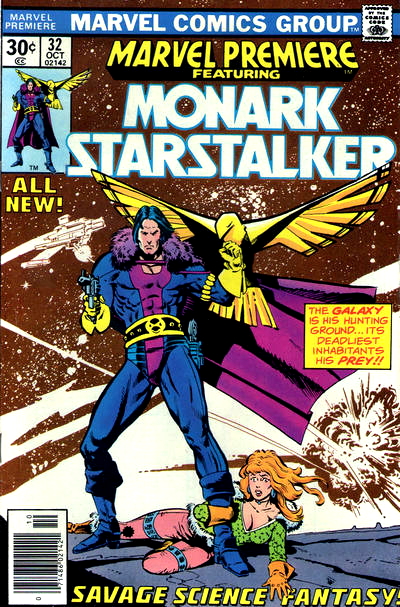
Cover to Marvel Premiere #32 (Oct., 1976). Art by Howard Chaykin and Al Milgrom.
However, for whatever reason, Chaykin seemed to hit a stride of sorts around the middle of ’76. No, he hadn’t suddenly begun a sustained run on a single title, but he was putting out new work on a fairly regular basis. That summer saw the publication of his contributions to two new issues of Mike Friedrich’s “ground-level” black-and-white comics, first as an artist (in Star*Reach #5, out in June), then as a writer (in Quack #1, released in July). The month of July also brought the debut of “Monark Starstalker” — a full-color science-fiction adventure feature both written and drawn by the creator, and presented in the 32nd issue of Marvel Comics’ Marvel Premiere. And while August didn’t see the publication of any new Chaykin material, the next month would give us two full-length, color comic book stories illustrated by him: Marvel Spotlight #31’s “The Infinity Formula”; and the first half of the tale that’s the primary topic of today’s post, Marvel Premiere #33’s “The Mark of Kane”.
As the book’s cover copy makes clear, the titular hero is Solomon Kane — a historical fantasy-adventure hero originally created back in the 1920s by pulp author Robert E. Howard (best known, of course, as the creator of the non-historical fantasy-adventure hero Conan). Kane was already familiar to readers of Marvel’s B&W comics magazine line, where he’d made multiple appearances in titles ranging from Dracula Lives to Savage Sword of Conan — though, as indicated by MP #33’s cover artwork (pencilled by Chaykin, with Klaus Janson providing inks), the version of the character we’re given here sports a decidedly different look than that which Marvel had presented us with in the past.
 The previous standard visual for Marvel’s take on Solomon Kane had been set by artist Ralph Reese in 1973’s Monsters Unleashed #1, which featured Reese and writer Roy Thomas’ adaptation of Howard’s short story “Skulls in the Stars” (see right). Building on the descriptive information provided in Howard’s stories, the Puritan adventurer was generally pictured as having long straight hair and wearing a hat and cloak; otherwise, his period-accurate attire was rendered as being as plain and simple as his religious affiliation would seem to suggest.
Howard Chaykin’s version, on the other hand, has dispensed with the hat, and has had a haircut besides. Such changes, while initially surprising, are probably not all that big a deal; not all the REH Kane stories and poems mention the hat, after all, and if the pulp writer ever specified the length and style of his hero’s hair, I must have missed it.
But those striped sleeves. Fifty years after my then nineteen-year-old self first laid eyes on ’em, it’s still hard to square that particular fashion statement with any of REH’s descriptions of Solomon Kane’s mode of dress, which tend to be dominated by such words as “black”, “dark”, “somber”, and “drab”.
Roy Thomas — the man who’d brought Robert E. Howard’s fantasy heroes to Marvel, as well as the writer and editor of the story we’re about to peruse — seems to have been cognizant that Chaykin’s idiosyncratic interpretation of Solomon Kane might ruffle a few feathers among the character’s more traditionally minded fans. In an “Introductory Note on Solomon Kane” text piece he wrote for Marvel Premiere #33’s letters page, Thomas described how he’d “lined up a talented new artist named Howard Chaykin” to illustrate Kane’s first color comics outing, then went on to add:
Howie… had a few reservations about the previous incarnations of Solomon Kane, who in many ways is the first true sword-and-sorcery hero of all time, pre-dating even King Kull and Conan the Cimmerian. Our outspoken artist felt that a whole new visual concept was called for. And, though I’ve enjoyed the versions by Messrs. [Steve] Gan, [Mike] Zeck, [Alan] Weiss, Reese, et al. in their various ways, I agreed with him that our color format in MARVEL PREMIERE might just be the right time to experiment with him.
We hope you enjoyed Howie’s version-and next time, if we can get him to take typewriter in hand, we’ll ask him to explain why he sees Solomon Kane as he sees him, instead of how he’s been depicted before, both in Marvel Comics and in other media.
Alas, any efforts made by Thomas to get Chaykin to ‘splain himself verbally in print seem to have come to naught; there’s no such commentary to be found in the letters column of MP #34, and if Chaykin ever discussed his reasoning in some other venue, I’m unaware of it. Perhaps that’s because, in the end, the explanation would have amounted to nothing more or less than that the always style-conscious artist just thought his striking new visual for REH’s dour Puritan adventurer looked cool.
In any event, that’s probably enough said about Solomon Kane’s (and Howard Chaykin’s) fashion sense, at least for now. Let’s go ahead and see what lies behind our featured comic’s cover, shall we?
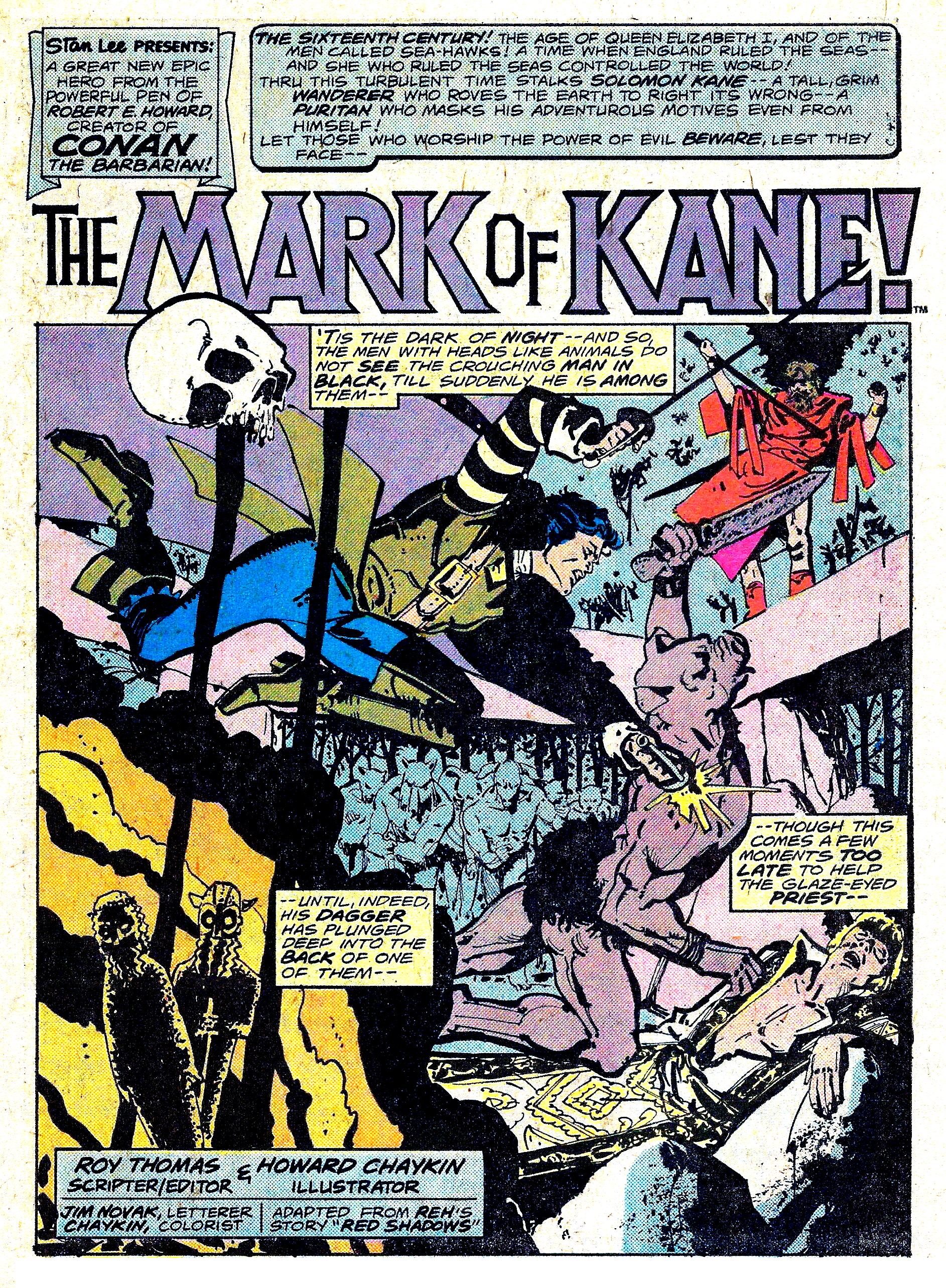
We’ll pause here at the credits box just long enough to make a couple of quick observations: first, that “The Mark of Kane” has been colored as well as pencilled and inked by Chaykin, suggesting that the artist was very much invested in this particular assignment; second, that the story has been adapted from “Red Shadows” — the first of Robert E. Howard’s Solomon Kane stories to have been published (if not the first to be written)… though, having said that, we’re obliged to note that the four-page action scene which which this version opens doesn’t appear in Howard’s original text at all.
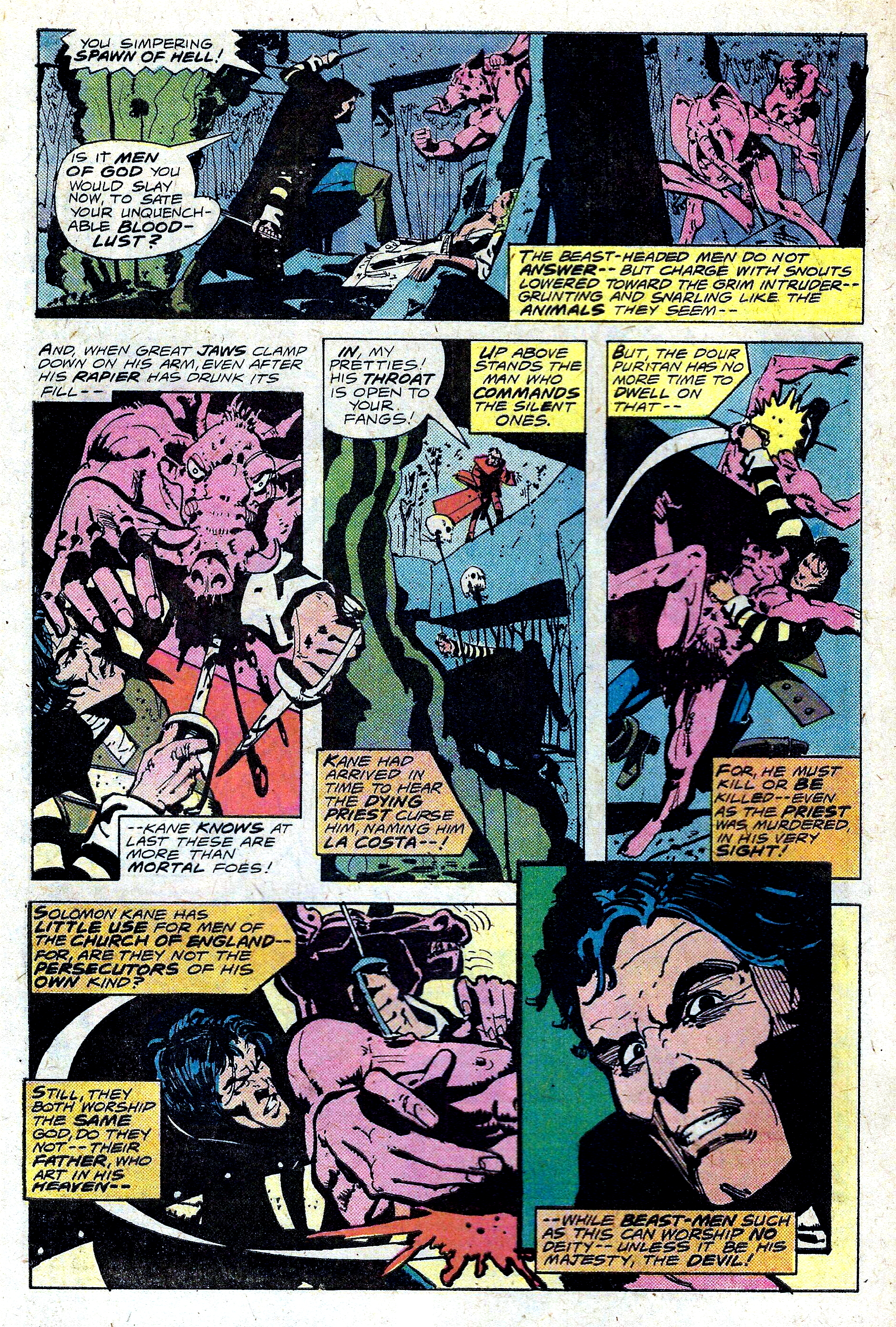
Why would Thomas and Chaykin opt to begin their adaptation with an almost all-original sequence? One reason may be that “Red Shadows”, in its original form, was a little too lean to be adapted into not just one, but two full-length comic books, which is what Marvel has opted to do here; the plot needed some padding, in other words. Another factor may be that Howard’s tale begins relatively quietly, whereas Marvel’s traditional way of doing things in these days was to get some action in right away, the better to grab the prospective buyer who might be flipping through the first few pages while standing at the spinner rack. Finally, the plot element of the “beast-headed men” — which isn’t even alluded to in Howard’s text — allows our storytellers to get a little flavor of “sorcery” into the first chapter of this sword-and-sorcery yarn, which (as we’ll see) would otherwise be wholly without it.
In any event, faithful to REH or not, this sequence offered an excellent opportunity for Chaykin to show off how much his style had evolved since the last time his work had appeared in Marvel’s color comics over three years before, reflecting an increased emphasis on panel composition and page design over detailed rendering — a shift perhaps best exemplified by his dramatic, Alex Toth-evoking spotting of blacks.
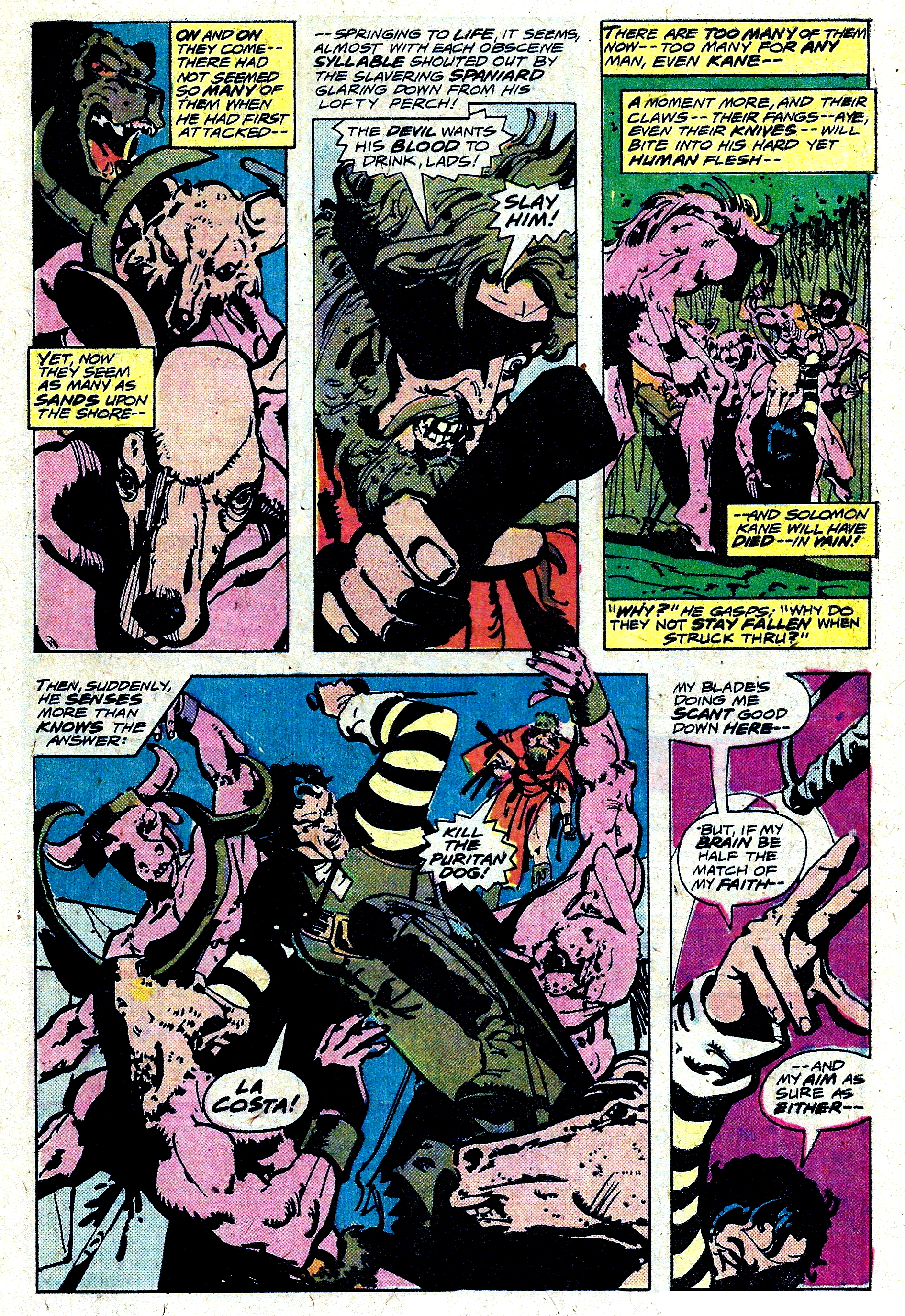
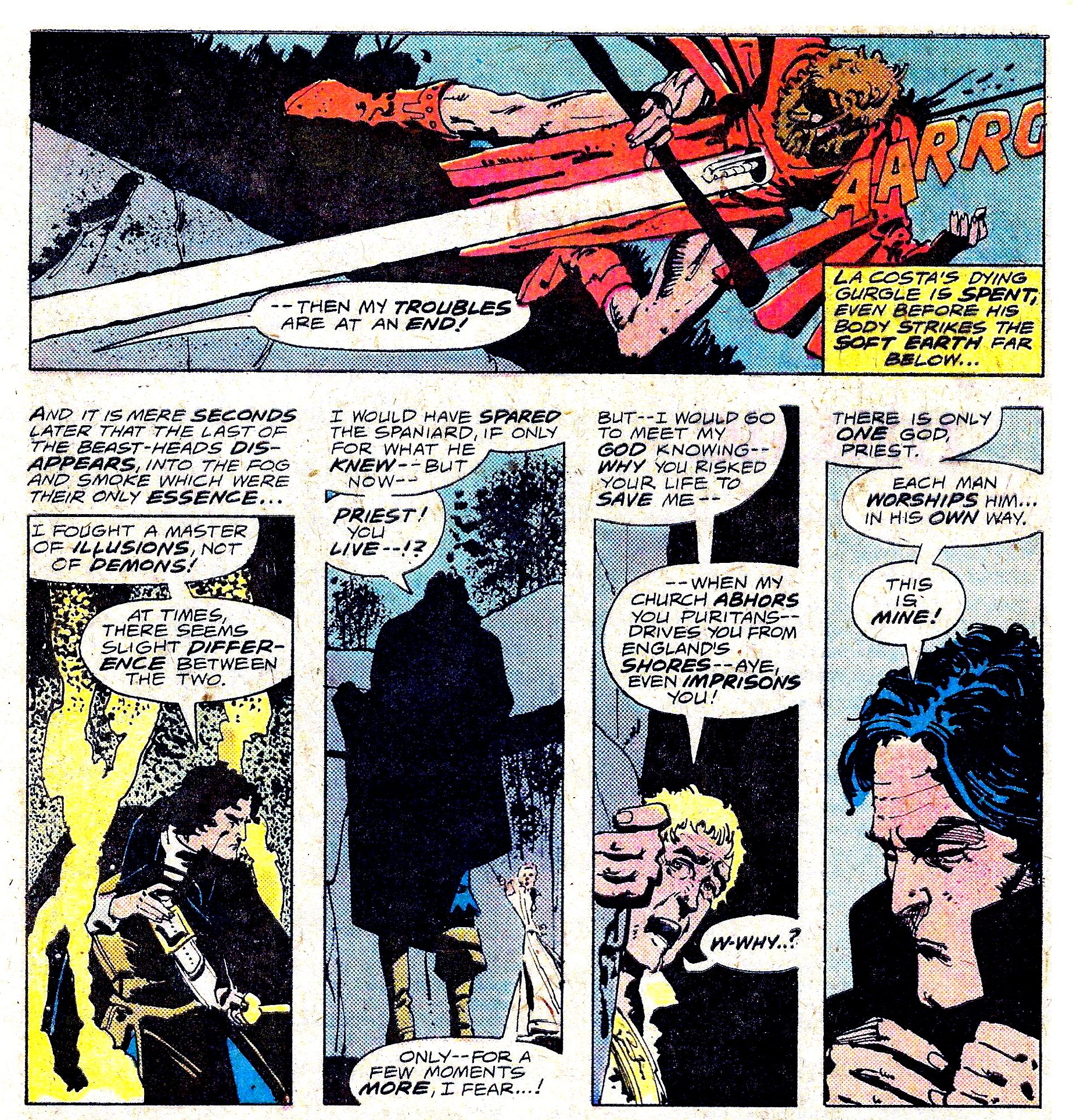
“But the priest does not hear the answer,” a narrative caption in the next panel tells us, “being dead.” And so, after burying the churchman under a tombstone carved with the simple words, “Here lies a man of God — Died 16 September, 1553”, Solomon Kane moves on to the next phase of his quest… and thus provides Thomas and Chaykin with the opportunity to provide a more complete introduction to our hero to any readers encountering him here for the first time…

“– the call which has already brought him face to face with werewolf and moor-monster and a severed hand that crawled in the night –” This line by Thomas, and the imagery Chaykin has provided to accompany it, subtly references several earlier Solomon Kane adventures published in Marvel’s black-and-white books — “The Silver Beast Beyond Torkertown” from Savage Sword of Conan #14, “Skulls in the Stars” from Monsters Unleashed #1, and “The Right Hand of Doom” from SSoC #13, respectively — thereby letting more knowledgeable (and continuity-conscious) fans know just where the present adventure is to be placed in Solomon Kane’s overall chronology. (Though, somewhat oddly, Thomas seems to have here placed “Silver Beast ” [the werewolf story] as taking place prior to the other two yarns, contradicting the information that had been presented in SSoC #14 just a couple of months earlier.)
As for the Bible-alluding “mark of Kane” concept, it is — as far as I know — original with Roy Thomas.
With the next page, we finally come to the scene with which Howard’s “Red Shadows” actually begins — though in the present context, it’s presented in the form of a flashback:
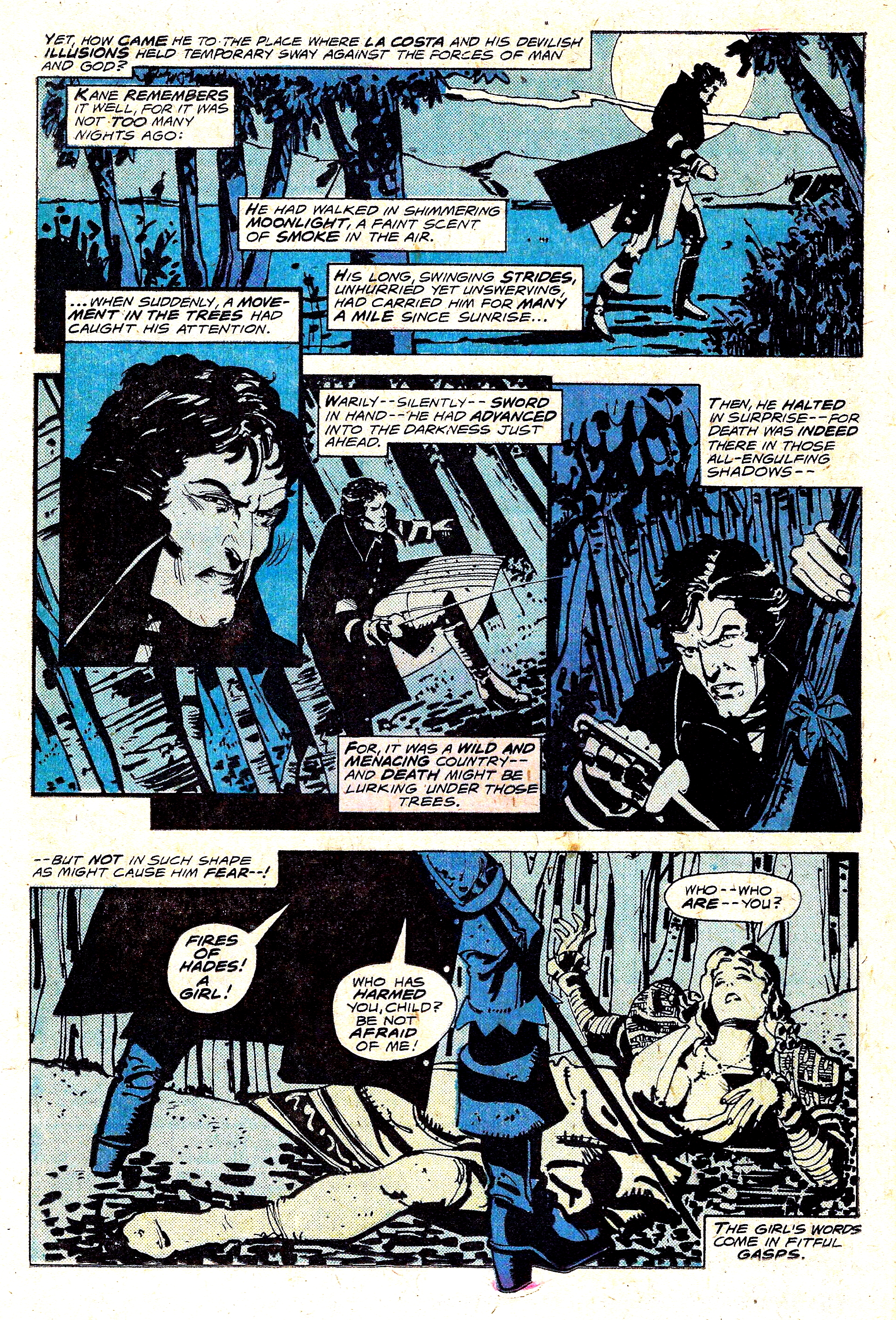

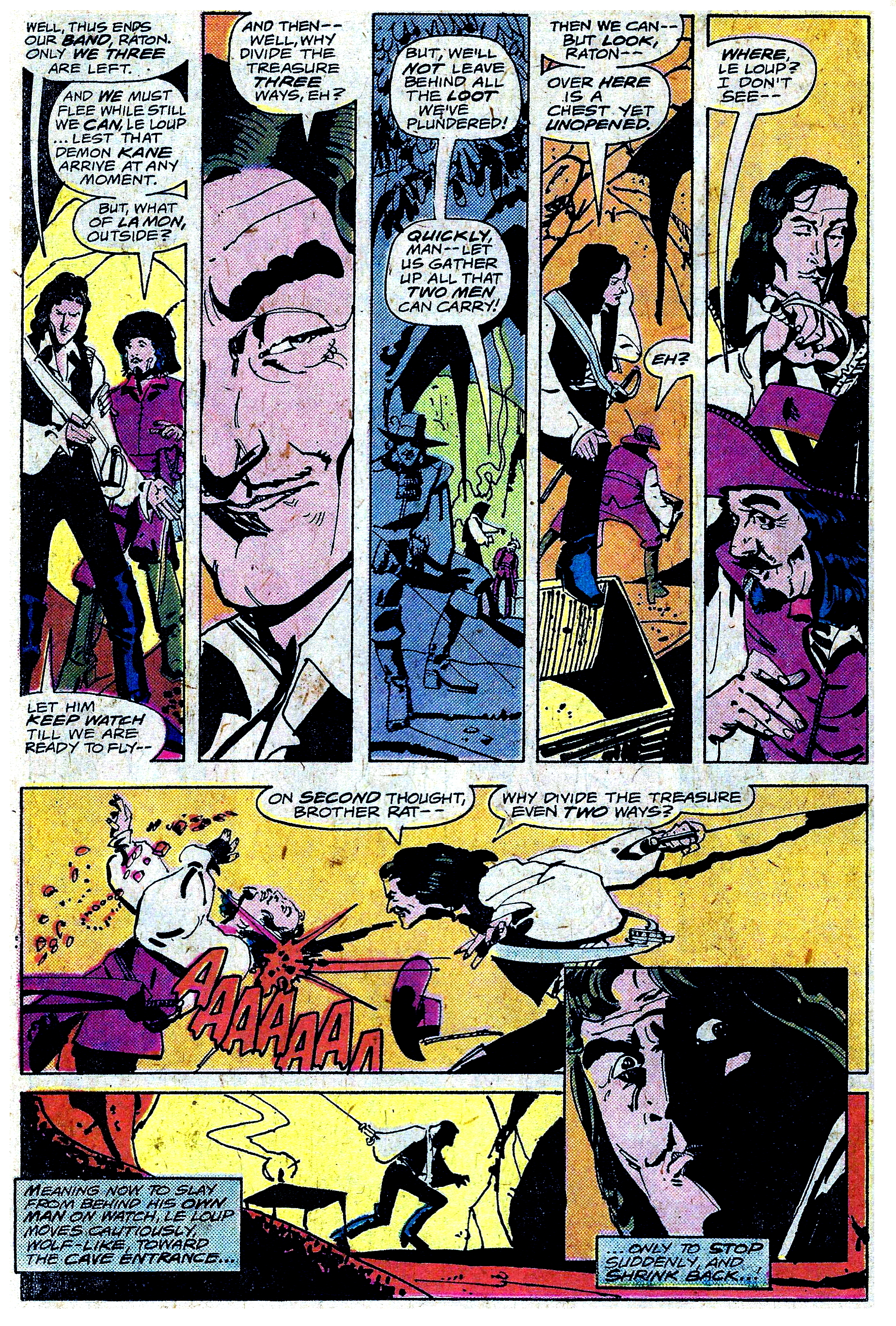
Raton isn’t so sure, noting that Kane has not only eluded Le Loup’s whole band of rogues for a fortnight, but has also within that same span of time dispatched several of their number, including the illusionist La Costa. Le Loup can’t argue with those facts, but remains confident that after the remainder of his gang return from their current raid on a hermitage, they’ll all together be able to take down the avenging Englishman. At this point, however, the two men’s conversation is suddenly interrupted…
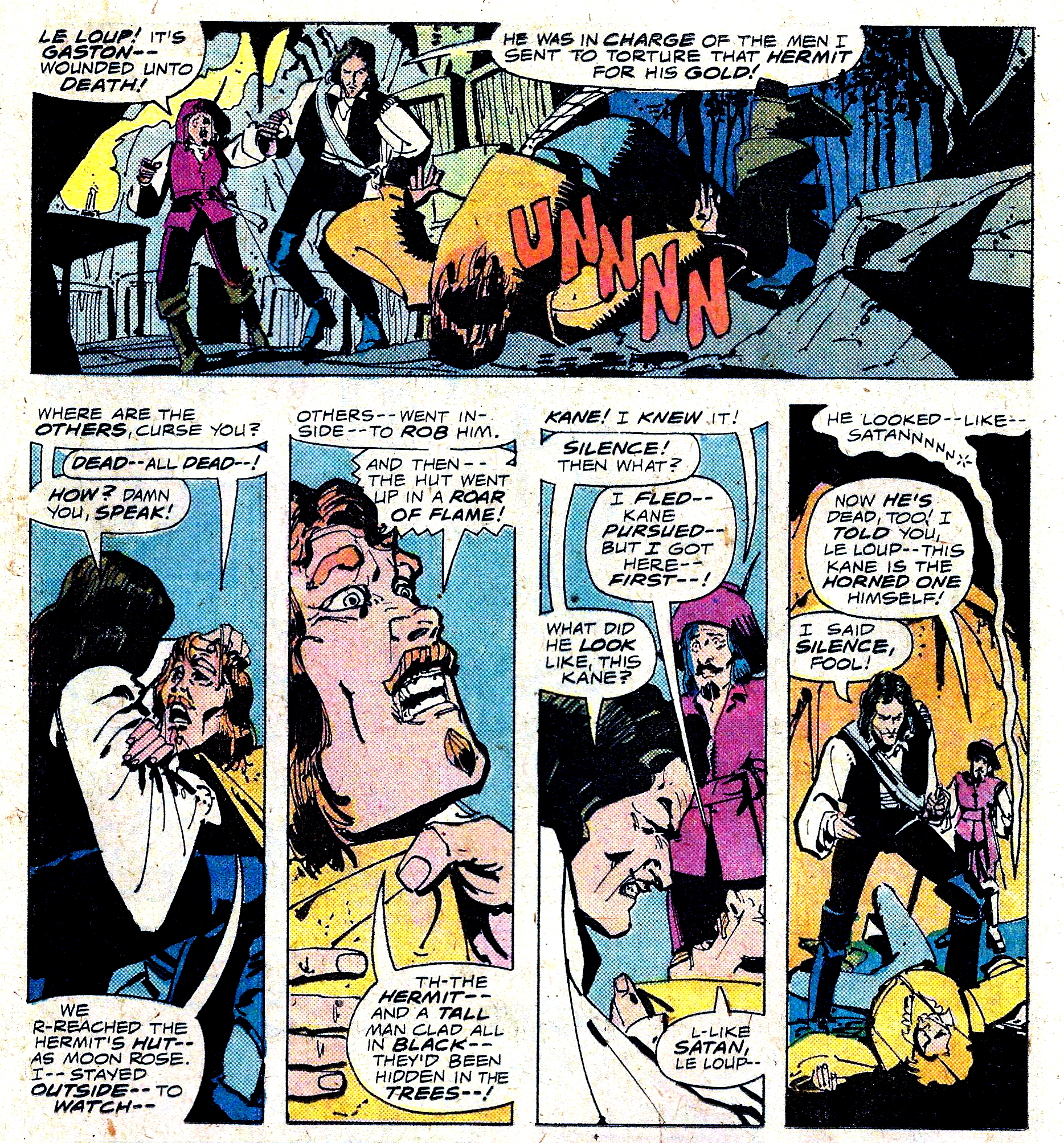
Having heard the commotion as he returned from an errand, yet another bandit, La Mon, pokes his head inside the cave entrance; seeing Gaston lying dead on the floor, he fearfully asks if Kane was the cause. La Loup curtly answers in the affirmative before ordering La Mon to stay outside and keep watch for their enemy…


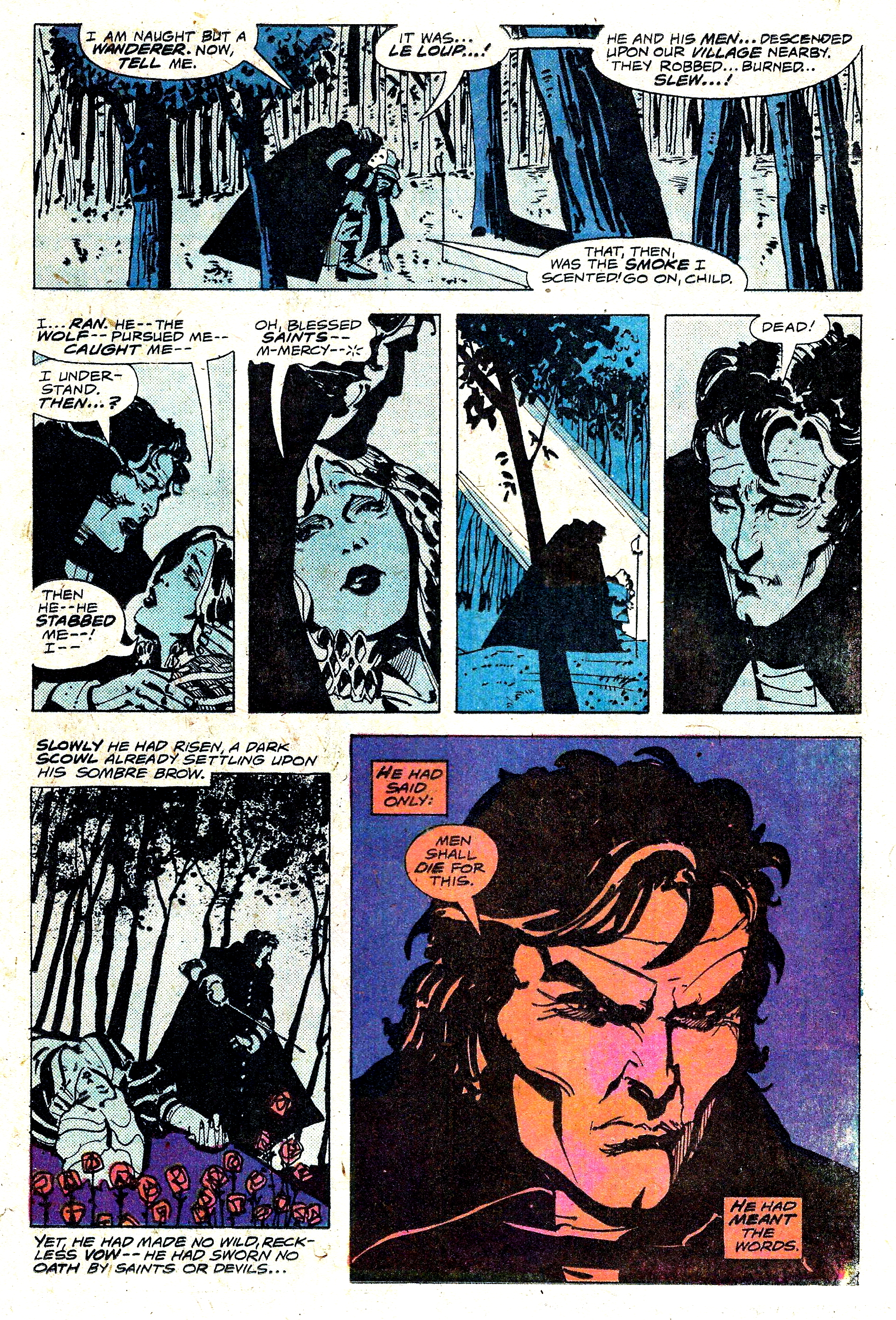
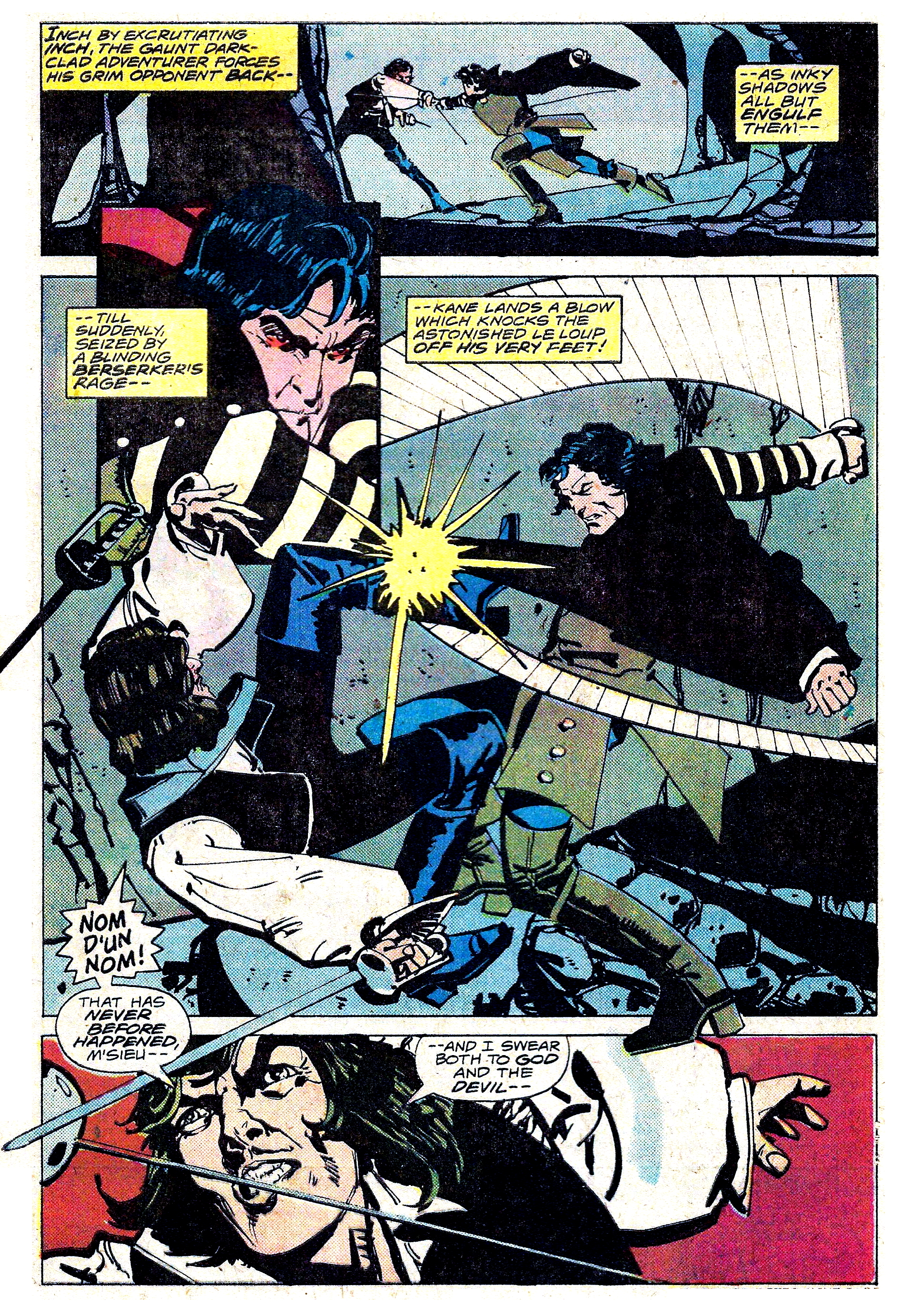
Kane grimly relates how he’d come upon the girl whom Le Loup had raped and mortally wounded, and how he’d vowed to avenge her death. Le Loup is amused to discover that Kane’s motivations stem from what he calls “the softer sentiments“, though he clearly believes that the other man has overreacted somewhat: “But, be not jealous, good fellow… there are many more wenches in the world.” To which Solomon Kane angrily retorts: “Le Loup, take care! I have never yet done a man to death by torture, –but by God, sir — you tempt me!”

The desperate sword fight that ensues between the two enemies (a duel that doesn’t occur in Howard’s original text, incidentally, indicating more plot-padding on the part of Marvel’ storytellers) soon begins to tilt in Kane’s favor…

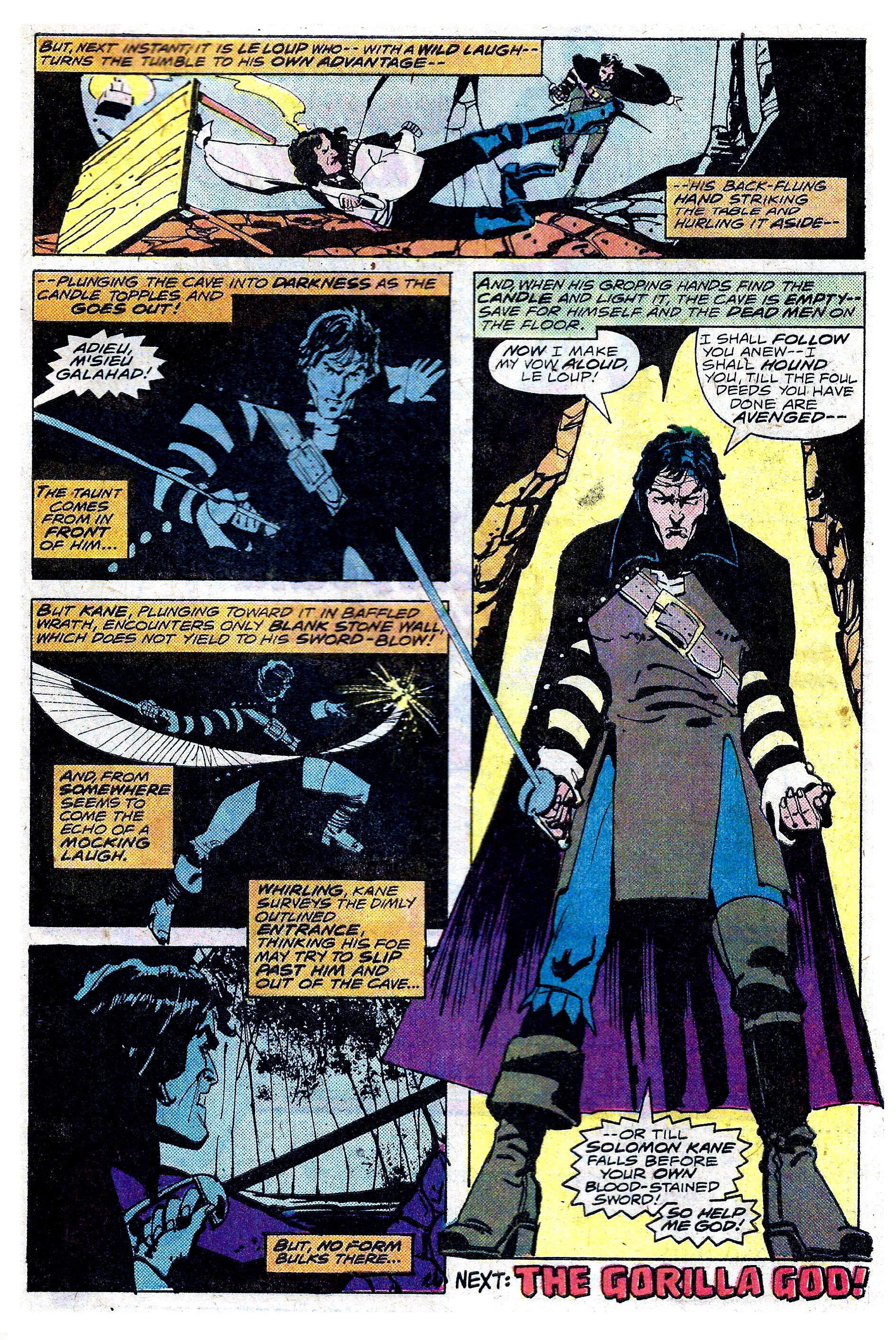
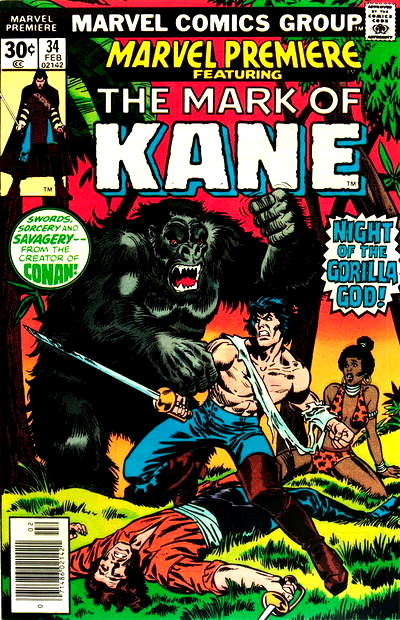 Thomas and Chaykin would conclude their adaptation of “Red Shadows” in the next bi-monthly issue of Marvel Premiere, #34, which came out in November, 1976. This one sports a cover that the Grand Comics Database attributes to Chaykin and inker Frank Giacoia, though it also observes that Marvel art director John Romita appears to have made some pretty heavy alterations to the original (your humble blogger is inclined to concur).
Turning to the issue’s opening splash page, we find that Chaykin has handed over the coloring duties to Don Warfield (who nevertheless hews strictly to the color scheme established by his predecessor for Kane’s apparel). We also see that the action of our narrative has moved from Europe to Africa — the setting (at least in part) of five out of the nine Solomon Kane stories completed by Robert E. Howard during his lifetime.

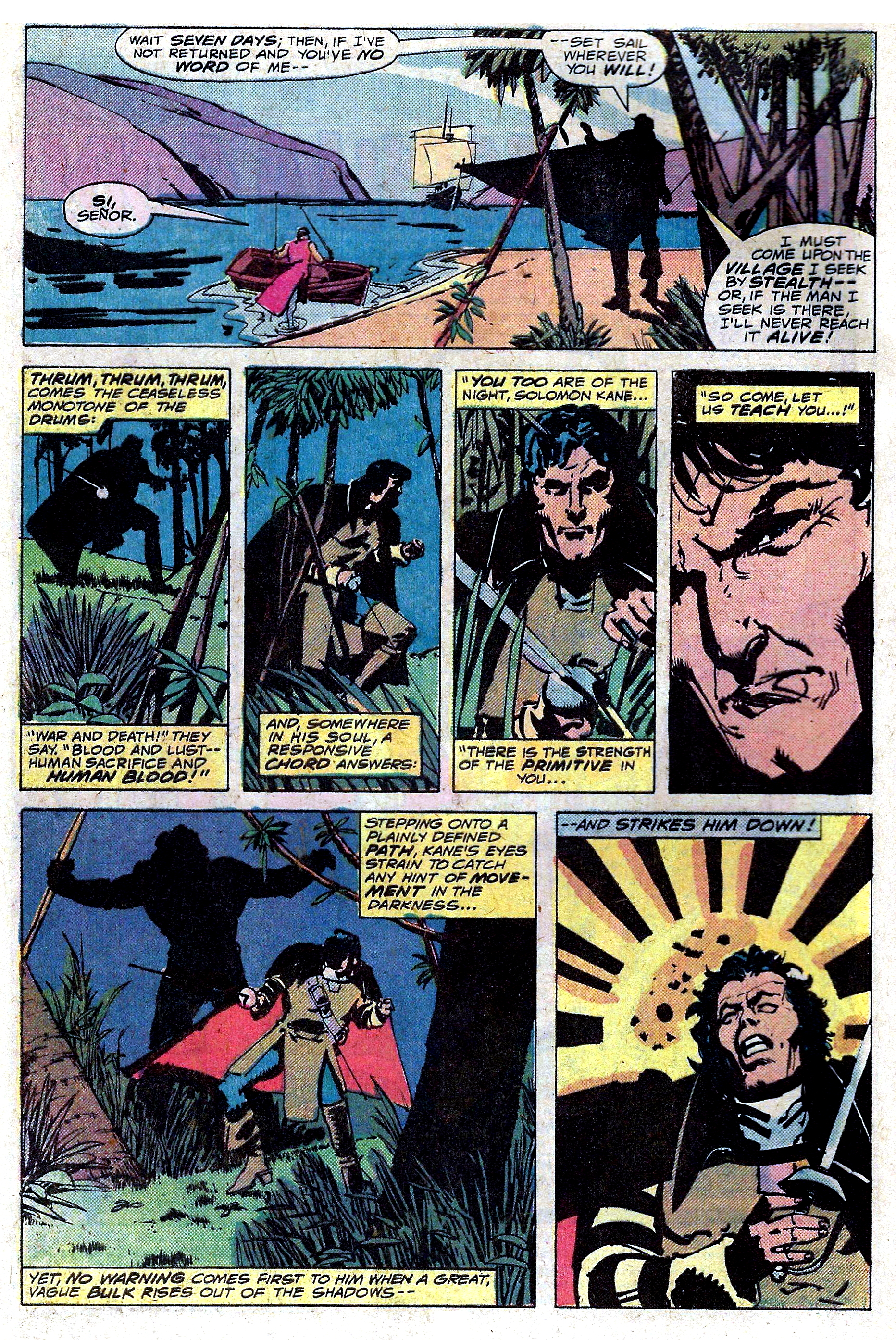
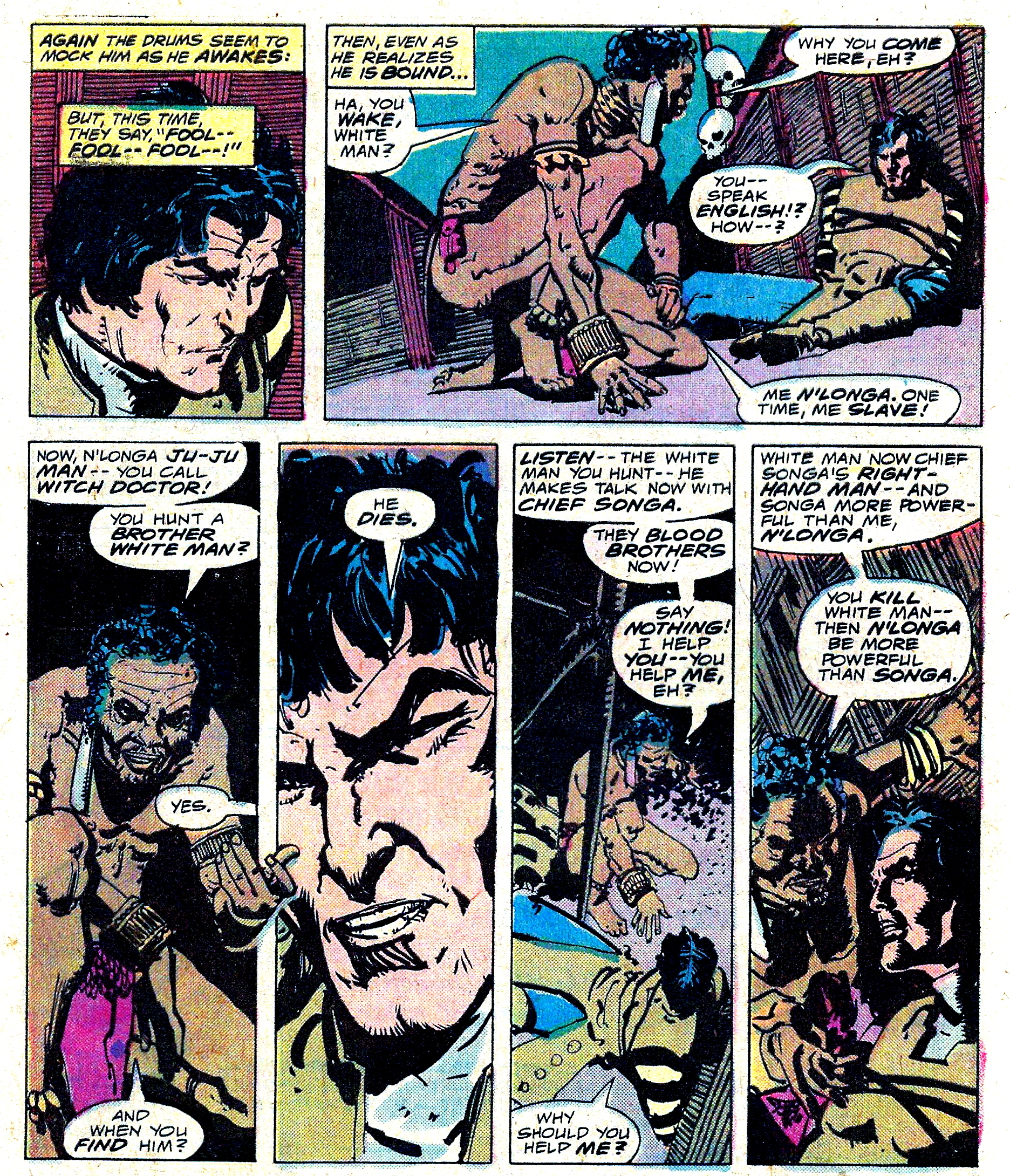
Having said his piece, the “ju-ju man” N’Longa slips away so swiftly “that Kane can scarcely be sure the whole affair was not a moment’s dream!”

“The last time I heard that accursed voice,” Kane answers defiantly, “was in a dark cave — whence you fled, like a hunted rat!” He goes on to relate how he followed Le Loup’s trail to the nearest port, then to Italy, and finally to Africa. Acknowledging that Kane almost had him cornered on more than one occasion, Le Loup proceeds to ask the question that continues to fascinate him: “What is the real reason you have followed me here, into the very jaws of death? Why? For the life of me, I cannot understand.”

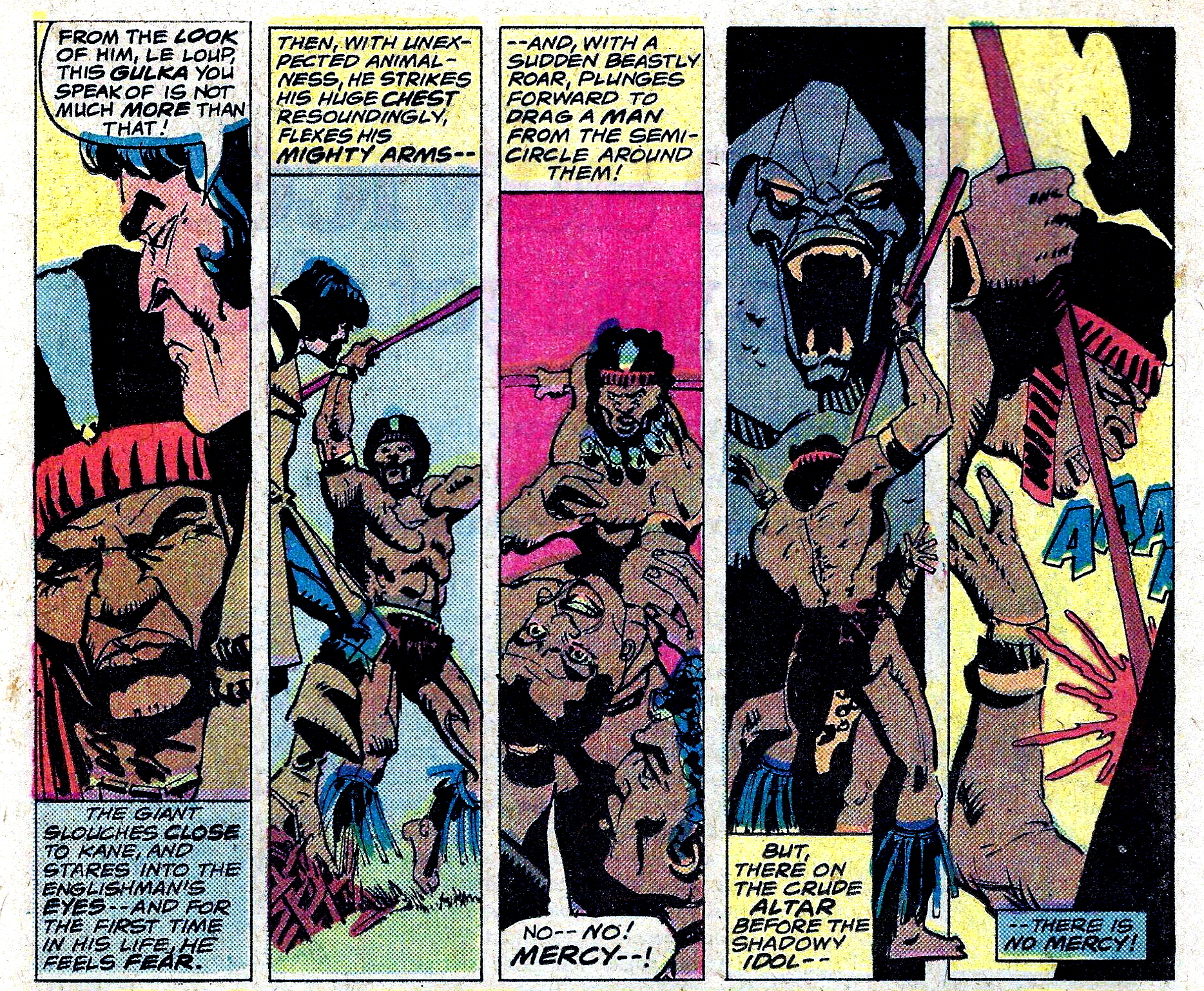
Back in July, in our post about Savage Sword of Conan #14, we discussed how, in adapting Robert E. Howard’s Conan story “Shadows in Zamboula”, Roy Thomas (and perhaps his artistic collaborator, Neal Adams) had taken some pains to minimize elements in the original text that couldn’t help but strike the modern reader as racist. Much the same sort of thing occurs here, as we see both Thomas and Chaykin grapple with material in “Red Shadows” that indisputably employs derogatory racial stereotypes.*
In Howard’s story, the warrior Gulka is introduced thusly:
A giant negro stalked into the space between them. He was the hugest man that Kane had ever seen, though he moved with catlike ease and suppleness. His arms and legs were like trees, and the great, sinuous muscles rippled with each motion. His apelike head was set squarely between gigantic shoulders. His great, dusky hands were like the talons of an ape, and his brow slanted back from above bestial eyes. Flat nose and great, thick red lips completed this picture of primitive, lustful savagery.
In contrast with that description, the Gulka we find here, as depicted both in Thomas’ words and Chaykin’s art, is — while clearly a formidable physical presence — no more “apelike” than the two white men with whom he shares the scene.
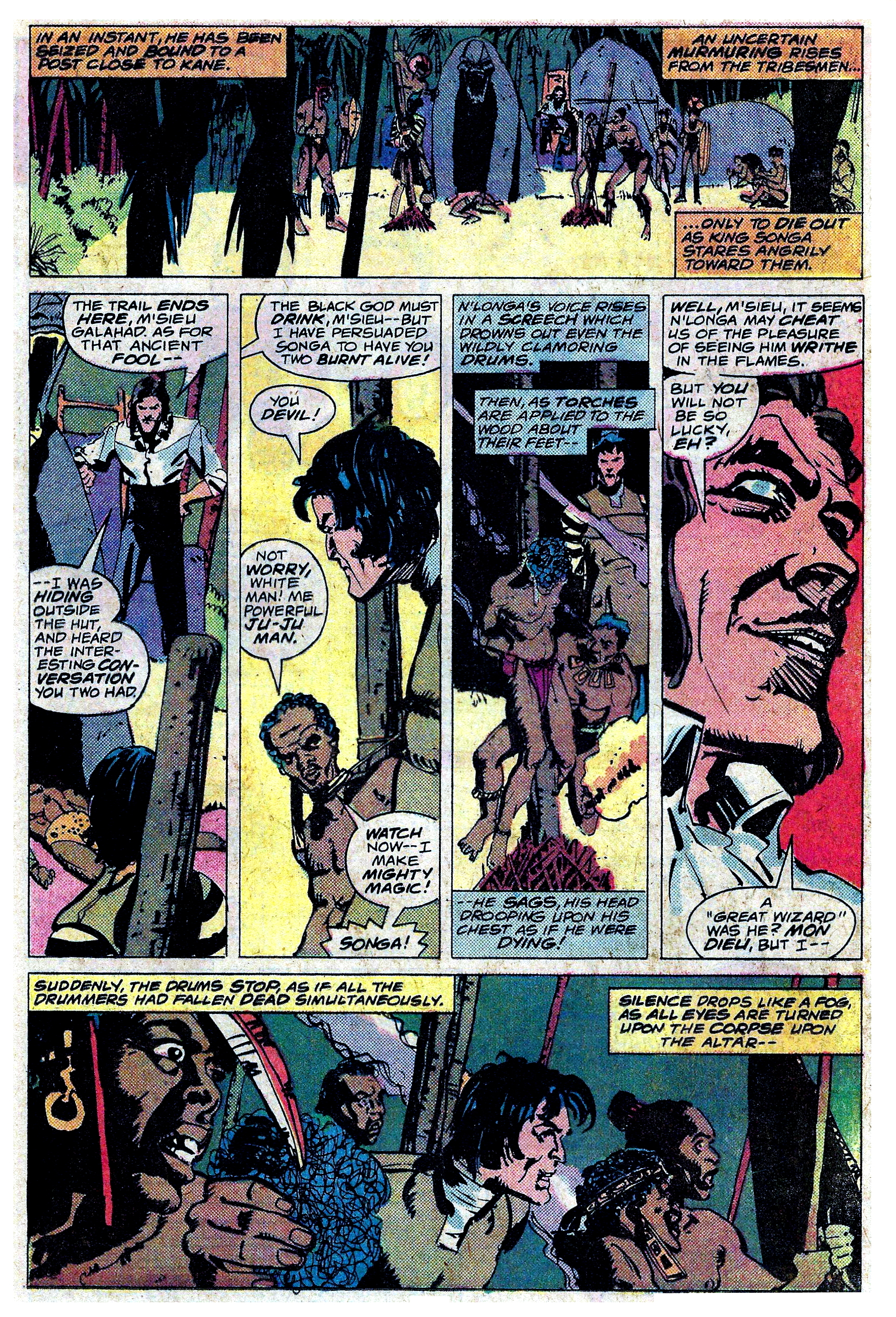


From Kull and the Barbarians #2 (Jul., 1975). Text by Roy Thomas (after REH); art by Alan Weiss and Neal Adams.
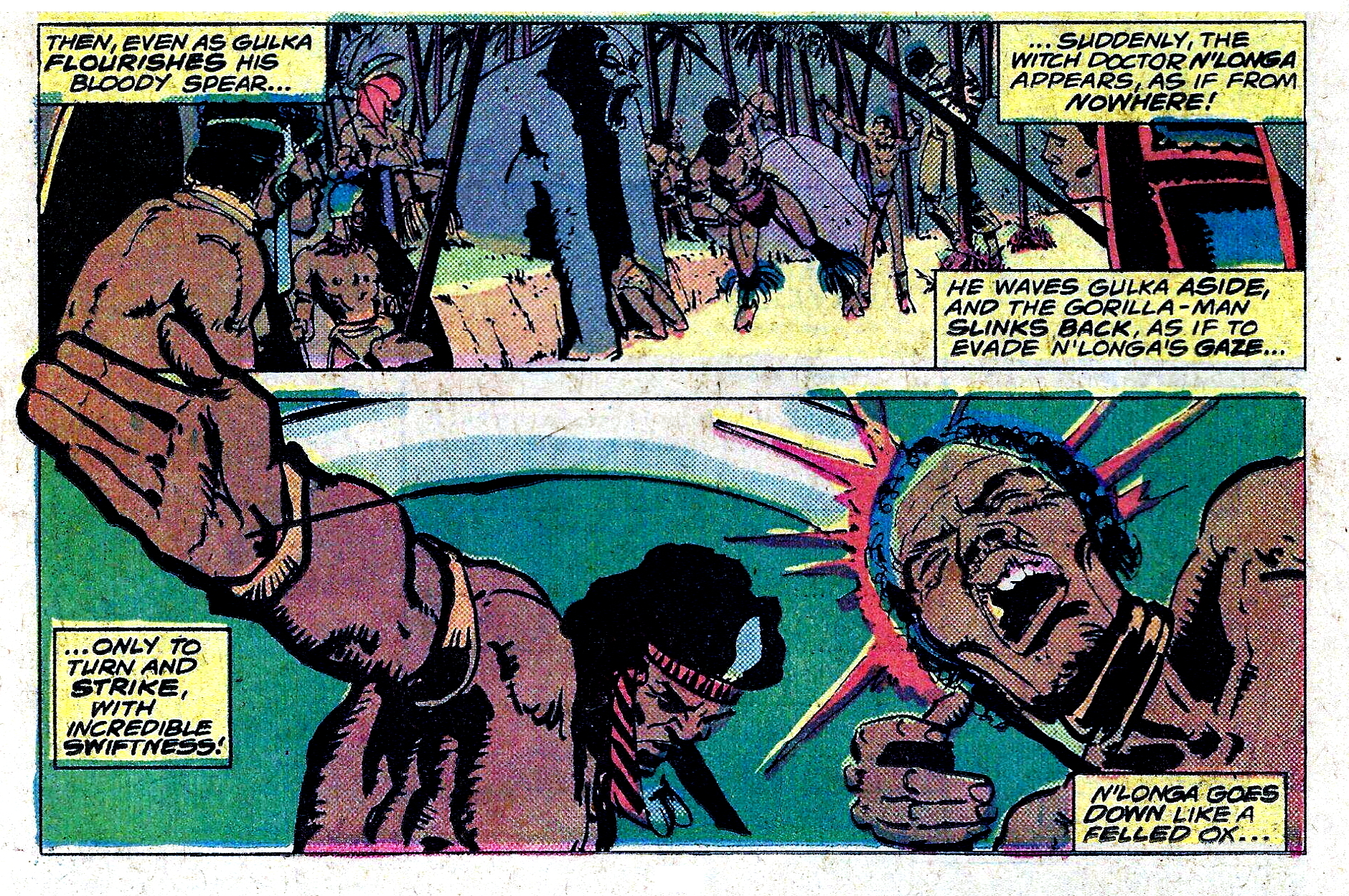
Regarding N’Longa’s “resurrection”, Marvel fans who’d been faithfully following the adventures of Solomon Kane in the black-and-white books for the last few years had enjoyed an advantage over newbies in this instance, as they’d seen N’Longa quite hale and hearty in the two-part adaptation of REH’s “The Hills of the Dead” (a story set later than “Red Shadows” in the “official” Kane chronology, obviously) that had appeared a year earlier in Kull and the Barbarians #2 and #3.
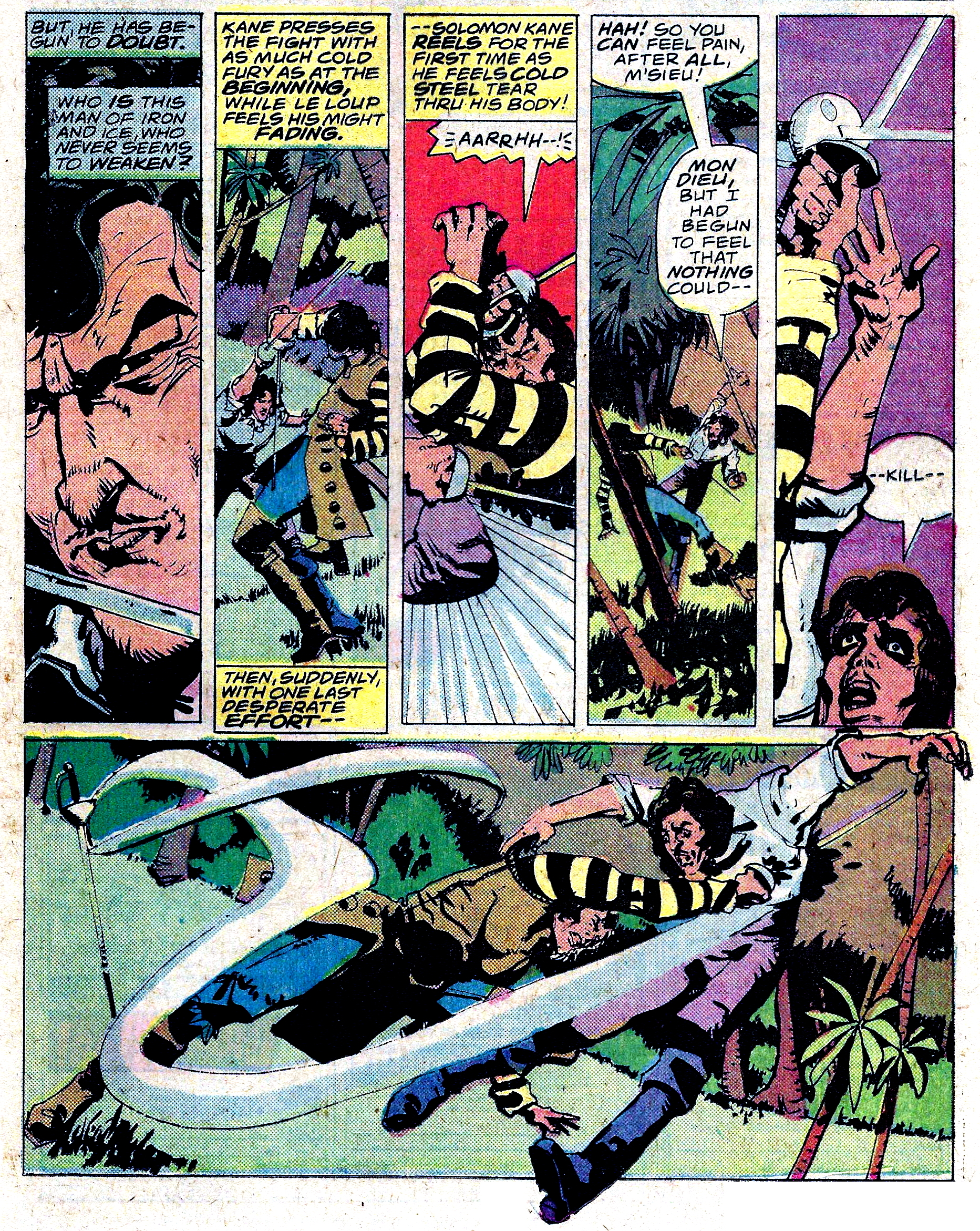
Kane immediately races into the jungle in pursuit of Le Loup; and following the trail of broken limbs and trampled underbrush his foe has left in his wake, their final confrontation is not long in coming…


The battle continues for several minutes, during which time Le Loup remains untouched by Kane’s blade. “The wolf grins savagely in the moonlight,” a narrative caption informs us…

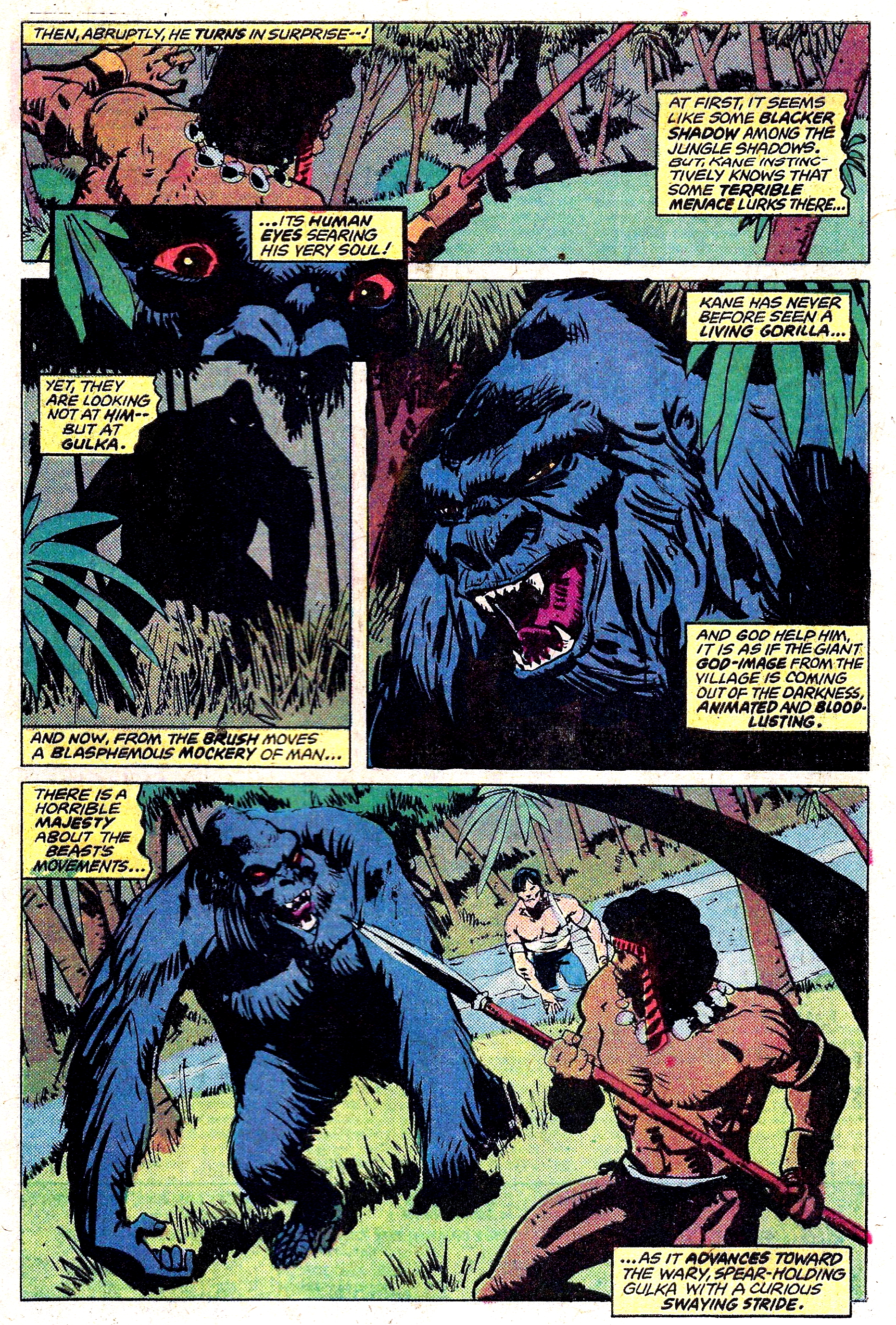
As in the earlier scenes featuring Gulka, Marvel’s storytellers here wisely choose to downplay Robert E. Howard’s interest in emphasizing the supposed similarities between the “primitive” African warrior and the great ape confronting him; for example, Thomas’ narrative captions for these pages, while incorporating a goodly amount of REH’s original verbiage, thankfully don’t incorporate this next bit:
The negro was facing the gorilla, spear at the charge. He was not afraid, but his sluggish mind was wondering over the miracle that brought this beast so far from his native jungles…
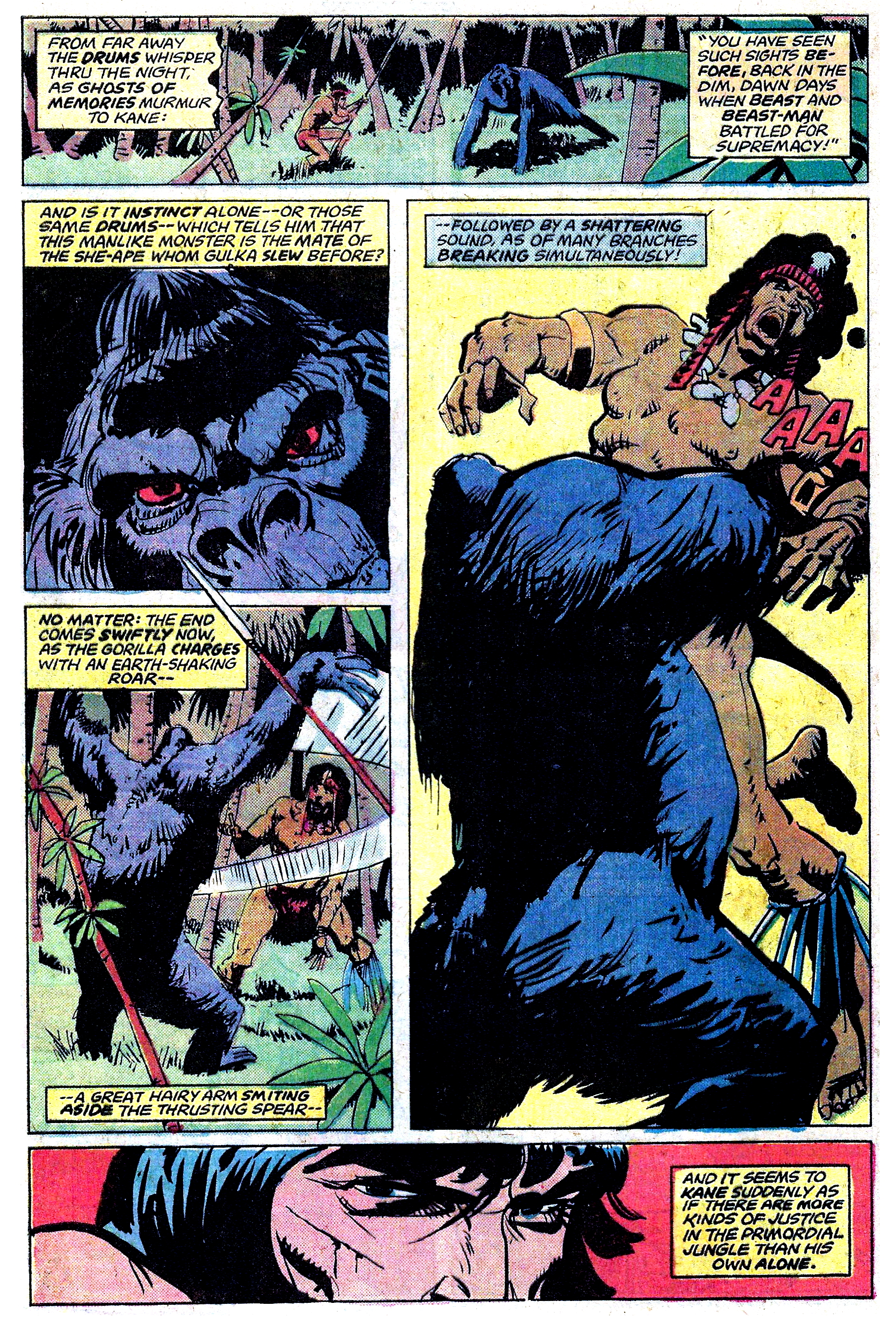
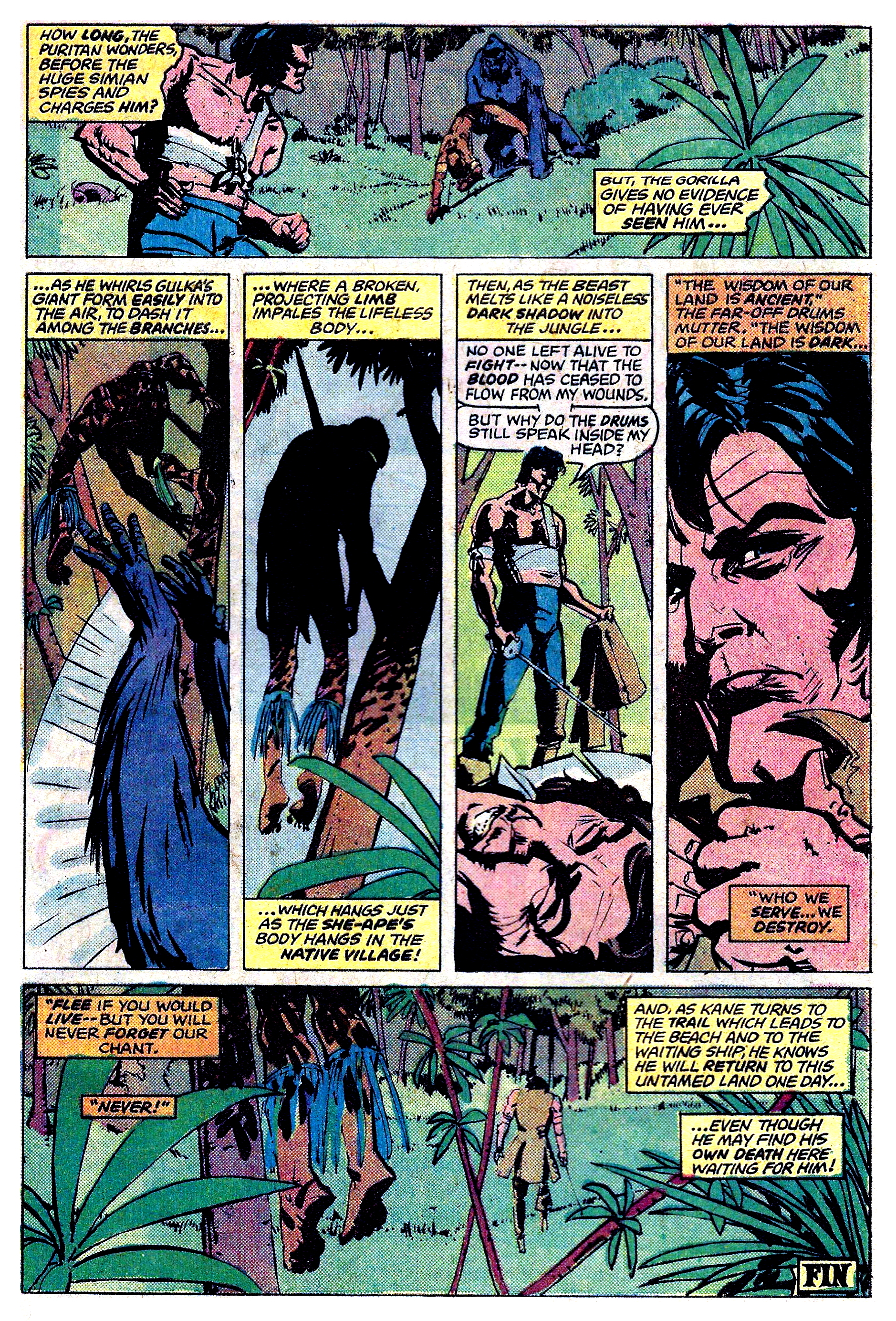
So ends Roy Thomas and Howard Chaykin’s adaptation of “Red Shadows” — for this reader’s money, perhaps the single most successful take on Solomon Kane ever offered by Marvel Comics, despite its undeniable idiosyncrasies — and despite its ultimately proving to be an outlier.
The Thomas-Chaykin team would produce just one more Solomon Kane story — a 10-page black-and-white adaptation of Robert E. Howard’s “Rattle of Bones” — which would run Savage Sword of Conan #18 (Jun., 1977). There’s a good chance that we’ll be taking a look at that one early next year, so for now, I’ll just note that, with the very next issue of SSoC, we’d see a return to Marvel’s more “traditional” look for the hero — i.e., black hat, long hair, no striped sleeves… a look which would persist through the remainder of the period Marvel held the license to the character.
Whether Chaykin’s redesigned version of Solomon Kane didn’t sell all that well, or if, rather, the young artist simply lost interest in working on the property, is a matter for speculation. It is, in fact, possible that Chaykin just got too busy around this time to do any more “Mark of Kane” material. As was noted in the letters column of Marvel Premiere #34, Marvel — and, more specifically, writer/editor Roy Thomas — already had him occupied with another, brand-new project:
…only a few short months from now, Roy and Howie will be teaming up once again — this time for a new science-fiction series called STAR WARS, based on the forthcoming Twentieth Century Fox motion picture epic written and directed by George (“American Graffiti”) Lucas. This one will be a six-issue wonder, since Roy and Howie have no interest in trying to squeeze a two-hour space opera of cosmic proportions into less than a hundred pages!
So watch this space (and Ye Olde Bullpen Bulletins) in the weeks to come, because before you know it, the STAR WARS will be upon you!
Was this the very first time that my younger self had read or heard about this forthcoming “motion picture epic” called Star Wars? It’s possible. If so, I imagine that nineteen-year-old must have been intrigued by the idea, and optimistic that the film would be good… but I suspect I was just as excited by the prospect of a six-issue “space opera” series by Roy Thomas and Howard Chaykin as I was about the movie it was to be based on.
Anyway, we’ll be getting to that epochal event in about seven months. But you won’t have to wait nearly that long to enjoy another example of Howard Chaykin’s “hot streak” of 1976-77 — rather, you’ll only have to sit tight for seven days, which is when we’ll dive into his and Jim Starlin’s go at Nick Fury, Agent of S.H.I.E.L.D., in Marvel Spotlight #31. I hope to see you then.
*All of REH’s African-set Solomon Kane stories contain racially objectionable material to one extent or another — though there’s an intriguing argument to be made that what’s actually going on in that sequence of narratives is a little more complicated than simple, undiluted racial animus. That being said, even the writers making that argument generally don’t attempt to claim that the stories (and their author) were racism-free.
I never found Chaykin’s art terribly compelling in the Bronze Age. Not bad, mark you, but for this kind of swashbuckling, I’d pick Buscema any day. This story as a whole, same thing. Not bad, but it didn’t have me demanding a series. And reading today, my taste hasn’t changed.
I don’t know, but I think more informed fashionistas might describe those sleeves as ‘hooped’ or ‘banded’ rather than ‘striped’ – wouldn’t stripes run down the length of the arm rather than going around? Anyhoo, there are some illustrations of the most famous puritan, Oliver Cromwell, and his New Model Army, all with the same design on their sleeves. Maybe Chaykin was more historically accurate than we suspected? Chaykin’s colouring matches those illustrations as well, with the sleeves ending in white cuffs, but Warfield seems to have dropped that for ease of using the same colour all the way down to the hands. I’d expect also that proper puritan etiquette might be more offended by Ralph Reese’s earlier bare-arm version, with flesh unnecessarily exposed to view. Shocking!
I always felt that the character Solomon Kane had the potential to be something, but somehow never really clicked for me. I was also quite taken with Chaykin’s art in this period but, as above, not enough to have me demanding a series.
Mike, thanks for the info. I did a Google search for Oliver Cromwell’s New Model Army and I did find one illustration showing them with sleeves similar to how Chaykin draws Kane in these issues.
https://www.q-files.com/media/article/2632/ad0952e3-5c1f-4ef5-89f7-9487becf6433.jpg
I’ll add my thanks to Ben’s for the historical fashion note, Mike. Just for the record, though, that bare arm in the Reese illo is due to Kane’s sleeve having been torn off earlier (I guess I should have picked another image to use as an example, but what can I say, I really liked that one. 🙂 )
Howard Chaykin’s ’70s work was certainly bolstered when he was inked by Berni Wrightson, Neal Adams, or Dick Giordano. I still like this solo effort, despite the “pirate” striped sleeves he put on Solomon Kane. His page design is taking greater prominence here than it had before, but his top comics work was still seven years away in American Flagg.
He’s still churning out the pages today, but it’s easy to get lost in a sea of creators. Back in the ’70s when there were fewer television stations (and programs), comics, films, etc. to choose from, one could pretty much keep track of *everything,* at least superficially.
Not now—-which makes having a breakaway hit that much harder, even for a longtime pro like Chaykin.
P.S. in terms of Chaykin’s output at this time, he was also doing quarter psge comic strips in National Lampoon, not to mention single illustrations in some of the Marvel mags, and the occasional Warren magazine story (in Eerie, for instance).
The earliest mention of Star Wars that I saw Roy Thomas make was in the Unknown Worlds of Science Fiction summer special.
I adored this when it came out and I think it still stands up remarkably well today. I have never been a big Chaykin fan, but if his work had proceeded in this vein, I think I would have been totally on board.
Great design and visual dynamics in service to a rollicking swashbuckling yarn.
That’s about all I can say about this one, but it did throw up a bizarre question that I would now like to put before Aot50YOCB Assembled. I was reminded of it in the panel in which King Songa cries ‘Aieee!’ Over my many years of comics reading, I have noticed that both British and American comics formerly had this tradition of African, Japanese, and Native American characters calling out ‘Aieee!’ (or minor variations thereof) when in pain or distress. I have never understood what this trope is based on, but strongly suspect there is a mindlessly racist undercurrent flowing through. For example, Sgt Fury comics and numerous UK war weeklies showed instances of Japanese people crying ‘Aieee!’. But I don’t recall the Howlers ever making such a shrill, ‘unmanly’ sound (‘Arrgh’, maybe, at a push).
Anyone here have any ideas of what it was all about? Or am I just being weirdly obsessive here? If so, just ignore me.
I am Brazilian, and I can tell you with no hesitation nor remorse that “Aieee!” or something that sounds much like it is a very common response to pain or distress here in these neighborhoods.
It is just an interjection, and feels fairly instinctive to me. I take it that it is rare among you English-native speakers, then?
You foreigners are surprising at times… (in case it is not clear, I say this in jest).
I could be completely mistaken, but “Aieee” seems more like sloppy writing than anything with a racial bias. But anyone, please correct me if I’m wrong.
I’m pretty sure I’ve seen AIEEE! as a scream from people in comics regardless of ethnicity. IIRC, the TV series Bob (Bob Newhart as a comic-book writer) made jokes about it (“Was the line ‘Buddy — Buddy — Aieee!” or “Aieee! Buddy — Buddy!”).
I would not even call it sloppy.
I am sincerely curious on whether the pain interjections are any different for English-speaking natives now.
I suppose having someone in pain or even surprised yell “Aieee” would mark a person in a comics story as not having steel nerves or an almost supernatural instinct for responding to danger, but even then I would not call it racism. It is the difference between a Conan, Reed Richards or Punisher and a J.J. Jameson or Steve Lombard, not between Conan and Juma or Lone Ranger and Tonto.
I would gladly have one of those rugged protagonists yell “Aieee” once in a while if only to humanize them (although it _may_ genuinely break character), but that is the extent of my concerns on that interjection.
I shall conduct a proper study of this. I intend to reread my entire collection (some 10,000 items, approx., which seems like a fair sample size) and do a proper statistical compilation of ‘Aieee’s’. I brought the matter up, so I guess it’s on me. I may be gone some time…
That may be a bit excessive.
Just saying.
Would it help if I added that my response to your response was “Aieee!” 😉
I think when I stub a toe or somehow cause myself pain somewhere else, my immediate vocalization may be something akin to “aieee!!!!” followed by a choice selection of old Anglo-Saxon terms often mistaken as “French”, aka some of those seven words that cannot be said on the radio as per George Carlin’s routine from the early ’70s.
I wonder if “Aieee” is the comic book equivalent of a Wilhelm scream? 🙂
OK, I had to look that one up! https://en.wikipedia.org/wiki/Wilhelm_scream
Fun fact – There’s a Seattle band called Aaiiee that have been playing since the early 80s.
https://www.discogs.com/artist/878115-Aaiiee
Lots of non-Asian comics characters scream AIEEEEE! in panels collected here. Scroll down a bit to see them:
https://flashbak.com/eeygaah-and-other-vintage-comic-book-screams-of-terror-384820/
A few years from now we may be all screaming this variant: A.I.! EEEEEEE!
😉
Thank you, MoB. That is a great compilation of distress cries. I love it.
You are right. There are plenty of white characters AIEEEing in that selection. Maybe my racism detector needs recalibrating.
As a further test, next time I experience sudden pain or an attack by a hostile supernatural manifestation (or both) I will analyse the sound of my cry.
Watch this space.
I don’t always love Howard Chaykin’s art – too much testosterone floating in the air all the time – but he is definitely good at delivering action scenes with a sense of tension and urgency.
A space opera movie from that George Lucas guy of “American Graffiti” fame… I am fairly certain that I have seen it. There were a few sequels too, I swear.
I didn’t like any Kane story ever and learned my lesson about picking up any sword and sorcery or heck, just plain sword storis. Even Conan bored me into never joining my comletism for comics. I did like Kull but only as king. Starstalker was much more to my taste, although not what was done to the character more recently.
“Why not?”
Those were the words that came to my mind as I sipped my umpteenth cup of coffee, completing Alan’s thoroughly enjoyable review. Did I find Marvel Premiere #33 particularly riveting? No. As others have commented, it came across as another S&S story with more intriguing art from a talented individual still seeking to find their “groove.”
But hey, since Kane is a Robert E. Howard character and with Marvel making serious green off his shirtless creation, what’s the harm in letting Howard Chaykin have some fun? Worse outcome is a lower selling issue of a lower selling title. And if it they catch lightning in a bottle and have a hit, so much the better. That was the beauty of books like Marvel Premiere & Spotlight back then.
Hence the comment, “Why not?”
On a final, rather embarrassing note, I vaguely recall reading something about “Star Wars” in Marvel’s comics around this time and didn’t give it a second thought. Back then, it was months before big movies made it to my area. As a result, I did not actually see “Star Wars” until July 1977. Even more difficult to believe in our social media saturated world, I really had no idea what it was about going in. To put it another way with a lame attempt at humor, “Help me, Alan-One, help me! You’re my only hope!”
Thanks Alan, I really enjoyed this instalment. I remember reading the first part of this story back in the day, but I didn’t read the second until some time later – dodgy distribution in the UK meant it never reached my usual newsagent and I had to wait until it turned up in a back issue bin.
At the time, I was all in on Conan, which to twelve-year-old me seemed like very grown-up fare, so I was expecting to get the same buzz from this, but I just didn’t – I found it rather flat and uninvolving. Kane didn’t grab me as a character, maybe because fictional puritans aren’t much more engaging than their real-life counterparts.
I did enjoy Howard Chaykin’s art though. I was completely unfamiliar with Alex Toth’s work at the time, but I really liked the stripped-back drawing style, the spot blacks and the use of negative space, although I couldn’t have told you why at the time. The inking on part two looks rougher to my eyes than on part one, though it’s none the worse for that. And Chaykin’s colouring on part one is gorgeous, especially in the night scenes. It looks great here scanned from the original newsprint pages, much better than the oversaturated colours of today’s online versions.
Either REH or Roy Thomas seems to have gone a bit adrift on dates – the caption atop the first page clearly sets the story in the time of Queen Elizabeth I, but a few pages later we’re told that Kane buries the unfortunate priest in September 1553, during the reign of Elizabeth’s predecessor, Mary I. Mary is best remembered for her bloody campaign to reverse the Protestant Reformation in England and restore the Roman Catholic faith, so the reference to the Church of England seems anachronistic. In any case, this part of the story is clearly sets in continental Europe, most likely France, so what was a Church of England priest doing there anyway? And according to Wikipedia, the first recorded use of the word Puritan didn’t come until 1564.
And speaking of anachronism, Le Loup and his accomplices are clothed in a style much more fitted to the 17th century than the 16th – strong Three Musketeers vibes are evident. But hey, it’s only a comic book, right?
Colin, excellent point about the years being off. It’s been a long time since I read the original “Red Shadows” by REH but fortunately it appears to be in the public domain and is posted on Project Gutenberg. I took a quick look at it there, and it doesn’t seem that REH gives the exact years the story occurs in. So, the error in on Thomas’ part.
Checking on Wikipedia, the majority of Kane’s fictional career in REH’s stories actually appears to have been in the late 1500s, as there are a couple of real-world events alluded to in them which date from 1578 and 1591.
In addition to Solomon Kane’s original adventures by Robert E. Howard and Kane’s Marvel Comics appearance, the character was also integrated by the author Philip Jose Farmer into his fascinating Wold Newton shared universe of fictional heroes and villains, whose enhanced abilities were attributed to the real-world crash of a meteorite in the Wold Newton in Yorkshire in 1795. One of Farmer’s assertions was that the occupants of the carriages that were exposed to the “radioactive” meteorite were themselves the recipients of genetic adaptations that they inherited from adventurers of the previous centuries. Relevant to this posting is the premise that Solomon Kane was an ancestor of Clark Savage, Jr., aka Doc Savage. Other prominent members of Farmer’s genealogical matrix are Sherlock Holmes, Tarzan, the Scarlet Pimpernel and the Shadow, among many others.
According to the Marvel Database, Solomon Kane was born around the year 1530, which would make him about 23 at the time of the story in 1553. However, according to Philip Jose Farmer’s Wold Newton Universe chronology, Kane was born 19 years later in 1549, which would have made him a lad of just 4 at the time of this story. So the former birth year fits the Marvel Premiere story plausibly, while the latter does not. Kane’s involvement in the Spanish Armada of 1588 would have made him about 58 according to the former birthdate, whereas he would have been 39 based on the latter birthdate. All things being equal, it seems more plausible to me that the Solomon Kane who fought at the time of the Spanish Armada would be 39 rather than 58, especially if he had adventures through the first decade of the 17th century, as the character’s last chronicled exploit occurred in 1610, when he would have reached the age of 61.
I first learned of Solomon Kane when I was nine years old in 1985, when I saw a house ad in Marvel Comics for the forthcoming six issue miniseries The Sword of Solomon Kane. I was certainly intrigued by the imagery in artist Bret Blevins’ illustration, and by the blurb “From the creator of Conan” but I unfortunately did not have the opportunity to pick up any of the issues of it.
https://marvel1980s.tumblr.com/post/99584536170/1986-solomon-kane-house-ad-by-bret-blevins
I finally was able to read the original REH stories featuring Solomon Kane a decade later in 1995 when I was 19 years old. Baen Books published a paperback collection of the complete Kane stories. I read it and really enjoyed it, even with the unfortunately very dated racist elements.
https://reh.world/publications/?reh_publication=3970
So, I recall shortly after finding Marvel Premiere #33 and #34 in the back issue bins of a comic shop located near Pace University in Pleasantville, NY, where I was attending college. I enjoyed the adaptation by Roy Thomas & Howard Chaykin, even if the yellow and black “bumblebee sleeves” (as I believe Thomas described them) that Chaykin gave Kane were somewhat incongruous.
I know that Chaykin has frequently expressed dislike for the work he did prior to American Flagg! in the early 1980s. But, honestly, I feel he does a very good job with the artwork here. His layouts are really dynamic & exciting.
It definitely makes sense to me that Conan is a much more popular REH creation than Solomon Kane. Conan is a brawny anti-hero who fights monsters & wizards and encounters gorgeous scantily clad women in a fantastic fictional pre-history. Kane is a gaunt, dour, chaste religious fanatic who lives during an actual historical era and who most frequently has sword duels with ordinary human opponents. Of course Conan is the more exciting figure. But I still have a definite fondness for Kane.
By the way, Thomas did eventually manage to team up Conan and Solomon Kane in the pages of Savage Sword of Conan in the mid-1990s. I covered that story in my blog a decade back. Here’s a link to that piece…
https://benjaminherman.wordpress.com/2014/09/24/super-blog-team-up-4-conan-the-barbarian-and-solomon-kane/
Sword of Solomon Kane from 1985-86 is one of my favorite comic miniseries, and really stuck with me as a 15-year-old. They’re some of the few comics I still own–the Mike Mignola issue is fantastic.
I bought the Mignola-drawn issue as a back issue and later got it autographed by him!
I enjoy Kane too. If I were writing a Kane comic I’d play with REH’s idea that Kane’s as keen on thrills and adventure as Conan, it’s just that he represses it and channels it into “find evil things, kill them.”
This must be noted:
“Red Shadows” appeared in the same issue of *Weird Tales* as “The Vegeance of Nitocris,” which was the first published work of Thomas Lanier “Tennessee” Williams.
Maybe Williams once considered naming Blanche DuBois (it means white woods) “Rouge Ombres” (that means red shadows).
In a later story, Solomon Kane speaks of N’Longa as his bloodbrother. Given racial attitudes of the time, I found that incredibly heartening.
I think it’s very good looking art overall, but those blue tinted pages where Kane finds the girl in the woods are especially striking… less being more and all that.
My comics collecting habit as of September 1976 hadn’t yet expanded to include any sword & sorcery fare, whether in a mythical ancient past or somewhat more recent Tudor times. Consequently, I didn’t select these tales of Solomon Kane. Anyhow, interesting how Thomas tries to thread the needle of converting Robert E. Howard’s original tale written from a Jim Crow culture of about 40 years earlier into a story that while not straying too far from the original but still with the usual Marvel style action and more “modern” sensibilities, such as they were 50 years ago. Did seem a mite peculiar switching from late 16th century western Europe to the jungles of Africa, at a time when relatively few Europeans ventured far beyond the coasts of sub-Saharan Africa. But then, it sort of dovetails with Thomas & Chaykin’s far more famed collaboration of a few months later, Star Wars. Both have aspects of the movie serials of decades before, one set in a past that is the cusp of modernity but still distant enough to seem alien while the other is of an imaginary culture which is “futuristic” even if in place “far far away and long long ago”. Despite very distinct settings and inhabitants, the main gist is still swashbuckling adventure and appeals to supernatural forces in struggles against evil.
Well, I commented on this post, but it’s no longer here, so I suppose Wp ate it. No accounting for “taste,” I suppose.
Anyway, I know I was aware of Solomon Kane fifty years ago because I have a drawing of the character that I did, standing in front if a majestic, haunted-seeming forest, that I drew the same year for some friends who were trying to get a fanzine started. I’d post it for you, so you could all get a chuckle at how stiff it looks, but fortunately (for me), Wp won’t let us attach things to our comments. Darn. I did enjoy the 2009 movie with James Purefoy and read the stories not long after that. Saying simply that they were “racist,” Alan is a huge understatement, especially the “Africa” stories. Thank goodness Roy choose to write around those moments in the Marvel adaptations.
As or Chaykin, I’ve always enjoyed his work, however, I couldn’t help but notice every time Roy referred to him as “dressed in black” at looking over and noticing the brown vest and boots, the bright blue pants and the yellow stripes on the sleeve. Sure the outside of his cape was black, but Howie preferred showing us the garish red lining (which no god-fearing Puritan would ever wear). Roy’s story was sort of rote and by the numbers, but then again, most of REH’s Solomon Kane stories were too. Thanks, Alan!