
In October, 1975 — just a little less than a quarter-century since their last headlining appearance in All-Star Comics #57 (Feb.-Mar., 1951), and about half that time since their revival in Flash #137 (Jun., 1963) — the Justice Society of America finally returned to newsstands in their own book. The premiere superhero team, not just of DC Comics but of all comics, was at last back in full force, ready to reclaim its former glory.
And it had Marvel Comics to thank for the opportunity.
Well, OK, not Marvel Comics exactly. Rather, it was Roy Thomas — no longer Marvel’s editor-in-chief as of late 1974, but still a contracted writer and editor with the company — who, one night in 1975, suggested the idea to his friend Gerry Conway, who had himself just jumped ship from the House of Ideas to sign on as a writer and editor for DC. And, of course, Roy Thomas was even then known to be one of the all-time Justice Society superfans, so the notion would hardly have seemed to come out of nowhere. Still, it was irregular. As Thomas himself would recall decades later in an article for his own fanzine Alter Ego (issue #14 [Apr., 2002])” “I was under exclusive contract to Marvel, and probably shouldn’t even have suggested the idea in the first place!)”
And, naturally, once the seed was planted, Gerry Conway — a younger man than Thomas, who’d first encountered the JSA in the context of their 1960s revival — had his own ideas, as was made plain to those of us who plucked a copy of All-Star Comics #58* out of the spinner rack back in the fall of ’75. For one thing, the “Justice Society of America” logo was a good bit smaller than, not only the book’s title (which happily echoed the classic logo of the Golden Age), but also the banner for something called the “Super Squad”. Were the JSA going to be no more than supporting players in their own comic? Plus, out of the three characters on Mike Grell’s cover implied by its copy to be the members of this so-called Super Squad, two of them weren’t even Justice Society members: the Star-Spangled Kid, who’d always belonged to DC’s junior varsity super-team, aka the Seven Soldiers of Victory; and someone we’d never seen before, who went by the name of “Power Girl”. (The third supposed Squadder, Robin, was in fact supposed to be an official JSA member in good standing, and in fact had been ever since Justice League of America #55 [Aug., 1967]. Had the Boy Teen Adult Wonder been demoted, or something?)
In an interview conducted by Roy Thomas for the same issue of Alter Ego quoted from above, Gerry Conway explained his thinking:
…I wanted to do a “modern” group — which at the time meant kids in costume. Youth rules — and the original JSA characters were a bit long in the tooth, according to continuity (even given that time seemed to run at a different rate on Earth-Two). Robin was a nod to the present; The Star-Spangled Kid was a nod to the past; and Power Girl was an attempt at something “new.”
Calling the resulting group the “Super-Squad” was intended to differentiate it from the JSA. Also, while I wanted to use the All-Star name for the comic, I knew that, in fact, none of these characters were what readers of the ’70s would consider to be “stars.” Hence, “Super-Squad.” Which also avoided the acronymic problem presented by the alternative “All-Star Squad.”
We’ll have a good bit more to say about those three “young” characters as we go through the book; but for now, let’s turn to our story’s opening splash page:

Joining writer-editor Conway to complete the series’ creative team (at least for the first two issues) were artists Ric Estrada and Wally Wood. Asked by Roy Thomas in 2002 how Estrada and Wood had come to work on the book, Conway was frank:
I didn’t have access to the so-called “good” artists — and I’m not sure I would have agreed with that designation at DC then anyway! Most of the artists I worked with then were people the other editors wouldn’t use, because they were either brand new (Keith Giffen) or were perceived as being “burned out” (Steve Ditko, Wally Wood) or just not “good enough” for the traditional DC super-hero book (Ric Estrada, Ernie Chan**, Dick Ayers, Chic Stone). But I’d seen Ric’s pencils on some books Joe Orlando was doing (I think), and thought he had a great storytelling/design sense.
Wally Wood, of course, was a master of long standing — though his stock had fallen somewhat among other editors at that time — but I’d never felt his storytelling was his strong suit. I had this (probably crackpot) theory that one could combine artists with different strengths and that the whole would be greater than the parts. I thought the teaming of Ric’s pencils and Wally’s inks would be exciting, and I was right (I’d like to think).
Ric Estrada was a veteran artist with credits going back to the 1950s, although the bulk of his comic-book work had been done since 1967, and most of that had been for DC’s romance and war books –neither of which my younger self was into at all. (Looking at the list of Estrada’s credits on the Mike’s Amazing World web site, I note only two stories by him that I would have read prior to the publication of All-Star #58, one in House of Mystery, and another in Plop!.) He may well have been a fine draftsman (to this date, I have only a limited familiarity with his work), but the fact was that, at least for me, his rendering style was largely subsumed under that of Wood — whose finishes tended to dominate all but the most distinctive pencillers (e.g., Steve Ditko). That said, I can at least add that, going just by the evidence of his two All-Star Comics issues, Estrada’s storytelling skills seem to have been on point.
Before moving on from this first page, we should also take note of the script’s explanation that the “All-Star Super Squad” is in fact a new team composed of the six JSAers pictured here, plus the three alleged youngsters highlighted on the cover. Good to know.

There were of course more than just these six JSA members available in 1975 for Gerry Conway to have selected for his team (several left out of the roll call here — Hourman, Johnny Thunder, and Wonder Woman, to be specific — had in fact just recently appeared in the latest annual Justice League/Justice Society team-up, as presented in JLA #123–124). So it’s kind of interesting to observe that of the half-dozen he’s opted to go with, three have direct analogues on the roster of Earth-One’s Justice League — those would of course be Flash, Green Lantern, and Hawkman — while the other three — Doctor Fate, Doctor Mid-Nite, and Wildcat — are unique to the Justice Society and Earth-Two.


The Star-Spangled Kid proceeds to finish the job with his fists… just like in the old days, when he and his sidekick Stripesy used to bust crime without any superpowers whatsoever in the pages of Star-Spangled Comics and World’s Finest Comics — as well as in Leading Comics, where the duo were both members of the Seven Soldiers of Victory. (For more details on the Kid and Stripesy’s Golden Age careers, see here.) As to why he’s in this book, my guess would be that the main factor making him attractive to Gerry Conway was his being one of the very few established Earth-Two superheroes circa 1975 who was less than middle-aged, at least physically speaking.


The last published adventure of the Seven Soldiers of Victory had appeared in 1945, and the final outing of the Star-Spangled Kid and Stripesy in their own feature had been in 1948 — making the Kid’s comments about being “twenty years away” from home, and his belonging “in the 1950s” seem off by at least a few years. Or at least that’s what Roy Thomas (one of the most notorious continuity sticklers in the comics field) thought in 2002, when he asked Gerry Conway about it for their Alter Ego #14 interview. Here’s Conway’s response:
I guess when I was writing that particular bit I confused Star-Spangled Kid and Stripesy with Captain America and Bucky (for obvious reasons)! Since Cap and Bucky’s careers continued into the ’50s despite Stan [Lee]’s assertion in Avengers #4 to the contrary (and let’s not get started on the continuity problems that created!), I must’ve assumed the same was true with SSK. Sloppy continuity on my part, but I suppose I’m in good company.


Using the Cosmic Control Rod, the Star-Spangled Kid manages to save a woman and child from being crushed by falling masonry — but the larger matter of how to stop the earthquake is a lot more daunting. “Catching crooks is something I’ve done all my life — but this is different!” he thinks to himself. “How do I become a bona fide world-saver — overnight?”


 Brain Wave (or, as it’s often spelled in this story, Brainwave) was a Golden Age villain who’d first fought the Justice Society in All-Star #15 (Feb.-Mar., 1943), and then gone on to face them on several later occasions as well, both solo and as a member of the Injustice Society of the World. However, in all of those stories, he’d had a markedly different physical appearance from the man we see on the pages above (as is demonstrated in the panel from the villain’s first appearance shown at left; text by Gardner Fox, art by Joe Gallagher)… something which Conway’s script acknowledges (and also promises to address) in the opening caption of the very next page…

Robin, “the ex-Boy Wonder“? That’s accurate, I suppose… but I still think it could use a little work.

Cover to Justice League of America #55 (Aug., 1967). Art by Mike Sekowsky and Murphy Anderson.

Panel from JLA #92 (Sep., 1971). Text by Mike Friedrich; art by Dick Dillin and Joe Giella.
As we’ve already pointed out, the Earth-Two Robin had officially joined the Justice Society way back in the first half of 1967’s JLA/JSA get-together. Since then he’d shown up for three more of those annual events, with the most recent having concluded just two months prior to All-Star #58’s release. Throughout all of those adventures, he’d consistently worn the same costume — an amalgamation of his mentor’s garb with his own original ensemble which, depending on whom you ask, is either a) one of the greatest abominations of superhero costume design ever committed to newsprint or b) actually kind of fun in its own peculiar way. But in the second of the Earth-Two Robin’s team-up outings, he’d met his Earth-One counterpart — and when the latter’s costume was damaged in battle, the elder Dick Grayson had invited his younger doppelgänger to borrow an outfit he’d previously considered for himself and passed on — one that had been “fashioned by a costume-maker I know — Neal Adams!” At the end of that 1971 two-parter, Earth-One’s Robin had mused that he might keep the new togs; but while that didn’t happen, his chronological predecessor had clearly had second thoughts about his own earlier rejection of Mr. Adams’ design, and — sometime between the conclusion of JLA #124 and our present story — had adopted a somewhat modified version of it.
And here’s a funny thing. Whether it’s because of the new costume, the new hairstyle (the Earth-Two Robin had never abandoned his traditional double-curl look prior to this issue), or simply the way that Ric Estrada and Wally Wood have opted to render his face and form, the JSA’s Richard Grayson now looks significantly younger than he did as recently as August. You can almost buy him as a “kid in costume”, to borrow Gerry Conway’s phrase — despite the fact that even by a conservative estimate, the character should be at least in his early forties at this point.***

Just a couple of weeks before this, in 1st Issue Special #9, DC had offered fans an exciting new take on Dr. Fate — one that had the superheroic sorcerer invoking ancient gods like Ishtar and Tezcatlipoca, identifying himself a champion of Order against Chaos, and casting spells in the visual form of cool graphics centered on the Egyptian ankh symbol. But despite the fact that that earlier comic had been produced under the editorial direction of Gerry Conway, we see little to no evidence of those innovations in this story; instead, the Doc talks pretty much as he always has, and shoots force beams from his fingertips. While the innovations of writer Martin Pasko and artist Walt Simonson would eventually make their way into All-Star Comics, it was going to take at least a few issues.

The two veteran heroes hasten to aid their somewhat younger colleague — but even as the dazed Robin comes around, the big green cork created by Green Lantern suddenly and unexpectedly bursts free of the fissure…


Leaving his teammate to find his own transportation (which Wildcat promptly does, by commandeering a local’s motorcycle), the Flash races on ahead…


 While I can’t prove this, naturally, I have little doubt that All-Star Comics #58 is remembered today more for the debut of Power Girl than it is for anything else. That said, this scene wasn’t quite the first time anyone outside the DC offices had laid eyes on the character, as she’d been previewed several months earlier in the 6th (May-Jun., 1975) issue of Amazing World of DC Comics, courtesy of a sketch by DC editor (and veteran artist) Joe Orlando (see right).
Orlando may (or may not) have been the first person to draw Power Girl — but most of the basic visual concepts of her design appear to have originated with her primary creator, Gerry Conway. As Conway later recalled for a retrospective on the heroine published in Back Issue #33 (Mar., 2009):
I don’t think there have been very many white-costumed heroes. And that was what I started with. We added the boots and a cape for some color, but the white actually stands out because there weren’t many other costumes that looked like that.
Elsewhere in the same article, Conway said:
I designed a lot of the characters I created when I was working at Marvel and DC in the ’70s… I would sketch out a preliminary design and pass it on to the guys who were drawing it. Sometimes they would modify it or redesign it, but not much changed with Power Girl. She looked like I wanted her to look. I was working with Joe Orlando and Ric Estrada at that time, and I sketched out an early version of Power Girl’s costume that had the open circle on her chest.
Whatever the individual contributions of Conway, Orlando, and Estrada to Power Girl’s original design may have been, your humble blogger suspects that, for many fans of a certain age, the first artist who comes to mind when thinking about the character’s earliest appearances isn’t any of them, but rather Wally Wood. That may be inevitable, given the fact that the legendary artist’s well-known penchant for — and undeniable skill in — the delineation of beautiful, voluptuous women made him a natural fit for the job of finishing Estrada’s pencilled drawings of Power Girl in ink. Those same factors have likely lent credence to a story told about Wood’s work on the character that have been making the rounds for quite a while; here’s the version that Gerry Conway himself told to Back Issue for the 2009 article quoted from above:
Wally inked the character, and his inks always overshadowed whatever pencils he worked with… He kept making her bust larger. Whatever Ric drew, Wally would bump up a size or two. I think we all approved except for Jenette [Kahn, DC’s publisher as of February, 1976], who thought it was sexist. In retrospect, she was probably right.
Conway was the editor for the first five issues of the revived All-Star — all of which featured Wood’s inks — so you’d figure he’d know, right? But here’s the thing; PG’s proportions are pretty darn, um, heroic from the first panel she shows up in in her debut story. How much bustier does Conway, or the others who’ve circulated this yarn over the decades, think Wood could have made her in her subsequent appearances, anyway?
In 2023, a post by Alex Jaffe on the official DC blog weighed in on the subject:
That rumor started as a joke that her co-creator Wally Wood told in interviews about something he thought about doing, that some people started taking for granted as truth. Check those original All-Star Comics issues themselves, and you’ll find even the earliest depictions of Power Girl’s proportions to be consistent. People do say the wildest things.
While your humble blogger can’t claim to have actually taken a magnifying glass to closely study each and every Power Girl panel embellished by Wally Wood, my casual observations of the artist’s eight-issue run on this series indicate that Mr. Jaffe is correct, at least as far as the visible evidence is concerned. Of course, that doesn’t mean that this legend won’t keep circulating for years to come (and maybe forever), given its evident appeal to the snickering middle-schooler still living inside many adult male comics fans (and pros)
But enough about that. Though, before moving on from PG, we should take a moment to consider how she fits into the “youth” angle Conway was working. As you may have noticed, the writer/editor included a footnote in the last panel above stating how “on Earth-Two, Superman has kept Power Girl’s existence a secret longer than he did on Earth-One.” But while that explanation accounts for the JSAers just finding out about Kal-L’s cuz now, in contrast to Earth-One’s Supergirl having been publicly active for years (ever since 1962, if you go by publication dates), it doesn’t address the question of why she appears to be so young in relation to her world’s Superman, whom we know must be at least in his fifties.

Cover to Showcase #97 (Feb., 1978). Art by Joe Staton and Joe Orlando.
For that information, we’d have to wait until 1977-78’s Showcase #97-99, a Power Girl-starring trilogy wherein writer Paul Levitz and artist Joe Staton (who were also the creative team on All-Star by that time) revealed that while the future Superman and Power Girl had both been rocketed away from an exploding Krypton-Two as infants, the latter had made the trip in a “symbioship” which took a lot longer to get to Earth than her cousin’s did, and which kept her from aging at a normal rate, as well — with the result that she arrived on Earth-Two with a physical age that was a couple of decades (or more) short of Kal-L’s. So, yeah — long story short, PG legitimately ticked the “young” box, even if her primary creator, i.e. Gerry Conway, may not have himself thoroughly worked out the rationale for such.
And now, to return at last to our story… the attacking Chinese soldiers we glimpsed in that last panel are quickly dealt with, mostly by Power Girl stomping her foot hard to make them fall down (though Wildcat insists on personally slugging a few). And then…


I find it telling that Conway opted to put quotes around the word “new” in the speech balloon where Power Girl refers to herself, the Star-Spangled Kid, and Robin as “we three ‘new’ heroes” — which suggests (to me, anyway) that he realized that, with the arguable exception of PG (who is of course a previously unknown Earth-Two version of a well-established Earth-One heroine), these folks aren’t really all that “new” at all. It’s also worth noting that, based on that same dialogue, Conway doesn’t seem to know that Robin is already part of the JSA and has been for some time. (I suppose you could argue that that’s actually Power Girl’s error, and one that may be excused in-story in the context of her just now making her public debut — she’s still learning the lay of the land, etc. — but I frankly doubt that that was the writer/editor’s intent.)
Finally, we should pause here just a moment longer to note that Conway has opted not to make this first installment of his new “All-Star Super Squad” series a done-in-one adventure, but rather the first half of a continued story. From a modern perspective, that may not seem like such a big deal; but in the landscape of DC’s superhero comics circa 1975, where the majority of issues not only usually featured one, but sometimes two complete stories, it was hardly the norm. I’d go so far as to call it an early marker on the road to DC’s output becoming more “Marvelized” — a process that would only accelerate over the next few years, as DC tried to compete with their rival for market share… and as more and more creators crossed from one publisher to another, a la Gerry Conway’s return to DC after having spent years marinating in the Marvel way of doing things.
 In any event, All-Star Comics readers of October, 1975 were going to have to wait two months to learn how the “Super Squad” would ultimately fare against Brain Wave. However, in the interest of providing this blog’s readers a complete narrative experience (not to mention freeing up some space on our posting schedule come December), we’re going to go ahead and cover the story’s concluding chapter here. You’re welcome.
Behind a cover by Ernie Chan, All-Star Comics #59 continues the story begun in the previous issue with the same creative team in place — albeit with an added credit for Paul Levitz for having provided writer/editor Conway with “an assist”. While Levitz was working on staff at DC as an assistant editor at this time, this appears to have involved helping out specifically on the writing end, as Levitz would recall later in his own interview with Roy Thomas for Alter Ego #14:
I think I broke down #59’s plot for Gerry when he got behind. We did that a couple of times. He’d verbally lay out the logic, and I’d do an overnight structure and type job. Not much creative work on my part.
(Of course, the full burden of “creative work” would eventually fall on Levitz’s shoulders as well, when he became the feature’s sole writer with All-Star #63.)
“Brainwave Blows Up!” begins with a scene showing the titular villain laying low the same six JSAers not named Robin who starred in the previous issue. Have we missed something? Nah, the whole thing is just an illusion BW has created for laughs. Once he’s dismissed the mental images of the defeated heroes, a figure whom we didn’t see last time asks plaintively if he’s through playing. “Oh — it’s you, old friend,” Brain Wave responds semi-apologetically. “Have I kept you waiting?” “Waiting is all I have left — old friend,” comes the reply.

Meanwhile, Flash and Wildcat, accompanied by Power Girl, have returned to the JSA’s headquarters. At first, Wildcat refuses entry to the latter, saying “nobody but a regular member of the JSA” may be allowed inside. Citing the present emergency, Flash ultimately prevails upon his old teammate to change his tune, and so…

This scene pretty much sets the template for Power Girl and Wildcat’s interactions going forward, at least for the next year or so. Again, this level of interpersonal conflict might seem unremarkable by today’s standards, but was actually still pretty unusual in the context of DC’s typical mid-Seventies fare. Even Len Wein — just about the only writer of this era who managed to concurrently script superhero comics for both major publishers for an extended period (1973-75, roughly speaking) — hadn’t done much to bring “Marvel-style” characterization to his DC assignments, outside of some small-scale bickering between Green Arrow and Hawkman in Justice League of America.


But though Robin at first exults in his success in accomplishing his objective, he quickly discovers that, despite the dynamite truck’s explosion having closed the fissure, the dangerous gas is still escaping somehow. Knowing this to be a scientific impossibility, the Ex-Boy Wonder deduces that the gas itself must be an illusion — and proceeds to test his hypothesis by removing his nose-filters. Ten seconds later, it’s clear he’s made the right call… though that hardly means he’s out of trouble:


It looks bad for Doctor Mid-Nite, but all hope is not lost — though to explain why and how, our storytellers have to turn back the clock a few minutes, so as to pick back up with the Star-Spangled Kid’s then-ongoing efforts to stop the earthquake. We see how a possible solution occurs to the youthful hero as he recalls what he’d recently read in an article about earthquakes…


Once they’re safely back on the ground, the two heroes quickly fill each other in, and then join Hawkman in taking the fight to Brain Wave’s costumed underlings. The trio makes quick work of these goons, but even after one of them confirms for Doc Mid-Nite that they are indeed working for the JSA’s old adversary, that just raises another question:


Panel from All-Star Comics #35 (Jun.-Jul., 1947). Text by John Broome; art by Lee Elias.
Degaton — or Per Degaton, as he’s been more frequently called, both before and after our present story — had first appeared in All-Star #35 (Jun.-Jul., 1947). There, he’d been depicted as a lowly lab assistant who stole a time machine from his boss and used it to become a supervillain. Not only was he not someone likely to be called the “greatest genius of all time“, but he was a redhead, who wore a mostly blue military-style uniform; in other words, he seemed to be a completely different character than the guy using his name in this story.
Predictably, Roy Thomas asked Gerry Conway about the changes he’d made both to Degaton and to Brain Wave in their Alter Ego interview. Conway responded thusly:
The original versions of those characters seemed pretty musty to me at the time. I was doing a contemporary, “modern” version of the JSA, with younger characters, in a very different style from that of the original series. I’m probably a bit of a philistine, but I never felt much commitment to consistency for its own sake — sigh.
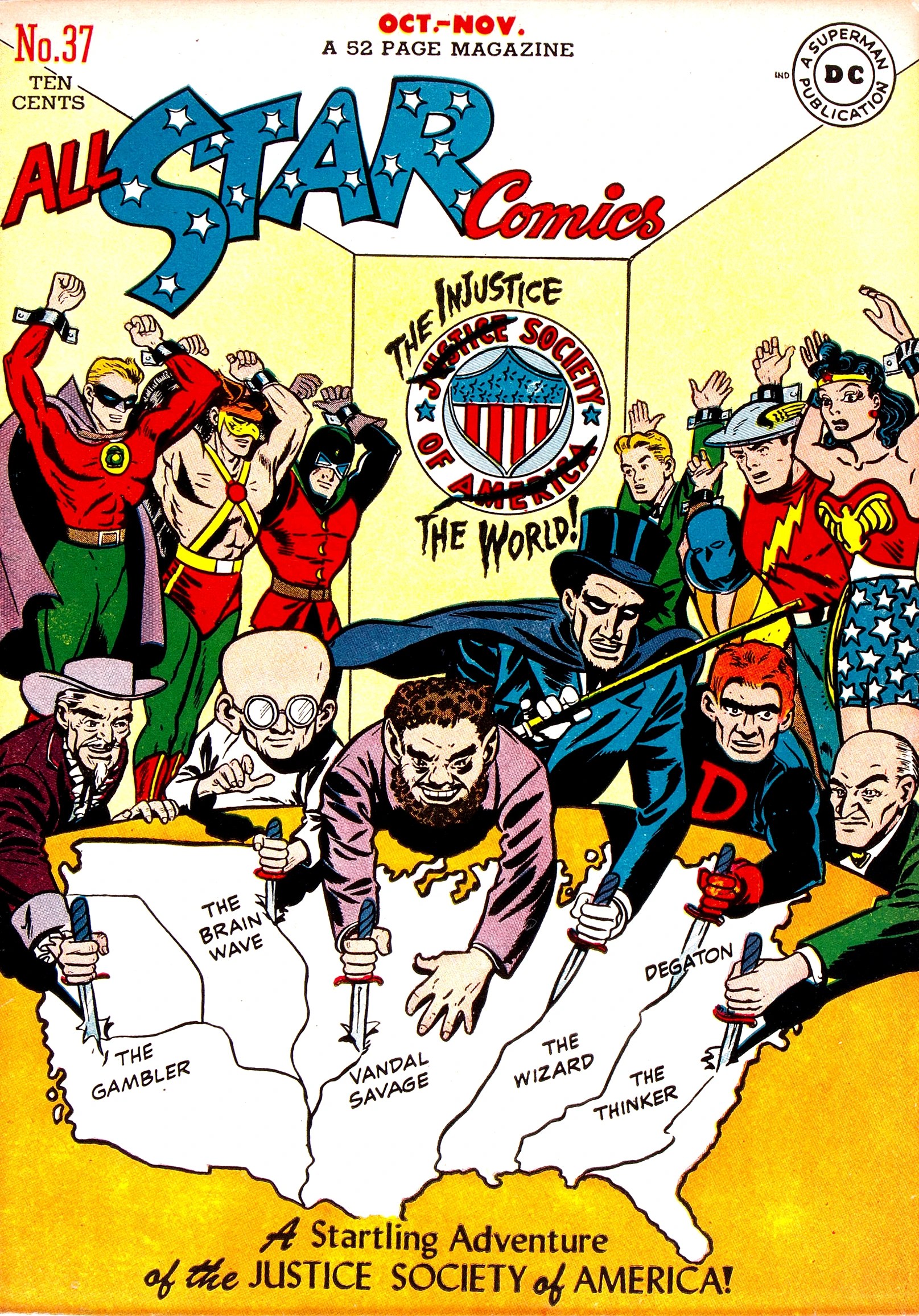
Cover to All-Star Comics #37 (Oct.-Nov., 1947). Cover by Irwin Hasen.
Conway’s justification seems pretty reasonable to me as far as Brain Wave goes, in part because the change in the character’s visual design is not only acknowledged, but (as we’ll see in just a bit) explained. But it doesn’t work as well in the case of Degaton, who has so little in common with his Golden Age namesake that it seems Conway could have just as easily invented a brand new character. My best guess as to why the writer/editor opted to take the route he did is that he liked the idea of bringing back an old Injustice Society ally of Brain Wave’s, and, for whatever reason, found Degaton (albeit with significant changes) better suited to his purpose than any of the other villains (i.e., the Gambler, Vandal Savage, the Wizard, and the Thinker) who’d been part of that team the one time Brain Wave joined up with them, back in All-Star #37 (Oct.-Nov., 1947).


The “young” heroes attempt to regroup and make another sally against their foes, but their powers seem no match for the mental might of Brain Wave…


Things are looking bad — but Green Lantern has a hunch that the change Brain Wave’s made in himself may somehow prove the key to his defeat. Though Power Girl is dubious, Dr. Fate picks up on the idea, and makes a suggestion to his companions that we readers aren’t made privy to. Moments later, the three heroes fly into action…


And so concludes the first new adventure of the All-Star Super… oh, the hell with it, of the Justice Society of America. Fifty years later, this two-parter still hold up as a pretty solid piece of super-team comics entertainment, at least to my mind, as well as a decent foundation on which to build a successful new JSA series… even with the less-than-fully-convincing “youngsters” vs. veterans stuff a part of the mix.
Interestingly, the status quo that Conway and co. seemed to have established at the end of All-Star #59 would be upended almost immediately. Though these two issues had given every indication that Robin would be a regular presence in the series going forward, that last panel above was actually the last we’d see of the character in these pages until issue #66 (May-Jun., 1977). Meanwhile, a major change was in store on the creative end as well, as the veteran Ric Estrada was departing the title after only two installments, to be replaced by a young and mostly untried young penciller named Keith Giffen. But how these developments would affect the All-Star Comics reading experience for the fans of 1976, as well as of the years and decades to come, is, naturally, a question we’ll have to leave for future posts.

Cover art by Gil Kane and Frank Giacoia.
*There had of course already been a All-Star #58, of sorts — i.e., All-Star Western #58 (Apr.-May, 1951), the first issue of a post-JSA version of All-Star, which retained the old title’s numbering as well as most of its name. But that sort of bibliographic inconsistency didn’t generally bother comic-book publishers in the 1970s.
**Contrary to Conway’s recollections (which of course concerned matters that were already twenty-six years in the past at the time this interview was conducted), Ernie Chan was contributing regularly to both Batman and Detective Comics at this time, as well as drawing covers for many of DC’s books, superhero titles included.
***The original, Golden Age Robin debuted in Detective Comics #38 (Apr., 1940), while his age wasn’t given in that first story, a tale published just a couple of years later in Batman #10 (Apr.-May, 1942) featured Bruce Wayne and Dick Grayson celebrating what appeared to be the latter’s eighth birthday, indicating that Dick couldn’t have been more than seven when he became Robin. While DC’s writers would never be completely consistent on this point, there seem to have been more references pegging the Boy Wonder as being around eight when he began his career as Batman’s partner than there were for any other age, at least in the pre-Crisis on Infinite Earths era. (For more details, see this column by CBR.com’s Brian Cronin.)
“This world doesn’t make sense to me…” Oh, boy can I identify! I was a teenager when this came out and I have since time traveled, so to speak, into being in my sixties now. The JSA stories were among my favorites and the characters were handled so well as well as the aspects of ageing I saw in my older family back the and now in myself and my contemporaries. If this post sounds gloomy, it’s not meant to be–I’m still around and didn’t have to go through Raganarok! But there are days that cosmic rod would come in handy…
I remember looking at that first issue and thinking a new day was dawning …it seemed so cool. And DC trying something new the same year I was starting 12th grade made it cooler somehow.
One thing you don’t mention is that Conway was showing Earth-Two’s history to be different from our aside from the superheroes. They’d already banned fluorocarbons (we were a couple of years out) and it looks like African apartheid is a black-dominated system.
I can’ say Wally Wood’s ever held any magic for me, but this is still a great issue.
Levitz continued the differentiation. I remember one of Canadas’ provinces being an independent country.
That was Quebec. I will presume that the first referendum had gone in favour of the province separating from the country on Earth-2.
right, that was back when Quebec independence was a much bigger thing. Gerry Conway would later be mocked for introducing Plastique the Quebec Separatist Terrorist as the terrorist wing had been dead and gone by that point (a later story explained she’s that old reliable The Very Last Diehard Who Won’t Quit).
It hadn’t occurred to me that Conway was doing an “apartheid, but with Blacks in charge” bit — I’d just assumed Dick was meeting with a representative of an anti-apartheid group — but on closer examination, I think you’re probably right.
I have to say, it’s a pretty terrible idea, for various reasons.
It’s funny but I presumed when I read the story that on Earth-2 the Apartheid system in South Africa had been done away with. Of course if you listen to certain people white South Africans are being mistreated by the government these days.
That all the waitstaff are white is a giveaway. I thought it was clever at the time, not so much now.
You do indeed recall correctly. They sent Roy a sample copy so they could have a letter for the first issue.
I seem to recall that JLA # 64 depicted Atlantis to have been restored to the surface on Earth-Two.
Yes, but I think it was an abandoned Atlantis, not an alt.Aquaman Atlantis. Of course the Earth-Two Aquaman stories established that Atlantis was exactly that, though I doubt Gardner Fox was thinking of that when he wrote it.
Hadn’t ever previously read these comics in their entirety but had read other excerpts on-line, predominantly focused on the debut of Power Girl and her, ahem, magnificent assets window and the Wally Wood legend which he appears to have initiated as a joke, maybe in maintaining his rep for naughtiness as best represented by his Sally Forth strips. Now I fear I’m exposing myself as a “dirty old man” in finding that PG’s debut was the most interesting thing about All Star Comics #58.
But managing to steal my eyes away from that famed cleavage, it strikes me as curious that DC opted to launch this “new” series continuing the numbering from where the JSA last starred in the mag a quarter-century earlier instead of a new number one. I don’t know if DC had done that sort of thing before, although I know Marvel had done something similar when it brought back Strange Tales starting with the numbering from the last issue before the old series was renamed Dr. Strange.
Also, I hadn’t realized that at some point at least, Dick Grayson had been meant to be all of 7 years old when he became Batman’s sidekick as Robin. Which maybe didn’t seem odd in the era of pure fantasy during the height of the Golden Age of super-heroes but certainly became more problematic by the 1970s when most super-hero scribes were striving for a somewhat more realistic approach to the fantasy yarns, one in which it no longer made sense for Batman to have taken such a very young child along with him on his campaigns against murderous rogues. Even age 14 doesn’t strike me as all that much better, particularly considering that Robin had no genuine super-powers — the real “wonder” is that he wasn’t murdered!
Of course, neither did the Star-Spangled Kid as originally conceived Conway’s dialogue for Dr. Mid-Nite regarding SSK’s psychological issues struck me as rather peculiar, but that’s not all that unusual for a Conway comic.
All in all, still fun to see this revival of the original super-team as modernized in 1975!
DC picked up the numbering of *Flash Comics* (discontinued in 1949) when it gave Barry Allen his own title with *Flash* #105 in 1959.
Oddly, when Hal Jordan got his own book, it didn’t pick up the numbering of Alan Scott’s and begin with *Green Lantern* #39.
Didn’t Wood also turn in an issue of the Cat with the star naked that Marie Severin had to fix? Wood had more than a reputation of naughtiness. He was a dirty old man who should have been blackballed just for the Caat thing if the story was true.
I always thought of Ric Estrada as the poor man’s Alex Toth. He had a similarly sparse approach to drawing, but lacked the powerful drawing skills, design, and *advanced* storytelling skills that the irascible bipolar genius (Toth) had. Estrada did his last work for DC in 1985 before being told, “We no longer require your services.” This has happened to many artists at the Big Two (and elsewhere) from the Golden Age to the present day.
As for Power Girl, she looks much like Wally Wood’s own Sally Forth character, drawn for Overseas Weekly from 1968 to 1974, except Sally usually ran around (semi-)nude.
Even the villain Brain Wave looks like Dr. Sivana, nemesis of the Big Red Cheese.
I think Ric Estrada’s reputation, like Don Heck’s, suffered in the 1970s and 80s because (a) he wasn’t terribly well suited to superheroes and (b) his art suffered when inked by pretty much anyone other than himself. Here, it looks like something Wood, or his assistants, hacked out over a weekend.
Estrada produced full art for dozens of backup stories in DC’s war comics line, and was the lead artist for their short-lived series Blitzkrieg; in those, his art had a rugged, almost woodcut style which suited the material really well.
I feel that some of Estrada’s best work was probably on the romance stories he drew. Just my opinion, but I think he had a real skill at drawing beautiful women.
By this time in my comic reading career I wasn’t following much of DC, except for my beloved Legion of Super Heroes. So I’m glad for the explanation of who Power Girl was. Basically Earth Two’s version of Supergirl. Okay. I’d always wondered about that, having seen her years later in I think Justice League Europe? Anyway, regarding Jenette Kahn’s comment of the situation being sexist, hey is it so wrong that uhh well endowed girl’s get some representation in comics too?
https://tombrevoort.com/2017/01/22/i-had-seen-house-ads-touting-the-imminent-return/
Robin will appear next in the annual JLA/JSA team up JLA#135 along with the Earth Two Batman who makes a comment about Robin working with the newly formed Super Squad (a name that was rarely used and eventually dropped completely).
I was surprised that the annual Justice League team ups didn’t crossover into this title like they later did with All Star Squadron and Infinity Inc but I guess inter title crossovers weren’t very common yet in the 70s.
I was always confused about the active membership of the Justice Society in this book compared to their appearances in JLA. In this book it’s implied that only the heroes shown in this issue are active members and all of the others (Superman, Wonder Woman, Johnny Thunder, Hourman etc) are no longer members but in the Justice League they still seem to be active members.
You didn’t mention it but this issue is the beginning of Star Spangled Kid’s use of Starman’s cosmic rod which paved the way for Courtney Whitmore to become a legacy character for both Star Spangled Kid and Starman which led to the TV series Stargirl.
Degaton’s altered appearance is eventually explained by Roy Thomas in the 1985 mini series America vs the Justice Society. I believe he was given a different body here and then eventually had his original body restored. He makes a comment on not liking the black hair.
While there wasn’t any formal crossover between the two titles in 1977, the JLA/JSA team-up in JLA # 147-148 was explicitly footnoted as occurring immediately after All-Star Comics # 68. At the end of that issue, the JSA had tracked the Psycho-Pirate to Earth-One and captured him, and he was shown with them in the first few pages of JLA # 147 aboard the JLA satellite. The All-Star heroes were about to take him with them into the Transmatter device to return to Earth-Two, before a certain 30th-century wizard pulled members of both teams into the future where (when?) they would team up with the Legion of Super-Heroes.
The art seemed to take a hit between #58 and # 59, perhaps as a function of having less time to do the work. Based on some things I have read, Wood was less than invigorated by Estrada’s pencils (which he inked here and on Richard Dragon). Possibly he re-drew more on #58 . . . .
“Super Squad” did not catch on, but, PG,, especially did.
Using Degaton made little sense to me, given that he was a time travel villain, but using him in the first Injustice Society story also made little sense.
I liked the book from the start but liked it more after Levitz took over.
Too bad you did not review (or probably buy) Man-Bat 31.
The book only lasted one more issue and the character did not make the splash he seemed capable of in 1975, but I also think it is the one time Steve Ditko (who was an alumnus of Jerry Robinson’s art school) drew Batman (with nice inks by Al Milgrom (who had inked the cover of the Creeper story in First Issue Special #7).
Man-Bat probably fell victim to the same crash in interest in supernatural/monstrous characters as claimed Man-Thing . . . .
I did buy Man-Bat #1, John, though it didn’t make the cut for last month’s posting schedule. Maybe if I’d remembered that it included Ditko’s only take on Batman, I’d have made a different call — but, alas, time waits for no man (or Man-Bat 😉 ).
The America vs the Justice Society mini series written by Roy Thomas in 1985 explains Degaton’s appearance in the first Injustice Society story.
Alan, I’ve really been looking forward to your write-up of these issues. I am definitely a huge Justice Society fan, albeit from having discovered the characters in the 1990s and 2000s via back issues & reprints. I’ve read the 1970s All-Star Comics issues in the two Justic Society collected editions that DC published in 2006 and 2007 and have periodically revisited those two trade paperbacks throughout the years. So, even though I came to these comic books some three decades or so after you, I definitely have a real fondness for them.
Happy 50th birthday to Power Girl. I really like the character when she’s written well… which sometimes she’s not. I first was exposed to her in the early 1990s in the pages of Justice League Europe where, um, she was basically a cranky straw feminist who was addicted to diet soda. This was, of course, post-Crisis on Infinite Earths, when her origin was majorly confusing, and she was the granddaughter of Arion the Atlantean sorcerer, I think. It was something of a revelation to me when several years later I read the JLA / JSA crossover guest-starring the New Gods and I discovered that originally PG was actually from Earth-Two and was superman’s cousin… plus she was a lot less cranky. I’m glad that in the last couple of decades her original backstory & personality has been restored.
Thinking about it, I feel that some writers really don’t know how to script assertive women too well, instead making them aggressive & belligerent. I do think Conway was a little bit guilty of this in his All-Star Comics stories. I expect he wanted to make her a liberated woman but wasn’t quite successful at pulling it off. I think that when Paul Levitz took over the series that he smoothed over PG’s rough edges, and she became a better character. But I’m sure you’ll be getting to those stories in future installments of this blog.
As for PG’s costume, okay, maybe her “boob window” is gratuitous, but it suits her personality, in that she’s unashamed of being a beautiful woman. It’s an iconic look, anyway, and it’s not surprising that sooner or later PG ends up returning to that costume. But maybe that’s just me as a male enjoying drawings of a sexy woman? I don’t know. But it does seem that there are at least some women who are fans of PG in her original costume. And I do feel like in the half century since her introduction there have been a lot of other female characters introduced who have much skimpier outfits who feel much more exploitive.
Urgh. Gerard Jones’ “women’s anger can be blamed on their diet” take was … not good. I liked a lot of his work, but not his JLE.
Of course, as we now know Gerard Jones has serious issues far beyond how he wrote women in JLE.
Ohhhh, yes.
Seems to me like Gerry Conway was much taken with Avengers #16, ‘The Old Order Changeth’ (is ‘changeth’ even a word?)
Like his later and not very well received ‘Detroit JLA’, Conway has attempted here to revitalise an established team by introducing, or focusing on, mostly new and supposedly younger members to introduce some different character dynamics. I think Paul Levitz would do better, when he took over the writing, at achieving a better blend of what we now consider a standard: the generational interplay of new and old heroes.
Power Girl did appeal (apart from the obvious to hormonal teenagers like I was then) as being a stronger character than the generally bland and Mary Marvel-style Supergirl. We might look back now and see some tedious and stereotypical ‘women’s lib from a male perspective’ behaviour (like Ben says above, ‘some writers really don’t know how to script assertive women too well’), but she felt like a breath of fresh air back then.
Can’t honestly share the love for Ric Estrada’s layouts and figure drawings, I was much happier with subsequent issues that Wally Wood did alone.
Does ‘All Star Comics presents Super Squad featuring the Justice Society of America’ earn any kind of record as an unnecessarily long title that would only appeal to a limited segment of the newsstand-buying audience that were cognizant of the group’s history?
Ric Estrada’s best work, I think, is found when he inked his own pencils. This can mostly be found in the DC mystery anthologies and the war books. A great example being Kanigher’s Gallery of War intermittent series.
Pure Estrada art is a thing of beauty – stripped down, superbly designed, and quirkily individualistic, with fluid storytelling.
I’ve seen Ric Estrada’s war and mystery material for DC, and it never came close to the level of Kubert, Toth, or Heath. Wally Wood’s inks on this title boosted the quality immeasurably. His line work is gorgeous and fluid, and his women are always pretty (when they are supposed to be). He also made Estrada’s clunky figure work a lot more streamlined and graceful. Here’s a solo Estrada page from close to the same time period. The figures are not a bizarre as Frank Robbins’, but they are a not-so-distant relative. The line weights are all *wrong* in indicating light, shadow, and/or depth.
https://www.comicartfans.com/gallerypiece.asp?piece=1601665
The subjectivity of taste again. I, too, love the work of Kubert, Heath, and Toth, but find Wood (after his remarkable EC science fiction strips) to be polished but bland. Frankly, I would rather have seen these All-Stars inked by Estrada himself, as this would have been more visually interesting, but, I realise, not commercially viable.
I have always been drawn to the work of certain mavericks of comicd art, such as Estrada, Robbins, Boyette, Wolverton, etc. I find their quirky styles to be charming and compelling, and a welcome change from the conservative mainstream.
Boyette is rather bland to me, but Wolverton quite the opposite: so remarkably zany, imaginative, and bizarrely unique. Love all of his work! His “grimy” rendering made quite an impact on Robert Crumb and other underground comix artists who looked to him for inspiration. Wolverton’s 1950s sci-fi stories for Atlas (later Marvel) have such atmospheric landscapes and strange worlds that I dare say their influence reached Moebius in his similar-themed Arzak stories of the 1970s, right down to the grainy, dotted rendering he employed.
Interesting link there – Wolverton to Moebius. I’ll have to ponder that one.
You might also enjoy Fletcher Hanks.
I recall Hanks’ golden age work. Odd, to say the least.
As for Wolverton and Moebius, for anyone who wants to compare approaches and subject matter, have a look at the following.
Here are two Wolverton sci-fi stories from the 1950s:
https://iamyouasheisme.wordpress.com/2018/06/11/where-monsters-dwell/
https://archive.org/details/aronaamora_yahoo_7/brainbats/1.jpg
and here are *all* of Moebius’ Arzach stories:
https://pdsoasis.github.io/arzachcomics.html
As for Wood, his work for Mad magazine remained strong and very focused right up until 1964 when he stopped working for the publication. Beautiful use of duotone paper as well as screen tones. He did a few strong stories for Warren afterwards (see “To Kill a God” and some of the others in early Vampirella issues 9, 11, and the like, and I added scans of “Killer Hawk” from Eerie no. 61 of 1974 in the comments section of Alan’s review of Eerie no. 67 some months ago).
I remember picking these up and thinking they were – OK. Somewhat generic superheroics, just as I found Estrada’s layouts rather generic. In those days, I bought a LOT of books on inertia, and this was one. (You could do that with 25cent books!) It really wasn’t until Paul Levitz took over and was joined by Joe Staton that this book found more of a focus and a voice. It helped that Levitz and Staton would do such side-projects as the aforementioned Power Girl three-parter in SHOWCASE and especially the origin of the Huntress, which a real high water mark for both creators.
I had forgotten that Roy Thomas had addressed the issue of Degaton’s appearance in that AMERICA VS. THE JUSTICE SOCIETY mini. My main memory of that story was being mad that Thomas felt the need to backpedal on Joe McCarthy being the reason for the JSA to split up. I thought having Tailgunner Joe as the villain was a superb touch on Levitz’ part, and I was pleased when John Ostrander restored that point when he wrote Hawkman in the 1980s.
I had loved the Justice Society’s appearances in the last four team-ups in JLA, so I was thrilled that the team got to have their very own title. Being only 9 years old at the time and having missed Hawkman’s previous Silver-Age appearances, it was confusing for me to see him in a yellow mask rather than his classic look, but then I realized that he had been depicted this way in Murphy Anderson two-page spread reprinted in JLA # 110, as well as the Evil Star story reprinted in JLA # 115. I was also disappointed at the inclusion of Wildcat, as I would have much more preferred to see Hourman, Starman, the Sandman or Mr. Terrific instead. In addition, I was more of a fan of Robin’s unique 1960’s costume than this new one which I felt was too reminiscent of his Earth-One counterpart.
Seeing the Star-Spangled Kid with Starman’s cosmic rod must have really inspired me about a year later when I “adapted” the two concepts into a character called Quasar Kid in a very crudely drawn comic book with my best friend Steve. The other characters that we created were all amalgams as well. I don’t think I had quite the reaction the rest of you older guys had to Power Girl’s appearance, but I did take note of her assertiveness and friction with Wildcat.
If I recall correctly, there was a fan on the letters page named Roy something-or-other who claimed that DC still owed him on a subscription that he had to All-Star Comics way back when the title changed mid-stream to All-Star Western. Let’s hope that he enjoyed the rest of the JSA’s new adventures through the late 70’s and 1980’s, especially that All-Star Squadron series.
Never read or saw this title before , but Powergirl, well er.. yes..hmmm.
To coin a phrase, that inked “y” shape sure is doing a lot of the heavy lifting.
patr100, your comment put me in mind of the following anecdote from Joe Staton, which appeared in Back Issue #33:
“One of my favorite stories,” says Staton, “was told to me by Howard Leroy Davis, a comics fan and writer. His little girl was very young when Power Girl started, and she brought the comic over to him and said, ‘Daddy, since Power Girl’s name starts with a “P,” why is her emblem a “Y?”’
One of the earliest comics I can remember reading was All-Star #61, which my mom bought for me as part of a batch of fifteen or so comics meant to keep me occupied and quiet during a car trip from North Carolina to Boston. I am quite fond of Wally Wood’s inking on this series: no matter who was penciling, Wood (or Wood and his assistants?) kept the look of the book somewhat consistent. As I noted in our discussion of the Warlord a few weeks back, I’m a huge fan of Mike Grell, and I’ve always wanted to have a copy of this first issue of the relaunched All-Star for the gorgeous Grell cover, one of his best efforts, in my opinion, but the first appearance of Power Girl makes it a “key issue” that’s out of my price range, alas. Maybe one day DC will reissue this as a facsimile.
Woody had at least one assistant working on these All-Star Comics issues, a gentleman named Al Sirois. He even fit his name in the street signs on page 11 panel 5 of issue #59, which can be seen above in Alan’s blogpost.
I hope one day you are able to find an affordable copy of #58.
I know Al through attending a couple of cons as guests together. He’s confirmed yes, he was a ghost. Didn’t know about the sign but yes, it’s blinkingly obvious once you brought it up.
Here is a short interview with Ric Estrada where he talks about working with Wally Wood on this issue:
https://www.twomorrows.com/alterego/articles/14estrada.html
The art is a bit of EC nostalgia, as both Wood and Estrada were EC artists ( and Kurtzman artists at that too!). Otherwise disappointed that the artists did not appear to have done much research on the various cities and landscape involved…a Cape Town without Table Mountain ????
Finally Conway appears to have made a big impact at DC, both with this and other launched series ( Blackhawks, Man-Bat, plus we have already seen Dr Fate previously. Pity it did not last ( as little did at DC in those days).
The Blackhawk relaunch was by Steve Skeates. David Antony Kraft did a couple of issues but not Conway.
hey frasersherman, correct! But I was referring to launches that Conway edited, rather than scripted. Inference is that Conway must have proposed the relaunch and had it accepted ( although this is an assumption on my part).
Got it. That makes sense, though it’s equally possible Skeates cooked up the idea. Or a composite — someone higher up suggested “bring back the Blackhawks” and Skeates and Conway cooked it up together.
I sort of thought “Conway’s Corners” was a place where Carmine Infantino’s ideas of what might sell (Man-Bat and Plastic Man, since their B&B Team-ups sold) and what fans and writers were telling Conway they wanted to see (JSA, Blackhawks. Metal Men) and a general bias toward group comics (Freedom Fighters, SSoSV, Super Team Family) intersected.
There were also some oddities (Kobra, Code Name: Assassin, Star Man, Dr Fate) which that mostly became First Issue Specials.
Conway did bring more of a mid-1970s Marvel sensibility to DC, but I did not think (as an Editor), he understood what made these characters work or why people thought the JSA or the Blackhawks were cool.
I did think he brought out good things in Marty Pasko ((Kobra #3 is a nice bit of work that has been undeservedly forgotten) even before Schwartz did on Pasko’s Superman run. I also thought SSoSV #2 by Conway and David Anthony Kraft had a nice take on CPT Comet, a great (but obscure) character.
Conway is a talented man, but to some extent, I thought his stint as an editor at DC was similar to Robert Liefeld’s contributions to Marvel’s “heroes Reborn” in the 1990s, something done to be cool that was a bit out of touch.
The genesis of Kobra is … complicated (https://atomicjunkshop.com/30739-2/). It seems like Infantino gave Kirby an idea, which Kirby combined with Steve Sherman’s idea for a Dr. Phibes riff … and then Infantino shelved it, Conway picked it up to give him an extra series to work on, then he had the art and story heavily redone.
I liked Kobra.
Kobra #3 was this inexplicably good issue done by a “pick-up team” of Pasko, Giffen, Giordano & Austin,
I thought Kobra had potential to be come a “force of nature” bad guy in the DC Universe (not necessarily evil in intent but laser-focused on ends and careless of his means to those ends).
I thought David Micheline did a good job in picking up Kobra as a “big bad” in the Aquaman series.
Back in 1978, I would have seen CPT Comet& Black Lighting as DC heroes with a lot of potential and Kobra as a DC bad guy with a change to be something more
I liked Estrada’s work on war comics (that he not infrequently also wrote https://www.comics.org/issue/23818/?issue_detail=; https://www.comics.org/issue/27141/). There had been rumors that Estrada had done story-boarding work for Fellini, while living in Europe but they appear to be untrue.
I think the idea probably came from Paul Levitz. but I liked the idea that Power Girl was like she was because she felt like circumstances had kept her from having her due and she was trying to prove herself.
Given that Conway left Marvel (in part) because he felt he had been “passed over” as Marvel EIC, that sense that a young person might feel passed over for a seemingly older (or seemingly more experienced, looking at you Len Wein) person who actually wasn’t, could have come from Conway (but might have been seen more clearly by someone else).
Reading between the lines of her first appearance here, I assumed that Jor-L’s ship had an FTL drive and her father’s ship could only achieve near-relativistic speed and she appeared younger than Superman due to time- dilation. (Levitz would reveal in PG’s Showcase try-out that she had been the prisoner of her sleeper-ship’s AI.)
I went back and read the Conway interview, reprinted in one of TwoMorrow’s JSA Companions. Of note: He gives Roy’s enthusiasm for the Golden Age credit for inspiring him to do the series, though he didn’t have the same affection for (or knowledge of) that era. He thought Brain Wave and Degaton looked “musty” so he got them redesigned (he was much less worried about the GA continuity than Roy would have been). Pairing Estrada and Wood was Conway’s idea: he got handed what DC considered the second and third-string artists (he disagrees) and he thought matching seemingly inconsistent talents would jazz things up (he thinks it did).
The Super-Squad was a way to distinguish the kids from the old guard (“It might have been All-Star Comics but I don’t think anyone would have considered the JSA stars back then.”), with Star as the Past, adult Robin as JSA present and Power Girl as the future.
Oh, Conway also mentions that after DC decided to axe its assistant editor positions to save money, he found a way to keep Paul Levitz on All-Star Comics. Conway thinks that worked out well.
Well, I was out of town this weekend, so I’m a bit late to the party and all the major observations have been made. A few small observations then, if you don’t mind. I agree with Ben that Power Girl’s boob window is appropriate, not only because of her more gregarious and out-going personality, but also due to her pride in being a beautiful woman. It may seem to cater to the “male gaze,” but what sexy outfit doesn’t? It’s our job as men to realize that a sexy outfit is not a sign of promiscuity or assume it’s an invitation to inappropriate behavior. In other words, guys, it’s not dirty unless you make it dirty. By the way, I prefer the current trend of drawing the boob window in the shape of Superman’s S-shield. It makes more sense that way.
As for Brainwave, I get that he doesn’t want to look like Dr. Sivana’s long-lost twin brother or Lex Luthor’s grandfather, but if his look in this story is an illusion, then what the hell is up with those EYES? Everytime I see him I think of (and yes, before we go there, I’m very old) Barney Google, with the “goo-goo-googly eyes.” I just can’t think of any reason why eyes that big–and without lids or lashes–make any sense. As far as the changes Conway ordered made to Degaton, I’m glad they changed all that back.
Estrada’s art here is competent, and if unimaginatively designed, at least doesn’t reach the realms of ridiculousness where Frank Robbins lived. Estrada wasn’t much better than Heck, but they were both better when not trying to draw super-heroes.
I remember the Super Squad, but don’t think I ever read these books. Thanks for the rundown, Alan!
I think the idea of the “big eyes” was that his glasses were part of his self image. Brain Wave is a 1940s idea of “mutant as Future Man” (see, e.g.,. C.M Kornbluth, The Mindworm; or Judith Merril. That Only a Mother).
This concept was quite unlike The X-Men (or even CPT Comet and Radea, his alien mutant friend).
This reboot of the JSA ran for several issues of All Star and continued for a few more in Adventure Comics after All Star was cancelled. There is a two volume reprint that collects the stories from both titles. Taken together it’s a good binge read.
I know you know it’s Kal-El, not Kal-L. 😄
As to Wallace (respect the dead’s wishes) Wood having kept making PG’s breasts bigger; I think it’s meant that he kept making the pencils C-cup to D-cup; not that he made them progressively bigger each issue, just that he always tweaked them a bit. It’s not seen when the pencils have been erased.
It’s funny to me that Wildcat doesn’t want to be outdone by kids, when one of them is Superman-like.
I want to see a Dr. Mid-Nite/Daredevil crossover and I’d change the spelling to, Midnight.
“Skid Row Mission” is a bit on the nose.
The Degaton reveal needs Alan-Moore-like powers of storytelling to make it in any way impactful.
FWIW, I bought this issue. I remember being exited about the JSA having their own book, but being unimpressed with the story and art.
I mean, “excited,” not, “exited,” but, exit is indeed what I did after a few issues.
“I know you know it’s Kal-El, not Kal-L.” Ah, Bill, but I don’t! Not when we’re talking about Earth-Two, anyway! 😉 https://dc.fandom.com/wiki/Kal-L_(Earth-Two)
That’s a very reasonable hypothesis about what might have really been meant by the original claim that Wood increased PG’s bust size every issue.