
 It’s been a while since we last discussed artist/writer/editor Jack Kirby’s Eternals in this space — so, as will come as no surprise to regular readers of the blog, prior to jumping in to the issue referred to both by this post’s title and by its featured cover image (the work of Kirby and Frank Giacoia, by the way), we’re going to spend some time catching up with the episodes of the ongoing saga which had appeared in the intervening months between the release of issues #2 and #6, way back in 1976… beginning, naturally enough, with issue #3, whose cover (also by Kirby and Giacoia) is shown at left.
Eternals #3’s “The Devil in New York!” (featuring the inks of John Verpoorten, who’d also done those honors for the title’s first two issues) picks up right where the previous installment had left off — which, in case you need a reminder, was with the full-page reveal of the awesome Arishem, leader of the Fourth Host of the space gods known as the Celestials. The present chapter opens as “Ike Harris” — originally introduced in issue #1 as a mere guide to archaeologist Daniel Damian and his daughter Margo, but who’d quickly outed himself as Ikaris, a member of an immortal, super-powered sibling race to Homo sapiens who call themselves Eternals — poses the question to his fellow Eternal, Ajak: “Does this Arishem herald the coming of disastrous times, such as befell man in the distant past?”

The Damians have come to this remote site in the Andes to investigate ancient mysteries — and they’ve been wildly successful so far, thanks to having arrived just ahead of the Fourth Host. But, as Ajak explains, Arishem and his associates are about to seal off the whole area for half a century — the span of time which the Celestials have allocated for passing judgement upon the three branches of humanity: us, the Eternals, and a third group called the Deviants. If the two ordinary humans don’t leave right away, they won’t be able to leave for fifty years (or, in Daniel’s case, ever) — and the growing rumbling noise that heralds the final descent of the Fourth Host signals that they have but moments left in which to choose…

Ikaris carries the protesting Margo to the small plane in which they arrived; before taking off, he zaps her into unconsciousness with twin energy beams shot from his eyes, all the while assuring her, “Some day, you’ll thank me for this.” (Yeah, right.) The plane gets airborne seconds before the Fourth Host seal the high plateau behind “an impenetrable atom shield“.
Meanwhile, in the undersea realm of Lemuria, the ruler of the Deviants, Brother Tode, is overseeing the painful physical punishment of his subordinate, Warlord Kro, whose efforts to prevent the return of the Celestials had been stymied in issues #1 and #2 by Ikaris and his allies. But when Kro claims to have a great new plan for defeating the hated space gods, Tode decides to hear him out..

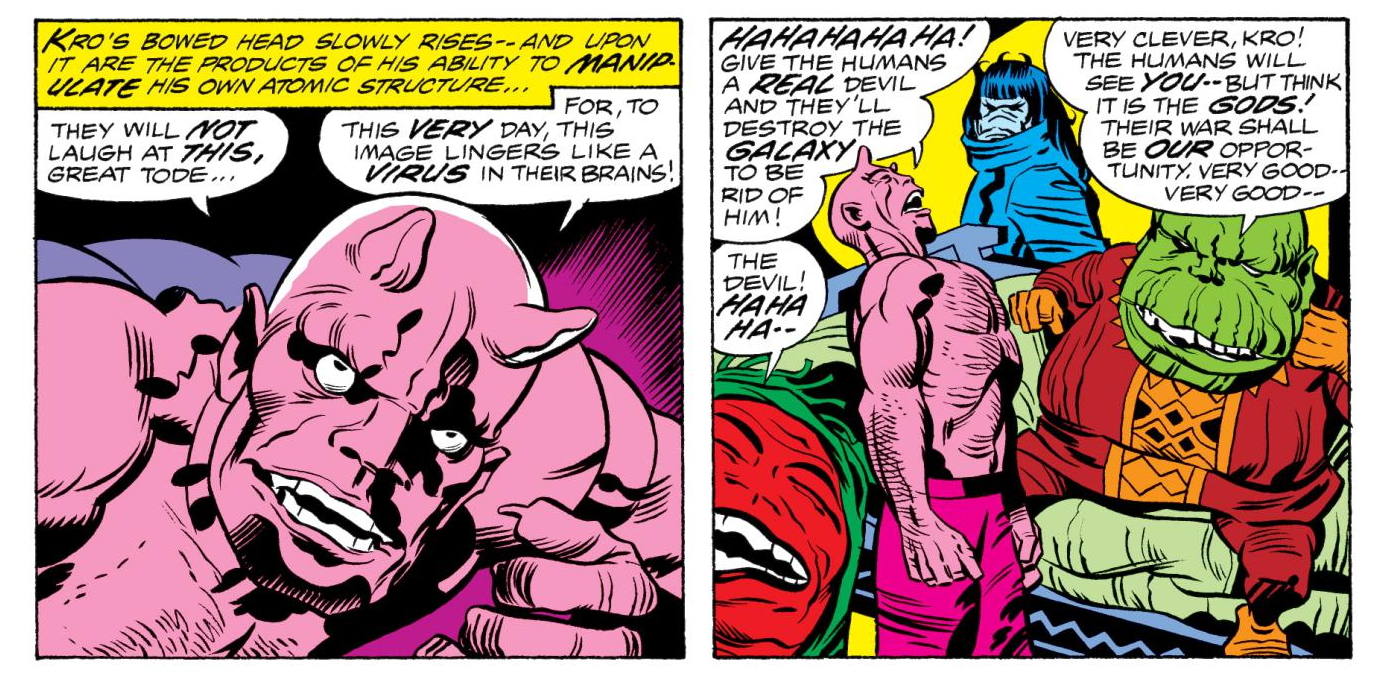
Back on the plane, Margo returns to awareness in time to see that a gleaming white dome now covers the rapidly receding plateau where the Fourth Host is busily establishing their base of operations. She quickly gets another surprise when Ikaris suddenly takes his hands off the cockpit’s controls, blithely assuring her as he does so that there’s no need to panic: “This plane is now flying in response to my very thought.” Then, as if the young woman wasn’t freaked out enough already, the Eternal uses his mental powers to make another, equally hands-free adjustment:

Three issues in, it’s about time we see Ikaris displaying the ability for which his mythological namesake is best known (though, as previously noted in our Eternals #1 post, we can only hope that “Ike” is better at it than that Greek guy).

Ikaris manages to evade the next blast from the attacking vessel — which, naturally, is full of Deviants, and commanded by Warlord Kro, besides. (That dude works fast, it appears.) Returning to the plane, he once again uses his natural mental abilities to first encapsulate the aircraft in a protective shield, then to send it hurtling high above the Earth, into “regions where it was never meant to fly”. From the perspective of the Deviants, the little plane appears to have simply vanished…

Once they’ve reached the New York metro area, Ikaris allows the capsule to dissolve before bringing the plane in for a normal landing at JFK Airport. Then, he and Margo take a cab to an apartment building on Manhattan’s West Side. “We have a friend in this building,” Ikaris tells his charge. “Someone who will help you during your stay…”


And so we’re introduced to yet another Eternal, one who’ll soon prove to be a major member of this series’ regular cast — Sersi (or, as it’s spelled for this one issue, “Sersy”).

Both Ikaris and Sersi understand that, as the latter puts it, “the Deviants have chosen New York for their first strike!” Ikaris is determined to meet them when they arrive, and Sersi accedes to his request to watch over Margo until the danger is past. As Ikaris makes his exit, Sersi calls encouragingly after him, “Give the rotten little bastards what they well deserve!”

 I’m unaware of any religious or folkloric tradition that has “space” as the Devil’s point of origin; usually, we think of Old Scratch as coming from “down there”, rather than any location up above. On the other hand, if I ever actually encountered a reddish-hued guy with horns walking unharmed through fire, and he told me he was the Devil, “returned from space to reclaim this domain!“, I might well be inclined to take him at his word. Who knows?
Anyway, let’s move on to Eternals #4, where behind yet another cover by Kirby and Giacoia, we find Kirby and Verpoorten resuming the narrative just where you’d expect, with Ikaris confronting the Deviant horde…

This powerhouse double-page spread seems to herald an epic battle to come, reminiscent of, say, the New Gods’ Orion throwing down against a swarm of parademons, or Thor mixing it up with a mess of trolls. But, instead, Kirby goes against our expectations. Ikaris gets to satisfyingly blast just one group of Deviants with his eye beams, after which…

The missile turns out to be a “brain mine” — a small object which affixes itself to Ikaris’ forehead, then swiftly drives him into a deep state of unconsciousness, thereby taking him out of action for the foreseeable future.
Arriving on the scene almost immediately, Warlord Kro orders that the now-helpless Eternal be conveyed to the Deviant vessel waiting off-shore; this done, he returns his full attention to the assault on New York…

In this issue, Kirby introduces the concept of a particular subset of Deviants called “Mutates“. But we’ll have to wait another few issues for an explanation as to just how these specimens differ from your average, run-of-the-mill Deviants — who, after all, are already genetic mutants by definition. At this point, all we have to go on is visual evidence; and it indicates that, if nothing else, the Mutates are even more monstrous-looking than others of their race.
Our story now turns back to Sersi and Margo, who’ve been watching TV news coverage of the invasion…
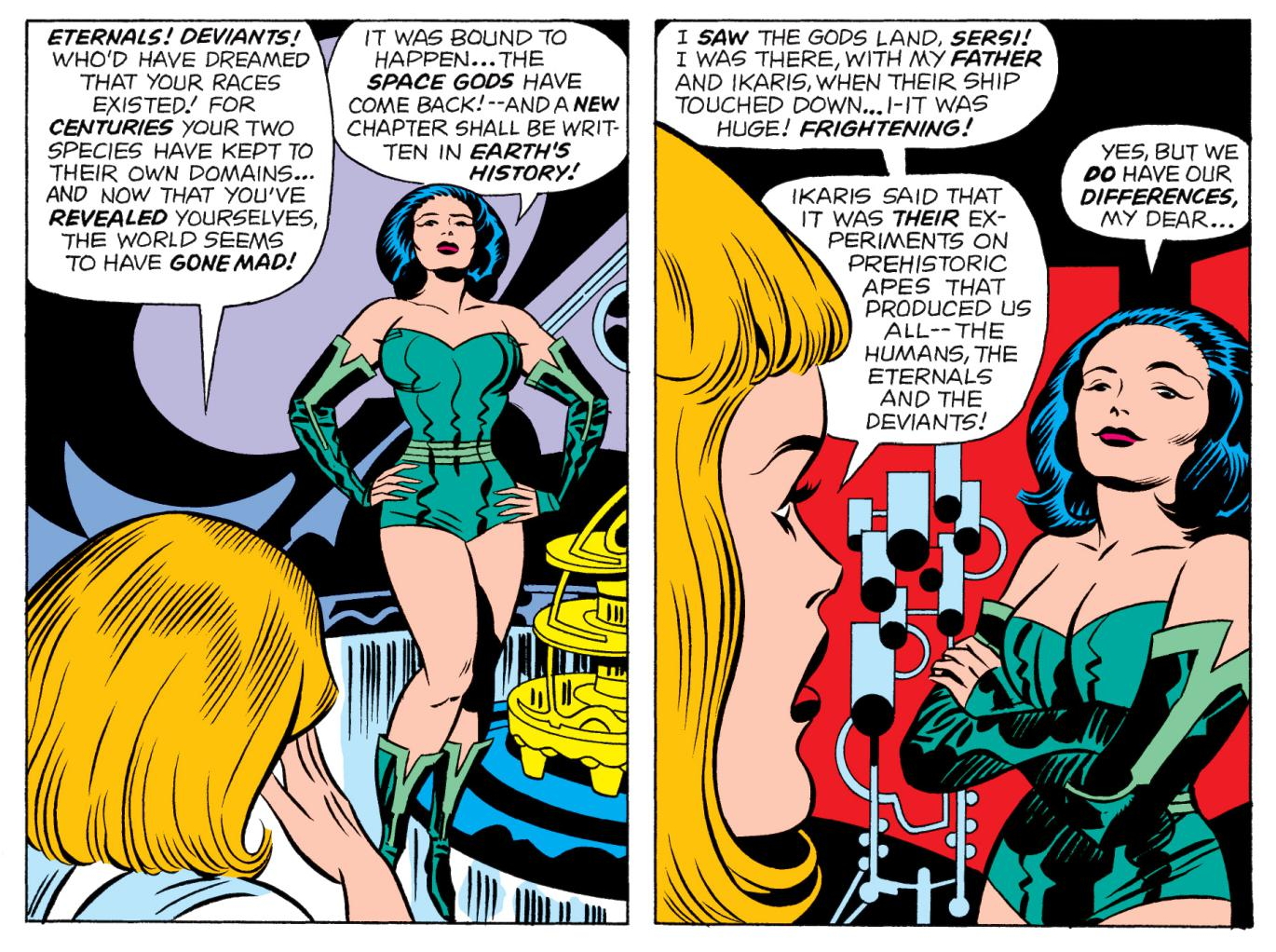

I suspect that Kirby intended for us to assume that Sersi was known to King Arthur’s court by the name Morgan le Fay — though, of course, there are plenty of other named enchantresses in the Arthurian legends whom she could have been just as easily. It’s an amusing bit, in any case.

Sersi’s eye-blasts make quick work of the Mutate — alas, he’s quickly followed through the now-broken window by a trio of “ordinary” Deviants wielding flame-pistols…


Meanwhile, on board the Deviant raiding ship lurking below the surface of New York Harbor, poor Ikaris is being loaded into a torpedo-like capsule…

Moments later, the capsule is ejected into the watery depths… and the heroic figure whom most readers have, up to now, surely assumed must be this series’ leading man is taken not just out of action, but out of sight — not only for the remainder of this issue, but for the whole of Eternals #5, to boot.

Yeah, Ajak could see to Ikaris’ immediate release, but hey, what’s the hurry? The “Lord of Flight” decides instead to let his old chum cool his heels for a spell; in the meantime, he ambles over for a chat with Dr. Damian about the latter’s progress in deciphering some interesting old Incan tablets. This narrative device allows Kirby to remind us readers that behind all the sound and fury of the Deviants’ attack on NYC, the main interest of this series remains with the Celestials, and their mysterious, and possibly apocalyptic, intentions towards our planet. It’s a theme that’s dramatically underscored by the full-page splash panel that closes out the issue — yet another jaw-dropping gawp at the ever-impressive Arishem:

 The “Next” blurb at the bottom of that last page promises readers that, come issue #5, we’re finally going to get a decent look at the home of the Eternals, aka Olympia — and that book’s cover by (say it with me) Kirby and Giacoia raises expectations even further, giving us our first look at four of that locale’s denizens… including one who looks an awful lot like the Marvel version of Zeus, lord of Olympus (who, incidentally, was himself making an appearance this very same month in Thor Annual #5), and another who can’t help but remind fans of Kirby’s “Fourth World” saga for DC Comics of one of its most prominent supporting players, Metron of the New Gods.
As for the other two newbies, we’re given a closer look of one of them as early as the story’s opening splash page, courtesy of Sersi’s “mirror”:

Before we move on to learn the name of this “juvenile” Eternal with the questionable (but very Kirbyesque) command of 1970s vernacular (“funky corn“? Really?), we’ll pause to note a significant change in the title’s creative team, as, after inking the first four issues, John Verpoorten has been replaced by Mike Royer. In 1976, Royer was already a familiar name to Kirby’s fans, having been the King’s regular inker for much of the auteur’s recent stint at DC; as he he’d done there, Royer picked up the lettering duties here as well.

So, Makarri=Mercury, eh? Well, that fits right in with all the other Eternals we’ve met to date, whose names (and, at least to some extent, natures) have all been derived from famous figures of classical mythology.
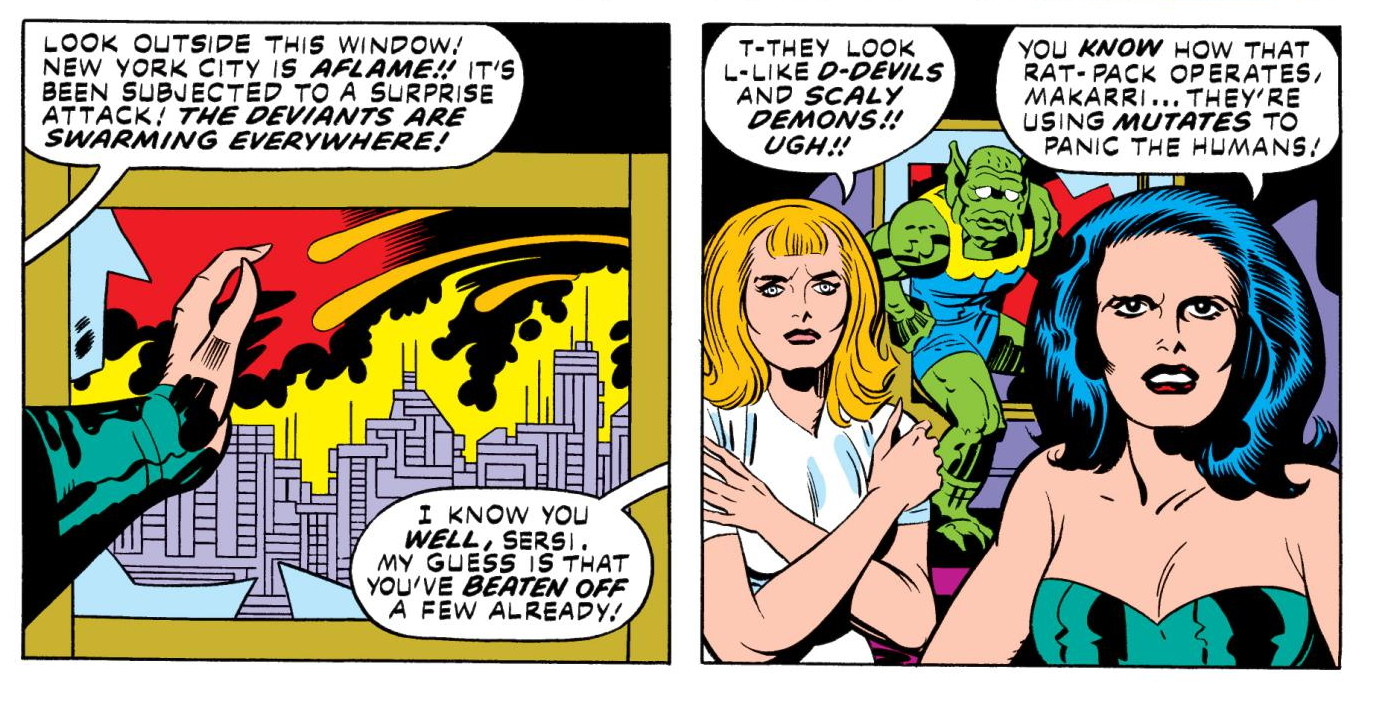

Makarri fumes helplessly at his viewscreen for a few moments, then goes sprinting off to find the only person who can approve his taking action — the Eternals’ “Prime One”.
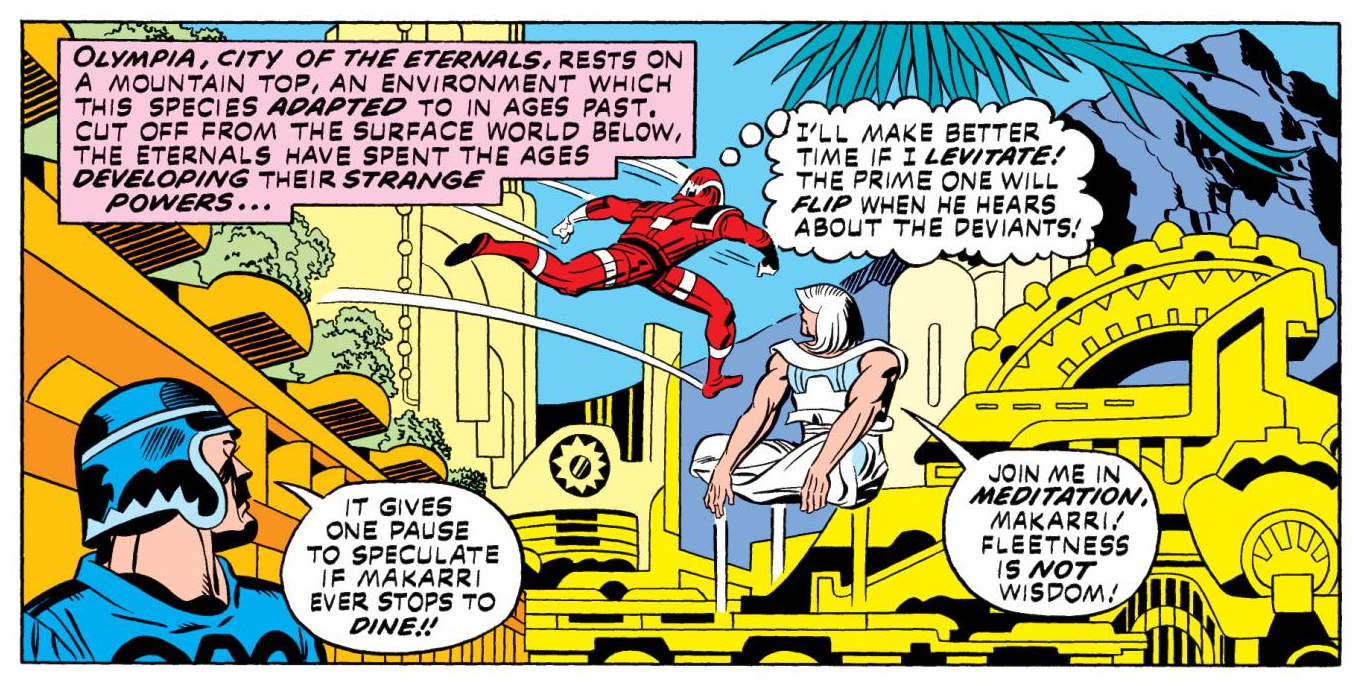
Obviously, “Olympia, city of the Eternals” is directly inspired by Mount Olympus, home of the gods in Greco-Roman mythology. But any Jack Kirby fan will recognize a more recent antecedent in Supertown, home of the gods of New Genesis in the Fourth World mythos. Even more specifically, this particular scene echoes Kirby’s introduction of the speed-loving Fastbak in New Gods #5 (Oct.-Nov., 1971).

Domo is the first Eternal we’ve met who doesn’t have a clear precursor in classical myth. While, as previously noted, he somewhat resembles the New Gods’ Metron in appearance, he seems to function more as an office administrator than that character, who was consistently portrayed as an insatiable seeker after the secrets of the universe — an impression that is buttressed by Domo’s very name, which is pretty obviously derived from the word “majordomo”. In any case, he’s dismissive of Makkari’s demand to see the Prime One, suggesting that his fellow Eternal “retire somewhere and dream up a more realistic reason for risking the great one’s wrath!”


Kro frantically demands that Sersi reverse this bizarre transformation, but she refuses — at least until one of the Deviants puts a gun to Margo Damian’s head and threatens to pull the trigger. Acknowledging that, as Sersi herself puts it, “Eternals are honor bound to protect those in their charge, she reluctantly returns the warlord’s hand to its normal state — after which Kro summons an air shuttle to come and take the two prisoners to the same undersea vessel where he’d previously sent Ikaris…


Zuras? Gee, that’s awfully suggestive of Zeus, isn’t it? And the lord of Olympia has a daughter named Ath — excuse me, named Thena? Yeah, after that one detour with Domo, I’d say we’re back on familiar Greco-Roman ground…


 Zuras isn’t quite a 100% dead ringer for Kirby’s design for Zeus, which had made its “modern” Marvel Universe debut back in 1965, in Journey into Mystery Annual #1 (see right; text by Stan Lee, art by Kirby and Vince Coletta) — if for no other reason than the new guy’s facial hair doesn’t include a mustache. Still, they’re close enough in appearance (as well as in other attributes) that, even if one doesn’t consider Zuras to be an outright remake of his mythical almost-namesake, it’s hard not to see him as a new variation on a familiar theme.


Back in New York, Kro and his Deviant forces continue to rampage through the city, spreading terror in their wake. There’s a certain irony here, as the ultimate goal is for the humans to cease fleeing and to fight back… only that fight is meant to take place against the Celestials, whom the Deviants are attempting to frame for the current chaos with their constant declarations of “We’ve come back from space to reclaim the Earth!“, and so forth…

Police Inspector James Fisher is a recognizable Kirby character-type: the middle-aged representative of official authority who, despite being an ordinary man, shows unyielding determination and courage in the face of an extraordinary threat. It’s very easy to imagine him swapping stories over a few beers with Det. Sgt. Dan “Terrible” Turpin (from New Gods) and General Argyle Fist (from Captain America).


Before Thena can take down any more Deviants with her crossbow-like weapon, a flying Mutate swoops in and smashes it with a metal club. Thena promptly turns the tables on that enemy by grabbing his club and knocking him into a wall; but then…


As he had in the previous issue, Kirby closes things out in #5 with a scene that returns the focus to the Celestials; he even includes another shot of Arishem, albeit not in the form of a full-page splash this time around.
Eternals #6 begins with an opening splash that, like the book’s cover, highlights the figures of Thena and Makkari as they prepare to continue their fight against the Deviant foe…


The police quickly surround and draw their weapons against the still-earthbound Kro, who remains defiant but calm as his Eternal enemies approach…


Kro’s unexpected gallantry towards Thena — and her readiness to take him at his word — is the first inking we’re given of a history between these two which, as it’s explored further in the issues to come, will prove to be one of the most compelling character arcs of the series. Perhaps even more significantly, it opens up the possibility that the Deviants may not be as thoroughly, irredeemably evil as they first appeared… and that the “Eternals versus Deviants” dynamic doesn’t map onto the Fourth World’s “New Genesis versus Apokolips” moral conflict quite as cleanly as longtime Jack Kirby fans might have assumed up to this point.

Sersi proceeds to mess further with her and Margo’s guards by turning their weapons rubbery and so forth. Finally, however, the ship’s commander arrives to break things up…


The capsule is opened, the brain mine is removed, and then…

Everyone involved in this conversation seems to be aware that the world may have just arrived at a critical inflection point, and that what happens in the days and weeks to come could determine the future of all three of Earth’s sentient races. But the most immediate concern — at least for the four Eternals and the single representative of Homo sapiens currently present — is to prevent a war from breaking out between the humans and the space gods…


Only “fright and property damage“? No physical human casualties whatsoever? Based on what we’ve been shown as well as told over these past few issues, that seems highly unlikely… but we’re going to have to take Kirby’s word for it, I reckon.


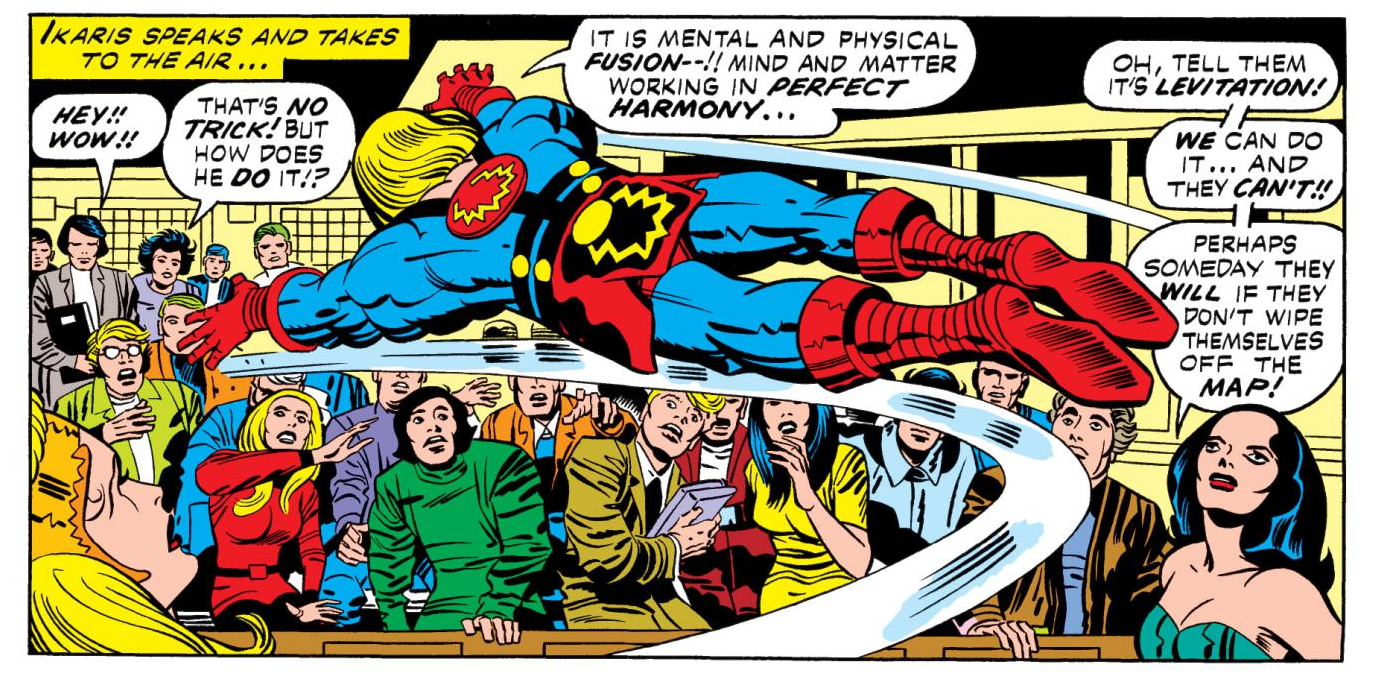
It’s interesting that Kirby is so specific in telling us that a whole week has passed since the previous page; I suspect he may have realized that even if the Deviants’ little escapade had only resulted in “fright and property damage”, there’d need to be time for more detailed negotiations with the appropriate local and federal authorities — as well as for tempers to cool and nerves to settle — before it could be considered feasible that a public institution such as CCNY would invite the leader of a terror attack to address a class of students.


“…I daresay I’d get some of your votes!” I have to say, that line sounded a lot more over the top half a century ago than it does today, at least to me.

For those readers who might have been wondering if The Eternals was taking place in the “main” Marvel Universe, this scene would appear to answer that question in the affirmative. Or does it? After all, nothing in the dialogue of the last two panels above specifies that the Fantastic Four are real people, as opposed to simply being comic-book characters.


On the other hand, the appearance of these S.H.I.E.L.D. agents — specifically identified as “Nick Fury’s men” — seems to allow for no other interpretation than that the events we’re observing are taking place on the same old Marvel-Earth that we’ve been reading about since 1962. So I guess that settles that, huh?
Well, maybe not — if only because of the all the other questions that arise if, indeed, the Eternals (and the Deviants, and the Celestials) share the same fictional setting as the FF, Nick Fury, and the Mighty Thor, starting with this one: in a world that already has an Olympus, Zeus, Athena, et al, what precisely is the point of Zuras and his fellow Olympians?
Three months prior to this, the main issues involved with integrating Kirby’s new characters and concepts into the fictional reality he’d had such a huge hand in originally creating had been well laid out in the letters page of Eternals #3 by Ralph Macchio. Though he’d be joining Marvel’s editorial staff in the very near future, at the time he wrote his missive Macchio was still “just” a letterhack (though a very prolific one).
Following an opening paragraph expressing his general admiration for Eternals #1, Macchio had gone on to say:
Much as I’m pleased with THE ETERNALS, there is a matter inherent in their design which is as important as the publication itself. I’m referring to this new concept being fit into the already overcrowded Marvel Universe. I’m sure there’ll be many a gleam in fannish eyes over the prospect of Spider Man or the Thing teaming with Ikaris and fighting Deviants in New York. But I firmly believe, after much thought, that the Earth inhabited by the Eternals should not be the Earth of the Marvel Super-Heroes. In fact, it’s imperative they be kept separate. In this new series, Jack is going to be answering many of the questions about the why’s of human existence and purpose on this planet, which is all well and good; but even if the answers do not contradict already established laws of the Marvel Universe, they will severely limit any possible storylines which might deal with the creation of Man and his reason for being here. In the Marvel World, the truly Big Questions should be left reasonably open to allow for sufficient latitude in storytelling. If you graft the new Kirby-mythos onto the Marvel mythos, you’re asking for inevitable contradictions that will destroy two of the most important elements that make Marvel, Marvel: continuity and verisimilitude. And I feel that if we go off in this direction, Marvel is going to find its space/time continuum unalterably locked up in the future.
Macchio wrapped up his letter by proposing a solution to the problem he’d identified: Marvel should establish the setting of The Eternals as being “a parallel Earth that hopefully does not have carbon copies of the Fantastic Four, Avengers, etc.” Doing so would allow Kirby “to utilize his imagination to the fullest extent, populating his own special world with as many characters and concepts as he saw fit”, while, at the same time, leaving the established Marvel Universe “to continue evolving without being forced to align itself to a whole new series of unexpected constants that would limit its growth and stagnate it.”
Marvel’s anonymous editorial response was essentially dismissive, if cordial:
We appreciate your concern, Ralph, but it is really doubtful that our newly-revealed race of Eternals will contradict any of the already established Marvel Universe. But, as always, we are interested in what the rest of Marveldom Assembled thinks. So let us know, hear?
As it turned out, plenty of other fans did have opinions on the matter, and the question of The Eternals‘ place in the MU would be argued back and forth in the letters column for many months to come. The controversy would, inevitably, seep into the title’s actual art and story — and arguably derail what, as of issue #6, still seemed a very promising series. How it all ultimately played out, creatively and otherwise, will, naturally, be a topic for future posts; I hope you’ll return to be part of the ongoing discussion.
Coincidentally, I have just finished rereading Eternals 1 to 19 and the annual for the first time in many years. I thoroughly enjoyed most of the run, even though it pales in comparison to the similarly high concept Fourth World material.
My major quibble remains the same as it was fifty years ago. As so eloquently expressed by Ralph Macchio inthe lettercol, the Eternals should not have been a part of the MU. Kirby should have been given the space to explore his concepts without the constraints of Marvel continuity. The series took a nosedive when the Hulk robot was introduced and it never recovered.
The mania for shoehorning everything into the MU back then irked me greatly. The Multiverse is completely accepted these days, and the latitude it allows would have been of considerable benefit in the 70s. It’s a shame that Kirby could not have been granted his own corner of it in which to weave his magic totally unencumbered.
Alan wrote: “I’m unaware of any religious or folkloric tradition that has “space” as the Devil’s point of origin; usually, we think of Old Scratch as coming from “down there”, rather than any location up above.”
In Isaiah 14 and Ezekiel 28 (in the Old Testament of the Bible) Satan is described as having once been a cherub in heaven who was cast down to the sides of the pit (hell), along with a third of the angels who were caught up in his rebellion against God. He is subsequently described as going to and fro on the earth as a deceiving spirit (and worse).
Many centuries later Dante Alighieri wrote the three-part The Divine Comedy, and in part two (Inferno) he portrays the devil as ruling from hell. This does not at all align with Biblical tenets, but Dante’s Roman Catholic fantasy seems to have influenced a lot of subsequent concepts in literature, legend, and entertainment media.
As for Kirby’s work here on The Eternals, it comes across as so trite and unimaginative to “riff” off of the Greco-Roman pantheon, even nominally, rather than to create his own character names with no relation to any antecedent. But he was a bit past his peak here, and in 1978 I was so delighted to see him team up with Stan Lee again for a one-shot Silver Surfer graphic novel. Even though it was another retelling of his origin, it was an unexpected but welcome return to the Silver Age Marvel sensibilities which made the company a success.
Hi, Alan,
It just struck me that the title of ETERNALS #6 is an allusion to GOD AND MAN AT YALE, the memoir/manifesto by arch-conservative William Buckley Jr. in which he writes about his time at Old Eli.
Frankly, other than that, not too much else grabbed me. I had dropped this series after issues 3 or 4, and even now I’m not sure I did the wrong thing.. I give Jack credit for continuing to pump out stories and art, but so much of what I see here is derivative – even SELF derivative – that I can’t help but hear the sound of wheels spinning.
Funny that Ralph Macchio would comment on incorporating the Eternals into the MU, given that a few years later, he and Mark Gruenwald would take over THOR from Roy Thomas at the end of a looooooong arc that began with Thomas trying to incorporate the Eternals into the MU!
You mentioned the sidelining of Ikaris for a whole issue. I’m pretty sure that Jack thought of ETERNALS as a true team book, which may have a couple of prominent characters, but no true star. Not unlike the relationship between Orion and the NEW GODS title.
Oh well. Thanks again for an enjoyable read, Alan!
P.S. “funky corn”????????????
It’s embarrassing when senior citizens try to be hip amongst youth culture. 🤣
Kirby might have used Skibidi Ohio rizzler if this had been published in the last year or two.
I hear you. My wife told me that “I’m cooked” for using “67.”
😅
The first time I saw Makkari in comics was when Mark Gruenwald made him a supporting character in the Quasar series. Some readers wrote in to ask why Gruenwald was giving Makkari such strange speech patterns, so in the letters page they said they were merely following in Kirby’s footsteps, and they reproduced that “funky corn” page as proof 🙂
Kirby was friends with Frank Zappa, as seen in photos, so maybe Funky Corn was a cryptic allusion to Lumpy Gravy (Zappa’s first solo album, and itself an unpleasant allusion).
I assume that “funky corn” is meant to be short form for “funky cornball”. It makes sense that a community as isolated as that of the Eternals would develop its own slang, and Makkari would be more likely to shorten words than most.
Maybe it is just me, but to my eye it looks like Kirby is taking a looser, less directed stance in Eternals than those of many of his most recent works. His emphasis on explosive action is as sharp as ever, but the characters are a bit more colorful and whimsical than I would expect, down to Sersi saying outright that she wants to find out if the academic that Margo wants to show them is worth flirting with. It is more of a sandbox approach, giving the characters their own voices and seeing where they will drive the story. Even Ikaris himself comes across as a bit more flamboyant than he usually is.
Kirby clearly finds Sersi a fun character to write. His Thena is somewhat more nuanced, but I sure found the way she carries Makkari over her elbow almost by instinct funny as well. I figure Kirby was fond of literal strong women; I am reminded of his work on Big Barda in Mister Miracle.
I’m tempted to criticize Ikaris for driving Margo unconscious, dragging her away from her father and being confident that she will thank him for that. But besides the circunstances giving him little real choice, this scene somehow reminds me how difficult it was to develop a modicum of respect for women back in the day. We have come a long way since, and good for us.
Still trying to figure out what that line from Ikaris at the plane is supposed to say or imply. “Simple like all (Eternals’) needs”? Foreign as his sense of aesthetics may be, he must realize that his garments are hardly simpler than the t-shirt look. Feels like he is trying to impress Margo, all the more so because he then goes on to show his skills at piloting and flying without a plane at the same time.
Can we compare Jack Kirby to The Rolling Stones? And if so, can we then compare The Eternals to their latest album, “Foreign Tongues”?
I make this argument because I see Jack Kirby in the same manner as I see this classic legacy band. Mick, Keith, Ron, Charlie and others have a clear, undeniable legacy that forever helped shape music going forward. However, there came that inevitable moment when they reached their creative peak. (I’m leaning towards “Exile on Main Street.”) From that point on, they certainly released quality albums – I would argue several are classic – but never again achieving those lofty heights. As years progressed, their music fell within a formula that was definitely appealing but also riddled with a “sameness.” This summer’s release has some good songs, but hardly anything to distinguish them from what we’ve heard before.
If you’re still with me at this point, I cannot help seeing parallels to Jack Kirby’s remarkable overall career – one that laid the foundation for an entire comic book universe that is now part of our culture – and work on The Eternals. While we are treated to some impressive art – particularly those double-page spreads – too many nuggets of the overall concepts and characters mine from past material. Again, not bad by any means. But nothing new under the sun.
As for my two cents about whether or not The Eternals should have joined the MU proper, while I believe that overall, they’ve become a reasonable “fit” alongside Iron Man, Wolverine and so on, were it up to me, I’d have kept them in a separate universe. (And before someone asks about having them crossover each summer with the Avengers like our friends at DC, for God’s sake, let’s just say “No!’)
While I confess that as 15-year-old, I’d have avoided this like broccoli, what I can’t avoid is my enthusiasm for each Saturday morning where I savor yet another stellar review from Alan!
I only got a few issues of the Eternals, a bit later than these issues. The series is fascinating as yet another variation of themes Kirby had been exploring of groups of super-powerful beings, mostly keeping themselves hidden from the larger world, in conflict with one another, as with the X-Men vs the Brotherhood of Evil Mutants; ancient mythic gods living and interacting with humans; and giant space gods posing threats to Earth, most famously represented by Galactus. The scene with a heckler transformed to have the head of the Thing was somewhat amusing – was that the last time Kirby drew the “Thing” within the pages of a comic rather than on a cover? Anyhow, we’re now at the point when Arishem should have finished his pondering and decided whether or not to destroy our little planet. Apparently, he’d decided to let us keep stewing in our own bubbling broth. The Celestials look like the sort of things that even if humans threw thousands of thermo-nuclear bombs at them, they’d just shrug them off and kick down a few of our skyscrapers in response.
The first couple of issues make it clear the Celestials don’t make snap decisions: we have 50 years before they finish judging us.
I think the last time Kirby drew the Thing inside a comic would have been What If # 11 – though, of course, in that story it’s a self-portrait.
I’ve always argued that Jack Kirby drew beautiful women. The evidence for it in these issues is the exquisite Sersi. Kirby really makes her stunning and gives her real personality. I also appreciate how he differentiates between Sersi and Thena, giving the later somewhat harsher features and very different body language which suits her status as a warrior.
My girlfriend and I went to see Christopher Nolan’s The Odyssey last weekend. Excellent film. But I have to admit, when the movie got to the part where Odysseus’ men meet Circe and are transformed into pigs by her, I think I was subconsciously expecting someone like Kirby’s Sersi to appear, rather than actress Samantha Morton! No knock on Morton, who does a good job in role of Circe. It just goes to show how ingrained Kirby’s interpretation of the mythological figure was in my mind! (For those who are interested, I posted my general thoughts about the movie on my own blog, so please check it out. Thanks.)
Anyway, Alan, I am very glad you shared the letter from future Marvel editor Ralph Macchio, since the lettercols from The Eternals were not included in the trade paperback collection that I have. I agree with the then-young Macchio, The Eternals series REALLY should have been allowed to exist in its own alternate reality, like the Squadron Supreme did. As has been observed by numerous readers over the years, the attempts to fit the Eternals and Deviants and Celestials into the mainstream Marvel universe were definitely a case of trying to fit a square peg into a round hole. I’ve recently seen the pages from Thor from the late 1970s where writer Roy Thomas attempted to integrate the Eternals into the Marvel universe, and her wrote an absolutely ridiculous scene where the Greek gods and Eternals are fighting while repeatedly telling each other, “Wow, it’s incredible how much we just so happen to resemble one another!” Ugh! I normally like Thomas’ work, but he really dropped the ball on that one.
I had the same thought about Samantha Morton as Circe in The Odessey. A solid actress – no question. But not the sexy, alluring beauty we’ve seen since that first scene in The Eternals. That and IIRC, in the original poem, that Circe and Homer enjoyed one another’s company in ways that went beyond fine wine and conversation.
Well, I certainly understand why Nolan changed that part. What worked for audiences 2,500 years ago may not work today, and in a modern context Odysseus and his men spending a year shacking up with a sexy Circe when they’re supposed to be speeding home to Ithica, where Penelope and Telemachus are patiently awaiting their return, would look really bad.
Yeah. Not sure Anne Hathaway would have appreciated it. And if Matt Damon’s smart, ain’t no way he’s ever letting her know about Charlize Theron. 🙂
Well, if she found out, he could claim, “she was a monster! I made me do it!”
I did love the scene where the Forgotten Hero yells at Hercules “I cleaned out the Aegean stables in a day and everyone gave you the credit!”
Well, my comment here will be short because I read very little of The Eternals back in the day. To my eye, without having read the book, I’ll admit, it looked like Kirby was just re-tooling the New Gods for Marvel and I wasn’t interested. While I’ll admit that Jack created some differences between the two groups, my initial assessment doesn’t seem far wrong.
I will say that Jack’s artwork looks bold and dynamic, a sure sign that the King was enjoying the book he was working on. I have no idea how his run with the Eternals went, so I hope he got more satisfaction here than he got working for DC.
I am not a fan of classic Kirby nor most of what he did on his return to Marvel but Eternals had me hooked. I know it has close parallels to New Gods but it has very little of what turned me off on the older property. Gone were the stupid names and his dialog was more naturalistic. I agree that Thomas did a terrible job integrating them in the 616 and that the whole process was unnecessary. The only bright side was he resisted using the Eternals to correct Golden Age continuity mistakes only he cared about. All Star Squadron suffering from that foible was bad enough. I really wouldn’t mind a mini where the Eternals remained on heir own Earth and skipped through the decades to reach the Final Judgement.
I liked these early issues well enough, and agree with young Ralph that the Eternals should have remained distinct from the Marvel universe. I have to note that one problem is the source material—Erich von Däniken may have been a best-selling writer but not a good one, never mind his “research.”
Von Daniken was engaging in fantasy masquerading as speculative history.
My wife caught the Chariots of the Gods movie when I was watching it and just boggled (“That carving’s supposed to be a man in a space capsule? That’s ridiculous!”).
I saw the film in 1973, when the dubbed English version was released in the U.S. Seemed fascinating to my then 10-year-old self, like the Bermuda Triangle, Big Foot, Nessie, Mothman of West Virginia, etc., etc. Reading more into depth of them all in later decades, I realized it was all bunk, with no credible evidence for any of it.
I was way into that stuff too. Von Daniken was one of the less convincing crackpots
Great soundtrack, though (if you’re into Eurolounge)
And sadly, there are still many people taken in by utter nonsense. I, too, read Von Daniken in my pre-teens and enjoyed it back then. But it’s beyond me how grown-ups could put any stock in fringe lunacy such as ancient astronauts, moon landing denial, flat earth, ghosts, Nessie hunting, etc.
So much energy wasted on conspiracy theories and supernatural bunkum by those who would be better off developing critical thinking skills.
For some people it falls on the border between “belief” and “wouldn’t it be cool if …” They bury their doubts because the fantasy is more fun. For other people, superficial plausibility is all it takes. As a society, we’re not as skeptical as we think.
I did believe in the possibility of Nessie well into adulthood. However I read an excellent book that broke down all the sightings and proved conclusively she ain’t there. Too bad.
A few random thoughts…
This series still does not fit within established Marvel continuity, despite some dire and some not-so-dire attempts to force the marriage. My own personal peeve was when (I think it was) Mark Gruenwald shifted Jim Starlin’s Titans (Mentor, Eros, et al) to being offshoots of the Eternals instead of the Olympians as Starlin had originally written. I’d prefer not to even think about the Thor issues up to #300.
Like we’ve discussed before, I don’t think you can assume that any reference to Shield agents was necessarily in Kirby’s original dialogue.
Glad to see Mike Royer reunited with Kirby, he was and is my favourite Kirby inker. Only problem I have is that at this late stage (starting with the last few Kamandi issues), Royer had started trying to soften Kirby’s male chins with three (always three) feathering lines that were never in the original pencils. You can see this in the first panel of Margo with Samuel Holden, his chin has been feathered and not by Jack Kirby. I’d also acknowledge that John Verpoorten did some solid, chunky Kirby inks.
Would have like to see the series continue just to see more of the Thena/Kro relationship. It feels as though a plot arc slightly more intelligent or interesting might have developed from this. I missed Thena’s “Don’t crow yet, Kro!” the first time round, made me smile here. Also liked that Kirby gave Thena slightly different female features to the comics norm.
Rick, I don’t mind the Stones/Kirby comparison, just don’t ever suggest that Lee and Kirby were the ‘Lennon and McCartney of comics’ or we might have a difference of opinion. I don’t think even Lennon and McCartney were the Lennon and McCartney that most people wax nostalgic about.
George Martin was far more responsible for shaping the Beatles hits than most give him credit for. Lennon and McCartney didn’t know how to write arrangements for orchestra. Those crescendos on “A Day in the Life” are pure Martin. Likewise those strings in “Eleanor Rigby.”
Now I will step on some toes. John Lennon’s original demos for “Julia” and “Across the Universe” had terrible, incompetent guitar on them. Martin rewrote the harmonic structure on those and made them masterful. Lennon learnt to play George Martin’s versions. Or how about how Martin spliced together “Strawberry Fields Forever,” making different outtakes at different tempi and keys work together. He was a genius.
Lennon was a strong lyricist and McCartney wrote good tunes, but George Martin’s oversight made it all (pardon the pun) come together.
This is why I went for the Stones over the Fab Four in my comment. I’ll never deny George Martin’s skills. On that note, I also fully acknowledge his talents in producing other bands such as America and The Little River Band. Nor will I ever overlook the work of either McCarthy or Lennon.
I love both the Beatles and the Stones, as well as the Who, the Kinks, etc., etc., including at least a few relatively more recent bands, such as Radiohead and Modest Mouse (yeah, I know they’ve both been around for over 30 years or so now; my perspective on “recent” has changed as I’ve gotten older). I personally rate the Beatles over the Stones but that’s just my particularity, and certainly Martin did much to bring out the best in the Beatles (he just couldn’t do it with Pete Best, however!). I also happen to like both lemon-flavored and macadamia-flavored ice cream but decline to argue with a close friend who hates “weird” ice cream flavors and is strictly a vanilla or chocolate ice cream guy. To each their own, different strokes for different folks, as Sly Stone sang so long ago.
Many people will never forget the work of McCarthy or Lenin. 😉
Not going to ever suggest Lee/Kirby as a Lennon/McCartney pairing.
But, like so many memorable partnerships, the sum of the parts was greater than the whole. Lee and Kirby together did better work than when they were apart.
Even without getting into the debate of how much of ‘Lee/Kirby’ was quite possibly mostly Kirby (at least, the good bits IMHO), many would argue that his best work was the Fourth World, which was entirely Kirby.
Lee-Kirby-Sinnott on Fantastic Four was hard to beat. One classic issue after another!
This blog actually begins with “funky corn,” then delves into Jack’s writing:
https://kirbydynamics.blogspot.com/2010/07/kirby-text-good-or-bad.html?m=1
that’s awesome, thanks.
if I ever get a tattoo FUNKY CORN is a top 3 contender
While I’ve never been a fan of Jack Kirby’s artwork, I do fully appreciate his massive creation of so many of the foundational characters of the Marvel Universe over just a period of just nine years in the 1960’s. I also enjoy in this series his attempts at characterization of some of the Eternals, Sersi in particular, and it seems to me that her appearance is not all that different from that of his depiction of Karnilla the Norn Queen from his run of Thor.
I found something that seems worthy of a no-prize: In the pages of Eternals # 5, towards the end, Sersi uses her magic mirror to show Margo Damian an image of her homestead of Olympia. After Margo expressed admiration and wonder about the reality of the mountaintop city, Sersi responds to her by saying “It is the city of the Eternals, CAROL.”
Also, I wonder if “Funky corn” could have been a phrase used by Funky Flashman, who returned to DC continuity just one month previously in, of all places, Secret Society of Super-Villains # 4
Contrary to some of the comments above, I don’t think Kirby was just recycling New Gods/Thor. This issue is a good idea why: the involvement of ordinary humans in the story. Sure, New Gods showed us people caught up in battles, like the Sheridan family in New Gods 5. But Orion and Kalibak going to a college class to explain the history of the conflict? Nope.
Total agreement this should never have been part of the MU. Among other problems that ended up making the Celedstials Galactus-level powerful and some change because how else could they overcome all of Earth’s gods and end the world?
Then there’s the genocide problem. Kirby is quite clear no world has ever passed muster with the Celestials — all of them have been wiped out. In the MU, the appropriate response would be “You think to judge this world? The Avengers would have words with you!” Instead, they’re not only more poweerful, they’re so exalted that somehow they’re justified in passing sentence.
While incorporating them into the MU was bad, incorporating them into the MCU is worse. We’ve just got a half-dozen random figures from myth and folklore lumped together so they’re not really anything, nor is there the consistency (Puck, Circe, Gilgamesh?) to make sense.
The failure of the MCU movie to use any of Kirby’s actual designs was disappointing, as were a number of other plot & storytelling choices.
Though I did get a kick out of multiple people telling the Eternals “Oh yeah, I’ve heard about you” when they assumed they were completely secret.