
Three months ago, in our post about Avengers #150, we discussed at length the circumstances surrounding writer Steve Englehart’s decision in the spring of 1976 to leave Marvel Comics. While the most immediate effect of his decision was that, come May, Marvel was forced to release that milestone issue of Avengers as a hybrid of new and reprinted material, Englehart’s overall departure from the House of Ideas took another few months to completely play out. In more recent posts, we’ve covered the writer’s final contributions to Doctor Strange and Captain Marvel, both of which saw the light of day in June, 1976; his last issue of his other regular assignment, Super-Villain Team-Up (not covered on this blog, sorry) was released a month later, in July. But Englehart’s final story from his first and best-regarded stint writing for Marvel didn’t come out until August, which is when the topic of today’s post arrived in spinner racks… a fact that’s somewhat ironic, given that Englehart’s script for this extra-long story was likely completed over a year prior to its release.
The first hint that we Marvelites of that era had that Steve Englehart was writing “Thor” — and not just for a one-off like you might find in an annual, but for a whole new series — was in a text piece that ran on the letters page of Captain America #189 (Sep., 1975). Entitled “An Adios from Stainless Steve”, it was Englehart’s explanation of why, despite earlier assurances that he would be returning to write the adventures of the Star-Spangled Avenger after taking a short break, things had worked out so that CA #186 had been his last issue, after all. Why had he changed his mind? According to the author, he’d been lured away by the prospect of “a plethora of new projects”; he then went on to offer more details:
So what are these new projects I’m abandoning all this for? Well, first, there’s our brand-new, black-and-white version of THOR. This new magazine concerns an earlier Asgard, when legends were first a-borning and those beyond the rainbow bridge were truly gods — with the first 45-page fantasy coming your way in MARVEL PREVIEW #3, and each succeeding chapter appearing in its own bi-monthly book.

From Marvel Preview #2 (1975). Art by Virgilio Redondo.
As regular readers of this blog are aware, Thor was (and still is) my favorite Marvel Comics character. So while my younger self of June, 1975 was certainly disappointed to see Englehart leave Captain America, the prospect of a whole new “Thor” title authored by one of my two favorite comic-book writers of the era (the other being Steve Gerber) seemed like a more than worthwhile tradeoff. And so I settled in to await the arrival of Marvel Preview #3 in July — an issue for which my appetite had already been whetted a couple of months earlier by the full-page house ad that had run in the back of the quarterly magazine’s second issue, even if its copy hadn’t mentioned Englehart’s name — because, y’know, Thor.
But when Marvel Preview #3 showed up on magazine racks, the God of Thunder was nowhere to be seen — rather, the entire issue was devoted to Blade, the Vampire Slayer. There was no editorial or letters column in that issue, so regular readers had to wait for issue #4 to get the official explanation (such as it was) that “some last minute schedule rearranging” was responsible — and that while the “Thor” story that had been meant for MP #3 would appear, eventually, it was uncertain whether that would be “in the regular color THOR or in a future issue of MP”. Evidently, the plan to launch a whole new black-and-white title devoted to the long-ago adventures of the Son of Odin had been abandoned, at least for now. That was bad news for us Thor fans, obviously — but at least we had that one Steve Englehart story out there for us to look forward to.
As things worked out, when the story did at last see print in August, 1976, it wasn’t in either an issue of the monthly Thor color comic or in Marvel Preview, but rather in the form of something that hadn’t been seen since 1971 — a Thor Annual. The giant-size, mostly-new-material Annuals — aka “King-Size Specials” — had been a regular fixture of Marvel’s publishing schedule in the mid-to-late 1960s, but had moved to a reprint format in 1969 prior to going almost completely dormant in 1971. In the years since then, Marvel had taken a new tack in regards to the extra-long format, launching an entire line of ongoing, quarterly Giant-Size comics. That venture had ultimately failed — but Marvel was still invested in making a go out of the bigger (and pricier) format. And so, earlier in 1976, they’d resurrected the Annual concept, now as a 50-cent, 48-page package geared towards presenting brand-new, extra-length stories. Such a format was clearly an eminently logical venue for presenting this long-awaited, special tale of the Prince of Asgard — and that’s just what we got with Thor Annual #5.
The book led off with a cover by Jack Kirby and John Verpoorten which, while it might not have ranked with Kirby’s best efforts of this era, still packed a lot of nostalgic charm for those of us who recalled the King’s long run of (mostly) spectacular covers for Journey into Mystery/Thor during the Silver Age. It also let us know going in that we could expect some major mythological action, with the gods of two pantheons going to war with each other. We’d seen Thor fight Hercules before, of course — several times, in fact — but an all-out clash between the armies of Asgard and Olympus? Regardless of whether our story was taking place in the long-ago or the here-and-now, this looked like it was going to be an epic event.
Turning to the comic’s symbolic opening splash page, we found the cover’s promise forcefully underscored:

The illustrators of this story were John Buscema and Tony DeZuñiga, who were also the regular art team on the monthly Thor series as this time. (Buscema had of course been drawing Thor on a pretty consistent basis ever since Jack Kirby’s departure from Marvel in 1970, while DeZuñiga had come aboard with issue #248, published just a few months before this.)

In some ways, the stated premise of the aborted black-and-white “Thor” series — which was to have been set in “an earlier Asgard, when legends were first a-borning and those beyond the rainbow bridge were truly gods” — suggests a reboot of the classic “Tales of Asgard” backup strip by Stan Lee and Jack Kirby, which had run from Journey into Mystery #97 (Oct., 1963) through Thor #145 (Oct., 1967). So it seems entirely appropriate that, like that earlier feature, it begins with a retelling of the Norse myths of creation.

Englehart’s script follows the account of these primordial events as presented in the 13th century Prose Edda pretty closely — although he’s taken a somewhat more delicate tack than the traditional source in his version of how Ymir’s first two children were born; there, instead of being generated from the runoff of the great Frost Giant’s melting form, they’re sweated out into the world from his left armpit. (Lee and Kirby skipped this bit entirely, in case you were wondering.)


From Journey into Mystery #98 (Nov., 1963). Text by Stan Lee; art by Jack Kirby and Don Heck.
Again, Englehart follows the Prose Edda in relating how Ymir was slain by Odin and his brothers — unlike Lee and Kirby, who’d opted back in JiM #98 simply to have Odin trap Ymir forever in a ring of fire, instead (see panel at left; inks by Don Heck). Their handling things that way made it easy enough for Roy Thomas and John Buscema to arrange for Ymir to escape said ring and threaten the world anew in Avengers #61, published some five years later — a return that Englehart and Buscema’s more mythologically accurate account of his defeat doesn’t address. But hey, these are myths. It’s probably best if we don’t expect these tales to jibe with Marvel’s present-day continuity in every detail… something which will become even clearer as we move into the Norse account of the early development of our physical universe, including the origins of life on Earth…


Over time, Marvel’s storytellers would further build out, and codify, the Marvel Universe version of the Nine Realms of Norse myth (ultimately even expanding the traditional cosmology to include a Tenth realm) — but the setup presented here is, I believe, indicative of where things basically stood as of 1976.


From Journey into Mystery #83 (Aug., 1962). Text by Stan Lee (plot) and Larry Lieber (script); art by Jack Kirby and Joe Sinnott.
One detail I distinctly recall my nineteen-year-old self appreciating when first reading this story back in August, 1976 was the way Buscema and DeZuñiga had drawn the torso portion of Thor’s costume with the original open sides, rather than the smaller, circular arm-holes that had soon afterwards become standard to the design. Since this story takes place long, long before Journey into Mystery #83, it only stands to reason that the Thunder God would be rocking his earlier look, right?


From Journey into Mystery #100 (Jan., 1964). Text by Stan Lee; art by Jack Kirby and Paul Reinman.
Early on in the “Tales of Asgard” series, Lee and Kirby had introduced the idea of the hammer Mjolnir having belonged first to Odin, with a youthful Thor having to first prove his worthiness before he was able to wield it. But that’s not a concept that one finds in Norse mythology, where it comes into Thor’s possession almost immediately after its forging; and Englehart appears here to have decided to follow the traditional account, rather than the previously established Marvel version of events. (That said, he has followed Marvel precedent in stating that Mjolnir was “forged in the furnace of the troll Geirrodur” — an idea that seems to have originated with writer Gerry Conway, back in Thor #210 [Apr., 1973] — rather than hewing to the Prose Edda’s attribution of the hammer’s making to the dwarf brothers Eitri and Brokkr.)

After sprinkling in a few more “authentic” (but previously unseen in Marvel’s comics) bits from Norse mythology — most notably, Thor’s goats Toothgnasher and Toothgrinder (who’d nevertheless have to wait another seven years for artist/writer Walt Simonson to import them into present-day continuity) — our storytellers return to a vision of Asgard more familiar to Marvel readers, offering brief looks at a Loki who’s the brother of Thor, rather than of Odin; a Balder who’s the best friend of Thor, rather than his brother; and a trio of warriors whose names — Fandral, Hogun, and Volstagg — are not to be found in any Edda, be it Prose or Poetic.
And with that, we’re finally through with the introductory material, and ready to begin the story proper…

Aww, look at li’l Sif! So cute! But wait, doesn’t the Marvel version of Sif have black hair? Well, sure, she does now — but in her very first appearance, way back in the “Tales of Asgard” strip that ran in Journey into Mystery #102 (Mar., 1964), the young goddess had been depicted with fair-colored locks, so that’s what we see here. It would be up to later creators (specifically, writer Alan Zelenetz and artist Bob Hall, in Thor Annual #11 [Nov., 1983]) to tweak the original Norse tale of how Loki cut off Sif’s long golden hair to provide the explanation for her raven tresses in the modern Marvel Universe.


Vikings fighting ancient Greek warriors? Is that at all plausible, historically speaking? Probably not — but it’s likely for the best not to get too hung up on anachronisms when you’re dealing with a story set in the Age of Myth…


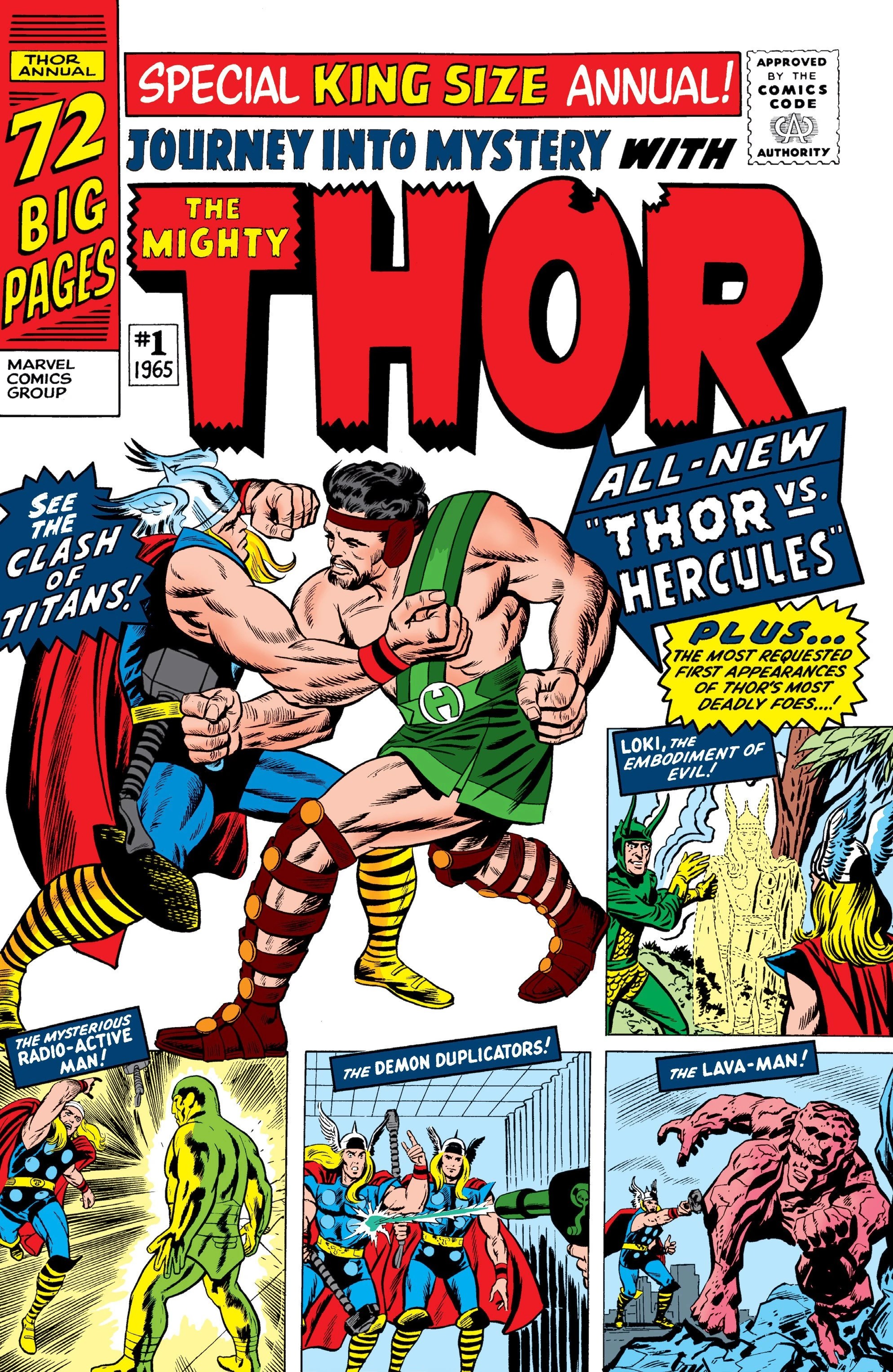
Cover to Journey into Mystery Annual #1 (1965). Art by Jack kirby and Sol Brodsky,
As is alluded to in Englehart’s narrative captions for this page, longtime Marvel readers had read an account of the first meeting of Thor and Hercules years before this, in Journey into Mystery Annual #1. And, sure, the two accounts can’t be readily reconciled — but this is the Age of Myth, remember? If you really have to know which one is “true” (assuming either is), well, just pick your favorite. Remember, your personal headcanon can never be wrong!

Scoffing at his foe’s claim to godhood — after all, he’s never seen this guy on Mount Olympus — Hercules uproots the tree Thor just slammed him into, and hurls it at the Odinson. When the massive missile essentially explodes around Thor, however, leaving him standing unharmed, Herc begins to reconsider his earlier opinion. Still, the fight must go on: “For Olympus!” “For Asgard!”


As is usually the case with Loki, the thought is father to the deed. He magically disguises himself as a fly, which then wings away from Asgard…


Just for the record, all of the Olympians we encounter in this scene have appeared in Marvel’s comics at least a couple of times before this — though the only ones who’ve seen any kind of real action are Zeus, Ares, and of course Hercules.


As with most of the Greek deities seen earlier in the story, Tyr — the Norse God of War — had made a handful of token appearances before this, though — as we previously noted in last year’s Thor #240 post — it would once again be up to later creators to fully flesh him out as a character.


From this wide-angle double-page spread, the focus shifts to individual and small-group conflicts — Balder versus Ares, the Warriors Three versus some nameless Olympian warriors — before inevitably coming to rest once more on the marquee matchup of Thor versus Hercules…


As you may have noticed, John Buscema’s page layouts for this story have tended to use fewer panels than most of those he was doing for the monthly Thor book around this same time. I honestly have no idea whether this was a technical decision driven by the density (or lack thereof) of Steve Englehart’s plot, or a purely artistic choice, or something of both — but given that this approach allowed him and Tony DeZuñiga to create images as gorgeous as their rendering of the ride of the Valkyries, I’m grateful.


Accompanied by Balder and several others, the triumphant Thor crosses the Rainbow Bridge to Midgard, then takes his goat-drawn chariot to the “southern fields” where lies the mortal realm won by their valor…


I’d love to know whether Englehart’s plot specified which Avengers should be included in Karnilla’s conjured vision, or if Buscema chose them himself. I suppose that the three “A”-listers — Captain America, Iron Man, and the Hulk — were basically no-brainers, but the Black Panther and Vision seem slightly more random choices (although it may be significant that both of those characters joined Earth’s Mightiest Heroes while Big John was the regular artist on the Avengers title).

And that’s that. I’m not going to try to tell you that “War of the Gods!” achieves the level of the best work Stan Lee and Jack Kirby ever turned out for “Tales of Asgard”, but it really hit the spot for this Thor fan in the summer of ’76, and I think it still holds up pretty well, half a century later. I would have loved to seen further installments in the series from the Englehart/Buscema/DeZuñiga team.
It seems very unlikely that that would have happened, however, even if the original plans for an ongoing black-and-white title starring Thor had come to fruition. That’s because those plans appear to have gone as far as having an entire second story completed — and the only member of the Thor Annual #5 creative team who remained in place for that one was inker Tony DeZuñiga. Rather than John Buscema, the penciller for “Thor the Mighty!” — which ultimately saw print in Marvel Preview #10, published in April, 1977 — was Jim Starlin; and the script wasn’t by Steve Englehart, but rather by Len Wein.

Cover to Marvel Preview #10 (Winter, 1977). Art by Ken Barr.
I haven’t reread this comic in decades, and it’s entirely possible that, eight months from now, I’ll write a full post about it. So at this point, all I’ll say is that, other than a scene in which Thor was tastefully implied to have gotten laid, I remember nothing about it — something I could never have said about Thor Annual #5. So, in the end, maybe it’s for the best that the B&W “Thor” book never came to be — although I have no doubt that my younger self would have followed it avidly given the chance, regardless of whom the ongoing creative team might have been.
Of course, back in August, 1976, I didn’t yet know any of this. At the time, I was just happy to have had another Marvel Comics story from Steve Englehart, especially since I still didn’t know where and when I’d see his work again. Thankfully, however, that mystery would be resolved within just three months; and so, I hope you’ll join me this November to read all about Justice League of America #139.
Meh. I’m sure if I read this, my eyes would have glazed over at all the mythological buildup to the fight. And even that wasn’t as readable as similar stories from Lee/Kirby. I’m glad you felt you got your money’s worth but for me this wasn’t at all Englehart at his best.
Hi, Alan,
I’m running a little behind commenting on your posts, but you KNEW I had to respond to this one, didn’t you?
But truth to tell, there’s not too much I can add. I was just thrilled to get an extra-long story by my favorite writer, illustrated by one of the greatest Marvel pencillers of the time. Tony DeZuniga was not necessarily a favorite, but in this case, his rather rough style worked well for this tale.
One of Englehart’s many strengths, I always felt, was pacing. He understand that you sometimes needed to go wide-screen for action scenes, even while ensuring you have enough of a story with characterization for the rest of the story. I thought that was well on display here. And yes, I could hear Wagner accompanying the arrival of the Valkyries.
That said, I thought the scene with Karnilla was a bit gratuitous – the kind of mix of foreshadowing and dramatic irony that I associate more with Roy Thomas than with Englehart. And yeah, it also gave me a pang knowing that this would be the last time Steve had anything to do with Earth’s Mightiest Heroes, or so I believed.
I think it would have been pretty cool to follow the education of young Thor (dare I call it the rising and advancing of his spirit?), especially at Englehart’s hand. At the same time, though, I wonder just how long such a series might run. Would it feature a lot of the continuity implant that would be seen later in the pages of THE RAMPAGING HULK black-and-white book? I wonder how many times you can visit that well, even allowing for Thor being thousands of years old.
Oh well, at least we had this top-notch story. Thanks, Alan! Now I really need to back to comment on the Warlock and Dracula and JLA posts….
Nice Buscema/de Zuñiga art, except in the first two splash pages, and these are supposed to be the “money shots” in a comic. In the first one the Hercules figure is oddly proportioned, and Thor only slightly better. In the second the large Thor head is drawn well enough, and with an appropriately pensive expression, but the inks are underwhelming.
I wonder if Tony de Zuñiga were using some uncredited assistants on those panels—-and why there, of all places? The inks on Thor’s face are not only spartan, but inconsistent. There are some THICK black outlines that show up at random surrounding his hair in places that have nothing to do with light source or proximity.
Otherwise, the smaller panels look great, which makes this even more puzzling.
The summer of 1976, upon moving from Treasure Island Naval Station, San Francisco, to Lemoore Naval Air Station (211 miles south of SF), I found that the Navy Exchange in Lemoore actually included the Annuals among their offerings on the comics racks and I had just enough money to get some of them. Alas, I never saw Defenders Annual #1 and so had to wait several years to get that one, but I did get the Thor Annual. I’d read only a handful of the Tales of Asgard, mostly in the Marvel Spectacular reprints. But several years earlier, I had read also books on the Greek and Norse myths, both Edith Hamilton’s and Thomas Bullfinch’s. Hence, I was already aware of several of the distinctions between the ancient mythic versions of the Norse myths and the Marvel variation. Englehart & Buscema present a sort of synthesis of the old myths and the Lee/Kirby/Conway version.
Having long since read Tales of Asgard, and comparing it to this tale, one thing that comes to my mind is that even when depicting Thor as clearly past his boyhood, Kirby still managed to make ToA Thor look younger than the Thor of the then current era. As depicted in this story, however, Buscema & DeZuniga make Thor look pretty much the same then as in the present, aside from the noted variation of the costume. Maybe a little subtle thing Kirby made the younger Thor (and Fandral and Hogun) look a little more boyish and brash even as a young adult god than the more middle-aged god of the 1960s. A bit like how Johnny Storm’s body and facial features gradually changed over the 100+ issues Kirby drew him from maybe 15 to 20 or however old he was supposed to be by issue 102.
Perusing the images you’ve posted here, and in thinking on all the issues of Thor I’ve ever read, it occurs to me that the nigh eternal worlds of Asgard and Olympus spent thousands of years in stasis, with little meaningful change, the gods even wearing the same clothes every day, year after year, century after century. Odin continually playing chess against himself, bored out of his mind! That explains Loki – Odin kept him around to make things interesting every so often with his wicked mischief. Such as provoking a war against the Olympians! Over the last 40 years, Thor and his godly kin have undergone multiple big changes, including Thor going through a variety of new costumes, starting during Simonson’s celebrated run as writer/artist. I haven’t kept up with it all, but ever so often come across an image of Marvel’s Thor that hardly resembles the version of Thor as conceived by Kirby back in 1962, the year I also happened to make my debut – with no costume at all!
Anyhow, I found this mag entertaining enough if not particularly memorable. Of course, keeping in mind that this was supposed to be a sort of introductory chapter to an ongoing series, I wonder how Englehart would’ve handled later stories of the young Thunder God and how distinct that may have been from Kirby’s Tales, as well as from how Englehart wrote Thor in Avengers. Just another of those things that will forever be left to our imaginations.
Knowing you and your love of Thor as I do, Alan, I’m not surprised that this particular comic was right up your alley. For myself, however, I would have been most upset if I’d read this book fifty years ago. I know I would have assumed that the History of Asgard would’ve been prologue to a more contemporary tale of the Thunder God, and would have been disappointed that it wasn’t. I realize that the tale of the first meeting of Thor and Hercules was intended to be the more “traditional” part of the story, but I already knew who Hercules was and how he and Thor met and what their relationship was like and didn’t need to see it re-hashed, even if said re-hashing was at the hands of one of Marvel’s best writers.
As for the art, looking back at it from fifty years forward, Big John’s pencils seem rushed here and not quite as confident as what I would expect to find in his other work. Perhaps that’s the result of DeZuñiga’s inks, I don’t know, but there’s an unfinished aspect to the art that seems very “un-Buscema-like” to me. Also on that two panel page that shows Herc and Thor leading their men into battle, several of the Asgardian’s horses, especially the ones carrying Balder and Thor, are decidedly too small for their riders, which also doesn’t seem like a mistake Buscema would make unless her were rushed to get to the end.
Ah, what the heck. As I’ve said before, I was never a big Thor fan in the first place, so nothing here was ever really going to make me happy. I’m glad you enjoyed it, Alan, but for me, had I bought this one fifty years ago, I would have considered it a waste of money. I enjoyed reading it with your commentary anyway, but as you always say, “your mileage may vary.” Thanks!
Loved pretty much everything Englehart did so yeah that includes this. He had a way of making Thor’s speech flow, not seemed trite. Like Listening to George Plimpton with that Boston Brahmin lilt. Other writers (Gerry Conway) would throw in a few Theee and Thou and call it a night. But Englehart’s “sounds” true, unforced. The artwork is great too it’s Buscema so go figure, of course it’s gonna be great. I liked delving into the Norse mythology too. And after all are their myths any more “out there” than others, like Christianity with it’s eating the flesh and drinking the blood, etc?
When Jesus Christ and His disciples had finished the Passover meal circa 33 A.D. (give or take a few years, because our calendar is not entirely accurate), He took bread, gave thanks, and broke it, saying, “This is My body which is given for you. This do in remembrance of Me.” And He gave them a cup of wine, saying, “This cup is the new testament in My blood, which is shed for you.” Jesus said these things after what is now called the Last Supper. He had not yet gone to Calvary’s cross to pay the price for the sins of mankind, the Just for the unjust. Clearly He was speaking *figuratively* about what many have subsequently called “Communion” or “the Eucharist” (which literally means “good gift” in Greek). But the Roman Catholic and Orthodox church, as well as certain denominations like the Lutherans, try to add more to this than what the Bible passage I quoted (Luke 22:17-20) actually says.
Alan, this is another comic book that I do not have. Reading your blog post about it, I have to say that it seems like a really exciting, interesting, well-told story.
Steve Englehart writes an action-packed yet also very thoughtful tale. The artwork by John Buscema & Tony DeZuniga is beautiful. I’m sure that Buscema hated DeZuniga’s inking, of course, but I feel that DeZuniga gave Big John’s layouts a really wonderful illustrative look. Y’know, as good as this must have looked in the Summer of 1976 in color as a standard-sized comic, I wonder if the art would have been even more impressive in a larger, black & white magazine format? Oh, well. Nice cover by Jack Kirby & John Verpoorten, as well. Verpoorten is not my favorite Kirby inker, but he still did nice work over the King’s pencils on the few occasions when they were paired up.
“But hey, these are myths. It’s probably best if we don’t expect these tales to jibe with Marvel’s present-day continuity in every detail…”
Oh, boy, I’ve heard that Roy Thomas later did a storyline in Thor where he attempted to explain why the details in the Thor comic books published by marvel were different from the actual Norse myths, and that the overall reader reaction to it was that it was an entirely unnecessary thing for Thomas to do. I like Thomas, but he really has an obsession with fixing every seeming continuity issue that he came across. I wish he’d just accepted the handwave that you give. I mean, they’re myths, they were told by many different people over a period of centuries, they’re probably not even internally consistent. No need to try to dot the I’s and cross the T’s on every single little thing.
Apologies for the digression. If I ever come across an affordable copy of this Annual at a comic con, maybe I’ll pick it up.
Looking forward to your retrospectives on Englehart’s DC Comics work, of course!
The storyline in Thor was that there was a huuuge cosmic cycle with the original Asgardians in the previous cycle, then transforming in this one. From what I’ve read, this may have been Mark Gruenwald’s idea rather than starting with Roy — but as Thomas was writer/editor on Thor at the time he could obviously have ignored it if he’d wanted to.
This comic failed to make to the spinner racks in the small SW Oregon logging town that I called home fifty years ago – and I won’t tell anyone what I call it now. But had it arrived there, Thor Annual #5 would have come home with me where it would have likely earned a lackluster “not bad ,but…”
Meaning that Steve Englehart’s writing was fine if not inspired, that John Buscema’s art was definitely not inspired (as I was beginning to tire of what I considered his “going through the motions” pencils) and Tony de Zuñiga (and friends) had the thankless job of trying make the uninspired look more appealing.
The overriding question I’d have had then is the one I have now. Why? Specifically, what was the motivation for a “Young Adult Thor” series? His sales weren’t that impressive. And while Norse mythology is certainly fertile ground for storytelling, the guy’s already got over a decade of stories under this belt that would seem to limit how far you could go without violating what’s already become cannon. Sure you can rehash a tussle with Zeus’s boisterous son and maybe a wrestling match with a few frost giants or even a Midgard serpent. But how much could be done with a more impactful story that it would be impossible for Thor not to acknowledge in the future?
Tales of Asgard certainty worked for what they were – crafting delightful background bits that enhanced current stories. But they also worked being shorter snippets.
Then again, my favorite TV right now is Star Trek: Strange New Worlds” where half the cast can’t end the series with anything more than a hangnail without violating what’s already in place with The Original Series so what do I know?
Actually, what I do know is that once again, Alan’s given us all a wonderful review to ponder and discuss. And thank will always work for me!
I think I picked this up a year or two after it was published in a Woolco department store that sometimes sold then-not-so-old comics strewn in a large bin for 20 cents each…a chaotic way to look for comics but also kind of exciting. I was never an avid Thor reader, but I enjoyed this issue more than most. It’s been years since I read it, but I recall digging the panel where the tree explodes around Thor and regarded it as a solid battle issue. Overall, I run hot and cold on John B. He’s well above the average comic book artist even when he doesn’t swing for the fences, but there are times when his apparent lack of interest in a subject will seemingly ooze from a panel… like the images of the Avengers appearing in Karnilla’s flame. No doubt he’s a “5 tool player” that the general audience probably preferred in the 70’s over Kirby….but I think it’s likely the same tale rendered by Kirby would have blown the roof off the place instead of just rattling the shutters. My roof anyway.
Sorry but I was disappointed with this for a few reasons.
Kirby (and Lee)’s Journey into Mystery Annual #1 was basically a re-tread of the Robin Hood/Little John battle over right of way and ego, with the usual splendid Kirby fight choreography, but it led nicely into the all-time classic Thor #125-130 (or thereabouts), where Hercules originally expected to greet Thor as a friend. If this story is accepted, that couldn’t have happened.
One of the reasons for loving Englehart’s work was usually his respect for continuity. Here, he basically dismisses the earlier classic tales in favour of a story that is, in all honesty, nowhere near as good. Thor and Hercules fight, then agree to come back and bring their armies to battle. For a start, that’s out of character for both of them. Since when would either of them expect other people to fight their battles?
We don’t actually get to see the resolution of the Thor/Hercules battle that should have been the centre-point of the story. They’re throwing punches at each other and then suddenly the Asgardians have triumphed and all the Olympians are dead, off-screen? Poor story-telling, not something you would normally expect from Englehart.
The artwork is mostly pedestrian and unexciting, As has been said, it’s like Big John B is on auto-pilot through most of this. Okay, Big John B’s auto-pilot is better than most people’s good days, but for a story that should have exceeded all expectations, this was not good enough. The finishes also disappoint, and I’d agree that the opening splash page doesn’t look like De Zuniga at all. Redondo, McLeod or Pollard, possibly?
I wasn’t impressed then, and I’m not now. Yeah, I know we are in a multiverse of possible alternatives and myths can be re-told in different ways, and ‘all stories are true’, but I remain convinced that the earlier stories were very much better.
Never much of a fan of de Zuñiga’s inks and Big John has a rare off day here as well. As comics fans we are of course no strangers to suspending belief but the myth sequence is just jarring and awkwardly inserted . Suddenly for one panel – a cow! With a “tell not show” word narrative to try to compensate for static visuals. A myth that is passed down verbally or written may not always translete to literal depiction . As Allan suggests, maybe one reason Lee/Kirby selectively adapted the raw material for mid to late 20th century consumption.
Good points, Patrick — though just for the record, Lee and Kirby included the cow as well (admittedly, they gave it a whole *three* panels). 🙂
Odd or no, I think the myths are the most memorable part of the comic. Don’t recall being bothered that it didn’t jibe with the regular comic. I do think that if this was meant to be a launch of a Thor b+w mag that they sure jumped ahead quickly. An issue or 2 of young Odin and why he hated his Mom’s family might be an interesting story.
I vaguely remember this. It’s a bit surprising I remember it at all since I’ve never been a big fan of Thor as a character but I hadn’t beat the completist bug yet. I think I got into Norse mythology before comics so Thor has never been what I first learned he should be. John Buscema does a pretty good job (even if he isn’t my preferred Buscema) and coupled with one of my least favorite inkers the art feels meh now. Things won’t get better soon considering what his next and last Avengers run will look like.
I think this was the first story to attempt to explain how come there are two (later far more) explicitly divine pantheons in the MU – and, more to the point, what that means to their respective heads and their successors to be.
That is its main accomplishment IMO. Even if it has to break continuity with earlier tales in order to achieve that goal.
A close second is the insight into the tenser aspects of the relationship between Thor and Odin. For some reason it is just refreshing to see an entity that is called “all-father” left and right turn out to be utterly clueless on how to deal with his own beloved son and end up hurting both while dealing with the consequences. Odin is rarely more relatable than here.
Karnilla showing empathy for Thor is icing on the cake. Ditto for Englehart having Thor in a very specific emotional place as the tale ends. He is by no means humble at this point, but he has at least achieved a modicum of understanding that there is a genuine place for humbleness even to the heir apparent of the all-father.
On the question of gods in the DCU/MU: https://atomicjunkshop.com/whatever-gods-there-be-theology-in-the-dcu-and-mu/
That was a good article, Fraser, thanks for the link.
Luis, I’m not sure how seeing Odin being utterly clueless in dealing with his son can be described as refreshing – isn’t that his thing, his go-to position every second or third issue since the early JiM days?
Sorry, but I also can’t agree regarding Karnilla. She has no direct mythological equivalent, and the only thing interesting about her in Marvel continuity is the conflict between her lifelong hatred of all things Asgardian and her (presumably much more recent and post-dating this story) hots for Balder. Why would she be playing Dear Abby to Thor, the prince of her sworn enemies?
There also seems to be a hiccup in in-story continuity. When Thor goes to Greece to proclaim his victory, Balder is very clearly with him. Then, when Thor returns in frustration to Asgard, Balder has become an onlooker: ‘oh, look, Thor hath returned!’. Surely you returned with him, didn’t you?
Now that I’ve read so many of the old “Balder swear allegiance to me and perhaps I will save Thor!” stories with Karnilla I really appreciate Simonson getting past that and jump-starting the relationship at last. well, if you can call it jump-starting after dangling on the edge of being together for so long.
If memory serves, in addition to Thor the Mighty, there were several more projects planned for the abandoned second wave of Marvel black and white mags, some of which turned up as issues of Marvel Preview. These included Sherlock Holmes and Starlords (plural). A couple more appeared as one-shots: Marvel Super Action and Legion of Monsters. Another – Masters of Terror – managed two issues.
Also, if I recall correctly, wasn’t there a later Thor appearance in the Marvel magazine line after Marvel Preview 10 ( which used up the story originally intended for Thor the Mighty 2). I think it was an issue of Bizarre Adventures that featured a John Bolton drawn Thor story sometime around 1982.
Marvel Preview became Bizarre Adventures as of issue 25. There was a subsequent Thor issue (32, cover dated August 1982).
Thank you, Brian. I dug out the issue and read the story for the first time in 44 years. Alan Zelenetz and John Bolton. Quite interesting and definitely a tale in the Thor the Mighty tradition – young Thor learning a lesson in humility.
I loved this issue! I had previously only read Thor’s Treasury
Edition and a few issue of Marvel Spotlight, but we studied Greek and Norse mythology in school, so the combination of the two was a whole lot of fun.
I loved these annuals and I think I bought as many as my 13-year-old budget would allow.